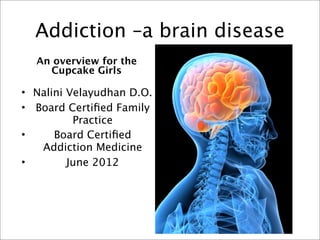
Addiction –a brain disease
  An overview for the
    Cupcake Girls

• Nalini Velayudhan D.O.
• Board Certified Family
          Practice
•     Board Certified
   Addiction Medicine
•        June 2012
The Nervous System
• Made up of two parts:
  – Central Nervous System
    • Brain, nerve cells (neurons)
  – Peripheral Nervous System
    • Spinal Cord, and nerve cells
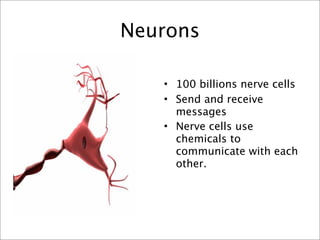
Neurons

   • 100 billions nerve cells
   • Send and receive
     messages
   • Nerve cells use
     chemicals to
     communicate with each
     other.
Neurotransmitters

        • Brain’s chemical
          messengers
        • Chemicals made in the
          neuron, released in the
          synapse and attach to
          nearby neuron.
Brain
  • Command center of
    the body
  • Weighs 3 lbs
  • Drugs affect
    different areas of
    the brain:
    – Brain stem
    – Limbic system
    – Cerebral Cortex
Brain
• Brain Stem: controls involuntary
  functions such as heartbeat, breathing,
  blood pressure, coughing, sneezing
• Cerebrum: learning, memory,
  reasoning, controls muscles, hearing,
  smelling, seeing, touching
• Cerebellum: controls balance, posture
Brain Areas involved in
• Brainstem: the ventral tegmental area
  (VTA) at the top of the brainstem
  contain nerve cells that use the
  neurotransmitter DOPAMINE to relay
  messages.
• Limbic System: the nucleus accumbens
  receive the messages from dopamine-
  containing neurons in the VTA.
• Cerebral Cortex: receive messages
  from other parts of the brain to make
Brain
Brain
• Limbic System: located on top of the
  brainstem and buried under the cortex
• More primitive brain structures
  (amygdala, hippocampus)
• Involved in emotions and motivations,
  particularly those related to survival~
  fear, anger, and sexual behavior
• Also related to feeling of pleasure that
  are related to survival such as eating,
Limbic System
Brain
                Hijacked
• Drugs of abuse act directly on this
  primitive area of the brainstem and
  limbic system hijacking the higher
  functioning cerebral cortex’s ability to
  stay in control.
• Drugs override the cortex and there is
  loss of reasoning and control.
Effects of Drugs of Abuse on the
              Brain
• Drugs of abuse produce a pleasurable
  event or “reward.”
• The brain is wired to repeat behaviors
  that are rewarding.
• Drugs of abuse are mistakenly believed
  to be essential to survival (like eating
  and drinking water) in an addicted
  brain.
• Drugs of abuse are many more times
Effects of drug abuse on the
Effects of drugs of abuse on the
              brain
• Almost all drugs change the way the
  brain works by altering chemical
  neurotransmission.
  – Dopamine *
  – GABA
  – NMDA
  – Glutamate
Effects of drugs of abuse on the
• Nicotine: activate the nicotinic Ach
  receptors.
• Alcohol: alters the balance between
  neurotransmitters like GABA and
  NMDA.
• Opiates (heroin, pain pills): mimic
  effects of natural neurotransmitters at
  mu receptors
Alcohol interacts with brain
         chemicals
Opiates and the reward
Effects of drugs of abuse on the
              brain
• PCP: blocks receptors and prevents
  neuronal messages from getting
  through.
• Methamphetamines: act by causing
  neurotransmitters to be released in
  greater amounts than normal into
  synaptic cleft.
• Cocaine: interferes with the molecules
Cocaine and the reward
Effects of drugs of abuse on the
              brain
• Prolonged drug use changes the brain
  in fundamental and long-lasting ways.
• Drugs of abuse interfere with the way
  nerve cells normally send, receive, and
  process information.
• Drugs of abuse “hijack” the brain’s
  ability to make the right decision
Addiction is a chronic disease
• Drug addiction is a chronic disorder
  like diabetes, high blood pressure or
  asthma.
• Treatment is essential- sometimes
  repeated treatment and prolonged
  treatment is needed.
• Treatment is behavior-based and
  medical based.
How to catch a problem
• 1. Have you ever ridden in a car driven by
  someone who had been using alcohol or
  drugs?
• 2. Do you ever use alcohol or drugs to
  relax, to feel better about yourself, or to
  fit in?
• 3. Do you ever use alcohol or drugs when
  you are alone?
• 4.Do you ever forget things you did while
  using alcohol or drugs?
• 5. Do family or friends ever tell you to cut
  down on your use of alcohol or drugs?
WITHDRAWAL
WITHDRAWAL
•   Alcohol
•   Sedative
•   Stimulant
•   Opioid
Alcohol Withdrawal
• Among patients who consume 20 standard
  alcoholic drinks/day symptomatic
  withdrawal is likely with abstinence.
• Three main categories of Alcohol Withdrawal
  Syndrome:
  – 1. Central nervous system excitation:
    restlessness, agitation, seizures
  – 2. Autonomic nervous system excessive activity:
    nausea, vomiting, tachycardia, tremulousness,
    hypertension
  – 3. Cognitive dysfunction
Alcohol Withdrawal
•   Three stages of withdrawal
Alcohol Withdrawal
• Stage 1: “minor withdrawal”
   – Begins five to eight hours after last drink
   – Characterized by anxiety, restlessness, agitation,
     mild nausea, decreased appetite, sleep
     disturbance, facial sweating, mild tremulousness,
     and fluctuation tachycardia and hypertension
Alcohol Withdrawal
•   Stage 2: “major withdrawal”
     – Occurs 24 to 72 hours after last drink
     – Characterized by marked restlessness and agitation,
       moderate tremulousness with constant eye movement,
       diaphoresis, nausea, vomiting, anorexia and diarrhea.
     – Patients have marked tachycardia (>120 bpm) and elevated
       systolic blood pressure (>160 mm Hg)
     – “Alcoholic hallucinosis” may be present- can be auditory or
       visual
     – Patient may be confused but easily reoriented
     – Seizures- typically grand mal- may occur, usually single,
       last < 5mins. Status epilepticus is not associated with
       alcohol withdrawal and indicates another problem
Alcohol Withdrawal
• Stage 3: “delirium tremens”
  – Can occur from 72 to 96 hours after last drink
  – Associated with fever, severe hypertension,
    tachycardia, deliriums, drenching sweats, and
    marked tremulousness
  – Causes of death include head trauma,
    cardiovascular complications, infections,
    aspiration pneumonia and fluid & electrolyte
    abnormalities
Sedative Withdrawal
• Sedative hypnotic drugs include:
  – Alcohol
  – Benzodiazepines
  – Barbiturates
  – Other sleeping pills
Sedative Withdrawal
• Signs of withdrawal may not be seen
  for 7 to 10 days after last intake of
  substance
  – This is because many benzodiazepines
    have long-acting metabolites
  – Many individuals also take more than one
    or more substance of abuse
Stimulant Withdrawal
• Amphetamines and Cocaine are the
  most prevalent stimulants abused
• Amphetamines:
  – Methamphetamine
  – MDMA- ecstasy
• Cocaine:
  – Cocaine HCL
  – “crack”- alkaloid form of cocaine (smoked)
Stimulant Withdrawal

• “Crash” drastic            • Malaise
  reduction in mood and      • Problems with memory,
  energy                       concentration
• Craving the stimulant
                             • Occasional suicidal
• Craving for sleep, hyper     ideation
  somnolence
• Depressed mood             • Craving can last months
                               to years after the last
• Anxiety
                               stimulant use
• Paranoia
• Hyperphagia- “the
Opioid Withdrawal
• Include Heroin, Methadone, Narcotic
  pain medications like: Vicodin, Lortab,
  Soma, Oxycodone, Percocet, Fentanyl,
  Morphine
Opioid Withdrawal

•   Watery eyes              •   Generalized body aches
•   Sniffles / runny nose    •   Abdominal cramps
•   Yawning                  •   Pupillary dilation
•   Muscle twitching         •   Anorexia
•   Diarrhea/ loose stools
•   Nausea and vomiting
Opioid Withdrawal
• Peak withdrawal symptoms most
  severe with discontinuing heroin use
• Longest duration of withdrawal
  symptoms with methadone but with
  lower peak severity
Withdrawal
• Alcohol and Sedative withdrawal can be
  lethal and life threatening sometimes
  requiring hospitalization.
  – Need monitoring and medical management
    for withdrawal seizures, delirium tremens,
    falls, head injury, aspiration
  – Need treatment to replenish fluids, vitamins,
    nutrients, support blood pressure, heart rate
• Opioid and Stimulant withdrawal less
  likely to be lethal.
Long Term Recovery
• Long term care involves outpatient
  support of medical condition
• 12 Step Recovery meetings like AA or
  NA
• Intensive Outpatient Programs
• Counseling
• Residential Care
• Spiritual connection with family,
Outline
Resources:
Alcoholics Anonymous (AA): www.aa.org
National Council on Alcoholism and Drug
Dependence, Inc. (NCADD): 800-622-2255
or www.ncadd.org
Substance Abuse and Mental Health Services
Administration (SAMHSA): 800-622-HELP or
www.samsha.gov/treatment
National Institute on Alcohol Abuse and
Alcoholism (NIAAA): 301-443-3860 or
www.niaaa.nih.gov
THANK YOU!


TREAT ADDICTION SAVE LIVES !
Addiction –a brain disease

Addiction –a brain disease

  • 1.
    Addiction –a braindisease An overview for the Cupcake Girls • Nalini Velayudhan D.O. • Board Certified Family Practice • Board Certified Addiction Medicine • June 2012
  • 2.
    The Nervous System •Made up of two parts: – Central Nervous System • Brain, nerve cells (neurons) – Peripheral Nervous System • Spinal Cord, and nerve cells
  • 3.
    Neurons • 100 billions nerve cells • Send and receive messages • Nerve cells use chemicals to communicate with each other.
  • 4.
    Neurotransmitters • Brain’s chemical messengers • Chemicals made in the neuron, released in the synapse and attach to nearby neuron.
  • 5.
    Brain •Command center of the body • Weighs 3 lbs • Drugs affect different areas of the brain: – Brain stem – Limbic system – Cerebral Cortex
  • 6.
    Brain • Brain Stem:controls involuntary functions such as heartbeat, breathing, blood pressure, coughing, sneezing • Cerebrum: learning, memory, reasoning, controls muscles, hearing, smelling, seeing, touching • Cerebellum: controls balance, posture
  • 7.
    Brain Areas involvedin • Brainstem: the ventral tegmental area (VTA) at the top of the brainstem contain nerve cells that use the neurotransmitter DOPAMINE to relay messages. • Limbic System: the nucleus accumbens receive the messages from dopamine- containing neurons in the VTA. • Cerebral Cortex: receive messages from other parts of the brain to make
  • 8.
  • 9.
    Brain • Limbic System:located on top of the brainstem and buried under the cortex • More primitive brain structures (amygdala, hippocampus) • Involved in emotions and motivations, particularly those related to survival~ fear, anger, and sexual behavior • Also related to feeling of pleasure that are related to survival such as eating,
  • 10.
  • 11.
    Brain Hijacked • Drugs of abuse act directly on this primitive area of the brainstem and limbic system hijacking the higher functioning cerebral cortex’s ability to stay in control. • Drugs override the cortex and there is loss of reasoning and control.
  • 12.
    Effects of Drugsof Abuse on the Brain • Drugs of abuse produce a pleasurable event or “reward.” • The brain is wired to repeat behaviors that are rewarding. • Drugs of abuse are mistakenly believed to be essential to survival (like eating and drinking water) in an addicted brain. • Drugs of abuse are many more times
  • 13.
    Effects of drugabuse on the
  • 14.
    Effects of drugsof abuse on the brain • Almost all drugs change the way the brain works by altering chemical neurotransmission. – Dopamine * – GABA – NMDA – Glutamate
  • 15.
    Effects of drugsof abuse on the • Nicotine: activate the nicotinic Ach receptors. • Alcohol: alters the balance between neurotransmitters like GABA and NMDA. • Opiates (heroin, pain pills): mimic effects of natural neurotransmitters at mu receptors
  • 16.
    Alcohol interacts withbrain chemicals
  • 17.
  • 18.
    Effects of drugsof abuse on the brain • PCP: blocks receptors and prevents neuronal messages from getting through. • Methamphetamines: act by causing neurotransmitters to be released in greater amounts than normal into synaptic cleft. • Cocaine: interferes with the molecules
  • 19.
  • 20.
    Effects of drugsof abuse on the brain • Prolonged drug use changes the brain in fundamental and long-lasting ways. • Drugs of abuse interfere with the way nerve cells normally send, receive, and process information. • Drugs of abuse “hijack” the brain’s ability to make the right decision
  • 21.
    Addiction is achronic disease • Drug addiction is a chronic disorder like diabetes, high blood pressure or asthma. • Treatment is essential- sometimes repeated treatment and prolonged treatment is needed. • Treatment is behavior-based and medical based.
  • 22.
    How to catcha problem • 1. Have you ever ridden in a car driven by someone who had been using alcohol or drugs? • 2. Do you ever use alcohol or drugs to relax, to feel better about yourself, or to fit in? • 3. Do you ever use alcohol or drugs when you are alone? • 4.Do you ever forget things you did while using alcohol or drugs? • 5. Do family or friends ever tell you to cut down on your use of alcohol or drugs?
  • 23.
  • 24.
    WITHDRAWAL • Alcohol • Sedative • Stimulant • Opioid
  • 25.
    Alcohol Withdrawal • Amongpatients who consume 20 standard alcoholic drinks/day symptomatic withdrawal is likely with abstinence. • Three main categories of Alcohol Withdrawal Syndrome: – 1. Central nervous system excitation: restlessness, agitation, seizures – 2. Autonomic nervous system excessive activity: nausea, vomiting, tachycardia, tremulousness, hypertension – 3. Cognitive dysfunction
  • 26.
    Alcohol Withdrawal • Three stages of withdrawal
  • 27.
    Alcohol Withdrawal • Stage1: “minor withdrawal” – Begins five to eight hours after last drink – Characterized by anxiety, restlessness, agitation, mild nausea, decreased appetite, sleep disturbance, facial sweating, mild tremulousness, and fluctuation tachycardia and hypertension
  • 28.
    Alcohol Withdrawal • Stage 2: “major withdrawal” – Occurs 24 to 72 hours after last drink – Characterized by marked restlessness and agitation, moderate tremulousness with constant eye movement, diaphoresis, nausea, vomiting, anorexia and diarrhea. – Patients have marked tachycardia (>120 bpm) and elevated systolic blood pressure (>160 mm Hg) – “Alcoholic hallucinosis” may be present- can be auditory or visual – Patient may be confused but easily reoriented – Seizures- typically grand mal- may occur, usually single, last < 5mins. Status epilepticus is not associated with alcohol withdrawal and indicates another problem
  • 29.
    Alcohol Withdrawal • Stage3: “delirium tremens” – Can occur from 72 to 96 hours after last drink – Associated with fever, severe hypertension, tachycardia, deliriums, drenching sweats, and marked tremulousness – Causes of death include head trauma, cardiovascular complications, infections, aspiration pneumonia and fluid & electrolyte abnormalities
  • 30.
    Sedative Withdrawal • Sedativehypnotic drugs include: – Alcohol – Benzodiazepines – Barbiturates – Other sleeping pills
  • 31.
    Sedative Withdrawal • Signsof withdrawal may not be seen for 7 to 10 days after last intake of substance – This is because many benzodiazepines have long-acting metabolites – Many individuals also take more than one or more substance of abuse
  • 32.
    Stimulant Withdrawal • Amphetaminesand Cocaine are the most prevalent stimulants abused • Amphetamines: – Methamphetamine – MDMA- ecstasy • Cocaine: – Cocaine HCL – “crack”- alkaloid form of cocaine (smoked)
  • 33.
    Stimulant Withdrawal • “Crash”drastic • Malaise reduction in mood and • Problems with memory, energy concentration • Craving the stimulant • Occasional suicidal • Craving for sleep, hyper ideation somnolence • Depressed mood • Craving can last months to years after the last • Anxiety stimulant use • Paranoia • Hyperphagia- “the
  • 34.
    Opioid Withdrawal • IncludeHeroin, Methadone, Narcotic pain medications like: Vicodin, Lortab, Soma, Oxycodone, Percocet, Fentanyl, Morphine
  • 35.
    Opioid Withdrawal • Watery eyes • Generalized body aches • Sniffles / runny nose • Abdominal cramps • Yawning • Pupillary dilation • Muscle twitching • Anorexia • Diarrhea/ loose stools • Nausea and vomiting
  • 36.
    Opioid Withdrawal • Peakwithdrawal symptoms most severe with discontinuing heroin use • Longest duration of withdrawal symptoms with methadone but with lower peak severity
  • 37.
    Withdrawal • Alcohol andSedative withdrawal can be lethal and life threatening sometimes requiring hospitalization. – Need monitoring and medical management for withdrawal seizures, delirium tremens, falls, head injury, aspiration – Need treatment to replenish fluids, vitamins, nutrients, support blood pressure, heart rate • Opioid and Stimulant withdrawal less likely to be lethal.
  • 38.
    Long Term Recovery •Long term care involves outpatient support of medical condition • 12 Step Recovery meetings like AA or NA • Intensive Outpatient Programs • Counseling • Residential Care • Spiritual connection with family,
  • 39.
    Outline Resources: Alcoholics Anonymous (AA):www.aa.org National Council on Alcoholism and Drug Dependence, Inc. (NCADD): 800-622-2255 or www.ncadd.org Substance Abuse and Mental Health Services Administration (SAMHSA): 800-622-HELP or www.samsha.gov/treatment National Institute on Alcohol Abuse and Alcoholism (NIAAA): 301-443-3860 or www.niaaa.nih.gov
  • 40.