Drugs & Society
SOC 204
Chapter 1 Drugs in Perspective
Introductions
 Fill out your answers to the questions.
 Partner up with someone.
 Discuss the first three questions.
 Find someone new and discuss the
next three questions.
 Find someone new and discuss the
last four questions.
 In your last partnership, prepare to:
 Introduce yourselves to the group.
 Share one insight you had from discussing
the questions.
Happy second day! How are you?
0%
0%
0%
100% A. I feel great! I’m ready!
B. I feel nervous.
C. I feel overwhelmed.
D. I feel blah.
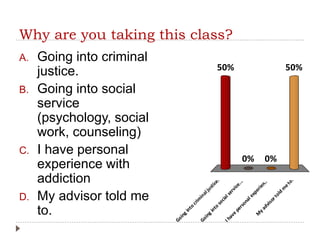
Why are you taking this class?
A. Going into criminal
justice.
B. Going into social
service
(psychology, social
work, counseling)
C. I have personal
experience with
addiction
D. My advisor told me
to.
Going
into
crim
inaljustice.
Going
into
socialservice...
Ihave
personalexperien..
M
yadvisortold
m
eto.
50% 50%
0%0%
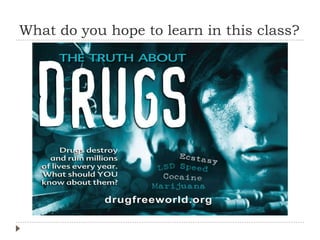
What do you hope to learn in this class?
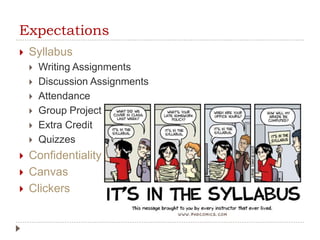
Expectations
 Syllabus
 Writing Assignments
 Discussion Assignments
 Attendance
 Group Project
 Extra Credit
 Quizzes
 Confidentiality
 Canvas
 Clickers
In this class, late homework:
0%
0%
0% A. Is penalized 10%
B. Gets a zero
C. Is turned in via Canvas
Michelle’s office hours are:
0%
0%
0%
0% A. 12:30-1:30 pm
B. 8:30-9:30 am
C. 10:30-11:30 am
D. Whenever she’s in
For class discussions:
A. I participate on
Canvas
B. I must do written
prep work and
participate
C. I participate during
class
Iparticipate
on
Canvas
Im
ustdo
w
ritten
prep
w
o..
Iparticipate
duringclass
0% 0%0%
If 80% of the class gets a clicker question
right, each person earns an extra credit
point.
A. True
B. False
True
False
0%0%
Definitions
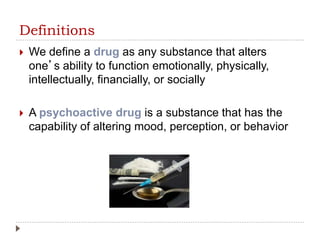
 We define a drug as any substance that alters
one’s ability to function emotionally, physically,
intellectually, financially, or socially
 A psychoactive drug is a substance that has the
capability of altering mood, perception, or behavior
Definitions
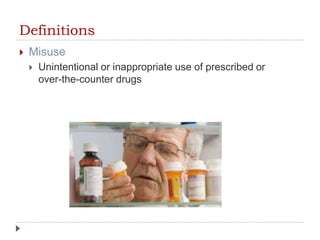
 Misuse
 Unintentional or inappropriate use of prescribed or
over-the-counter drugs
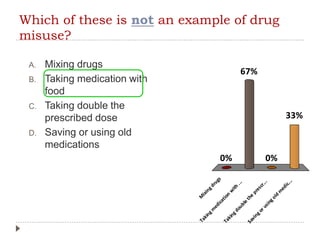
Which of these is not an example of drug
misuse?
A. Mixing drugs
B. Taking medication with
food
C. Taking double the
prescribed dose
D. Saving or using old
medications
M
ixingdrugs
Takingm
edication
w
ith
...
Takingdouble
the
prescr...
Savingorusingold
m
edic...
0%
33%
0%
67%
Definitions
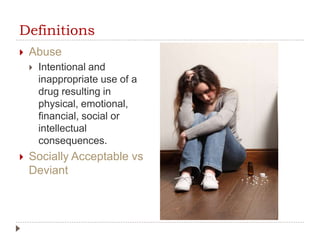
 Abuse
 Intentional and
inappropriate use of a
drug resulting in
physical, emotional,
financial, social or
intellectual
consequences.
 Socially Acceptable vs
Deviant
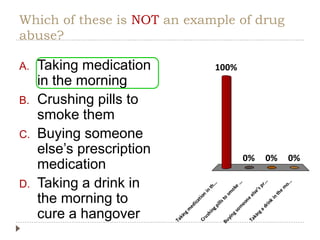
Which of these is NOT an example of drug
abuse?
A. Taking medication
in the morning
B. Crushing pills to
smoke them
C. Buying someone
else’s prescription
medication
D. Taking a drink in
the morning to
cure a hangover
Takingm
edication
in
th...
Crushingpillsto
sm
oke
...
Buyingsom
eone
else’spr...
Takinga
drink
in
the
m
o...
100%
0%0%0%
Definitions
 Addiction/Dependency
 Physical Dependence
 Tolerance
 Withdrawal
 Psychological Dependence
 Cravings
 Preoccupation
 OLD LANGUAGE
 New: Substance Use Disorder (mild, moderate, severe)
Which of these is NOT a sign of
dependency?
67%
0%
33%
0% A. Tolerance
B. Withdrawal
C. Cravings
D. Drunkenness
Definitions
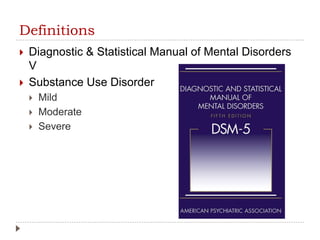
 Diagnostic & Statistical Manual of Mental Disorders
V
 Substance Use Disorder
 Mild
 Moderate
 Severe
A psychiatrist can diagnose someone with
addiction according to the DSM-5.
0%
0% A. True
B. False
Definitions
 Any definition is limited and is influenced by one’s
experiences and background – and is arbitrary
Drugs Around the World in 80 Minutes
Historical Perspective
 A historical perspective on drugs provides insight
into the role that drugs have played over time
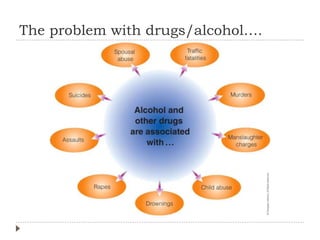
The problem with drugs/alcohol….
The problem with the previous slide is:
A. There are no
statistics
B. It doesn’t say
where the info
came from
C. Correlation does
not equal
causation
D. All of the above
There
areno
statistics
Itdoesn’tsayw
herethe
...
Correlation
doesnotequ..Alloftheabove
0% 0%0%0%
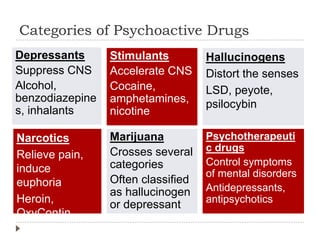
Categories of Psychoactive Drugs
Depressants
Suppress CNS
Alcohol,
benzodiazepine
s, inhalants
Stimulants
Accelerate CNS
Cocaine,
amphetamines,
nicotine
Narcotics
Relieve pain,
induce
euphoria
Heroin,
OxyContin
Hallucinogens
Distort the senses
LSD, peyote,
psilocybin
Marijuana
Crosses several
categories
Often classified
as hallucinogen
or depressant
Psychotherapeuti
c drugs
Control symptoms
of mental disorders
Antidepressants,
antipsychotics
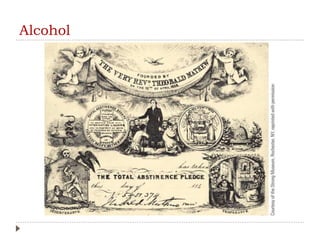
Alcohol
 Beverages may have been fermented
intentionally as early as about 10,000
BC
 Early Egyptians, Hebrews, Chinese,
Greek, and Romans were fond of
alcohol
 Egyptians developed distillation,
which produces a higher alcohol
content than fermentation
 The Irish, Scots, Dutch, Russians,
and French all developed
characteristic alcoholic beverages
Alcohol
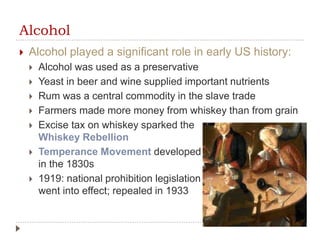
 Alcohol played a significant role in early US history:
 Alcohol was used as a preservative
 Yeast in beer and wine supplied important nutrients
 Rum was a central commodity in the slave trade
 Farmers made more money from whiskey than from grain
 Excise tax on whiskey sparked the
Whiskey Rebellion
 Temperance Movement developed
in the 1830s
 1919: national prohibition legislation
went into effect; repealed in 1933
Alcohol
Marijuana
 Marijuana has been cultivated for
its fiber since 8000 BC
 Chinese Emperor Shen Nung
prescribed marijuana for many
aliments 4,700 years ago
 Marijuana was used in India for
festive and religious purposes by
the 2nd century BC
 Greeks, Romans, Persians and
Assyrians all used marijuana for
medical purposes
Marijuana
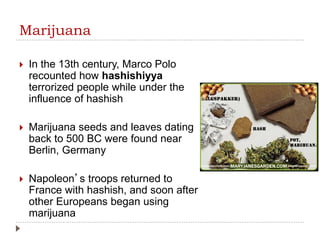
 In the 13th century, Marco Polo
recounted how hashishiyya
terrorized people while under the
influence of hashish
 Marijuana seeds and leaves dating
back to 500 BC were found near
Berlin, Germany
 Napoleon’s troops returned to
France with hashish, and soon after
other Europeans began using
marijuana
Marijuana
 Use of marijuana was noted in the
Americas in 1545
 English settlers grew marijuana
(hemp) to make clothing, rope, linens,
and blankets
 By the late 1800s numerous reports
detailed cannabis use for many medical
reasons
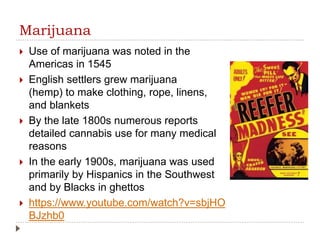
 In the early 1900s, marijuana was used
primarily by Hispanics in the Southwest
and by Blacks in ghettos
 https://www.youtube.com/watch?v=sbjHO
BJzhb0
Marijuana has been used in all of the
following ways except:
0%
0%
0%
0% A. Medical use
B. Religious use
C. To treat
depression
D. For its fibers
Narcotics
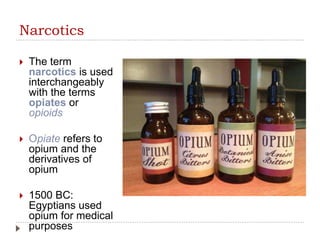
 The term
narcotics is used
interchangeably
with the terms
opiates or
opioids
 Opiate refers to
opium and the
derivatives of
opium
 1500 BC:
Egyptians used
opium for medical
purposes
Narcotics
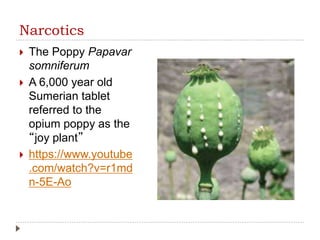
 The Poppy Papavar
somniferum
 A 6,000 year old
Sumerian tablet
referred to the
opium poppy as the
“joy plant”
 https://www.youtube
.com/watch?v=r1md
n-5E-Ao
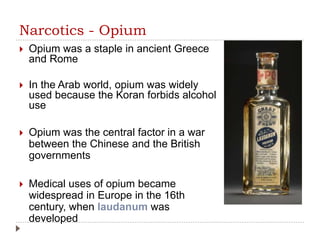
Narcotics - Opium
 Opium was a staple in ancient Greece
and Rome
 In the Arab world, opium was widely
used because the Koran forbids alcohol
use
 Opium was the central factor in a war
between the Chinese and the British
governments
 Medical uses of opium became
widespread in Europe in the 16th
century, when laudanum was
developed
Narcotics – Morphine & Heroin
 In 1805, the active ingredient in opium was identified and
called morphine
 During the Civil War, morphine dependency was so
common that it was called soldier’s disease
 An estimated 1 million Americans
were dependent on morphine and
other narcotics by the end of the
19th century
 In 1874 a “wonder drug” was
developed to relieve pain and treat
morphine dependency – it was called
heroin
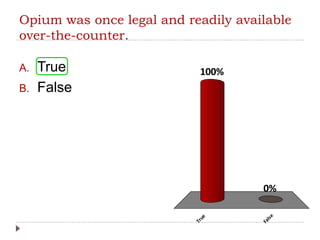
Opium was once legal and readily available
over-the-counter.
A. True
B. False
True
False
0%
100%
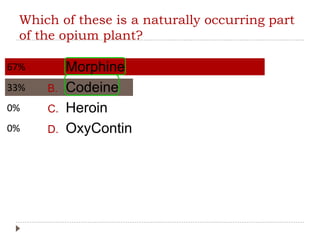
Which of these is a naturally occurring part
of the opium plant?
0%
0%
33%
67% A. Morphine
B. Codeine
C. Heroin
D. OxyContin
Cocaine
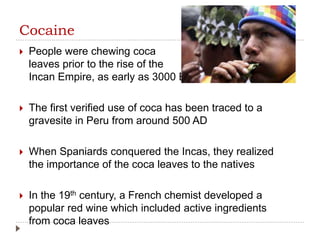
 People were chewing coca
leaves prior to the rise of the
Incan Empire, as early as 3000 BC
 The first verified use of coca has been traced to a
gravesite in Peru from around 500 AD
 When Spaniards conquered the Incas, they realized
the importance of the coca leaves to the natives
 In the 19th century, a French chemist developed a
popular red wine which included active ingredients
from coca leaves
Cocaine
 Early proponents of cocaine
included Sigmund Freud,
Robert Louis Stevenson, and
Sir Arthur Conan Doyle
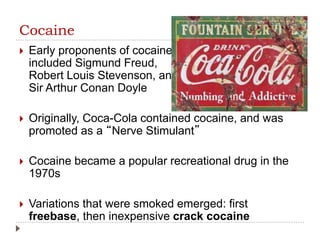
 Originally, Coca-Cola contained cocaine, and was
promoted as a “Nerve Stimulant”
 Cocaine became a popular recreational drug in the
1970s
 Variations that were smoked emerged: first
freebase, then inexpensive crack cocaine
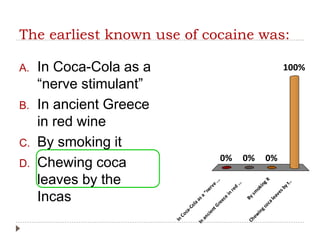
The earliest known use of cocaine was:
A. In Coca-Cola as a
“nerve stimulant”
B. In ancient Greece
in red wine
C. By smoking it
D. Chewing coca
leaves by the
Incas
In
Coca-Colaasa
“nerve...
In
ancientGreece
in
red
...
Bysm
oking
it
Chew
ingcocaleavesbyt..
0%
100%
0%0%
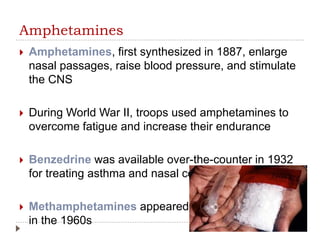
Amphetamines
 Amphetamines, first synthesized in 1887, enlarge
nasal passages, raise blood pressure, and stimulate
the CNS
 During World War II, troops used amphetamines to
overcome fatigue and increase their endurance
 Benzedrine was available over-the-counter in 1932
for treating asthma and nasal congestion
 Methamphetamines appeared
in the 1960s
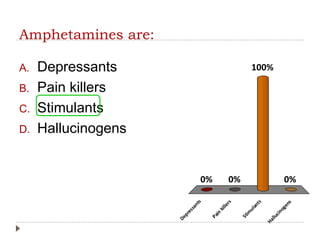
Amphetamines are:
A. Depressants
B. Pain killers
C. Stimulants
D. Hallucinogens
Depressants
Pain
killers
Stim
ulants
Hallucinogens
0% 0%
100%
0%
Sedative-Hypnotic Drugs
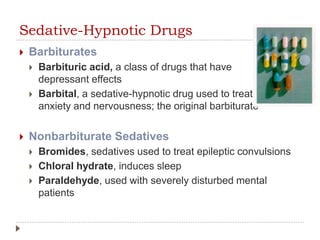
 Barbiturates
 Barbituric acid, a class of drugs that have
depressant effects
 Barbital, a sedative-hypnotic drug used to treat
anxiety and nervousness; the original barbiturate
 Nonbarbiturate Sedatives
 Bromides, sedatives used to treat epileptic convulsions
 Chloral hydrate, induces sleep
 Paraldehyde, used with severely disturbed mental
patients
Sedative-Hypnotic Drugs
 Minor tranquilizers, or
antianxiety agents
 Meprobamate, also used for
treating psychosomatic conditions
 Benzodiazepines such as
Librium and Valium
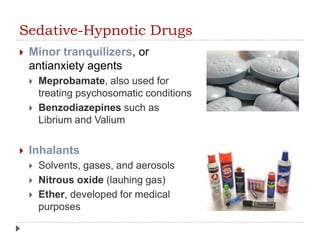
 Inhalants
 Solvents, gases, and aerosols
 Nitrous oxide (lauhing gas)
 Ether, developed for medical
purposes
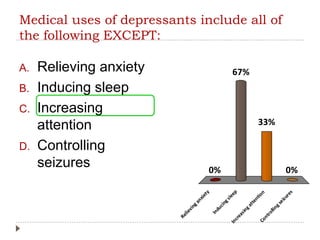
Medical uses of depressants include all of
the following EXCEPT:
A. Relieving anxiety
B. Inducing sleep
C. Increasing
attention
D. Controlling
seizures
Relievinganxiety
InducingsleepIncreasingattentionControllingseizures
0% 0%
33%
67%
Sedative-Hypnotic Drugs - Inhalants
 Inhalants are among
the first drugs used by
young children
 Huffing
 Sudden death
syndrome
 https://www.youtube.c
om/watch?v=Avcz9Z1
ekcM
Hallucinogens
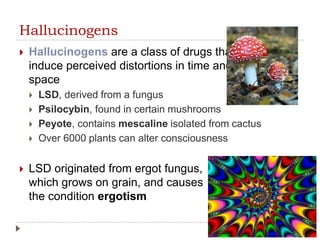
 Hallucinogens are a class of drugs that
induce perceived distortions in time and
space
 LSD, derived from a fungus
 Psilocybin, found in certain mushrooms
 Peyote, contains mescaline isolated from cactus
 Over 6000 plants can alter consciousness
 LSD originated from ergot fungus,
which grows on grain, and causes
the condition ergotism
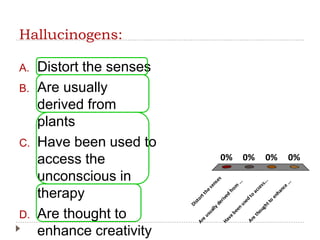
Hallucinogens:
A. Distort the senses
B. Are usually
derived from
plants
C. Have been used to
access the
unconscious in
therapy
D. Are thought to
enhance creativity
Distortthesenses
Are
usually
derived
from
...
Havebeen
used
to
access...
Are
thoughtto
enhance
...
0% 0%0%0%

Goldberg Chapter 1 Fall 2015 Hybrid

  • 1.
    Drugs & Society SOC204 Chapter 1 Drugs in Perspective
  • 2.
    Introductions  Fill outyour answers to the questions.  Partner up with someone.  Discuss the first three questions.  Find someone new and discuss the next three questions.  Find someone new and discuss the last four questions.  In your last partnership, prepare to:  Introduce yourselves to the group.  Share one insight you had from discussing the questions.
  • 3.
    Happy second day!How are you? 0% 0% 0% 100% A. I feel great! I’m ready! B. I feel nervous. C. I feel overwhelmed. D. I feel blah.
  • 4.
    Why are youtaking this class? A. Going into criminal justice. B. Going into social service (psychology, social work, counseling) C. I have personal experience with addiction D. My advisor told me to. Going into crim inaljustice. Going into socialservice... Ihave personalexperien.. M yadvisortold m eto. 50% 50% 0%0%
  • 5.
    What do youhope to learn in this class?
  • 6.
    Expectations  Syllabus  WritingAssignments  Discussion Assignments  Attendance  Group Project  Extra Credit  Quizzes  Confidentiality  Canvas  Clickers
  • 7.
    In this class,late homework: 0% 0% 0% A. Is penalized 10% B. Gets a zero C. Is turned in via Canvas
  • 8.
    Michelle’s office hoursare: 0% 0% 0% 0% A. 12:30-1:30 pm B. 8:30-9:30 am C. 10:30-11:30 am D. Whenever she’s in
  • 9.
    For class discussions: A.I participate on Canvas B. I must do written prep work and participate C. I participate during class Iparticipate on Canvas Im ustdo w ritten prep w o.. Iparticipate duringclass 0% 0%0%
  • 10.
    If 80% ofthe class gets a clicker question right, each person earns an extra credit point. A. True B. False True False 0%0%
  • 11.
    Definitions  We definea drug as any substance that alters one’s ability to function emotionally, physically, intellectually, financially, or socially  A psychoactive drug is a substance that has the capability of altering mood, perception, or behavior
  • 12.
    Definitions  Misuse  Unintentionalor inappropriate use of prescribed or over-the-counter drugs
  • 13.
    Which of theseis not an example of drug misuse? A. Mixing drugs B. Taking medication with food C. Taking double the prescribed dose D. Saving or using old medications M ixingdrugs Takingm edication w ith ... Takingdouble the prescr... Savingorusingold m edic... 0% 33% 0% 67%
  • 14.
    Definitions  Abuse  Intentionaland inappropriate use of a drug resulting in physical, emotional, financial, social or intellectual consequences.  Socially Acceptable vs Deviant
  • 15.
    Which of theseis NOT an example of drug abuse? A. Taking medication in the morning B. Crushing pills to smoke them C. Buying someone else’s prescription medication D. Taking a drink in the morning to cure a hangover Takingm edication in th... Crushingpillsto sm oke ... Buyingsom eone else’spr... Takinga drink in the m o... 100% 0%0%0%
  • 16.
    Definitions  Addiction/Dependency  PhysicalDependence  Tolerance  Withdrawal  Psychological Dependence  Cravings  Preoccupation  OLD LANGUAGE  New: Substance Use Disorder (mild, moderate, severe)
  • 17.
    Which of theseis NOT a sign of dependency? 67% 0% 33% 0% A. Tolerance B. Withdrawal C. Cravings D. Drunkenness
  • 18.
    Definitions  Diagnostic &Statistical Manual of Mental Disorders V  Substance Use Disorder  Mild  Moderate  Severe
  • 19.
    A psychiatrist candiagnose someone with addiction according to the DSM-5. 0% 0% A. True B. False
  • 20.
    Definitions  Any definitionis limited and is influenced by one’s experiences and background – and is arbitrary
  • 21.
    Drugs Around theWorld in 80 Minutes
  • 22.
    Historical Perspective  Ahistorical perspective on drugs provides insight into the role that drugs have played over time
  • 23.
    The problem withdrugs/alcohol….
  • 24.
    The problem withthe previous slide is: A. There are no statistics B. It doesn’t say where the info came from C. Correlation does not equal causation D. All of the above There areno statistics Itdoesn’tsayw herethe ... Correlation doesnotequ..Alloftheabove 0% 0%0%0%
  • 25.
    Categories of PsychoactiveDrugs Depressants Suppress CNS Alcohol, benzodiazepine s, inhalants Stimulants Accelerate CNS Cocaine, amphetamines, nicotine Narcotics Relieve pain, induce euphoria Heroin, OxyContin Hallucinogens Distort the senses LSD, peyote, psilocybin Marijuana Crosses several categories Often classified as hallucinogen or depressant Psychotherapeuti c drugs Control symptoms of mental disorders Antidepressants, antipsychotics
  • 26.
    Alcohol  Beverages mayhave been fermented intentionally as early as about 10,000 BC  Early Egyptians, Hebrews, Chinese, Greek, and Romans were fond of alcohol  Egyptians developed distillation, which produces a higher alcohol content than fermentation  The Irish, Scots, Dutch, Russians, and French all developed characteristic alcoholic beverages
  • 27.
    Alcohol  Alcohol playeda significant role in early US history:  Alcohol was used as a preservative  Yeast in beer and wine supplied important nutrients  Rum was a central commodity in the slave trade  Farmers made more money from whiskey than from grain  Excise tax on whiskey sparked the Whiskey Rebellion  Temperance Movement developed in the 1830s  1919: national prohibition legislation went into effect; repealed in 1933
  • 28.
  • 29.
    Marijuana  Marijuana hasbeen cultivated for its fiber since 8000 BC  Chinese Emperor Shen Nung prescribed marijuana for many aliments 4,700 years ago  Marijuana was used in India for festive and religious purposes by the 2nd century BC  Greeks, Romans, Persians and Assyrians all used marijuana for medical purposes
  • 30.
    Marijuana  In the13th century, Marco Polo recounted how hashishiyya terrorized people while under the influence of hashish  Marijuana seeds and leaves dating back to 500 BC were found near Berlin, Germany  Napoleon’s troops returned to France with hashish, and soon after other Europeans began using marijuana
  • 31.
    Marijuana  Use ofmarijuana was noted in the Americas in 1545  English settlers grew marijuana (hemp) to make clothing, rope, linens, and blankets  By the late 1800s numerous reports detailed cannabis use for many medical reasons  In the early 1900s, marijuana was used primarily by Hispanics in the Southwest and by Blacks in ghettos  https://www.youtube.com/watch?v=sbjHO BJzhb0
  • 32.
    Marijuana has beenused in all of the following ways except: 0% 0% 0% 0% A. Medical use B. Religious use C. To treat depression D. For its fibers
  • 33.
    Narcotics  The term narcoticsis used interchangeably with the terms opiates or opioids  Opiate refers to opium and the derivatives of opium  1500 BC: Egyptians used opium for medical purposes
  • 34.
    Narcotics  The PoppyPapavar somniferum  A 6,000 year old Sumerian tablet referred to the opium poppy as the “joy plant”  https://www.youtube .com/watch?v=r1md n-5E-Ao
  • 35.
    Narcotics - Opium Opium was a staple in ancient Greece and Rome  In the Arab world, opium was widely used because the Koran forbids alcohol use  Opium was the central factor in a war between the Chinese and the British governments  Medical uses of opium became widespread in Europe in the 16th century, when laudanum was developed
  • 36.
    Narcotics – Morphine& Heroin  In 1805, the active ingredient in opium was identified and called morphine  During the Civil War, morphine dependency was so common that it was called soldier’s disease  An estimated 1 million Americans were dependent on morphine and other narcotics by the end of the 19th century  In 1874 a “wonder drug” was developed to relieve pain and treat morphine dependency – it was called heroin
  • 37.
    Opium was oncelegal and readily available over-the-counter. A. True B. False True False 0% 100%
  • 38.
    Which of theseis a naturally occurring part of the opium plant? 0% 0% 33% 67% A. Morphine B. Codeine C. Heroin D. OxyContin
  • 39.
    Cocaine  People werechewing coca leaves prior to the rise of the Incan Empire, as early as 3000 BC  The first verified use of coca has been traced to a gravesite in Peru from around 500 AD  When Spaniards conquered the Incas, they realized the importance of the coca leaves to the natives  In the 19th century, a French chemist developed a popular red wine which included active ingredients from coca leaves
  • 40.
    Cocaine  Early proponentsof cocaine included Sigmund Freud, Robert Louis Stevenson, and Sir Arthur Conan Doyle  Originally, Coca-Cola contained cocaine, and was promoted as a “Nerve Stimulant”  Cocaine became a popular recreational drug in the 1970s  Variations that were smoked emerged: first freebase, then inexpensive crack cocaine
  • 41.
    The earliest knownuse of cocaine was: A. In Coca-Cola as a “nerve stimulant” B. In ancient Greece in red wine C. By smoking it D. Chewing coca leaves by the Incas In Coca-Colaasa “nerve... In ancientGreece in red ... Bysm oking it Chew ingcocaleavesbyt.. 0% 100% 0%0%
  • 42.
    Amphetamines  Amphetamines, firstsynthesized in 1887, enlarge nasal passages, raise blood pressure, and stimulate the CNS  During World War II, troops used amphetamines to overcome fatigue and increase their endurance  Benzedrine was available over-the-counter in 1932 for treating asthma and nasal congestion  Methamphetamines appeared in the 1960s
  • 43.
    Amphetamines are: A. Depressants B.Pain killers C. Stimulants D. Hallucinogens Depressants Pain killers Stim ulants Hallucinogens 0% 0% 100% 0%
  • 44.
    Sedative-Hypnotic Drugs  Barbiturates Barbituric acid, a class of drugs that have depressant effects  Barbital, a sedative-hypnotic drug used to treat anxiety and nervousness; the original barbiturate  Nonbarbiturate Sedatives  Bromides, sedatives used to treat epileptic convulsions  Chloral hydrate, induces sleep  Paraldehyde, used with severely disturbed mental patients
  • 45.
    Sedative-Hypnotic Drugs  Minortranquilizers, or antianxiety agents  Meprobamate, also used for treating psychosomatic conditions  Benzodiazepines such as Librium and Valium  Inhalants  Solvents, gases, and aerosols  Nitrous oxide (lauhing gas)  Ether, developed for medical purposes
  • 46.
    Medical uses ofdepressants include all of the following EXCEPT: A. Relieving anxiety B. Inducing sleep C. Increasing attention D. Controlling seizures Relievinganxiety InducingsleepIncreasingattentionControllingseizures 0% 0% 33% 67%
  • 47.
    Sedative-Hypnotic Drugs -Inhalants  Inhalants are among the first drugs used by young children  Huffing  Sudden death syndrome  https://www.youtube.c om/watch?v=Avcz9Z1 ekcM
  • 48.
    Hallucinogens  Hallucinogens area class of drugs that induce perceived distortions in time and space  LSD, derived from a fungus  Psilocybin, found in certain mushrooms  Peyote, contains mescaline isolated from cactus  Over 6000 plants can alter consciousness  LSD originated from ergot fungus, which grows on grain, and causes the condition ergotism
  • 49.
    Hallucinogens: A. Distort thesenses B. Are usually derived from plants C. Have been used to access the unconscious in therapy D. Are thought to enhance creativity Distortthesenses Are usually derived from ... Havebeen used to access... Are thoughtto enhance ... 0% 0%0%0%

Editor's Notes

  • #3 1. Ten years ago, I thought drugs were . . . 2. Today, I think drugs are . . . 3. My perceptions of drugs are influenced by . . . 4. My parents’ view of drugs is . . . 5. A drug is harmful when . . . 6. My peers’ view of drugs is . . . 7. A drug is . . . 8. Drug misuse is . . . 9. Drug abuse is . . . 10. Drug use is considered socially deviant when . . .
  • #7 Small group brainstorm
  • #13 Drug Any substance, natural or artificial, other than food, that by its chemical nature alters structure or function in a living organism Psychoactive drug A drug that specifically affects thoughts, emotions, or behavior Illicit drug A drug that is unlawful to possess or use Deviant drug use Drug use that is not common within a social group and is disapproved of by the majority Drug misuse Use of drugs or chemicals in greater amounts than prescribed by a doctor, or for purposes other than, those intended by the manufacturer Drug abuse Substance use in a manner, an amount, or in situations such that it causes social, occupational, psychological, or physical problems Drug dependence A more precise term than addiction A state in which an individual uses a drug so frequently or consistently that it would be difficult for the person to stop May be physiological and/or psychological
  • #14 The elderly use more prescription and over-the-counter drugs than people in other age groups.
  • #18 http://www.dsm5.org/Documents/Substance%20Use%20Disorder%20Fact%20Sheet.pdf http://pubs.niaaa.nih.gov/publications/dsmfactsheet/dsmfact.pdf Alcohol Use Disorder: A Comparison Between DSM–IV and DSM–5 DSM-V - Major Changes to Addictive Disease Classifications    2010 - Marchby Bob CurleyThe first draft of the American Psychiatric Association’s (APA) latest Diagnostic and Statistical Manual of Mental Disorders (DSM-V) eliminates the disease categories for substance abuse and dependence and replaces it with a new “addictions and related disorders” -- just one of several major changes to the “Bible” used almost universally to diagnose (and get insurance reimbursement for) behavioral-health problems. “Eliminating the category of dependence will better differentiate between the compulsive drug-seeking behavior of addiction and normal responses of tolerance and withdrawal that some patients experience when using prescribed medications that affect the central nervous system,” the APA explained in a Feb. 10 press release. “The term dependence is misleading, because people confuse it with addiction, when in fact the tolerance and withdrawal patients experience are very normal responses to prescribed medications that affect the central nervous system,” said Charles O’Brien, M.D., Ph.D., chair of the APA’s DSM Substance-Related Disorders Work Group. “On the other hand, addiction is compulsive drug- seeking behavior which is quite different. We hope that this new classification will help end this wide-spread misunderstanding.” The new category for addictive diseases would include a variety of “substance-use disorders” broken down by drug type, such as “cannabis-use disorder” and “alcohol-use disorder.” Diagnostic criteria for these disorders in DSM-V would remain “very similar” to those found in the current DSM-IV, according to APA. However, the symptom of “drug craving” would be added to the criteria, while a symptom that referred to “problems with law enforcement” would be eliminated “because of cultural considerations that make the criteria difficult to apply internationally,” APA said. Also new to the DSM-V are diagnostic criteria for “cannabis withdrawal,” which the APA says is caused by “cessation of cannabis use that has been heavy and prolonged,” results in “clinically significant distress or impairment in social, occupational, or other important areas of functioning,” and is characterized by at least three of these symptoms: irritability, anger or aggression; nervousness or anxiety; sleep difficulties (insomnia); decreased appetite or weight loss; restlessness; depressed mood; and or physical symptoms such as stomach pain, shakiness or tremors, sweating, fever, chills, and headache. Battle Over ‘Addiction’ and ‘Dependence’ The APA has gone back and forth between use of the terms “addiction” and “dependence” to describe alcohol and other drug problems, noted researcher Stanton Peele, Ph.D. “Every book I’ve written has the word “addiction” in the title, so I’m glad the term will now be recognized,” wrote Peele in the Huffington Post on Feb. 11. “But the change back may make us wonder whether we will have to reconsider every twenty years or so whether it is more beneficial or harmful to use a word loaded with cultural meanings (“addiction”), or a more neutral term (“dependence”).” In fact, “dependence” made it into the DSM-IV by just a single vote, O’Brien noted in a May 2006 editorial in the American Journal of Psychiatry co-authored by Nora Volkow, M.D., director of the National Institute on Drug Abuse, and T-K Li, M.D., then-head of the National Institute on Alcohol Abuse and Alcoholism. “Experience over the past two decades has demonstrated that this decision was a serious mistake,” the trio wrote. “The term ‘dependence’ has traditionally been used to describe ‘physical dependence,’ which refers to the adaptations that result in withdrawal symptoms when drugs, such as alcohol and heroin, are discontinued. Physical dependence is also observed with certain psychoactive medications, such as antidepressants and beta-blockers. However, the adaptations associated with drug withdrawal are distinct from the adaptations that result in addiction, which refers to the loss of control over the intense urges to take the drug even at the expense of adverse consequences.”
  • #26   B. Trends in Drug Use 1. The perceived risk decreases as drug use increases; as drug use decreases the perceived risk increases. 2. The perceived availability of marijuana has changed little over time and, therefore, does not appear to explain differences in rates of use. 3. The National Survey on Drug Use and Health is a door-to-door survey estimating drug use in adolescents and adults in the United States. 4. Alcohol and cocaine use in 18- to 25-year-olds stays fairly consistent over time. 5. Drug use patterns seen in multiple surveys are most likely to be accurate. 6. Decreases or increases in drug use are not related to changes in government legislation, but are related to social trends. Have Things Really Changed? 1. Humans have used psychoactive drugs for thousands of years for therapeutic and recreational purposes. 2. Drug use has affected society in many areas: religion, law, government, economics, language, and education.
  • #30 This pledge card displays powerful and contrasting symbolism about temperance.
  • #35 Opioids are synthetic opiates.
  • #36 The poppy Papavar somniferum is the main source of nonsynthetic narcotics.
  • #42 Caffeine is the number one drug of choice for many Americans.
  • #51 Americans’ attitude concerning nitrous oxide was nonchalant in the first half of the 19th century.
  • #56 Cigarette smoking is the single largest preventable cause mania, of illness and premature death in the United States.