CNSCNS
DEPRESSANTSDEPRESSANTS
::
SEDATIVE-SEDATIVE-
HYPNOTICSHYPNOTICS
CHAPTER 6CHAPTER 6
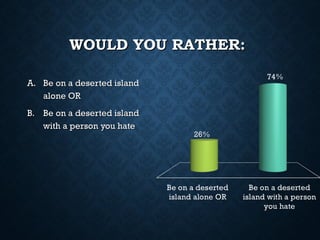
WOULD YOU RATHER:WOULD YOU RATHER:
A.A. Be on a deserted islandBe on a deserted island
alone ORalone OR
B.B. Be on a deserted islandBe on a deserted island
with a person you hatewith a person you hate
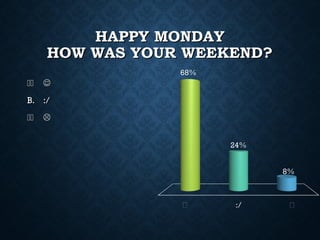
HAPPY MONDAYHAPPY MONDAY
HOW WAS YOUR WEEKEND?HOW WAS YOUR WEEKEND?
AAAA 
B.B. :/:/
AAAA 
INTRODUCTION TO CNSINTRODUCTION TO CNS
DEPRESSANTSDEPRESSANTS
•Why are CNS depressants problematic?Why are CNS depressants problematic?
• Usually prescribed under physician’sUsually prescribed under physician’s
directiondirection
• Second most frequently abused prescriptionSecond most frequently abused prescription
drug and sometimes contributes to death duedrug and sometimes contributes to death due
to accidental overdosesto accidental overdoses
• Can cause very alarming and dangerousCan cause very alarming and dangerous
behavior if not closely monitoredbehavior if not closely monitored
• Most problems associated with these drugsMost problems associated with these drugs
due to inadequate professional supervisiondue to inadequate professional supervision
INTRODUCTION TO CNSINTRODUCTION TO CNS
DEPRESSANTS (CONTINUED)DEPRESSANTS (CONTINUED)
• Why are CNS depressants problematic?Why are CNS depressants problematic?
• Seemingly unrelated drug groupsSeemingly unrelated drug groups
can cause CNS depressioncan cause CNS depression
• Combination use can causeCombination use can cause
dangerous drug interactionsdangerous drug interactions
• Can cause disruptive personalityCan cause disruptive personality
changeschanges
THE HISTORY OF CNSTHE HISTORY OF CNS
DEPRESSANTSDEPRESSANTS
• Attempts to find CNS depressants other than alcohol began in theAttempts to find CNS depressants other than alcohol began in the
1800s.1800s.
• Bromides were introduced to treat nervousness and anxiety in theBromides were introduced to treat nervousness and anxiety in the
1800s.1800s.
• Very popular but toxicVery popular but toxic
• In the early 1900s, bromides were replaced by barbiturates.In the early 1900s, bromides were replaced by barbiturates.
• Initially heralded as safe and effectiveInitially heralded as safe and effective
• Apparent problems with tolerance,Apparent problems with tolerance,
dependence, and safetydependence, and safety
THE HISTORY OF CNSTHE HISTORY OF CNS
DEPRESSANTS (CONTINUED)DEPRESSANTS (CONTINUED)
• In the 1950s the first benzodiazepines were marketed as substitutesIn the 1950s the first benzodiazepines were marketed as substitutes
for barbiturates.for barbiturates.
• Relatively safe when used for shortRelatively safe when used for short
periodsperiods
• Long-term use can cause dependenceLong-term use can cause dependence
and withdrawal problemsand withdrawal problems
THETHE HISTORY OF CNSHISTORY OF CNS
DEPRESSANTS (CONTINUED)DEPRESSANTS (CONTINUED)
• Benzodiazepines were routinely prescribed for stress, anxiety, orBenzodiazepines were routinely prescribed for stress, anxiety, or
apprehension.apprehension.
• In 1973, 100 million prescriptions wereIn 1973, 100 million prescriptions were
written for benzodiazepines.written for benzodiazepines.
• Twice as many women as men takingTwice as many women as men taking
them.them.
• As medical community became aware of the problem, use ofAs medical community became aware of the problem, use of
depressants declined, but benzodiazepines remained still verydepressants declined, but benzodiazepines remained still very
popular.popular.
• Classified as Schedule V drugsClassified as Schedule V drugs
SEDATIVE-HYPNOTIC DRUGSSEDATIVE-HYPNOTIC DRUGS
(DEPRESSANTS)(DEPRESSANTS)
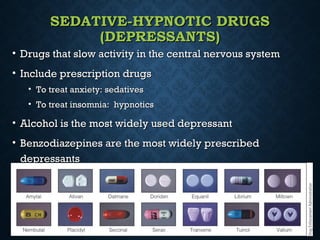
• Drugs that slow activity in the central nervous systemDrugs that slow activity in the central nervous system
• Include prescription drugsInclude prescription drugs
• To treat anxiety: sedativesTo treat anxiety: sedatives
• To treat insomnia: hypnoticsTo treat insomnia: hypnotics
• Alcohol is the most widely used depressantAlcohol is the most widely used depressant
• Benzodiazepines are the most widely prescribedBenzodiazepines are the most widely prescribed
depressantsdepressants
THE EFFECTS OF CNSTHE EFFECTS OF CNS
DEPRESSANTSDEPRESSANTS
• CNS depressants reduce CNS activity andCNS depressants reduce CNS activity and
diminish the brain’s level of awareness.diminish the brain’s level of awareness.
• Depressant drugs include:Depressant drugs include:
• BenzodiazepinesBenzodiazepines
• Barbiturate-like drugsBarbiturate-like drugs
• AlcoholAlcohol
• AntihistaminesAntihistamines
• Opioid narcotics like heroinOpioid narcotics like heroin
THE EFFECTS OF CNSTHE EFFECTS OF CNS
DEPRESSANTS (CONTINUED)DEPRESSANTS (CONTINUED)
• Depressants are usually classified according to the degree of theirDepressants are usually classified according to the degree of their
medical effects on the body. For example:medical effects on the body. For example:
• SedativesSedatives cause mild depression andcause mild depression and
relaxationrelaxation
• AnxiolyticAnxiolytic—drugs that relieve anxiety—drugs that relieve anxiety
• HypnoticsHypnotics induce drowsiness andinduce drowsiness and
encourage sleepencourage sleep
• AmnesiacAmnesiac effects can cause the loss ofeffects can cause the loss of
memorymemory
THE EFFECTS OF CNSTHE EFFECTS OF CNS
DEPRESSANTS (CONTINUED)DEPRESSANTS (CONTINUED)
•The same drug can cause different effects depending on dose.The same drug can cause different effects depending on dose.
•Low dose (sedatives—relieve anxietyLow dose (sedatives—relieve anxiety
and promote relaxation)and promote relaxation)
•Higher doses (hypnotics—can causeHigher doses (hypnotics—can cause
drowsiness and promote sleep)drowsiness and promote sleep)
•Even higher doses (anesthetics canEven higher doses (anesthetics can
cause anesthesia and are used forcause anesthesia and are used for
patient management during surgery)patient management during surgery)
EFFECTSEFFECTS
• Produce a depressed, mood-altering actionProduce a depressed, mood-altering action
on the central nervous system – act on GABAon the central nervous system – act on GABA
• Slow activity of the cardiovascular, muscularSlow activity of the cardiovascular, muscular
and respiratory systemsand respiratory systems
• Can cause confusion, inadequate emotionalCan cause confusion, inadequate emotional
control, slurred speech, poor judgment, andcontrol, slurred speech, poor judgment, and
intoxicationintoxication
TYPES OF CNSTYPES OF CNS
DEPRESSANTSDEPRESSANTS
•Benzodiazepines: Valium-Type DrugsBenzodiazepines: Valium-Type Drugs
• Prescribed for anxiety, relaxation and sleepPrescribed for anxiety, relaxation and sleep
• Medical usesMedical uses
• Relief from anxiety, treatment of neurosis,Relief from anxiety, treatment of neurosis,
relaxation of muscles, alleviation of lower-backrelaxation of muscles, alleviation of lower-back
pain, treatment of convulsive disorders,pain, treatment of convulsive disorders,
induction of sleep, relief from withdrawalinduction of sleep, relief from withdrawal
symptoms, induction of amnesiasymptoms, induction of amnesia
TYPES OF CNS DEPRESSANTSTYPES OF CNS DEPRESSANTS
(CONTINUED)(CONTINUED)
• Mechanisms of action for benzodiazepineMechanisms of action for benzodiazepine
• Affect neurons that have receptorsAffect neurons that have receptors
for the neurotransmitterfor the neurotransmitter GABAGABA
• GABA:GABA: most common inhibitory transmitter in brain regionsmost common inhibitory transmitter in brain regions
• Limbic system (alter mood)Limbic system (alter mood)
• RAS (cause drowsiness)RAS (cause drowsiness)
• Motor cortex (relax muscles)Motor cortex (relax muscles)
TYPES OF CNS DEPRESSANTSTYPES OF CNS DEPRESSANTS
(CONTINUED)(CONTINUED)
• Types of benzodiazepinesTypes of benzodiazepines
• Many benzodiazepine compoundsMany benzodiazepine compounds
available in the United Statesavailable in the United States
• Distinguished primarily by theirDistinguished primarily by their
duration of action:duration of action: short-actingshort-acting
(hypnotics),(hypnotics), long-actinglong-acting (sedatives)(sedatives)
• Side effects include drowsiness to paradoxical effects (e.g.Side effects include drowsiness to paradoxical effects (e.g.
increased restlessness), tolerance, dependence, withdrawal, andincreased restlessness), tolerance, dependence, withdrawal, and
abuseabuse
TYPES OF CNS DEPRESSANTSTYPES OF CNS DEPRESSANTS
(CONTINUED)(CONTINUED)
• BarbituratesBarbiturates played an importantplayed an important
historical role as sedative-hypnotic agents.historical role as sedative-hypnotic agents.
• However, due to their narrow margin of safety and their abuseHowever, due to their narrow margin of safety and their abuse
liability, they were replaced by benzodiazepines.liability, they were replaced by benzodiazepines.
• Caused many negative side effects, fromCaused many negative side effects, from
nausea to death, from respiratory ornausea to death, from respiratory or
cardiovascular depressioncardiovascular depression
OTHER TYPES OF CNSOTHER TYPES OF CNS
DEPRESSANTSDEPRESSANTS
• Drugs with barbiturate-like properties:Drugs with barbiturate-like properties:
• Chloral hydrateChloral hydrate
• GlutethimideGlutethimide
• MethyprylonMethyprylon
• MethaqualoneMethaqualone
• AntihistaminesAntihistamines
• Propofol (abused general anesthetic)Propofol (abused general anesthetic)
• GHB (gamma hydroxybutyrate)GHB (gamma hydroxybutyrate)
MEDICAL USESMEDICAL USES
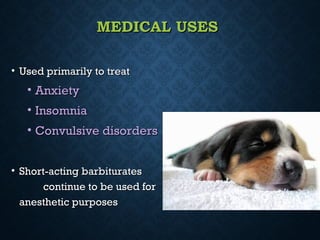
• Used primarily to treatUsed primarily to treat
• AnxietyAnxiety
• InsomniaInsomnia
• Convulsive disordersConvulsive disorders
• Short-acting barbituratesShort-acting barbiturates
continue to be used forcontinue to be used for
anesthetic purposesanesthetic purposes
MECHANISMS OF ACTIONMECHANISMS OF ACTION
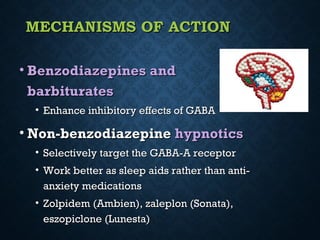
• Benzodiazepines andBenzodiazepines and
barbituratesbarbiturates
• Enhance inhibitory effects of GABAEnhance inhibitory effects of GABA
• Non-benzodiazepineNon-benzodiazepine hypnoticshypnotics
• Selectively target the GABA-A receptorSelectively target the GABA-A receptor
• Work better as sleep aids rather than anti-Work better as sleep aids rather than anti-
anxiety medicationsanxiety medications
• Zolpidem (Ambien), zaleplon (Sonata),Zolpidem (Ambien), zaleplon (Sonata),
eszopiclone (Lunesta)eszopiclone (Lunesta)
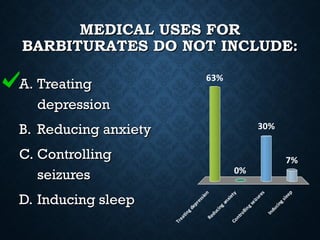
MEDICAL USES FORMEDICAL USES FOR
BARBITURATES DO NOT INCLUDE:BARBITURATES DO NOT INCLUDE:
A.A. TreatingTreating
depressiondepression
B.B. Reducing anxietyReducing anxiety
C.C. ControllingControlling
seizuresseizures
D.D. Inducing sleepInducing sleep
Treatingdepression
Reducing
anxietyControllingseizures
Inducingsleep
63%
7%
30%
0%
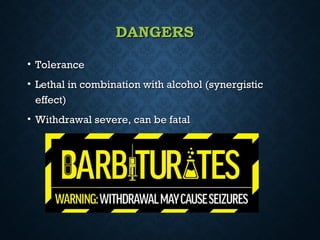
DANGERSDANGERS
• ToleranceTolerance
• Lethal in combination with alcohol (synergisticLethal in combination with alcohol (synergistic
effect)effect)
• Withdrawal severe, can be fatalWithdrawal severe, can be fatal
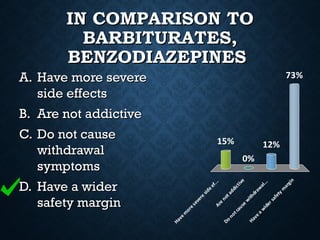
IN COMPARISON TOIN COMPARISON TO
BARBITURATES,BARBITURATES,
BENZODIAZEPINESBENZODIAZEPINES
A.A. Have more severeHave more severe
side effectsside effects
B.B. Are not addictiveAre not addictive
C.C. Do not causeDo not cause
withdrawalwithdrawal
symptomssymptoms
D.D. Have a widerHave a wider
safety marginsafety margin
Havem
oresevere
sideef...Are
notaddictive
Do
notcause
w
ithdraw
al...
Havea
w
idersafety
m
argin
15%
73%
12%
0%
PATTERNS OF ABUSEPATTERNS OF ABUSE
WITH CNS DEPRESSANTSWITH CNS DEPRESSANTS
• The American Psychiatric AssociationThe American Psychiatric Association
considers dependence on CNS depressantsconsiders dependence on CNS depressants
a psychiatric disorder.a psychiatric disorder.
PATTERNS OF ABUSE WITHPATTERNS OF ABUSE WITH
CNS DEPRESSANTSCNS DEPRESSANTS
(CONTINUED)(CONTINUED)
•People most likely to abuse CNS depressants include individuals who:People most likely to abuse CNS depressants include individuals who:
• Use drugs to relieve continual stressUse drugs to relieve continual stress
• Paradoxically feel euphoria and stimulationParadoxically feel euphoria and stimulation
from depressantsfrom depressants
• Use depressants to counteract theUse depressants to counteract the
unpleasant effects of other drugs of abuseunpleasant effects of other drugs of abuse
• Combine depressants with alcohol andCombine depressants with alcohol and
heroin to potentiate the effectsheroin to potentiate the effects
PATTERNS OF ABUSE WITHPATTERNS OF ABUSE WITH
CNS DEPRESSANTSCNS DEPRESSANTS
(CONTINUED)(CONTINUED)
•Detoxification:Detoxification: The elimination of a toxic substance, such as a drug, andThe elimination of a toxic substance, such as a drug, and
its effectsits effects
• With CNS depressants, this is achieved byWith CNS depressants, this is achieved by
substituting a longer-acting barbiturate forsubstituting a longer-acting barbiturate for
the offending CNS depressant and graduallythe offending CNS depressant and gradually
reducing the dose to avoid unpleasantreducing the dose to avoid unpleasant
withdrawal effects. Withdrawal from CNSwithdrawal effects. Withdrawal from CNS
depressants, if not managed properly, candepressants, if not managed properly, can
be very dangerous, or even fatal.be very dangerous, or even fatal.
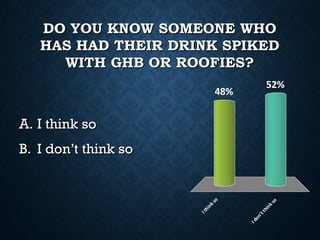
DO YOU KNOW SOMEONE WHODO YOU KNOW SOMEONE WHO
HAS HAD THEIR DRINK SPIKEDHAS HAD THEIR DRINK SPIKED
WITH GHB OR ROOFIES?WITH GHB OR ROOFIES?
A.A. I think soI think so
B.B. I don’t think soI don’t think so
Ithinkso
Idon’tthinkso
52%
48%
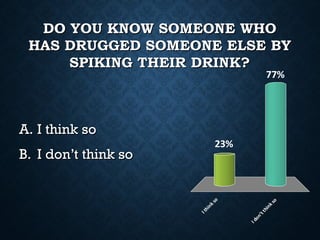
DO YOU KNOW SOMEONE WHODO YOU KNOW SOMEONE WHO
HAS DRUGGED SOMEONE ELSE BYHAS DRUGGED SOMEONE ELSE BY
SPIKING THEIR DRINK?SPIKING THEIR DRINK?
A.A. I think soI think so
B.B. I don’t think soI don’t think so
Ithinkso
Idon’tthinkso
77%
23%
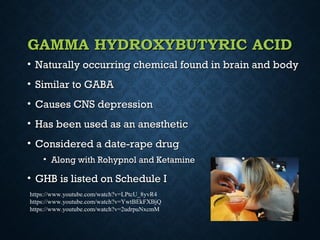
GAMMA HYDROXYBUTYRIC ACIDGAMMA HYDROXYBUTYRIC ACID
• Naturally occurring chemical found in brain and bodyNaturally occurring chemical found in brain and body
• Similar to GABASimilar to GABA
• Causes CNS depressionCauses CNS depression
• Has been used as an anestheticHas been used as an anesthetic
• Considered a date-rape drugConsidered a date-rape drug
• Along with Rohypnol and KetamineAlong with Rohypnol and Ketamine
• GHB is listed on Schedule IGHB is listed on Schedule I
https://www.youtube.com/watch?v=LPtcU_8yvR4
https://www.youtube.com/watch?v=YwtBEkFXBjQ
https://www.youtube.com/watch?v=2udrpuNxcmM
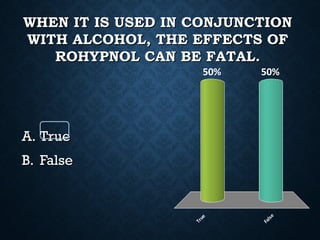
WHEN IT IS USED IN CONJUNCTIONWHEN IT IS USED IN CONJUNCTION
WITH ALCOHOL, THE EFFECTS OFWITH ALCOHOL, THE EFFECTS OF
ROHYPNOL CAN BE FATAL.ROHYPNOL CAN BE FATAL.
A.A. TrueTrue
B.B. FalseFalse
True
False
50%50%
WED 4/26WED 4/26
DO YOU HAVE A TATTOO?DO YOU HAVE A TATTOO?
A.A. Yes, more than oneYes, more than one
B.B. Yes, oneYes, one
C.C. No way! Never!No way! Never!
D.D. No, but considering one.No, but considering one.
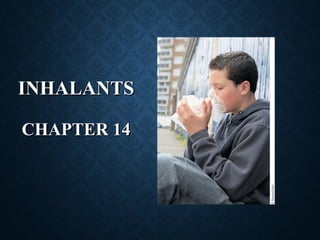
INHALANTSINHALANTS
CHAPTER 14CHAPTER 14
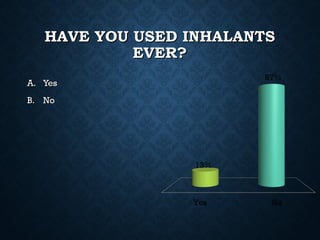
HAVE YOU USED INHALANTSHAVE YOU USED INHALANTS
EVER?EVER?
A.A. YesYes
B.B. NoNo
INTRODUCTIONINTRODUCTION
• Volatile substances introduced via the lungs.Volatile substances introduced via the lungs.
• Most cause intoxicating and/or euphorigenicMost cause intoxicating and/or euphorigenic
effects.effects.
• Many of these substances were never intendedMany of these substances were never intended
to be used by humans as drugs; consequently,to be used by humans as drugs; consequently,
they are not often thought of as having abusethey are not often thought of as having abuse
potential.potential.
INTRODUCTIONINTRODUCTION
(CONTINUED)(CONTINUED)
• Inhalants are among the most commonlyInhalants are among the most commonly
used drugs by adolescents.used drugs by adolescents.
• A widespread misconception is thatA widespread misconception is that
inhalant abuse is a harmless phase thatinhalant abuse is a harmless phase that
occurs commonly during normal childhoodoccurs commonly during normal childhood
and teenage development and as such isand teenage development and as such is
not worthy of significant concern.not worthy of significant concern.
POTENTIALPOTENTIAL
CONSEQUENCESCONSEQUENCES
• ““Sudden Sniffing Death Syndrome” (SSDS): ASudden Sniffing Death Syndrome” (SSDS): A
condition characterized by serious cardiaccondition characterized by serious cardiac
arrhythmia occurring during or immediatelyarrhythmia occurring during or immediately
after inhalingafter inhaling
• Brain damageBrain damage
• Damage to heart, kidney, liver, and boneDamage to heart, kidney, liver, and bone
marrowmarrow
HISTORYHISTORY
• In 1776, British chemist Joseph PriestleyIn 1776, British chemist Joseph Priestley
synthesized nitrous oxide, a colorless gas with asynthesized nitrous oxide, a colorless gas with a
slightly sweet odor and no noticeable taste.slightly sweet odor and no noticeable taste.
• Priestly and Humphry Davy suggested correctlyPriestly and Humphry Davy suggested correctly
that the gas might be useful as an anesthetic, andthat the gas might be useful as an anesthetic, and
experiments were conducted to test thisexperiments were conducted to test this
possibility.possibility.
HISTORY (CONTINUED)HISTORY (CONTINUED)
• Abuse of inhalants came to public attention inAbuse of inhalants came to public attention in
the 1950s when the news media reported thatthe 1950s when the news media reported that
young people were getting high from sniffingyoung people were getting high from sniffing
glue.glue.
LEGISLATIONLEGISLATION
• Inhalants are generallyInhalants are generally not regulatednot regulated asas
are other drugs of abuse.are other drugs of abuse.
• Some states have adopted lawsSome states have adopted laws
preventing the use, sale, and/orpreventing the use, sale, and/or
distribution to minors of variousdistribution to minors of various
products abused commonly as inhalants.products abused commonly as inhalants.
TYPES OF INHALANTSTYPES OF INHALANTS
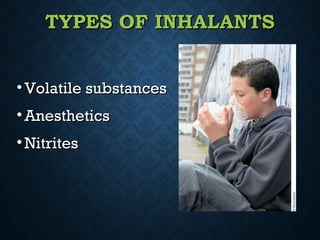
• Volatile substancesVolatile substances
• AnestheticsAnesthetics
• NitritesNitrites
VOLATILE SUBSTANCESVOLATILE SUBSTANCES
• Includes aerosols, art or office supplies,Includes aerosols, art or office supplies,
adhesives, fuels, and industrial or householdadhesives, fuels, and industrial or household
solvents.solvents.
• Some abusers inhale vapors directly from theirSome abusers inhale vapors directly from their
original containers (called sniffing or snorting).original containers (called sniffing or snorting).
• Some abusers inhale volatile solvents from plasticSome abusers inhale volatile solvents from plastic
bags (called bagging) or from old rags orbags (called bagging) or from old rags or
bandannas soaked in the solvent fluid and heldbandannas soaked in the solvent fluid and held
over the mouth (called huffing).over the mouth (called huffing).
POTENTIAL EFFECTS OFPOTENTIAL EFFECTS OF
INHALING VOLATILEINHALING VOLATILE
SUBSTANCESSUBSTANCES
• Can cause irritation of airways causing coughingCan cause irritation of airways causing coughing
and sneezing.and sneezing.
• Low doses often bring a brief feeling ofLow doses often bring a brief feeling of
lightheadedness, mild stimulation followed by alightheadedness, mild stimulation followed by a
loss of control, lack of coordination, andloss of control, lack of coordination, and
disorientation accompanied by dizziness anddisorientation accompanied by dizziness and
possible hallucinations.possible hallucinations.
• In some instances, higher doses can produceIn some instances, higher doses can produce
relaxation, sleep or even coma.relaxation, sleep or even coma.
POTENTIAL EFFECTS OFPOTENTIAL EFFECTS OF
INHALING VOLATILEINHALING VOLATILE
SUBSTANCES (CONTINUED)SUBSTANCES (CONTINUED)
• If inhalation is continued, dangerous hypoxia mayIf inhalation is continued, dangerous hypoxia may
occur and cause brain damage or deathoccur and cause brain damage or death..
• Other effects include hypertension and damage toOther effects include hypertension and damage to
the cardiac muscle, peripheral nerves, brain, andthe cardiac muscle, peripheral nerves, brain, and
kidneys.kidneys.
• Chronic abusers of inhalants frequently lose theirChronic abusers of inhalants frequently lose their
appetite, are continually tired, and experienceappetite, are continually tired, and experience
nosebleeds.nosebleeds.
AEROSOLSAEROSOLS
• Include spray paints, deodorant and hair sprays,Include spray paints, deodorant and hair sprays,
vegetable oil sprays for cooking, and fabric protectorvegetable oil sprays for cooking, and fabric protector
sprayssprays
• Often abused not because of the effects produced byOften abused not because of the effects produced by
their principal ingredients but rather because of thetheir principal ingredients but rather because of the
effects of their propellant gaseseffects of their propellant gases
• Can be dangerous because these devices are capable ofCan be dangerous because these devices are capable of
generating very high concentrations of the inhaledgenerating very high concentrations of the inhaled
chemicalschemicals
TOLUENETOLUENE
• Found in some glues, paints, thinners, nail polishes, andFound in some glues, paints, thinners, nail polishes, and
typewriter correction fluidtypewriter correction fluid
• A principal ingredient in “Texas shoe shine”A principal ingredient in “Texas shoe shine”
• Detectable in the arterial blood within 10 seconds ofDetectable in the arterial blood within 10 seconds of
inhalation exposureinhalation exposure
• Highly lipid solubleHighly lipid soluble
• Can cause brain damage, impaired cognition and gaitCan cause brain damage, impaired cognition and gait
disturbancesdisturbances
• Liver and kidney damage have been reportedLiver and kidney damage have been reported
BUTANE AND PROPANEBUTANE AND PROPANE
• Found commonly in found in lighter fluid, hairFound commonly in found in lighter fluid, hair
and paint sprays.and paint sprays.
• SSDS, and serious burn injuries (because ofSSDS, and serious burn injuries (because of
flammability) have resulted from abuseflammability) have resulted from abuse
GASOLINEGASOLINE
• A mixture of volatile chemicals, includingA mixture of volatile chemicals, including
toluene, benzene, and triorthocresyltoluene, benzene, and triorthocresyl
phosphate (TCP)phosphate (TCP)
• Because of its widespread availability, youngBecause of its widespread availability, young
people, particularly in rural settings,people, particularly in rural settings,
sometimes abuse gasolinesometimes abuse gasoline
GASOLINE (CONTINUED)GASOLINE (CONTINUED)
• As a mixture of chemicals, its intentional inhalation can be especiallyAs a mixture of chemicals, its intentional inhalation can be especially
dangerous.dangerous.
• Benzene is an organic compound that causesBenzene is an organic compound that causes
impaired immunologic function, boneimpaired immunologic function, bone
marrow injury, increased risk of leukemia,marrow injury, increased risk of leukemia,
and reproductive system toxicity.and reproductive system toxicity.
• TCP is a fuel additive that causesTCP is a fuel additive that causes
degeneration of motor neurons.degeneration of motor neurons.
FREONSFREONS
• Freons and other related agents are used inFreons and other related agents are used in
refrigerators, air conditioners, and airbrushes.refrigerators, air conditioners, and airbrushes.
• Inhalation can cause not only serious liverInhalation can cause not only serious liver
damage but also SSDS.damage but also SSDS.
• Inhalation can cause freeze injuries.Inhalation can cause freeze injuries.
ANESTHETICS (E.G.ANESTHETICS (E.G.
NITROUS OXIDE)NITROUS OXIDE)
• ““Laughing gas”: frequently used inLaughing gas”: frequently used in
outpatient proceduresoutpatient procedures
• Can also be sold in large balloons orCan also be sold in large balloons or
small cylindrical cartridges used assmall cylindrical cartridges used as
charges for whipped cream dispenserscharges for whipped cream dispensers
NITROUS OXIDENITROUS OXIDE
• Significant abuse problems of nitrous oxide areSignificant abuse problems of nitrous oxide are
infrequent, but there are occasional reports ofinfrequent, but there are occasional reports of
severe hypoxia or death due to acute overdosessevere hypoxia or death due to acute overdoses
• Can cause loss of sensation, limb spasms, alteredCan cause loss of sensation, limb spasms, altered
perception and motor coordination, blackoutsperception and motor coordination, blackouts
resulting from blood pressure changes andresulting from blood pressure changes and
reduced cardiac function.reduced cardiac function.
NITRITESNITRITES
• Cause vasodilationCause vasodilation
• Prototype, amyl nitrite, has been usedPrototype, amyl nitrite, has been used
in the past to treat anginain the past to treat angina
• Abuse has decreased dramaticallyAbuse has decreased dramatically
WHY ABUSED?WHY ABUSED?
• Legally obtainedLegally obtained
• Readily availableReadily available
• InexpensiveInexpensive
• Easy to concealEasy to conceal
• Lack of information about potential dangersLack of information about potential dangers
WHO ABUSES?WHO ABUSES?
• Primarily adolescentsPrimarily adolescents, but even small children., but even small children.
• More adolescent males than females.More adolescent males than females.
• Chronic inhalant users frequently have a profileChronic inhalant users frequently have a profile
like that associated with other substance abusers.like that associated with other substance abusers.
That is, often they live in unhappy surroundingsThat is, often they live in unhappy surroundings
with severe family or school problems, they havewith severe family or school problems, they have
poor self-images, and sniffing gives them anpoor self-images, and sniffing gives them an
accessible escape.accessible escape.
• http://www.youtube.com/watch?v=3g99h4qaCiohttp://www.youtube.com/watch?v=3g99h4qaCio
SIGNS OF INHALANT ABUSESIGNS OF INHALANT ABUSE
• Often collect an unusual assortment ofOften collect an unusual assortment of
chemicals (such as glues, paints, thinners andchemicals (such as glues, paints, thinners and
solvents, nail polish, liquid eraser, and cleaningsolvents, nail polish, liquid eraser, and cleaning
fluids) in bedrooms or with belongingsfluids) in bedrooms or with belongings
• Have breath that occasionally smells of solventsHave breath that occasionally smells of solvents
• Often have the sniffles similar to a cold butOften have the sniffles similar to a cold but
without other symptoms of the ailmentwithout other symptoms of the ailment
SIGNS OF INHALANT ABUSESIGNS OF INHALANT ABUSE
(CONTINUED)(CONTINUED)
• Appear drunk for short periods of time (15 toAppear drunk for short periods of time (15 to
60 minutes) but recover quickly60 minutes) but recover quickly
• Do not do well in school and are usuallyDo not do well in school and are usually
unkemptunkempt
• Sitting with a pen or marker near noseSitting with a pen or marker near nose
• Constantly smelling clothing sleevesConstantly smelling clothing sleeves
SIGNS OF INHALANT ABUSESIGNS OF INHALANT ABUSE
(CONTINUED)(CONTINUED)
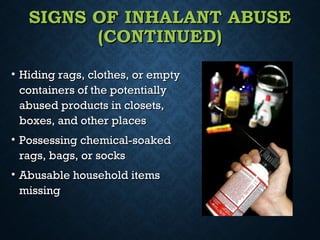
• Hiding rags, clothes, or emptyHiding rags, clothes, or empty
containers of the potentiallycontainers of the potentially
abused products in closets,abused products in closets,
boxes, and other placesboxes, and other places
• Possessing chemical-soakedPossessing chemical-soaked
rags, bags, or socksrags, bags, or socks
• Abusable household itemsAbusable household items
missingmissing
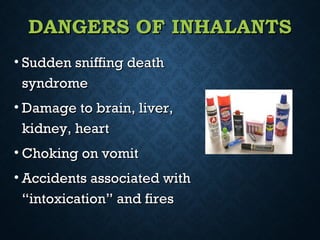
DANGERS OF INHALANTSDANGERS OF INHALANTS
• Sudden sniffing deathSudden sniffing death
syndromesyndrome
• Damage to brain, liver,Damage to brain, liver,
kidney, heartkidney, heart
• Choking on vomitChoking on vomit
• Accidents associated withAccidents associated with
“intoxication” and fires“intoxication” and fires
THE HIGHEST RATETHE HIGHEST RATE
OF INHALANT USE BYOF INHALANT USE BY
YOUTHS OCCURSYOUTHS OCCURS
AMONG ASIANS.AMONG ASIANS.
A.A. TrueTrue
B.B. FalseFalse
True
False
0%0%
MORE PEOPLE DIE FROMMORE PEOPLE DIE FROM
INHALING AIRINHALING AIR
FRESHENERS THANFRESHENERS THAN
FROM INHALINGFROM INHALING
GASOLINE.GASOLINE.
A.A. TrueTrue
B.B. FalseFalse True
False
0%0%
NITROUS OXIDE HAS BEENNITROUS OXIDE HAS BEEN
USED AS AN ANESTHETIC BYUSED AS AN ANESTHETIC BY
DENTISTS.DENTISTS.
A.A. TrueTrue
B.B. FalseFalse
True
False
0%0%

Drugs & Society Chapter 6

  • 1.
  • 2.
    WOULD YOU RATHER:WOULDYOU RATHER: A.A. Be on a deserted islandBe on a deserted island alone ORalone OR B.B. Be on a deserted islandBe on a deserted island with a person you hatewith a person you hate
  • 3.
    HAPPY MONDAYHAPPY MONDAY HOWWAS YOUR WEEKEND?HOW WAS YOUR WEEKEND? AAAA  B.B. :/:/ AAAA 
  • 4.
    INTRODUCTION TO CNSINTRODUCTIONTO CNS DEPRESSANTSDEPRESSANTS •Why are CNS depressants problematic?Why are CNS depressants problematic? • Usually prescribed under physician’sUsually prescribed under physician’s directiondirection • Second most frequently abused prescriptionSecond most frequently abused prescription drug and sometimes contributes to death duedrug and sometimes contributes to death due to accidental overdosesto accidental overdoses • Can cause very alarming and dangerousCan cause very alarming and dangerous behavior if not closely monitoredbehavior if not closely monitored • Most problems associated with these drugsMost problems associated with these drugs due to inadequate professional supervisiondue to inadequate professional supervision
  • 5.
    INTRODUCTION TO CNSINTRODUCTIONTO CNS DEPRESSANTS (CONTINUED)DEPRESSANTS (CONTINUED) • Why are CNS depressants problematic?Why are CNS depressants problematic? • Seemingly unrelated drug groupsSeemingly unrelated drug groups can cause CNS depressioncan cause CNS depression • Combination use can causeCombination use can cause dangerous drug interactionsdangerous drug interactions • Can cause disruptive personalityCan cause disruptive personality changeschanges
  • 6.
    THE HISTORY OFCNSTHE HISTORY OF CNS DEPRESSANTSDEPRESSANTS • Attempts to find CNS depressants other than alcohol began in theAttempts to find CNS depressants other than alcohol began in the 1800s.1800s. • Bromides were introduced to treat nervousness and anxiety in theBromides were introduced to treat nervousness and anxiety in the 1800s.1800s. • Very popular but toxicVery popular but toxic • In the early 1900s, bromides were replaced by barbiturates.In the early 1900s, bromides were replaced by barbiturates. • Initially heralded as safe and effectiveInitially heralded as safe and effective • Apparent problems with tolerance,Apparent problems with tolerance, dependence, and safetydependence, and safety
  • 7.
    THE HISTORY OFCNSTHE HISTORY OF CNS DEPRESSANTS (CONTINUED)DEPRESSANTS (CONTINUED) • In the 1950s the first benzodiazepines were marketed as substitutesIn the 1950s the first benzodiazepines were marketed as substitutes for barbiturates.for barbiturates. • Relatively safe when used for shortRelatively safe when used for short periodsperiods • Long-term use can cause dependenceLong-term use can cause dependence and withdrawal problemsand withdrawal problems
  • 8.
    THETHE HISTORY OFCNSHISTORY OF CNS DEPRESSANTS (CONTINUED)DEPRESSANTS (CONTINUED) • Benzodiazepines were routinely prescribed for stress, anxiety, orBenzodiazepines were routinely prescribed for stress, anxiety, or apprehension.apprehension. • In 1973, 100 million prescriptions wereIn 1973, 100 million prescriptions were written for benzodiazepines.written for benzodiazepines. • Twice as many women as men takingTwice as many women as men taking them.them. • As medical community became aware of the problem, use ofAs medical community became aware of the problem, use of depressants declined, but benzodiazepines remained still verydepressants declined, but benzodiazepines remained still very popular.popular. • Classified as Schedule V drugsClassified as Schedule V drugs
  • 9.
    SEDATIVE-HYPNOTIC DRUGSSEDATIVE-HYPNOTIC DRUGS (DEPRESSANTS)(DEPRESSANTS) •Drugs that slow activity in the central nervous systemDrugs that slow activity in the central nervous system • Include prescription drugsInclude prescription drugs • To treat anxiety: sedativesTo treat anxiety: sedatives • To treat insomnia: hypnoticsTo treat insomnia: hypnotics • Alcohol is the most widely used depressantAlcohol is the most widely used depressant • Benzodiazepines are the most widely prescribedBenzodiazepines are the most widely prescribed depressantsdepressants
  • 10.
    THE EFFECTS OFCNSTHE EFFECTS OF CNS DEPRESSANTSDEPRESSANTS • CNS depressants reduce CNS activity andCNS depressants reduce CNS activity and diminish the brain’s level of awareness.diminish the brain’s level of awareness. • Depressant drugs include:Depressant drugs include: • BenzodiazepinesBenzodiazepines • Barbiturate-like drugsBarbiturate-like drugs • AlcoholAlcohol • AntihistaminesAntihistamines • Opioid narcotics like heroinOpioid narcotics like heroin
  • 11.
    THE EFFECTS OFCNSTHE EFFECTS OF CNS DEPRESSANTS (CONTINUED)DEPRESSANTS (CONTINUED) • Depressants are usually classified according to the degree of theirDepressants are usually classified according to the degree of their medical effects on the body. For example:medical effects on the body. For example: • SedativesSedatives cause mild depression andcause mild depression and relaxationrelaxation • AnxiolyticAnxiolytic—drugs that relieve anxiety—drugs that relieve anxiety • HypnoticsHypnotics induce drowsiness andinduce drowsiness and encourage sleepencourage sleep • AmnesiacAmnesiac effects can cause the loss ofeffects can cause the loss of memorymemory
  • 12.
    THE EFFECTS OFCNSTHE EFFECTS OF CNS DEPRESSANTS (CONTINUED)DEPRESSANTS (CONTINUED) •The same drug can cause different effects depending on dose.The same drug can cause different effects depending on dose. •Low dose (sedatives—relieve anxietyLow dose (sedatives—relieve anxiety and promote relaxation)and promote relaxation) •Higher doses (hypnotics—can causeHigher doses (hypnotics—can cause drowsiness and promote sleep)drowsiness and promote sleep) •Even higher doses (anesthetics canEven higher doses (anesthetics can cause anesthesia and are used forcause anesthesia and are used for patient management during surgery)patient management during surgery)
  • 13.
    EFFECTSEFFECTS • Produce adepressed, mood-altering actionProduce a depressed, mood-altering action on the central nervous system – act on GABAon the central nervous system – act on GABA • Slow activity of the cardiovascular, muscularSlow activity of the cardiovascular, muscular and respiratory systemsand respiratory systems • Can cause confusion, inadequate emotionalCan cause confusion, inadequate emotional control, slurred speech, poor judgment, andcontrol, slurred speech, poor judgment, and intoxicationintoxication
  • 14.
    TYPES OF CNSTYPESOF CNS DEPRESSANTSDEPRESSANTS •Benzodiazepines: Valium-Type DrugsBenzodiazepines: Valium-Type Drugs • Prescribed for anxiety, relaxation and sleepPrescribed for anxiety, relaxation and sleep • Medical usesMedical uses • Relief from anxiety, treatment of neurosis,Relief from anxiety, treatment of neurosis, relaxation of muscles, alleviation of lower-backrelaxation of muscles, alleviation of lower-back pain, treatment of convulsive disorders,pain, treatment of convulsive disorders, induction of sleep, relief from withdrawalinduction of sleep, relief from withdrawal symptoms, induction of amnesiasymptoms, induction of amnesia
  • 15.
    TYPES OF CNSDEPRESSANTSTYPES OF CNS DEPRESSANTS (CONTINUED)(CONTINUED) • Mechanisms of action for benzodiazepineMechanisms of action for benzodiazepine • Affect neurons that have receptorsAffect neurons that have receptors for the neurotransmitterfor the neurotransmitter GABAGABA • GABA:GABA: most common inhibitory transmitter in brain regionsmost common inhibitory transmitter in brain regions • Limbic system (alter mood)Limbic system (alter mood) • RAS (cause drowsiness)RAS (cause drowsiness) • Motor cortex (relax muscles)Motor cortex (relax muscles)
  • 16.
    TYPES OF CNSDEPRESSANTSTYPES OF CNS DEPRESSANTS (CONTINUED)(CONTINUED) • Types of benzodiazepinesTypes of benzodiazepines • Many benzodiazepine compoundsMany benzodiazepine compounds available in the United Statesavailable in the United States • Distinguished primarily by theirDistinguished primarily by their duration of action:duration of action: short-actingshort-acting (hypnotics),(hypnotics), long-actinglong-acting (sedatives)(sedatives) • Side effects include drowsiness to paradoxical effects (e.g.Side effects include drowsiness to paradoxical effects (e.g. increased restlessness), tolerance, dependence, withdrawal, andincreased restlessness), tolerance, dependence, withdrawal, and abuseabuse
  • 17.
    TYPES OF CNSDEPRESSANTSTYPES OF CNS DEPRESSANTS (CONTINUED)(CONTINUED) • BarbituratesBarbiturates played an importantplayed an important historical role as sedative-hypnotic agents.historical role as sedative-hypnotic agents. • However, due to their narrow margin of safety and their abuseHowever, due to their narrow margin of safety and their abuse liability, they were replaced by benzodiazepines.liability, they were replaced by benzodiazepines. • Caused many negative side effects, fromCaused many negative side effects, from nausea to death, from respiratory ornausea to death, from respiratory or cardiovascular depressioncardiovascular depression
  • 18.
    OTHER TYPES OFCNSOTHER TYPES OF CNS DEPRESSANTSDEPRESSANTS • Drugs with barbiturate-like properties:Drugs with barbiturate-like properties: • Chloral hydrateChloral hydrate • GlutethimideGlutethimide • MethyprylonMethyprylon • MethaqualoneMethaqualone • AntihistaminesAntihistamines • Propofol (abused general anesthetic)Propofol (abused general anesthetic) • GHB (gamma hydroxybutyrate)GHB (gamma hydroxybutyrate)
  • 19.
    MEDICAL USESMEDICAL USES •Used primarily to treatUsed primarily to treat • AnxietyAnxiety • InsomniaInsomnia • Convulsive disordersConvulsive disorders • Short-acting barbituratesShort-acting barbiturates continue to be used forcontinue to be used for anesthetic purposesanesthetic purposes
  • 20.
    MECHANISMS OF ACTIONMECHANISMSOF ACTION • Benzodiazepines andBenzodiazepines and barbituratesbarbiturates • Enhance inhibitory effects of GABAEnhance inhibitory effects of GABA • Non-benzodiazepineNon-benzodiazepine hypnoticshypnotics • Selectively target the GABA-A receptorSelectively target the GABA-A receptor • Work better as sleep aids rather than anti-Work better as sleep aids rather than anti- anxiety medicationsanxiety medications • Zolpidem (Ambien), zaleplon (Sonata),Zolpidem (Ambien), zaleplon (Sonata), eszopiclone (Lunesta)eszopiclone (Lunesta)
  • 21.
    MEDICAL USES FORMEDICALUSES FOR BARBITURATES DO NOT INCLUDE:BARBITURATES DO NOT INCLUDE: A.A. TreatingTreating depressiondepression B.B. Reducing anxietyReducing anxiety C.C. ControllingControlling seizuresseizures D.D. Inducing sleepInducing sleep Treatingdepression Reducing anxietyControllingseizures Inducingsleep 63% 7% 30% 0%
  • 22.
    DANGERSDANGERS • ToleranceTolerance • Lethalin combination with alcohol (synergisticLethal in combination with alcohol (synergistic effect)effect) • Withdrawal severe, can be fatalWithdrawal severe, can be fatal
  • 23.
    IN COMPARISON TOINCOMPARISON TO BARBITURATES,BARBITURATES, BENZODIAZEPINESBENZODIAZEPINES A.A. Have more severeHave more severe side effectsside effects B.B. Are not addictiveAre not addictive C.C. Do not causeDo not cause withdrawalwithdrawal symptomssymptoms D.D. Have a widerHave a wider safety marginsafety margin Havem oresevere sideef...Are notaddictive Do notcause w ithdraw al... Havea w idersafety m argin 15% 73% 12% 0%
  • 24.
    PATTERNS OF ABUSEPATTERNSOF ABUSE WITH CNS DEPRESSANTSWITH CNS DEPRESSANTS • The American Psychiatric AssociationThe American Psychiatric Association considers dependence on CNS depressantsconsiders dependence on CNS depressants a psychiatric disorder.a psychiatric disorder.
  • 25.
    PATTERNS OF ABUSEWITHPATTERNS OF ABUSE WITH CNS DEPRESSANTSCNS DEPRESSANTS (CONTINUED)(CONTINUED) •People most likely to abuse CNS depressants include individuals who:People most likely to abuse CNS depressants include individuals who: • Use drugs to relieve continual stressUse drugs to relieve continual stress • Paradoxically feel euphoria and stimulationParadoxically feel euphoria and stimulation from depressantsfrom depressants • Use depressants to counteract theUse depressants to counteract the unpleasant effects of other drugs of abuseunpleasant effects of other drugs of abuse • Combine depressants with alcohol andCombine depressants with alcohol and heroin to potentiate the effectsheroin to potentiate the effects
  • 26.
    PATTERNS OF ABUSEWITHPATTERNS OF ABUSE WITH CNS DEPRESSANTSCNS DEPRESSANTS (CONTINUED)(CONTINUED) •Detoxification:Detoxification: The elimination of a toxic substance, such as a drug, andThe elimination of a toxic substance, such as a drug, and its effectsits effects • With CNS depressants, this is achieved byWith CNS depressants, this is achieved by substituting a longer-acting barbiturate forsubstituting a longer-acting barbiturate for the offending CNS depressant and graduallythe offending CNS depressant and gradually reducing the dose to avoid unpleasantreducing the dose to avoid unpleasant withdrawal effects. Withdrawal from CNSwithdrawal effects. Withdrawal from CNS depressants, if not managed properly, candepressants, if not managed properly, can be very dangerous, or even fatal.be very dangerous, or even fatal.
  • 27.
    DO YOU KNOWSOMEONE WHODO YOU KNOW SOMEONE WHO HAS HAD THEIR DRINK SPIKEDHAS HAD THEIR DRINK SPIKED WITH GHB OR ROOFIES?WITH GHB OR ROOFIES? A.A. I think soI think so B.B. I don’t think soI don’t think so Ithinkso Idon’tthinkso 52% 48%
  • 28.
    DO YOU KNOWSOMEONE WHODO YOU KNOW SOMEONE WHO HAS DRUGGED SOMEONE ELSE BYHAS DRUGGED SOMEONE ELSE BY SPIKING THEIR DRINK?SPIKING THEIR DRINK? A.A. I think soI think so B.B. I don’t think soI don’t think so Ithinkso Idon’tthinkso 77% 23%
  • 29.
    GAMMA HYDROXYBUTYRIC ACIDGAMMAHYDROXYBUTYRIC ACID • Naturally occurring chemical found in brain and bodyNaturally occurring chemical found in brain and body • Similar to GABASimilar to GABA • Causes CNS depressionCauses CNS depression • Has been used as an anestheticHas been used as an anesthetic • Considered a date-rape drugConsidered a date-rape drug • Along with Rohypnol and KetamineAlong with Rohypnol and Ketamine • GHB is listed on Schedule IGHB is listed on Schedule I https://www.youtube.com/watch?v=LPtcU_8yvR4 https://www.youtube.com/watch?v=YwtBEkFXBjQ https://www.youtube.com/watch?v=2udrpuNxcmM
  • 30.
    WHEN IT ISUSED IN CONJUNCTIONWHEN IT IS USED IN CONJUNCTION WITH ALCOHOL, THE EFFECTS OFWITH ALCOHOL, THE EFFECTS OF ROHYPNOL CAN BE FATAL.ROHYPNOL CAN BE FATAL. A.A. TrueTrue B.B. FalseFalse True False 50%50%
  • 31.
    WED 4/26WED 4/26 DOYOU HAVE A TATTOO?DO YOU HAVE A TATTOO? A.A. Yes, more than oneYes, more than one B.B. Yes, oneYes, one C.C. No way! Never!No way! Never! D.D. No, but considering one.No, but considering one.
  • 32.
  • 33.
    HAVE YOU USEDINHALANTSHAVE YOU USED INHALANTS EVER?EVER? A.A. YesYes B.B. NoNo
  • 34.
    INTRODUCTIONINTRODUCTION • Volatile substancesintroduced via the lungs.Volatile substances introduced via the lungs. • Most cause intoxicating and/or euphorigenicMost cause intoxicating and/or euphorigenic effects.effects. • Many of these substances were never intendedMany of these substances were never intended to be used by humans as drugs; consequently,to be used by humans as drugs; consequently, they are not often thought of as having abusethey are not often thought of as having abuse potential.potential.
  • 35.
    INTRODUCTIONINTRODUCTION (CONTINUED)(CONTINUED) • Inhalants areamong the most commonlyInhalants are among the most commonly used drugs by adolescents.used drugs by adolescents. • A widespread misconception is thatA widespread misconception is that inhalant abuse is a harmless phase thatinhalant abuse is a harmless phase that occurs commonly during normal childhoodoccurs commonly during normal childhood and teenage development and as such isand teenage development and as such is not worthy of significant concern.not worthy of significant concern.
  • 36.
    POTENTIALPOTENTIAL CONSEQUENCESCONSEQUENCES • ““Sudden SniffingDeath Syndrome” (SSDS): ASudden Sniffing Death Syndrome” (SSDS): A condition characterized by serious cardiaccondition characterized by serious cardiac arrhythmia occurring during or immediatelyarrhythmia occurring during or immediately after inhalingafter inhaling • Brain damageBrain damage • Damage to heart, kidney, liver, and boneDamage to heart, kidney, liver, and bone marrowmarrow
  • 37.
    HISTORYHISTORY • In 1776,British chemist Joseph PriestleyIn 1776, British chemist Joseph Priestley synthesized nitrous oxide, a colorless gas with asynthesized nitrous oxide, a colorless gas with a slightly sweet odor and no noticeable taste.slightly sweet odor and no noticeable taste. • Priestly and Humphry Davy suggested correctlyPriestly and Humphry Davy suggested correctly that the gas might be useful as an anesthetic, andthat the gas might be useful as an anesthetic, and experiments were conducted to test thisexperiments were conducted to test this possibility.possibility.
  • 38.
    HISTORY (CONTINUED)HISTORY (CONTINUED) •Abuse of inhalants came to public attention inAbuse of inhalants came to public attention in the 1950s when the news media reported thatthe 1950s when the news media reported that young people were getting high from sniffingyoung people were getting high from sniffing glue.glue.
  • 39.
    LEGISLATIONLEGISLATION • Inhalants aregenerallyInhalants are generally not regulatednot regulated asas are other drugs of abuse.are other drugs of abuse. • Some states have adopted lawsSome states have adopted laws preventing the use, sale, and/orpreventing the use, sale, and/or distribution to minors of variousdistribution to minors of various products abused commonly as inhalants.products abused commonly as inhalants.
  • 40.
    TYPES OF INHALANTSTYPESOF INHALANTS • Volatile substancesVolatile substances • AnestheticsAnesthetics • NitritesNitrites
  • 41.
    VOLATILE SUBSTANCESVOLATILE SUBSTANCES •Includes aerosols, art or office supplies,Includes aerosols, art or office supplies, adhesives, fuels, and industrial or householdadhesives, fuels, and industrial or household solvents.solvents. • Some abusers inhale vapors directly from theirSome abusers inhale vapors directly from their original containers (called sniffing or snorting).original containers (called sniffing or snorting). • Some abusers inhale volatile solvents from plasticSome abusers inhale volatile solvents from plastic bags (called bagging) or from old rags orbags (called bagging) or from old rags or bandannas soaked in the solvent fluid and heldbandannas soaked in the solvent fluid and held over the mouth (called huffing).over the mouth (called huffing).
  • 42.
    POTENTIAL EFFECTS OFPOTENTIALEFFECTS OF INHALING VOLATILEINHALING VOLATILE SUBSTANCESSUBSTANCES • Can cause irritation of airways causing coughingCan cause irritation of airways causing coughing and sneezing.and sneezing. • Low doses often bring a brief feeling ofLow doses often bring a brief feeling of lightheadedness, mild stimulation followed by alightheadedness, mild stimulation followed by a loss of control, lack of coordination, andloss of control, lack of coordination, and disorientation accompanied by dizziness anddisorientation accompanied by dizziness and possible hallucinations.possible hallucinations. • In some instances, higher doses can produceIn some instances, higher doses can produce relaxation, sleep or even coma.relaxation, sleep or even coma.
  • 43.
    POTENTIAL EFFECTS OFPOTENTIALEFFECTS OF INHALING VOLATILEINHALING VOLATILE SUBSTANCES (CONTINUED)SUBSTANCES (CONTINUED) • If inhalation is continued, dangerous hypoxia mayIf inhalation is continued, dangerous hypoxia may occur and cause brain damage or deathoccur and cause brain damage or death.. • Other effects include hypertension and damage toOther effects include hypertension and damage to the cardiac muscle, peripheral nerves, brain, andthe cardiac muscle, peripheral nerves, brain, and kidneys.kidneys. • Chronic abusers of inhalants frequently lose theirChronic abusers of inhalants frequently lose their appetite, are continually tired, and experienceappetite, are continually tired, and experience nosebleeds.nosebleeds.
  • 44.
    AEROSOLSAEROSOLS • Include spraypaints, deodorant and hair sprays,Include spray paints, deodorant and hair sprays, vegetable oil sprays for cooking, and fabric protectorvegetable oil sprays for cooking, and fabric protector sprayssprays • Often abused not because of the effects produced byOften abused not because of the effects produced by their principal ingredients but rather because of thetheir principal ingredients but rather because of the effects of their propellant gaseseffects of their propellant gases • Can be dangerous because these devices are capable ofCan be dangerous because these devices are capable of generating very high concentrations of the inhaledgenerating very high concentrations of the inhaled chemicalschemicals
  • 45.
    TOLUENETOLUENE • Found insome glues, paints, thinners, nail polishes, andFound in some glues, paints, thinners, nail polishes, and typewriter correction fluidtypewriter correction fluid • A principal ingredient in “Texas shoe shine”A principal ingredient in “Texas shoe shine” • Detectable in the arterial blood within 10 seconds ofDetectable in the arterial blood within 10 seconds of inhalation exposureinhalation exposure • Highly lipid solubleHighly lipid soluble • Can cause brain damage, impaired cognition and gaitCan cause brain damage, impaired cognition and gait disturbancesdisturbances • Liver and kidney damage have been reportedLiver and kidney damage have been reported
  • 46.
    BUTANE AND PROPANEBUTANEAND PROPANE • Found commonly in found in lighter fluid, hairFound commonly in found in lighter fluid, hair and paint sprays.and paint sprays. • SSDS, and serious burn injuries (because ofSSDS, and serious burn injuries (because of flammability) have resulted from abuseflammability) have resulted from abuse
  • 47.
    GASOLINEGASOLINE • A mixtureof volatile chemicals, includingA mixture of volatile chemicals, including toluene, benzene, and triorthocresyltoluene, benzene, and triorthocresyl phosphate (TCP)phosphate (TCP) • Because of its widespread availability, youngBecause of its widespread availability, young people, particularly in rural settings,people, particularly in rural settings, sometimes abuse gasolinesometimes abuse gasoline
  • 48.
    GASOLINE (CONTINUED)GASOLINE (CONTINUED) •As a mixture of chemicals, its intentional inhalation can be especiallyAs a mixture of chemicals, its intentional inhalation can be especially dangerous.dangerous. • Benzene is an organic compound that causesBenzene is an organic compound that causes impaired immunologic function, boneimpaired immunologic function, bone marrow injury, increased risk of leukemia,marrow injury, increased risk of leukemia, and reproductive system toxicity.and reproductive system toxicity. • TCP is a fuel additive that causesTCP is a fuel additive that causes degeneration of motor neurons.degeneration of motor neurons.
  • 49.
    FREONSFREONS • Freons andother related agents are used inFreons and other related agents are used in refrigerators, air conditioners, and airbrushes.refrigerators, air conditioners, and airbrushes. • Inhalation can cause not only serious liverInhalation can cause not only serious liver damage but also SSDS.damage but also SSDS. • Inhalation can cause freeze injuries.Inhalation can cause freeze injuries.
  • 50.
    ANESTHETICS (E.G.ANESTHETICS (E.G. NITROUSOXIDE)NITROUS OXIDE) • ““Laughing gas”: frequently used inLaughing gas”: frequently used in outpatient proceduresoutpatient procedures • Can also be sold in large balloons orCan also be sold in large balloons or small cylindrical cartridges used assmall cylindrical cartridges used as charges for whipped cream dispenserscharges for whipped cream dispensers
  • 51.
    NITROUS OXIDENITROUS OXIDE •Significant abuse problems of nitrous oxide areSignificant abuse problems of nitrous oxide are infrequent, but there are occasional reports ofinfrequent, but there are occasional reports of severe hypoxia or death due to acute overdosessevere hypoxia or death due to acute overdoses • Can cause loss of sensation, limb spasms, alteredCan cause loss of sensation, limb spasms, altered perception and motor coordination, blackoutsperception and motor coordination, blackouts resulting from blood pressure changes andresulting from blood pressure changes and reduced cardiac function.reduced cardiac function.
  • 52.
    NITRITESNITRITES • Cause vasodilationCausevasodilation • Prototype, amyl nitrite, has been usedPrototype, amyl nitrite, has been used in the past to treat anginain the past to treat angina • Abuse has decreased dramaticallyAbuse has decreased dramatically
  • 53.
    WHY ABUSED?WHY ABUSED? •Legally obtainedLegally obtained • Readily availableReadily available • InexpensiveInexpensive • Easy to concealEasy to conceal • Lack of information about potential dangersLack of information about potential dangers
  • 54.
    WHO ABUSES?WHO ABUSES? •Primarily adolescentsPrimarily adolescents, but even small children., but even small children. • More adolescent males than females.More adolescent males than females. • Chronic inhalant users frequently have a profileChronic inhalant users frequently have a profile like that associated with other substance abusers.like that associated with other substance abusers. That is, often they live in unhappy surroundingsThat is, often they live in unhappy surroundings with severe family or school problems, they havewith severe family or school problems, they have poor self-images, and sniffing gives them anpoor self-images, and sniffing gives them an accessible escape.accessible escape. • http://www.youtube.com/watch?v=3g99h4qaCiohttp://www.youtube.com/watch?v=3g99h4qaCio
  • 55.
    SIGNS OF INHALANTABUSESIGNS OF INHALANT ABUSE • Often collect an unusual assortment ofOften collect an unusual assortment of chemicals (such as glues, paints, thinners andchemicals (such as glues, paints, thinners and solvents, nail polish, liquid eraser, and cleaningsolvents, nail polish, liquid eraser, and cleaning fluids) in bedrooms or with belongingsfluids) in bedrooms or with belongings • Have breath that occasionally smells of solventsHave breath that occasionally smells of solvents • Often have the sniffles similar to a cold butOften have the sniffles similar to a cold but without other symptoms of the ailmentwithout other symptoms of the ailment
  • 56.
    SIGNS OF INHALANTABUSESIGNS OF INHALANT ABUSE (CONTINUED)(CONTINUED) • Appear drunk for short periods of time (15 toAppear drunk for short periods of time (15 to 60 minutes) but recover quickly60 minutes) but recover quickly • Do not do well in school and are usuallyDo not do well in school and are usually unkemptunkempt • Sitting with a pen or marker near noseSitting with a pen or marker near nose • Constantly smelling clothing sleevesConstantly smelling clothing sleeves
  • 57.
    SIGNS OF INHALANTABUSESIGNS OF INHALANT ABUSE (CONTINUED)(CONTINUED) • Hiding rags, clothes, or emptyHiding rags, clothes, or empty containers of the potentiallycontainers of the potentially abused products in closets,abused products in closets, boxes, and other placesboxes, and other places • Possessing chemical-soakedPossessing chemical-soaked rags, bags, or socksrags, bags, or socks • Abusable household itemsAbusable household items missingmissing
  • 58.
    DANGERS OF INHALANTSDANGERSOF INHALANTS • Sudden sniffing deathSudden sniffing death syndromesyndrome • Damage to brain, liver,Damage to brain, liver, kidney, heartkidney, heart • Choking on vomitChoking on vomit • Accidents associated withAccidents associated with “intoxication” and fires“intoxication” and fires
  • 59.
    THE HIGHEST RATETHEHIGHEST RATE OF INHALANT USE BYOF INHALANT USE BY YOUTHS OCCURSYOUTHS OCCURS AMONG ASIANS.AMONG ASIANS. A.A. TrueTrue B.B. FalseFalse True False 0%0%
  • 60.
    MORE PEOPLE DIEFROMMORE PEOPLE DIE FROM INHALING AIRINHALING AIR FRESHENERS THANFRESHENERS THAN FROM INHALINGFROM INHALING GASOLINE.GASOLINE. A.A. TrueTrue B.B. FalseFalse True False 0%0%
  • 61.
    NITROUS OXIDE HASBEENNITROUS OXIDE HAS BEEN USED AS AN ANESTHETIC BYUSED AS AN ANESTHETIC BY DENTISTS.DENTISTS. A.A. TrueTrue B.B. FalseFalse True False 0%0%

Editor's Notes

  • #10 Depressants = drugs that slow activity in the central nervous system Include prescription drugs that treat anxiety (sedatives) and insomnia (hypnotics) As a group, also called sedative-hypnotics Alcohol is the most widely used depressant Benzodiazepines are the most widely prescribed depressants Barbiturates Barbiturates are used to treat anxiety, insomnia, and seizure disorders. They are not, however, prescribed as often due to the availability of benzodiazepines and non-benzodiazepines. Barbiturates can be addictive and have strong withdrawal symptoms and rebound (exaggerated) effects on rapid eye movement (REM) sleep when they are abruptly stopped and can interfere with sleep. It is advisable, therefore, to stop barbiturates by slowly lowering their dose over a period of more than five or six days. It also is important to use the correct dose of barbiturates since a relatively small overdose may lead to coma or death. The main differences among barbiturates are their half-lives (duration of their effects). Drugs such as secobarbital sodium and pentobarbital sodium are short-acting, while others such as amobarbital sodium and butabarbital sodium are intermediate-acting, and phenobarbital and mephobarbital are long-acting. Examples of barbiturates: Nembutal (phenobarbital) Mebaral (mephobarbital) Amytal Sodium (amobarbital sodium) Butisol (butabarbital sodium) Seconal Sodium Pulvules (secobarbital sodium)
  • #14 Can cause confusion, short attention span, impaired cognitive functioning, inadequate emotional control, slurred speech, poor judgment, hangovers, and intoxication Barbital Sedative-hypnotic drug used to treat anxiety and nervousness; the original barbiturate Veronal Brand name for barbital Phenobarbital Second barbiturate developed Produces relaxation and relieves anxiety HAZARDS Reduced attention span Impaired cognitive functioning Diminished hand-eye coordination Inadequate emotional control Nausea Vomiting Birth defects Confusion Poor judgment Slurred speech Vertigo Diarrhea Respiratory failure Violent behavior Combination of alcohol and barbiturates can lead to accidental or intentional death Withdrawal is life-threatening without medical supervision: marked by profuse sweating, insomnia, muscular twitching, paranoia, vomiting, aches and pains, cramps, quick temper, nightmares, hallucinations, and seizures
  • #20 The effectiveness of barbiturates as sleep agents is questionable, because they interfere with rapid eye movement (REM), and may result in rebound insomnia Anticonvulsants These drugs may be used to treat conditions that contribute towards sleep disruption such as restless legs syndrome, nocturnal eating syndrome, periodic limb movement disorder, and insomnia related tobipolar disorder. Examples of anticonvulsants: Tegretol (carbamazepine) Carbatrol (carbamazepine extended-release) Depakene (valproic acid) Depakote (divalproex sodium) Neurontin (gabapentin)
  • #21 Benzodiazepines and barbiturates Bond with brain receptors Enhance the normally inhibitory effects of GABA Nonbenzodiazepine hypnotics Selectively target the GABA-A receptor Seem to work better as sleeping pills than as antianxiety drugs Include zolpidem (Ambien), zaleplon (Sonata), and eszopiclone (Lunesta)
  • #23 HAZARDS Reduced attention span Impaired cognitive functioning Diminished hand-eye coordination Inadequate emotional control Nausea Vomiting Birth defects Confusion Poor judgment Slurred speech Vertigo Diarrhea Respiratory failure Violent behavior Combination of alcohol and barbiturates can lead to accidental or intentional death Withdrawal is life-threatening without medical supervision: marked by profuse sweating, insomnia, muscular twitching, paranoia, vomiting, aches and pains, cramps, quick temper, nightmares, hallucinations, and seizures
  • #30 Naturally-occurring chemical found in the brain and body Structurally similar to the inhibitory neurotransmitter GABA Causes CNS depression, especially when combined with alcohol Has been used as an anesthetic Behavioral effects similar to alcohol Lack of coordination and slurred speech Considered a date-rape drug Except for a specific formulation used to treat cataplexy, GHB is listed on Schedule I
  • #45 Inhalants serve as gateway drugs Twice as many 8th-grade students use inhalants as 12th-grade students Strong relationship between inhalant use and other problem behaviors and sensation-seeking Sudden Sniffing Death Syndrome http://www.drugfreeworld.org/drugfacts/inhalants/international-statistics.html 22% first time users Long-term effects: nosebleeds, liver and kidney damage, sores, weight loss, depression, irritability, disorientation, paranoia, hostility, and bone marrow abnormalities Volatile solvents and other compounds used for intoxicating purposes Have depressant effects similar to sedative-hypnotics High-dose exposure causes intoxication, with effects similar to alcohol Products that can be abused by inhalation include gasoline, glue, paint, lighter fluid, spray cans, nail polish, correction fluid Volatile solvents (petroleum, acetone, toluene) Paint, paint thinner and remover, nail polish remover, correction fluid, glues, cements Overly informative news articles and education programs actually demonstrated how to abuse volatile solvents Abuse tends to occur as localized fads Most abusers are very young—solvents are readily available and inexpensive Aerosols, propellants, gases (butane, propane) Spray paint, hair spray, lighters, whipped cream Anesthetics (nitrous oxide, ether) Current and former medical anesthetics Nitrous oxide (“laughing gas”) was first used in the early 1800s Still used for light anesthesia, especially by dentists Used as a propellant for commercial and home whipping-cream dispensers Nitrites (isoamyl, isobutyl) “Locker room,” “Rush,” “poppers” Relaxes blood vessels which increases blood flow, but also lowers blood pressure. Used as a treatment for cyanide poisoning. With high doses there maybe lightheadedness or faintness Consumer Product Safety Commission has taken steps to remove poppers and other nitrites from the market since 1988 Glue (volatile hydrocarbon solvents) Psychoactive agent is toluene Possible immediate cardiorespiratory arrest Brain damage and memory loss Anesthetic inhalants Ether used as industrial solvent and anesthetic Nitrous oxide (laughing gas) Can cause irreparable brain damage or death due to decreased oxygen (hypoxia) Nitrite inhalants Inhaled for sexual purposes Amyl nitrite: used to treat angina pectoris and congestive heart failure Butyl nitrite: found in perfume and antifreeze Isobutyl: used to treat angina pain; causes vasodilation, flushing, and warmth Suppresses the immune system
  • #60 Inhalants serve as gateway drugs Twice as many 8th-grade students use inhalants as 12th-grade students Strong relationship between inhalant use and other problem behaviors and sensation-seeking Sudden Sniffing Death Syndrome http://www.drugfreeworld.org/drugfacts/inhalants/international-statistics.html 22% first time users Long-term effects: nosebleeds, liver and kidney damage, sores, weight loss, depression, irritability, disorientation, paranoia, hostility, and bone marrow abnormalities Kidney damage Brain damage Peripheral nerve damage Irritation of the respiratory tract Severe headache Death by suffocation
  • #61 Inhalants serve as gateway drugs Twice as many 8th-grade students use inhalants as 12th-grade students Strong relationship between inhalant use and other problem behaviors and sensation-seeking Sudden Sniffing Death Syndrome http://www.drugfreeworld.org/drugfacts/inhalants/international-statistics.html 22% first time users Long-term effects: nosebleeds, liver and kidney damage, sores, weight loss, depression, irritability, disorientation, paranoia, hostility, and bone marrow abnormalities
  • #62 Inhalants serve as gateway drugs Twice as many 8th-grade students use inhalants as 12th-grade students Strong relationship between inhalant use and other problem behaviors and sensation-seeking Sudden Sniffing Death Syndrome http://www.drugfreeworld.org/drugfacts/inhalants/international-statistics.html 22% first time users Long-term effects: nosebleeds, liver and kidney damage, sores, weight loss, depression, irritability, disorientation, paranoia, hostility, and bone marrow abnormalities Volatile solvents and other compounds used for intoxicating purposes Have depressant effects similar to sedative-hypnotics High-dose exposure causes intoxication, with effects similar to alcohol Products that can be abused by inhalation include gasoline, glue, paint, lighter fluid, spray cans, nail polish, correction fluid Volatile solvents (petroleum, acetone, toluene) Paint, paint thinner and remover, nail polish remover, correction fluid, glues, cements Overly informative news articles and education programs actually demonstrated how to abuse volatile solvents Abuse tends to occur as localized fads Most abusers are very young—solvents are readily available and inexpensive Aerosols, propellants, gases (butane, propane) Spray paint, hair spray, lighters, whipped cream Anesthetics (nitrous oxide, ether) Current and former medical anesthetics Nitrous oxide (“laughing gas”) was first used in the early 1800s Still used for light anesthesia, especially by dentists Used as a propellant for commercial and home whipping-cream dispensers Nitrites (isoamyl, isobutyl) “Locker room,” “Rush,” “poppers” Relaxes blood vessels which increases blood flow, but also lowers blood pressure. Used as a treatment for cyanide poisoning. With high doses there maybe lightheadedness or faintness Consumer Product Safety Commission has taken steps to remove poppers and other nitrites from the market since 1988 Glue (volatile hydrocarbon solvents) Psychoactive agent is toluene Possible immediate cardiorespiratory arrest Brain damage and memory loss Anesthetic inhalants Ether used as industrial solvent and anesthetic Nitrous oxide (laughing gas) Can cause irreparable brain damage or death due to decreased oxygen (hypoxia) Nitrite inhalants Inhaled for sexual purposes Amyl nitrite: used to treat angina pectoris and congestive heart failure Butyl nitrite: found in perfume and antifreeze Isobutyl: used to treat angina pain; causes vasodilation, flushing, and warmth Suppresses the immune system
  • #63 Inhalants serve as gateway drugs Twice as many 8th-grade students use inhalants as 12th-grade students Strong relationship between inhalant use and other problem behaviors and sensation-seeking Sudden Sniffing Death Syndrome http://www.drugfreeworld.org/drugfacts/inhalants/international-statistics.html 22% first time users Long-term effects: nosebleeds, liver and kidney damage, sores, weight loss, depression, irritability, disorientation, paranoia, hostility, and bone marrow abnormalities Kidney damage Brain damage Peripheral nerve damage Irritation of the respiratory tract Severe headache Death by suffocation
  • #64 White, Hispanic, Asian, black
  • #66 Use has declined in recent years