Snake bite  By Dr. Osman Sadig Bukhari
Snake bite is : - A  major public health problem  & an  important cause of  morbidity  and  mortality  ,  specially in the tropics  - In 2002/2003/2004  628  cases were  admitted in Gedarif Teaching Hospital with  8 deaths.
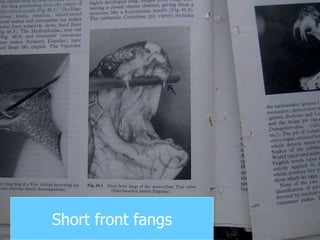
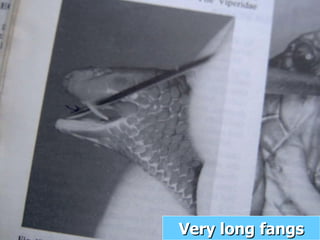
Out of 2700 species 500 belong to three  important families :- 1-  Viperidae  :  vasculotoxic  with long  erectile fangs.  2-  Elapidae  : Neurotoxic  with short fangs. 3-  Hydrophidae  :  Myotoxic  with short  fangs & flat tail.
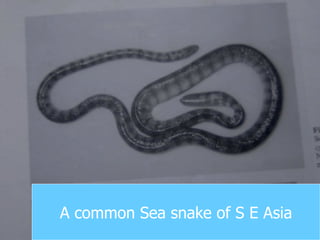
A common Sea snake of S E Asia
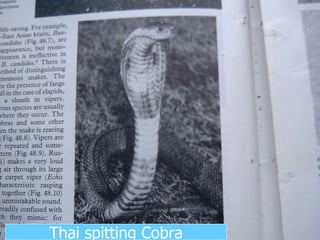
Thai spitting Cobra
Short front fangs
Very long fangs
Envenomation Envenomation is either through:  1-  Bites   2-  Spray  of venom into the eyes of the  aggressor.  Some bites may be defensive without   injecting the venom .
Venom composition 20 or more components & 90 % of the  dry weight is protein .  1-  Polypeptide enzymes  : a-  Proteases : activate blood clotting casc  b-  Phospholipases : cytolytic & produces  presynaptic neurotoxin that prevent  release of Ach at the N/ muscular  junction .
c-  Hydrolases : increase vascular  permeability and causes edema,  blistering, bruises and necrosis.  d-  Hyaluronidases:  promote spread of  venom through the tissues. e-  Amino acid oxidases:  digestive. 2-  Non- enzymatic polypeptide toxins   (Elapidae & Hydrophidae) contains  postsynaptic neurotoxins that bind to  Ach receptors at the motor end plates  and cause paralysis.  3-  Histamines & 5HT  contribute to local pain
and permeability at the bite site.  4- Non- toxic proteins .  5- Non protein ingredients  include CHO,  lipids, amino acids & amines . In conclusion : Snake venoms contain a variety of  toxins and the variation of its  composition from sp. to sp. explains  the clinical diversity of snake bites  from family to family .
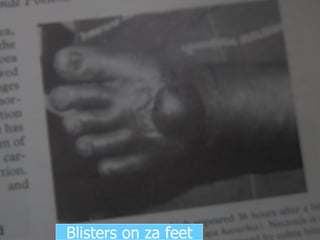
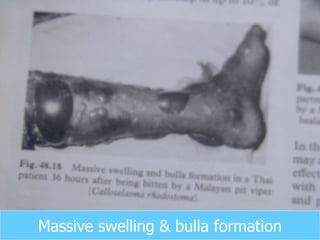
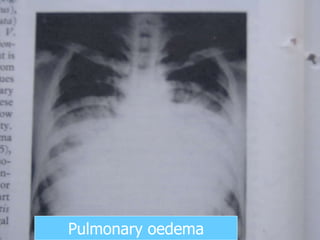
Pathophysiology 1-  Absorption  of venom from bite site  depends on the tissue binding affinity  of the venom components, mol. size  and the local effects of za venom on  tissue permeability & blood supply. 2-  Local swelling  is due  to increased  vascular permeability leading to  swelling, blisters and bruising.  Systemic envenomation may cause  serous effusions and pulm edema .
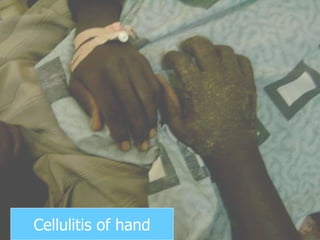
Cellulitis of hand
Blisters on za feet
Massive swelling & bulla formation
Pulmonary oedema
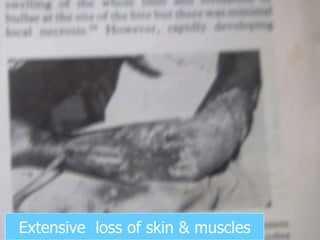
3-  Local tissue necrosis  results from :-  a- Direct action of myotoxic and  cytolytic factors  b- Ischemia due to:  - thrombosis  - Compression by tight tourniquet  - Compression of arteries by  swollen muscles within a tight  facial compartment
Extensive  loss of skin & muscles
4-  Hypotension & shock  may occur within  minutes due to:- - Vasodilating amines - leak of plasma & blood into bitten  limb & elsewhere - Massive GIT bleeding - Direct effects of toxins on the myocardium
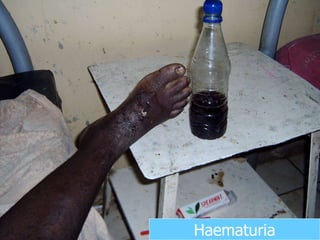
5-  Bleeding & clotting disturb  are due to:  - DIC  - Thrombocytopenia  - Haemorrhagin which damage vascular  endothelium.  The combination of  defibrination ,  thrombocytopenia  and  vessel wall   damage  result in massive bleeding specially in Viper bites
Haematuria
6-  Intravascular haemolysis : Rare, but massive intravascular  haemolysis can lead to  acute renal  failure
7-  Renal failure  is rare complication of  severe envenomation due to:-  - ATN from prolonged hypotension  - DIC  - Direct tubular toxicity  - HBuria  - Myoglobinuria  - Hyperkalaemia ..
8-  Neurotoxicity : Neurotoxic polypeptie & phospholipases  cause paralysis by blocking N/ muscular   transmission . Death may follow:  -  Respiratory muscle paralysis +++ - Bulbar palsy causing  resp obstruction  or paralysis.
9 -  Rabdomyolysis  with release of  myoglobin, muscle enzymes & K.  Death  may follow :-  - respiratory paralysis  - bulbar palsy,  - acute hyperkalaemia  - later renal failure . 10-  Venous ophthalmia : Spray from spitting  cobras leads to corneal erosions,  conjunctivitis, anterior uveitis &  secondary infections
Clinical features :- 1- Most bites are on the  FEET   2-  Envenomation is not inevitable  even in  severe bites.  Snake bites are unpredictable  so keep the pat. in for 24 hrs .  3- Disease   may result from  fear,  anxiety, local   TR or from Envenomation 4- Nearly 50% of people bitten by snakes suffer  few or no toxic effects . On the other hand  mortality without effective TR is high   ( up to 15%)
1- Viperidae   produce  more   local effects  than   others .  -  Early syncope, nausea,  vomiting,  colics,  diarrhea, angioedema & wheeze  may occur.  - Hypotension & shock may occur early.  -   Local painful swelling  and may  become massive & spread up za limb in  2-3 days with tender L. nodes.  Absence of swelling 2 hrs after bite  usually mean no envenomation
-  Blistering & bleeding at puncture site  are  early symptoms. Spreading  bruising  and  blistering  suggest a large dose of  venom and may proceed to  necrosis  with   secondary infections .  -  Very severe pain & tense swelling  may  indicate intercompartmental pressure.  -  Sudden severe pain, absence major of  arterial pulses   and demarcated cold limb  indicate thrombosis of artery.
-  Spontaneous systemic bleeding : Gum  bleeding, ecchymosis,  conjunctival  haemorrhage, Hria, GIT bleeding,  menorrhg  ,  intra or retroperitoneal  bleeding  SAH and intracerebral  bleeding. Haemoptysis is rare.  Incoagulable blood  from defibrination  may occur.  Hage into vital organs may be fatal   -  Necrosis of za skin, S/C tissue and  muscles. 2ry   Infection  with offensive  smell may follow
-  Tissue infarction & gangrene  may  follow vascular thrombosis. -  Anemia, jaundice & black urine  may  result from haemolysis .  -  Renal failure  may complicate .
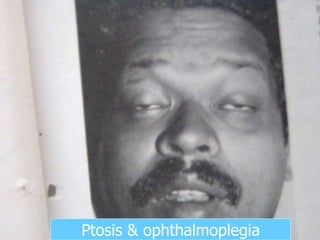
2- Elapidae -  Local tissue swelling  is a feature of Asian  Cobras & African spitting Cobras. The  bite is painful  and may be followed by  necrosis .  -  Vomiting, hypotension & polymorph   leucocytosis suggest systemic  envenomation - More specific features include  ptosis and   ophthalmoplegia. B ulbar palsy and resp  paralysis and failure  in severe cases  -  ECG changes & raised cardiac enzymes .
Ptosis & ophthalmoplegia
3-  Hydrophidae -  Early signs similar to Elapidae - Specific signs include  myalgia   and  myoglobinuria  3-5 hrs later. -  Limb paralysis  may be followed by  resp   paralysis & failure  which may be  delayed for up to 60 hrs.  -  Hyperkalaemia  may cause cardiac arrest -  Acute renal failure  may follow.
Course & prognosis:- -  Local swelling  is  usually evident within 2  hours, max in za 2 nd  or 3 rd  day & may  take Ws or Ms to resolve.  - Pats may be totally  defibrinated  in 1-2  hours after bite by viperidae. -  Deaths most unusual before ½ hour . -  Untreated mortality is hard to assess as hospital admissions include the mainly  severe cases. It can be reduced by TR.
-  Interval betw bite & death  may be as  early as few min. or as long as 6 Ws.  -  Prognosis is worse in infants & elderly .
Laboratory - Neutrophil leucocytosis - Decreased haematocrit - Thrombocytopenia - Increased FDP - Prolonged PT - Incoagulable blood - Increased CPK; AST & ALT - Urine ex, BUN & E.
Management of snake bite  First aids 1 -  Reassure  the victim 2 -  Immobilize the bitten limb  using splint  and crepe bandage. 3 - Take za victim  quickly to za nearest  health   facility . 4 -  Avoid harmful time wasting TR:   (cauterization, incision & excision,  vacuum or mouth suction, local  chemicals, cryotherapy & arterial  tourniquet  )
5-  Take snake to za hospital if killed . TR of early symptoms 1-  Paracetamol . Not aspirin. 2 -  IV chlorpromazine  for vomiting 3- IV  chlorpheneramine or S/C adr., IV  fluids  for anaphylaxis and shock 4- Clear the air way, nurse pat on his side,  insert airway & elevate the jaw,  artificial ventilation & oxygen for  resp  distress
C-  TR at health facility 1- Snake bite is a  med emergency 2-  Quick clinical assessment:  ( site of bite, duration of bite, snake  brought vomiting & fainting, fang  marks, any bleeding, local signs, look  for blood in gingival sulci & recent  wounds, look for signs of shock and  TR, signs of neurotoxicity, colour  and amount of urine)
3-  Observe closely pat for 24 hrs  even if no  signs.  Snake bite is unpredictable   4-  Anti-venom administration :- It is za  only specific therapy  & should  be given in excess of za venom injected  as soon as it is indicated  Whether to give  or not ?  May produce  severe reactions, expensive & in short  supply
Indications for administration   include a- Systemic envenomation : 1- Haemostatic abnormality:- spontaneous  systemic bleeding, incoagulable blood,   prolonged PT,  FDP and thrombocytop 2- Acute renal failure:- oliguria/ anuria-  biochem 3- Cardiovascular abn.( hypot, shock, HF abn. ECG & pulm edema) 4 – Neurotoxicity (Ptosis, ophthalmoplegia,  paralysis)
5- Generalized rhabdomyolysis and  intravascular haemolysis  b- Local envenomation :  1- Signs of local envenomation +  (neutrophil leucocytosis, high CPK,  AST and ALT, haemococ and  hypoxaemia)  2- Severe local swelling extending more  than ½ of za bitten limb or blistering  or bruising) at any stage specially in  pats showing biochemical  abnormalities in 1.  C- impaired consciousness
D-  Administration of anti-venom -  Preliminary testing is not necessary  and delays TR. -  Multival anti- venom  is given as soon  as it is indicated & it is never late e.g for 2/52 or more in persisting haemostatic abnormalities.  Local effects of  the venom  are probably  not reversible if  anti- venom is delayed more than 2 hours  -  Slow IV infusion  diluted in 250-500 ml NS or DNS over ½ hr. Rarely slow IV  injection at 2 ml/min.
- No absolute contraindication  Dose = amount of antivenom required to  neutralize the venom injected.  In practice it is empirical. 2-10 amp,  but it should be based on studies.  Dose can be repeated. 2 nd  dose if  cardio-resp or neurotoxic symptoms  persist for > 30 min or in  incoagulable blood > 6 hrs after  initial dose.  -  Same dose for children. -  The response to anti-venom is quick if sufficient dose is given
E-  Reaction to anti-venom  develop 10-180  min after administration & treated by adr,  hydrocortisone & antihistamine. In severe  envenomation continue infusion despite  reaction with S/C and adr as necessary  - Anaphylactoid - Pyrogenic - Serum sickness  F-  Anti-cholinesterase  for neurotoxicity G-  Supportive TR -  Artificial ventilation  for neurotoxic bites. Anticholinesterases should always be tried -  Plasma expander & dopamine for shock.
- conservative  management  or dialysis  for  renal failure -  Antibiotic +/- ATS for local infection -  Incision for intercompartmental synr - Strict bed rest, fresh blood, fresh frozen  plasma or specific clotting factors & vit K for  haemostatic abn. Avoid IM & repeated  venepuncture. Use IV canulae. Heparin and  anti- fibrinolytic agents ? H- Local tissue debridement & skin graft .
Prevention of snake bite   (precautions) -  Snakes should never unnecessarily be  disturbed, handled or attacked even if they  are thought to be harmless or dead   -  Avoid venomous sp. as pets -  Protective clothings, boots, socks & long  trousers  should be worn by persons at risk.  -  Carry light at night  sp. for farmers, harvesters,  fire wood collectors & for those removing  debris likely to conceal snakes  -  Immunization  with venom toxoid to those at  risk.
Snake bite is : - A  major public health problem  and an  important cause of  morbidity  and  mortality  ,  specially in the tropics  - It is important occupational disease - Goverments, academic institutions, pharmaceut agricultural bodies should encourage & sponsor clinical studies in all aspects of snake bite.  - Education & training on snake bite should be included in the curriculum of medical schools. - Community education on snake bites ,first aid methods and preventive measures is recommended.

Snake Bite

  • 1.
    Snake bite By Dr. Osman Sadig Bukhari
  • 2.
    Snake bite is: - A major public health problem & an important cause of morbidity and mortality , specially in the tropics - In 2002/2003/2004 628 cases were admitted in Gedarif Teaching Hospital with 8 deaths.
  • 3.
    Out of 2700species 500 belong to three important families :- 1- Viperidae : vasculotoxic with long erectile fangs. 2- Elapidae : Neurotoxic with short fangs. 3- Hydrophidae : Myotoxic with short fangs & flat tail.
  • 4.
    A common Seasnake of S E Asia
  • 5.
  • 6.
  • 7.
  • 8.
    Envenomation Envenomation iseither through: 1- Bites 2- Spray of venom into the eyes of the aggressor. Some bites may be defensive without injecting the venom .
  • 9.
    Venom composition 20or more components & 90 % of the dry weight is protein . 1- Polypeptide enzymes : a- Proteases : activate blood clotting casc b- Phospholipases : cytolytic & produces presynaptic neurotoxin that prevent release of Ach at the N/ muscular junction .
  • 10.
    c- Hydrolases: increase vascular permeability and causes edema, blistering, bruises and necrosis. d- Hyaluronidases: promote spread of venom through the tissues. e- Amino acid oxidases: digestive. 2- Non- enzymatic polypeptide toxins (Elapidae & Hydrophidae) contains postsynaptic neurotoxins that bind to Ach receptors at the motor end plates and cause paralysis. 3- Histamines & 5HT contribute to local pain
  • 11.
    and permeability atthe bite site. 4- Non- toxic proteins . 5- Non protein ingredients include CHO, lipids, amino acids & amines . In conclusion : Snake venoms contain a variety of toxins and the variation of its composition from sp. to sp. explains the clinical diversity of snake bites from family to family .
  • 12.
    Pathophysiology 1- Absorption of venom from bite site depends on the tissue binding affinity of the venom components, mol. size and the local effects of za venom on tissue permeability & blood supply. 2- Local swelling is due to increased vascular permeability leading to swelling, blisters and bruising. Systemic envenomation may cause serous effusions and pulm edema .
  • 13.
  • 14.
  • 15.
    Massive swelling &bulla formation
  • 16.
  • 17.
    3- Localtissue necrosis results from :- a- Direct action of myotoxic and cytolytic factors b- Ischemia due to: - thrombosis - Compression by tight tourniquet - Compression of arteries by swollen muscles within a tight facial compartment
  • 18.
    Extensive lossof skin & muscles
  • 19.
    4- Hypotension& shock may occur within minutes due to:- - Vasodilating amines - leak of plasma & blood into bitten limb & elsewhere - Massive GIT bleeding - Direct effects of toxins on the myocardium
  • 20.
    5- Bleeding& clotting disturb are due to: - DIC - Thrombocytopenia - Haemorrhagin which damage vascular endothelium. The combination of defibrination , thrombocytopenia and vessel wall damage result in massive bleeding specially in Viper bites
  • 21.
  • 22.
    6- Intravascularhaemolysis : Rare, but massive intravascular haemolysis can lead to acute renal failure
  • 23.
    7- Renalfailure is rare complication of severe envenomation due to:- - ATN from prolonged hypotension - DIC - Direct tubular toxicity - HBuria - Myoglobinuria - Hyperkalaemia ..
  • 24.
    8- Neurotoxicity: Neurotoxic polypeptie & phospholipases cause paralysis by blocking N/ muscular transmission . Death may follow: - Respiratory muscle paralysis +++ - Bulbar palsy causing resp obstruction or paralysis.
  • 25.
    9 - Rabdomyolysis with release of myoglobin, muscle enzymes & K. Death may follow :- - respiratory paralysis - bulbar palsy, - acute hyperkalaemia - later renal failure . 10- Venous ophthalmia : Spray from spitting cobras leads to corneal erosions, conjunctivitis, anterior uveitis & secondary infections
  • 26.
    Clinical features :-1- Most bites are on the FEET 2- Envenomation is not inevitable even in severe bites. Snake bites are unpredictable so keep the pat. in for 24 hrs . 3- Disease may result from fear, anxiety, local TR or from Envenomation 4- Nearly 50% of people bitten by snakes suffer few or no toxic effects . On the other hand mortality without effective TR is high ( up to 15%)
  • 27.
    1- Viperidae produce more local effects than others . - Early syncope, nausea, vomiting, colics, diarrhea, angioedema & wheeze may occur. - Hypotension & shock may occur early. - Local painful swelling and may become massive & spread up za limb in 2-3 days with tender L. nodes. Absence of swelling 2 hrs after bite usually mean no envenomation
  • 28.
    - Blistering& bleeding at puncture site are early symptoms. Spreading bruising and blistering suggest a large dose of venom and may proceed to necrosis with secondary infections . - Very severe pain & tense swelling may indicate intercompartmental pressure. - Sudden severe pain, absence major of arterial pulses and demarcated cold limb indicate thrombosis of artery.
  • 29.
    - Spontaneoussystemic bleeding : Gum bleeding, ecchymosis, conjunctival haemorrhage, Hria, GIT bleeding, menorrhg , intra or retroperitoneal bleeding SAH and intracerebral bleeding. Haemoptysis is rare. Incoagulable blood from defibrination may occur. Hage into vital organs may be fatal - Necrosis of za skin, S/C tissue and muscles. 2ry Infection with offensive smell may follow
  • 30.
    - Tissueinfarction & gangrene may follow vascular thrombosis. - Anemia, jaundice & black urine may result from haemolysis . - Renal failure may complicate .
  • 31.
    2- Elapidae - Local tissue swelling is a feature of Asian Cobras & African spitting Cobras. The bite is painful and may be followed by necrosis . - Vomiting, hypotension & polymorph leucocytosis suggest systemic envenomation - More specific features include ptosis and ophthalmoplegia. B ulbar palsy and resp paralysis and failure in severe cases - ECG changes & raised cardiac enzymes .
  • 32.
  • 33.
    3- Hydrophidae- Early signs similar to Elapidae - Specific signs include myalgia and myoglobinuria 3-5 hrs later. - Limb paralysis may be followed by resp paralysis & failure which may be delayed for up to 60 hrs. - Hyperkalaemia may cause cardiac arrest - Acute renal failure may follow.
  • 34.
    Course & prognosis:-- Local swelling is usually evident within 2 hours, max in za 2 nd or 3 rd day & may take Ws or Ms to resolve. - Pats may be totally defibrinated in 1-2 hours after bite by viperidae. - Deaths most unusual before ½ hour . - Untreated mortality is hard to assess as hospital admissions include the mainly severe cases. It can be reduced by TR.
  • 35.
    - Intervalbetw bite & death may be as early as few min. or as long as 6 Ws. - Prognosis is worse in infants & elderly .
  • 36.
    Laboratory - Neutrophilleucocytosis - Decreased haematocrit - Thrombocytopenia - Increased FDP - Prolonged PT - Incoagulable blood - Increased CPK; AST & ALT - Urine ex, BUN & E.
  • 37.
    Management of snakebite First aids 1 - Reassure the victim 2 - Immobilize the bitten limb using splint and crepe bandage. 3 - Take za victim quickly to za nearest health facility . 4 - Avoid harmful time wasting TR: (cauterization, incision & excision, vacuum or mouth suction, local chemicals, cryotherapy & arterial tourniquet )
  • 38.
    5- Takesnake to za hospital if killed . TR of early symptoms 1- Paracetamol . Not aspirin. 2 - IV chlorpromazine for vomiting 3- IV chlorpheneramine or S/C adr., IV fluids for anaphylaxis and shock 4- Clear the air way, nurse pat on his side, insert airway & elevate the jaw, artificial ventilation & oxygen for resp distress
  • 39.
    C- TRat health facility 1- Snake bite is a med emergency 2- Quick clinical assessment: ( site of bite, duration of bite, snake brought vomiting & fainting, fang marks, any bleeding, local signs, look for blood in gingival sulci & recent wounds, look for signs of shock and TR, signs of neurotoxicity, colour and amount of urine)
  • 40.
    3- Observeclosely pat for 24 hrs even if no signs. Snake bite is unpredictable 4- Anti-venom administration :- It is za only specific therapy & should be given in excess of za venom injected as soon as it is indicated Whether to give or not ? May produce severe reactions, expensive & in short supply
  • 41.
    Indications for administration include a- Systemic envenomation : 1- Haemostatic abnormality:- spontaneous systemic bleeding, incoagulable blood, prolonged PT, FDP and thrombocytop 2- Acute renal failure:- oliguria/ anuria- biochem 3- Cardiovascular abn.( hypot, shock, HF abn. ECG & pulm edema) 4 – Neurotoxicity (Ptosis, ophthalmoplegia, paralysis)
  • 42.
    5- Generalized rhabdomyolysisand intravascular haemolysis b- Local envenomation : 1- Signs of local envenomation + (neutrophil leucocytosis, high CPK, AST and ALT, haemococ and hypoxaemia) 2- Severe local swelling extending more than ½ of za bitten limb or blistering or bruising) at any stage specially in pats showing biochemical abnormalities in 1. C- impaired consciousness
  • 43.
    D- Administrationof anti-venom - Preliminary testing is not necessary and delays TR. - Multival anti- venom is given as soon as it is indicated & it is never late e.g for 2/52 or more in persisting haemostatic abnormalities. Local effects of the venom are probably not reversible if anti- venom is delayed more than 2 hours - Slow IV infusion diluted in 250-500 ml NS or DNS over ½ hr. Rarely slow IV injection at 2 ml/min.
  • 44.
    - No absolutecontraindication Dose = amount of antivenom required to neutralize the venom injected. In practice it is empirical. 2-10 amp, but it should be based on studies. Dose can be repeated. 2 nd dose if cardio-resp or neurotoxic symptoms persist for > 30 min or in incoagulable blood > 6 hrs after initial dose. - Same dose for children. - The response to anti-venom is quick if sufficient dose is given
  • 45.
    E- Reactionto anti-venom develop 10-180 min after administration & treated by adr, hydrocortisone & antihistamine. In severe envenomation continue infusion despite reaction with S/C and adr as necessary - Anaphylactoid - Pyrogenic - Serum sickness F- Anti-cholinesterase for neurotoxicity G- Supportive TR - Artificial ventilation for neurotoxic bites. Anticholinesterases should always be tried - Plasma expander & dopamine for shock.
  • 46.
    - conservative management or dialysis for renal failure - Antibiotic +/- ATS for local infection - Incision for intercompartmental synr - Strict bed rest, fresh blood, fresh frozen plasma or specific clotting factors & vit K for haemostatic abn. Avoid IM & repeated venepuncture. Use IV canulae. Heparin and anti- fibrinolytic agents ? H- Local tissue debridement & skin graft .
  • 47.
    Prevention of snakebite (precautions) - Snakes should never unnecessarily be disturbed, handled or attacked even if they are thought to be harmless or dead - Avoid venomous sp. as pets - Protective clothings, boots, socks & long trousers should be worn by persons at risk. - Carry light at night sp. for farmers, harvesters, fire wood collectors & for those removing debris likely to conceal snakes - Immunization with venom toxoid to those at risk.
  • 48.
    Snake bite is: - A major public health problem and an important cause of morbidity and mortality , specially in the tropics - It is important occupational disease - Goverments, academic institutions, pharmaceut agricultural bodies should encourage & sponsor clinical studies in all aspects of snake bite. - Education & training on snake bite should be included in the curriculum of medical schools. - Community education on snake bites ,first aid methods and preventive measures is recommended.