Malaria   By Dr. Osman Sadig
Malaria: - is a m ajor health problem  in developing  tropical countries: 1- Annual incidence of 300– 500 x 1000 000 2-  1% mortality , mainly in  under 5 years , pregnant ladies & non immune 3- 80% of cases & 90% of deaths in AFRICA. - In Sudan :-  1- 250/ 10 000 population/ year (7.5 million/ year 2- 35 000 deaths every year
3- 20—40% of health institute attendance 4- 20—30% of total hospital admissions 5- 15—20% of total deaths 6- 22% loss of working hours Organism:- -  Plasmodium falciparum  ( 95% in Sudan) - P. vivax - P. ovale - P. malariae **  P. falcip is endemic in the tropics , has  no   hypnozoites  to sustain transmission which depends on the presence of vector all za year.
**  P.f invades RBC of all ages, multiple RBC infection is common & mature trophoz are absent in the peripheral blood.   **  P.f  is the only sp. of malaria associated with life threatening complications  & is often  drug resistant **  P.v. & P.o.  are endemic in the temperate zones, invade reticulocytes & cause relapsing malaria. **  P.m.  produces chronic low parasitaemia.
**  5—7% of infections are multiple with more than one sp. **  Light microscopy  of stained BF is used to diagnose malaria & identify the sps. Transmission 1-  Female anopheles mosquito  (A. gambiensis and A. arabiensis). Transmission depends on the presence of gametocytes in the peri blood 2-  BT & sharing needles . No relapse with this mode of transmission 3-  Transplacental   Congenital malaria
Epidemiology Transmission of malaria  depends on the  presence of:-  1-  Infected reservoir 2-  Susceptible human being 3-  Competent vector 4-  Multiple opportunities for contact  between the vector & human host.
 
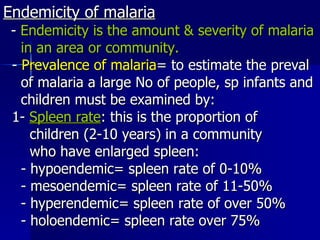
Endemicity of malaria -  Endemicity is the amount & severity of malaria in an area or community. -  Prevalence of malaria = to estimate the preval of malaria a large No of people, sp infants and children must be examined by: 1-  Spleen rate : this is the proportion of children (2-10 years) in a community  who have enlarged spleen: - hypoendemic= spleen rate of 0-10% - mesoendemic= spleen rate of 11-50%  - hyperendemic= spleen rate of over 50% - holoendemic= spleen rate over 75%
2-  Parasite rate = it is the proportion of  persons in a given community who show  parasites in the peripheral blood.
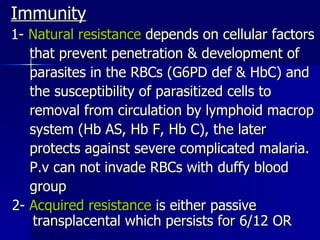
Immunity 1-  Natural resistance  depends on cellular factors that prevent penetration & development of parasites in the RBCs (G6PD def & HbC) and the susceptibility of parasitized cells to removal from circulation by lymphoid macrop system (Hb AS, Hb F, Hb C), the later  protects against severe complicated malaria. P.v can not invade RBCs with duffy blood group 2-  Acquired resistance  is either passive  transplacental which persists for 6/12 OR
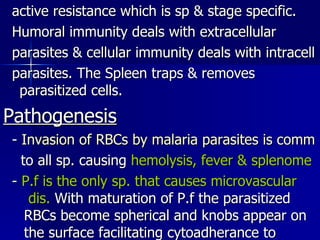
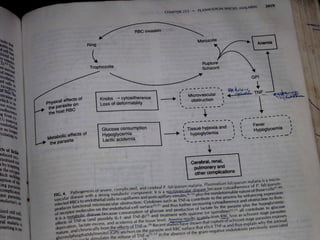
active resistance which is sp & stage specific. Humoral immunity deals with extracellular parasites & cellular immunity deals with intracell parasites. The Spleen traps & removes  parasitized cells. Pathogenesis -  Invasion of RBCs by malaria parasites is comm to all sp. causing  hemolysis, fever & splenome -  P.f is the only sp. that causes microvascular  dis.  With maturation of P.f the parasitized  RBCs become spherical and knobs appear on  the surface facilitating cytoadherance to
endoth cells of capillaries & post capillary  venules of vital organs. Cytokines (TNF alpha)  increases cytoadherance and microvascular  obstruction, tissue anoxia and wide spread  organ failure.
 
1-  Fever  is due to rupture of the schizonts releasing toxic substances stimulating  macrophages to release endogenous pyrogen raising temp. via the hypothalamus 2-  Anaemia : rapidly developing anaemia is a feature of P.f in children < 5y & pregn ladies - hemolysis of parasitized & unparasitized RBCs - dyserythropoiesis  - TNF alpha. - haemodilution from sequestration of RBCs in the spleen - depletion of folate stores
3-  Hypoglycemia :- related to the degree of parasitaemia - depletion of glycogen stores from low intake - Increased Glucose consumption by the large numbers of parasites. - Hypoglycemic effect of TNF - Quinine therapy & release of insulin - Suppression of gluconeogenesis 4-  Black water fever  wz severe intravas hemolys causing anaemia, Hb uria & renal failure 5- Immune  thrombocytopenia & coagulopathy
6-  Liver :- congested & enlarged with  centrilobular necrosis in severe cases 7-  Jaundice : either hemolytic or hepato cellular. Hepato renal syndrome can occur. 8-  Spleen : there is R/E hyperplasia with  congestion, hage & thrombosis. Spleen is  tender & may rupture. Hypersplenism. 9-  Kidneys : Ischemic pre renal failure may occur as well as immune complex nephritis 10-  CNS : congested meningeal & cerebral capill with parasitized RBCs with ring hage & mild  reversible peri vascular inflammation.
11-  Lungs : pulm edema 12-  GIT : micro vascular dis causes mucosal  edema, hage & ulceration causing D & V 13-  Adrenals : congestion & hage 14-  Placenta : may be heavily parasitized sp. In PG & may cause abortion & low birth Wt.
Uncomplicated malaria Case definition : 1-  Suspected malaria : Malaria is suspected when a pat presents with fever (or history of fever in za last 24 hours) and other S & S suggestive of malaria after exclusion of other common causes of fever in the area. 2-  Confirmed malaria : Malaria is confirmed by demonstration of asexual forms of za parasite in za thick or thin peri BF or by rapid diagnost test in the presence of fever
* When malaria is suspected & there is no facilities for lab. diagnosis., assume that the  pat has malaria when there is no other obvious cause for za fever. *  Incubation period  is 9—14 days in P.f *  Periodic fever  is the hallmark of malaria and coincides with rupture of RBCs & release of new merozoites. - Tertian wz P.v & P.o - Quartan wz P.m - Contin. wz irregular intermittent spikes wz P.f, sometimes quotidian or sub tertian
*  Paroxysms : - Cold stage  —15 min to hours - Hot stage  –2—6 hours - Sweating stage  —2—4 hours *  Anaemia & splenomegaly  are other signs *  Herpes labialis  is common *  Natural history of falciparum malaria  varies from  rapidly fatal in the non immune  to  no symptom in semi immune  even with significa parasitaemia. In non immune hyperparasit with double infection (>5%) may lead to fatal outcome in za absence of skilled management.
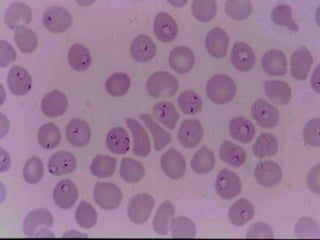
Lab diagnosis of malaria 1-  Thick BF stained with Giemsa  is examined microscopically for: - presence of infection - Stage of parasite - parasite count + 1—10 parasites/ 100 fields ++ 11—100 parasites/ 100 fields +++ 1—10 parasites/ one field ++++ 11—100 parasites/ one field   *  Thin BF is used where sp other than P.f  coexist
 
2-  Rapid diagnostic tests   e.g. ICT. This is not good in areas of high transmission where asymptomatic parasitaemia & antigenaemia is common.  High cost  but can be used by unskilled personale , used in  emergency  and  epidemic situations  & where the cost of  malaria TR is high to avoid unnecessary use  of drugs. Other investigations include: CBC, urine exam BUN & E, blood sugar & serum bilirubin.
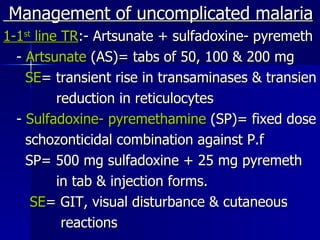
Management of uncomplicated malaria 1-1 st  line TR :- Artsunate + sulfadoxine- pyremeth -  Artsunate  (AS)= tabs of 50, 100 & 200 mg SE = transient rise in transaminases & transien reduction in reticulocytes -  Sulfadoxine- pyremethamine  (SP)= fixed dose schozonticidal combination against P.f SP= 500 mg sulfadoxine + 25 mg pyremeth in tab & injection forms. SE = GIT, visual disturbance & cutaneous  reactions
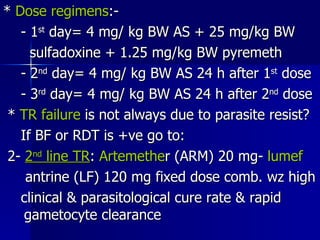
*  Dose regimens :- - 1 st  day= 4 mg/ kg BW AS + 25 mg/kg BW sulfadoxine + 1.25 mg/kg BW pyremeth - 2 nd  day= 4 mg/ kg BW AS 24 h after 1 st  dose - 3 rd  day= 4 mg/ kg BW AS 24 h after 2 nd  dose *  TR failure  is not always due to parasite resist? If BF or RDT is +ve go to: 2-  2 nd  line TR :  Artemethe r (ARM) 20 mg-  lumef antrine (LF) 120 mg fixed dose comb. wz high clinical & parasitological cure rate & rapid  gametocyte clearance
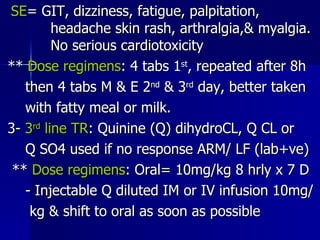
SE = GIT, dizziness, fatigue, palpitation,  headache skin rash, arthralgia,& myalgia.  No serious cardiotoxicity **  Dose regimens : 4 tabs 1 st , repeated after 8h then 4 tabs M & E 2 nd  & 3 rd  day, better taken with fatty meal or milk. 3-  3 rd  line TR : Quinine (Q) dihydroCL, Q CL or  Q SO4 used if no response ARM/ LF (lab+ve) **  Dose regimens : Oral= 10mg/kg 8 hrly x 7 D - Injectable Q diluted IM or IV infusion 10mg/ kg & shift to oral as soon as possible
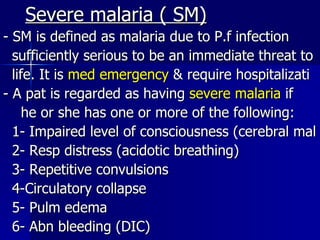
Severe malaria ( SM) - SM is defined as malaria due to P.f infection sufficiently serious to be an immediate threat to life. It is  med emergency  & require hospitalizati - A pat is regarded as having  severe malaria  if he or she has one or more of the following: 1- Impaired level of consciousness (cerebral mal 2- Resp distress (acidotic breathing) 3- Repetitive convulsions 4-Circulatory collapse 5- Pulm edema 6- Abn bleeding (DIC)
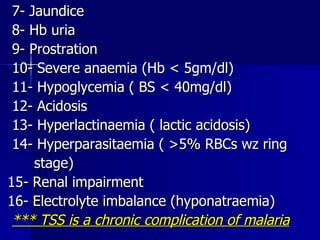
7- Jaundice 8- Hb uria 9- Prostration 10- Severe anaemia (Hb < 5gm/dl) 11- Hypoglycemia ( BS < 40mg/dl) 12- Acidosis 13- Hyperlactinaemia ( lactic acidosis) 14- Hyperparasitaemia ( >5% RBCs wz ring  stage) 15- Renal impairment 16- Electrolyte imbalance (hyponatraemia) *** TSS is a chronic complication of malaria
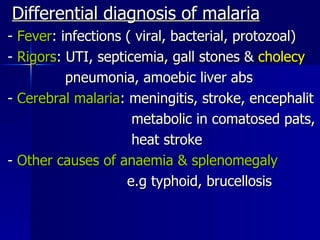
Differential diagnosis of malaria -  Fever : infections ( viral, bacterial, protozoal) -  Rigors : UTI, septicemia, gall stones &  cholecy pneumonia, amoebic liver abs -  Cerebral malaria : meningitis, stroke, encephalit metabolic in comatosed pats, heat stroke -  Other causes of anaemia & splenomegaly e.g typhoid, brucellosis
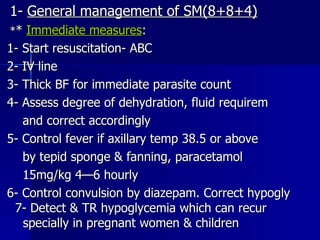
1-  General management of SM(8+8+4) * *  Immediate measures : 1- Start resuscitation- ABC 2- IV line 3- Thick BF for immediate parasite count 4- Assess degree of dehydration, fluid requirem and correct accordingly 5- Control fever if axillary temp 38.5 or above by tepid sponge & fanning, paracetamol 15mg/kg 4—6 hourly 6- Control convulsion by diazepam. Correct hypogly  7- Detect & TR hypoglycemia which can recur  specially in pregnant women & children
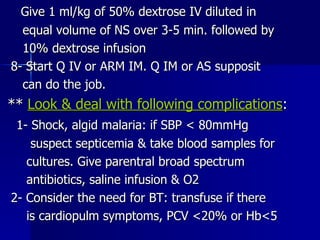
Give 1 ml/kg of 50% dextrose IV diluted in equal volume of NS over 3-5 min. followed by 10% dextrose infusion 8- Start Q IV or ARM IM. Q IM or AS supposit can do the job. **  Look & deal with following complications : 1- Shock, algid malaria: if SBP < 80mmHg suspect septicemia & take blood samples for cultures. Give parentral broad spectrum antibiotics, saline infusion & O2 2- Consider the need for BT: transfuse if there is cardiopulm symptoms, PCV <20% or Hb<5
3- Metabolic acidosis: exclude & TR hypoglycem hypovolaemia & gm –ve septicemia. 4- Spontaneous bleeding & coagulopathy: fresh screened whole BT or clotting factors, Vit K 10mg IV daily for adults 5- Acute renal failure: exclude dehydr, maintain strict fluid balance. Dialysis if indicated 6- Black- water fever (malarial Hb uria): suitable antimalarial & screened fresh BT 7- Acute pulm edema: prevent by avoiding  overload. IV frusemide & O2  8- Exclude common infections that mimic malaria e.g. WBC, L/P & CXR
**  Monitor the patient : 1- level of consciousness by Glasgow scale 6 hrly to assess the progress until the pat regains full consciousness 2- Fluid input/ output: detect dehydr & TR but avoid overload e.g pulm edema 3- Monitor vital signs every 6 hrs to detect  compl of SM 4- level of parasitaemia: monitor parasite count daily to monitor therapeutic effect
2-  Specific treatment of SM **  Pre referral TR : Q IM or AS suppositories 10mg/kg rectal caps. Then refer to hospital **  Hospital TR: 1-  Q IV infusion or IM  if IV is not feasible & shift  to oral as soon as possible. Total of  10mg/kg 8 hrly for 7 days 2-  Q for 3 days & shift to 1 st  line therapy  if the patient can take oral medication & can not  tolerate oral Q. SE = N, V & tinnitus. Over dose cause HA, dizzi, CNS dist & delerium, hypoglycemia, hypotn
3-  ARM injections  ( 40mg & 80mg/ml) as  monotherapy should only be used for SM - 1.6 mg/kg initially, repeated after 12 hrs and then daily  for 6 days (total of 8 amp) - 1.6 mg/kg initially, repeated after 12 hrs and then daily in za 2 nd  & 3 rd  day (4 amp) followed by the 1 st  line TR if the pat can take orally. -  SE  of ARM are mild= HA, abd pain, vomiting itching, non specific ST changes & 1 st degree A/V block.
Malaria in pregnancy (MIP) 1-The manifestation of malaria in preg , specially in the 2 nd  half, include: - fever  - anaemia - splenomegaly  - acute pulm edema - hypoglycemia  - 2ndry infections 2-  Management of MIP : TR malaria & compl,  manage labour -  1 st  trimester = oral Q is safe 10mg/kgx3x7 -  2 nd  & 3 rd  trimester = oral Q for 7 days OR oral Q for 3 days followed by SP in full dose OR use 1 st  line TR
3-  Management of SM during preg : -  Q 10mg/kg x3x7 days through out preg - Start wz IV infusion or IM & shift to oral OR - Start wz Q IV or IM for at least for 3 days OR then shift to 1 st  line TR in 2 nd  & 3 rd  trim OR - ARM injections for 7 days -  Management of  pulm edema, hypoglycemi anaemia wz packed cell transfusion, renal F and septicaemic shock or algid malaria by 3 rd  generation cephalosporin, monitoring of vital signs & fluids if required (SBP< 90)
4-  Intermittent preventive TR (IPT):   - recommended only in high transmission  areas - SP= 1 st  dose in za 1 st  ANC visit after  quickening (16-20W) - 2 nd  dose 4W later
TR of Vivax malaria - malaria other than P.f constitute 5—15% in  Sudan, mainly in eastern borders. Death is  rare & relapse expected wz P.v & Po. - Still sensitive to CQ & susceptible to ARM/LF - Primaquine used following TR of asexual forms to clear exsoerythrocytic phase 15mg/d x14 d. CI in preg, during lactation & children < 1year
Malaria prophylaxis & prevention - The following are at higher risk for malaria: 1- travelers from malaria free areas 2- preg women, sp primigravida 3- SS dis 4- splenectomized individuals 5- children on steroids & immunosupp drugs 6- expatriates & sudanese returning from non malarious areas -  Mefloquine  250mg weekly, starting one week before entering the area & for 4W after leaving za area.
Mefloquine not recommended in children < 3/12 -  atovaquine 250mg + proguanil 100mg  begin one day before entering the area & for 7 days after leaving the area in those can not take  Mefloquine.
Tropical splenomegaly (TSS) - Results from  abn immunological response  to malaria - Occurs in  malaria endemic areas  in the indigenous inhabitants. Parasites not present - There is  high malarial Ab titre wz over- produc of IgM  & reduced C3 -  Massive splenomegaly  >10cm which is firm - Hepatic sinusoidal dilatation, infilt wz lymphocy and Kupffer cell hyperplasia -  Pancytopeni a with normocytic normochromic anaemia & reticulocytosis
- The condition is  reversible -  Increased susceptibility to infection  & there is wasting in advanced cases -  Criteria for diagn of TSS : exclusion of other  causes of massive splenomegaly, immunity to  malaria, raised IgM, hepatic sinusoidal  lymphocytosis & IgM on immunofl & the response to anti malarial prophylaxis  -  TR for symptomatic pats with anaemia & large spleen- --  Chemoprophylaxis  + F acid  Splenectomy  wz permanent malaria  chemoprophylaxis in those who fail to  respond.

Malaria

  • 1.
    Malaria By Dr. Osman Sadig
  • 2.
    Malaria: - isa m ajor health problem in developing tropical countries: 1- Annual incidence of 300– 500 x 1000 000 2- 1% mortality , mainly in under 5 years , pregnant ladies & non immune 3- 80% of cases & 90% of deaths in AFRICA. - In Sudan :- 1- 250/ 10 000 population/ year (7.5 million/ year 2- 35 000 deaths every year
  • 3.
    3- 20—40% ofhealth institute attendance 4- 20—30% of total hospital admissions 5- 15—20% of total deaths 6- 22% loss of working hours Organism:- - Plasmodium falciparum ( 95% in Sudan) - P. vivax - P. ovale - P. malariae ** P. falcip is endemic in the tropics , has no hypnozoites to sustain transmission which depends on the presence of vector all za year.
  • 4.
    ** P.finvades RBC of all ages, multiple RBC infection is common & mature trophoz are absent in the peripheral blood. ** P.f is the only sp. of malaria associated with life threatening complications & is often drug resistant ** P.v. & P.o. are endemic in the temperate zones, invade reticulocytes & cause relapsing malaria. ** P.m. produces chronic low parasitaemia.
  • 5.
    ** 5—7%of infections are multiple with more than one sp. ** Light microscopy of stained BF is used to diagnose malaria & identify the sps. Transmission 1- Female anopheles mosquito (A. gambiensis and A. arabiensis). Transmission depends on the presence of gametocytes in the peri blood 2- BT & sharing needles . No relapse with this mode of transmission 3- Transplacental Congenital malaria
  • 6.
    Epidemiology Transmission ofmalaria depends on the presence of:- 1- Infected reservoir 2- Susceptible human being 3- Competent vector 4- Multiple opportunities for contact between the vector & human host.
  • 7.
  • 8.
    Endemicity of malaria- Endemicity is the amount & severity of malaria in an area or community. - Prevalence of malaria = to estimate the preval of malaria a large No of people, sp infants and children must be examined by: 1- Spleen rate : this is the proportion of children (2-10 years) in a community who have enlarged spleen: - hypoendemic= spleen rate of 0-10% - mesoendemic= spleen rate of 11-50% - hyperendemic= spleen rate of over 50% - holoendemic= spleen rate over 75%
  • 9.
    2- Parasiterate = it is the proportion of persons in a given community who show parasites in the peripheral blood.
  • 10.
    Immunity 1- Natural resistance depends on cellular factors that prevent penetration & development of parasites in the RBCs (G6PD def & HbC) and the susceptibility of parasitized cells to removal from circulation by lymphoid macrop system (Hb AS, Hb F, Hb C), the later protects against severe complicated malaria. P.v can not invade RBCs with duffy blood group 2- Acquired resistance is either passive transplacental which persists for 6/12 OR
  • 11.
    active resistance whichis sp & stage specific. Humoral immunity deals with extracellular parasites & cellular immunity deals with intracell parasites. The Spleen traps & removes parasitized cells. Pathogenesis - Invasion of RBCs by malaria parasites is comm to all sp. causing hemolysis, fever & splenome - P.f is the only sp. that causes microvascular dis. With maturation of P.f the parasitized RBCs become spherical and knobs appear on the surface facilitating cytoadherance to
  • 12.
    endoth cells ofcapillaries & post capillary venules of vital organs. Cytokines (TNF alpha) increases cytoadherance and microvascular obstruction, tissue anoxia and wide spread organ failure.
  • 13.
  • 14.
    1- Fever is due to rupture of the schizonts releasing toxic substances stimulating macrophages to release endogenous pyrogen raising temp. via the hypothalamus 2- Anaemia : rapidly developing anaemia is a feature of P.f in children < 5y & pregn ladies - hemolysis of parasitized & unparasitized RBCs - dyserythropoiesis - TNF alpha. - haemodilution from sequestration of RBCs in the spleen - depletion of folate stores
  • 15.
    3- Hypoglycemia:- related to the degree of parasitaemia - depletion of glycogen stores from low intake - Increased Glucose consumption by the large numbers of parasites. - Hypoglycemic effect of TNF - Quinine therapy & release of insulin - Suppression of gluconeogenesis 4- Black water fever wz severe intravas hemolys causing anaemia, Hb uria & renal failure 5- Immune thrombocytopenia & coagulopathy
  • 16.
    6- Liver:- congested & enlarged with centrilobular necrosis in severe cases 7- Jaundice : either hemolytic or hepato cellular. Hepato renal syndrome can occur. 8- Spleen : there is R/E hyperplasia with congestion, hage & thrombosis. Spleen is tender & may rupture. Hypersplenism. 9- Kidneys : Ischemic pre renal failure may occur as well as immune complex nephritis 10- CNS : congested meningeal & cerebral capill with parasitized RBCs with ring hage & mild reversible peri vascular inflammation.
  • 17.
    11- Lungs: pulm edema 12- GIT : micro vascular dis causes mucosal edema, hage & ulceration causing D & V 13- Adrenals : congestion & hage 14- Placenta : may be heavily parasitized sp. In PG & may cause abortion & low birth Wt.
  • 18.
    Uncomplicated malaria Casedefinition : 1- Suspected malaria : Malaria is suspected when a pat presents with fever (or history of fever in za last 24 hours) and other S & S suggestive of malaria after exclusion of other common causes of fever in the area. 2- Confirmed malaria : Malaria is confirmed by demonstration of asexual forms of za parasite in za thick or thin peri BF or by rapid diagnost test in the presence of fever
  • 19.
    * When malariais suspected & there is no facilities for lab. diagnosis., assume that the pat has malaria when there is no other obvious cause for za fever. * Incubation period is 9—14 days in P.f * Periodic fever is the hallmark of malaria and coincides with rupture of RBCs & release of new merozoites. - Tertian wz P.v & P.o - Quartan wz P.m - Contin. wz irregular intermittent spikes wz P.f, sometimes quotidian or sub tertian
  • 20.
    * Paroxysms: - Cold stage —15 min to hours - Hot stage –2—6 hours - Sweating stage —2—4 hours * Anaemia & splenomegaly are other signs * Herpes labialis is common * Natural history of falciparum malaria varies from rapidly fatal in the non immune to no symptom in semi immune even with significa parasitaemia. In non immune hyperparasit with double infection (>5%) may lead to fatal outcome in za absence of skilled management.
  • 21.
    Lab diagnosis ofmalaria 1- Thick BF stained with Giemsa is examined microscopically for: - presence of infection - Stage of parasite - parasite count + 1—10 parasites/ 100 fields ++ 11—100 parasites/ 100 fields +++ 1—10 parasites/ one field ++++ 11—100 parasites/ one field * Thin BF is used where sp other than P.f coexist
  • 22.
  • 23.
    2- Rapiddiagnostic tests e.g. ICT. This is not good in areas of high transmission where asymptomatic parasitaemia & antigenaemia is common. High cost but can be used by unskilled personale , used in emergency and epidemic situations & where the cost of malaria TR is high to avoid unnecessary use of drugs. Other investigations include: CBC, urine exam BUN & E, blood sugar & serum bilirubin.
  • 24.
    Management of uncomplicatedmalaria 1-1 st line TR :- Artsunate + sulfadoxine- pyremeth - Artsunate (AS)= tabs of 50, 100 & 200 mg SE = transient rise in transaminases & transien reduction in reticulocytes - Sulfadoxine- pyremethamine (SP)= fixed dose schozonticidal combination against P.f SP= 500 mg sulfadoxine + 25 mg pyremeth in tab & injection forms. SE = GIT, visual disturbance & cutaneous reactions
  • 25.
    * Doseregimens :- - 1 st day= 4 mg/ kg BW AS + 25 mg/kg BW sulfadoxine + 1.25 mg/kg BW pyremeth - 2 nd day= 4 mg/ kg BW AS 24 h after 1 st dose - 3 rd day= 4 mg/ kg BW AS 24 h after 2 nd dose * TR failure is not always due to parasite resist? If BF or RDT is +ve go to: 2- 2 nd line TR : Artemethe r (ARM) 20 mg- lumef antrine (LF) 120 mg fixed dose comb. wz high clinical & parasitological cure rate & rapid gametocyte clearance
  • 26.
    SE = GIT,dizziness, fatigue, palpitation, headache skin rash, arthralgia,& myalgia. No serious cardiotoxicity ** Dose regimens : 4 tabs 1 st , repeated after 8h then 4 tabs M & E 2 nd & 3 rd day, better taken with fatty meal or milk. 3- 3 rd line TR : Quinine (Q) dihydroCL, Q CL or Q SO4 used if no response ARM/ LF (lab+ve) ** Dose regimens : Oral= 10mg/kg 8 hrly x 7 D - Injectable Q diluted IM or IV infusion 10mg/ kg & shift to oral as soon as possible
  • 27.
    Severe malaria (SM) - SM is defined as malaria due to P.f infection sufficiently serious to be an immediate threat to life. It is med emergency & require hospitalizati - A pat is regarded as having severe malaria if he or she has one or more of the following: 1- Impaired level of consciousness (cerebral mal 2- Resp distress (acidotic breathing) 3- Repetitive convulsions 4-Circulatory collapse 5- Pulm edema 6- Abn bleeding (DIC)
  • 28.
    7- Jaundice 8-Hb uria 9- Prostration 10- Severe anaemia (Hb < 5gm/dl) 11- Hypoglycemia ( BS < 40mg/dl) 12- Acidosis 13- Hyperlactinaemia ( lactic acidosis) 14- Hyperparasitaemia ( >5% RBCs wz ring stage) 15- Renal impairment 16- Electrolyte imbalance (hyponatraemia) *** TSS is a chronic complication of malaria
  • 29.
    Differential diagnosis ofmalaria - Fever : infections ( viral, bacterial, protozoal) - Rigors : UTI, septicemia, gall stones & cholecy pneumonia, amoebic liver abs - Cerebral malaria : meningitis, stroke, encephalit metabolic in comatosed pats, heat stroke - Other causes of anaemia & splenomegaly e.g typhoid, brucellosis
  • 30.
    1- Generalmanagement of SM(8+8+4) * * Immediate measures : 1- Start resuscitation- ABC 2- IV line 3- Thick BF for immediate parasite count 4- Assess degree of dehydration, fluid requirem and correct accordingly 5- Control fever if axillary temp 38.5 or above by tepid sponge & fanning, paracetamol 15mg/kg 4—6 hourly 6- Control convulsion by diazepam. Correct hypogly 7- Detect & TR hypoglycemia which can recur specially in pregnant women & children
  • 31.
    Give 1 ml/kgof 50% dextrose IV diluted in equal volume of NS over 3-5 min. followed by 10% dextrose infusion 8- Start Q IV or ARM IM. Q IM or AS supposit can do the job. ** Look & deal with following complications : 1- Shock, algid malaria: if SBP < 80mmHg suspect septicemia & take blood samples for cultures. Give parentral broad spectrum antibiotics, saline infusion & O2 2- Consider the need for BT: transfuse if there is cardiopulm symptoms, PCV <20% or Hb<5
  • 32.
    3- Metabolic acidosis:exclude & TR hypoglycem hypovolaemia & gm –ve septicemia. 4- Spontaneous bleeding & coagulopathy: fresh screened whole BT or clotting factors, Vit K 10mg IV daily for adults 5- Acute renal failure: exclude dehydr, maintain strict fluid balance. Dialysis if indicated 6- Black- water fever (malarial Hb uria): suitable antimalarial & screened fresh BT 7- Acute pulm edema: prevent by avoiding overload. IV frusemide & O2 8- Exclude common infections that mimic malaria e.g. WBC, L/P & CXR
  • 33.
    ** Monitorthe patient : 1- level of consciousness by Glasgow scale 6 hrly to assess the progress until the pat regains full consciousness 2- Fluid input/ output: detect dehydr & TR but avoid overload e.g pulm edema 3- Monitor vital signs every 6 hrs to detect compl of SM 4- level of parasitaemia: monitor parasite count daily to monitor therapeutic effect
  • 34.
    2- Specifictreatment of SM ** Pre referral TR : Q IM or AS suppositories 10mg/kg rectal caps. Then refer to hospital ** Hospital TR: 1- Q IV infusion or IM if IV is not feasible & shift to oral as soon as possible. Total of 10mg/kg 8 hrly for 7 days 2- Q for 3 days & shift to 1 st line therapy if the patient can take oral medication & can not tolerate oral Q. SE = N, V & tinnitus. Over dose cause HA, dizzi, CNS dist & delerium, hypoglycemia, hypotn
  • 35.
    3- ARMinjections ( 40mg & 80mg/ml) as monotherapy should only be used for SM - 1.6 mg/kg initially, repeated after 12 hrs and then daily for 6 days (total of 8 amp) - 1.6 mg/kg initially, repeated after 12 hrs and then daily in za 2 nd & 3 rd day (4 amp) followed by the 1 st line TR if the pat can take orally. - SE of ARM are mild= HA, abd pain, vomiting itching, non specific ST changes & 1 st degree A/V block.
  • 36.
    Malaria in pregnancy(MIP) 1-The manifestation of malaria in preg , specially in the 2 nd half, include: - fever - anaemia - splenomegaly - acute pulm edema - hypoglycemia - 2ndry infections 2- Management of MIP : TR malaria & compl, manage labour - 1 st trimester = oral Q is safe 10mg/kgx3x7 - 2 nd & 3 rd trimester = oral Q for 7 days OR oral Q for 3 days followed by SP in full dose OR use 1 st line TR
  • 37.
    3- Managementof SM during preg : - Q 10mg/kg x3x7 days through out preg - Start wz IV infusion or IM & shift to oral OR - Start wz Q IV or IM for at least for 3 days OR then shift to 1 st line TR in 2 nd & 3 rd trim OR - ARM injections for 7 days - Management of pulm edema, hypoglycemi anaemia wz packed cell transfusion, renal F and septicaemic shock or algid malaria by 3 rd generation cephalosporin, monitoring of vital signs & fluids if required (SBP< 90)
  • 38.
    4- Intermittentpreventive TR (IPT): - recommended only in high transmission areas - SP= 1 st dose in za 1 st ANC visit after quickening (16-20W) - 2 nd dose 4W later
  • 39.
    TR of Vivaxmalaria - malaria other than P.f constitute 5—15% in Sudan, mainly in eastern borders. Death is rare & relapse expected wz P.v & Po. - Still sensitive to CQ & susceptible to ARM/LF - Primaquine used following TR of asexual forms to clear exsoerythrocytic phase 15mg/d x14 d. CI in preg, during lactation & children < 1year
  • 40.
    Malaria prophylaxis &prevention - The following are at higher risk for malaria: 1- travelers from malaria free areas 2- preg women, sp primigravida 3- SS dis 4- splenectomized individuals 5- children on steroids & immunosupp drugs 6- expatriates & sudanese returning from non malarious areas - Mefloquine 250mg weekly, starting one week before entering the area & for 4W after leaving za area.
  • 41.
    Mefloquine not recommendedin children < 3/12 - atovaquine 250mg + proguanil 100mg begin one day before entering the area & for 7 days after leaving the area in those can not take Mefloquine.
  • 42.
    Tropical splenomegaly (TSS)- Results from abn immunological response to malaria - Occurs in malaria endemic areas in the indigenous inhabitants. Parasites not present - There is high malarial Ab titre wz over- produc of IgM & reduced C3 - Massive splenomegaly >10cm which is firm - Hepatic sinusoidal dilatation, infilt wz lymphocy and Kupffer cell hyperplasia - Pancytopeni a with normocytic normochromic anaemia & reticulocytosis
  • 43.
    - The conditionis reversible - Increased susceptibility to infection & there is wasting in advanced cases - Criteria for diagn of TSS : exclusion of other causes of massive splenomegaly, immunity to malaria, raised IgM, hepatic sinusoidal lymphocytosis & IgM on immunofl & the response to anti malarial prophylaxis - TR for symptomatic pats with anaemia & large spleen- -- Chemoprophylaxis + F acid Splenectomy wz permanent malaria chemoprophylaxis in those who fail to respond.