HR FLORIDA 2010 CONFERENCE & EXPO
       August 30 – September 1, 2010


                Presenters:


          Charles K. Bens, PhD.
          Healthy at Work, Inc.

                    and


       Gail Hill Smith, MBA, PHR, CHC
      Your Nutrition Partners, LLC
“The role HR must play in the economic
recovery is vital”.
“HR will be at the epicenter of the change
needed to turn the global economy around”.
“HR’s role to to provide consumers more
controls, if you want to see costs decrease and
access improve”.
                                                        Steve Forbes
         2010 SHRM Management Conference and Exposition, Sand Diego, CA
Ideal Workplace Wellness
Program:
• Define and set goals of program.
• Upper management support. Employee involvement.
• Work-life (lifestyle) balance.
• Employee growth and development.
• Employee recognition.
• Added component: HR’s role to monitor Health Care
reform measures to provide consumers more controls.
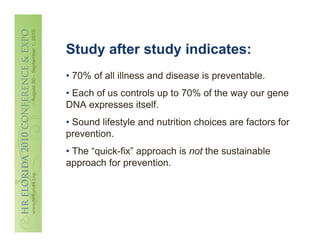
Study after study indicates:
• 70% of all illness and disease is preventable.
• Each of us controls up to 70% of the way our gene
DNA expresses itself.
• Sound lifestyle and nutrition choices are factors for
prevention.
• The “quick-fix” approach is not the sustainable
approach for prevention.
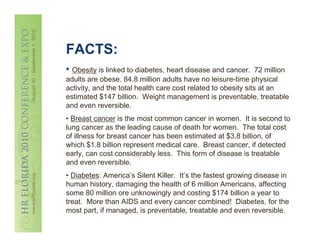
FACTS:
• Obesity is linked to diabetes, heart disease and cancer.      72 million
adults are obese. 84.8 million adults have no leisure-time physical
activity, and the total health care cost related to obesity sits at an
estimated $147 billion. Weight management is preventable, treatable
and even reversible.
• Breast cancer is the most common cancer in women. It is second to
lung cancer as the leading cause of death for women. The total cost
of illness for breast cancer has been estimated at $3.8 billion, of
which $1.8 billion represent medical care. Breast cancer, if detected
early, can cost considerably less. This form of disease is treatable
and even reversible.
• Diabetes: America’s Silent Killer. It’s the fastest growing disease in
human history, damaging the health of 6 million Americans, affecting
some 80 million ore unknowingly and costing $174 billion a year to
treat. More than AIDS and every cancer combined! Diabetes, for the
most part, if managed, is preventable, treatable and even reversible.
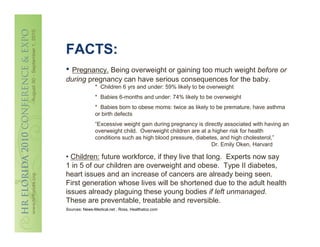
FACTS:
• Pregnancy. Being overweight or gaining too much weight before or
during pregnancy can have serious consequences for the baby.
               * Children 6 yrs and under: 59% likely to be overweight
               * Babies 6-months and under: 74% likely to be overweight
               * Babies born to obese moms: twice as likely to be premature, have asthma
               or birth defects
               “Excessive weight gain during pregnancy is directly associated with having an
               overweight child. Overweight children are at a higher risk for health
               conditions such as high blood pressure, diabetes, and high cholesterol,”
                                                             Dr. Emily Oken, Harvard

• Children: future workforce, if they live that long. Experts now say
1 in 5 of our children are overweight and obese. Type II diabetes,
heart issues and an increase of cancers are already being seen.
First generation whose lives will be shortened due to the adult health
issues already plaguing these young bodies if left unmanaged.
These are preventable, treatable and reversible.
Sources: News-Medical.net , Ross, Healthatoz.com
Wellness Program measurement
models:
• Wellness Council of America.
• The Alliance for Wellness ROI, Inc.
• The Corporate Executive Board.
• Life Force Solutions, Inc.

 Companies must build a culture of health and
 enable employees to become better guardians of
 their own well being.
 Source: Overman, S. (2009) Next-Generation Wellness at Work, ABC CLIO, LLC
SHRM
Nutrition = Wellness


      Presented by:
   Charles K. Bens, Ph.D.
   Healthy at Work, Inc.
Only 15% of SHRM members surveyed
 had nutrition as a top priority in their
           wellness program.

                 Why?

Nutrition is the number one cause of poor
 health in the workplace. How could so
      many employers not get this?
Food as Pharma:
    Time Magazine 06-22-09
   “There is an overwhelmingly strong
  database of studies suggesting that the
quality of calories we eat has a high impact
 on our well-being and our risk of chronic
           disease and longevity.”

                    Dr. David Ludwig
                    Children’s Hospital, Boston
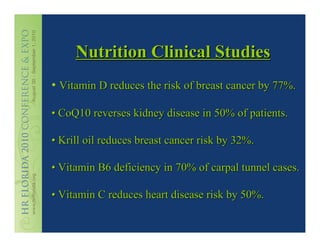
Nutrition Clinical Studies
• Vitamin D reduces the risk of breast cancer by 77%.

• CoQ10 reverses kidney disease in 50% of patients.

• Krill oil reduces breast cancer risk by 32%.

• Vitamin B6 deficiency in 70% of carpal tunnel cases.

• Vitamin C reduces heart disease risk by 50%.
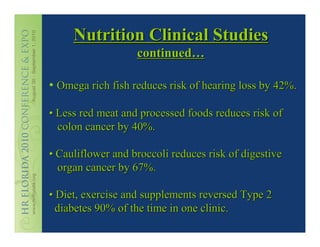
Nutrition Clinical Studies
                   continued…

• Omega rich fish reduces risk of hearing loss by 42%.

• Less red meat and processed foods reduces risk of
  colon cancer by 40%.

• Cauliflower and broccoli reduces risk of digestive
  organ cancer by 67%.

• Diet, exercise and supplements reversed Type 2
  diabetes 90% of the time in one clinic.
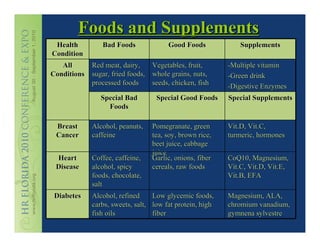
Foods and Supplements
 Health         Bad Foods              Good Foods             Supplements
Condition
   All     Red meat, dairy,    Vegetables, fruit,         -Multiple vitamin
Conditions sugar, fried foods, whole grains, nuts,        -Green drink
           processed foods     seeds, chicken, fish       -Digestive Enzymes
                Special Bad        Special Good Foods     Special Supplements
                  Foods

 Breast      Alcohol, peanuts,   Pomegranate, green       Vit.D, Vit.C,
 Cancer      caffeine            tea, soy, brown rice,    turmeric, hormones
                                 beet juice, cabbage
                                 juice
 Heart       Coffee, caffeine,   Garlic, onions, fiber    CoQ10, Magnesium,
 Disease     alcohol, spicy      cereals, raw foods       Vit.C, Vit.D, Vit.E,
             foods, chocolate,                            Vit.B, EFA
             salt
 Diabetes    Alcohol, refined     Low glycemic foods,     Magnesium, ALA,
             carbs, sweets, salt, low fat protein, high   chromium vanadium,
             fish oils            fiber                   gymnena sylvestre
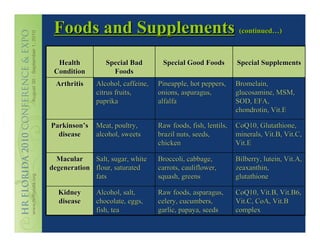
Foods and Supplements (continued…)
  Health         Special Bad        Special Good Foods         Special Supplements
 Condition         Foods
  Arthritis   Alcohol, caffeine,   Pineapple, hot peppers,     Bromelain,
              citrus fruits,       onions, asparagus,          glucosamine, MSM,
              paprika              alfalfa                     SOD, EFA,
                                                               chondrotin, Vit.E

Parkinson’s   Meat, poultry,       Raw foods, fish, lentils,   CoQ10, Glutathione,
  disease     alcohol, sweets      brazil nuts, seeds,         minerals, Vit.B, Vit.C,
                                   chicken                     Vit.E

  Macular    Salt, sugar, white    Broccoli, cabbage,          Bilberry, lutein, Vit.A,
degeneration flour, saturated      carrots, cauliflower,       zeaxanthin,
             fats                  squash, greens              glutathione

  Kidney      Alcohol, salt,       Raw foods, asparagus,       CoQ10, Vit.B, Vit.B6,
  disease     chocolate, eggs,     celery, cucumbers,          Vit.C, CoA, Vit.B
              fish, tea            garlic, papaya, seeds       complex
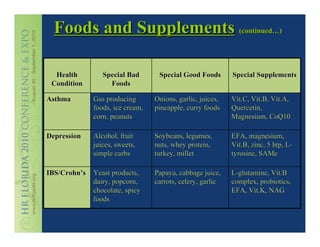
Foods and Supplements (continued…)

  Health         Special Bad       Special Good Foods       Special Supplements
 Condition         Foods

Asthma        Gas producing       Onions, garlic, juices,   Vit.C, Vit.B, Vit.A,
              foods, ice cream,   pineapple, curry foods    Quercetin,
              corn, peanuts                                 Magnesium, CoQ10

Depression    Alcohol, fruit      Soybeans, legumes,        EFA, magnesium,
              juices, sweets,     nuts, whey protein,       Vit.B, zinc, 5 htp, L-
              simple carbs        turkey, millet            tyrosine, SAMe

IBS/Crohn’s   Yeast products,     Papaya, cabbage juice,    L-glutamine, Vit.B
              dairy, popcorn,     carrots, celery, garlic   complex, probiotics,
              chocolate, spicy                              EFA, Vit.K, NAG
              foods
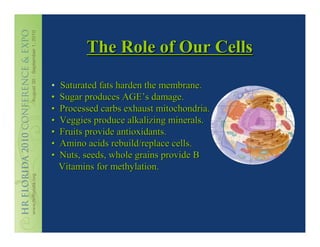
The Role of Our Cells

•   Saturated fats harden the membrane.
•   Sugar produces AGE’s damage.
•   Processed carbs exhaust mitochondria.
•   Veggies produce alkalizing minerals.
•   Fruits provide antioxidants.
•   Amino acids rebuild/replace cells.
•   Nuts, seeds, whole grains provide B
    Vitamins for methylation.
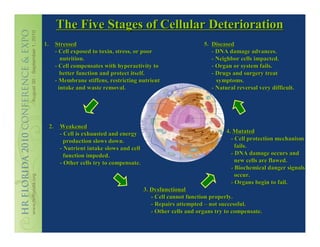
The Five Stages of Cellular Deterioration
1.        Stressed                                                   5. Diseased
          - Cell exposed to toxin, stress, or poor                      - DNA damage advances.
             nutrition.                                                 - Neighbor cells impacted.
          - Cell compensates with hyperactivity to                      - Organ or system fails.
             better function and protect itself.                        - Drugs and surgery treat
          - Membrane stiffens, restricting nutrient                       symptoms.
            intake and waste removal.                                   - Natural reversal very difficult.


     2.    Weakened
           - Cell is exhausted and energy                                     4. Mutated
             production slows down.                                             - Cell protection mechanism
           - Nutrient intake slows and cell                                       fails.
             function impeded.                                                  - DNA damage occurs and
           - Other cells try to compensate.                                       new cells are flawed.
                                                                                - Biochemical danger signals
                                                                                  occur.
                                                                                - Organs begin to fail.
                                              3. Dysfunctional
                                                 - Cell cannot function properly.
                                                 - Repairs attempted – not successful.
                                                 - Other cells and organs try to compensate.
Testing for Early Signs of
 Nutritional Deficiencies
   • pH Balance
   • Symptom Analysis
   • Thermography
   • Electro Dermal Screening
   • Blood/Cell Analysis
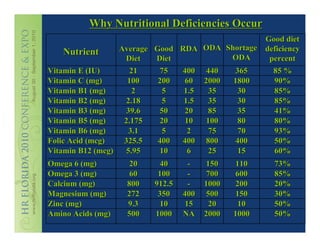
Why Nutritional Deficiencies Occur
                                                Good diet
     Nutrient     Average Good RDA ODA Shortage deficiency
                   Diet   Diet          ODA      percent
Vitamin E (IU)       21    75  400 440   365      85 %
Vitamin C (mg)      100    200  60 2000  1800     90%
Vitamin B1 (mg)       2     5   1.5  35   30      85%
Vitamin B2 (mg)    2.18     5   1.5  35   30      85%
Vitamin B3 (mg)    39.6    50   20   85   35      41%
Vitamin B5 (mg)    2.175   20   10  100   80      80%
Vitamin B6 (mg)     3.1     5    2   75   70      93%
Folic Acid (mcg)   325.5   400 400 800   400      50%
Vitamin B12 (mcg)  5.95    10    6   25   15      60%
Omega 6 (mg)        20    40      -    150    110    73%
Omega 3 (mg)        60    100     -    700    600    85%
Calcium (mg)       800   912.5    -    1000   200    20%
Magnesium (mg)     272    350    400   500    150    30%
Zinc (mg)          9.3    10     15     20     10    50%
Amino Acids (mg)   500   1000    NA    2000   1000   50%
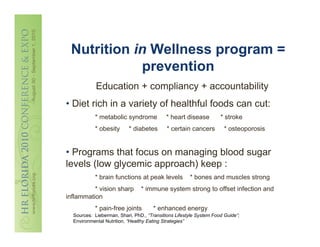
Nutrition in Wellness program =
            prevention
            Education + compliancy + accountability
• Diet rich in a variety of healthful foods can cut:
           * metabolic syndrome            * heart disease          * stroke
           * obesity       * diabetes       * certain cancers         * osteoporosis


• Programs that focus on managing blood sugar
levels (low glycemic approach) keep :
           * brain functions at peak levels           * bones and muscles strong
          * vision sharp        * immune system strong to offset infection and
inflammation
           * pain-free joints         * enhanced energy
  Sources: Lieberman, Shari, PhD., “Transitions Lifestyle System Food Guide”;
  Environmental Nutrition, “Healthy Eating Strategies”
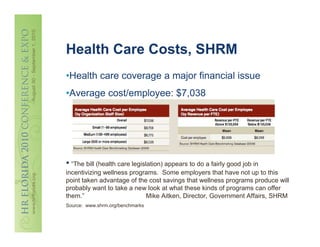
Health Care Costs, SHRM
•Health care coverage a major financial issue
•Average cost/employee: $7,038


• “The bill (health care legislation) appears to do a fairly good job in
incentivizing wellness programs. Some employers that have not up to this
point taken advantage of the cost savings that wellness programs produce will
probably want to take a new look at what these kinds of programs can offer
them.”                      Mike Aitken, Director, Government Affairs, SHRM
Source: www.shrm.org/benchmarks
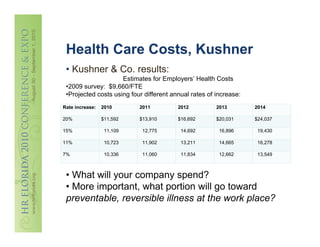
Health Care Costs, Kushner
 • Kushner & Co. results:
                     Estimates for Employers’ Health Costs
 •2009 survey: $9,660/FTE
 •Projected costs using four different annual rates of increase:
Rate increase:   2010      2011          2012          2013        2014

20%              $11,592   $13,910       $16,692       $20,031     $24,037

15%               11,109    12,775        14,692        16,896      19,430

11%               10,723    11,902        13,211        14,665      16,278

7%                10,336    11,060        11,834        12,662      13,549


 • What will your company spend?
 • More important, what portion will go toward
 preventable, reversible illness at the work place?
Stress reduction in Wellness
       program = prevention
         Education + compliancy + accountability

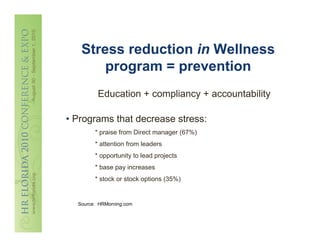
• Programs that decrease stress:
        * praise from Direct manager (67%)
        * attention from leaders
        * opportunity to lead projects
        * base pay increases
        * stock or stock options (35%)


  Source: HRMorning.com
Nutritional stress reduction in
Wellness programs = prevention
       Education + compliancy + accountability

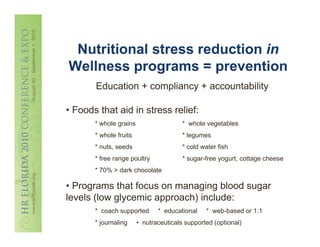
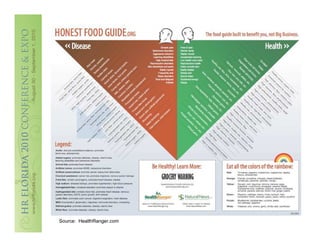
• Foods that aid in stress relief:
       * whole grains                   * whole vegetables
       * whole fruits                   * legumes
       * nuts, seeds                    * cold water fish
       * free range poultry             * sugar-free yogurt, cottage cheese
       * 70% > dark chocolate

• Programs that focus on managing blood sugar
levels (low glycemic approach) include:
       * coach supported       * educational    * web-based or 1:1
       * journaling     • nutraceuticals supported (optional)
Source: HealthRanger.com
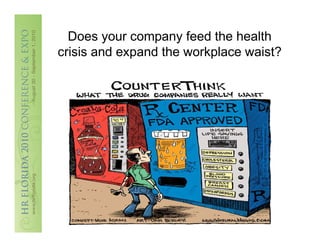
Does your company feed the health
crisis and expand the workplace waist?
HR FLORIDA 2010 CONFERENCE & EXPO
           August 30 – September 1, 2010


                    Presenters:


             Charles K. Bens, PhD.
             Healthy at Work, Inc.
        888-737-9617 * ckbens@ij.net
          www.behealthyatwork.com
                        and
           Gail Hill Smith, MBA, PHR, CHC
          Your Nutrition Partners, LLC
407-761-8143 * YourNutritionPartners@gmail.com
         www.YourNutritionPartners.com
PAGE TITLE
• This is a sample text box for visual comparison
with the banner info.
• This is a sample text box for visual comparison
with the banner info.
• This is a sample text box for visual comparison
with the banner info.
• This is a sample text box for visual comparison
with the banner info. This is a sample text box for
visual comparison with the banner info.
PAGE TITLE
• This is a sample text box for visual comparison
with the banner info.
• This is a sample text box for visual comparison
with the banner info.
• This is a sample text box for visual comparison
with the banner info.
• This is a sample text box for visual comparison
with the banner info. This is a sample text box for
visual comparison with the banner info.

Smith - The Expanding Workplace Waist: How to Tighten Healthcare Spending

  • 1.
    HR FLORIDA 2010CONFERENCE & EXPO August 30 – September 1, 2010 Presenters: Charles K. Bens, PhD. Healthy at Work, Inc. and Gail Hill Smith, MBA, PHR, CHC Your Nutrition Partners, LLC
  • 2.
    “The role HRmust play in the economic recovery is vital”. “HR will be at the epicenter of the change needed to turn the global economy around”. “HR’s role to to provide consumers more controls, if you want to see costs decrease and access improve”. Steve Forbes 2010 SHRM Management Conference and Exposition, Sand Diego, CA
  • 3.
    Ideal Workplace Wellness Program: •Define and set goals of program. • Upper management support. Employee involvement. • Work-life (lifestyle) balance. • Employee growth and development. • Employee recognition. • Added component: HR’s role to monitor Health Care reform measures to provide consumers more controls.
  • 4.
    Study after studyindicates: • 70% of all illness and disease is preventable. • Each of us controls up to 70% of the way our gene DNA expresses itself. • Sound lifestyle and nutrition choices are factors for prevention. • The “quick-fix” approach is not the sustainable approach for prevention.
  • 5.
    FACTS: • Obesity islinked to diabetes, heart disease and cancer. 72 million adults are obese. 84.8 million adults have no leisure-time physical activity, and the total health care cost related to obesity sits at an estimated $147 billion. Weight management is preventable, treatable and even reversible. • Breast cancer is the most common cancer in women. It is second to lung cancer as the leading cause of death for women. The total cost of illness for breast cancer has been estimated at $3.8 billion, of which $1.8 billion represent medical care. Breast cancer, if detected early, can cost considerably less. This form of disease is treatable and even reversible. • Diabetes: America’s Silent Killer. It’s the fastest growing disease in human history, damaging the health of 6 million Americans, affecting some 80 million ore unknowingly and costing $174 billion a year to treat. More than AIDS and every cancer combined! Diabetes, for the most part, if managed, is preventable, treatable and even reversible.
  • 6.
    FACTS: • Pregnancy. Beingoverweight or gaining too much weight before or during pregnancy can have serious consequences for the baby. * Children 6 yrs and under: 59% likely to be overweight * Babies 6-months and under: 74% likely to be overweight * Babies born to obese moms: twice as likely to be premature, have asthma or birth defects “Excessive weight gain during pregnancy is directly associated with having an overweight child. Overweight children are at a higher risk for health conditions such as high blood pressure, diabetes, and high cholesterol,” Dr. Emily Oken, Harvard • Children: future workforce, if they live that long. Experts now say 1 in 5 of our children are overweight and obese. Type II diabetes, heart issues and an increase of cancers are already being seen. First generation whose lives will be shortened due to the adult health issues already plaguing these young bodies if left unmanaged. These are preventable, treatable and reversible. Sources: News-Medical.net , Ross, Healthatoz.com
  • 8.
    Wellness Program measurement models: •Wellness Council of America. • The Alliance for Wellness ROI, Inc. • The Corporate Executive Board. • Life Force Solutions, Inc. Companies must build a culture of health and enable employees to become better guardians of their own well being. Source: Overman, S. (2009) Next-Generation Wellness at Work, ABC CLIO, LLC
  • 9.
    SHRM Nutrition = Wellness Presented by: Charles K. Bens, Ph.D. Healthy at Work, Inc.
  • 10.
    Only 15% ofSHRM members surveyed had nutrition as a top priority in their wellness program. Why? Nutrition is the number one cause of poor health in the workplace. How could so many employers not get this?
  • 11.
    Food as Pharma: Time Magazine 06-22-09 “There is an overwhelmingly strong database of studies suggesting that the quality of calories we eat has a high impact on our well-being and our risk of chronic disease and longevity.” Dr. David Ludwig Children’s Hospital, Boston
  • 12.
    Nutrition Clinical Studies •Vitamin D reduces the risk of breast cancer by 77%. • CoQ10 reverses kidney disease in 50% of patients. • Krill oil reduces breast cancer risk by 32%. • Vitamin B6 deficiency in 70% of carpal tunnel cases. • Vitamin C reduces heart disease risk by 50%.
  • 13.
    Nutrition Clinical Studies continued… • Omega rich fish reduces risk of hearing loss by 42%. • Less red meat and processed foods reduces risk of colon cancer by 40%. • Cauliflower and broccoli reduces risk of digestive organ cancer by 67%. • Diet, exercise and supplements reversed Type 2 diabetes 90% of the time in one clinic.
  • 14.
    Foods and Supplements Health Bad Foods Good Foods Supplements Condition All Red meat, dairy, Vegetables, fruit, -Multiple vitamin Conditions sugar, fried foods, whole grains, nuts, -Green drink processed foods seeds, chicken, fish -Digestive Enzymes Special Bad Special Good Foods Special Supplements Foods Breast Alcohol, peanuts, Pomegranate, green Vit.D, Vit.C, Cancer caffeine tea, soy, brown rice, turmeric, hormones beet juice, cabbage juice Heart Coffee, caffeine, Garlic, onions, fiber CoQ10, Magnesium, Disease alcohol, spicy cereals, raw foods Vit.C, Vit.D, Vit.E, foods, chocolate, Vit.B, EFA salt Diabetes Alcohol, refined Low glycemic foods, Magnesium, ALA, carbs, sweets, salt, low fat protein, high chromium vanadium, fish oils fiber gymnena sylvestre
  • 15.
    Foods and Supplements(continued…) Health Special Bad Special Good Foods Special Supplements Condition Foods Arthritis Alcohol, caffeine, Pineapple, hot peppers, Bromelain, citrus fruits, onions, asparagus, glucosamine, MSM, paprika alfalfa SOD, EFA, chondrotin, Vit.E Parkinson’s Meat, poultry, Raw foods, fish, lentils, CoQ10, Glutathione, disease alcohol, sweets brazil nuts, seeds, minerals, Vit.B, Vit.C, chicken Vit.E Macular Salt, sugar, white Broccoli, cabbage, Bilberry, lutein, Vit.A, degeneration flour, saturated carrots, cauliflower, zeaxanthin, fats squash, greens glutathione Kidney Alcohol, salt, Raw foods, asparagus, CoQ10, Vit.B, Vit.B6, disease chocolate, eggs, celery, cucumbers, Vit.C, CoA, Vit.B fish, tea garlic, papaya, seeds complex
  • 16.
    Foods and Supplements(continued…) Health Special Bad Special Good Foods Special Supplements Condition Foods Asthma Gas producing Onions, garlic, juices, Vit.C, Vit.B, Vit.A, foods, ice cream, pineapple, curry foods Quercetin, corn, peanuts Magnesium, CoQ10 Depression Alcohol, fruit Soybeans, legumes, EFA, magnesium, juices, sweets, nuts, whey protein, Vit.B, zinc, 5 htp, L- simple carbs turkey, millet tyrosine, SAMe IBS/Crohn’s Yeast products, Papaya, cabbage juice, L-glutamine, Vit.B dairy, popcorn, carrots, celery, garlic complex, probiotics, chocolate, spicy EFA, Vit.K, NAG foods
  • 17.
    The Role ofOur Cells • Saturated fats harden the membrane. • Sugar produces AGE’s damage. • Processed carbs exhaust mitochondria. • Veggies produce alkalizing minerals. • Fruits provide antioxidants. • Amino acids rebuild/replace cells. • Nuts, seeds, whole grains provide B Vitamins for methylation.
  • 18.
    The Five Stagesof Cellular Deterioration 1. Stressed 5. Diseased - Cell exposed to toxin, stress, or poor - DNA damage advances. nutrition. - Neighbor cells impacted. - Cell compensates with hyperactivity to - Organ or system fails. better function and protect itself. - Drugs and surgery treat - Membrane stiffens, restricting nutrient symptoms. intake and waste removal. - Natural reversal very difficult. 2. Weakened - Cell is exhausted and energy 4. Mutated production slows down. - Cell protection mechanism - Nutrient intake slows and cell fails. function impeded. - DNA damage occurs and - Other cells try to compensate. new cells are flawed. - Biochemical danger signals occur. - Organs begin to fail. 3. Dysfunctional - Cell cannot function properly. - Repairs attempted – not successful. - Other cells and organs try to compensate.
  • 19.
    Testing for EarlySigns of Nutritional Deficiencies • pH Balance • Symptom Analysis • Thermography • Electro Dermal Screening • Blood/Cell Analysis
  • 20.
    Why Nutritional DeficienciesOccur Good diet Nutrient Average Good RDA ODA Shortage deficiency Diet Diet ODA percent Vitamin E (IU) 21 75 400 440 365 85 % Vitamin C (mg) 100 200 60 2000 1800 90% Vitamin B1 (mg) 2 5 1.5 35 30 85% Vitamin B2 (mg) 2.18 5 1.5 35 30 85% Vitamin B3 (mg) 39.6 50 20 85 35 41% Vitamin B5 (mg) 2.175 20 10 100 80 80% Vitamin B6 (mg) 3.1 5 2 75 70 93% Folic Acid (mcg) 325.5 400 400 800 400 50% Vitamin B12 (mcg) 5.95 10 6 25 15 60% Omega 6 (mg) 20 40 - 150 110 73% Omega 3 (mg) 60 100 - 700 600 85% Calcium (mg) 800 912.5 - 1000 200 20% Magnesium (mg) 272 350 400 500 150 30% Zinc (mg) 9.3 10 15 20 10 50% Amino Acids (mg) 500 1000 NA 2000 1000 50%
  • 21.
    Nutrition in Wellnessprogram = prevention Education + compliancy + accountability • Diet rich in a variety of healthful foods can cut: * metabolic syndrome * heart disease * stroke * obesity * diabetes * certain cancers * osteoporosis • Programs that focus on managing blood sugar levels (low glycemic approach) keep : * brain functions at peak levels * bones and muscles strong * vision sharp * immune system strong to offset infection and inflammation * pain-free joints * enhanced energy Sources: Lieberman, Shari, PhD., “Transitions Lifestyle System Food Guide”; Environmental Nutrition, “Healthy Eating Strategies”
  • 22.
    Health Care Costs,SHRM •Health care coverage a major financial issue •Average cost/employee: $7,038 • “The bill (health care legislation) appears to do a fairly good job in incentivizing wellness programs. Some employers that have not up to this point taken advantage of the cost savings that wellness programs produce will probably want to take a new look at what these kinds of programs can offer them.” Mike Aitken, Director, Government Affairs, SHRM Source: www.shrm.org/benchmarks
  • 23.
    Health Care Costs,Kushner • Kushner & Co. results: Estimates for Employers’ Health Costs •2009 survey: $9,660/FTE •Projected costs using four different annual rates of increase: Rate increase: 2010 2011 2012 2013 2014 20% $11,592 $13,910 $16,692 $20,031 $24,037 15% 11,109 12,775 14,692 16,896 19,430 11% 10,723 11,902 13,211 14,665 16,278 7% 10,336 11,060 11,834 12,662 13,549 • What will your company spend? • More important, what portion will go toward preventable, reversible illness at the work place?
  • 24.
    Stress reduction inWellness program = prevention Education + compliancy + accountability • Programs that decrease stress: * praise from Direct manager (67%) * attention from leaders * opportunity to lead projects * base pay increases * stock or stock options (35%) Source: HRMorning.com
  • 25.
    Nutritional stress reductionin Wellness programs = prevention Education + compliancy + accountability • Foods that aid in stress relief: * whole grains * whole vegetables * whole fruits * legumes * nuts, seeds * cold water fish * free range poultry * sugar-free yogurt, cottage cheese * 70% > dark chocolate • Programs that focus on managing blood sugar levels (low glycemic approach) include: * coach supported * educational * web-based or 1:1 * journaling • nutraceuticals supported (optional)
  • 26.
  • 27.
    Does your companyfeed the health crisis and expand the workplace waist?
  • 28.
    HR FLORIDA 2010CONFERENCE & EXPO August 30 – September 1, 2010 Presenters: Charles K. Bens, PhD. Healthy at Work, Inc. 888-737-9617 * ckbens@ij.net www.behealthyatwork.com and Gail Hill Smith, MBA, PHR, CHC Your Nutrition Partners, LLC 407-761-8143 * YourNutritionPartners@gmail.com www.YourNutritionPartners.com
  • 29.
    PAGE TITLE • Thisis a sample text box for visual comparison with the banner info. • This is a sample text box for visual comparison with the banner info. • This is a sample text box for visual comparison with the banner info. • This is a sample text box for visual comparison with the banner info. This is a sample text box for visual comparison with the banner info.
  • 30.
    PAGE TITLE • Thisis a sample text box for visual comparison with the banner info. • This is a sample text box for visual comparison with the banner info. • This is a sample text box for visual comparison with the banner info. • This is a sample text box for visual comparison with the banner info. This is a sample text box for visual comparison with the banner info.