WELCOMEHR FLORIDA 2011PHR/SPHR CERTIFICATION PREP COURSESponsored by:August 28, 2011
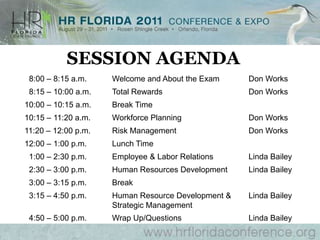
SESSION AGENDA
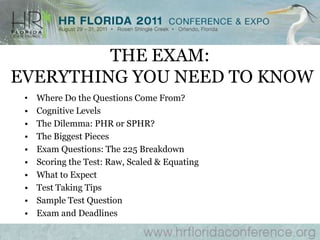
THE EXAM: EVERYTHING YOU NEED TO KNOWWhere Do the Questions Come From?
Cognitive Levels
The Dilemma: PHR or SPHR?
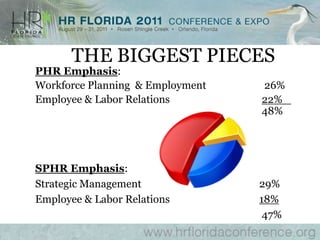
The Biggest Pieces
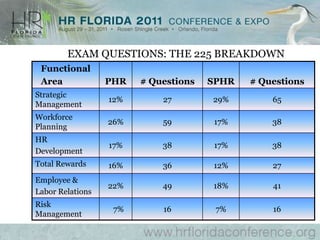
Exam Questions: The 225 Breakdown
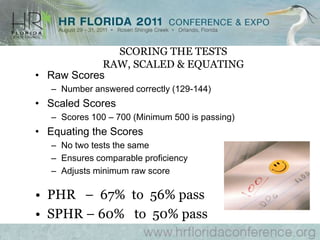
Scoring the Test: Raw, Scaled & Equating
What to Expect
Test Taking Tips
Sample Test Question
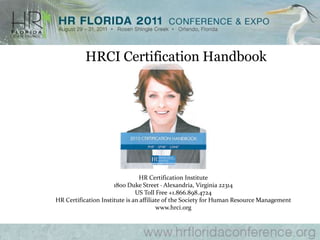
Exam and DeadlinesHRCI Certification HandbookHR Certification Institute1800 Duke Street · Alexandria, Virginia 22314US Toll Free +1.866.898.4724HR Certification Institute is an affiliate of the Society for Human Resource Managementwww.hrci.org
WHERE DO THE QUESTIONS COME FROM?Teams of Certified HR Professionals With Special Training in Item DevelopmentEvery Question Passes 3 Levels of ReviewEvery Question Pre-tested Before Being Used to Score the Exam
THE DILEMMA:PHR/SPHR?ResponsibilityReportingBreadth/ScopeImpactBusiness KnowledgeCredibility
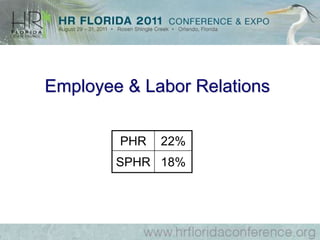
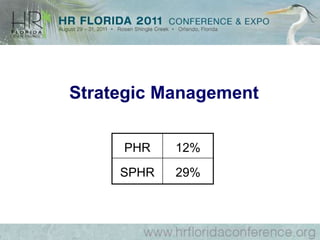
THE BIGGEST PIECESPHR Emphasis:			 			Workforce Planning  & Employment	     	  26% Employee & Labor Relations		     	 22% 			     					 48%	 	SPHR Emphasis:Strategic Management				29%Employee & Labor Relations		   	18%                                  				 	 47%
EXAM QUESTIONS: THE 225 BREAKDOWN
SCORING THE TESTSRAW, SCALED & EQUATINGRaw ScoresNumber answered correctly (129-144)Scaled ScoresScores 100 – 700 (Minimum 500 is passing)Equating the ScoresNo two tests the sameEnsures comparable proficiencyAdjusts minimum raw scorePHR   –  67%  to  56% passSPHR – 60%   to  50% pass
WHAT TO EXPECT No Trick Questions No Trivia Questions No Dates No All of the Above No None of the Above Know Acronyms
TEST TAKING TIPSRelax - Don’t Study the Night BeforeWon’t Know All of the AnswersArrive on TimeDress Comfortably - Bring SweaterNo Extra Credit for Finishing Early1.07 Per Question
TEST TAKING TIPS  (cont)The Basics:Read each question carefully! The Answer is NOT always “C” Read All of the Choices Answer All Questions First Chosen Answers are Usually Correct
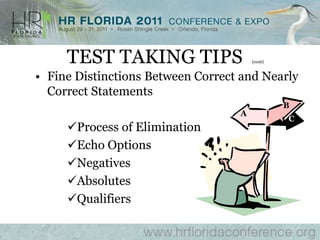
TEST TAKING TIPS  (cont)Fine Distinctions Between Correct and Nearly Correct StatementsProcess of Elimination
Echo Options
Negatives
Absolutes
QualifiersBAC
Sample Test QuestionThe owner of a growing authentic Japanese Steak house is looking to hire his 10th employee. The amount of applicants overwhelm him.  In frustration, the owner suddenly announces that only Japanese applicants may apply.  One Caucasian applicant remains.  The applicant states that the owner has acted illegally and that he is going to report the owner to the EEOC.  The owner  _________A.  Has nothing to fear from this EEOC complaint B.  Should just hire the applicant to keep him quietC.  Must go ahead and interview this applicantD.  Should interview the applicant and make a contingent offer
EXAM & DEADLINES
TOTAL REWARDSPresented byDon C. Works, III, JD, SPHRJackson Lewis LLPOrlando407-246-8433worksd@jacksonlewis.com
LAWS GOVERNING COMPENSATIONDavis-Bacon Act, 1931Copeland "Anti-Kickback" Act, 1934Walsh-Healey Act, 1936Fair Labor Standards Act (FLSA), 1938Equal Pay (EPA), 1963
FLSAEstablishes Minimum WageRequires Overtime Pay - 1.5 hours over 40Establishes exemptions from overtime & minimum wage (“exempt” v. “non-exempt”)Limits employment of child labor
FLSA EXEMPTIONS	Exempt Employees Must Generally Meet Two Tests Requirements:Paid on a Salary Basis, With a Salary of At Least $455/week and Without Improper DeductionsPerform Exempt Duties
EXECUTIVE EXEMPTIONEmployee’s Primary Duty Must be the Management of an Enterprise or a Department or Subdivision and:– Direct the Work of at Least Two or More FTE’s          (or  Equivalent PTE’s) – Authority to Hire, Fire or Make Recommendations– Recommendations are Given Particular Weight
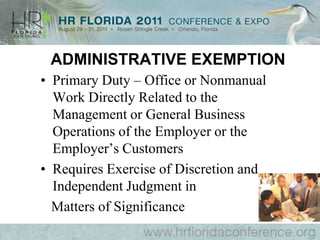
ADMINISTRATIVE EXEMPTIONPrimary Duty – Office or Nonmanual Work Directly Related to the Management or General Business Operations of the Employer or the Employer’s CustomersRequires Exercise of Discretion and Independent Judgment in    Matters of Significance
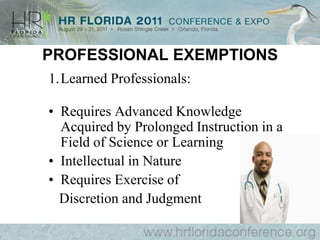
PROFESSIONAL EXEMPTIONSLearned Professionals:Requires Advanced Knowledge Acquired by Prolonged Instruction in a Field of Science or LearningIntellectual in NatureRequires Exercise of    Discretion and Judgment
PROFESSIONAL EXEMPTIONSCreative Professionals:Have a Primary Duty Performing Work That Requires Invention, Imagination, Originality, or Talent
Perform in a Recognized     Field of Creative or    Artistic Endeavor
HIGHLY COMPENSATED EMPLOYEE EXEMPTIONA Highly Compensated Employee Must:Minimum Compensation of at least $100,000.00 ($455/week of which must be paid on a salary basis)Perform One of the Job Duties of an Exempt Administrative, Executive, or Professional
COMPUTER RELATED OCCUPATIONSSalary of $455 Per Week or $27.63 Per HourPerforms higher level computer work involving design, analysis and implementation of systems“Help desk” positions not exempt
OUTSIDE SALES EXEMPTIONAn Employee Must:Have a Primary Duty Involving Making Sales or Obtaining Orders and ContractsBe Customarily and Regularly Engaged Away From the Employer’s Place of BusinessNote:  No salary requirement
PERMISSIBLE DEDUCTIONS FROM SALARYFull day absences due to sickness or disability if deductions under a bona fide plan, policy or practice of providing wage replacement benefits for these types of absencesGood faith full day disciplinary suspensions for infractions of written workplace conduct rulesFirst or last week of employment, as long as the employee is paid a proportionate share of salary for time actually workedPenalties imposed in good faith for violating safety rules of “major significance”FMLA leave including both partial and full day absencesTo offset amounts received as payment for jury fees, witness fees or military pay
SAFE HARBOR“Salary Basis” will not be destroyed if:Employer Has a Clearly Communicated Policy Prohibiting Improper Pay DeductionsEmployees Are Reimbursed for Any Improper DeductionsEmployer Makes a Good-Faith Effort to Comply in the Future
FLSA MINIMUM WAGE REQUIREMENTS$7.25 July 24, 2009$2.13 Per Hour Tip Credit Unchanged– Cash Wage Plus Tips = Minimum Wage
FLSA BASIC OVERTIME REQUIREMENTSSets Rate of Overtime Pay    (1.5  X Regular Pay)Requires Overtime for “Hours Worked”Workweek Is Any Fixed, Recurring Period of 168 Hours (7 Days X 24 Hours)
COMPENSATORY TIMEOvertime Usually Must Be Paid in CashPublic-Sector Employers May Grant Compensatory Time OffPrivate-Sector Employers May Not Pay With “Comp” Time
PORTAL-TO-PORTAL ACT Defines the Beginning and End of the Workday Provides Guidelines On:On-call/standby TimePreparatory/Concluding ActivitiesWaiting TimeMeals and BreaksTravel TimeTraining Time
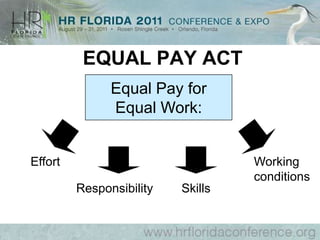
EQUAL PAY ACTEqual Pay forEqual Work:EffortWorkingconditionsResponsibilitySkills
DIRECT VERSUS INDIRECT COMPENSATIONBase PayDifferential PayIncentive PaySelected EmployeesCash RecognitionLegally Required BenefitsIncome ReplacementSTD/LTDMedicalDeferred PayPay for Time Not Worked/Unpaid Leave
ECONOMIC FACTORS THAT   IMPACT COMPENSATION SYSTEMInflation – COLA’sSalary CompressionInterest RatesForeign CompetitionWage/Price SpiralEconomic GrowthProductivity/Labor Market Trends
COMPENSATION SYSTEM OBJECTIVESAttractMotivateRetainCompetitiveEquitable
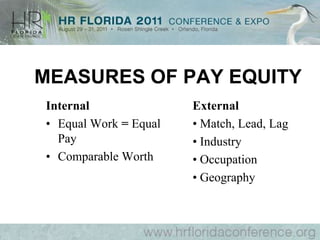
MEASURES OF PAY EQUITYInternalEqual Work = Equal PayComparable WorthExternal Match, Lead, Lag Industry Occupation Geography
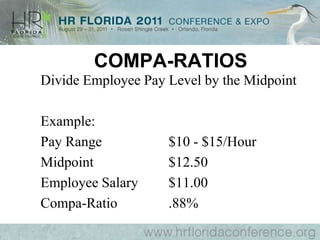
COMPA-RATIOSDivide Employee Pay Level by the MidpointExample:  Pay Range			$10 - $15/HourMidpoint			$12.50Employee Salary 	$11.00Compa-Ratio		.88%
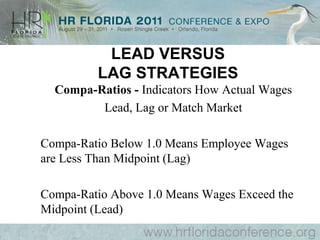
LEAD VERSUS LAG STRATEGIESCompa-Ratios - Indicators How Actual Wages Lead, Lag or Match MarketCompa-Ratio Below 1.0 Means Employee Wages are Less Than Midpoint (Lag)Compa-Ratio Above 1.0 Means Wages Exceed the Midpoint (Lead)
JOB EVALUATIONUsed to Determine Relative Worth Of JobsDerived from Job AnalysisNon-Quantitative/Quantitative
JOB EVALUATION METHODOLOGYJob RankingPaired ComparisonPoint-Factor Factor ComparisonMarket Based
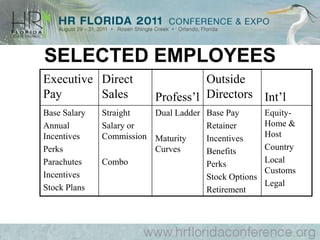
SELECTED EMPLOYEES
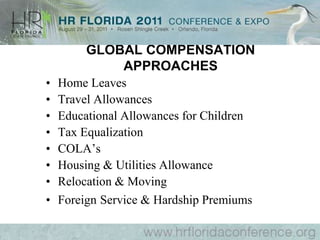
GLOBAL COMPENSATION APPROACHESHome LeavesTravel AllowancesEducational Allowances for ChildrenTax EqualizationCOLA’sHousing & Utilities AllowanceRelocation & Moving  ForeignService & Hardship Premiums
GLOBAL COMPENSATION APPROACHESBalance SheetGlobal MarketTax Equalization Plan
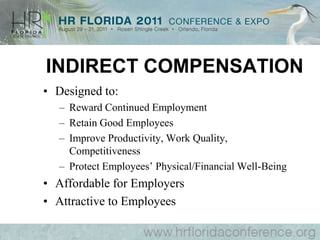
INDIRECT COMPENSATIONDesigned to:Reward Continued EmploymentRetain Good EmployeesImprove Productivity, Work Quality, CompetitivenessProtect Employees’ Physical/Financial Well-BeingAffordable for EmployersAttractive to Employees
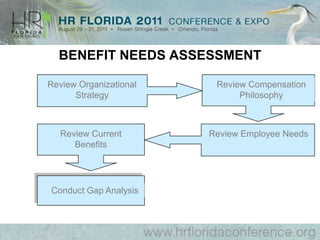
Review Organizational StrategyReview Compensation PhilosophyReview Employee NeedsReview Current BenefitsConduct Gap AnalysisBENEFIT NEEDS ASSESSMENT
GAP ANALYSIS   Revise Benefits That Are Not Meeting   Employee or Organizational Needs
LEGALLY MANDATED BENEFITSSocial Security/MedicareUnemployment InsuranceWorkers’ CompensationCOBRAFMLA
WORKERS’ COMPENSATIONStateInsurance Program Paid for by the   Employer According to the State by Its Own State Law and by the Federal Government for Federal WorkersProvides Income Continuation and   Reimbursement of Accident Expenses for   Employees Who Are Injured on the Job
CATEGORIES OF WORKERS’ COMPENSATION BENEFITS1. Permanent and Total Disability2. Permanent and Temporary Partial   Disability3. Survivor’s Benefits in Cases of Fatal Injuries4. Medical Expenses5. Rehabilitation
EMPLOYEE RETIREMENT INCOME SECURITY ACT (ERISA)Applies to Retirement Plans, Medical    Plans, Group Life Insurance, Long Term DisabilitiesBasic Standards must be Met for Benefit    Programs to Maintain their Tax-Favored StatusDesigned to Protect Employees in Private    Sector
ERISA (continued)Two minimum options for vesting:1. Cliff Vesting2. Graded
ERISA (continued)Pension Benefit Guaranty Corporation (PBGC)– Guarantee of Payment (With Limits) to Employees Covered by Terminated Pension PlansRevenue Act Of 1978    – Section 125 - Can Offer Favorable Tax Treatment on Benefits    – Section 401k - Allow Tax Favored Pay Deferrals Toward RetirementRetirement Equity Act (REA), 1984- Legal Protection for Spousal Beneficiaries
REQUIRED COMMUNICATIONERISA Requires:Summaries of the Plan Description, Annual Report, and Material ModificationsFiling Form 5500 With the IRSOther Required Communications Include:Continuation of Benefits’ NoticeExplanation of Stock Options (SEC Regulation)Posting of Workers’ Compensation Benefits (Required by States)
Consolidated Omnibus BudgetReconciliation Act (COBRA)Employers Who Provide Health Care and   Employ More Than 20 People Must Provide Continuation BenefitsException: Employment Terminated Due to Gross Misconduct
COBRA QUALIFYING EVENTSVoluntary TerminationInvoluntary Termination of Employment for any Reason Other Than Gross MisconductDisability as Determined by the SSAReduction in Hours Resulting in Loss of BenefitsDivorce or Legal Separation From the EmployeeEmployee Becomes Eligible for MedicareDependent Ceases to Be a “Dependent Child” Under Plan RulesDeath of the Employee
CONTINUATION PERIODS(Months)Termination of Employment      for Gross Misconduct                                                0Termination of Employment for any     Reason other than Gross Misconduct                      18Reduction in Hours                                                  18Employee Is Disabled at the Time of      Reduction in Hours or Termination                         29Divorce or Death of the Employed Spouse              36Dependent Child Loses Eligibility Status                36
WHEN DOES A COBRA COVERAGE END?Premium for Coverage Is Not PaidEmployer Terminates Group Health   CoverageBeneficiary Becomes Covered Under   Another Group Health PlanQualified Beneficiary Is Entitled to Medicare Benefits
COBRA(continued)Four Notices Employers Must Provide:1. General Notice2. Election Notice3. Notice of Unavailability    of Continuation Coverage4. Notice of Termination of Continuation
FAMILY AND MEDICAL LEAVE ACT (FMLA)Provides 12 Weeks of Unpaid Leave for: Serious Health Condition of Employee, Spouse, Parent or Child; Birth, Adoption or Placement & To Care for Child; A Qualifying Exigency; Being the Spouse, Child, Parent or Next of Kin of a Covered Service Member with a Serious Injury or Illness.Covered Employers - 50+ EmployeesEligible Employees – 12 Months/1,250 Hours at Worksite with 50 or more employees within 75 miles     a. Health Benefit Continuation     b. Reinstatement Rights     c. Intermittent Leave (right to transfer to accommodate)
Uniformed Services Employment & Reemployment Rights Act “USERRA”Provides protected leave for up to 5 years of military serviceGuarantees reinstatement to job individual would have held but for leave (escalator principle)Must permit continuation of health care coverage for up to 24 months (can require payment of up to 102% of premiums) 
OLDER WORKERS BENEFITPROTECTION ACT  (OWBPA) 1990Covers Compensation, Terms, Conditions and Privileges Provided Under Employee Benefit PlansMust Be Given 21 or 45 Days to Consider Any    Agreement Under ADEAGroup Terminations or Retirement Programs -Provide 7 Days to Revoke Agreement After Signing Eligible Employees Must Be Provided With    Certain Demographic Information As a Part of    Group Term Release or ADEA Claims
OMNIBUS BUDGET RECONCILIATION ACT (OBRA) Reduces Compensation Limits in Qualified    Retirement ProgramsRequire That Health Plans Honor Qualified    Medical Child Support Orders for Dependent    Children of Employees When Issued by a CourtGroup Health Plans Must Provide Coverage for    Dependent Adopted Children When Those Children Are Placed for Adoption in a Covered Employee’s Home
Health Insurance Portability &Accountability Act (HIPAA)Limits Exclusion for Preexisting ConditionsEnsures Availability of CoverageGuarantees RenewabilityAllows Employees to Change Jobs Without    Concern of Losing CoverageRestricts "Actively at Work" Requirements to    Health Plan EligibilityEstablished Anti-discrimination Rules for    Plan Participants
QUALIFIED DEFERREDCOMPENSATION PLANSHelp to Recruit and Retain EmployeesAllow People to Retire, Creating New Employment OpportunitiesProvide Tax Deferrals for Owners and Highly Compensated Employees (HCEs)
CHARACTERISTICS OFQUALIFIED PLANSUnder ERISA, Plans Must:Be in Writing and Be Communicated to EmployeesBe Established for Exclusive Benefit of Employees/beneficiariesSatisfy Rules Concerning Eligibility, Vesting, and FundingNot Favor Officers, Shareholders, or HCEs
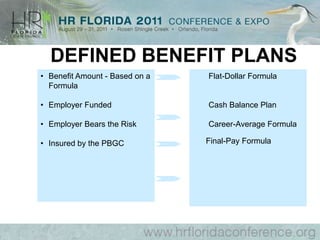
DEFINED BENEFIT PLANSFlat-Dollar FormulaCash Balance PlanCareer-Average Formula      Final-Pay FormulaBenefit Amount - Based on a Formula
Employer Funded
Employer Bears the Risk
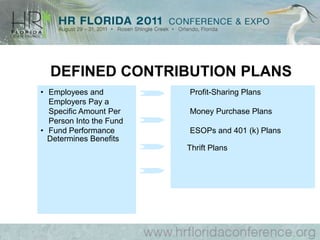
Insured by the PBGCDEFINED CONTRIBUTION PLANSProfit-Sharing PlansMoney Purchase PlansESOPs and 401 (k) Plans      Thrift PlansEmployees and Employers Pay a Specific Amount Per Person Into the Fund
Fund Performance   Determines Benefits
CASH BALANCE PLANType of Defined Benefit PlanDefines Benefit in Terms of Stated Account BalanceEmployers Assume Investment Risks and RewardsIs PortableAt Retirement Employees Receive:Lifetime AnnuityLump Sum
NONQUALIFIED DEFERREDPLANSProvide Additional Benefits to Key Executives Employees Defer Reporting Income; Not Subject to the Limits Placed on Qualified PlansEmployer Contributions Are Not Deductible Funds Are not protected by ERISA
HEALTH-CARE PLANSIndemnity (Fee-for-service) PlansFull-choice PlanEmployees Can Go to Any Qualified PhysicianFees Are Generated When Services Are UsedManaged Care PlansPrepaid Health-care PlansPhysician Is Paid Per Capita (Per Head) Rather Than for Actual Treatment ProvidedMembers Enroll and Pay a Set Monthly or Annual Fee
TYPES OF MANAGED CARE PLANSHealth Maintenance OrganizationsGroup, Staff, and IPA ModelsPreferred Provider Organizations	Point-of-service OrganizationsExclusive Provider OrganizationsPhysician Hospital Organizations
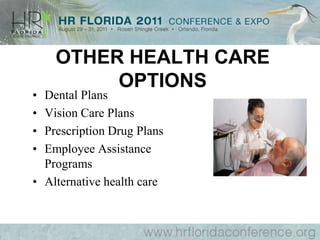
OTHER HEALTH CARE OPTIONSDental PlansVision Care PlansPrescription Drug PlansEmployee Assistance ProgramsAlternative health care
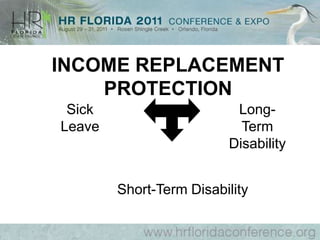
INCOME REPLACEMENTPROTECTIONSick LeaveLong-Term DisabilityShort-Term Disability
CAFETERIA PLANS SECTION 125 Premium-only PlansEmployees Receive Favorable Tax Treatment on Benefits Already OfferedFlexible Spending AccountsPretax Dollars Are Set Aside to Pay for Dependent Care or Unreimbursed ExpensesMust “Use It or Lose It”Full Cafeteria PlansBenefit Credits Are Used to Purchase BenefitsUnused Credits Can Be Cashed Out
CAFETERIA PLANS – ADVANTAGESTailored to Employee’s Needs; Change as Employees’      Lives ChangeEfficient Use of BenefitsEmployer Sensitivity to All Program Costs and Employee Cost SharingEmployee’s Awareness of Benefits and CostFavorable Tax TreatmentEmployer’s Cost of Benefits Can Be Lowered Over Time
CAFETERIA PLANS – DISADVANTAGESInappropriate Benefits ChosenComplicated Record KeepingAdverse Selection (Benefits Selected Only by Employees Who Fully Utilize Those Benefits)NondiscriminationRequirementsIRSCode
LIFE INSURANCE PROTECTIONSalary ContinuationGroup-Term Life InsuranceExcess Group-Term Life InsuranceDependent Group Life InsuranceSplit-Dollar Plans
PAID LEAVEPaid Leave for Events:Holiday PayVacation PayCommunity Service PayLeave of AbsenceBereavement LeavePaid-Time-Off BanksLumped Into One Account
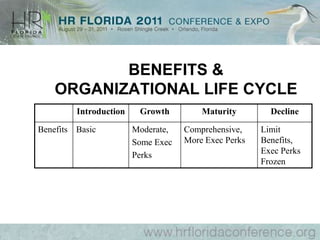
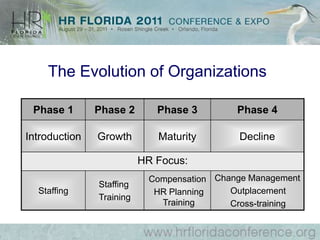
BENEFITS &ORGANIZATIONAL LIFE CYCLE
WORKFORCE PLANNINGPresented byDon C. Works, III, JD, SPHRJackson Lewis LLPOrlando407-246-8433worksd@jacksonlewis.com
EQUAL EMPLOYMENT OPPORTUNITYDecisions Must Be Job and Business RelatedHiringWork AssignmentsCompensationPromotionsTerminations
PURPOSE OF EQUAL EMPLOYMENT OPPORTUNITY INITIATIVESPrevent Employee Discrimination In The WorkplaceTake Remedial Action To Offset Past Employee Discrimination
TWO TYPES OF DISCRIMINATIONDisparate Treatment – Intentional ActDirect DiscriminationUnequal Treatment Decision Based on Protected Characteristic Prejudiced Actions Different Standards For Different Groups Disparate Impact – Unintended or IntentionalIndirect DiscriminationUnequal Consequences Or Results Decision Not Based on Protected Characteristic Unintentional Discrimination Neutral Actions Same Standards But Different Consequences
ADVERSE IMPACTOccurs When There Is A Substantially Different Rate Of Selection In Hiring, Promotion, or Other Employment Decisions Which Works To The Disadvantage Of Members Of Protected Groups4/5ths Rule – success rate of protected group less than 80% of other group
2007 EEO-1 REPORT OVERHAUL"Two or more races, not Hispanic or Latino"; "Asians, not Hispanic or Latino"; "Native Hawaiian or Other Pacific Islander, not Hispanic or Latino"; "Asian and Pacific Islanders" Category Deleted
EEO-1 REPORT OVERHAUL"Officials and Managers" Divided Into Two Levels Based on Responsibility and Influence Within the Organization: (1) “Executive/Senior Level Officials and Managers”  (2) “First/Mid-Level Official and Managers”Non-Managerial Business and Financial Occupations Moved From the "Officials and Managers" Category to the "Professionals" Category
Title VII of the Civil Rights ActProhibits discrimination against protected classes.Makes it unlawful to deny career advancements to protected classes.Prohibits discrimination because of pregnancy, childbirth, or related conditions.
Title VII of the Civil Rights ActProvides equal opportunity for training.Prohibits sexual harassment.Prohibits compensation discrimination.
Age Discrimination in Employment ActAge 40 and overOlder Workers Benefit Protection ActRelease languageGroup versus individual releases
Americans with Disabilities Act (ADA)Protects qualified individuals with a disabilityProhibits medical exams or inquiries about a disability, except in certain situationsRequires reasonable accommodation that enables employees to perform essential functions as long as there is no undue hardship
Who Is Protected By ADA?Individual with a physical/mental impairment that substantially limits a major life activityRecord of impairmentRegarded as having an impairmentAssociated with a disabled personCan perform the essential functions of the job with or without reasonable accommodation
Other Legislation Which Impacts Workforce PlanningPregnancy Discrimination ActImmigration Reform & Control ActRehabilitation Act (contractors - $2,500+)Worker Adjustment & Retraining Notification Act (“WARN”)EPPAFair Credit Reporting Act
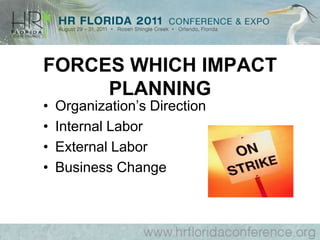
FORCES WHICH IMPACT PLANNINGOrganization’s DirectionInternal LaborExternal LaborBusiness Change
JAC FITZ-ENZ – P.E.R.M. MODELProjectionsEvaluate - Key Group ReviewRecruitment PlanMeasurement - ROI
P.E.R.M. ROI – INDICATORSPlanning - % of Jobs Filled InternallyEvaluation – Past Source Performance & TenureRecruitment – Future Source Cost, Time, QualityMeasurement – Business KPI’s Affected
ANALYSIS OF RECRUITMENT SOURCESSourcing MediaAdvertisingAgenciesReferralsEventsSelection MethodsScreeningAssessmentInterviewsTesting
INCREASING INTERVIEWING ACCURACYAll Voters Must Know PositionDelay Yes/No DecisionMulti-Factor AssessmentGive Each Interviewer 2-3 Traits to AssessPanel InterviewsFormal Debriefing ~ Lou Adler
WORKFORCE PLANNING METRICSCost Per HireTime to FillYield Ratios – Used to evaluate recruiting sourcesAdverse Impact
JOB ANALYSIS DEFINEDSystematic study of a job to determine qualifications, responsibilities, conditions and relationship to other jobsIdentify Tasks, Duties & ResponsibilitiesEvaluate KSAs (Knowledge, Skills and Abilities)
ORGANIZATIONAL LEVELOrganizational DevelopmentFunction & ResponsibilitiesDevelopment of Organizational Divisions
ORGANIZATIONAL LEVELClassification & CompensationCreation of Job Families Pay Equity
JOB LEVELRecruitment & SelectionJob DescriptionJob Specifications - KSAs
JOB LEVELTraining & Performance ManagementJob Relevant GoalsStandards of Performance
DISSECTING TASKSJob CategoryResponsibilityTask StatementWhat Makes a Good Task Statement?
TASK STATEMENTBehaviorally BasedActionTargetHowWhy
TASK STATEMENT	Analyzes jobs using various methodologies within federal, local, and professional standards in efforts to define levels of responsibility & specific tasks; as well as the level of specific KSAs, necessary for successful performance.
KSAs vs. CompetenciesKnowledge – SpecificSkill – Degree of PerformanceAbility – Mental or Physical CapacityCompetencies: Groupings of KSAs that Relate to a Particular Purpose or Function
METHODOLOGY5 PHASES OF JOB ANALYSISIdentification of Function & ResponsibilitiesTask Statement Data CollectionTask Statement Development & RefinementKSA Development & RefinementDocumentation Report
JOB ANALYSIS METHODOLOGY CLOSE UPPHASE I – ORGANIZATIONAL LEVELPurpose & Responsibilities of JobPlace in Organizational HierarchyLocation & Work Environment
JOB ANALYSIS METHODOLOGY CLOSE UPPHASE II – INITIAL TASK STATEMENTCollect Existing Task Statement InformationDevelop List of Tasks & Responsibilities– Strategic Tools: Surveys, Questionnaires,         Round  Tables, Workplace Shadowing
Job Analysis MethodologyCLOSE UPPHASE III – TASK DEVELOPMENT &                          REFINEMENTConsolidate & RefineFrequency & DurationImportance Levels
Job Analysis MethodologyCLOSE UPPHASE IV – KSA DEVELOPMENT &                        REFINEMENTDetermine KSAs Needed to Effectively Perform Each TaskMinimum QualificationsCompetency Model Development
Job Analysis MethodologyCLOSE UPPHASE V – DOCUMENTATION REPORTStatistically Analyze All Task & KSA DataCreate Written Job Descriptions & SpecsDetermine Classification & CompensationDevelop Plans for Selection & Performance ManagementPrepare Report Documenting Methodology & Results
USES OF JOB ANALYSISRecruitingCompensationCareer PathsSuccession PlanningTrainingOrganizational DesignPerformance StandardsPerformance EvaluationsTime ManagementComplianceAAPLegal Defense
JOB DESIGNRational Approach – Frederick Taylor – work should be arranged so that employees can be efficient & output maximizedJob Enrichment – Frederick Hertzberg – design work for employees’ personal enrichment
RELIABILITY & VALIDITYReliability is the Ability of an    Instrument to Measure Consistently and with Relative Absence of Error
RELIABILITY & VALIDITYValidity is the Ability of an Instrument to Measure What it is Intended to Measure Validation Answers Two Questions:What does the instrument measure?How well does the instrument measure it?
RELIABILITY & VALIDITY A Reliable Item is Consistent  May Not Be Valid
RELIABILITY & VALIDITYReliability Can Be Measured By : Parallel Forms – uses two forms with different items – scores correlated for each individualTest/Retest – measures degree to which scores are the same over timeInternal Consistency – equivalent parts of test taken separately and results correlated
RELIABILITY & VALIDITYContent Validity – Simplest    Job Analysis KeyConstruct Validity – Most Complex Measures Theoretical Construct or TraitCriterion-Related Validity – (Preferred) Trait of Work Behavior that is Predicted by a Test
CRITERION RELATED VALIDITYConcurrent Validity – Test is Given to         Current Employees– Scores Correlated         with Performance         RatingsPredictive Validity – Before the Fact Measure – Test Results Correlated    with Subsequent Job     Performance Usually     After 12 Months    (Preferred by EEOC)
RISK MANAGEMENTPresented byDon C. Works, III, JD, SPHRJackson Lewis LLPOrlando407-246-8433worksd@jacksonlewis.com
DefinitionRisk Management is the use of insurance and other strategies in an effort to prevent or minimize an organization's exposure to liability in the event a loss or injury occurs.
Categories of Operational RiskPersonnel RiskPhysical AssetsTechnologyRelationships External/Regulatory
OSHA General Duty Clause	Each employee has the right to “a place of employment which is free from recognized hazards that are causing or are likely to cause death or serious physical harm.”
Employee Responsibilities & RightsComply with rulesRight to safety & healthRight to request inspectionRight to file complaintRight to be informed of workplace hazardsRight to request action to correct hazardsRight to file a discrimination/retaliation complaintRight to receive training
Best Known OSHA StandardHazard Communication (also known as the Employee Right-to-Know Law)  It requires:An inventory of hazardous chemicals An evaluation of chemical hazardsCommunication / TrainingMSDS
OSHA Inspection PrioritiesImminent dangerCatastrophes & fatal accidentsEmployee complaintsHigh-hazard industriesFollow-up inspectionsAre they in order of priority?
Purpose of Safety ProgramsPrevent work-related injuries, accidents or incidentsDefinitions:Incident – deviation from any acceptable standardHazard – incident without adequate controls applied
Classification of IncidentsUnsafe ActsFailing to use protective equipmentRemoving safety devicesUsing equipment improperlyDressing improperlyOperating equipment at unsafe speedsPerforming unauthorized proceduresUnsafe ConditionsDefective equipmentHazardous processNoise, heat, dustFumes, chemicalsPoor ventilationImproper lightingUnsafe floor surfacesUnsafe stacking, storingInadequate personal protection equipment
Accident InvestigationPurpose of investigations?Most important result of investigations?Priorities at the scene?
HealthHealth HazardsInfectious DiseasesEnvironmental Health HazardsFetal Protection PoliciesEmployee Assistance ProgramsCan you require EAP treatment?Employee Wellness & Fitness ProgramsChemical Dependency
SecurityFireIndustrial SabotageTrespassingEmployee Theft Natural DisastersTheft/Sabotage of Classified InformationViolence Terrorism
Theft and Fraud30% of employees admit stealing40% hits companies under 100 workersTechnology has made it easierGoes up in a down economyWhy some organizations make employees take 1 – 2 weeks off
Security Risk AnalysisVulnerabilities are considered firstSpecific or genericProbability of occurrence Virtually certainHighly probableModerately probableImprobableAssessment of impact or costLevel 1 (fatal to org.), 2, 3, or 4 (negligible)
Business Continuity & RecoveryDisaster Recovery Plan  procedures to recover lost data in the event of a disasterEmergency Response/Preparedness Plandescribes the action to be taken by all personnel to respond to natural or human disasters
Can the Workplace Cause Stress &  Violence?HarassmentPoor management stylePressure for increased productivity\unrealistic job expectationsMis-handled job terminationsUntrained supervisorsLack of zero tolerance for inappropriate behavior
Workplace PrivacyEmployer Privacy ConcernsProtection of Propriety InformationIdentify what needs protectingGet confidentiality & nondisclosure agreementsTechnology Security RisksEmployee Privacy ConcernsIdentify TheftMonitoring employees
Employee & Labor Relations
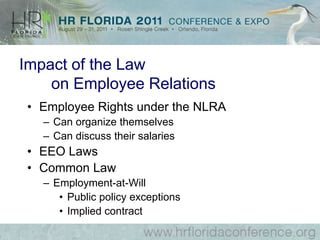
Impact of the Law 	on Employee RelationsEmployee Rights under the NLRACan organize themselvesCan discuss their salariesEEO LawsCommon LawEmployment-at-WillPublic policy exceptionsImplied contract
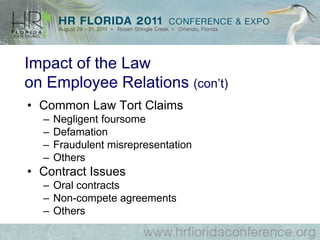
Impact of the Law on Employee Relations (con’t)Common Law Tort ClaimsNegligent foursomeDefamationFraudulent misrepresentationOthersContract IssuesOral contractsNon-compete agreementsOthers
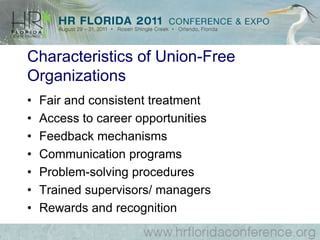
Characteristics of Union-Free OrganizationsFair and consistent treatmentAccess to career opportunitiesFeedback mechanismsCommunication programsProblem-solving proceduresTrained supervisors/ managersRewards and recognition
Employee Involvement StrategiesJob DesignAlternative Work SchedulesTeamsEmployee Suggestion SystemsEmployee SurveysFocus Groups
Problem-Solving ProceduresDiscipline ProcessAlternative Dispute Resolution (ADR)Prevents escalation of issuesPrivate forumCost-effectiveAn umbrella term for over 23 optionsMust have basic elements of due processBecomes a condition of employment
The MOST beneficial outcome of an effective employee discipline process is:A structured method for addressing substandard performance.A productive workforce with high levels of personal accountabilityA reduction of legal challenges to termination decisions.Workforce compliance with rules and performance standards.
Labor Relations LegislationNational Labor Relations Act (NLRA)Pro-unionLabor-Management Relations Act (LMRA)Established balance of powerUnion shops, right-to-work statesLabor-Management Reporting and Disclosure Act (LMRDA)Protect employees from corrupt unionsOthers
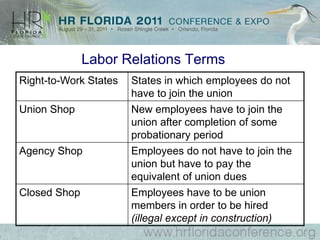
Labor Relations Terms
Union OrganizingInitial contact may occur via: A union organizer contacting employeesManagement contacting a unionEmployees contacting a union
Union Organizing TacticsInside organizingSaltingLeafletingMeetingsHome visitsInternet campaignsOthers
PicketingA form of free speechOrganizational picketingInduce employees to accept the unionRecognitional picketingObtain the employer’s recognition of the unionInformational picketingAdvise the public
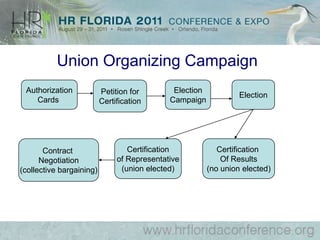
Union Organizing CampaignPetition forCertificationAuthorizationCards ElectionCampaignElectionCertification Of Results(no union elected)Certificationof Representative(union elected)Contract Negotiation(collective bargaining)
Managements Rights in a CampaignTake the initiativeState an opinionPoint out the consequences of a strikeCommunicate through supervisors & meetingsState that improvements are notdependent on unionizationPoint out the financial costs of a union
Employer Unfair Labor Practices (ULPs)ThreatenInterrogatePromiseSpyKnown as “TIPS” or “SPIT”Don’t forget discrimination or retaliation
Union Organizing CampaignAuthorization CardsPrimary method of employees showing interestUnion must have 30% of eligible employees sign to proceedUsually will not petition for an election until more than one-half of employees signAre legal documentsDon’t touch the cards if presented
Petition for CertificationElection is most traditional route toward union recognition – 90%Authorization cards are primary example of supporting evidenceConsent Election(waive pre-election hearing)Directed ElectionVoluntary recognition can occur, but happens infrequently
NLRB Pre-Election HearingAfter determining validity of signatures and sufficient interest, the following are issues are decided:Voter eligibilityDetermination of the bargaining unitCommunity of interestsGeographyOthersTime, date or place of the election
ElectionExcelsior ListNames and addresses of all eligible bargaining unit employeesVoter EligibilityOn payroll for at least 3 payroll periodsCampaignNot within 24 hours of election
Election ProcessLooks like a general electionNo campaigning around polling areaBoth parties have representativesEither party may challenge voter eligibilityNLRB counts unchallenged ballotsSimple majority of voting employees wins 50% plus one person
Other Paths to UnionizationEmployer volunteers recognitionUnion convinces the employer to grant recognitionUnion convinces the employer to witness its majority statusCounting the authorization cardsULPs
Unfair Labor Practices by the EmployerTIPS Employee committeesElectromation CaseCrown Cork and Seal Company CaseNo negotiating or proposingDiscouraging union membership illegallyRetaliationRefusal to bargain
Unfair Labor Practices by the UnionRestraints and coercionFailure to provide fair representationDiscrimination against non-membersExcessive membership feesFeatherbeddingRefusal to bargain
Collective BargainingDefinition – the process by which management and union representatives negotiate the employment conditions for a particular bargaining unitMust be done in good faithResults in (ideally) – a collective bargaining agreement (CBA)
Collective Bargaining SubjectsMandatory Subjects Issues identified specifically by labor laws or court decisions as subject to bargainingWages, benefits, working conditions, overtime, etc.Can only strike legally over mandatory subjectsPermissive Subjects Those that may be bargained but are not obligatoryBenefits for retirees, settlement of ULPs, etc.Illegal subjectsThose that are unlawful by statute
Collective Bargaining – Public SectorSubjects are limited – why?No mandatory subjectsPublic sector employees generally not permitted to strikeNo negotiation over wage ratesStates may differ
Collective Bargaining PatternsPattern (parallel) BargainingUnion focuses on one employer and then negotiates similar contracts with competitorsAuto industryCoalition (multiple employer) BargainingMore than one employer negotiates with unionTrucking industry / coal mining industryCoordinated BargainingEmployer bargains with two or unions simultaneouslyAirline industry
Contract ClausesUnion security clausesUnion shopAgency shopManagement rightsBumpingStrikes and lockoutsZipper clause
Enforcement ProvisionsGrievance procedureSpecific stepsWeingarten rightsArbitrationVoluntaryCompulsoryBinding
Protected Concerted ActivitiesLockout When management shuts down operationsStrikesA refusal by employees to workEconomic strikes (can replace strikers)Unfair labor practices strikes (must reinstate strikers)Wildcat strikes (unprotected)Sympathy strikes
Protected Concerted Activities (con’t)PicketingInformationalCommon situs picketingConsumer picketingSecondary BoycottsGenerally illegalExceptions:Ally doctrineDouble breastingOthers
DecertificationVery similar to election process30% of employees sign a petitionMajority of voting employees decideReasons:Inability to negotiate the first contractFair treatment of employees by employersPoor job of unions providing serviceOthers
Questions?
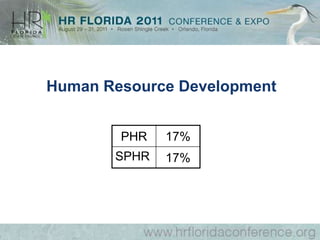
Human Resource Development
Legislation Affecting HRDCopyright ActPublic domainWho owns copyrights?Fair useU.S. Patent ActTrademark ActTitle VII, Civil Rights ActAge Discrimination in Employment ActAmerican with Disability Act
Functions of HRDProvides employees with the skills to meet current & future job demandsAligns & links HRD learning objectives, activities, and outcomes with organization’s goals & business needsIncludes:Organizational Development Training & DevelopmentCareer Development
The Learning OrganizationLearning is tied to business objectives Change is embracedAssumptions are always questionedLearning is both a part of work & a part of everyone's job descriptionFailures become opportunities to learnEmployees take responsibility for their own learning
Knowledge ManagementThe process of creating, acquiring, sharing and managing knowledge to augment individual & organizational performance Facilitates information exchange & transfer between employeesTaps expertise of those leaving the organization
Global Issues for HRDOrganization change and knowledge management become more complexWestern motivation models and leadership theories may not applyDemand for multilingual/multicultural training is increasingCultural issues have a greater influence on the selection of appropriate training
Competency ModelsA set of behaviors encompassing skills, knowledge, abilities, and personal attributesMay be defined on an organizational or individual basisCore competencies differentiate an organization from its competition and provides for a competitive advantage
Organizational DevelopmentEnhances the effectiveness of an organization and the well-being of its membersOccurs on both a large & small scale Is change managementPrimary roles for HR professionals:Serve as change agentsConduct evaluations of OD interventions
OD Intervention StrategiesInterpersonal strategiesDeal with work relationshipsTechnological strategies Focus on processesInclude job design & work flow analysisStructural strategiesLook at how the structure of the organization is helping or hindering the organization
Quality InitiativesISO 9000+ / Six Sigma / LeanQuality ToolsProcess-flow analysisControl chartCause-and-effect diagramScatter diagramHistogramCheck sheetPareto chart
Training & DevelopmentThe ADDIE ModelAssessment or AnalysisDesignDevelopmentImplementationEvaluation
Types of Training ProgramsOrientation and on-boardingSkill developmentSupervisory/managerial Defense in lawsuitsCorporate responsibilityOther
Evaluation of Training ProgramsDon Kirkpatrick’s ModelLevel One – did you like it?ReactionLevel Two – did you learn anything?Measuring learningLevel Three – did anything change?Measuring behaviorLevel Four – any affect on organization?Measuring results
Learning and MotivationAssumptions about adult learningObstacles Learning stylesAuditoryVisualKinestheticLearning levelsIntrinsic vs. extrinsic factors
Which of the following intrinsic factors affect an employee’s willingness to do the job?Opportunities for recognition and relationships with co-workersOpportunities for personal growth and achievementWorking conditions and job securityJob environment and pay
Motivational TheoriesMaslow’s Hierarchy of NeedsHerzberg's Motivation-Hygiene TheoryVroom’s Expectancy TheorySkinner’s Behavioral Reinforcement TheoryEquity TheoryMcClelland’s TheoryTheory X and Theory Y
A first-line supervisor desires a management position.However, only college graduates seem to be promoted.The employee decides not to enroll in college since balancing work and school would be too hard. According to Vroom, the employeeDoes not believe that a college degree will lead to a management job.Does not want a management position badly enough.Does not trust company management.Lacks confidence in himself.
Career DevelopmentCareer PlanningFocus on the individualCareer ManagementFocus on the organizationTalent ManagementIntegration of HR processes that attract, develop & retain employees that will meet current & future business needs
Career Development ProgramsEmployee self-assessment toolsCoachingMentoringContinuing educationCommittee/team participationApprenticeshipJob rotation, enlargement and enrichmentFast-track programs
Career Development Programs (con’t)Internal mobilityPromotionsRelocationsTransfersDemotions ???Dual ladder programsSuccession planning / replacement planningExpatriation and repatriation
Leadership & ManagementWhich is more important?Are leaders born or made?How are leaders developed?Can leadership be taught and learned?What are some obstacles to developing leaders?
Leadership TheoriesTrait Theories Behavioral TheoriesSituation Leadership TheoryHersey-Blanchard’s TheoryBehavioral Leadership TheoriesBlake-Mouton’s TheoryContingency TheoriesFiedler’s TheoryTransformational/Transactional Leaders

2011 certification prep workshop

  • 1.
    WELCOMEHR FLORIDA 2011PHR/SPHRCERTIFICATION PREP COURSESponsored by:August 28, 2011
  • 2.
  • 3.
    THE EXAM: EVERYTHINGYOU NEED TO KNOWWhere Do the Questions Come From?
  • 4.
  • 5.
  • 6.
  • 7.
    Exam Questions: The225 Breakdown
  • 8.
    Scoring the Test:Raw, Scaled & Equating
  • 9.
  • 10.
  • 11.
  • 12.
    Exam and DeadlinesHRCICertification HandbookHR Certification Institute1800 Duke Street · Alexandria, Virginia 22314US Toll Free +1.866.898.4724HR Certification Institute is an affiliate of the Society for Human Resource Managementwww.hrci.org
  • 13.
    WHERE DO THEQUESTIONS COME FROM?Teams of Certified HR Professionals With Special Training in Item DevelopmentEvery Question Passes 3 Levels of ReviewEvery Question Pre-tested Before Being Used to Score the Exam
  • 14.
  • 15.
    THE BIGGEST PIECESPHREmphasis: Workforce Planning & Employment 26% Employee & Labor Relations 22% 48% SPHR Emphasis:Strategic Management 29%Employee & Labor Relations 18% 47%
  • 16.
    EXAM QUESTIONS: THE225 BREAKDOWN
  • 17.
    SCORING THE TESTSRAW,SCALED & EQUATINGRaw ScoresNumber answered correctly (129-144)Scaled ScoresScores 100 – 700 (Minimum 500 is passing)Equating the ScoresNo two tests the sameEnsures comparable proficiencyAdjusts minimum raw scorePHR – 67% to 56% passSPHR – 60% to 50% pass
  • 18.
    WHAT TO EXPECTNo Trick Questions No Trivia Questions No Dates No All of the Above No None of the Above Know Acronyms
  • 19.
    TEST TAKING TIPSRelax- Don’t Study the Night BeforeWon’t Know All of the AnswersArrive on TimeDress Comfortably - Bring SweaterNo Extra Credit for Finishing Early1.07 Per Question
  • 20.
    TEST TAKING TIPS (cont)The Basics:Read each question carefully! The Answer is NOT always “C” Read All of the Choices Answer All Questions First Chosen Answers are Usually Correct
  • 21.
    TEST TAKING TIPS (cont)Fine Distinctions Between Correct and Nearly Correct StatementsProcess of Elimination
  • 22.
  • 23.
  • 24.
  • 25.
  • 26.
    Sample Test QuestionTheowner of a growing authentic Japanese Steak house is looking to hire his 10th employee. The amount of applicants overwhelm him. In frustration, the owner suddenly announces that only Japanese applicants may apply. One Caucasian applicant remains. The applicant states that the owner has acted illegally and that he is going to report the owner to the EEOC. The owner _________A. Has nothing to fear from this EEOC complaint B. Should just hire the applicant to keep him quietC. Must go ahead and interview this applicantD. Should interview the applicant and make a contingent offer
  • 27.
  • 28.
    TOTAL REWARDSPresented byDonC. Works, III, JD, SPHRJackson Lewis LLPOrlando407-246-8433worksd@jacksonlewis.com
  • 29.
    LAWS GOVERNING COMPENSATIONDavis-BaconAct, 1931Copeland "Anti-Kickback" Act, 1934Walsh-Healey Act, 1936Fair Labor Standards Act (FLSA), 1938Equal Pay (EPA), 1963
  • 30.
    FLSAEstablishes Minimum WageRequiresOvertime Pay - 1.5 hours over 40Establishes exemptions from overtime & minimum wage (“exempt” v. “non-exempt”)Limits employment of child labor
  • 31.
    FLSA EXEMPTIONS Exempt EmployeesMust Generally Meet Two Tests Requirements:Paid on a Salary Basis, With a Salary of At Least $455/week and Without Improper DeductionsPerform Exempt Duties
  • 32.
    EXECUTIVE EXEMPTIONEmployee’s PrimaryDuty Must be the Management of an Enterprise or a Department or Subdivision and:– Direct the Work of at Least Two or More FTE’s (or Equivalent PTE’s) – Authority to Hire, Fire or Make Recommendations– Recommendations are Given Particular Weight
  • 33.
    ADMINISTRATIVE EXEMPTIONPrimary Duty– Office or Nonmanual Work Directly Related to the Management or General Business Operations of the Employer or the Employer’s CustomersRequires Exercise of Discretion and Independent Judgment in Matters of Significance
  • 34.
    PROFESSIONAL EXEMPTIONSLearned Professionals:RequiresAdvanced Knowledge Acquired by Prolonged Instruction in a Field of Science or LearningIntellectual in NatureRequires Exercise of Discretion and Judgment
  • 35.
    PROFESSIONAL EXEMPTIONSCreative Professionals:Havea Primary Duty Performing Work That Requires Invention, Imagination, Originality, or Talent
  • 36.
    Perform in aRecognized Field of Creative or Artistic Endeavor
  • 37.
    HIGHLY COMPENSATED EMPLOYEEEXEMPTIONA Highly Compensated Employee Must:Minimum Compensation of at least $100,000.00 ($455/week of which must be paid on a salary basis)Perform One of the Job Duties of an Exempt Administrative, Executive, or Professional
  • 38.
    COMPUTER RELATED OCCUPATIONSSalaryof $455 Per Week or $27.63 Per HourPerforms higher level computer work involving design, analysis and implementation of systems“Help desk” positions not exempt
  • 39.
    OUTSIDE SALES EXEMPTIONAnEmployee Must:Have a Primary Duty Involving Making Sales or Obtaining Orders and ContractsBe Customarily and Regularly Engaged Away From the Employer’s Place of BusinessNote: No salary requirement
  • 40.
    PERMISSIBLE DEDUCTIONS FROMSALARYFull day absences due to sickness or disability if deductions under a bona fide plan, policy or practice of providing wage replacement benefits for these types of absencesGood faith full day disciplinary suspensions for infractions of written workplace conduct rulesFirst or last week of employment, as long as the employee is paid a proportionate share of salary for time actually workedPenalties imposed in good faith for violating safety rules of “major significance”FMLA leave including both partial and full day absencesTo offset amounts received as payment for jury fees, witness fees or military pay
  • 41.
    SAFE HARBOR“Salary Basis”will not be destroyed if:Employer Has a Clearly Communicated Policy Prohibiting Improper Pay DeductionsEmployees Are Reimbursed for Any Improper DeductionsEmployer Makes a Good-Faith Effort to Comply in the Future
  • 42.
    FLSA MINIMUM WAGEREQUIREMENTS$7.25 July 24, 2009$2.13 Per Hour Tip Credit Unchanged– Cash Wage Plus Tips = Minimum Wage
  • 43.
    FLSA BASIC OVERTIMEREQUIREMENTSSets Rate of Overtime Pay (1.5 X Regular Pay)Requires Overtime for “Hours Worked”Workweek Is Any Fixed, Recurring Period of 168 Hours (7 Days X 24 Hours)
  • 44.
    COMPENSATORY TIMEOvertime UsuallyMust Be Paid in CashPublic-Sector Employers May Grant Compensatory Time OffPrivate-Sector Employers May Not Pay With “Comp” Time
  • 45.
    PORTAL-TO-PORTAL ACT Definesthe Beginning and End of the Workday Provides Guidelines On:On-call/standby TimePreparatory/Concluding ActivitiesWaiting TimeMeals and BreaksTravel TimeTraining Time
  • 46.
    EQUAL PAY ACTEqualPay forEqual Work:EffortWorkingconditionsResponsibilitySkills
  • 47.
    DIRECT VERSUS INDIRECTCOMPENSATIONBase PayDifferential PayIncentive PaySelected EmployeesCash RecognitionLegally Required BenefitsIncome ReplacementSTD/LTDMedicalDeferred PayPay for Time Not Worked/Unpaid Leave
  • 48.
    ECONOMIC FACTORS THAT IMPACT COMPENSATION SYSTEMInflation – COLA’sSalary CompressionInterest RatesForeign CompetitionWage/Price SpiralEconomic GrowthProductivity/Labor Market Trends
  • 49.
  • 50.
    MEASURES OF PAYEQUITYInternalEqual Work = Equal PayComparable WorthExternal Match, Lead, Lag Industry Occupation Geography
  • 51.
    COMPA-RATIOSDivide Employee PayLevel by the MidpointExample: Pay Range $10 - $15/HourMidpoint $12.50Employee Salary $11.00Compa-Ratio .88%
  • 52.
    LEAD VERSUS LAGSTRATEGIESCompa-Ratios - Indicators How Actual Wages Lead, Lag or Match MarketCompa-Ratio Below 1.0 Means Employee Wages are Less Than Midpoint (Lag)Compa-Ratio Above 1.0 Means Wages Exceed the Midpoint (Lead)
  • 53.
    JOB EVALUATIONUsed toDetermine Relative Worth Of JobsDerived from Job AnalysisNon-Quantitative/Quantitative
  • 54.
    JOB EVALUATION METHODOLOGYJobRankingPaired ComparisonPoint-Factor Factor ComparisonMarket Based
  • 55.
  • 56.
    GLOBAL COMPENSATION APPROACHESHomeLeavesTravel AllowancesEducational Allowances for ChildrenTax EqualizationCOLA’sHousing & Utilities AllowanceRelocation & Moving ForeignService & Hardship Premiums
  • 57.
    GLOBAL COMPENSATION APPROACHESBalanceSheetGlobal MarketTax Equalization Plan
  • 58.
    INDIRECT COMPENSATIONDesigned to:RewardContinued EmploymentRetain Good EmployeesImprove Productivity, Work Quality, CompetitivenessProtect Employees’ Physical/Financial Well-BeingAffordable for EmployersAttractive to Employees
  • 59.
    Review Organizational StrategyReviewCompensation PhilosophyReview Employee NeedsReview Current BenefitsConduct Gap AnalysisBENEFIT NEEDS ASSESSMENT
  • 60.
    GAP ANALYSIS Revise Benefits That Are Not Meeting Employee or Organizational Needs
  • 61.
    LEGALLY MANDATED BENEFITSSocialSecurity/MedicareUnemployment InsuranceWorkers’ CompensationCOBRAFMLA
  • 62.
    WORKERS’ COMPENSATIONStateInsurance ProgramPaid for by the Employer According to the State by Its Own State Law and by the Federal Government for Federal WorkersProvides Income Continuation and Reimbursement of Accident Expenses for Employees Who Are Injured on the Job
  • 63.
    CATEGORIES OF WORKERS’COMPENSATION BENEFITS1. Permanent and Total Disability2. Permanent and Temporary Partial Disability3. Survivor’s Benefits in Cases of Fatal Injuries4. Medical Expenses5. Rehabilitation
  • 64.
    EMPLOYEE RETIREMENT INCOMESECURITY ACT (ERISA)Applies to Retirement Plans, Medical Plans, Group Life Insurance, Long Term DisabilitiesBasic Standards must be Met for Benefit Programs to Maintain their Tax-Favored StatusDesigned to Protect Employees in Private Sector
  • 65.
    ERISA (continued)Two minimumoptions for vesting:1. Cliff Vesting2. Graded
  • 66.
    ERISA (continued)Pension BenefitGuaranty Corporation (PBGC)– Guarantee of Payment (With Limits) to Employees Covered by Terminated Pension PlansRevenue Act Of 1978 – Section 125 - Can Offer Favorable Tax Treatment on Benefits – Section 401k - Allow Tax Favored Pay Deferrals Toward RetirementRetirement Equity Act (REA), 1984- Legal Protection for Spousal Beneficiaries
  • 67.
    REQUIRED COMMUNICATIONERISA Requires:Summariesof the Plan Description, Annual Report, and Material ModificationsFiling Form 5500 With the IRSOther Required Communications Include:Continuation of Benefits’ NoticeExplanation of Stock Options (SEC Regulation)Posting of Workers’ Compensation Benefits (Required by States)
  • 68.
    Consolidated Omnibus BudgetReconciliationAct (COBRA)Employers Who Provide Health Care and Employ More Than 20 People Must Provide Continuation BenefitsException: Employment Terminated Due to Gross Misconduct
  • 69.
    COBRA QUALIFYING EVENTSVoluntaryTerminationInvoluntary Termination of Employment for any Reason Other Than Gross MisconductDisability as Determined by the SSAReduction in Hours Resulting in Loss of BenefitsDivorce or Legal Separation From the EmployeeEmployee Becomes Eligible for MedicareDependent Ceases to Be a “Dependent Child” Under Plan RulesDeath of the Employee
  • 70.
    CONTINUATION PERIODS(Months)Termination ofEmployment for Gross Misconduct 0Termination of Employment for any Reason other than Gross Misconduct 18Reduction in Hours 18Employee Is Disabled at the Time of Reduction in Hours or Termination 29Divorce or Death of the Employed Spouse 36Dependent Child Loses Eligibility Status 36
  • 71.
    WHEN DOES ACOBRA COVERAGE END?Premium for Coverage Is Not PaidEmployer Terminates Group Health CoverageBeneficiary Becomes Covered Under Another Group Health PlanQualified Beneficiary Is Entitled to Medicare Benefits
  • 72.
    COBRA(continued)Four Notices EmployersMust Provide:1. General Notice2. Election Notice3. Notice of Unavailability of Continuation Coverage4. Notice of Termination of Continuation
  • 73.
    FAMILY AND MEDICALLEAVE ACT (FMLA)Provides 12 Weeks of Unpaid Leave for: Serious Health Condition of Employee, Spouse, Parent or Child; Birth, Adoption or Placement & To Care for Child; A Qualifying Exigency; Being the Spouse, Child, Parent or Next of Kin of a Covered Service Member with a Serious Injury or Illness.Covered Employers - 50+ EmployeesEligible Employees – 12 Months/1,250 Hours at Worksite with 50 or more employees within 75 miles a. Health Benefit Continuation b. Reinstatement Rights c. Intermittent Leave (right to transfer to accommodate)
  • 74.
    Uniformed Services Employment& Reemployment Rights Act “USERRA”Provides protected leave for up to 5 years of military serviceGuarantees reinstatement to job individual would have held but for leave (escalator principle)Must permit continuation of health care coverage for up to 24 months (can require payment of up to 102% of premiums) 
  • 75.
    OLDER WORKERS BENEFITPROTECTIONACT (OWBPA) 1990Covers Compensation, Terms, Conditions and Privileges Provided Under Employee Benefit PlansMust Be Given 21 or 45 Days to Consider Any Agreement Under ADEAGroup Terminations or Retirement Programs -Provide 7 Days to Revoke Agreement After Signing Eligible Employees Must Be Provided With Certain Demographic Information As a Part of Group Term Release or ADEA Claims
  • 76.
    OMNIBUS BUDGET RECONCILIATIONACT (OBRA) Reduces Compensation Limits in Qualified Retirement ProgramsRequire That Health Plans Honor Qualified Medical Child Support Orders for Dependent Children of Employees When Issued by a CourtGroup Health Plans Must Provide Coverage for Dependent Adopted Children When Those Children Are Placed for Adoption in a Covered Employee’s Home
  • 77.
    Health Insurance Portability&Accountability Act (HIPAA)Limits Exclusion for Preexisting ConditionsEnsures Availability of CoverageGuarantees RenewabilityAllows Employees to Change Jobs Without Concern of Losing CoverageRestricts "Actively at Work" Requirements to Health Plan EligibilityEstablished Anti-discrimination Rules for Plan Participants
  • 78.
    QUALIFIED DEFERREDCOMPENSATION PLANSHelpto Recruit and Retain EmployeesAllow People to Retire, Creating New Employment OpportunitiesProvide Tax Deferrals for Owners and Highly Compensated Employees (HCEs)
  • 79.
    CHARACTERISTICS OFQUALIFIED PLANSUnderERISA, Plans Must:Be in Writing and Be Communicated to EmployeesBe Established for Exclusive Benefit of Employees/beneficiariesSatisfy Rules Concerning Eligibility, Vesting, and FundingNot Favor Officers, Shareholders, or HCEs
  • 80.
    DEFINED BENEFIT PLANSFlat-DollarFormulaCash Balance PlanCareer-Average Formula Final-Pay FormulaBenefit Amount - Based on a Formula
  • 81.
  • 82.
  • 83.
    Insured by thePBGCDEFINED CONTRIBUTION PLANSProfit-Sharing PlansMoney Purchase PlansESOPs and 401 (k) Plans Thrift PlansEmployees and Employers Pay a Specific Amount Per Person Into the Fund
  • 84.
    Fund Performance Determines Benefits
  • 85.
    CASH BALANCE PLANTypeof Defined Benefit PlanDefines Benefit in Terms of Stated Account BalanceEmployers Assume Investment Risks and RewardsIs PortableAt Retirement Employees Receive:Lifetime AnnuityLump Sum
  • 86.
    NONQUALIFIED DEFERREDPLANSProvide AdditionalBenefits to Key Executives Employees Defer Reporting Income; Not Subject to the Limits Placed on Qualified PlansEmployer Contributions Are Not Deductible Funds Are not protected by ERISA
  • 87.
    HEALTH-CARE PLANSIndemnity (Fee-for-service)PlansFull-choice PlanEmployees Can Go to Any Qualified PhysicianFees Are Generated When Services Are UsedManaged Care PlansPrepaid Health-care PlansPhysician Is Paid Per Capita (Per Head) Rather Than for Actual Treatment ProvidedMembers Enroll and Pay a Set Monthly or Annual Fee
  • 88.
    TYPES OF MANAGEDCARE PLANSHealth Maintenance OrganizationsGroup, Staff, and IPA ModelsPreferred Provider Organizations Point-of-service OrganizationsExclusive Provider OrganizationsPhysician Hospital Organizations
  • 89.
    OTHER HEALTH CAREOPTIONSDental PlansVision Care PlansPrescription Drug PlansEmployee Assistance ProgramsAlternative health care
  • 90.
  • 91.
    CAFETERIA PLANS SECTION125 Premium-only PlansEmployees Receive Favorable Tax Treatment on Benefits Already OfferedFlexible Spending AccountsPretax Dollars Are Set Aside to Pay for Dependent Care or Unreimbursed ExpensesMust “Use It or Lose It”Full Cafeteria PlansBenefit Credits Are Used to Purchase BenefitsUnused Credits Can Be Cashed Out
  • 92.
    CAFETERIA PLANS –ADVANTAGESTailored to Employee’s Needs; Change as Employees’ Lives ChangeEfficient Use of BenefitsEmployer Sensitivity to All Program Costs and Employee Cost SharingEmployee’s Awareness of Benefits and CostFavorable Tax TreatmentEmployer’s Cost of Benefits Can Be Lowered Over Time
  • 93.
    CAFETERIA PLANS –DISADVANTAGESInappropriate Benefits ChosenComplicated Record KeepingAdverse Selection (Benefits Selected Only by Employees Who Fully Utilize Those Benefits)NondiscriminationRequirementsIRSCode
  • 94.
    LIFE INSURANCE PROTECTIONSalaryContinuationGroup-Term Life InsuranceExcess Group-Term Life InsuranceDependent Group Life InsuranceSplit-Dollar Plans
  • 95.
    PAID LEAVEPaid Leavefor Events:Holiday PayVacation PayCommunity Service PayLeave of AbsenceBereavement LeavePaid-Time-Off BanksLumped Into One Account
  • 96.
  • 97.
    WORKFORCE PLANNINGPresented byDonC. Works, III, JD, SPHRJackson Lewis LLPOrlando407-246-8433worksd@jacksonlewis.com
  • 98.
    EQUAL EMPLOYMENT OPPORTUNITYDecisionsMust Be Job and Business RelatedHiringWork AssignmentsCompensationPromotionsTerminations
  • 99.
    PURPOSE OF EQUALEMPLOYMENT OPPORTUNITY INITIATIVESPrevent Employee Discrimination In The WorkplaceTake Remedial Action To Offset Past Employee Discrimination
  • 100.
    TWO TYPES OFDISCRIMINATIONDisparate Treatment – Intentional ActDirect DiscriminationUnequal Treatment Decision Based on Protected Characteristic Prejudiced Actions Different Standards For Different Groups Disparate Impact – Unintended or IntentionalIndirect DiscriminationUnequal Consequences Or Results Decision Not Based on Protected Characteristic Unintentional Discrimination Neutral Actions Same Standards But Different Consequences
  • 101.
    ADVERSE IMPACTOccurs WhenThere Is A Substantially Different Rate Of Selection In Hiring, Promotion, or Other Employment Decisions Which Works To The Disadvantage Of Members Of Protected Groups4/5ths Rule – success rate of protected group less than 80% of other group
  • 102.
    2007 EEO-1 REPORTOVERHAUL"Two or more races, not Hispanic or Latino"; "Asians, not Hispanic or Latino"; "Native Hawaiian or Other Pacific Islander, not Hispanic or Latino"; "Asian and Pacific Islanders" Category Deleted
  • 103.
    EEO-1 REPORT OVERHAUL"Officialsand Managers" Divided Into Two Levels Based on Responsibility and Influence Within the Organization: (1) “Executive/Senior Level Officials and Managers” (2) “First/Mid-Level Official and Managers”Non-Managerial Business and Financial Occupations Moved From the "Officials and Managers" Category to the "Professionals" Category
  • 104.
    Title VII ofthe Civil Rights ActProhibits discrimination against protected classes.Makes it unlawful to deny career advancements to protected classes.Prohibits discrimination because of pregnancy, childbirth, or related conditions.
  • 105.
    Title VII ofthe Civil Rights ActProvides equal opportunity for training.Prohibits sexual harassment.Prohibits compensation discrimination.
  • 106.
    Age Discrimination inEmployment ActAge 40 and overOlder Workers Benefit Protection ActRelease languageGroup versus individual releases
  • 107.
    Americans with DisabilitiesAct (ADA)Protects qualified individuals with a disabilityProhibits medical exams or inquiries about a disability, except in certain situationsRequires reasonable accommodation that enables employees to perform essential functions as long as there is no undue hardship
  • 108.
    Who Is ProtectedBy ADA?Individual with a physical/mental impairment that substantially limits a major life activityRecord of impairmentRegarded as having an impairmentAssociated with a disabled personCan perform the essential functions of the job with or without reasonable accommodation
  • 109.
    Other Legislation WhichImpacts Workforce PlanningPregnancy Discrimination ActImmigration Reform & Control ActRehabilitation Act (contractors - $2,500+)Worker Adjustment & Retraining Notification Act (“WARN”)EPPAFair Credit Reporting Act
  • 110.
    FORCES WHICH IMPACTPLANNINGOrganization’s DirectionInternal LaborExternal LaborBusiness Change
  • 111.
    JAC FITZ-ENZ –P.E.R.M. MODELProjectionsEvaluate - Key Group ReviewRecruitment PlanMeasurement - ROI
  • 112.
    P.E.R.M. ROI –INDICATORSPlanning - % of Jobs Filled InternallyEvaluation – Past Source Performance & TenureRecruitment – Future Source Cost, Time, QualityMeasurement – Business KPI’s Affected
  • 113.
    ANALYSIS OF RECRUITMENTSOURCESSourcing MediaAdvertisingAgenciesReferralsEventsSelection MethodsScreeningAssessmentInterviewsTesting
  • 114.
    INCREASING INTERVIEWING ACCURACYAllVoters Must Know PositionDelay Yes/No DecisionMulti-Factor AssessmentGive Each Interviewer 2-3 Traits to AssessPanel InterviewsFormal Debriefing ~ Lou Adler
  • 115.
    WORKFORCE PLANNING METRICSCostPer HireTime to FillYield Ratios – Used to evaluate recruiting sourcesAdverse Impact
  • 116.
    JOB ANALYSIS DEFINEDSystematicstudy of a job to determine qualifications, responsibilities, conditions and relationship to other jobsIdentify Tasks, Duties & ResponsibilitiesEvaluate KSAs (Knowledge, Skills and Abilities)
  • 117.
    ORGANIZATIONAL LEVELOrganizational DevelopmentFunction& ResponsibilitiesDevelopment of Organizational Divisions
  • 118.
    ORGANIZATIONAL LEVELClassification &CompensationCreation of Job Families Pay Equity
  • 119.
    JOB LEVELRecruitment &SelectionJob DescriptionJob Specifications - KSAs
  • 120.
    JOB LEVELTraining &Performance ManagementJob Relevant GoalsStandards of Performance
  • 121.
    DISSECTING TASKSJob CategoryResponsibilityTaskStatementWhat Makes a Good Task Statement?
  • 122.
  • 123.
    TASK STATEMENT Analyzes jobsusing various methodologies within federal, local, and professional standards in efforts to define levels of responsibility & specific tasks; as well as the level of specific KSAs, necessary for successful performance.
  • 124.
    KSAs vs. CompetenciesKnowledge– SpecificSkill – Degree of PerformanceAbility – Mental or Physical CapacityCompetencies: Groupings of KSAs that Relate to a Particular Purpose or Function
  • 125.
    METHODOLOGY5 PHASES OFJOB ANALYSISIdentification of Function & ResponsibilitiesTask Statement Data CollectionTask Statement Development & RefinementKSA Development & RefinementDocumentation Report
  • 126.
    JOB ANALYSIS METHODOLOGYCLOSE UPPHASE I – ORGANIZATIONAL LEVELPurpose & Responsibilities of JobPlace in Organizational HierarchyLocation & Work Environment
  • 127.
    JOB ANALYSIS METHODOLOGYCLOSE UPPHASE II – INITIAL TASK STATEMENTCollect Existing Task Statement InformationDevelop List of Tasks & Responsibilities– Strategic Tools: Surveys, Questionnaires, Round Tables, Workplace Shadowing
  • 128.
    Job Analysis MethodologyCLOSEUPPHASE III – TASK DEVELOPMENT & REFINEMENTConsolidate & RefineFrequency & DurationImportance Levels
  • 129.
    Job Analysis MethodologyCLOSEUPPHASE IV – KSA DEVELOPMENT & REFINEMENTDetermine KSAs Needed to Effectively Perform Each TaskMinimum QualificationsCompetency Model Development
  • 130.
    Job Analysis MethodologyCLOSEUPPHASE V – DOCUMENTATION REPORTStatistically Analyze All Task & KSA DataCreate Written Job Descriptions & SpecsDetermine Classification & CompensationDevelop Plans for Selection & Performance ManagementPrepare Report Documenting Methodology & Results
  • 131.
    USES OF JOBANALYSISRecruitingCompensationCareer PathsSuccession PlanningTrainingOrganizational DesignPerformance StandardsPerformance EvaluationsTime ManagementComplianceAAPLegal Defense
  • 132.
    JOB DESIGNRational Approach– Frederick Taylor – work should be arranged so that employees can be efficient & output maximizedJob Enrichment – Frederick Hertzberg – design work for employees’ personal enrichment
  • 133.
    RELIABILITY & VALIDITYReliabilityis the Ability of an Instrument to Measure Consistently and with Relative Absence of Error
  • 134.
    RELIABILITY & VALIDITYValidityis the Ability of an Instrument to Measure What it is Intended to Measure Validation Answers Two Questions:What does the instrument measure?How well does the instrument measure it?
  • 135.
    RELIABILITY & VALIDITYA Reliable Item is Consistent May Not Be Valid
  • 136.
    RELIABILITY & VALIDITYReliabilityCan Be Measured By : Parallel Forms – uses two forms with different items – scores correlated for each individualTest/Retest – measures degree to which scores are the same over timeInternal Consistency – equivalent parts of test taken separately and results correlated
  • 137.
    RELIABILITY & VALIDITYContentValidity – Simplest Job Analysis KeyConstruct Validity – Most Complex Measures Theoretical Construct or TraitCriterion-Related Validity – (Preferred) Trait of Work Behavior that is Predicted by a Test
  • 138.
    CRITERION RELATED VALIDITYConcurrentValidity – Test is Given to Current Employees– Scores Correlated with Performance RatingsPredictive Validity – Before the Fact Measure – Test Results Correlated with Subsequent Job Performance Usually After 12 Months (Preferred by EEOC)
  • 139.
    RISK MANAGEMENTPresented byDonC. Works, III, JD, SPHRJackson Lewis LLPOrlando407-246-8433worksd@jacksonlewis.com
  • 140.
    DefinitionRisk Management isthe use of insurance and other strategies in an effort to prevent or minimize an organization's exposure to liability in the event a loss or injury occurs.
  • 141.
    Categories of OperationalRiskPersonnel RiskPhysical AssetsTechnologyRelationships External/Regulatory
  • 142.
    OSHA General DutyClause Each employee has the right to “a place of employment which is free from recognized hazards that are causing or are likely to cause death or serious physical harm.”
  • 143.
    Employee Responsibilities &RightsComply with rulesRight to safety & healthRight to request inspectionRight to file complaintRight to be informed of workplace hazardsRight to request action to correct hazardsRight to file a discrimination/retaliation complaintRight to receive training
  • 144.
    Best Known OSHAStandardHazard Communication (also known as the Employee Right-to-Know Law) It requires:An inventory of hazardous chemicals An evaluation of chemical hazardsCommunication / TrainingMSDS
  • 145.
    OSHA Inspection PrioritiesImminentdangerCatastrophes & fatal accidentsEmployee complaintsHigh-hazard industriesFollow-up inspectionsAre they in order of priority?
  • 146.
    Purpose of SafetyProgramsPrevent work-related injuries, accidents or incidentsDefinitions:Incident – deviation from any acceptable standardHazard – incident without adequate controls applied
  • 147.
    Classification of IncidentsUnsafeActsFailing to use protective equipmentRemoving safety devicesUsing equipment improperlyDressing improperlyOperating equipment at unsafe speedsPerforming unauthorized proceduresUnsafe ConditionsDefective equipmentHazardous processNoise, heat, dustFumes, chemicalsPoor ventilationImproper lightingUnsafe floor surfacesUnsafe stacking, storingInadequate personal protection equipment
  • 148.
    Accident InvestigationPurpose ofinvestigations?Most important result of investigations?Priorities at the scene?
  • 149.
    HealthHealth HazardsInfectious DiseasesEnvironmentalHealth HazardsFetal Protection PoliciesEmployee Assistance ProgramsCan you require EAP treatment?Employee Wellness & Fitness ProgramsChemical Dependency
  • 150.
    SecurityFireIndustrial SabotageTrespassingEmployee TheftNatural DisastersTheft/Sabotage of Classified InformationViolence Terrorism
  • 151.
    Theft and Fraud30%of employees admit stealing40% hits companies under 100 workersTechnology has made it easierGoes up in a down economyWhy some organizations make employees take 1 – 2 weeks off
  • 152.
    Security Risk AnalysisVulnerabilitiesare considered firstSpecific or genericProbability of occurrence Virtually certainHighly probableModerately probableImprobableAssessment of impact or costLevel 1 (fatal to org.), 2, 3, or 4 (negligible)
  • 153.
    Business Continuity &RecoveryDisaster Recovery Plan procedures to recover lost data in the event of a disasterEmergency Response/Preparedness Plandescribes the action to be taken by all personnel to respond to natural or human disasters
  • 154.
    Can the WorkplaceCause Stress & Violence?HarassmentPoor management stylePressure for increased productivity\unrealistic job expectationsMis-handled job terminationsUntrained supervisorsLack of zero tolerance for inappropriate behavior
  • 155.
    Workplace PrivacyEmployer PrivacyConcernsProtection of Propriety InformationIdentify what needs protectingGet confidentiality & nondisclosure agreementsTechnology Security RisksEmployee Privacy ConcernsIdentify TheftMonitoring employees
  • 156.
  • 157.
    Impact of theLaw on Employee RelationsEmployee Rights under the NLRACan organize themselvesCan discuss their salariesEEO LawsCommon LawEmployment-at-WillPublic policy exceptionsImplied contract
  • 158.
    Impact of theLaw on Employee Relations (con’t)Common Law Tort ClaimsNegligent foursomeDefamationFraudulent misrepresentationOthersContract IssuesOral contractsNon-compete agreementsOthers
  • 159.
    Characteristics of Union-FreeOrganizationsFair and consistent treatmentAccess to career opportunitiesFeedback mechanismsCommunication programsProblem-solving proceduresTrained supervisors/ managersRewards and recognition
  • 160.
    Employee Involvement StrategiesJobDesignAlternative Work SchedulesTeamsEmployee Suggestion SystemsEmployee SurveysFocus Groups
  • 161.
    Problem-Solving ProceduresDiscipline ProcessAlternativeDispute Resolution (ADR)Prevents escalation of issuesPrivate forumCost-effectiveAn umbrella term for over 23 optionsMust have basic elements of due processBecomes a condition of employment
  • 162.
    The MOST beneficialoutcome of an effective employee discipline process is:A structured method for addressing substandard performance.A productive workforce with high levels of personal accountabilityA reduction of legal challenges to termination decisions.Workforce compliance with rules and performance standards.
  • 163.
    Labor Relations LegislationNationalLabor Relations Act (NLRA)Pro-unionLabor-Management Relations Act (LMRA)Established balance of powerUnion shops, right-to-work statesLabor-Management Reporting and Disclosure Act (LMRDA)Protect employees from corrupt unionsOthers
  • 164.
  • 165.
    Union OrganizingInitial contactmay occur via: A union organizer contacting employeesManagement contacting a unionEmployees contacting a union
  • 166.
    Union Organizing TacticsInsideorganizingSaltingLeafletingMeetingsHome visitsInternet campaignsOthers
  • 167.
    PicketingA form offree speechOrganizational picketingInduce employees to accept the unionRecognitional picketingObtain the employer’s recognition of the unionInformational picketingAdvise the public
  • 168.
    Union Organizing CampaignPetitionforCertificationAuthorizationCards ElectionCampaignElectionCertification Of Results(no union elected)Certificationof Representative(union elected)Contract Negotiation(collective bargaining)
  • 169.
    Managements Rights ina CampaignTake the initiativeState an opinionPoint out the consequences of a strikeCommunicate through supervisors & meetingsState that improvements are notdependent on unionizationPoint out the financial costs of a union
  • 170.
    Employer Unfair LaborPractices (ULPs)ThreatenInterrogatePromiseSpyKnown as “TIPS” or “SPIT”Don’t forget discrimination or retaliation
  • 171.
    Union Organizing CampaignAuthorizationCardsPrimary method of employees showing interestUnion must have 30% of eligible employees sign to proceedUsually will not petition for an election until more than one-half of employees signAre legal documentsDon’t touch the cards if presented
  • 172.
    Petition for CertificationElectionis most traditional route toward union recognition – 90%Authorization cards are primary example of supporting evidenceConsent Election(waive pre-election hearing)Directed ElectionVoluntary recognition can occur, but happens infrequently
  • 173.
    NLRB Pre-Election HearingAfterdetermining validity of signatures and sufficient interest, the following are issues are decided:Voter eligibilityDetermination of the bargaining unitCommunity of interestsGeographyOthersTime, date or place of the election
  • 174.
    ElectionExcelsior ListNames andaddresses of all eligible bargaining unit employeesVoter EligibilityOn payroll for at least 3 payroll periodsCampaignNot within 24 hours of election
  • 175.
    Election ProcessLooks likea general electionNo campaigning around polling areaBoth parties have representativesEither party may challenge voter eligibilityNLRB counts unchallenged ballotsSimple majority of voting employees wins 50% plus one person
  • 176.
    Other Paths toUnionizationEmployer volunteers recognitionUnion convinces the employer to grant recognitionUnion convinces the employer to witness its majority statusCounting the authorization cardsULPs
  • 177.
    Unfair Labor Practicesby the EmployerTIPS Employee committeesElectromation CaseCrown Cork and Seal Company CaseNo negotiating or proposingDiscouraging union membership illegallyRetaliationRefusal to bargain
  • 178.
    Unfair Labor Practicesby the UnionRestraints and coercionFailure to provide fair representationDiscrimination against non-membersExcessive membership feesFeatherbeddingRefusal to bargain
  • 179.
    Collective BargainingDefinition –the process by which management and union representatives negotiate the employment conditions for a particular bargaining unitMust be done in good faithResults in (ideally) – a collective bargaining agreement (CBA)
  • 180.
    Collective Bargaining SubjectsMandatorySubjects Issues identified specifically by labor laws or court decisions as subject to bargainingWages, benefits, working conditions, overtime, etc.Can only strike legally over mandatory subjectsPermissive Subjects Those that may be bargained but are not obligatoryBenefits for retirees, settlement of ULPs, etc.Illegal subjectsThose that are unlawful by statute
  • 181.
    Collective Bargaining –Public SectorSubjects are limited – why?No mandatory subjectsPublic sector employees generally not permitted to strikeNo negotiation over wage ratesStates may differ
  • 182.
    Collective Bargaining PatternsPattern(parallel) BargainingUnion focuses on one employer and then negotiates similar contracts with competitorsAuto industryCoalition (multiple employer) BargainingMore than one employer negotiates with unionTrucking industry / coal mining industryCoordinated BargainingEmployer bargains with two or unions simultaneouslyAirline industry
  • 183.
    Contract ClausesUnion securityclausesUnion shopAgency shopManagement rightsBumpingStrikes and lockoutsZipper clause
  • 184.
    Enforcement ProvisionsGrievance procedureSpecificstepsWeingarten rightsArbitrationVoluntaryCompulsoryBinding
  • 185.
    Protected Concerted ActivitiesLockoutWhen management shuts down operationsStrikesA refusal by employees to workEconomic strikes (can replace strikers)Unfair labor practices strikes (must reinstate strikers)Wildcat strikes (unprotected)Sympathy strikes
  • 186.
    Protected Concerted Activities(con’t)PicketingInformationalCommon situs picketingConsumer picketingSecondary BoycottsGenerally illegalExceptions:Ally doctrineDouble breastingOthers
  • 187.
    DecertificationVery similar toelection process30% of employees sign a petitionMajority of voting employees decideReasons:Inability to negotiate the first contractFair treatment of employees by employersPoor job of unions providing serviceOthers
  • 188.
  • 189.
  • 190.
    Legislation Affecting HRDCopyrightActPublic domainWho owns copyrights?Fair useU.S. Patent ActTrademark ActTitle VII, Civil Rights ActAge Discrimination in Employment ActAmerican with Disability Act
  • 191.
    Functions of HRDProvidesemployees with the skills to meet current & future job demandsAligns & links HRD learning objectives, activities, and outcomes with organization’s goals & business needsIncludes:Organizational Development Training & DevelopmentCareer Development
  • 192.
    The Learning OrganizationLearningis tied to business objectives Change is embracedAssumptions are always questionedLearning is both a part of work & a part of everyone's job descriptionFailures become opportunities to learnEmployees take responsibility for their own learning
  • 193.
    Knowledge ManagementThe processof creating, acquiring, sharing and managing knowledge to augment individual & organizational performance Facilitates information exchange & transfer between employeesTaps expertise of those leaving the organization
  • 194.
    Global Issues forHRDOrganization change and knowledge management become more complexWestern motivation models and leadership theories may not applyDemand for multilingual/multicultural training is increasingCultural issues have a greater influence on the selection of appropriate training
  • 195.
    Competency ModelsA setof behaviors encompassing skills, knowledge, abilities, and personal attributesMay be defined on an organizational or individual basisCore competencies differentiate an organization from its competition and provides for a competitive advantage
  • 196.
    Organizational DevelopmentEnhances theeffectiveness of an organization and the well-being of its membersOccurs on both a large & small scale Is change managementPrimary roles for HR professionals:Serve as change agentsConduct evaluations of OD interventions
  • 197.
    OD Intervention StrategiesInterpersonalstrategiesDeal with work relationshipsTechnological strategies Focus on processesInclude job design & work flow analysisStructural strategiesLook at how the structure of the organization is helping or hindering the organization
  • 198.
    Quality InitiativesISO 9000+/ Six Sigma / LeanQuality ToolsProcess-flow analysisControl chartCause-and-effect diagramScatter diagramHistogramCheck sheetPareto chart
  • 199.
    Training & DevelopmentTheADDIE ModelAssessment or AnalysisDesignDevelopmentImplementationEvaluation
  • 200.
    Types of TrainingProgramsOrientation and on-boardingSkill developmentSupervisory/managerial Defense in lawsuitsCorporate responsibilityOther
  • 201.
    Evaluation of TrainingProgramsDon Kirkpatrick’s ModelLevel One – did you like it?ReactionLevel Two – did you learn anything?Measuring learningLevel Three – did anything change?Measuring behaviorLevel Four – any affect on organization?Measuring results
  • 202.
    Learning and MotivationAssumptionsabout adult learningObstacles Learning stylesAuditoryVisualKinestheticLearning levelsIntrinsic vs. extrinsic factors
  • 203.
    Which of thefollowing intrinsic factors affect an employee’s willingness to do the job?Opportunities for recognition and relationships with co-workersOpportunities for personal growth and achievementWorking conditions and job securityJob environment and pay
  • 204.
    Motivational TheoriesMaslow’s Hierarchyof NeedsHerzberg's Motivation-Hygiene TheoryVroom’s Expectancy TheorySkinner’s Behavioral Reinforcement TheoryEquity TheoryMcClelland’s TheoryTheory X and Theory Y
  • 205.
    A first-line supervisordesires a management position.However, only college graduates seem to be promoted.The employee decides not to enroll in college since balancing work and school would be too hard. According to Vroom, the employeeDoes not believe that a college degree will lead to a management job.Does not want a management position badly enough.Does not trust company management.Lacks confidence in himself.
  • 206.
    Career DevelopmentCareer PlanningFocuson the individualCareer ManagementFocus on the organizationTalent ManagementIntegration of HR processes that attract, develop & retain employees that will meet current & future business needs
  • 207.
    Career Development ProgramsEmployeeself-assessment toolsCoachingMentoringContinuing educationCommittee/team participationApprenticeshipJob rotation, enlargement and enrichmentFast-track programs
  • 208.
    Career Development Programs(con’t)Internal mobilityPromotionsRelocationsTransfersDemotions ???Dual ladder programsSuccession planning / replacement planningExpatriation and repatriation
  • 209.
    Leadership & ManagementWhichis more important?Are leaders born or made?How are leaders developed?Can leadership be taught and learned?What are some obstacles to developing leaders?
  • 210.
    Leadership TheoriesTrait TheoriesBehavioral TheoriesSituation Leadership TheoryHersey-Blanchard’s TheoryBehavioral Leadership TheoriesBlake-Mouton’s TheoryContingency TheoriesFiedler’s TheoryTransformational/Transactional Leaders