Recruit, Engage, Retain Through
     Social Responsibility


    JOHN CHRISTOPHER PH.D. AND
        MICHELLE BERNHART


     HR FLORIDA CONFERENCE & EXPO
        AUGUST 29 – SEPTEMBER 1
CSR - What & Why?

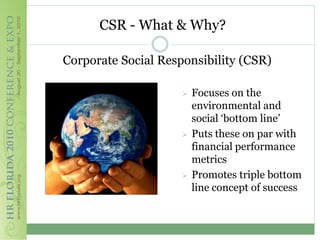
Corporate Social Responsibility (CSR)

                        Focuses on the
                         environmental and
                         social „bottom line‟
                        Puts these on par with
                         financial performance
                         metrics
                        Promotes triple bottom
                         line concept of success
CSR - What & Why?

Value of Triple Bottom Line Definition of Success

    Employee-organization
     relationship is center
     stage
    HR managers have a
     new process to build
     engagement
    CSR is a strong driver of
     recruitment and
     retention
CSR - What & Why?

CSR - Strong Driver of Attraction and Engagement
                         50% of consumers view
                          employee treatment as
                          central to CSR
                         64% of Millennials report
                          employer CSR activities
                          increase their loyalty
                         90% of employees would
                          choose an employer
                          perceived as more socially
                          responsible
CSR - What & Why?

CSR - Strong Driver of Attraction and Engagement


    Meta-analysis of 50
     studies found CSR
     social components,
     including treatment of
     employees, significantly
     affected financial
     performance measures
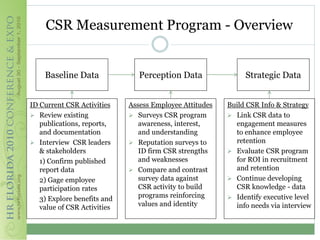
CSR Measurement Program - Overview


    Baseline Data               Perception Data               Strategic Data


ID Current CSR Activities    Assess Employee Attitudes   Build CSR Info & Strategy
 Review existing             Surveys CSR program        Link CSR data to
   publications, reports,       awareness, interest,       engagement measures
   and documentation            and understanding          to enhance employee
 Interview CSR leaders       Reputation surveys to       retention
   & stakeholders               ID firm CSR strengths     Evaluate CSR program
   1) Confirm published         and weaknesses             for ROI in recruitment
   report data                Compare and contrast        and retention
   2) Gage employee             survey data against       Continue developing
   participation rates          CSR activity to build      CSR knowledge - data
   3) Explore benefits and      programs reinforcing      Identify executive level
   value of CSR Activities      values and identity        info needs via interview
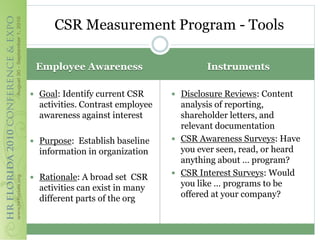
CSR Measurement Program - Tools

 Employee Awareness                       Instruments

 Goal: Identify current CSR       Disclosure Reviews: Content
  activities. Contrast employee     analysis of reporting,
  awareness against interest        shareholder letters, and
                                    relevant documentation
 Purpose: Establish baseline      CSR Awareness Surveys: Have
  information in organization       you ever seen, read, or heard
                                    anything about … program?
                                   CSR Interest Surveys: Would
 Rationale: A broad set CSR
  activities can exist in many      you like … programs to be
  different parts of the org        offered at your company?
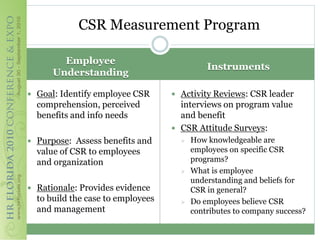
CSR Measurement Program

        Employee
                                             Instruments
      Understanding

 Goal: Identify employee CSR       Activity Reviews: CSR leader
  comprehension, perceived           interviews on program value
  benefits and info needs            and benefit
                                    CSR Attitude Surveys:
 Purpose: Assess benefits and          How knowledgeable are
  value of CSR to employees              employees on specific CSR
  and organization                       programs?
                                        What is employee
                                         understanding and beliefs for
 Rationale: Provides evidence           CSR in general?
  to build the case to employees        Do employees believe CSR
  and management                         contributes to company success?
CSR Measurement Program

        Employee
                                        Instruments
       Involvement

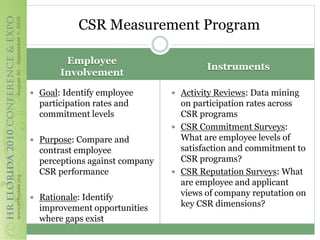
 Goal: Identify employee        Activity Reviews: Data mining
  participation rates and         on participation rates across
  commitment levels               CSR programs
                                 CSR Commitment Surveys:
 Purpose: Compare and            What are employee levels of
  contrast employee               satisfaction and commitment to
  perceptions against company     CSR programs?
  CSR performance                CSR Reputation Surveys: What
                                  are employee and applicant
 Rationale: Identify
                                  views of company reputation on
  improvement opportunities       key CSR dimensions?
  where gaps exist
CSR Measurement Program

      Organizational
                                            Instruments
       Knowledge
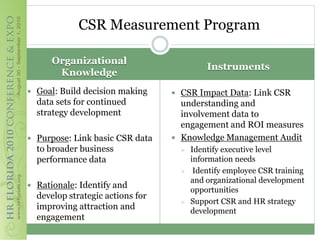
 Goal: Build decision making      CSR Impact Data: Link CSR
  data sets for continued           understanding and
  strategy development              involvement data to
                                    engagement and ROI measures
 Purpose: Link basic CSR data     Knowledge Management Audit
  to broader business                  Identify executive level
  performance data                      information needs
                                        Identify employee CSR training
                                        and organizational development
 Rationale: Identify and
                                        opportunities
  develop strategic actions for
                                       Support CSR and HR strategy
  improving attraction and              development
  engagement
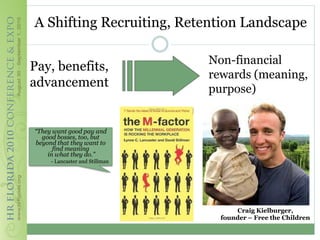
A Shifting Recruiting, Retention Landscape

                                Non-financial
Pay, benefits,
                                rewards (meaning,
advancement                     purpose)


“They want good pay and
  good bosses, too, but
beyond that they want to
      find meaning
    in what they do.”
     - Lancaster and Stillman


                                      Craig Kielburger,
                                  founder – Free the Children
A Shifting Landscape

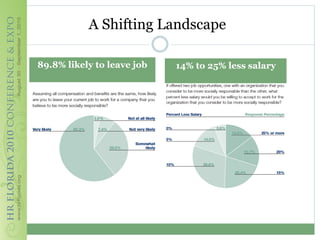
89.8% likely to leave job   14% to 25% less salary
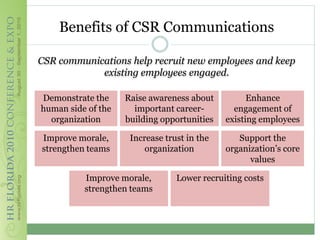
Benefits of CSR Communications

CSR communications help recruit new employees and keep
            existing employees engaged.

Demonstrate the     Raise awareness about          Enhance
human side of the     important career-        engagement of
  organization      building opportunities   existing employees

Improve morale,      Increase trust in the      Support the
strengthen teams         organization        organization‟s core
                                                   values

          Improve morale,        Lower recruiting costs
          strengthen teams
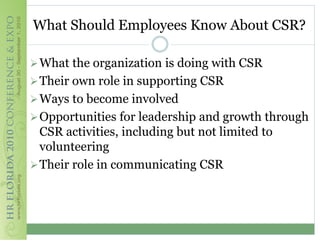
What Should Employees Know About CSR?

 What the organization is doing with CSR
 Their own role in supporting CSR
 Ways to become involved
 Opportunities for leadership and growth through
  CSR activities, including but not limited to
  volunteering
 Their role in communicating CSR
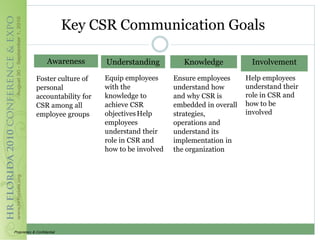
Key CSR Communication Goals

                     Awareness     Understanding           Knowledge           Involvement

              Foster culture of    Equip employees      Ensure employees      Help employees
              personal             with the             understand how        understand their
              accountability for   knowledge to         and why CSR is        role in CSR and
              CSR among all        achieve CSR          embedded in overall   how to be
              employee groups      objectives Help      strategies,           involved
                                   employees            operations and
                                   understand their     understand its
                                   role in CSR and      implementation in
                                   how to be involved   the organization


Proprietary & Confidential
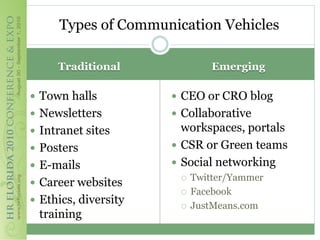
Types of Communication Vehicles

     Traditional               Emerging

 Town halls           CEO or CRO blog
 Newsletters          Collaborative
 Intranet sites        workspaces, portals
 Posters              CSR or Green teams
 E-mails              Social networking
                          Twitter/Yammer
 Career websites
                          Facebook
 Ethics, diversity
                          JustMeans.com
 training
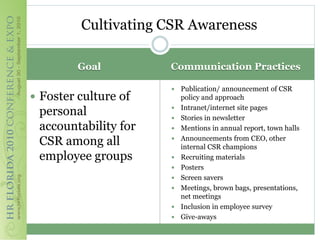
Cultivating CSR Awareness

         Goal         Communication Practices

                         Publication/ announcement of CSR
 Foster culture of       policy and approach
                          Intranet/internet site pages
 personal             
                         Stories in newsletter
 accountability for      Mentions in annual report, town halls

 CSR among all           Announcements from CEO, other
                          internal CSR champions
 employee groups         Recruiting materials
                         Posters
                         Screen savers
                         Meetings, brown bags, presentations,
                          net meetings
                         Inclusion in employee survey
                         Give-aways
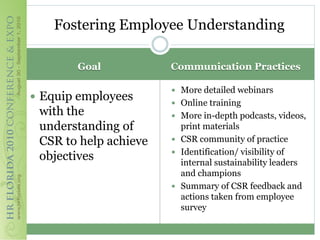
Fostering Employee Understanding

       Goal            Communication Practices

                        More detailed webinars
 Equip employees
                        Online training
 with the               More in-depth podcasts, videos,
 understanding of        print materials
 CSR to help achieve    CSR community of practice
                        Identification/ visibility of
 objectives              internal sustainability leaders
                         and champions
                        Summary of CSR feedback and
                         actions taken from employee
                         survey
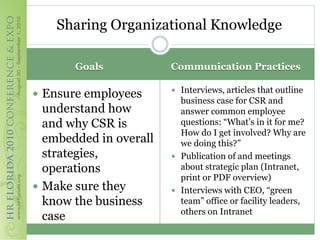
Sharing Organizational Knowledge

       Goals            Communication Practices

                         Interviews, articles that outline
 Ensure employees
                          business case for CSR and
  understand how          answer common employee
  and why CSR is          questions: “What‟s in it for me?
                          How do I get involved? Why are
  embedded in overall     we doing this?”
  strategies,            Publication of and meetings
  operations              about strategic plan (Intranet,
                          print or PDF overview)
 Make sure they         Interviews with CEO, “green
  know the business       team” office or facility leaders,
                          others on Intranet
  case
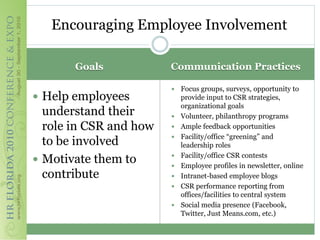
Encouraging Employee Involvement

       Goals            Communication Practices

                           Focus groups, surveys, opportunity to
 Help employees            provide input to CSR strategies,
                            organizational goals
  understand their         Volunteer, philanthropy programs
  role in CSR and how      Ample feedback opportunities
                            Facility/office “greening” and
  to be involved        
                            leadership roles
                            Facility/office CSR contests
 Motivate them to      
                           Employee profiles in newsletter, online
  contribute               Intranet-based employee blogs
                           CSR performance reporting from
                            offices/facilities to central system
                           Social media presence (Facebook,
                            Twitter, Just Means.com, etc.)
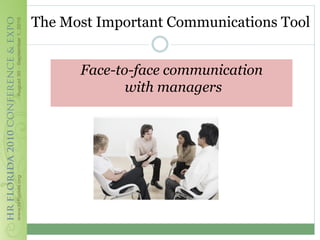
The Most Important Communications Tool


      Face-to-face communication
             with managers
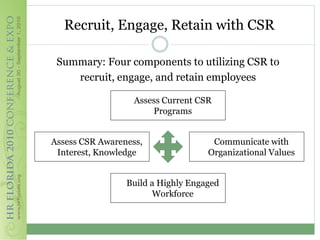
Recruit, Engage, Retain with CSR

 Summary: Four components to utilizing CSR to
    recruit, engage, and retain employees

                   Assess Current CSR
                       Programs


Assess CSR Awareness,                Communicate with
 Interest, Knowledge                Organizational Values


                 Build a Highly Engaged
                       Workforce
Suggestions for Further Reading

   Bhattacharya, C.B., Sen, S., & Korschun, D. (2008) Using Corporate Social
    Responsibility to Win the War for Talent. MIT Sloan Management Review. 49(2).
   Boston College Center for Corporate Citizenship, NetImpact, et al. (2008)
    Corporate Responsibility & Sustainability Communications: Who’s Listening?
    Who’s Leading? What Matters Most?
   Colbert, B. A., & Kurucz, E. (2007) Three Conceptions of Triple Bottom Line
    Business Sustainability and the Role for HRM. HR. Human Resource Planning
    30(1).
   IBM Global Business Services (2009) Attaining Sustainable Growth through
    Corporate Social Responsibility
   IBM Global Business Services (2008) The Enterprise of the Future: Global CEO
    Study
   Nair, Chandran (2009) A new role for human resources. Ethical Corporation.
    www.ethicalcorp.com/content.asp?ContentID=6559&newsletter=24
   Orliztsky, M., Schmidt, F.L., & Rynes, S.L. (2009) Corporate Social and Financial
    Performance: A Meta Analysis. Organization Studies 24(3).
   Ragan Research (2009). Assessing Your Department’s Effectiveness in
    Communicating CSR.

Christopher - Recruit, Engage, Retain through Social Responsibility

  • 1.
    Recruit, Engage, RetainThrough Social Responsibility JOHN CHRISTOPHER PH.D. AND MICHELLE BERNHART HR FLORIDA CONFERENCE & EXPO AUGUST 29 – SEPTEMBER 1
  • 2.
    CSR - What& Why? Corporate Social Responsibility (CSR)  Focuses on the environmental and social „bottom line‟  Puts these on par with financial performance metrics  Promotes triple bottom line concept of success
  • 3.
    CSR - What& Why? Value of Triple Bottom Line Definition of Success  Employee-organization relationship is center stage  HR managers have a new process to build engagement  CSR is a strong driver of recruitment and retention
  • 4.
    CSR - What& Why? CSR - Strong Driver of Attraction and Engagement  50% of consumers view employee treatment as central to CSR  64% of Millennials report employer CSR activities increase their loyalty  90% of employees would choose an employer perceived as more socially responsible
  • 5.
    CSR - What& Why? CSR - Strong Driver of Attraction and Engagement  Meta-analysis of 50 studies found CSR social components, including treatment of employees, significantly affected financial performance measures
  • 6.
    CSR Measurement Program- Overview Baseline Data Perception Data Strategic Data ID Current CSR Activities Assess Employee Attitudes Build CSR Info & Strategy  Review existing  Surveys CSR program  Link CSR data to publications, reports, awareness, interest, engagement measures and documentation and understanding to enhance employee  Interview CSR leaders  Reputation surveys to retention & stakeholders ID firm CSR strengths  Evaluate CSR program 1) Confirm published and weaknesses for ROI in recruitment report data  Compare and contrast and retention 2) Gage employee survey data against  Continue developing participation rates CSR activity to build CSR knowledge - data 3) Explore benefits and programs reinforcing  Identify executive level value of CSR Activities values and identity info needs via interview
  • 7.
    CSR Measurement Program- Tools Employee Awareness Instruments  Goal: Identify current CSR  Disclosure Reviews: Content activities. Contrast employee analysis of reporting, awareness against interest shareholder letters, and relevant documentation  Purpose: Establish baseline  CSR Awareness Surveys: Have information in organization you ever seen, read, or heard anything about … program?  CSR Interest Surveys: Would  Rationale: A broad set CSR activities can exist in many you like … programs to be different parts of the org offered at your company?
  • 8.
    CSR Measurement Program Employee Instruments Understanding  Goal: Identify employee CSR  Activity Reviews: CSR leader comprehension, perceived interviews on program value benefits and info needs and benefit  CSR Attitude Surveys:  Purpose: Assess benefits and  How knowledgeable are value of CSR to employees employees on specific CSR and organization programs?  What is employee understanding and beliefs for  Rationale: Provides evidence CSR in general? to build the case to employees  Do employees believe CSR and management contributes to company success?
  • 9.
    CSR Measurement Program Employee Instruments Involvement  Goal: Identify employee  Activity Reviews: Data mining participation rates and on participation rates across commitment levels CSR programs  CSR Commitment Surveys:  Purpose: Compare and What are employee levels of contrast employee satisfaction and commitment to perceptions against company CSR programs? CSR performance  CSR Reputation Surveys: What are employee and applicant  Rationale: Identify views of company reputation on improvement opportunities key CSR dimensions? where gaps exist
  • 10.
    CSR Measurement Program Organizational Instruments Knowledge  Goal: Build decision making  CSR Impact Data: Link CSR data sets for continued understanding and strategy development involvement data to engagement and ROI measures  Purpose: Link basic CSR data  Knowledge Management Audit to broader business  Identify executive level performance data information needs  Identify employee CSR training and organizational development  Rationale: Identify and opportunities develop strategic actions for  Support CSR and HR strategy improving attraction and development engagement
  • 11.
    A Shifting Recruiting,Retention Landscape Non-financial Pay, benefits, rewards (meaning, advancement purpose) “They want good pay and good bosses, too, but beyond that they want to find meaning in what they do.” - Lancaster and Stillman Craig Kielburger, founder – Free the Children
  • 12.
    A Shifting Landscape 89.8%likely to leave job 14% to 25% less salary
  • 13.
    Benefits of CSRCommunications CSR communications help recruit new employees and keep existing employees engaged. Demonstrate the Raise awareness about Enhance human side of the important career- engagement of organization building opportunities existing employees Improve morale, Increase trust in the Support the strengthen teams organization organization‟s core values Improve morale, Lower recruiting costs strengthen teams
  • 14.
    What Should EmployeesKnow About CSR?  What the organization is doing with CSR  Their own role in supporting CSR  Ways to become involved  Opportunities for leadership and growth through CSR activities, including but not limited to volunteering  Their role in communicating CSR
  • 15.
    Key CSR CommunicationGoals Awareness Understanding Knowledge Involvement Foster culture of Equip employees Ensure employees Help employees personal with the understand how understand their accountability for knowledge to and why CSR is role in CSR and CSR among all achieve CSR embedded in overall how to be employee groups objectives Help strategies, involved employees operations and understand their understand its role in CSR and implementation in how to be involved the organization Proprietary & Confidential
  • 16.
    Types of CommunicationVehicles Traditional Emerging  Town halls  CEO or CRO blog  Newsletters  Collaborative  Intranet sites workspaces, portals  Posters  CSR or Green teams  E-mails  Social networking  Twitter/Yammer  Career websites  Facebook  Ethics, diversity  JustMeans.com training
  • 17.
    Cultivating CSR Awareness Goal Communication Practices  Publication/ announcement of CSR  Foster culture of policy and approach Intranet/internet site pages personal   Stories in newsletter accountability for  Mentions in annual report, town halls CSR among all  Announcements from CEO, other internal CSR champions employee groups  Recruiting materials  Posters  Screen savers  Meetings, brown bags, presentations, net meetings  Inclusion in employee survey  Give-aways
  • 18.
    Fostering Employee Understanding Goal Communication Practices  More detailed webinars  Equip employees  Online training with the  More in-depth podcasts, videos, understanding of print materials CSR to help achieve  CSR community of practice  Identification/ visibility of objectives internal sustainability leaders and champions  Summary of CSR feedback and actions taken from employee survey
  • 19.
    Sharing Organizational Knowledge Goals Communication Practices  Interviews, articles that outline  Ensure employees business case for CSR and understand how answer common employee and why CSR is questions: “What‟s in it for me? How do I get involved? Why are embedded in overall we doing this?” strategies,  Publication of and meetings operations about strategic plan (Intranet, print or PDF overview)  Make sure they  Interviews with CEO, “green know the business team” office or facility leaders, others on Intranet case
  • 20.
    Encouraging Employee Involvement Goals Communication Practices  Focus groups, surveys, opportunity to  Help employees provide input to CSR strategies, organizational goals understand their  Volunteer, philanthropy programs role in CSR and how  Ample feedback opportunities Facility/office “greening” and to be involved  leadership roles Facility/office CSR contests  Motivate them to   Employee profiles in newsletter, online contribute  Intranet-based employee blogs  CSR performance reporting from offices/facilities to central system  Social media presence (Facebook, Twitter, Just Means.com, etc.)
  • 21.
    The Most ImportantCommunications Tool Face-to-face communication with managers
  • 22.
    Recruit, Engage, Retainwith CSR Summary: Four components to utilizing CSR to recruit, engage, and retain employees Assess Current CSR Programs Assess CSR Awareness, Communicate with Interest, Knowledge Organizational Values Build a Highly Engaged Workforce
  • 23.
    Suggestions for FurtherReading  Bhattacharya, C.B., Sen, S., & Korschun, D. (2008) Using Corporate Social Responsibility to Win the War for Talent. MIT Sloan Management Review. 49(2).  Boston College Center for Corporate Citizenship, NetImpact, et al. (2008) Corporate Responsibility & Sustainability Communications: Who’s Listening? Who’s Leading? What Matters Most?  Colbert, B. A., & Kurucz, E. (2007) Three Conceptions of Triple Bottom Line Business Sustainability and the Role for HRM. HR. Human Resource Planning 30(1).  IBM Global Business Services (2009) Attaining Sustainable Growth through Corporate Social Responsibility  IBM Global Business Services (2008) The Enterprise of the Future: Global CEO Study  Nair, Chandran (2009) A new role for human resources. Ethical Corporation. www.ethicalcorp.com/content.asp?ContentID=6559&newsletter=24  Orliztsky, M., Schmidt, F.L., & Rynes, S.L. (2009) Corporate Social and Financial Performance: A Meta Analysis. Organization Studies 24(3).  Ragan Research (2009). Assessing Your Department’s Effectiveness in Communicating CSR.