1
 Describe the physiologic functions of Vitamin
D.
 Relate the effects of Vitamin D deficiency to
multiple disease states.
 Identify the influence of Vitamin D deficiency
on health.
 Determine if you are at risk for Vitamin D
deficiency.
2
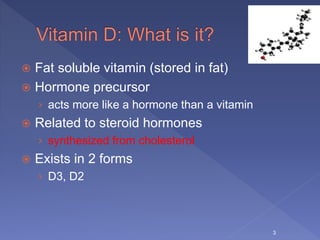
 Fat soluble vitamin (stored in fat)
 Hormone precursor
› acts more like a hormone than a vitamin
 Related to steroid hormones
› synthesized from cholesterol
 Exists in 2 forms
› D3, D2
3
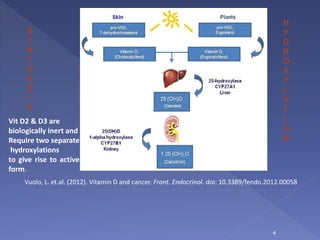
H
Y
D
R
O
X
Y
L
A
T
I
O
N
S
Y
N
T
H
E
S
I
S
Vit D2 & D3 are
biologically inert and
Require two separate
hydroxylations
to give rise to active
form.
Vuolo, L. et.al. (2012). Vitamin D and cancer. Front. Endocrinol. doi: 10.3389/fendo.2012.00058
4
5
Vitamin D3 form is required by human body.
 1,25 dihydroxyvitamin D is the physiologically
active form (serum half-life = 4-6 hours)
 The inactive 25-hydroxy-VitD3 most often
measured clinically in the serum
› Indicator of Vit D stores in the body
› Reflects amount of Vit D derived from both food &
sun
› 2-3 week half-life
6
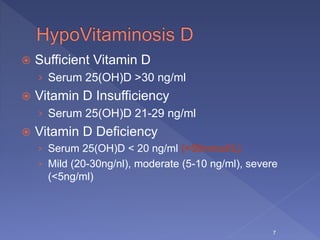
 Sufficient Vitamin D
› Serum 25(OH)D >30 ng/ml
 Vitamin D Insufficiency
› Serum 25(OH)D 21-29 ng/ml
 Vitamin D Deficiency
› Serum 25(OH)D < 20 ng/ml (<50nmol/L)
› Mild (20-30ng/nl), moderate (5-10 ng/ml), severe
(<5ng/ml)
7
 Present in most tissues and cells in the body
› Epithelial cells
› Osteoblasts
› Myocytes
› Pancreatic cells
› Antigen-presenting cells
› Cortical neurons and glia (microglia, astrocytes,
oligodendrocytes)
8
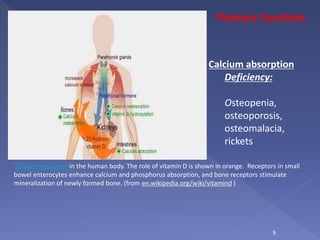
Calcium regulation in the human body. The role of vitamin D is shown in orange. Receptors in small
bowel enterocytes enhance calcium and phosphorus absorption, and bone receptors stimulate
mineralization of newly formed bone. (from en.wikipedia.org/wiki/vitamind )
Primary Function
Calcium absorption
Deficiency:
Osteopenia,
osteoporosis,
osteomalacia,
rickets
9
 Modulates immune system/pro-inflammatory
cytokines= reduction of inflammation
› Deficiency: arthritis, lupus, IBS, Multiple sclerosis
 Inhibits Cell growth/angiogenesis/differentiation
› Deficiency: cancer (prostrate, breast, colon)
 Glucose metabolism/pancreatic B-cell function/
insulin sensitivity
› Deficiency: diabetes mellitus
10
 Influences smooth muscle tone, endothelium,
cardiomyocytes, controls intracellular Ca+, RAAS
› Deficiency: cardiovascular disease, hypertension(B.P),
stroke
 Anti-oxidative/neuroprotective
› Deficiency: depression
 Neuromuscular stability
› Deficiency: musculoskeletal pain
11
 Lower circulating Vitamin D
› Inadequate sun exposure in chronically ill,
institutionalized or homebound
› poor dietary intake
 Aging (> 50 years)
 Obesity (body mass index > 30 kg/m2)-body fat
sequesters the vitamin
 Sun protective clothing/sunblock (SPF 30)
12
 People
13
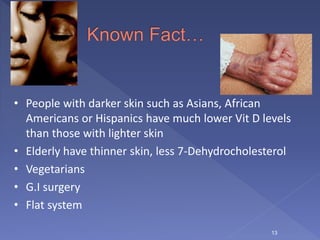
• People with darker skin such as Asians, African
Americans or Hispanics have much lower Vit D levels
than those with lighter skin
• Elderly have thinner skin, less 7-Dehydrocholesterol
• Vegetarians
• G.I surgery
• Flat system
 Prevention and treatment of bone disease
› Osteopenia, osteoporosis
› Hip fracture, nonvertebral fractures
› > 65 yrs, 800-2000 IU/day (indefinitely)
 Fall Prevention
› 22% reduction (improved muscle function)
› > 65 yrs, 800-5000 IU/day (indefinitely)
 During Pregnancy :
› Decrease chances of rickets and abortions
14
Haines,S.T., and Park,S.K. (2012). Vitamin D Supplementation: What’s known, what to do and what’s
needed. Pharmacotherapy, 32(4): 354-382
 Cardiovascular disease- hypertension, heart
failure
 Endocrine disorders- diabetes
 Respiratory Diseases- asthma, COPD
 Infectious Diseases- tuberculosis
 Neurologic diseases
› depression, dementia
15
Haines,S.T., and Park,S.K. (2012). Vitamin D Supplementation: What’s known, what to do and
what’s Needed. Pharmacotherapy, 32(4): 354-382.
www.VitaminDWiki.com16
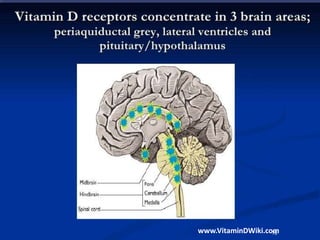
Vitamin D affects the development of neurons as well
as their maintenance and survival.
17
 Targets factors that lead to neurogeneration
 Anti-ischemic factors
 Good level promotes neurotrophic growth
factors: NGNF, BDNF,GDNF
 Deficiency causes programmed death of the
neurons (apoptosis)-proposed mechanism
DeLuca,G.C., Kimball,S.M., Kolasinski.J., Ramagopalan,S.V. & Eberes,G.C. (2013). Review:
The role of vitamin D in nervous systems health and disease. Neuropathology and Applied
Neurobiology, 39: 460.
18
19
 Complaints of non-specific musculoskeletal
pain
 inadequate dietary intake of Vitamin D
 Indoors: Homebound/institutionalized, high
latitudes, inadequate sun exposure
 renal or hepatic disease, osteoporosis
 Chronically ill, elderly
 Post-menopausal or pregnant/lactating
20
 Major depression syndrome
 Rheumatoid arthritis
 Cardiovascular disease
 Osteoporosis
 Chronic fatigue syndrome
21
 Chronic Drug use:
› Anti Epileptic Drug use especially Dilantin and
Phenobarb
› Corticosteroids
› Azole antifungals
› Antiretrovirals
 These drugs cause destruction of 25(OH)D
and 1,25(OH)2D
22
 Re-test high-risk individuals every 5 years if
not on supplementation
 Otherwise annually when on maintenance
dose
23
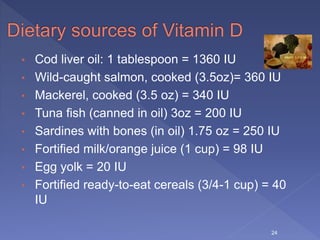
• Cod liver oil: 1 tablespoon = 1360 IU
• Wild-caught salmon, cooked (3.5oz)= 360 IU
• Mackerel, cooked (3.5 oz) = 340 IU
• Tuna fish (canned in oil) 3oz = 200 IU
• Sardines with bones (in oil) 1.75 oz = 250 IU
• Fortified milk/orange juice (1 cup) = 98 IU
• Egg yolk = 20 IU
• Fortified ready-to-eat cereals (3/4-1 cup) = 40
IU
24
 Dose of supplementation to achieve good
levels theoretically unknown
› But twice the upper limit of normal Vit D would
not cause any toxicity
› Unknown long term effects of Vit D
supplementation or long term effects of Vit D
toxicity
25
 Children: 400I.U/day
 Adults 12- 50 yrs - 600 IU/d
 Adults 50-70 yrs 800 IU/d
 If obese or if on certain medications, need 2-3 x
more Vit D for their age group
 Supplement for Fall prevention
 Can be taken on empty stomach or with meal (does
not require dietary fat for absorption)
26
*Endocrine Society CPGs (2011)
 Vitamin D3 >3 times as effective as D2 and
has more sustained blood levels
 Initially: 200,000 IU D3 orally, once
weekly/every after 15 days. 5 times atleast.
 Then every after 3 months.
 Avoid single large doses of 300,00-500,00 IU
27
 Variable absorption based on body fat
 More body fat, need 2-3x more Vit D to
maintain level
 Recommendation: “dosing” supplement
› 5-30 minutes sunlight Early morning at Dawn
time
› Artificial UVB radiation (tanning bed) not reliable
28
 IOM recommendations of Vit D
supplementation recommended is 600 IU/d,
(800 IU if >70)
 These are dietary recommendations and not
for disease states
 25(0H)D blood level above 30ng/ml may have
additional health benefits in reducing the risk
of some diseases
29

Dawn d

  • 1.
  • 2.
     Describe thephysiologic functions of Vitamin D.  Relate the effects of Vitamin D deficiency to multiple disease states.  Identify the influence of Vitamin D deficiency on health.  Determine if you are at risk for Vitamin D deficiency. 2
  • 3.
     Fat solublevitamin (stored in fat)  Hormone precursor › acts more like a hormone than a vitamin  Related to steroid hormones › synthesized from cholesterol  Exists in 2 forms › D3, D2 3
  • 4.
    H Y D R O X Y L A T I O N S Y N T H E S I S Vit D2 &D3 are biologically inert and Require two separate hydroxylations to give rise to active form. Vuolo, L. et.al. (2012). Vitamin D and cancer. Front. Endocrinol. doi: 10.3389/fendo.2012.00058 4
  • 5.
    5 Vitamin D3 formis required by human body.
  • 6.
     1,25 dihydroxyvitaminD is the physiologically active form (serum half-life = 4-6 hours)  The inactive 25-hydroxy-VitD3 most often measured clinically in the serum › Indicator of Vit D stores in the body › Reflects amount of Vit D derived from both food & sun › 2-3 week half-life 6
  • 7.
     Sufficient VitaminD › Serum 25(OH)D >30 ng/ml  Vitamin D Insufficiency › Serum 25(OH)D 21-29 ng/ml  Vitamin D Deficiency › Serum 25(OH)D < 20 ng/ml (<50nmol/L) › Mild (20-30ng/nl), moderate (5-10 ng/ml), severe (<5ng/ml) 7
  • 8.
     Present inmost tissues and cells in the body › Epithelial cells › Osteoblasts › Myocytes › Pancreatic cells › Antigen-presenting cells › Cortical neurons and glia (microglia, astrocytes, oligodendrocytes) 8
  • 9.
    Calcium regulation inthe human body. The role of vitamin D is shown in orange. Receptors in small bowel enterocytes enhance calcium and phosphorus absorption, and bone receptors stimulate mineralization of newly formed bone. (from en.wikipedia.org/wiki/vitamind ) Primary Function Calcium absorption Deficiency: Osteopenia, osteoporosis, osteomalacia, rickets 9
  • 10.
     Modulates immunesystem/pro-inflammatory cytokines= reduction of inflammation › Deficiency: arthritis, lupus, IBS, Multiple sclerosis  Inhibits Cell growth/angiogenesis/differentiation › Deficiency: cancer (prostrate, breast, colon)  Glucose metabolism/pancreatic B-cell function/ insulin sensitivity › Deficiency: diabetes mellitus 10
  • 11.
     Influences smoothmuscle tone, endothelium, cardiomyocytes, controls intracellular Ca+, RAAS › Deficiency: cardiovascular disease, hypertension(B.P), stroke  Anti-oxidative/neuroprotective › Deficiency: depression  Neuromuscular stability › Deficiency: musculoskeletal pain 11
  • 12.
     Lower circulatingVitamin D › Inadequate sun exposure in chronically ill, institutionalized or homebound › poor dietary intake  Aging (> 50 years)  Obesity (body mass index > 30 kg/m2)-body fat sequesters the vitamin  Sun protective clothing/sunblock (SPF 30) 12
  • 13.
     People 13 • Peoplewith darker skin such as Asians, African Americans or Hispanics have much lower Vit D levels than those with lighter skin • Elderly have thinner skin, less 7-Dehydrocholesterol • Vegetarians • G.I surgery • Flat system
  • 14.
     Prevention andtreatment of bone disease › Osteopenia, osteoporosis › Hip fracture, nonvertebral fractures › > 65 yrs, 800-2000 IU/day (indefinitely)  Fall Prevention › 22% reduction (improved muscle function) › > 65 yrs, 800-5000 IU/day (indefinitely)  During Pregnancy : › Decrease chances of rickets and abortions 14 Haines,S.T., and Park,S.K. (2012). Vitamin D Supplementation: What’s known, what to do and what’s needed. Pharmacotherapy, 32(4): 354-382
  • 15.
     Cardiovascular disease-hypertension, heart failure  Endocrine disorders- diabetes  Respiratory Diseases- asthma, COPD  Infectious Diseases- tuberculosis  Neurologic diseases › depression, dementia 15 Haines,S.T., and Park,S.K. (2012). Vitamin D Supplementation: What’s known, what to do and what’s Needed. Pharmacotherapy, 32(4): 354-382.
  • 16.
  • 17.
    Vitamin D affectsthe development of neurons as well as their maintenance and survival. 17
  • 18.
     Targets factorsthat lead to neurogeneration  Anti-ischemic factors  Good level promotes neurotrophic growth factors: NGNF, BDNF,GDNF  Deficiency causes programmed death of the neurons (apoptosis)-proposed mechanism DeLuca,G.C., Kimball,S.M., Kolasinski.J., Ramagopalan,S.V. & Eberes,G.C. (2013). Review: The role of vitamin D in nervous systems health and disease. Neuropathology and Applied Neurobiology, 39: 460. 18
  • 19.
  • 20.
     Complaints ofnon-specific musculoskeletal pain  inadequate dietary intake of Vitamin D  Indoors: Homebound/institutionalized, high latitudes, inadequate sun exposure  renal or hepatic disease, osteoporosis  Chronically ill, elderly  Post-menopausal or pregnant/lactating 20
  • 21.
     Major depressionsyndrome  Rheumatoid arthritis  Cardiovascular disease  Osteoporosis  Chronic fatigue syndrome 21
  • 22.
     Chronic Druguse: › Anti Epileptic Drug use especially Dilantin and Phenobarb › Corticosteroids › Azole antifungals › Antiretrovirals  These drugs cause destruction of 25(OH)D and 1,25(OH)2D 22
  • 23.
     Re-test high-riskindividuals every 5 years if not on supplementation  Otherwise annually when on maintenance dose 23
  • 24.
    • Cod liveroil: 1 tablespoon = 1360 IU • Wild-caught salmon, cooked (3.5oz)= 360 IU • Mackerel, cooked (3.5 oz) = 340 IU • Tuna fish (canned in oil) 3oz = 200 IU • Sardines with bones (in oil) 1.75 oz = 250 IU • Fortified milk/orange juice (1 cup) = 98 IU • Egg yolk = 20 IU • Fortified ready-to-eat cereals (3/4-1 cup) = 40 IU 24
  • 25.
     Dose ofsupplementation to achieve good levels theoretically unknown › But twice the upper limit of normal Vit D would not cause any toxicity › Unknown long term effects of Vit D supplementation or long term effects of Vit D toxicity 25
  • 26.
     Children: 400I.U/day Adults 12- 50 yrs - 600 IU/d  Adults 50-70 yrs 800 IU/d  If obese or if on certain medications, need 2-3 x more Vit D for their age group  Supplement for Fall prevention  Can be taken on empty stomach or with meal (does not require dietary fat for absorption) 26 *Endocrine Society CPGs (2011)
  • 27.
     Vitamin D3>3 times as effective as D2 and has more sustained blood levels  Initially: 200,000 IU D3 orally, once weekly/every after 15 days. 5 times atleast.  Then every after 3 months.  Avoid single large doses of 300,00-500,00 IU 27
  • 28.
     Variable absorptionbased on body fat  More body fat, need 2-3x more Vit D to maintain level  Recommendation: “dosing” supplement › 5-30 minutes sunlight Early morning at Dawn time › Artificial UVB radiation (tanning bed) not reliable 28
  • 29.
     IOM recommendationsof Vit D supplementation recommended is 600 IU/d, (800 IU if >70)  These are dietary recommendations and not for disease states  25(0H)D blood level above 30ng/ml may have additional health benefits in reducing the risk of some diseases 29