International Journal of Mechanical Engineering and Technology (IJMET), ISSN 0976 – 6340(Print),
ISSN 0976 – 6359(Online), Volume 6, Issue 4, April (2015), pp. 01-10© IAEME
1
SMART VEHICLE AND SMART SIGNBOARD SYSTEM
WITH ZONAL SPEED REGULATION
Bindu Prakash1
, Rekha T2
, Akhila T J3,
Anu S Pillai4
, Shibinlal S5
, Raymond D Harock6
1
Associate professor, EEE Department, College of Engineering Perumon, India,
2
Assistant professor, EEE Department, College of Engineering Perumon, India,
3,4,5,6
B.Tech Scholar, EEE Department, College of Engineering Perumon, India,
ABSTRACT
To control the accident highway department have placed the signboards. Increasing number
of accidents at busy junctions are a major threat faced by today’s world. Nowadays people are
driving very fast; we lost our valuable life by making small mistake while driving (school zone, hills
area, and highways). Most of accidents are occur due to two wheelers Speed control is required at
busy junctions. In order to avoid such kind of accidents and to alert the drivers and to control their
vehicle speed in such kind of places the highway department have placed the signboards. But
sometimes it may be possible to view that kind of signboards and there is a chance for accident. In
this paper we are controlling the speed of two wheelers. This paper is composed of two separate
units: zone transmitter unit and receiver unit. Once the information is received from the zones
through zigbee, the vehicle’s embedded unit automatically alerts the driver, to reduce the speed
according to the zone, it waits for few seconds, and otherwise vehicle’s speed control unit
automatically reduces the speed.
Keywords: CDI Unit, Flywheel, Pulsar Coil, Spark Plug, Zigbee.
1. INTRODUCTION
One of the major causes of road accident in the world is driving too fast, recent studies shows
that one third of the serious road accidents are due to inappropriate speed, as well as change in road
way (like presence of road work or unexpected obstacles).So in order to avoid such kind of accidents
and to alert the drivers and to control their vehicle speed in such kind of places the highway
department have placed the signboards. But sometimes it may not to possible to view that kind of
INTERNATIONAL JOURNAL OF MECHANICAL ENGINEERING AND
TECHNOLOGY (IJMET)
ISSN 0976 – 6340 (Print)
ISSN 0976 – 6359 (Online)
Volume 6, Issue 4, April (2015), pp. 01-10
© IAEME: www.iaeme.com/IJMET.asp
Journal Impact Factor (2015): 8.8293 (Calculated by GISI)
www.jifactor.com
IJMET
© I A E M E
International Journal of Mechanical Engineering and Technology (IJMET), ISSN 0976
ISSN 0976 – 6359(Online), Volume 6, Issue
signboards and there is a chance for accident
can control the speed of vehicles. Here we are designing a speed control system for vehicles which
can intimate the driver about the zones and limit speed of the vehicle automa
This paper develops an intelligent speed adaptation, which can monitor the vehicle speed and
implements an action when the vehicle is detected to be exceeding the speed displayed in the speed
display (sign) boards [2]. The speed display boards
protocol. The driver should take great attention on the speed of the vehicle especially when driving
through busy junctions, railway crossings, school and college zones etc[3].The citizens are ought to
obey the speed enforcement rules in order to avoid the accidents, any violation in this are considered
as a greater offence. Traffic Police are authorized to check every vehicle and take actions against the
violation [4]. But it may not be practically possible alwa
a way that the vehicle speed is automatically controlled through over a wireless communication
[5][6].
2. EXISTING SYSTEM
The figure 1 shows electrical circuit demonstration for the working of a two wheeler. It has
an excitor coil which is excited by flywheel of two
voltage to the circuit. It has also a pulse rotor. It has one magnet
trigger circuit of SCR. The rotation of which depends on the requirement of speed.
Fig.1.
There is an ignition stop switch when it is closed and charges the capacitor .There is a
d1 through which the capacitor is charged and it is connected to primary of step up transformer.
There will be an SCR, in a solid state device which when triggered discharges the capacitor and
produces ignition .There will be an ignition coil and sp
fuel in the engine.
3. PROPOSED SYSTEM
The proposed system consists
connected, one in the speed display board and the other inside the vehicle. The module at display
Board includes, Microcontroller based Embedded System with Zigbee wireless communication
module etc. Speed limit of each sign board can be configured by the authority by using keypad. The
system uses wireless methods for the communication using ZIGBEE Trans
International Journal of Mechanical Engineering and Technology (IJMET), ISSN 0976
6359(Online), Volume 6, Issue 4, April (2015), pp. 01-10© IAEME
2
is a chance for accident. So there is an utmost need to design a system which
can control the speed of vehicles. Here we are designing a speed control system for vehicles which
can intimate the driver about the zones and limit speed of the vehicle automatically
This paper develops an intelligent speed adaptation, which can monitor the vehicle speed and
implements an action when the vehicle is detected to be exceeding the speed displayed in the speed
[2]. The speed display boards are working as per the highway speed limiting
protocol. The driver should take great attention on the speed of the vehicle especially when driving
through busy junctions, railway crossings, school and college zones etc[3].The citizens are ought to
speed enforcement rules in order to avoid the accidents, any violation in this are considered
Police are authorized to check every vehicle and take actions against the
[4]. But it may not be practically possible always. The proposed system is designed in such
a way that the vehicle speed is automatically controlled through over a wireless communication
The figure 1 shows electrical circuit demonstration for the working of a two wheeler. It has
an excitor coil which is excited by flywheel of two wheeler. It has a magnet which induces ac
voltage to the circuit. It has also a pulse rotor. It has one magnet and induces a dc voltage in the
trigger circuit of SCR. The rotation of which depends on the requirement of speed.
Demonstration circuit of existing system
There is an ignition stop switch when it is closed and charges the capacitor .There is a
d1 through which the capacitor is charged and it is connected to primary of step up transformer.
There will be an SCR, in a solid state device which when triggered discharges the capacitor and
produces ignition .There will be an ignition coil and spark plug which produces spark for ignition of
consists of two microcontroller based embedded modules [2]
connected, one in the speed display board and the other inside the vehicle. The module at display
Microcontroller based Embedded System with Zigbee wireless communication
limit of each sign board can be configured by the authority by using keypad. The
system uses wireless methods for the communication using ZIGBEE Trans- Receive module.
International Journal of Mechanical Engineering and Technology (IJMET), ISSN 0976 – 6340(Print),
. So there is an utmost need to design a system which
can control the speed of vehicles. Here we are designing a speed control system for vehicles which
tically [1].
This paper develops an intelligent speed adaptation, which can monitor the vehicle speed and
implements an action when the vehicle is detected to be exceeding the speed displayed in the speed
are working as per the highway speed limiting
protocol. The driver should take great attention on the speed of the vehicle especially when driving
through busy junctions, railway crossings, school and college zones etc[3].The citizens are ought to
speed enforcement rules in order to avoid the accidents, any violation in this are considered
Police are authorized to check every vehicle and take actions against the
ys. The proposed system is designed in such
a way that the vehicle speed is automatically controlled through over a wireless communication
The figure 1 shows electrical circuit demonstration for the working of a two wheeler. It has
wheeler. It has a magnet which induces ac
and induces a dc voltage in the
trigger circuit of SCR. The rotation of which depends on the requirement of speed.
There is an ignition stop switch when it is closed and charges the capacitor .There is a diode
d1 through which the capacitor is charged and it is connected to primary of step up transformer.
There will be an SCR, in a solid state device which when triggered discharges the capacitor and
ark plug which produces spark for ignition of
of two microcontroller based embedded modules [2]
connected, one in the speed display board and the other inside the vehicle. The module at display
Microcontroller based Embedded System with Zigbee wireless communication
limit of each sign board can be configured by the authority by using keypad. The
Receive module.
International Journal of Mechanical Engineering and Technology (IJMET), ISSN 0976 – 6340(Print),
ISSN 0976 – 6359(Online), Volume 6, Issue 4, April (2015), pp. 01-10© IAEME
3
The wireless ZIGBEE module transmits the speed limit and warnings to the vehicle. On the other
hand in the vehicle module, the ZIGBEE Receiver unit announces the speed limit warnings through
audio encoder and speaker. The microcontroller in the receiver unit, checks the current speed of the
vehicle and compare it with zone speed. If the speed is above the specified limit, the Central
controlling signal produce trigger signals for the motor that control accelerator unit to drop the speed
within the specified range.
4. BLOCK DIAGRAM
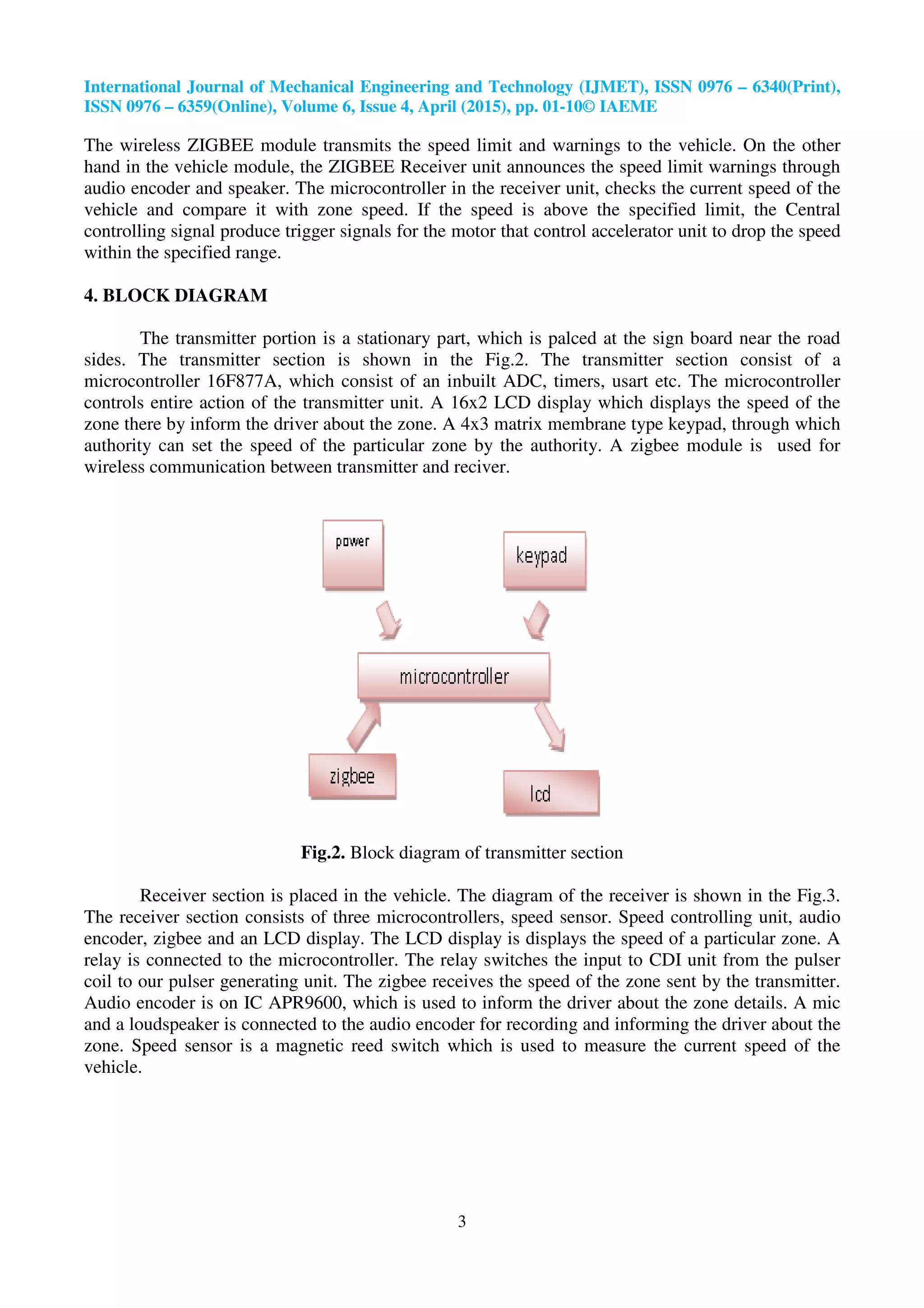
The transmitter portion is a stationary part, which is palced at the sign board near the road
sides. The transmitter section is shown in the Fig.2. The transmitter section consist of a
microcontroller 16F877A, which consist of an inbuilt ADC, timers, usart etc. The microcontroller
controls entire action of the transmitter unit. A 16x2 LCD display which displays the speed of the
zone there by inform the driver about the zone. A 4x3 matrix membrane type keypad, through which
authority can set the speed of the particular zone by the authority. A zigbee module is used for
wireless communication between transmitter and reciver.
Fig.2. Block diagram of transmitter section
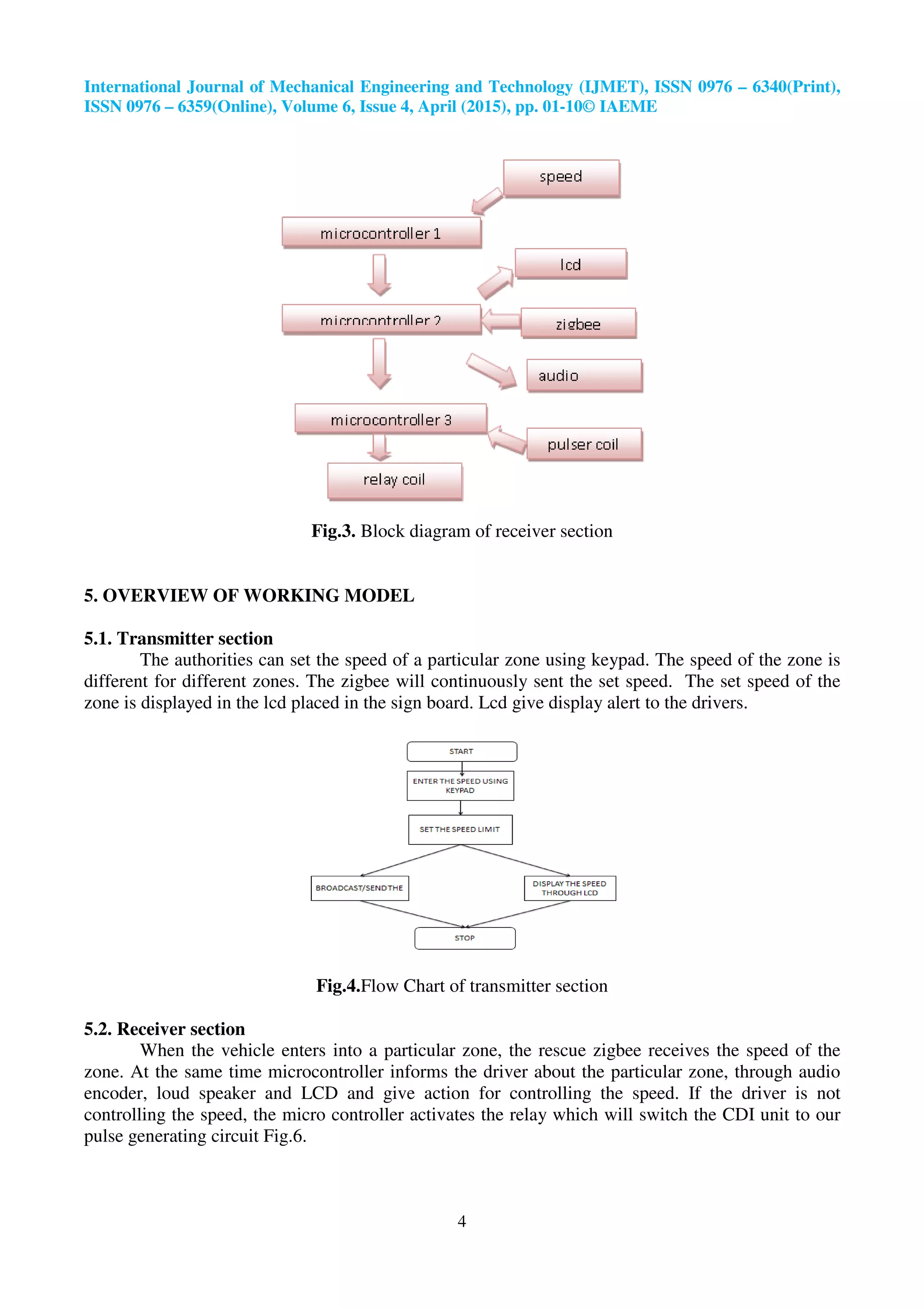
Receiver section is placed in the vehicle. The diagram of the receiver is shown in the Fig.3.
The receiver section consists of three microcontrollers, speed sensor. Speed controlling unit, audio
encoder, zigbee and an LCD display. The LCD display is displays the speed of a particular zone. A
relay is connected to the microcontroller. The relay switches the input to CDI unit from the pulser
coil to our pulser generating unit. The zigbee receives the speed of the zone sent by the transmitter.
Audio encoder is on IC APR9600, which is used to inform the driver about the zone details. A mic
and a loudspeaker is connected to the audio encoder for recording and informing the driver about the
zone. Speed sensor is a magnetic reed switch which is used to measure the current speed of the
vehicle.
International Journal of Mechanical Engineering and Technology (IJMET), ISSN 0976
ISSN 0976 – 6359(Online), Volume 6, Issue
Fig.3.
5. OVERVIEW OF WORKING MODEL
5.1. Transmitter section
The authorities can set the speed of a particular zone using keypad. The speed of the zone is
different for different zones. The zigbee will continuously sent the set speed.
zone is displayed in the lcd placed in the sign board. Lcd give display alert to the drivers.
Fig.4.
5.2. Receiver section
When the vehicle enters into a particular zone, the rescue
zone. At the same time microcontroller informs the driver about the particular zone, through audio
encoder, loud speaker and LCD and give action for controlling the speed. If the driver is not
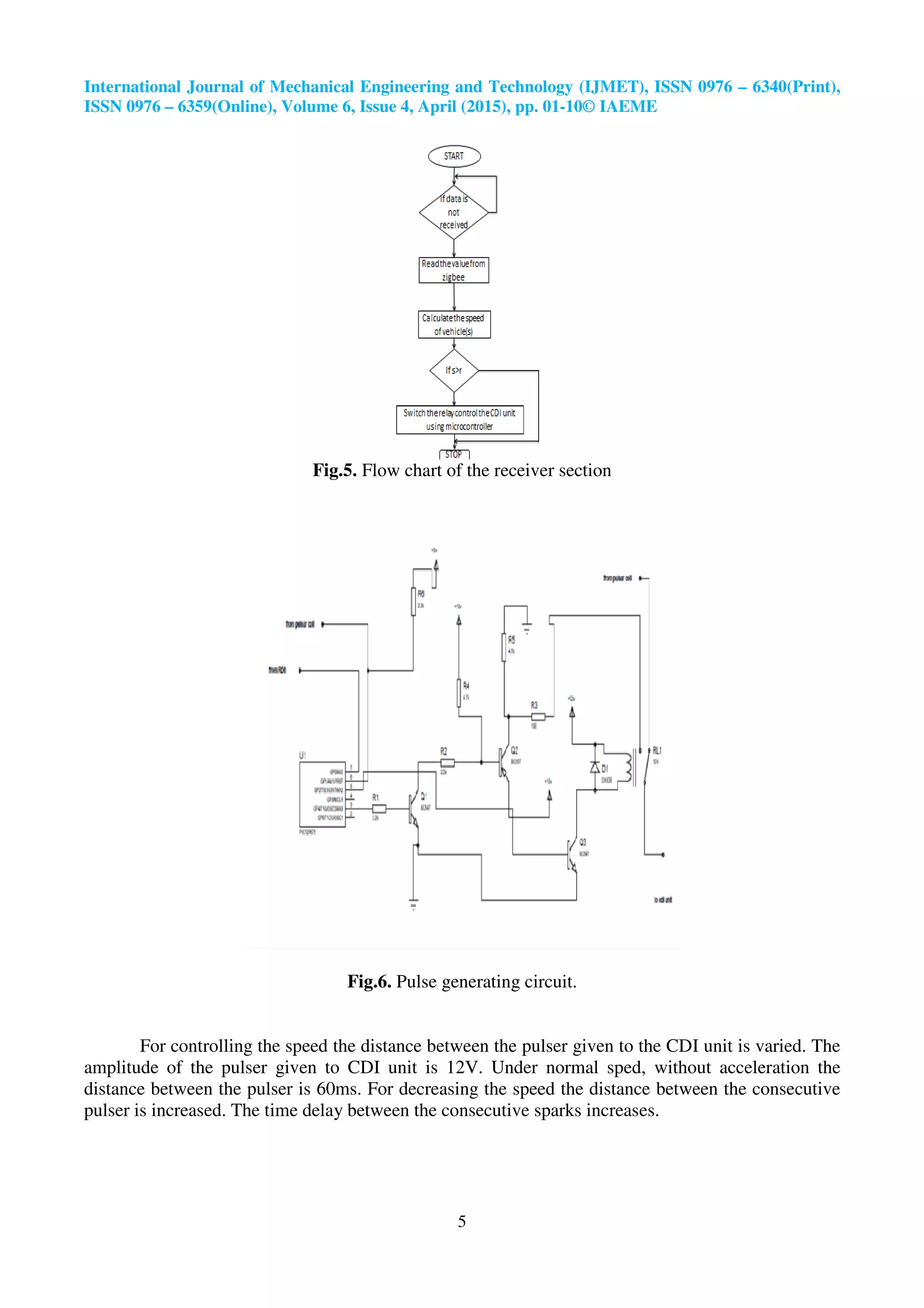
controlling the speed, the micro controller activates the relay which will switch the CDI unit to our
pulse generating circuit Fig.6.
International Journal of Mechanical Engineering and Technology (IJMET), ISSN 0976
6359(Online), Volume 6, Issue 4, April (2015), pp. 01-10© IAEME
4
Fig.3. Block diagram of receiver section
OVERVIEW OF WORKING MODEL
The authorities can set the speed of a particular zone using keypad. The speed of the zone is
different for different zones. The zigbee will continuously sent the set speed.
zone is displayed in the lcd placed in the sign board. Lcd give display alert to the drivers.
Fig.4.Flow Chart of transmitter section
When the vehicle enters into a particular zone, the rescue zigbee receives the speed of the
zone. At the same time microcontroller informs the driver about the particular zone, through audio
encoder, loud speaker and LCD and give action for controlling the speed. If the driver is not
ro controller activates the relay which will switch the CDI unit to our
International Journal of Mechanical Engineering and Technology (IJMET), ISSN 0976 – 6340(Print),
The authorities can set the speed of a particular zone using keypad. The speed of the zone is
different for different zones. The zigbee will continuously sent the set speed. The set speed of the
zone is displayed in the lcd placed in the sign board. Lcd give display alert to the drivers.
zigbee receives the speed of the
zone. At the same time microcontroller informs the driver about the particular zone, through audio
encoder, loud speaker and LCD and give action for controlling the speed. If the driver is not
ro controller activates the relay which will switch the CDI unit to our
International Journal of Mechanical Engineering and Technology (IJMET), ISSN 0976
ISSN 0976 – 6359(Online), Volume 6, Issue
Fig.5.
For controlling the speed the distance between the pulser
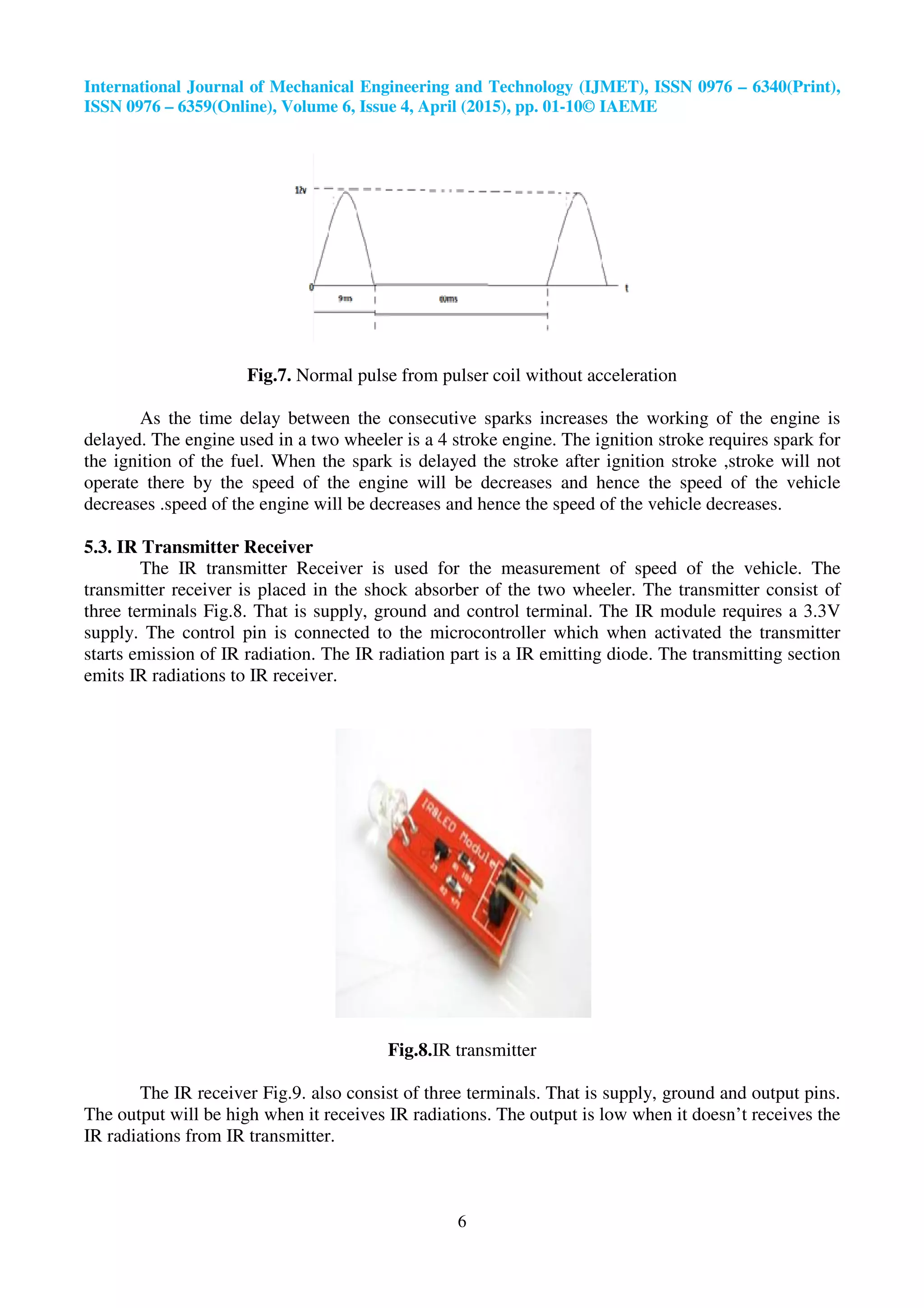
amplitude of the pulser given to CDI unit is 12V. Under normal sped, without acceleration the
distance between the pulser is 60ms. For decreasing the speed the distance between the consecutive
pulser is increased. The time delay between the consecutive sparks increases.
International Journal of Mechanical Engineering and Technology (IJMET), ISSN 0976
6359(Online), Volume 6, Issue 4, April (2015), pp. 01-10© IAEME
5
Fig.5. Flow chart of the receiver section
Fig.6. Pulse generating circuit.
For controlling the speed the distance between the pulser given to the CDI unit is varied. The
amplitude of the pulser given to CDI unit is 12V. Under normal sped, without acceleration the
distance between the pulser is 60ms. For decreasing the speed the distance between the consecutive
time delay between the consecutive sparks increases.
International Journal of Mechanical Engineering and Technology (IJMET), ISSN 0976 – 6340(Print),
given to the CDI unit is varied. The
amplitude of the pulser given to CDI unit is 12V. Under normal sped, without acceleration the
distance between the pulser is 60ms. For decreasing the speed the distance between the consecutive
International Journal of Mechanical Engineering and Technology (IJMET), ISSN 0976
ISSN 0976 – 6359(Online), Volume 6, Issue
Fig.7. Normal pulse from pulser coil without acceleration
As the time delay between the
delayed. The engine used in a two wheeler is a 4 strok
the ignition of the fuel. When the spark is delayed the stroke after ignition stroke ,stroke will not
operate there by the speed of the engine will be decreases and hence the speed of the vehicle
decreases .speed of the engine will be decreases and hence the speed of the vehicle decreases.
5.3. IR Transmitter Receiver
The IR transmitter Receiver is used for the measurement of speed of the vehicle. The
transmitter receiver is placed in the shock absorber of
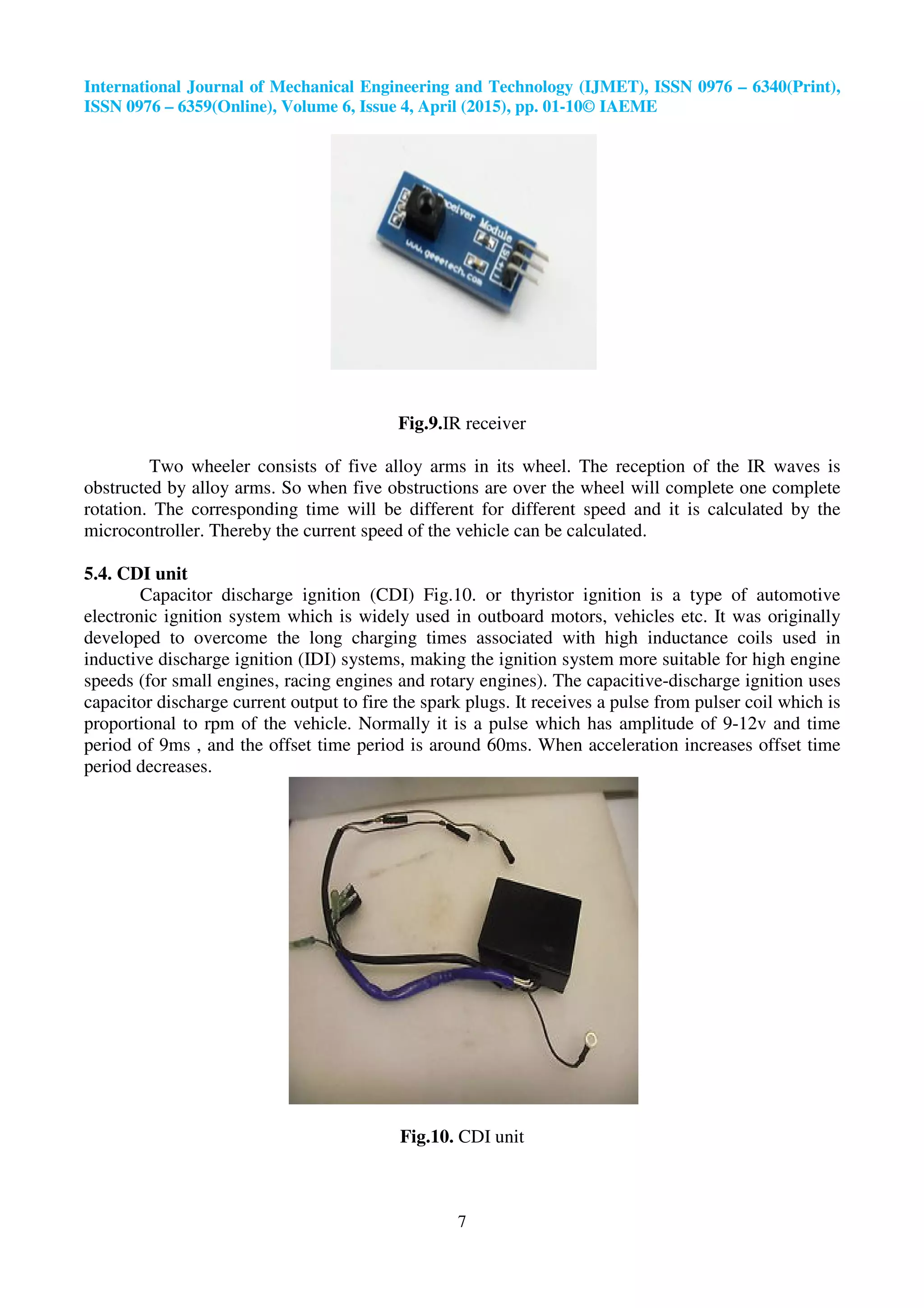
three terminals Fig.8. That is supply, ground and control terminal. The IR module requires a 3.3V
supply. The control pin is connected to the microcontroller which when activated the transmitter
starts emission of IR radiation. The IR radiation part is a IR emitting diode. The transmitting section
emits IR radiations to IR receiver.
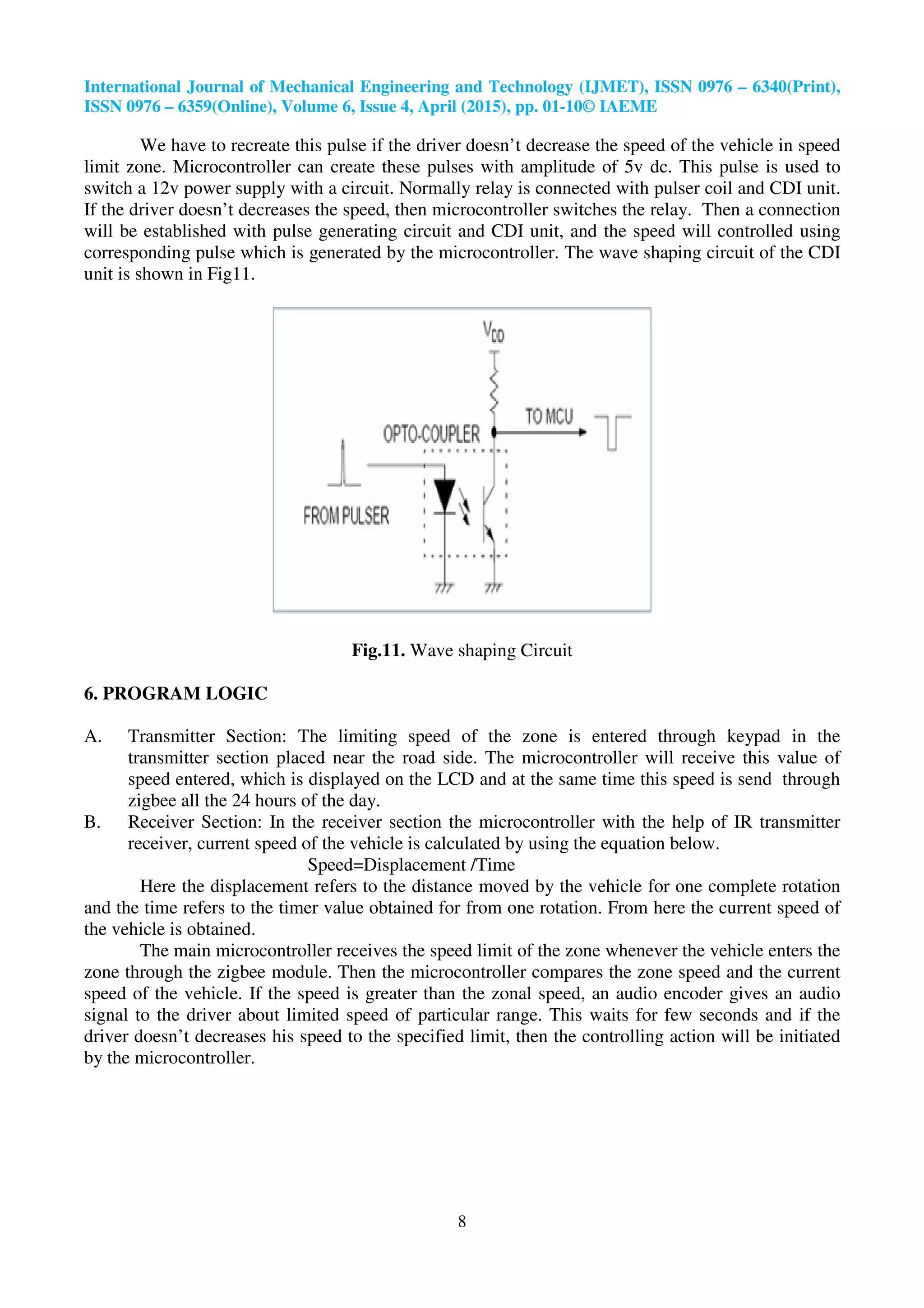
The IR receiver Fig.9. also consist of three terminals. That is supply, gro
The output will be high when it receives IR radiations. The output is low when it doesn’t receives the
IR radiations from IR transmitter.
International Journal of Mechanical Engineering and Technology (IJMET), ISSN 0976
6359(Online), Volume 6, Issue 4, April (2015), pp. 01-10© IAEME
6
Normal pulse from pulser coil without acceleration
As the time delay between the consecutive sparks increases the working of the engine is
delayed. The engine used in a two wheeler is a 4 stroke engine. The ignition stroke requires spark for
the ignition of the fuel. When the spark is delayed the stroke after ignition stroke ,stroke will not
operate there by the speed of the engine will be decreases and hence the speed of the vehicle
speed of the engine will be decreases and hence the speed of the vehicle decreases.
The IR transmitter Receiver is used for the measurement of speed of the vehicle. The
transmitter receiver is placed in the shock absorber of the two wheeler. The transmitter consist of
three terminals Fig.8. That is supply, ground and control terminal. The IR module requires a 3.3V
supply. The control pin is connected to the microcontroller which when activated the transmitter
of IR radiation. The IR radiation part is a IR emitting diode. The transmitting section
emits IR radiations to IR receiver.
Fig.8.IR transmitter
The IR receiver Fig.9. also consist of three terminals. That is supply, gro
The output will be high when it receives IR radiations. The output is low when it doesn’t receives the
IR radiations from IR transmitter.
International Journal of Mechanical Engineering and Technology (IJMET), ISSN 0976 – 6340(Print),
Normal pulse from pulser coil without acceleration
sparks increases the working of the engine is
e engine. The ignition stroke requires spark for
the ignition of the fuel. When the spark is delayed the stroke after ignition stroke ,stroke will not
operate there by the speed of the engine will be decreases and hence the speed of the vehicle
speed of the engine will be decreases and hence the speed of the vehicle decreases.
The IR transmitter Receiver is used for the measurement of speed of the vehicle. The
the two wheeler. The transmitter consist of
three terminals Fig.8. That is supply, ground and control terminal. The IR module requires a 3.3V
supply. The control pin is connected to the microcontroller which when activated the transmitter
of IR radiation. The IR radiation part is a IR emitting diode. The transmitting section
The IR receiver Fig.9. also consist of three terminals. That is supply, ground and output pins.
The output will be high when it receives IR radiations. The output is low when it doesn’t receives the
International Journal of Mechanical Engineering and Technology (IJMET), ISSN 0976
ISSN 0976 – 6359(Online), Volume 6, Issue
Two wheeler consists of five alloy arms in its
obstructed by alloy arms. So when five obstructions are over the wheel will complete one complete
rotation. The corresponding time will be different for different speed and it is calculated by the
microcontroller. Thereby the current speed of
5.4. CDI unit
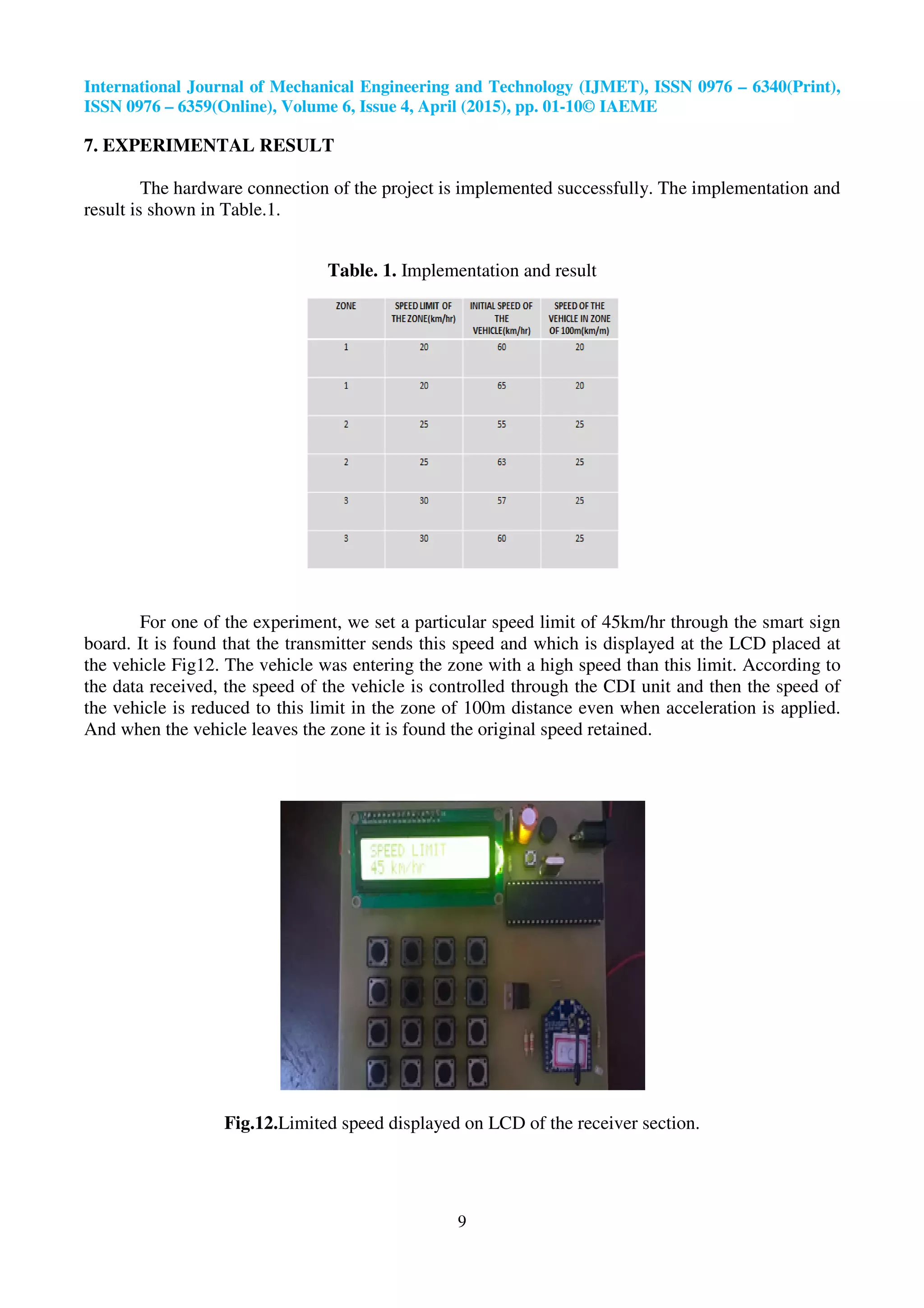
Capacitor discharge ignition (CDI) Fig.10. or thyristor ignition is a type of automotive
electronic ignition system which is widely used in outboard motors, vehicles etc.
developed to overcome the long charging times associated with high inductance coils used in
inductive discharge ignition (IDI) systems, making the ignition system more suitable for high engine
speeds (for small engines, racing engines and
capacitor discharge current output to fire the spark plugs. It receives a pulse from pulser coil which is
proportional to rpm of the vehicle. Normally it is a pulse which has amplitude of 9
period of 9ms , and the offset time period is around 60ms. When acceleration increases offset time
period decreases.
International Journal of Mechanical Engineering and Technology (IJMET), ISSN 0976
6359(Online), Volume 6, Issue 4, April (2015), pp. 01-10© IAEME
7
Fig.9.IR receiver
Two wheeler consists of five alloy arms in its wheel. The reception of the IR waves is
obstructed by alloy arms. So when five obstructions are over the wheel will complete one complete
rotation. The corresponding time will be different for different speed and it is calculated by the
ereby the current speed of the vehicle can be calculated.
Capacitor discharge ignition (CDI) Fig.10. or thyristor ignition is a type of automotive
electronic ignition system which is widely used in outboard motors, vehicles etc.
developed to overcome the long charging times associated with high inductance coils used in
inductive discharge ignition (IDI) systems, making the ignition system more suitable for high engine
speeds (for small engines, racing engines and rotary engines). The capacitive-
capacitor discharge current output to fire the spark plugs. It receives a pulse from pulser coil which is
proportional to rpm of the vehicle. Normally it is a pulse which has amplitude of 9
period of 9ms , and the offset time period is around 60ms. When acceleration increases offset time
Fig.10. CDI unit
International Journal of Mechanical Engineering and Technology (IJMET), ISSN 0976 – 6340(Print),
wheel. The reception of the IR waves is
obstructed by alloy arms. So when five obstructions are over the wheel will complete one complete
rotation. The corresponding time will be different for different speed and it is calculated by the
Capacitor discharge ignition (CDI) Fig.10. or thyristor ignition is a type of automotive
electronic ignition system which is widely used in outboard motors, vehicles etc. It was originally
developed to overcome the long charging times associated with high inductance coils used in
inductive discharge ignition (IDI) systems, making the ignition system more suitable for high engine
-discharge ignition uses
capacitor discharge current output to fire the spark plugs. It receives a pulse from pulser coil which is
proportional to rpm of the vehicle. Normally it is a pulse which has amplitude of 9-12v and time
period of 9ms , and the offset time period is around 60ms. When acceleration increases offset time
International Journal of Mechanical Engineering and Technology (IJMET), ISSN 0976
ISSN 0976 – 6359(Online), Volume 6, Issue
We have to recreate this pulse if the driver doesn’t decrease the speed of the vehicle in speed
limit zone. Microcontroller can create these pulses with amplitude of 5v dc. This pulse is used to
switch a 12v power supply with a circuit. Normally relay is connected with pulser coil and CDI unit.
If the driver doesn’t decreases the speed, then microcontroller switches the
will be established with pulse generating circuit and CDI unit, and the speed will controlled using
corresponding pulse which is generated by the microcontroller. The wave shaping circuit of the CDI
unit is shown in Fig11.
6. PROGRAM LOGIC
A. Transmitter Section: The limiting speed of the zone is entered through keypad in the
transmitter section placed near the road side. The microcontroller will receive this value of
speed entered, which is displayed on the LCD and at the same time this speed is send th
zigbee all the 24 hours of the day.
B. Receiver Section: In the receiver section the microcontroller with the help of IR transmitter
receiver, current speed of the vehicle is calculated by using the equation below.
Speed=Displacement /Time
Here the displacement refers to the distance moved by the vehicle for one complete rotation
and the time refers to the timer value obtained for from one rotation. From here the current sp
the vehicle is obtained.
The main microcontroller receives the spee
zone through the zigbee module. Then the microcontroller compares the zone speed and the current
speed of the vehicle. If the speed is greater than the zonal speed, an audio encoder gives an audio
signal to the driver about limited speed of particular range. This waits for few seconds and if the
driver doesn’t decreases his speed to the specified limit, then the controlling action will be in
by the microcontroller.
International Journal of Mechanical Engineering and Technology (IJMET), ISSN 0976
6359(Online), Volume 6, Issue 4, April (2015), pp. 01-10© IAEME
8
We have to recreate this pulse if the driver doesn’t decrease the speed of the vehicle in speed
troller can create these pulses with amplitude of 5v dc. This pulse is used to
switch a 12v power supply with a circuit. Normally relay is connected with pulser coil and CDI unit.
If the driver doesn’t decreases the speed, then microcontroller switches the relay. Then a connection
will be established with pulse generating circuit and CDI unit, and the speed will controlled using
corresponding pulse which is generated by the microcontroller. The wave shaping circuit of the CDI
Fig.11. Wave shaping Circuit
Section: The limiting speed of the zone is entered through keypad in the
transmitter section placed near the road side. The microcontroller will receive this value of
speed entered, which is displayed on the LCD and at the same time this speed is send th
zigbee all the 24 hours of the day.
Receiver Section: In the receiver section the microcontroller with the help of IR transmitter
receiver, current speed of the vehicle is calculated by using the equation below.
Speed=Displacement /Time
the displacement refers to the distance moved by the vehicle for one complete rotation
and the time refers to the timer value obtained for from one rotation. From here the current sp
The main microcontroller receives the speed limit of the zone whenever the vehicle enters the
zone through the zigbee module. Then the microcontroller compares the zone speed and the current
speed of the vehicle. If the speed is greater than the zonal speed, an audio encoder gives an audio
to the driver about limited speed of particular range. This waits for few seconds and if the
driver doesn’t decreases his speed to the specified limit, then the controlling action will be in
International Journal of Mechanical Engineering and Technology (IJMET), ISSN 0976 – 6340(Print),
We have to recreate this pulse if the driver doesn’t decrease the speed of the vehicle in speed
troller can create these pulses with amplitude of 5v dc. This pulse is used to
switch a 12v power supply with a circuit. Normally relay is connected with pulser coil and CDI unit.
relay. Then a connection
will be established with pulse generating circuit and CDI unit, and the speed will controlled using
corresponding pulse which is generated by the microcontroller. The wave shaping circuit of the CDI
Section: The limiting speed of the zone is entered through keypad in the
transmitter section placed near the road side. The microcontroller will receive this value of
speed entered, which is displayed on the LCD and at the same time this speed is send through
Receiver Section: In the receiver section the microcontroller with the help of IR transmitter
receiver, current speed of the vehicle is calculated by using the equation below.
the displacement refers to the distance moved by the vehicle for one complete rotation
and the time refers to the timer value obtained for from one rotation. From here the current speed of
d limit of the zone whenever the vehicle enters the
zone through the zigbee module. Then the microcontroller compares the zone speed and the current
speed of the vehicle. If the speed is greater than the zonal speed, an audio encoder gives an audio
to the driver about limited speed of particular range. This waits for few seconds and if the
driver doesn’t decreases his speed to the specified limit, then the controlling action will be initiated
International Journal of Mechanical Engineering and Technology (IJMET), ISSN 0976
ISSN 0976 – 6359(Online), Volume 6, Issue
7. EXPERIMENTAL RESULT
The hardware connection of the project is implemented successfully. The implementation and
result is shown in Table.1.
Table. 1.
For one of the experiment, we set a particular speed limit of 45km/hr through the smart sign
board. It is found that the transmitter sends this speed and which is displayed at the LCD placed at
the vehicle Fig12. The vehicle was entering the zone with a high speed than this limit. According to
the data received, the speed of the vehicle is contr
the vehicle is reduced to this limit in the zone of 100m distance even when acceleration is applied.
And when the vehicle leaves the zone it is found the original speed retained.
Fig.12.Limited speed displayed
International Journal of Mechanical Engineering and Technology (IJMET), ISSN 0976
6359(Online), Volume 6, Issue 4, April (2015), pp. 01-10© IAEME
9
The hardware connection of the project is implemented successfully. The implementation and
Table. 1. Implementation and result
For one of the experiment, we set a particular speed limit of 45km/hr through the smart sign
board. It is found that the transmitter sends this speed and which is displayed at the LCD placed at
Fig12. The vehicle was entering the zone with a high speed than this limit. According to
of the vehicle is controlled through the CDI unit and then the speed of
the vehicle is reduced to this limit in the zone of 100m distance even when acceleration is applied.
And when the vehicle leaves the zone it is found the original speed retained.
Limited speed displayed on LCD of the receiver section.
International Journal of Mechanical Engineering and Technology (IJMET), ISSN 0976 – 6340(Print),
The hardware connection of the project is implemented successfully. The implementation and
For one of the experiment, we set a particular speed limit of 45km/hr through the smart sign
board. It is found that the transmitter sends this speed and which is displayed at the LCD placed at
Fig12. The vehicle was entering the zone with a high speed than this limit. According to
olled through the CDI unit and then the speed of
the vehicle is reduced to this limit in the zone of 100m distance even when acceleration is applied.
on LCD of the receiver section.
International Journal of Mechanical Engineering and Technology (IJMET), ISSN 0976 – 6340(Print),
ISSN 0976 – 6359(Online), Volume 6, Issue 4, April (2015), pp. 01-10© IAEME
10
8. CONCLUSION
The paper has been successfully designed and tested. The project succeeded in implementing
a system to reduce the traffic violations. The project is easy to implement on current system, low
cost. low power consumption and durable, ensures maximum safety to passengers and public. The
paper succeeded in implementing a system to reduce the traffic violations. The driver gets all
information about the road without distracting from driving, driver gets all information even in bad
weather conditions. This project is further enhanced by automatic sped control when the vehicle gets
any hazard signal from outside environment. The driver is made aware of his over speed whenever
the vehicle enters the region of limited speed through an audio encoder and if the driver seems not
reducing the speed, the present system automatically reduce its speed to the specified range of the
zone. Wireless transmission about the particular speed of the region is achieved with the help of
zigbee.
VI. REFERENCES
1. “An autonomous speed control and object detection system for vehicles based on RF
technology” International Journal of Advanced Research in Computer and Communication
Engineering Vol. 2, Issue 9, September 2013
2. “Design of RF based speed control system for Vehicles” International Journal of Advanced
Research in Computer and Communication Engineering Vol. 1, Issue 8, October 2012.
3. Rajesh Kannan Megalingam, Vineeth Mohan, Paul Leons, Rizwin Shooja, Ajay M, “Smart
Traffic Controller using Wireless Sensor Network for Dynamic Traffic Routing and Over
Speed Detection”, IEEE Global Humanitarian Technology Conference (GHTC), pp: 528 -
533, 2011.
4. Nourdine Aliane, Javier Fernández, Sergio Bemposta and Mario Mata, “Traffic Violation
Alert and Management”, 14th
International IEEE Conference on Intelligent Transportation
Systems, pp: 1716 - 1720, 2011.
5. “Over speed violation management of a vehicle through zigbee”International Journal of
Engineering and Technology (IJET) Rubini.R and UmaMakeswari.A M.Tech-Embedded
Systems, School of Computing, SASTRA University Thanjavur, Tamil Nadu, India
6. An Article on “An RFID-Based Intelligent Vehicle Speed Controller Using Active Traffic
Signals”Joshué Pérez, Fernando Seco, Vicente Milanés, Antonio Jiménez, Julio C. Díaz and
Teresa de Pedro.
7. Apoorv Prem, “Articulated Vehicle Systems” International Journal of Mechanical
Engineering & Technology (IJMET), Volume 5, Issue 7, 2014, pp. 36 - 41, ISSN Print: 0976
– 6340, ISSN Online: 0976 – 6359.
8. Mohamed HediChabchoub and HafedhTrabelsi, “DC-DC Converter For Ultracapacitor
Boosted Electric Vehicle” International Journal of Advanced Research in Engineering &
Technology (IJARET), Volume 3, Issue 2, 2012, pp. 71 - 81, ISSN Print: 0976-6480, ISSN
Online: 0976-6499.

Smart vehicle and smart signboard system with zonal speed regulation

  • 1.
    International Journal ofMechanical Engineering and Technology (IJMET), ISSN 0976 – 6340(Print), ISSN 0976 – 6359(Online), Volume 6, Issue 4, April (2015), pp. 01-10© IAEME 1 SMART VEHICLE AND SMART SIGNBOARD SYSTEM WITH ZONAL SPEED REGULATION Bindu Prakash1 , Rekha T2 , Akhila T J3, Anu S Pillai4 , Shibinlal S5 , Raymond D Harock6 1 Associate professor, EEE Department, College of Engineering Perumon, India, 2 Assistant professor, EEE Department, College of Engineering Perumon, India, 3,4,5,6 B.Tech Scholar, EEE Department, College of Engineering Perumon, India, ABSTRACT To control the accident highway department have placed the signboards. Increasing number of accidents at busy junctions are a major threat faced by today’s world. Nowadays people are driving very fast; we lost our valuable life by making small mistake while driving (school zone, hills area, and highways). Most of accidents are occur due to two wheelers Speed control is required at busy junctions. In order to avoid such kind of accidents and to alert the drivers and to control their vehicle speed in such kind of places the highway department have placed the signboards. But sometimes it may be possible to view that kind of signboards and there is a chance for accident. In this paper we are controlling the speed of two wheelers. This paper is composed of two separate units: zone transmitter unit and receiver unit. Once the information is received from the zones through zigbee, the vehicle’s embedded unit automatically alerts the driver, to reduce the speed according to the zone, it waits for few seconds, and otherwise vehicle’s speed control unit automatically reduces the speed. Keywords: CDI Unit, Flywheel, Pulsar Coil, Spark Plug, Zigbee. 1. INTRODUCTION One of the major causes of road accident in the world is driving too fast, recent studies shows that one third of the serious road accidents are due to inappropriate speed, as well as change in road way (like presence of road work or unexpected obstacles).So in order to avoid such kind of accidents and to alert the drivers and to control their vehicle speed in such kind of places the highway department have placed the signboards. But sometimes it may not to possible to view that kind of INTERNATIONAL JOURNAL OF MECHANICAL ENGINEERING AND TECHNOLOGY (IJMET) ISSN 0976 – 6340 (Print) ISSN 0976 – 6359 (Online) Volume 6, Issue 4, April (2015), pp. 01-10 © IAEME: www.iaeme.com/IJMET.asp Journal Impact Factor (2015): 8.8293 (Calculated by GISI) www.jifactor.com IJMET © I A E M E
  • 2.
    International Journal ofMechanical Engineering and Technology (IJMET), ISSN 0976 ISSN 0976 – 6359(Online), Volume 6, Issue signboards and there is a chance for accident can control the speed of vehicles. Here we are designing a speed control system for vehicles which can intimate the driver about the zones and limit speed of the vehicle automa This paper develops an intelligent speed adaptation, which can monitor the vehicle speed and implements an action when the vehicle is detected to be exceeding the speed displayed in the speed display (sign) boards [2]. The speed display boards protocol. The driver should take great attention on the speed of the vehicle especially when driving through busy junctions, railway crossings, school and college zones etc[3].The citizens are ought to obey the speed enforcement rules in order to avoid the accidents, any violation in this are considered as a greater offence. Traffic Police are authorized to check every vehicle and take actions against the violation [4]. But it may not be practically possible alwa a way that the vehicle speed is automatically controlled through over a wireless communication [5][6]. 2. EXISTING SYSTEM The figure 1 shows electrical circuit demonstration for the working of a two wheeler. It has an excitor coil which is excited by flywheel of two voltage to the circuit. It has also a pulse rotor. It has one magnet trigger circuit of SCR. The rotation of which depends on the requirement of speed. Fig.1. There is an ignition stop switch when it is closed and charges the capacitor .There is a d1 through which the capacitor is charged and it is connected to primary of step up transformer. There will be an SCR, in a solid state device which when triggered discharges the capacitor and produces ignition .There will be an ignition coil and sp fuel in the engine. 3. PROPOSED SYSTEM The proposed system consists connected, one in the speed display board and the other inside the vehicle. The module at display Board includes, Microcontroller based Embedded System with Zigbee wireless communication module etc. Speed limit of each sign board can be configured by the authority by using keypad. The system uses wireless methods for the communication using ZIGBEE Trans International Journal of Mechanical Engineering and Technology (IJMET), ISSN 0976 6359(Online), Volume 6, Issue 4, April (2015), pp. 01-10© IAEME 2 is a chance for accident. So there is an utmost need to design a system which can control the speed of vehicles. Here we are designing a speed control system for vehicles which can intimate the driver about the zones and limit speed of the vehicle automatically This paper develops an intelligent speed adaptation, which can monitor the vehicle speed and implements an action when the vehicle is detected to be exceeding the speed displayed in the speed [2]. The speed display boards are working as per the highway speed limiting protocol. The driver should take great attention on the speed of the vehicle especially when driving through busy junctions, railway crossings, school and college zones etc[3].The citizens are ought to speed enforcement rules in order to avoid the accidents, any violation in this are considered Police are authorized to check every vehicle and take actions against the [4]. But it may not be practically possible always. The proposed system is designed in such a way that the vehicle speed is automatically controlled through over a wireless communication The figure 1 shows electrical circuit demonstration for the working of a two wheeler. It has an excitor coil which is excited by flywheel of two wheeler. It has a magnet which induces ac voltage to the circuit. It has also a pulse rotor. It has one magnet and induces a dc voltage in the trigger circuit of SCR. The rotation of which depends on the requirement of speed. Demonstration circuit of existing system There is an ignition stop switch when it is closed and charges the capacitor .There is a d1 through which the capacitor is charged and it is connected to primary of step up transformer. There will be an SCR, in a solid state device which when triggered discharges the capacitor and produces ignition .There will be an ignition coil and spark plug which produces spark for ignition of consists of two microcontroller based embedded modules [2] connected, one in the speed display board and the other inside the vehicle. The module at display Microcontroller based Embedded System with Zigbee wireless communication limit of each sign board can be configured by the authority by using keypad. The system uses wireless methods for the communication using ZIGBEE Trans- Receive module. International Journal of Mechanical Engineering and Technology (IJMET), ISSN 0976 – 6340(Print), . So there is an utmost need to design a system which can control the speed of vehicles. Here we are designing a speed control system for vehicles which tically [1]. This paper develops an intelligent speed adaptation, which can monitor the vehicle speed and implements an action when the vehicle is detected to be exceeding the speed displayed in the speed are working as per the highway speed limiting protocol. The driver should take great attention on the speed of the vehicle especially when driving through busy junctions, railway crossings, school and college zones etc[3].The citizens are ought to speed enforcement rules in order to avoid the accidents, any violation in this are considered Police are authorized to check every vehicle and take actions against the ys. The proposed system is designed in such a way that the vehicle speed is automatically controlled through over a wireless communication The figure 1 shows electrical circuit demonstration for the working of a two wheeler. It has wheeler. It has a magnet which induces ac and induces a dc voltage in the trigger circuit of SCR. The rotation of which depends on the requirement of speed. There is an ignition stop switch when it is closed and charges the capacitor .There is a diode d1 through which the capacitor is charged and it is connected to primary of step up transformer. There will be an SCR, in a solid state device which when triggered discharges the capacitor and ark plug which produces spark for ignition of of two microcontroller based embedded modules [2] connected, one in the speed display board and the other inside the vehicle. The module at display Microcontroller based Embedded System with Zigbee wireless communication limit of each sign board can be configured by the authority by using keypad. The Receive module.
  • 3.
    International Journal ofMechanical Engineering and Technology (IJMET), ISSN 0976 – 6340(Print), ISSN 0976 – 6359(Online), Volume 6, Issue 4, April (2015), pp. 01-10© IAEME 3 The wireless ZIGBEE module transmits the speed limit and warnings to the vehicle. On the other hand in the vehicle module, the ZIGBEE Receiver unit announces the speed limit warnings through audio encoder and speaker. The microcontroller in the receiver unit, checks the current speed of the vehicle and compare it with zone speed. If the speed is above the specified limit, the Central controlling signal produce trigger signals for the motor that control accelerator unit to drop the speed within the specified range. 4. BLOCK DIAGRAM The transmitter portion is a stationary part, which is palced at the sign board near the road sides. The transmitter section is shown in the Fig.2. The transmitter section consist of a microcontroller 16F877A, which consist of an inbuilt ADC, timers, usart etc. The microcontroller controls entire action of the transmitter unit. A 16x2 LCD display which displays the speed of the zone there by inform the driver about the zone. A 4x3 matrix membrane type keypad, through which authority can set the speed of the particular zone by the authority. A zigbee module is used for wireless communication between transmitter and reciver. Fig.2. Block diagram of transmitter section Receiver section is placed in the vehicle. The diagram of the receiver is shown in the Fig.3. The receiver section consists of three microcontrollers, speed sensor. Speed controlling unit, audio encoder, zigbee and an LCD display. The LCD display is displays the speed of a particular zone. A relay is connected to the microcontroller. The relay switches the input to CDI unit from the pulser coil to our pulser generating unit. The zigbee receives the speed of the zone sent by the transmitter. Audio encoder is on IC APR9600, which is used to inform the driver about the zone details. A mic and a loudspeaker is connected to the audio encoder for recording and informing the driver about the zone. Speed sensor is a magnetic reed switch which is used to measure the current speed of the vehicle.
  • 4.
    International Journal ofMechanical Engineering and Technology (IJMET), ISSN 0976 ISSN 0976 – 6359(Online), Volume 6, Issue Fig.3. 5. OVERVIEW OF WORKING MODEL 5.1. Transmitter section The authorities can set the speed of a particular zone using keypad. The speed of the zone is different for different zones. The zigbee will continuously sent the set speed. zone is displayed in the lcd placed in the sign board. Lcd give display alert to the drivers. Fig.4. 5.2. Receiver section When the vehicle enters into a particular zone, the rescue zone. At the same time microcontroller informs the driver about the particular zone, through audio encoder, loud speaker and LCD and give action for controlling the speed. If the driver is not controlling the speed, the micro controller activates the relay which will switch the CDI unit to our pulse generating circuit Fig.6. International Journal of Mechanical Engineering and Technology (IJMET), ISSN 0976 6359(Online), Volume 6, Issue 4, April (2015), pp. 01-10© IAEME 4 Fig.3. Block diagram of receiver section OVERVIEW OF WORKING MODEL The authorities can set the speed of a particular zone using keypad. The speed of the zone is different for different zones. The zigbee will continuously sent the set speed. zone is displayed in the lcd placed in the sign board. Lcd give display alert to the drivers. Fig.4.Flow Chart of transmitter section When the vehicle enters into a particular zone, the rescue zigbee receives the speed of the zone. At the same time microcontroller informs the driver about the particular zone, through audio encoder, loud speaker and LCD and give action for controlling the speed. If the driver is not ro controller activates the relay which will switch the CDI unit to our International Journal of Mechanical Engineering and Technology (IJMET), ISSN 0976 – 6340(Print), The authorities can set the speed of a particular zone using keypad. The speed of the zone is different for different zones. The zigbee will continuously sent the set speed. The set speed of the zone is displayed in the lcd placed in the sign board. Lcd give display alert to the drivers. zigbee receives the speed of the zone. At the same time microcontroller informs the driver about the particular zone, through audio encoder, loud speaker and LCD and give action for controlling the speed. If the driver is not ro controller activates the relay which will switch the CDI unit to our
  • 5.
    International Journal ofMechanical Engineering and Technology (IJMET), ISSN 0976 ISSN 0976 – 6359(Online), Volume 6, Issue Fig.5. For controlling the speed the distance between the pulser amplitude of the pulser given to CDI unit is 12V. Under normal sped, without acceleration the distance between the pulser is 60ms. For decreasing the speed the distance between the consecutive pulser is increased. The time delay between the consecutive sparks increases. International Journal of Mechanical Engineering and Technology (IJMET), ISSN 0976 6359(Online), Volume 6, Issue 4, April (2015), pp. 01-10© IAEME 5 Fig.5. Flow chart of the receiver section Fig.6. Pulse generating circuit. For controlling the speed the distance between the pulser given to the CDI unit is varied. The amplitude of the pulser given to CDI unit is 12V. Under normal sped, without acceleration the distance between the pulser is 60ms. For decreasing the speed the distance between the consecutive time delay between the consecutive sparks increases. International Journal of Mechanical Engineering and Technology (IJMET), ISSN 0976 – 6340(Print), given to the CDI unit is varied. The amplitude of the pulser given to CDI unit is 12V. Under normal sped, without acceleration the distance between the pulser is 60ms. For decreasing the speed the distance between the consecutive
  • 6.
    International Journal ofMechanical Engineering and Technology (IJMET), ISSN 0976 ISSN 0976 – 6359(Online), Volume 6, Issue Fig.7. Normal pulse from pulser coil without acceleration As the time delay between the delayed. The engine used in a two wheeler is a 4 strok the ignition of the fuel. When the spark is delayed the stroke after ignition stroke ,stroke will not operate there by the speed of the engine will be decreases and hence the speed of the vehicle decreases .speed of the engine will be decreases and hence the speed of the vehicle decreases. 5.3. IR Transmitter Receiver The IR transmitter Receiver is used for the measurement of speed of the vehicle. The transmitter receiver is placed in the shock absorber of three terminals Fig.8. That is supply, ground and control terminal. The IR module requires a 3.3V supply. The control pin is connected to the microcontroller which when activated the transmitter starts emission of IR radiation. The IR radiation part is a IR emitting diode. The transmitting section emits IR radiations to IR receiver. The IR receiver Fig.9. also consist of three terminals. That is supply, gro The output will be high when it receives IR radiations. The output is low when it doesn’t receives the IR radiations from IR transmitter. International Journal of Mechanical Engineering and Technology (IJMET), ISSN 0976 6359(Online), Volume 6, Issue 4, April (2015), pp. 01-10© IAEME 6 Normal pulse from pulser coil without acceleration As the time delay between the consecutive sparks increases the working of the engine is delayed. The engine used in a two wheeler is a 4 stroke engine. The ignition stroke requires spark for the ignition of the fuel. When the spark is delayed the stroke after ignition stroke ,stroke will not operate there by the speed of the engine will be decreases and hence the speed of the vehicle speed of the engine will be decreases and hence the speed of the vehicle decreases. The IR transmitter Receiver is used for the measurement of speed of the vehicle. The transmitter receiver is placed in the shock absorber of the two wheeler. The transmitter consist of three terminals Fig.8. That is supply, ground and control terminal. The IR module requires a 3.3V supply. The control pin is connected to the microcontroller which when activated the transmitter of IR radiation. The IR radiation part is a IR emitting diode. The transmitting section emits IR radiations to IR receiver. Fig.8.IR transmitter The IR receiver Fig.9. also consist of three terminals. That is supply, gro The output will be high when it receives IR radiations. The output is low when it doesn’t receives the IR radiations from IR transmitter. International Journal of Mechanical Engineering and Technology (IJMET), ISSN 0976 – 6340(Print), Normal pulse from pulser coil without acceleration sparks increases the working of the engine is e engine. The ignition stroke requires spark for the ignition of the fuel. When the spark is delayed the stroke after ignition stroke ,stroke will not operate there by the speed of the engine will be decreases and hence the speed of the vehicle speed of the engine will be decreases and hence the speed of the vehicle decreases. The IR transmitter Receiver is used for the measurement of speed of the vehicle. The the two wheeler. The transmitter consist of three terminals Fig.8. That is supply, ground and control terminal. The IR module requires a 3.3V supply. The control pin is connected to the microcontroller which when activated the transmitter of IR radiation. The IR radiation part is a IR emitting diode. The transmitting section The IR receiver Fig.9. also consist of three terminals. That is supply, ground and output pins. The output will be high when it receives IR radiations. The output is low when it doesn’t receives the
  • 7.
    International Journal ofMechanical Engineering and Technology (IJMET), ISSN 0976 ISSN 0976 – 6359(Online), Volume 6, Issue Two wheeler consists of five alloy arms in its obstructed by alloy arms. So when five obstructions are over the wheel will complete one complete rotation. The corresponding time will be different for different speed and it is calculated by the microcontroller. Thereby the current speed of 5.4. CDI unit Capacitor discharge ignition (CDI) Fig.10. or thyristor ignition is a type of automotive electronic ignition system which is widely used in outboard motors, vehicles etc. developed to overcome the long charging times associated with high inductance coils used in inductive discharge ignition (IDI) systems, making the ignition system more suitable for high engine speeds (for small engines, racing engines and capacitor discharge current output to fire the spark plugs. It receives a pulse from pulser coil which is proportional to rpm of the vehicle. Normally it is a pulse which has amplitude of 9 period of 9ms , and the offset time period is around 60ms. When acceleration increases offset time period decreases. International Journal of Mechanical Engineering and Technology (IJMET), ISSN 0976 6359(Online), Volume 6, Issue 4, April (2015), pp. 01-10© IAEME 7 Fig.9.IR receiver Two wheeler consists of five alloy arms in its wheel. The reception of the IR waves is obstructed by alloy arms. So when five obstructions are over the wheel will complete one complete rotation. The corresponding time will be different for different speed and it is calculated by the ereby the current speed of the vehicle can be calculated. Capacitor discharge ignition (CDI) Fig.10. or thyristor ignition is a type of automotive electronic ignition system which is widely used in outboard motors, vehicles etc. developed to overcome the long charging times associated with high inductance coils used in inductive discharge ignition (IDI) systems, making the ignition system more suitable for high engine speeds (for small engines, racing engines and rotary engines). The capacitive- capacitor discharge current output to fire the spark plugs. It receives a pulse from pulser coil which is proportional to rpm of the vehicle. Normally it is a pulse which has amplitude of 9 period of 9ms , and the offset time period is around 60ms. When acceleration increases offset time Fig.10. CDI unit International Journal of Mechanical Engineering and Technology (IJMET), ISSN 0976 – 6340(Print), wheel. The reception of the IR waves is obstructed by alloy arms. So when five obstructions are over the wheel will complete one complete rotation. The corresponding time will be different for different speed and it is calculated by the Capacitor discharge ignition (CDI) Fig.10. or thyristor ignition is a type of automotive electronic ignition system which is widely used in outboard motors, vehicles etc. It was originally developed to overcome the long charging times associated with high inductance coils used in inductive discharge ignition (IDI) systems, making the ignition system more suitable for high engine -discharge ignition uses capacitor discharge current output to fire the spark plugs. It receives a pulse from pulser coil which is proportional to rpm of the vehicle. Normally it is a pulse which has amplitude of 9-12v and time period of 9ms , and the offset time period is around 60ms. When acceleration increases offset time
  • 8.
    International Journal ofMechanical Engineering and Technology (IJMET), ISSN 0976 ISSN 0976 – 6359(Online), Volume 6, Issue We have to recreate this pulse if the driver doesn’t decrease the speed of the vehicle in speed limit zone. Microcontroller can create these pulses with amplitude of 5v dc. This pulse is used to switch a 12v power supply with a circuit. Normally relay is connected with pulser coil and CDI unit. If the driver doesn’t decreases the speed, then microcontroller switches the will be established with pulse generating circuit and CDI unit, and the speed will controlled using corresponding pulse which is generated by the microcontroller. The wave shaping circuit of the CDI unit is shown in Fig11. 6. PROGRAM LOGIC A. Transmitter Section: The limiting speed of the zone is entered through keypad in the transmitter section placed near the road side. The microcontroller will receive this value of speed entered, which is displayed on the LCD and at the same time this speed is send th zigbee all the 24 hours of the day. B. Receiver Section: In the receiver section the microcontroller with the help of IR transmitter receiver, current speed of the vehicle is calculated by using the equation below. Speed=Displacement /Time Here the displacement refers to the distance moved by the vehicle for one complete rotation and the time refers to the timer value obtained for from one rotation. From here the current sp the vehicle is obtained. The main microcontroller receives the spee zone through the zigbee module. Then the microcontroller compares the zone speed and the current speed of the vehicle. If the speed is greater than the zonal speed, an audio encoder gives an audio signal to the driver about limited speed of particular range. This waits for few seconds and if the driver doesn’t decreases his speed to the specified limit, then the controlling action will be in by the microcontroller. International Journal of Mechanical Engineering and Technology (IJMET), ISSN 0976 6359(Online), Volume 6, Issue 4, April (2015), pp. 01-10© IAEME 8 We have to recreate this pulse if the driver doesn’t decrease the speed of the vehicle in speed troller can create these pulses with amplitude of 5v dc. This pulse is used to switch a 12v power supply with a circuit. Normally relay is connected with pulser coil and CDI unit. If the driver doesn’t decreases the speed, then microcontroller switches the relay. Then a connection will be established with pulse generating circuit and CDI unit, and the speed will controlled using corresponding pulse which is generated by the microcontroller. The wave shaping circuit of the CDI Fig.11. Wave shaping Circuit Section: The limiting speed of the zone is entered through keypad in the transmitter section placed near the road side. The microcontroller will receive this value of speed entered, which is displayed on the LCD and at the same time this speed is send th zigbee all the 24 hours of the day. Receiver Section: In the receiver section the microcontroller with the help of IR transmitter receiver, current speed of the vehicle is calculated by using the equation below. Speed=Displacement /Time the displacement refers to the distance moved by the vehicle for one complete rotation and the time refers to the timer value obtained for from one rotation. From here the current sp The main microcontroller receives the speed limit of the zone whenever the vehicle enters the zone through the zigbee module. Then the microcontroller compares the zone speed and the current speed of the vehicle. If the speed is greater than the zonal speed, an audio encoder gives an audio to the driver about limited speed of particular range. This waits for few seconds and if the driver doesn’t decreases his speed to the specified limit, then the controlling action will be in International Journal of Mechanical Engineering and Technology (IJMET), ISSN 0976 – 6340(Print), We have to recreate this pulse if the driver doesn’t decrease the speed of the vehicle in speed troller can create these pulses with amplitude of 5v dc. This pulse is used to switch a 12v power supply with a circuit. Normally relay is connected with pulser coil and CDI unit. relay. Then a connection will be established with pulse generating circuit and CDI unit, and the speed will controlled using corresponding pulse which is generated by the microcontroller. The wave shaping circuit of the CDI Section: The limiting speed of the zone is entered through keypad in the transmitter section placed near the road side. The microcontroller will receive this value of speed entered, which is displayed on the LCD and at the same time this speed is send through Receiver Section: In the receiver section the microcontroller with the help of IR transmitter receiver, current speed of the vehicle is calculated by using the equation below. the displacement refers to the distance moved by the vehicle for one complete rotation and the time refers to the timer value obtained for from one rotation. From here the current speed of d limit of the zone whenever the vehicle enters the zone through the zigbee module. Then the microcontroller compares the zone speed and the current speed of the vehicle. If the speed is greater than the zonal speed, an audio encoder gives an audio to the driver about limited speed of particular range. This waits for few seconds and if the driver doesn’t decreases his speed to the specified limit, then the controlling action will be initiated
  • 9.
    International Journal ofMechanical Engineering and Technology (IJMET), ISSN 0976 ISSN 0976 – 6359(Online), Volume 6, Issue 7. EXPERIMENTAL RESULT The hardware connection of the project is implemented successfully. The implementation and result is shown in Table.1. Table. 1. For one of the experiment, we set a particular speed limit of 45km/hr through the smart sign board. It is found that the transmitter sends this speed and which is displayed at the LCD placed at the vehicle Fig12. The vehicle was entering the zone with a high speed than this limit. According to the data received, the speed of the vehicle is contr the vehicle is reduced to this limit in the zone of 100m distance even when acceleration is applied. And when the vehicle leaves the zone it is found the original speed retained. Fig.12.Limited speed displayed International Journal of Mechanical Engineering and Technology (IJMET), ISSN 0976 6359(Online), Volume 6, Issue 4, April (2015), pp. 01-10© IAEME 9 The hardware connection of the project is implemented successfully. The implementation and Table. 1. Implementation and result For one of the experiment, we set a particular speed limit of 45km/hr through the smart sign board. It is found that the transmitter sends this speed and which is displayed at the LCD placed at Fig12. The vehicle was entering the zone with a high speed than this limit. According to of the vehicle is controlled through the CDI unit and then the speed of the vehicle is reduced to this limit in the zone of 100m distance even when acceleration is applied. And when the vehicle leaves the zone it is found the original speed retained. Limited speed displayed on LCD of the receiver section. International Journal of Mechanical Engineering and Technology (IJMET), ISSN 0976 – 6340(Print), The hardware connection of the project is implemented successfully. The implementation and For one of the experiment, we set a particular speed limit of 45km/hr through the smart sign board. It is found that the transmitter sends this speed and which is displayed at the LCD placed at Fig12. The vehicle was entering the zone with a high speed than this limit. According to olled through the CDI unit and then the speed of the vehicle is reduced to this limit in the zone of 100m distance even when acceleration is applied. on LCD of the receiver section.
  • 10.
    International Journal ofMechanical Engineering and Technology (IJMET), ISSN 0976 – 6340(Print), ISSN 0976 – 6359(Online), Volume 6, Issue 4, April (2015), pp. 01-10© IAEME 10 8. CONCLUSION The paper has been successfully designed and tested. The project succeeded in implementing a system to reduce the traffic violations. The project is easy to implement on current system, low cost. low power consumption and durable, ensures maximum safety to passengers and public. The paper succeeded in implementing a system to reduce the traffic violations. The driver gets all information about the road without distracting from driving, driver gets all information even in bad weather conditions. This project is further enhanced by automatic sped control when the vehicle gets any hazard signal from outside environment. The driver is made aware of his over speed whenever the vehicle enters the region of limited speed through an audio encoder and if the driver seems not reducing the speed, the present system automatically reduce its speed to the specified range of the zone. Wireless transmission about the particular speed of the region is achieved with the help of zigbee. VI. REFERENCES 1. “An autonomous speed control and object detection system for vehicles based on RF technology” International Journal of Advanced Research in Computer and Communication Engineering Vol. 2, Issue 9, September 2013 2. “Design of RF based speed control system for Vehicles” International Journal of Advanced Research in Computer and Communication Engineering Vol. 1, Issue 8, October 2012. 3. Rajesh Kannan Megalingam, Vineeth Mohan, Paul Leons, Rizwin Shooja, Ajay M, “Smart Traffic Controller using Wireless Sensor Network for Dynamic Traffic Routing and Over Speed Detection”, IEEE Global Humanitarian Technology Conference (GHTC), pp: 528 - 533, 2011. 4. Nourdine Aliane, Javier Fernández, Sergio Bemposta and Mario Mata, “Traffic Violation Alert and Management”, 14th International IEEE Conference on Intelligent Transportation Systems, pp: 1716 - 1720, 2011. 5. “Over speed violation management of a vehicle through zigbee”International Journal of Engineering and Technology (IJET) Rubini.R and UmaMakeswari.A M.Tech-Embedded Systems, School of Computing, SASTRA University Thanjavur, Tamil Nadu, India 6. An Article on “An RFID-Based Intelligent Vehicle Speed Controller Using Active Traffic Signals”Joshué Pérez, Fernando Seco, Vicente Milanés, Antonio Jiménez, Julio C. Díaz and Teresa de Pedro. 7. Apoorv Prem, “Articulated Vehicle Systems” International Journal of Mechanical Engineering & Technology (IJMET), Volume 5, Issue 7, 2014, pp. 36 - 41, ISSN Print: 0976 – 6340, ISSN Online: 0976 – 6359. 8. Mohamed HediChabchoub and HafedhTrabelsi, “DC-DC Converter For Ultracapacitor Boosted Electric Vehicle” International Journal of Advanced Research in Engineering & Technology (IJARET), Volume 3, Issue 2, 2012, pp. 71 - 81, ISSN Print: 0976-6480, ISSN Online: 0976-6499.