See discussions, stats, and author profiles for this publication at: https://www.researchgate.net/publication/348949560
Design of Auto-Braking System for Accident Prevention and Accident
Detection System Using IoT
Chapter · February 2021
DOI: 10.1007/978-3-030-52624-5_7
CITATIONS
0
READS
917
5 authors, including:
Gitanjali Mehta
Galgotias University, Greater Noida, India
35 PUBLICATIONS   123 CITATIONS   
SEE PROFILE
All content following this page was uploaded by Gitanjali Mehta on 12 April 2021.
The user has requested enhancement of the downloaded file.
101
© Springer Nature Switzerland AG 2021
D. Gupta et al. (eds.), Smart Sensors for Industrial Internet of Things, Internet
of Things, https://doi.org/10.1007/978-3-030-52624-5_7
Design of Auto-Braking System
for Accident Prevention and Accident
Detection System Using IoT
Gitanjali Mehta, Manoj Singh, Shubham Dubey, Uzair, and Yogesh Mishra
Abstract  In recent times, frequencies of accidents have increased considerably.
This is because of an increase in the number of vehicles, carelessness of drivers, and
over speeding. Over speeding is the main reason for increase in the number of acci-
dents. In this work, the primary concern is to decrease the impact of collision, and
after that communicating with the nearby hospital for providing necessary support
to the victims. According to data provided by the Ministry of National Highway,
most of the deaths occurred because of not getting help in crucial times or not get-
ting an ambulance service in time. Our main aim is to communicate with the nearest
hospital through GPS and help the victims. Our work is divided into two main parts.
One is sensing and communication part. Other is the braking part which has three
steps. When the distance of the vehicle from the obstacle is more than 30 m then the
system is disabled. If the distance becomes less than 30 m then a warning is gener-
ated by the system for the driver to apply brakes. If the distance is further reduced
and becomes less than 4 m understanding that the driver has lost control over the
vehicle, control is fully transferred to the braking system and plugging braking is
used to stop the vehicle instantly to reduce the impact of a possible collision.
Keywords  Accident prevention · Auto-braking system · Accident detection ·
Internet of Things
1  Introduction
1.1  Overall Description
India is one of the most populated countries, hence the population explosion has
made a direct impact in the market of automobiles. The cause of the accidents is
mainly due to the quality of roads and the unavailability of new technologies in
vehicles. Transportation is the basic need for daily life and to reduce the severity of
G. Mehta (*) · M. Singh · S. Dubey · Uzair · Y. Mishra
School of Electrical, Electronics and Communication Engineering, Galgotias University,
Greater Noida, India
102
accidental impact these technologies should be updated. Many people face various
problems in their day-to-day life because of a lack of available traveling resources.
The government is not taking the required decision and lacking the appropriate laws
of traffic so that common men and children are not able to travel in secure vehicles
[1–3]. So, for the betterment of the society, we came up with the research work
“Design of Auto-Braking System for Accident Prevention and Accident Detection
System using IoT”.
There are many applications in the market to provide safety in vehicles but they
are not up to the mark. In our work, we have developed such a technology which can
prevent accidents and in case of failure which is evitable there is an alarming system
built in the setup which will alarm the nearby hospital, police stations, and the rela-
tives of the victim by sending messages to registered contact number [3, 4].
1.2  Survey
We use transportation to do many of our daily life works but it can create the worst
scenarios and even kill people through accidents. In 2008, India ranked fourth in
fatal injuries caused by road accidents and the age group which is more involved in
these injuries is 15–29. In the absence of required actions, traffic crashes will reach
the toll of death of around 1.9 million people annually by 2020.
1.3  Accident Detection
When an accident occurs, we are going to communicate with the nearby hospital to
provide the necessary support to the victim.According to statistics from the Ministry
of National Highway, accidents are classified into three types. In the first type, the
accident is so severe and the victim dies on the spot. In the second type, the victim
is seriously injured and can be safe if proper health facility is provided to him on
time. In the third type, causality is not severe and takes time to recover but can be
recovered. So our prime concern is on the second type and we are focused to pro-
vide them help on time thus providing a signal to the nearby hospital using
IOTs [5, 6].
1.4  Motivation
We get the motivation for this work from fall detection technology in Apple watch.
Similar technology is used by Apple watch, which detects when there is a hard fall
or there is a severe impact. An emergency message is popped up in which we can
G. Mehta et al.
103
ask for emergency help if we are seriously injured, or can click on “I M OK”, to
disable the system. If any option is not chosen then the watch will wait for a few
seconds and automatically send the signal to relatives or nearby hospitals.
Recently an incident occurred in San Francisco in which a person falls from the
terrace and is not able to move, then watch sends signal automatically and the
person is rescued.
1.5  Braking Mechanism
In this part, we are concerned about reducing the impact of collision, as by reducing
the impact we can decrease the severity of accidents. According to statistics from
the Ministry of Highway, Government of India, most of the accidents occurred due
to over speeding, so by reducing the speed of vehicles at the last moment we can
definitely reduce the casualties. According to statistics, many accidents occurred
due to panic of the driver when an accident is going to occur, and he is unable to
apply brakes or lose control over vehicles [7, 8]. So we also need to sense the dis-
tance between vehicle and obstacle and give warning to the driver to apply brakes
(Fig. 1). When the distance is further reduced motor driver circuit comes into pic-
ture and decelerates the motor. When the distance is less than 4 m brakes are applied
automatically.
Fig. 1  Braking mechanism to prevent collision of two vehicles
Design of Auto-Braking System for Accident Prevention and Accident Detecti…
104
2  Methodology
2.1  Block Diagram
Figure 2 shows the block diagram of the proposed system. The Arduino Uno is a
microcontroller board based on the Microchip ATmega328P microcontroller.
Arduino has made a huge impact in the electrical and electronics world. In this
work, it is used to detect the input from the piezoelectric sensor and send the signal
through GPS. A separate 9 V portable power supply powers the Arduino board or
we can use the supply of the vehicle [8].
GPS is a global positioning system used to detect the location of anything on the
earth. It uses longitude and latitudinal coordinates to find the position of the device.
There is a transmitter and a receiver in the GPS module in which the transmitter
transmits the signal to satellite and the receiver receives the coordinates. In this
project, GPS is used to communicate with nearby hospitals.
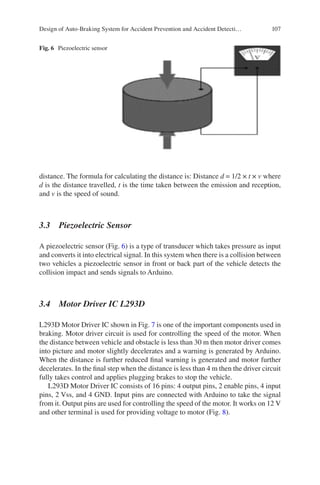
A piezoelectric sensor is a type of transducer which takes pressure as input and
converts it into electrical signal. In this system when there is a collision between two
vehicles a piezoelectric sensor is used in the front part which detects the collision
and sends a signal to Arduino.
Internet of Things is abbreviated as IoT. In the present time every device can
be connected with each other with the help of IoT, data is stored in the cloud so
that our time can be saved. IoT is almost used everywhere in today’s world and
after Industry 4.0 even large machines can be controlled from anywhere around
the world [5, 6].
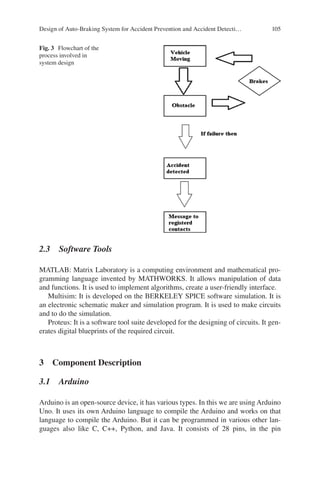
2.2  Flowchart
Figure 3 shows the flowchart of the process involved in the designed system.
Fig. 2  Block diagram of the system
G. Mehta et al.
105
2.3  Software Tools
MATLAB: Matrix Laboratory is a computing environment and mathematical pro-
gramming language invented by MATHWORKS. It allows manipulation of data
and functions. It is used to implement algorithms, create a user-friendly interface.
Multisim: It is developed on the BERKELEY SPICE software simulation. It is
an electronic schematic maker and simulation program. It is used to make circuits
and to do the simulation.
Proteus: It is a software tool suite developed for the designing of circuits. It gen-
erates digital blueprints of the required circuit.
3  Component Description
3.1  Arduino
Arduino is an open-source device, it has various types. In this we are using Arduino
Uno. It uses its own Arduino language to compile the Arduino and works on that
language to compile the Arduino. But it can be programmed in various other lan-
guages also like C, C++, Python, and Java. It consists of 28 pins, in the pin
Fig. 3  Flowchart of the
process involved in
system design
Design of Auto-Braking System for Accident Prevention and Accident Detecti…
106
configuration it has 13 digital input-output pins which can be used for either input
or output. It has six analog pins that can be also used for input and output port, and
it works on 5 V supply, it consists of three GND terminals (Fig. 4) [8].
3.2  Ultrasonic Sensors
Ultrasonic sensor (Fig. 5) plays a major role in measuring the distance between two
vehicles or any obstacles. Ultrasonic sensor uses high-frequency signals or waves
which cannot be heard by normal human ears. Sound wave is emitted by ultrasonic
sensors which strike with obstacles and revert, which calculates the distance between
the vehicles and obstruction. Ultrasonic sensors are used in submarines, aircrafts,
and radars. It consists of two parts, i.e., transmitter and receiver. The transmitter
transmits the signal whereas the receiver collects the reflected signal to calculate the
Fig. 4  Arduino Uno Board
Fig. 5  Ultrasonic sensors
G. Mehta et al.
107
distance. The formula for calculating the distance is: Distance d = 1/2 × t × v where
d is the distance travelled, t is the time taken between the emission and reception,
and v is the speed of sound.
3.3  Piezoelectric Sensor
A piezoelectric sensor (Fig. 6) is a type of transducer which takes pressure as input
and converts it into electrical signal. In this system when there is a collision between
two vehicles a piezoelectric sensor in front or back part of the vehicle detects the
collision impact and sends signals to Arduino.
3.4  
Motor Driver IC L293D
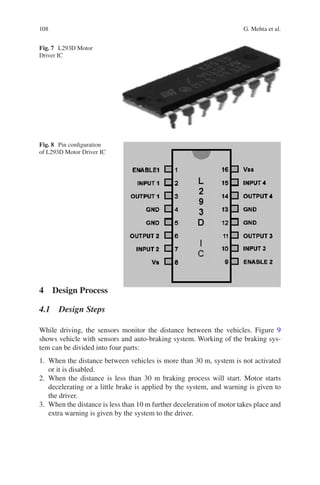
L293D Motor Driver IC shown in Fig. 7 is one of the important components used in
braking. Motor driver circuit is used for controlling the speed of the motor. When
the distance between vehicle and obstacle is less than 30 m then motor driver comes
into picture and motor slightly decelerates and a warning is generated by Arduino.
When the distance is further reduced final warning is generated and motor further
decelerates. In the final step when the distance is less than 4 m then the driver circuit
fully takes control and applies plugging brakes to stop the vehicle.
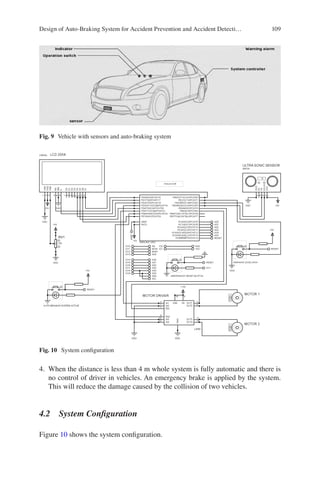
L293D Motor Driver IC consists of 16 pins: 4 output pins, 2 enable pins, 4 input
pins, 2 Vss, and 4 GND. Input pins are connected with Arduino to take the signal
from it. Output pins are used for controlling the speed of the motor. It works on 12 V
and other terminal is used for providing voltage to motor (Fig. 8).
Fig. 6  Piezoelectric sensor
Design of Auto-Braking System for Accident Prevention and Accident Detecti…
108
4  Design Process
4.1  Design Steps
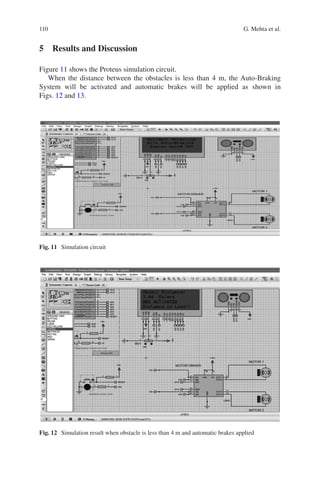
While driving, the sensors monitor the distance between the vehicles. Figure  9
shows vehicle with sensors and auto-braking system. Working of the braking sys-
tem can be divided into four parts:
	
1.	 When the distance between vehicles is more than 30 m, system is not activated
or it is disabled.
	
2.	When the distance is less than 30 m braking process will start. Motor starts
decelerating or a little brake is applied by the system, and warning is given to
the driver.
	
3.	 When the distance is less than 10 m further deceleration of motor takes place and
extra warning is given by the system to the driver.
Fig. 7  L293D Motor
Driver IC
Fig. 8  Pin configuration
of L293D Motor Driver IC
G. Mehta et al.
109
	
4.	 When the distance is less than 4 m whole system is fully automatic and there is
no control of driver in vehicles. An emergency brake is applied by the system.
This will reduce the damage caused by the collision of two vehicles.
4.2  System Configuration
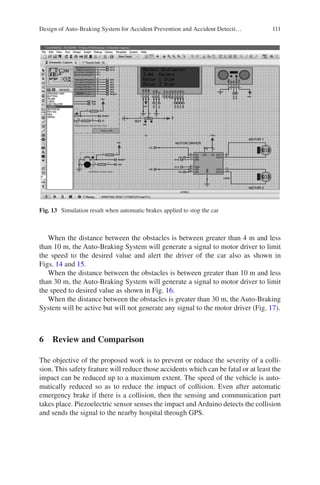
Figure 10 shows the system configuration.
Fig. 9  Vehicle with sensors and auto-braking system
Fig. 10  System configuration
Design of Auto-Braking System for Accident Prevention and Accident Detecti…
110
5  Results and Discussion
Figure 11 shows the Proteus simulation circuit.
When the distance between the obstacles is less than 4 m, the Auto-Braking
System will be activated and automatic brakes will be applied as shown in
Figs. 12 and 13.
Fig. 11  Simulation circuit
Fig. 12  Simulation result when obstacle is less than 4 m and automatic brakes applied
G. Mehta et al.
111
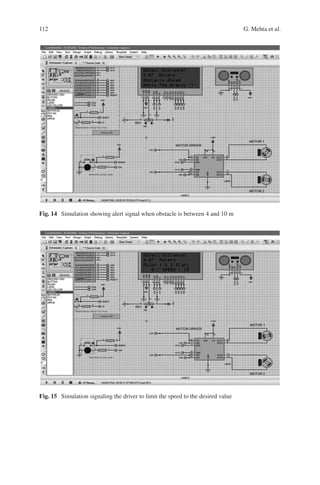
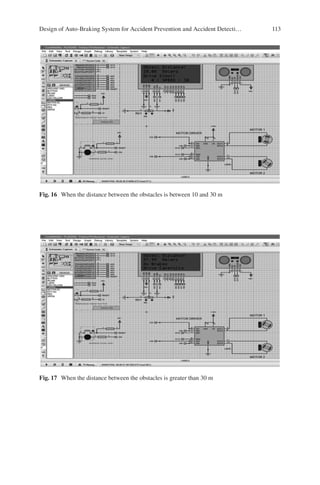
When the distance between the obstacles is between greater than 4 m and less
than 10 m, the Auto-Braking System will generate a signal to motor driver to limit
the speed to the desired value and alert the driver of the car also as shown in
Figs. 14 and 15.
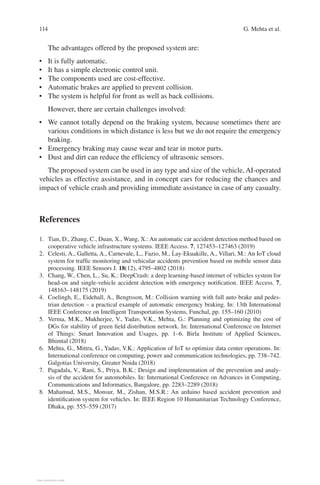
When the distance between the obstacles is between greater than 10 m and less
than 30 m, the Auto-Braking System will generate a signal to motor driver to limit
the speed to desired value as shown in Fig. 16.
When the distance between the obstacles is greater than 30 m, the Auto-Braking
System will be active but will not generate any signal to the motor driver (Fig. 17).
6  Review and Comparison
The objective of the proposed work is to prevent or reduce the severity of a colli-
sion. This safety feature will reduce those accidents which can be fatal or at least the
impact can be reduced up to a maximum extent. The speed of the vehicle is auto-
matically reduced so as to reduce the impact of collision. Even after automatic
emergency brake if there is a collision, then the sensing and communication part
takes place. Piezoelectric sensor senses the impact and Arduino detects the collision
and sends the signal to the nearby hospital through GPS.
Fig. 13  Simulation result when automatic brakes applied to stop the car
Design of Auto-Braking System for Accident Prevention and Accident Detecti…
112
Fig. 14  Simulation showing alert signal when obstacle is between 4 and 10 m
Fig. 15  Simulation signaling the driver to limit the speed to the desired value
G. Mehta et al.
113
Fig. 16  When the distance between the obstacles is between 10 and 30 m
Fig. 17  When the distance between the obstacles is greater than 30 m
Design of Auto-Braking System for Accident Prevention and Accident Detecti…
114
The advantages offered by the proposed system are:
•	 It is fully automatic.
•	 It has a simple electronic control unit.
•	 The components used are cost-effective.
•	 Automatic brakes are applied to prevent collision.
•	 The system is helpful for front as well as back collisions.
However, there are certain challenges involved:
•	 We cannot totally depend on the braking system, because sometimes there are
various conditions in which distance is less but we do not require the emergency
braking.
•	 Emergency braking may cause wear and tear in motor parts.
•	 Dust and dirt can reduce the efficiency of ultrasonic sensors.
The proposed system can be used in any type and size of the vehicle, AI-operated
vehicles as effective assistance, and in concept cars for reducing the chances and
impact of vehicle crash and providing immediate assistance in case of any casualty.
References
	
1.	 Tian, D., Zhang, C., Duan, X., Wang, X.: An automatic car accident detection method based on
cooperative vehicle infrastructure systems. IEEE Access. 7, 127453–127463 (2019)
	
2.	 Celesti, A., Galletta, A., Carnevale, L., Fazio, M., Ĺay-Ekuakille, A., Villari, M.: An IoT cloud
system for traffic monitoring and vehicular accidents prevention based on mobile sensor data
processing. IEEE Sensors J. 18(12), 4795–4802 (2018)
	
3.	 Chang, W., Chen, L., Su, K.: DeepCrash: a deep learning-based internet of vehicles system for
head-on and single-vehicle accident detection with emergency notification. IEEE Access. 7,
148163–148175 (2019)
	
4.	 Coelingh, E., Eidehall, A., Bengtsson, M.: Collision warning with full auto brake and pedes-
trian detection – a practical example of automatic emergency braking. In: 13th International
IEEE Conference on Intelligent Transportation Systems, Funchal, pp. 155–160 (2010)
	
5.	 Verma, M.K., Mukherjee, V., Yadav, V.K., Mehta, G.: Planning and optimizing the cost of
DGs for stability of green field distribution network. In: International Conference on Internet
of Things: Smart Innovation and Usages, pp.  1–6. Birla Institute of Applied Sciences,
Bhimtal (2018)
	
6.	 Mehta, G., Mittra, G., Yadav, V.K.: Application of IoT to optimize data center operations. In:
International conference on computing, power and communication technologies, pp. 738–742.
Galgotias University, Greater Noida (2018)
	
7.	 Pagadala, V., Rani, S., Priya, B.K.: Design and implementation of the prevention and analy-
sis of the accident for automobiles. In: International Conference on Advances in Computing,
Communications and Informatics, Bangalore, pp. 2283–2289 (2018)
	
8.	 Mahamud, M.S., Monsur, M., Zishan, M.S.R.: An arduino based accident prevention and
identification system for vehicles. In: IEEE Region 10 Humanitarian Technology Conference,
Dhaka, pp. 555–559 (2017)
G. Mehta et al.
View publication stats

Designof auto brakingsystemforaccidentpreventionandaccidentdetectionsystemusingiot

  • 1.
    See discussions, stats,and author profiles for this publication at: https://www.researchgate.net/publication/348949560 Design of Auto-Braking System for Accident Prevention and Accident Detection System Using IoT Chapter · February 2021 DOI: 10.1007/978-3-030-52624-5_7 CITATIONS 0 READS 917 5 authors, including: Gitanjali Mehta Galgotias University, Greater Noida, India 35 PUBLICATIONS   123 CITATIONS    SEE PROFILE All content following this page was uploaded by Gitanjali Mehta on 12 April 2021. The user has requested enhancement of the downloaded file.
  • 2.
    101 © Springer NatureSwitzerland AG 2021 D. Gupta et al. (eds.), Smart Sensors for Industrial Internet of Things, Internet of Things, https://doi.org/10.1007/978-3-030-52624-5_7 Design of Auto-Braking System for Accident Prevention and Accident Detection System Using IoT Gitanjali Mehta, Manoj Singh, Shubham Dubey, Uzair, and Yogesh Mishra Abstract  In recent times, frequencies of accidents have increased considerably. This is because of an increase in the number of vehicles, carelessness of drivers, and over speeding. Over speeding is the main reason for increase in the number of acci- dents. In this work, the primary concern is to decrease the impact of collision, and after that communicating with the nearby hospital for providing necessary support to the victims. According to data provided by the Ministry of National Highway, most of the deaths occurred because of not getting help in crucial times or not get- ting an ambulance service in time. Our main aim is to communicate with the nearest hospital through GPS and help the victims. Our work is divided into two main parts. One is sensing and communication part. Other is the braking part which has three steps. When the distance of the vehicle from the obstacle is more than 30 m then the system is disabled. If the distance becomes less than 30 m then a warning is gener- ated by the system for the driver to apply brakes. If the distance is further reduced and becomes less than 4 m understanding that the driver has lost control over the vehicle, control is fully transferred to the braking system and plugging braking is used to stop the vehicle instantly to reduce the impact of a possible collision. Keywords  Accident prevention · Auto-braking system · Accident detection · Internet of Things 1  Introduction 1.1  Overall Description India is one of the most populated countries, hence the population explosion has made a direct impact in the market of automobiles. The cause of the accidents is mainly due to the quality of roads and the unavailability of new technologies in vehicles. Transportation is the basic need for daily life and to reduce the severity of G. Mehta (*) · M. Singh · S. Dubey · Uzair · Y. Mishra School of Electrical, Electronics and Communication Engineering, Galgotias University, Greater Noida, India
  • 3.
    102 accidental impact thesetechnologies should be updated. Many people face various problems in their day-to-day life because of a lack of available traveling resources. The government is not taking the required decision and lacking the appropriate laws of traffic so that common men and children are not able to travel in secure vehicles [1–3]. So, for the betterment of the society, we came up with the research work “Design of Auto-Braking System for Accident Prevention and Accident Detection System using IoT”. There are many applications in the market to provide safety in vehicles but they are not up to the mark. In our work, we have developed such a technology which can prevent accidents and in case of failure which is evitable there is an alarming system built in the setup which will alarm the nearby hospital, police stations, and the rela- tives of the victim by sending messages to registered contact number [3, 4]. 1.2  Survey We use transportation to do many of our daily life works but it can create the worst scenarios and even kill people through accidents. In 2008, India ranked fourth in fatal injuries caused by road accidents and the age group which is more involved in these injuries is 15–29. In the absence of required actions, traffic crashes will reach the toll of death of around 1.9 million people annually by 2020. 1.3  Accident Detection When an accident occurs, we are going to communicate with the nearby hospital to provide the necessary support to the victim.According to statistics from the Ministry of National Highway, accidents are classified into three types. In the first type, the accident is so severe and the victim dies on the spot. In the second type, the victim is seriously injured and can be safe if proper health facility is provided to him on time. In the third type, causality is not severe and takes time to recover but can be recovered. So our prime concern is on the second type and we are focused to pro- vide them help on time thus providing a signal to the nearby hospital using IOTs [5, 6]. 1.4  Motivation We get the motivation for this work from fall detection technology in Apple watch. Similar technology is used by Apple watch, which detects when there is a hard fall or there is a severe impact. An emergency message is popped up in which we can G. Mehta et al.
  • 4.
    103 ask for emergencyhelp if we are seriously injured, or can click on “I M OK”, to disable the system. If any option is not chosen then the watch will wait for a few seconds and automatically send the signal to relatives or nearby hospitals. Recently an incident occurred in San Francisco in which a person falls from the terrace and is not able to move, then watch sends signal automatically and the person is rescued. 1.5  Braking Mechanism In this part, we are concerned about reducing the impact of collision, as by reducing the impact we can decrease the severity of accidents. According to statistics from the Ministry of Highway, Government of India, most of the accidents occurred due to over speeding, so by reducing the speed of vehicles at the last moment we can definitely reduce the casualties. According to statistics, many accidents occurred due to panic of the driver when an accident is going to occur, and he is unable to apply brakes or lose control over vehicles [7, 8]. So we also need to sense the dis- tance between vehicle and obstacle and give warning to the driver to apply brakes (Fig. 1). When the distance is further reduced motor driver circuit comes into pic- ture and decelerates the motor. When the distance is less than 4 m brakes are applied automatically. Fig. 1  Braking mechanism to prevent collision of two vehicles Design of Auto-Braking System for Accident Prevention and Accident Detecti…
  • 5.
    104 2  Methodology 2.1  BlockDiagram Figure 2 shows the block diagram of the proposed system. The Arduino Uno is a microcontroller board based on the Microchip ATmega328P microcontroller. Arduino has made a huge impact in the electrical and electronics world. In this work, it is used to detect the input from the piezoelectric sensor and send the signal through GPS. A separate 9 V portable power supply powers the Arduino board or we can use the supply of the vehicle [8]. GPS is a global positioning system used to detect the location of anything on the earth. It uses longitude and latitudinal coordinates to find the position of the device. There is a transmitter and a receiver in the GPS module in which the transmitter transmits the signal to satellite and the receiver receives the coordinates. In this project, GPS is used to communicate with nearby hospitals. A piezoelectric sensor is a type of transducer which takes pressure as input and converts it into electrical signal. In this system when there is a collision between two vehicles a piezoelectric sensor is used in the front part which detects the collision and sends a signal to Arduino. Internet of Things is abbreviated as IoT. In the present time every device can be connected with each other with the help of IoT, data is stored in the cloud so that our time can be saved. IoT is almost used everywhere in today’s world and after Industry 4.0 even large machines can be controlled from anywhere around the world [5, 6]. 2.2  Flowchart Figure 3 shows the flowchart of the process involved in the designed system. Fig. 2  Block diagram of the system G. Mehta et al.
  • 6.
    105 2.3  Software Tools MATLAB:Matrix Laboratory is a computing environment and mathematical pro- gramming language invented by MATHWORKS. It allows manipulation of data and functions. It is used to implement algorithms, create a user-friendly interface. Multisim: It is developed on the BERKELEY SPICE software simulation. It is an electronic schematic maker and simulation program. It is used to make circuits and to do the simulation. Proteus: It is a software tool suite developed for the designing of circuits. It gen- erates digital blueprints of the required circuit. 3  Component Description 3.1  Arduino Arduino is an open-source device, it has various types. In this we are using Arduino Uno. It uses its own Arduino language to compile the Arduino and works on that language to compile the Arduino. But it can be programmed in various other lan- guages also like C, C++, Python, and Java. It consists of 28 pins, in the pin Fig. 3  Flowchart of the process involved in system design Design of Auto-Braking System for Accident Prevention and Accident Detecti…
  • 7.
    106 configuration it has13 digital input-output pins which can be used for either input or output. It has six analog pins that can be also used for input and output port, and it works on 5 V supply, it consists of three GND terminals (Fig. 4) [8]. 3.2  Ultrasonic Sensors Ultrasonic sensor (Fig. 5) plays a major role in measuring the distance between two vehicles or any obstacles. Ultrasonic sensor uses high-frequency signals or waves which cannot be heard by normal human ears. Sound wave is emitted by ultrasonic sensors which strike with obstacles and revert, which calculates the distance between the vehicles and obstruction. Ultrasonic sensors are used in submarines, aircrafts, and radars. It consists of two parts, i.e., transmitter and receiver. The transmitter transmits the signal whereas the receiver collects the reflected signal to calculate the Fig. 4  Arduino Uno Board Fig. 5  Ultrasonic sensors G. Mehta et al.
  • 8.
    107 distance. The formulafor calculating the distance is: Distance d = 1/2 × t × v where d is the distance travelled, t is the time taken between the emission and reception, and v is the speed of sound. 3.3  Piezoelectric Sensor A piezoelectric sensor (Fig. 6) is a type of transducer which takes pressure as input and converts it into electrical signal. In this system when there is a collision between two vehicles a piezoelectric sensor in front or back part of the vehicle detects the collision impact and sends signals to Arduino. 3.4  Motor Driver IC L293D L293D Motor Driver IC shown in Fig. 7 is one of the important components used in braking. Motor driver circuit is used for controlling the speed of the motor. When the distance between vehicle and obstacle is less than 30 m then motor driver comes into picture and motor slightly decelerates and a warning is generated by Arduino. When the distance is further reduced final warning is generated and motor further decelerates. In the final step when the distance is less than 4 m then the driver circuit fully takes control and applies plugging brakes to stop the vehicle. L293D Motor Driver IC consists of 16 pins: 4 output pins, 2 enable pins, 4 input pins, 2 Vss, and 4 GND. Input pins are connected with Arduino to take the signal from it. Output pins are used for controlling the speed of the motor. It works on 12 V and other terminal is used for providing voltage to motor (Fig. 8). Fig. 6  Piezoelectric sensor Design of Auto-Braking System for Accident Prevention and Accident Detecti…
  • 9.
    108 4  Design Process 4.1 Design Steps While driving, the sensors monitor the distance between the vehicles. Figure  9 shows vehicle with sensors and auto-braking system. Working of the braking sys- tem can be divided into four parts: 1. When the distance between vehicles is more than 30 m, system is not activated or it is disabled. 2. When the distance is less than 30 m braking process will start. Motor starts decelerating or a little brake is applied by the system, and warning is given to the driver. 3. When the distance is less than 10 m further deceleration of motor takes place and extra warning is given by the system to the driver. Fig. 7  L293D Motor Driver IC Fig. 8  Pin configuration of L293D Motor Driver IC G. Mehta et al.
  • 10.
    109 4. When thedistance is less than 4 m whole system is fully automatic and there is no control of driver in vehicles. An emergency brake is applied by the system. This will reduce the damage caused by the collision of two vehicles. 4.2  System Configuration Figure 10 shows the system configuration. Fig. 9  Vehicle with sensors and auto-braking system Fig. 10  System configuration Design of Auto-Braking System for Accident Prevention and Accident Detecti…
  • 11.
    110 5  Results and Discussion Figure11 shows the Proteus simulation circuit. When the distance between the obstacles is less than 4 m, the Auto-Braking System will be activated and automatic brakes will be applied as shown in Figs. 12 and 13. Fig. 11  Simulation circuit Fig. 12  Simulation result when obstacle is less than 4 m and automatic brakes applied G. Mehta et al.
  • 12.
    111 When the distancebetween the obstacles is between greater than 4 m and less than 10 m, the Auto-Braking System will generate a signal to motor driver to limit the speed to the desired value and alert the driver of the car also as shown in Figs. 14 and 15. When the distance between the obstacles is between greater than 10 m and less than 30 m, the Auto-Braking System will generate a signal to motor driver to limit the speed to desired value as shown in Fig. 16. When the distance between the obstacles is greater than 30 m, the Auto-Braking System will be active but will not generate any signal to the motor driver (Fig. 17). 6  Review and Comparison The objective of the proposed work is to prevent or reduce the severity of a colli- sion. This safety feature will reduce those accidents which can be fatal or at least the impact can be reduced up to a maximum extent. The speed of the vehicle is auto- matically reduced so as to reduce the impact of collision. Even after automatic emergency brake if there is a collision, then the sensing and communication part takes place. Piezoelectric sensor senses the impact and Arduino detects the collision and sends the signal to the nearby hospital through GPS. Fig. 13  Simulation result when automatic brakes applied to stop the car Design of Auto-Braking System for Accident Prevention and Accident Detecti…
  • 13.
    112 Fig. 14  Simulationshowing alert signal when obstacle is between 4 and 10 m Fig. 15  Simulation signaling the driver to limit the speed to the desired value G. Mehta et al.
  • 14.
    113 Fig. 16  Whenthe distance between the obstacles is between 10 and 30 m Fig. 17  When the distance between the obstacles is greater than 30 m Design of Auto-Braking System for Accident Prevention and Accident Detecti…
  • 15.
    114 The advantages offeredby the proposed system are: • It is fully automatic. • It has a simple electronic control unit. • The components used are cost-effective. • Automatic brakes are applied to prevent collision. • The system is helpful for front as well as back collisions. However, there are certain challenges involved: • We cannot totally depend on the braking system, because sometimes there are various conditions in which distance is less but we do not require the emergency braking. • Emergency braking may cause wear and tear in motor parts. • Dust and dirt can reduce the efficiency of ultrasonic sensors. The proposed system can be used in any type and size of the vehicle, AI-operated vehicles as effective assistance, and in concept cars for reducing the chances and impact of vehicle crash and providing immediate assistance in case of any casualty. References 1. Tian, D., Zhang, C., Duan, X., Wang, X.: An automatic car accident detection method based on cooperative vehicle infrastructure systems. IEEE Access. 7, 127453–127463 (2019) 2. Celesti, A., Galletta, A., Carnevale, L., Fazio, M., Ĺay-Ekuakille, A., Villari, M.: An IoT cloud system for traffic monitoring and vehicular accidents prevention based on mobile sensor data processing. IEEE Sensors J. 18(12), 4795–4802 (2018) 3. Chang, W., Chen, L., Su, K.: DeepCrash: a deep learning-based internet of vehicles system for head-on and single-vehicle accident detection with emergency notification. IEEE Access. 7, 148163–148175 (2019) 4. Coelingh, E., Eidehall, A., Bengtsson, M.: Collision warning with full auto brake and pedes- trian detection – a practical example of automatic emergency braking. In: 13th International IEEE Conference on Intelligent Transportation Systems, Funchal, pp. 155–160 (2010) 5. Verma, M.K., Mukherjee, V., Yadav, V.K., Mehta, G.: Planning and optimizing the cost of DGs for stability of green field distribution network. In: International Conference on Internet of Things: Smart Innovation and Usages, pp.  1–6. Birla Institute of Applied Sciences, Bhimtal (2018) 6. Mehta, G., Mittra, G., Yadav, V.K.: Application of IoT to optimize data center operations. In: International conference on computing, power and communication technologies, pp. 738–742. Galgotias University, Greater Noida (2018) 7. Pagadala, V., Rani, S., Priya, B.K.: Design and implementation of the prevention and analy- sis of the accident for automobiles. In: International Conference on Advances in Computing, Communications and Informatics, Bangalore, pp. 2283–2289 (2018) 8. Mahamud, M.S., Monsur, M., Zishan, M.S.R.: An arduino based accident prevention and identification system for vehicles. In: IEEE Region 10 Humanitarian Technology Conference, Dhaka, pp. 555–559 (2017) G. Mehta et al. View publication stats View publication stats