The document summarizes a student project proposal for a "Smart Waste Management System". Key points:
- The project aims to develop an IoT-based system using sensors to monitor waste bin levels in real-time and optimize garbage collection routes.
- Sensors will detect waste levels and segregation to increase efficiency. Notifications will inform drivers which bins are full.
- This addresses issues like overflowing bins, uninformed routes wasting time/resources.
- The proposal outlines the existing system, problem statement, proposed solution, scope, architectural design, implementation tools, project plan and references.
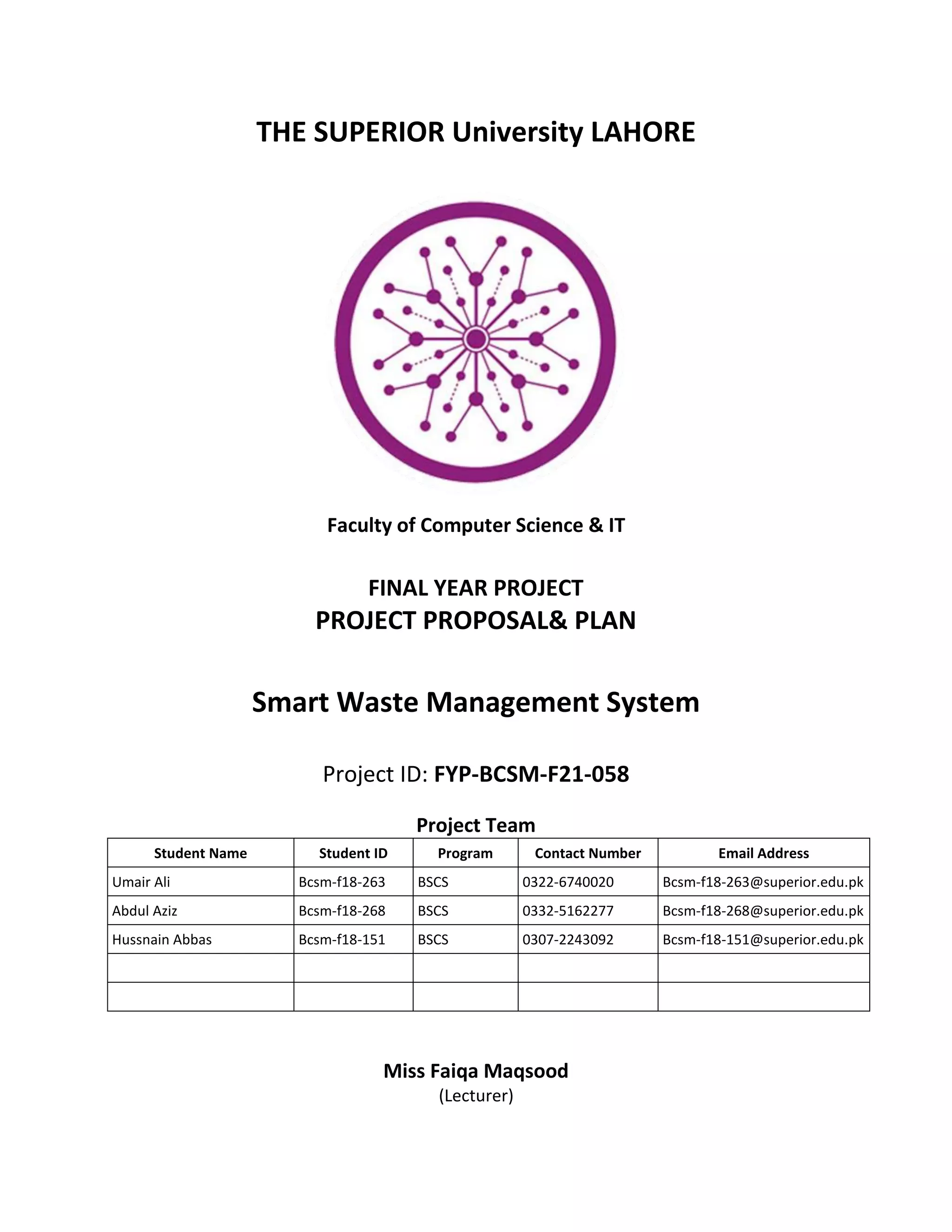
THE SUPERIOR UniversityLAHORE
Faculty of Computer Science & IT
FINAL YEAR PROJECT
PROJECT PROPOSAL& PLAN
Smart Waste Management System
Project ID: FYP-BCSM-F21-058
Project Team
Student Name Student ID Program Contact Number Email Address
Umair Ali Bcsm-f18-263 BSCS 0322-6740020 Bcsm-f18-263@superior.edu.pk
Abdul Aziz Bcsm-f18-268 BSCS 0332-5162277 Bcsm-f18-268@superior.edu.pk
Hussnain Abbas Bcsm-f18-151 BSCS 0307-2243092 Bcsm-f18-151@superior.edu.pk
Miss Faiqa Maqsood
(Lecturer)
2.
Smart Waste ManagementSystem
Change Record
Author(s) Version Date Notes Supervisor’s Signature
1.0 Original Draft
Changes Based on
Feedback from
Supervisor
Changes Based on
Feedback From Faculty
Added Project Plan
Changes Based on
Feedback from
Supervisor
3.
Project Proposal
Project Title:Smart Waste Management System
Executive Summary
It creates unhygienic conditions for the citizens in the nearby surrounding, leading to the
spread of infectious diseases and illness. To avoid this problem, IoT based “Smart Waste
Management” is the best and trending solution. In the proposed system, public dustbins will be
provided with embedded device which helps in real time monitoring of level of garbage in
garbage bins. The data regarding the garbage levels will be used to provide optimized route for
garbage collecting vans, which will reduce cost associated with fuel. The load sensors will
increase efficiency of data related to garbage level and moisture sensors will be used to provide
data of waste segregation in a dust bin.
1. Introduction
The proposed system would be able to automate the solid waste monitoring process and
management of the overall collection process using IOT (Internet of Things). In the proposed
system, whenever the waste bin gets filled this is acknowledged by placing the circuit at the
waste bin, which transmits it to the receiver at the desired place in the area or spot.
In the proposed system, the received signal indicates the waste bin status at the monitoring
and controlling system.
The signal status will let waste collector (Truck drivers) know which bin is full and which is still
empty, so by this the driver can pick the fully loaded bin, and in addition it will let driver to
know which bin is still empty.
4.
2. Existing System/ Competitive Analysis
The existing system giving correct information about the collection of garbage into bin soon
when the bin level reaches its maximum level. The
system will thus provide accurate reports, increasing the
efficiency of the system. The real time monitoring of the
garbage level with the help of sensors and wireless
communication will reduce the number of trips required by
the garbage collection vehicle and thus will reduce the total
expenditure associated with the Garbage bin. This system
consists of an single ultrasonic sensor to collect information
on the level of garbage. After collection of data then send on our cloud storage and then comes
on our platform.
3. Problem Statement
Following problems are associate with waste collection:
In the typically way of collecting the waste, waste is being overflow in the bin, and areas get
messy. In some specific area sometimes due to any event bin gets unexpectedly full, so there is
no existing method to let the driver know the bin is ready to collect.
Another problem is waste of time and recourses, the truck driver didn’t know which place has
full bin, and often they went in the place which has empty bin and hence waste the time.
Major problem is overloaded bins create diseases which are harmful for the majorities.
5.
4. Proposed Solution
Theproposed system will be cost effecting and fast system.
The concept will be implement using internet of things and arduino as a hardware device.
Smart system will send notification to the truck driver if a bin is ready to collected.
Bin will be attracted with some sensors which will send the notification to the drivers.
5. Scope of the Project
1. Sensor Based Waste Collection Bins is used to identify status of waste bins if it is empty
or filled so as to customize the waste collection schedule accordingly and also save the
cost.
2. Real time waste management system by using smart dustbins to check the fill level of
dustbins whether the dustbins are full or not, through this system the information of all
smart dustbins can be accessed from anywhere and anytime by the concern person.
3. It will inform the status of each and every dustbin in real time so that concerned
authority can send the garbage collection metropolitan cities it is not possible to check
each and every place where the garbage dump yard is full or not.
4. We are going to implement a project called IoT Based Smart Garbage and Waste
Collection bins. This system also helps to monitor the fake reports and hence can reduce
the corruption in the overall management system.
6.
5. The smartgarbage management system makes the garbage collection more efficient the
use of solar panels in such systems may reduce the energy consumption.
6. System Architectural Design
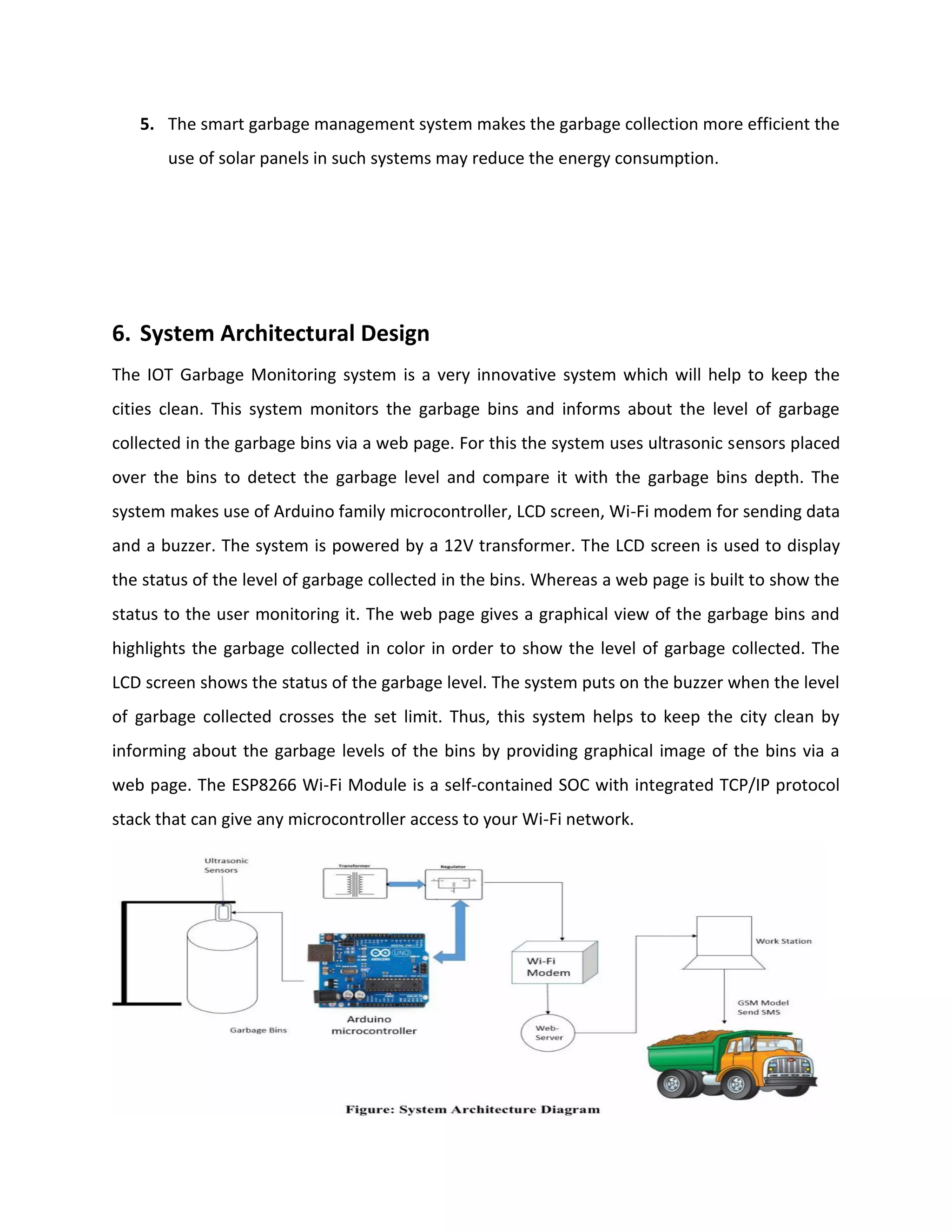
The IOT Garbage Monitoring system is a very innovative system which will help to keep the
cities clean. This system monitors the garbage bins and informs about the level of garbage
collected in the garbage bins via a web page. For this the system uses ultrasonic sensors placed
over the bins to detect the garbage level and compare it with the garbage bins depth. The
system makes use of Arduino family microcontroller, LCD screen, Wi-Fi modem for sending data
and a buzzer. The system is powered by a 12V transformer. The LCD screen is used to display
the status of the level of garbage collected in the bins. Whereas a web page is built to show the
status to the user monitoring it. The web page gives a graphical view of the garbage bins and
highlights the garbage collected in color in order to show the level of garbage collected. The
LCD screen shows the status of the garbage level. The system puts on the buzzer when the level
of garbage collected crosses the set limit. Thus, this system helps to keep the city clean by
informing about the garbage levels of the bins by providing graphical image of the bins via a
web page. The ESP8266 Wi-Fi Module is a self-contained SOC with integrated TCP/IP protocol
stack that can give any microcontroller access to your Wi-Fi network.
7.
7. Implementation Toolsand Techniques
Techniques:
Image processing
Data Analysis
Machine Learning
Artificial Intelligence (optional)
Tools:
Php Charm
Visual Studio Code
Frontend Technology:
HTML
CSS
JAVASCRIPT
REACT.JS + VUE.JS+ ANGULAR.JS
Backend Technology:
PHP
Python
NodeJS
Database
MySQL
Mongo DB
8.
8. Project Plan
•Electronics
1. Power Supply Unit
2. Sensor Module
3. Wi-Fi Module
• Programming
• Application/Cloud Development
• 3D Designing
• Mechanical Structure
8.1. Work Breakdown Structure
[A work breakdown structure (WBS) is deliverable based decomposition of project scope. The WBS includes 100% of
the work defined by the project scope and captures all deliverables – internal, external, interim – in terms of the
work to be completed, including project management. You have to give division of responsibilities and duties
among team members.]
Sample WBS
1. Project Management
1.1. Work Breakdown Structure (WBS)
1.2. Roles & Responsibility Matrix
1.3. Change Control System
2. Reports / Documentation
2.1. Final Documentation Introduction
2.2. Literature / Markey Survey
2.3. Requirements Analysis
2.4. System Design
2.5. Implementation
2.6. Testing & Performance Evaluation
2.7. Conclusion & Outlook
9.
2.8. End UserDocumentation
2.9. Application Administration Documentation
2.10. System Administrator Documentation
3. System
3.1. Development Environment
3.1.1. IDE
3.1.2. Version Control
3.1.3. Server
3.1.4. Database
3.2. Presentation Layer
3.2.1. Deliverable 1
3.2.2. Deliverable 2
3.2.3. . . .
3.3. Business Logic Layer
3.3.1. Deliverable 1
3.3.2. Deliverable 2
3.3.3. . . .
3.4. Data Management Layer
3.4.1. Deliverable 1
3.4.2. Deliverable 2
3.4.3. . . .
3.5. Physical Layer
3.5.1. Deliverable 1
3.5.2. Deliverable 2
3.5.3. . . .
Roles & Responsibility Matrix:
The purpose of roles & responsibility matrix is to identify who will do what.
10.
WBS
#
WBS Deliverable Activity# Activity to
Complete the
Deliverable
Duration
(# of Days)
Responsible
Team Member(s)
& Role(s)
8.2. Gantt Chart
[Gantt Chart consisting of Timeline with milestone. Specific items to include in this section are as follows:
• Timeline with milestones: Gantt chart in Microsoft project 2013. The following are required elements of
your Gantt chart:
o Project duration is from the date your project is enrolled to the completion date:
o Each milestone is to be labeled with a title.
o Schedule all tasks not just “Design” or “Testing.” Break this schedule down to specific
assignments.
o Each task is to be labeled with a title and person or persons assigned to the task.
o Subdivide larger items so that no task is longer than about one week
o Link tasks which are dependent on the completion of a previous task.]
8.3. Empathy Map
11.
References
[12 pt, Calibri,Justified]
[Give references to the resources you have consulted in finalizing your project topic.]
12.
List of FacultyProposed Changes
Project Title
Proposed Change Proposed By Supervisor’s Decision
Name of Faculty
Member(s) who proposed
this change
Approved/Disapproved
and/or Comments
Date: __________________ Supervisor’s Signature: ______________
![8. Project Plan
• Electronics
1. Power Supply Unit
2. Sensor Module
3. Wi-Fi Module
• Programming
• Application/Cloud Development
• 3D Designing
• Mechanical Structure
8.1. Work Breakdown Structure
[A work breakdown structure (WBS) is deliverable based decomposition of project scope. The WBS includes 100% of
the work defined by the project scope and captures all deliverables – internal, external, interim – in terms of the
work to be completed, including project management. You have to give division of responsibilities and duties
among team members.]
Sample WBS
1. Project Management
1.1. Work Breakdown Structure (WBS)
1.2. Roles & Responsibility Matrix
1.3. Change Control System
2. Reports / Documentation
2.1. Final Documentation Introduction
2.2. Literature / Markey Survey
2.3. Requirements Analysis
2.4. System Design
2.5. Implementation
2.6. Testing & Performance Evaluation
2.7. Conclusion & Outlook](https://image.slidesharecdn.com/template-03-projectproposalplan-211207083857/75/Template-03-project-proposal-amp-plan-8-2048.jpg)
![WBS
#
WBS Deliverable Activity # Activity to
Complete the
Deliverable
Duration
(# of Days)
Responsible
Team Member(s)
& Role(s)
8.2. Gantt Chart
[Gantt Chart consisting of Timeline with milestone. Specific items to include in this section are as follows:
• Timeline with milestones: Gantt chart in Microsoft project 2013. The following are required elements of
your Gantt chart:
o Project duration is from the date your project is enrolled to the completion date:
o Each milestone is to be labeled with a title.
o Schedule all tasks not just “Design” or “Testing.” Break this schedule down to specific
assignments.
o Each task is to be labeled with a title and person or persons assigned to the task.
o Subdivide larger items so that no task is longer than about one week
o Link tasks which are dependent on the completion of a previous task.]
8.3. Empathy Map](https://image.slidesharecdn.com/template-03-projectproposalplan-211207083857/75/Template-03-project-proposal-amp-plan-10-2048.jpg)
![References
[12 pt, Calibri, Justified]
[Give references to the resources you have consulted in finalizing your project topic.]](https://image.slidesharecdn.com/template-03-projectproposalplan-211207083857/75/Template-03-project-proposal-amp-plan-11-2048.jpg)