Sr. No. Roll No. Name PRN NO.
1 58 Younis Giri 12010378
2 69 Aniruddha Thakur 12120191
3 72 Rameshwari Ramesh Ugale 12120241
4 75 Sagar Yadav 12120251
5 76 Dhiraj Zope 12120161
MECH-D: Batch 3 - Group 3
IoT Based Garbage Monitoring System
Guide – Prof. Ketki Shribavikar
Mechatronics
Content
1. Introduction
2. Problem Statement
3. Literature Review
4. Solution
5. Components list
6. Result
7. Conclusion
Introduction
The IoT based garbage monitoring system is a modern solution to
the age-old problem of waste management. With the advent of
technology, it has become possible to monitor and manage garbage
in a more efficient and effective manner.
This system involves the use of sensors that are placed in garbage
bins to detect the level of waste inside them. The data collected by
these sensors is then transmitted to a central server where it is
analyzed and used to optimize garbage collection routes and
schedules.
Problem Statement
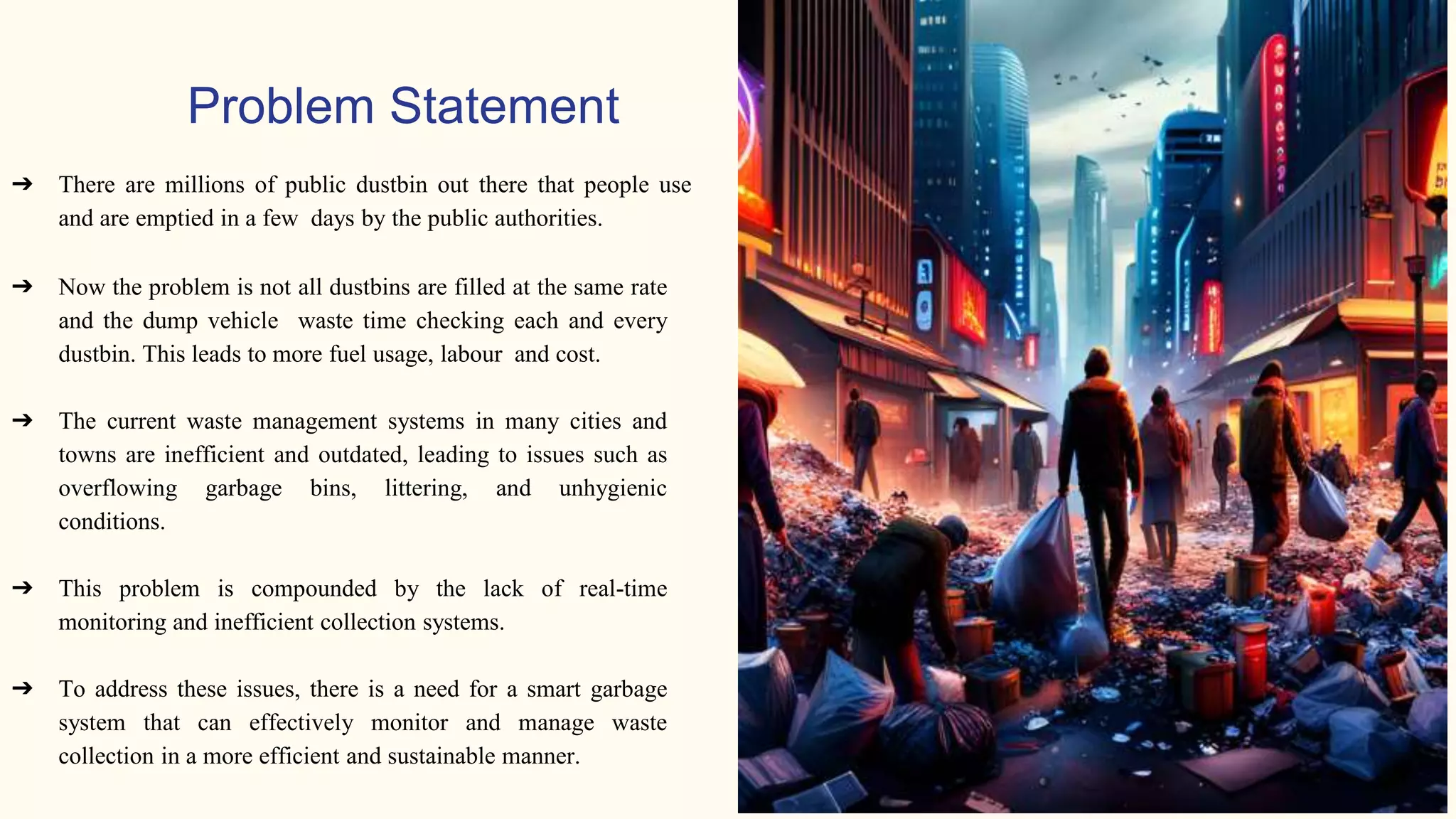
âž” There are millions of public dustbin out there that people use
and are emptied in a few days by the public authorities.
âž” Now the problem is not all dustbins are filled at the same rate
and the dump vehicle waste time checking each and every
dustbin. This leads to more fuel usage, labour and cost.
âž” The current waste management systems in many cities and
towns are inefficient and outdated, leading to issues such as
overflowing garbage bins, littering, and unhygienic
conditions.
âž” This problem is compounded by the lack of real-time
monitoring and inefficient collection systems.
âž” To address these issues, there is a need for a smart garbage
system that can effectively monitor and manage waste
collection in a more efficient and sustainable manner.
Solution
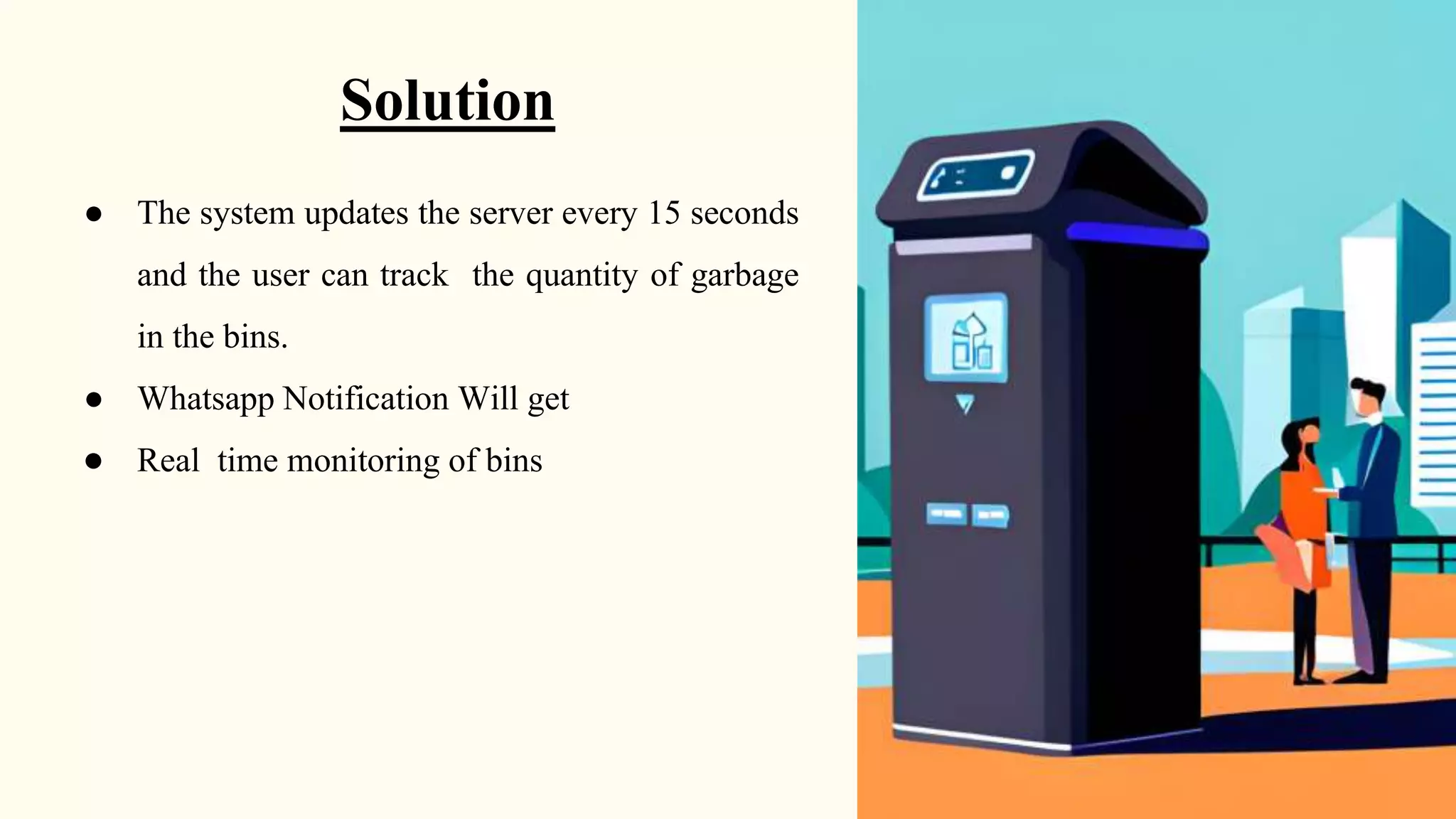
â—Ź The system updates the server every 15 seconds
and the user can track the quantity of garbage
in the bins.
â—Ź Whatsapp Notification Will get
â—Ź Real time monitoring of bins
Literature Review
Title: An IoT-based Smart Waste Management System for Sustainable Environment by H. J. Mekonnen, J.
W. Choi
This study proposes a truck-level monitoring system using GPS sensors and IoT technology. The system is designed
to monitor the location and fill level of garbage trucks, as well as to optimize waste collection routes and schedules.
The authors propose a cloud-based platform for data analysis and decision-making. The study shows that the
proposed system can improve waste collection efficiency and reduce collection costs.
Title: An Intelligent System for Smart Waste Management in Smart Cities by J. Vasanthi, R. R. Selvi, R.
Subashini
This study proposes an intelligent system for waste management in smart cities. The authors propose a bin-level
monitoring system using infrared sensors to monitor the fill level of garbage bins. The data collected is transmitted to
a central server for analysis and decision-making. The authors also investigate the use of machine learning algorithms
to predict fill level and optimize waste collection schedules. The study shows that the proposed system can improve
waste management efficiency and reduce collection costs.
Title: Smart Sensors for IoT by Peter Brida
This study provides an overview of smart sensors and their applications in the IoT. The authors describe the different
types of smart sensors, including environmental sensors, biomedical sensors, and structural sensors. They also
discuss the challenges in the development and deployment of smart sensors, including power management and data
processing. The study shows that smart sensors have great potential in various IoT applications, such as smart
homes, smart cities, and industrial automation.
Title: A Review of Smart Sensor Networks for IoT by Hugo Landaluce
This study provides a comprehensive review of smart sensor networks for the IoT. The authors discuss the various
network architectures, including centralized and decentralized approaches. They also describe the different
communication protocols, such as Bluetooth, Wi-Fi, and ZigBee. The study shows that smart sensor networks can
provide real-time monitoring and measurement capabilities for various IoT applications.
Component used for the system
â—Ź Node MCU ESP8266
âž” NodeMCU ESP8266 is a low-cost Wi-Fi module.
âž” NodeMCU ESP8266 offers various features,
âž” Programming NodeMCU ESP8266 is easy.
âž” low power consumption
I2C Adapter
âž” I2C adapter is a device that allows a computer or
microcontroller to communicate with I2C devices.
âž” The I2C adapter offers multiple channels or ports to
allow multiple I2C devices to be connected and
controlled simultaneously.
Ultrasonic sensor
âž” Ultrasonic sensors use sound waves to
detect objects and measure distance.
âž” Working Principle Of Sensor
âž” They can detect a variety of materials.
âž” applications of the Sensor.
âž” Power Consumption
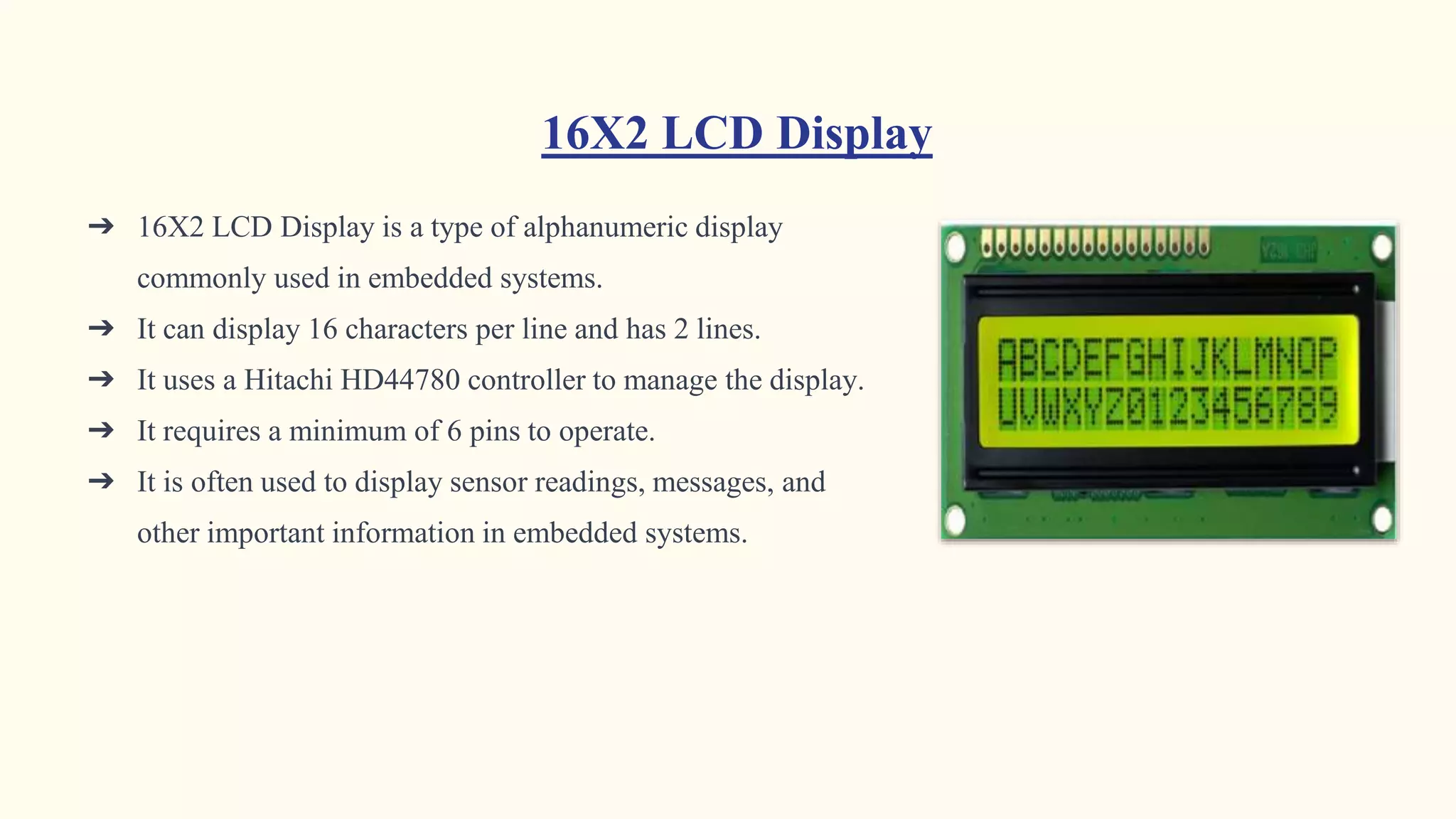
16X2 LCD Display
âž” 16X2 LCD Display is a type of alphanumeric display
commonly used in embedded systems.
âž” It can display 16 characters per line and has 2 lines.
âž” It uses a Hitachi HD44780 controller to manage the display.
âž” It requires a minimum of 6 pins to operate.
âž” It is often used to display sensor readings, messages, and
other important information in embedded systems.
Ardunio IDE
âž” Arduino IDE is an integrated development environment
used for programming Arduino boards.
âž” It provides a user-friendly interface for writing, compiling,
and uploading code to the board.
âž” It supports a simplified C++ programming language and
provides a library of functions that make it easy to
interface with hardware components.
âž” The IDE also includes a serial monitor for debugging and
testing code. It is open source and available for free
download.
Flow Diagram
Circuit Diagram
Result
Benefits
âž” It will allows for real-time monitoring of waste levels, which
means that garbage collection can be done only when
required, reducing the number of trips and saving time and
resources.
âž” This also helps to reduce carbon emissions, making it an eco-
friendly option.
âž” Secondly, the IoT smart dustbin promotes recycling and waste
reduction by providing users with information on how to
dispose of different types of waste.
âž” This not only encourages responsible waste disposal but also
helps to reduce the amount of waste sent to landfills,
promoting sustainability.
Challenges
â—Ź While the IoT based garbage monitoring system has many benefits,
there are also some challenges that must be addressed.
â—Ź One of the biggest challenges is the cost of implementing the
system, which can be high due to the need for sensors,
communication infrastructure, and data analysis tools.
â—Ź Another challenge is the potential for technical issues such as sensor
malfunctions or communication failures. These issues can lead to
inaccurate data and disrupt the functioning of the system.
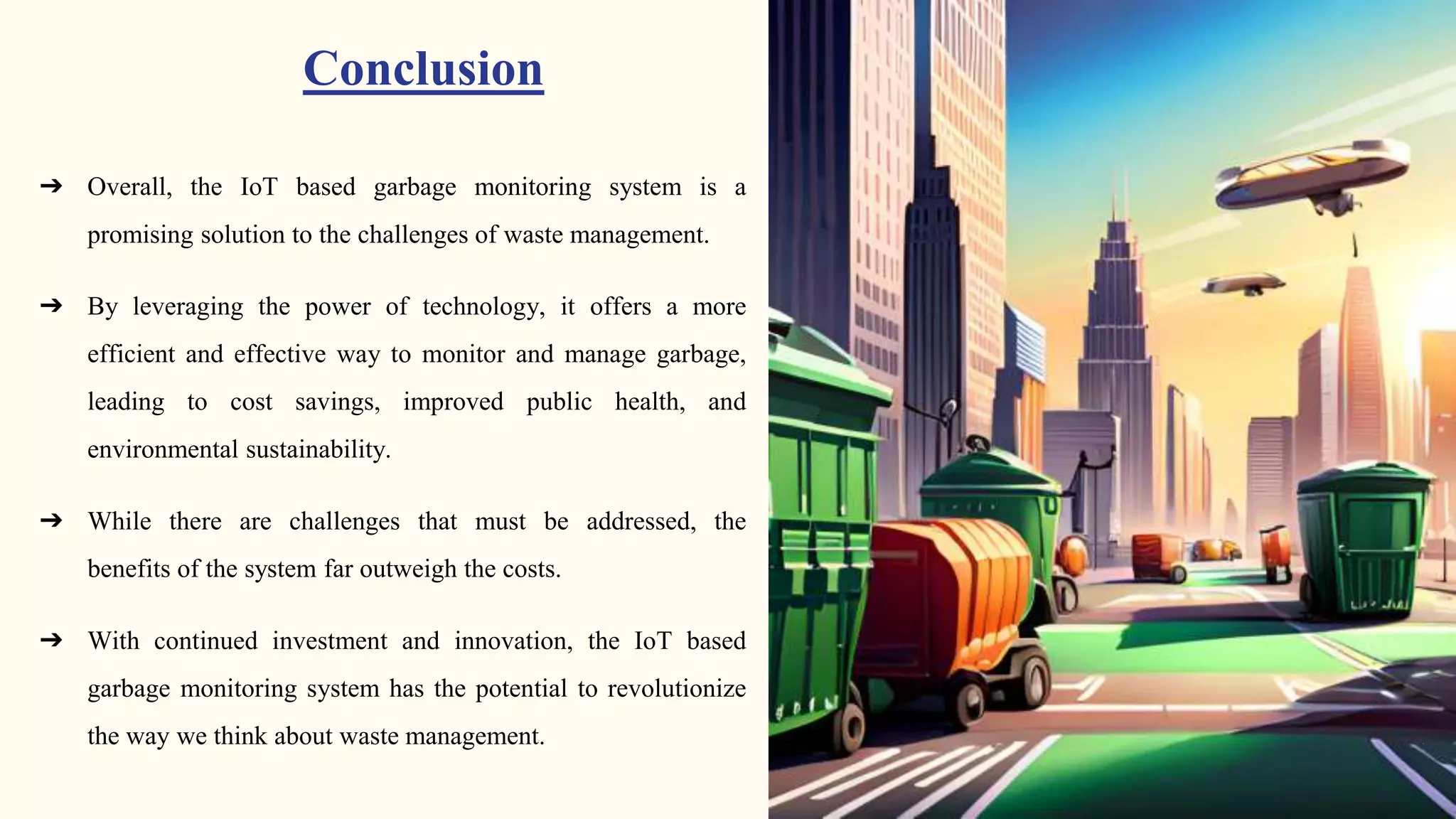
Conclusion
âž” Overall, the IoT based garbage monitoring system is a
promising solution to the challenges of waste management.
âž” By leveraging the power of technology, it offers a more
efficient and effective way to monitor and manage garbage,
leading to cost savings, improved public health, and
environmental sustainability.
âž” While there are challenges that must be addressed, the
benefits of the system far outweigh the costs.
âž” With continued investment and innovation, the IoT based
garbage monitoring system has the potential to revolutionize
the way we think about waste management.
References
1. G. Ravi Kumar, V. P. Jagathy Raj, B. Sathish Kumar, K. Srinivasan“A smart city model with IoT-based
smart dustbins”
2. A. Dharmalingam, N. Selvam, M. Thirumarimurugan “Smart Dustbin for Smart Cities: An IoT-based
Solution for Waste Management”
3. J. Vasanthi, R. R. Selvi, R. Subashini“An Intelligent System for Smart Waste Management in Smart
Cities”
4. S. S. Patil, P. R. Bhavsar, S. S. Patil, R. K. Patil“Smart Dustbin Monitoring System using IoT for Efficient
Waste Management in Smart Cities”
5. A. Madhuri, K. Mohan Kumar“Smart City Waste Management using IoT”
6. J. B. A. Deepak, P. Soundararajan“Design and Implementation of a Garbage Monitoring System based on
IoT”
7. H. J. Mekonnen, J. W. Choi“An IoT-based Smart Waste Management System for Sustainable
Environment”
8. V. K. Shah, K. R. Luhar, K. N. Upadhyay, R. N. Rathod“Smart Garbage Monitoring System based on
IoT”

mecha cp.pptx

  • 1.
    Sr. No. RollNo. Name PRN NO. 1 58 Younis Giri 12010378 2 69 Aniruddha Thakur 12120191 3 72 Rameshwari Ramesh Ugale 12120241 4 75 Sagar Yadav 12120251 5 76 Dhiraj Zope 12120161 MECH-D: Batch 3 - Group 3 IoT Based Garbage Monitoring System Guide – Prof. Ketki Shribavikar Mechatronics
  • 2.
    Content 1. Introduction 2. ProblemStatement 3. Literature Review 4. Solution 5. Components list 6. Result 7. Conclusion
  • 3.
    Introduction The IoT basedgarbage monitoring system is a modern solution to the age-old problem of waste management. With the advent of technology, it has become possible to monitor and manage garbage in a more efficient and effective manner. This system involves the use of sensors that are placed in garbage bins to detect the level of waste inside them. The data collected by these sensors is then transmitted to a central server where it is analyzed and used to optimize garbage collection routes and schedules.
  • 4.
    Problem Statement âž” Thereare millions of public dustbin out there that people use and are emptied in a few days by the public authorities. âž” Now the problem is not all dustbins are filled at the same rate and the dump vehicle waste time checking each and every dustbin. This leads to more fuel usage, labour and cost. âž” The current waste management systems in many cities and towns are inefficient and outdated, leading to issues such as overflowing garbage bins, littering, and unhygienic conditions. âž” This problem is compounded by the lack of real-time monitoring and inefficient collection systems. âž” To address these issues, there is a need for a smart garbage system that can effectively monitor and manage waste collection in a more efficient and sustainable manner.
  • 5.
    Solution â—Ź The systemupdates the server every 15 seconds and the user can track the quantity of garbage in the bins. â—Ź Whatsapp Notification Will get â—Ź Real time monitoring of bins
  • 6.
    Literature Review Title: AnIoT-based Smart Waste Management System for Sustainable Environment by H. J. Mekonnen, J. W. Choi This study proposes a truck-level monitoring system using GPS sensors and IoT technology. The system is designed to monitor the location and fill level of garbage trucks, as well as to optimize waste collection routes and schedules. The authors propose a cloud-based platform for data analysis and decision-making. The study shows that the proposed system can improve waste collection efficiency and reduce collection costs. Title: An Intelligent System for Smart Waste Management in Smart Cities by J. Vasanthi, R. R. Selvi, R. Subashini This study proposes an intelligent system for waste management in smart cities. The authors propose a bin-level monitoring system using infrared sensors to monitor the fill level of garbage bins. The data collected is transmitted to a central server for analysis and decision-making. The authors also investigate the use of machine learning algorithms to predict fill level and optimize waste collection schedules. The study shows that the proposed system can improve waste management efficiency and reduce collection costs.
  • 7.
    Title: Smart Sensorsfor IoT by Peter Brida This study provides an overview of smart sensors and their applications in the IoT. The authors describe the different types of smart sensors, including environmental sensors, biomedical sensors, and structural sensors. They also discuss the challenges in the development and deployment of smart sensors, including power management and data processing. The study shows that smart sensors have great potential in various IoT applications, such as smart homes, smart cities, and industrial automation. Title: A Review of Smart Sensor Networks for IoT by Hugo Landaluce This study provides a comprehensive review of smart sensor networks for the IoT. The authors discuss the various network architectures, including centralized and decentralized approaches. They also describe the different communication protocols, such as Bluetooth, Wi-Fi, and ZigBee. The study shows that smart sensor networks can provide real-time monitoring and measurement capabilities for various IoT applications.
  • 8.
    Component used forthe system â—Ź Node MCU ESP8266 âž” NodeMCU ESP8266 is a low-cost Wi-Fi module. âž” NodeMCU ESP8266 offers various features, âž” Programming NodeMCU ESP8266 is easy. âž” low power consumption
  • 9.
    I2C Adapter âž” I2Cadapter is a device that allows a computer or microcontroller to communicate with I2C devices. âž” The I2C adapter offers multiple channels or ports to allow multiple I2C devices to be connected and controlled simultaneously.
  • 10.
    Ultrasonic sensor âž” Ultrasonicsensors use sound waves to detect objects and measure distance. âž” Working Principle Of Sensor âž” They can detect a variety of materials. âž” applications of the Sensor. âž” Power Consumption
  • 11.
    16X2 LCD Display ➔16X2 LCD Display is a type of alphanumeric display commonly used in embedded systems. ➔ It can display 16 characters per line and has 2 lines. ➔ It uses a Hitachi HD44780 controller to manage the display. ➔ It requires a minimum of 6 pins to operate. ➔ It is often used to display sensor readings, messages, and other important information in embedded systems.
  • 12.
    Ardunio IDE âž” ArduinoIDE is an integrated development environment used for programming Arduino boards. âž” It provides a user-friendly interface for writing, compiling, and uploading code to the board. âž” It supports a simplified C++ programming language and provides a library of functions that make it easy to interface with hardware components. âž” The IDE also includes a serial monitor for debugging and testing code. It is open source and available for free download.
  • 13.
  • 14.
  • 15.
  • 16.
    Benefits âž” It willallows for real-time monitoring of waste levels, which means that garbage collection can be done only when required, reducing the number of trips and saving time and resources. âž” This also helps to reduce carbon emissions, making it an eco- friendly option. âž” Secondly, the IoT smart dustbin promotes recycling and waste reduction by providing users with information on how to dispose of different types of waste. âž” This not only encourages responsible waste disposal but also helps to reduce the amount of waste sent to landfills, promoting sustainability.
  • 17.
    Challenges â—Ź While theIoT based garbage monitoring system has many benefits, there are also some challenges that must be addressed. â—Ź One of the biggest challenges is the cost of implementing the system, which can be high due to the need for sensors, communication infrastructure, and data analysis tools. â—Ź Another challenge is the potential for technical issues such as sensor malfunctions or communication failures. These issues can lead to inaccurate data and disrupt the functioning of the system.
  • 18.
    Conclusion âž” Overall, theIoT based garbage monitoring system is a promising solution to the challenges of waste management. âž” By leveraging the power of technology, it offers a more efficient and effective way to monitor and manage garbage, leading to cost savings, improved public health, and environmental sustainability. âž” While there are challenges that must be addressed, the benefits of the system far outweigh the costs. âž” With continued investment and innovation, the IoT based garbage monitoring system has the potential to revolutionize the way we think about waste management.
  • 19.
    References 1. G. RaviKumar, V. P. Jagathy Raj, B. Sathish Kumar, K. Srinivasan“A smart city model with IoT-based smart dustbins” 2. A. Dharmalingam, N. Selvam, M. Thirumarimurugan “Smart Dustbin for Smart Cities: An IoT-based Solution for Waste Management” 3. J. Vasanthi, R. R. Selvi, R. Subashini“An Intelligent System for Smart Waste Management in Smart Cities” 4. S. S. Patil, P. R. Bhavsar, S. S. Patil, R. K. Patil“Smart Dustbin Monitoring System using IoT for Efficient Waste Management in Smart Cities” 5. A. Madhuri, K. Mohan Kumar“Smart City Waste Management using IoT” 6. J. B. A. Deepak, P. Soundararajan“Design and Implementation of a Garbage Monitoring System based on IoT” 7. H. J. Mekonnen, J. W. Choi“An IoT-based Smart Waste Management System for Sustainable Environment” 8. V. K. Shah, K. R. Luhar, K. N. Upadhyay, R. N. Rathod“Smart Garbage Monitoring System based on IoT”