Pune Smart City
Mobility Challenge
A guide by Varun U & Suhas M
The Idea
While we’d have loved to extend
this to the entire ecosystem, for this
challenge we’ve selected 2 areas of focus
that we thought would be of maximum
importance::
➔ Intelligent Traffic
Management System
Highlight what’s new, unusual, or
surprising.
➔ Solving First Mile-Last Mile
Woes
Give people a reason to care.
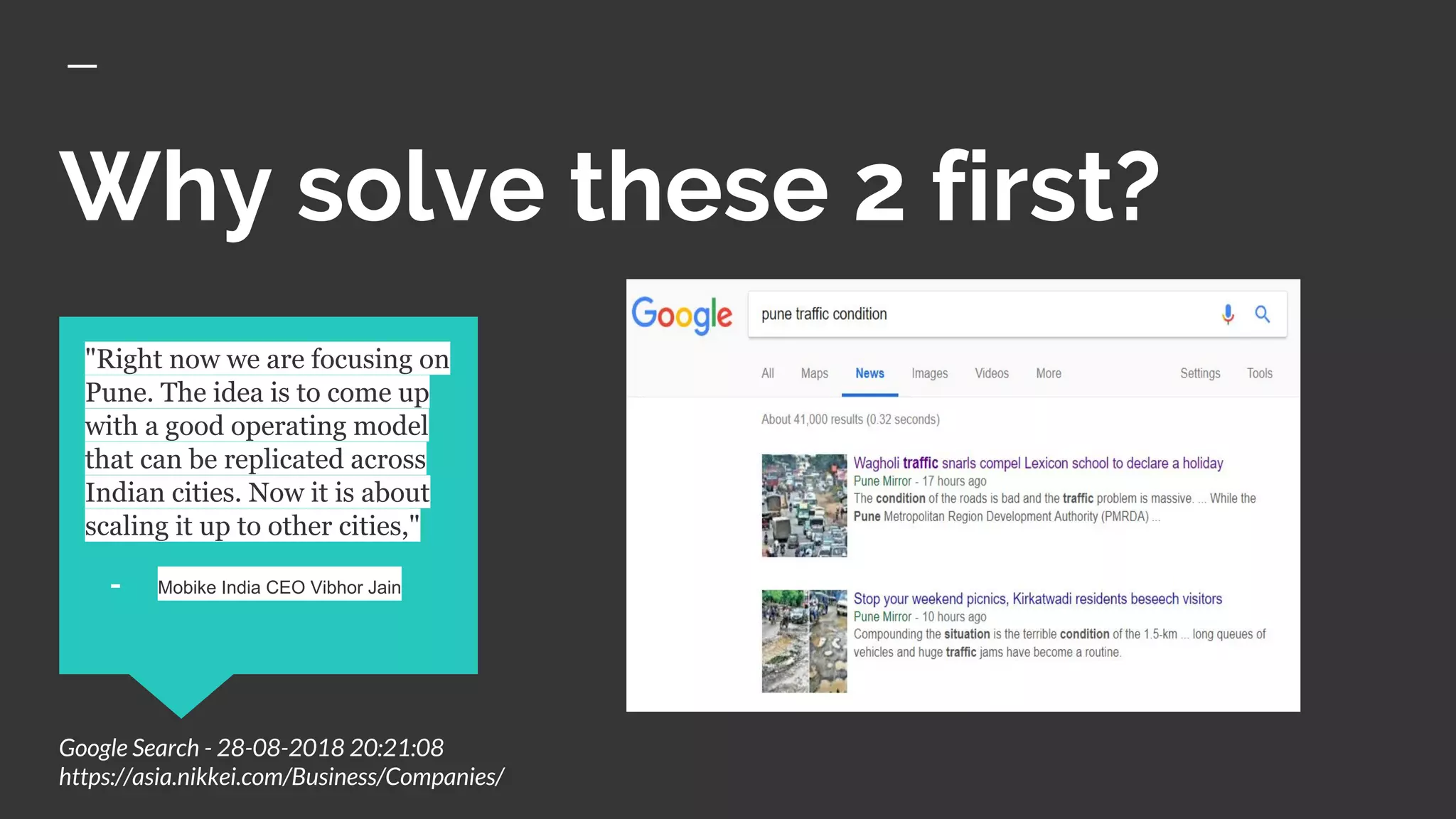
Why solve these 2 first?
"Right now we are focusing on
Pune. The idea is to come up
with a good operating model
that can be replicated across
Indian cities. Now it is about
scaling it up to other cities,"
- Mobike India CEO Vibhor Jain
Google Search - 28-08-2018 20:21:08
https://asia.nikkei.com/Business/Companies/
Intelligent Traffic Management
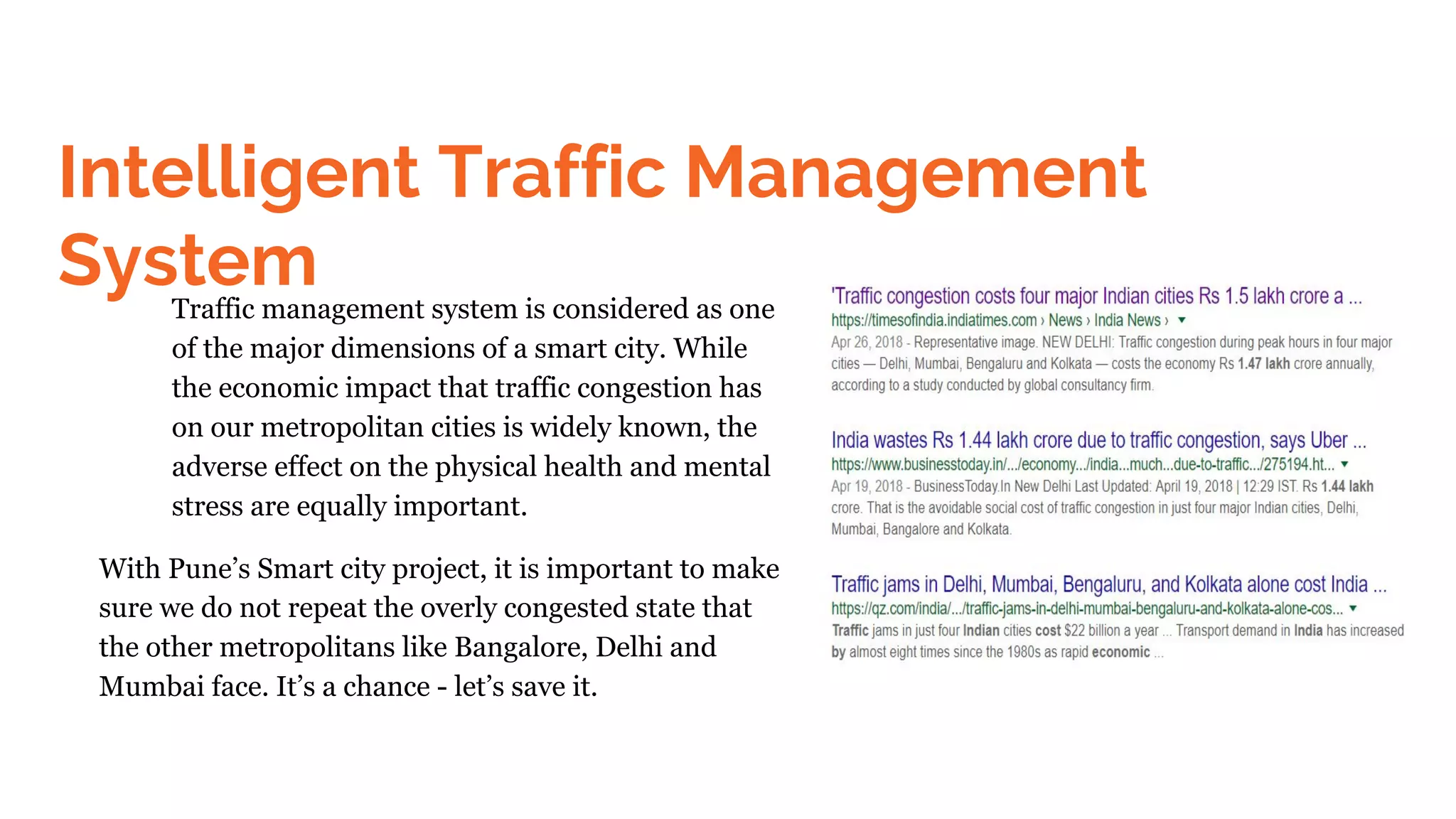
SystemTraffic management system is considered as one
of the major dimensions of a smart city. While
the economic impact that traffic congestion has
on our metropolitan cities is widely known, the
adverse effect on the physical health and mental
stress are equally important.
With Pune’s Smart city project, it is important to make
sure we do not repeat the overly congested state that
the other metropolitans like Bangalore, Delhi and
Mumbai face. It’s a chance - let’s save it.
The Goal & Implementation
We are preparing a new transport
management system that can be rolled
out with the promise of busting
congestion through better real-time data
and predictive technology. The goal is to
predict 30 minutes into the future and
act in 5 minutes – this helps to divert
traffic, coordinate public transport and
provide real-time information to
customers about any disruptions or
alternative routes
For this purpose, our system takes traffic density as input from a)
cameras b) and Ultrasound sensors, then manages traffic signals.
Another algorithm based on Artificial Intelligence is used to predict the
traffic density for future to minimize the traffic congestion. Besides this,
GPS technology is also used to prioritize the emergency vehicles such as
ambulances and fire brigade vehicles during a traffic jam. In case of fire
on the road, Smoke sensors are also part of this system to detect this
situation. To demonstrate the effectiveness of the proposed traffic
management system, if selected, we will prototype a working
demonstration which not only optimizes the flow of traffic but also
connects nearby rescue departments with a centralized server.
Moreover, it will also extracts useful information presented in beautiful
dashboards that may help the authorities in future road planning.
Milestones
2018 2019
October 2018
Initial Prototype ready
January 2019
Testing and Iterations.
Launch of Beta
July 2019
Phase 1 Deployment
November 2019
Phase 2 Deployment
Solving for First Mile -
Last Mile Woes
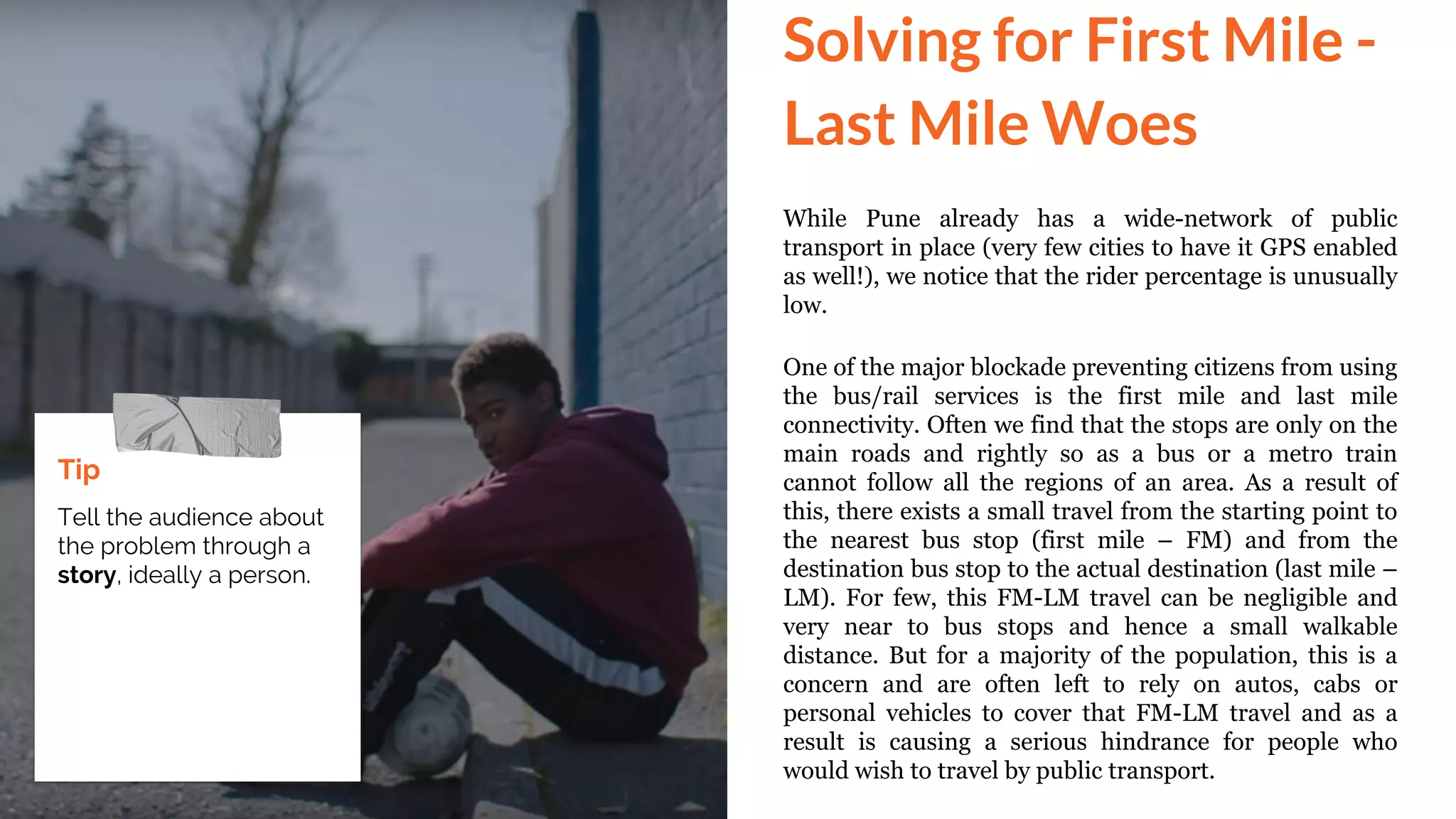
While Pune already has a wide-network of public
transport in place (very few cities to have it GPS enabled
as well!), we notice that the rider percentage is unusually
low.
One of the major blockade preventing citizens from using
the bus/rail services is the first mile and last mile
connectivity. Often we find that the stops are only on the
main roads and rightly so as a bus or a metro train
cannot follow all the regions of an area. As a result of
this, there exists a small travel from the starting point to
the nearest bus stop (first mile – FM) and from the
destination bus stop to the actual destination (last mile –
LM). For few, this FM-LM travel can be negligible and
very near to bus stops and hence a small walkable
distance. But for a majority of the population, this is a
concern and are often left to rely on autos, cabs or
personal vehicles to cover that FM-LM travel and as a
result is causing a serious hindrance for people who
would wish to travel by public transport.
Tip
Tell the audience about
the problem through a
story, ideally a person.
The Current
Scenario
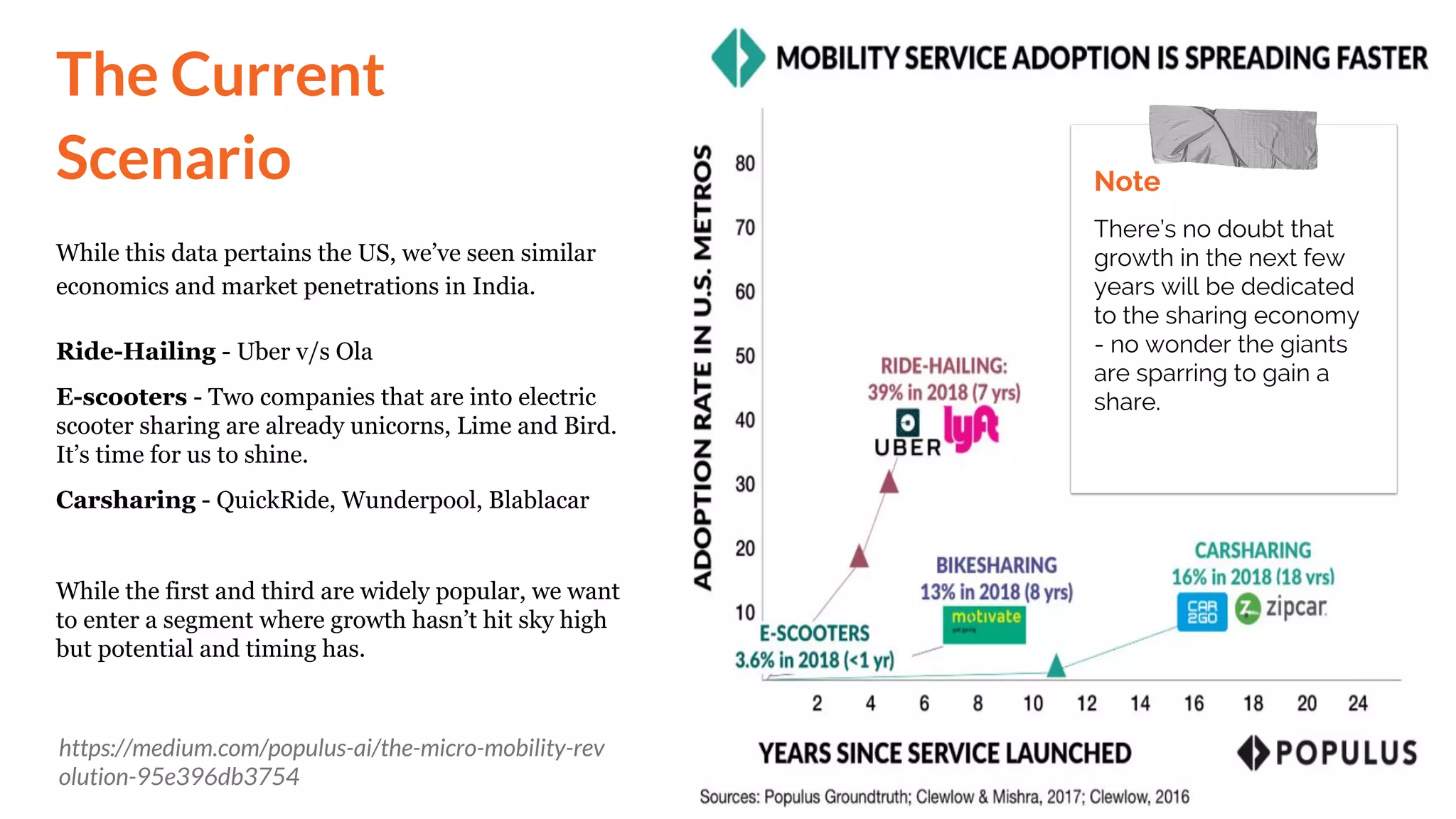
While this data pertains the US, we’ve seen similar
economics and market penetrations in India.
Ride-Hailing - Uber v/s Ola
E-scooters - Two companies that are into electric
scooter sharing are already unicorns, Lime and Bird.
It’s time for us to shine.
Carsharing - QuickRide, Wunderpool, Blablacar
While the first and third are widely popular, we want
to enter a segment where growth hasn’t hit sky high
but potential and timing has.
https://medium.com/populus-ai/the-micro-mobility-rev
olution-95e396db3754
Note
There’s no doubt that
growth in the next few
years will be dedicated
to the sharing economy
- no wonder the giants
are sparring to gain a
share.
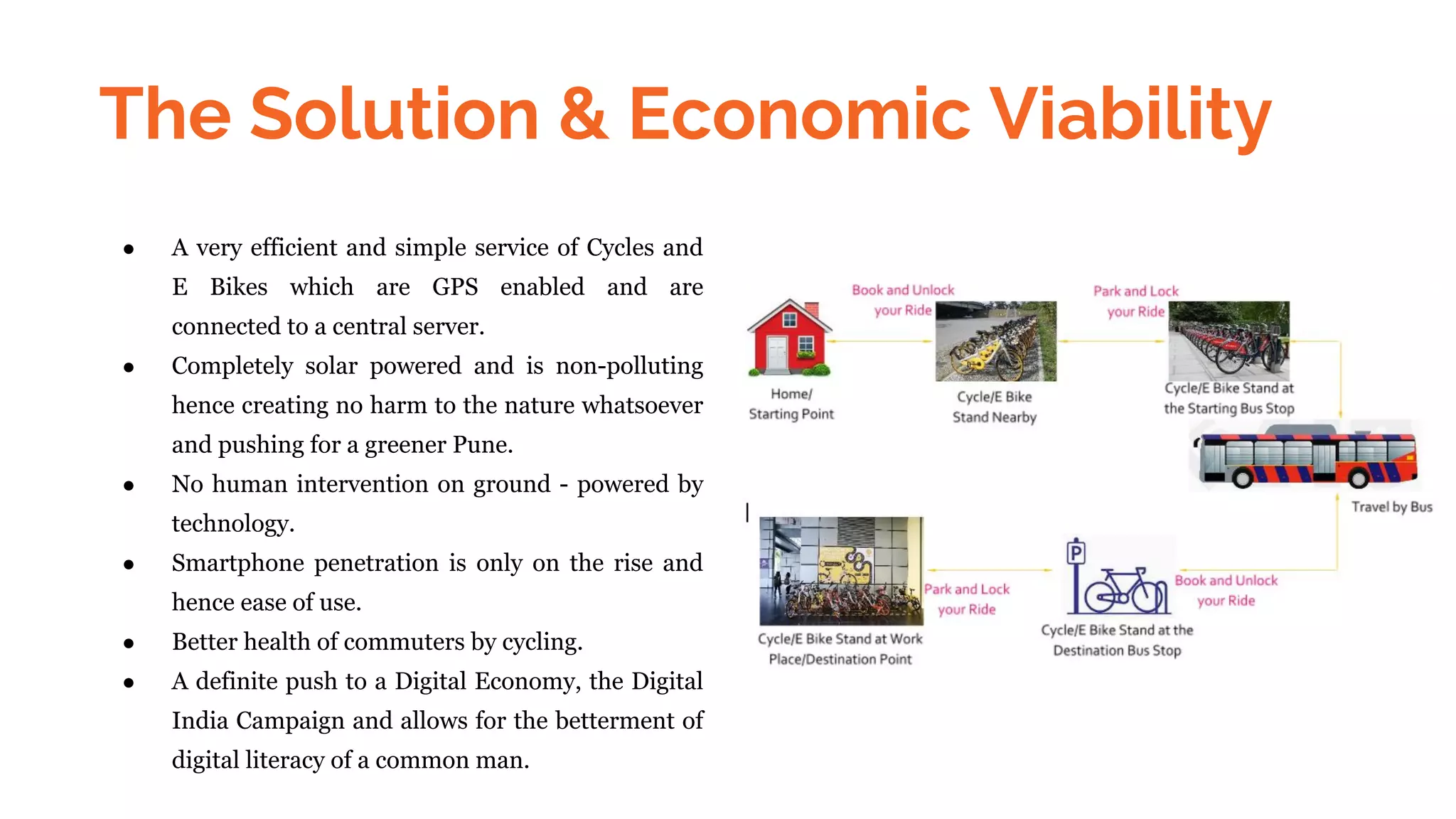
● A very efficient and simple service of Cycles and
E Bikes which are GPS enabled and are
connected to a central server.
● Completely solar powered and is non-polluting
hence creating no harm to the nature whatsoever
and pushing for a greener Pune.
● No human intervention on ground - powered by
technology.
● Smartphone penetration is only on the rise and
hence ease of use.
● Better health of commuters by cycling.
● A definite push to a Digital Economy, the Digital
India Campaign and allows for the betterment of
digital literacy of a common man.
The Solution & Economic Viability
Economic Viability
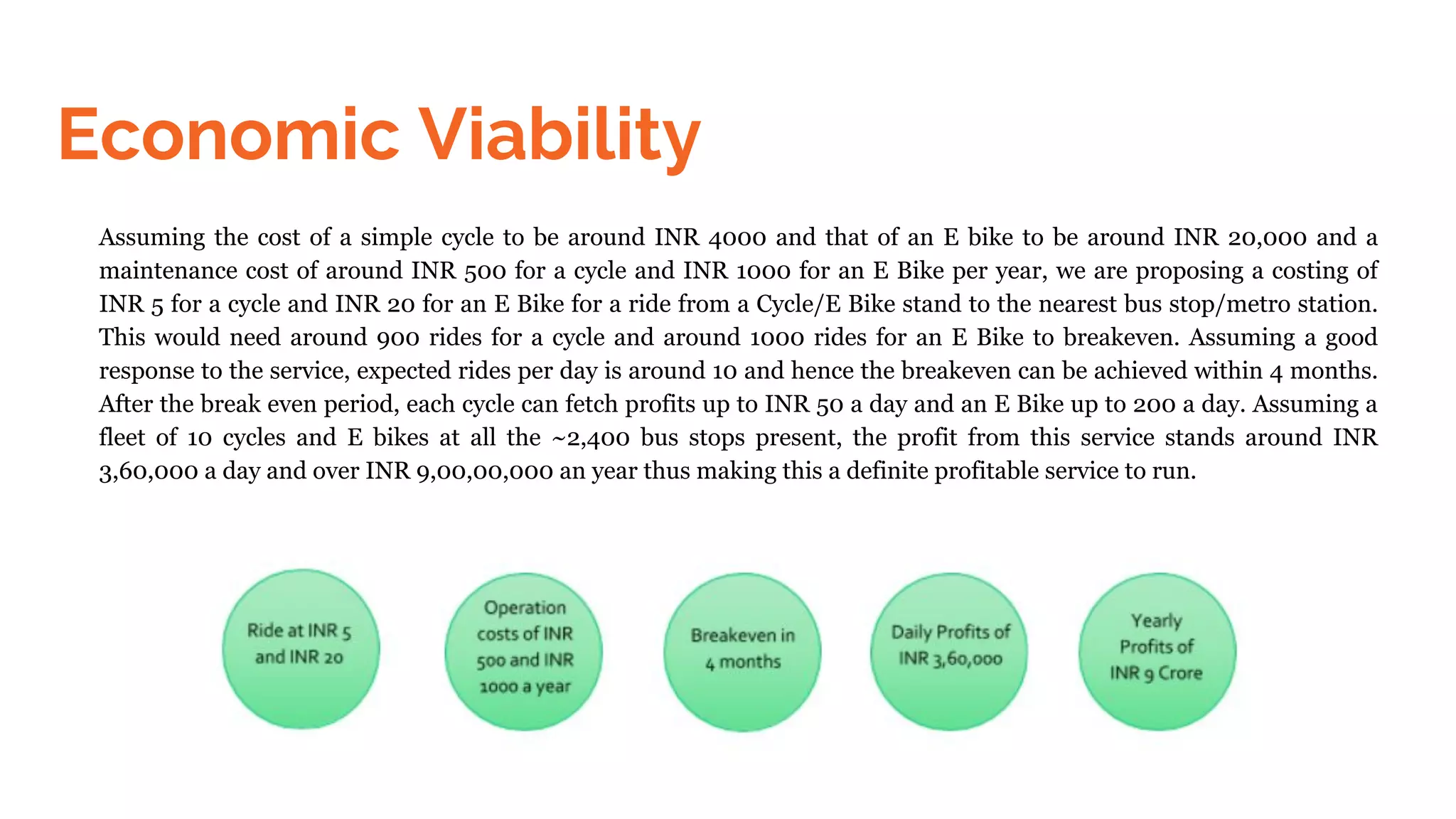
Assuming the cost of a simple cycle to be around INR 4000 and that of an E bike to be around INR 20,000 and a
maintenance cost of around INR 500 for a cycle and INR 1000 for an E Bike per year, we are proposing a costing of
INR 5 for a cycle and INR 20 for an E Bike for a ride from a Cycle/E Bike stand to the nearest bus stop/metro station.
This would need around 900 rides for a cycle and around 1000 rides for an E Bike to breakeven. Assuming a good
response to the service, expected rides per day is around 10 and hence the breakeven can be achieved within 4 months.
After the break even period, each cycle can fetch profits up to INR 50 a day and an E Bike up to 200 a day. Assuming a
fleet of 10 cycles and E bikes at all the ~2,400 bus stops present, the profit from this service stands around INR
3,60,000 a day and over INR 9,00,00,000 an year thus making this a definite profitable service to run.
Milestones
2018 2019
October 2018
Initial Prototype ready
January 2019
Deployment of Beta
Program
March 2019
Deployment across Area
1-10
July 2019
Deployment across city

Smart City: Intelligent Traffic Management System

  • 1.
    Pune Smart City MobilityChallenge A guide by Varun U & Suhas M
  • 2.
    The Idea While we’dhave loved to extend this to the entire ecosystem, for this challenge we’ve selected 2 areas of focus that we thought would be of maximum importance:: ➔ Intelligent Traffic Management System Highlight what’s new, unusual, or surprising. ➔ Solving First Mile-Last Mile Woes Give people a reason to care.
  • 3.
    Why solve these2 first? "Right now we are focusing on Pune. The idea is to come up with a good operating model that can be replicated across Indian cities. Now it is about scaling it up to other cities," - Mobike India CEO Vibhor Jain Google Search - 28-08-2018 20:21:08 https://asia.nikkei.com/Business/Companies/
  • 4.
    Intelligent Traffic Management SystemTrafficmanagement system is considered as one of the major dimensions of a smart city. While the economic impact that traffic congestion has on our metropolitan cities is widely known, the adverse effect on the physical health and mental stress are equally important. With Pune’s Smart city project, it is important to make sure we do not repeat the overly congested state that the other metropolitans like Bangalore, Delhi and Mumbai face. It’s a chance - let’s save it.
  • 5.
    The Goal &Implementation We are preparing a new transport management system that can be rolled out with the promise of busting congestion through better real-time data and predictive technology. The goal is to predict 30 minutes into the future and act in 5 minutes – this helps to divert traffic, coordinate public transport and provide real-time information to customers about any disruptions or alternative routes For this purpose, our system takes traffic density as input from a) cameras b) and Ultrasound sensors, then manages traffic signals. Another algorithm based on Artificial Intelligence is used to predict the traffic density for future to minimize the traffic congestion. Besides this, GPS technology is also used to prioritize the emergency vehicles such as ambulances and fire brigade vehicles during a traffic jam. In case of fire on the road, Smoke sensors are also part of this system to detect this situation. To demonstrate the effectiveness of the proposed traffic management system, if selected, we will prototype a working demonstration which not only optimizes the flow of traffic but also connects nearby rescue departments with a centralized server. Moreover, it will also extracts useful information presented in beautiful dashboards that may help the authorities in future road planning.
  • 6.
    Milestones 2018 2019 October 2018 InitialPrototype ready January 2019 Testing and Iterations. Launch of Beta July 2019 Phase 1 Deployment November 2019 Phase 2 Deployment
  • 7.
    Solving for FirstMile - Last Mile Woes While Pune already has a wide-network of public transport in place (very few cities to have it GPS enabled as well!), we notice that the rider percentage is unusually low. One of the major blockade preventing citizens from using the bus/rail services is the first mile and last mile connectivity. Often we find that the stops are only on the main roads and rightly so as a bus or a metro train cannot follow all the regions of an area. As a result of this, there exists a small travel from the starting point to the nearest bus stop (first mile – FM) and from the destination bus stop to the actual destination (last mile – LM). For few, this FM-LM travel can be negligible and very near to bus stops and hence a small walkable distance. But for a majority of the population, this is a concern and are often left to rely on autos, cabs or personal vehicles to cover that FM-LM travel and as a result is causing a serious hindrance for people who would wish to travel by public transport. Tip Tell the audience about the problem through a story, ideally a person.
  • 8.
    The Current Scenario While thisdata pertains the US, we’ve seen similar economics and market penetrations in India. Ride-Hailing - Uber v/s Ola E-scooters - Two companies that are into electric scooter sharing are already unicorns, Lime and Bird. It’s time for us to shine. Carsharing - QuickRide, Wunderpool, Blablacar While the first and third are widely popular, we want to enter a segment where growth hasn’t hit sky high but potential and timing has. https://medium.com/populus-ai/the-micro-mobility-rev olution-95e396db3754 Note There’s no doubt that growth in the next few years will be dedicated to the sharing economy - no wonder the giants are sparring to gain a share.
  • 9.
    ● A veryefficient and simple service of Cycles and E Bikes which are GPS enabled and are connected to a central server. ● Completely solar powered and is non-polluting hence creating no harm to the nature whatsoever and pushing for a greener Pune. ● No human intervention on ground - powered by technology. ● Smartphone penetration is only on the rise and hence ease of use. ● Better health of commuters by cycling. ● A definite push to a Digital Economy, the Digital India Campaign and allows for the betterment of digital literacy of a common man. The Solution & Economic Viability
  • 10.
    Economic Viability Assuming thecost of a simple cycle to be around INR 4000 and that of an E bike to be around INR 20,000 and a maintenance cost of around INR 500 for a cycle and INR 1000 for an E Bike per year, we are proposing a costing of INR 5 for a cycle and INR 20 for an E Bike for a ride from a Cycle/E Bike stand to the nearest bus stop/metro station. This would need around 900 rides for a cycle and around 1000 rides for an E Bike to breakeven. Assuming a good response to the service, expected rides per day is around 10 and hence the breakeven can be achieved within 4 months. After the break even period, each cycle can fetch profits up to INR 50 a day and an E Bike up to 200 a day. Assuming a fleet of 10 cycles and E bikes at all the ~2,400 bus stops present, the profit from this service stands around INR 3,60,000 a day and over INR 9,00,00,000 an year thus making this a definite profitable service to run.
  • 11.
    Milestones 2018 2019 October 2018 InitialPrototype ready January 2019 Deployment of Beta Program March 2019 Deployment across Area 1-10 July 2019 Deployment across city