Transitioning to
Product
Management
And Thriving
Mihir Patel
Product Manager, Oracle
Overview
● Who
● Why
● What
● How
● Lessons from the field
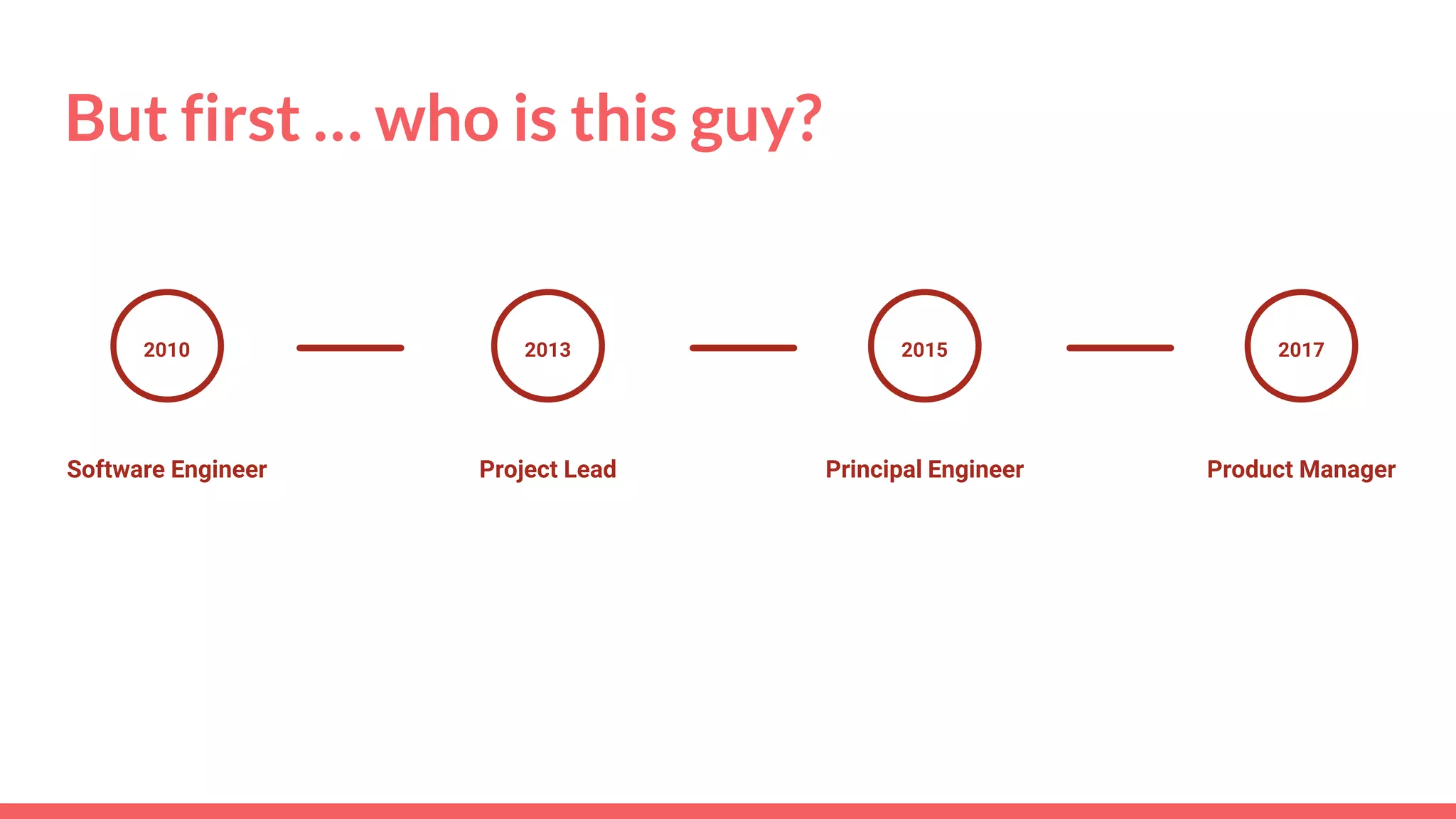
But first … who is this guy?
Project Lead
2013
Principal Engineer
2015
Product Manager
20172010
Software Engineer
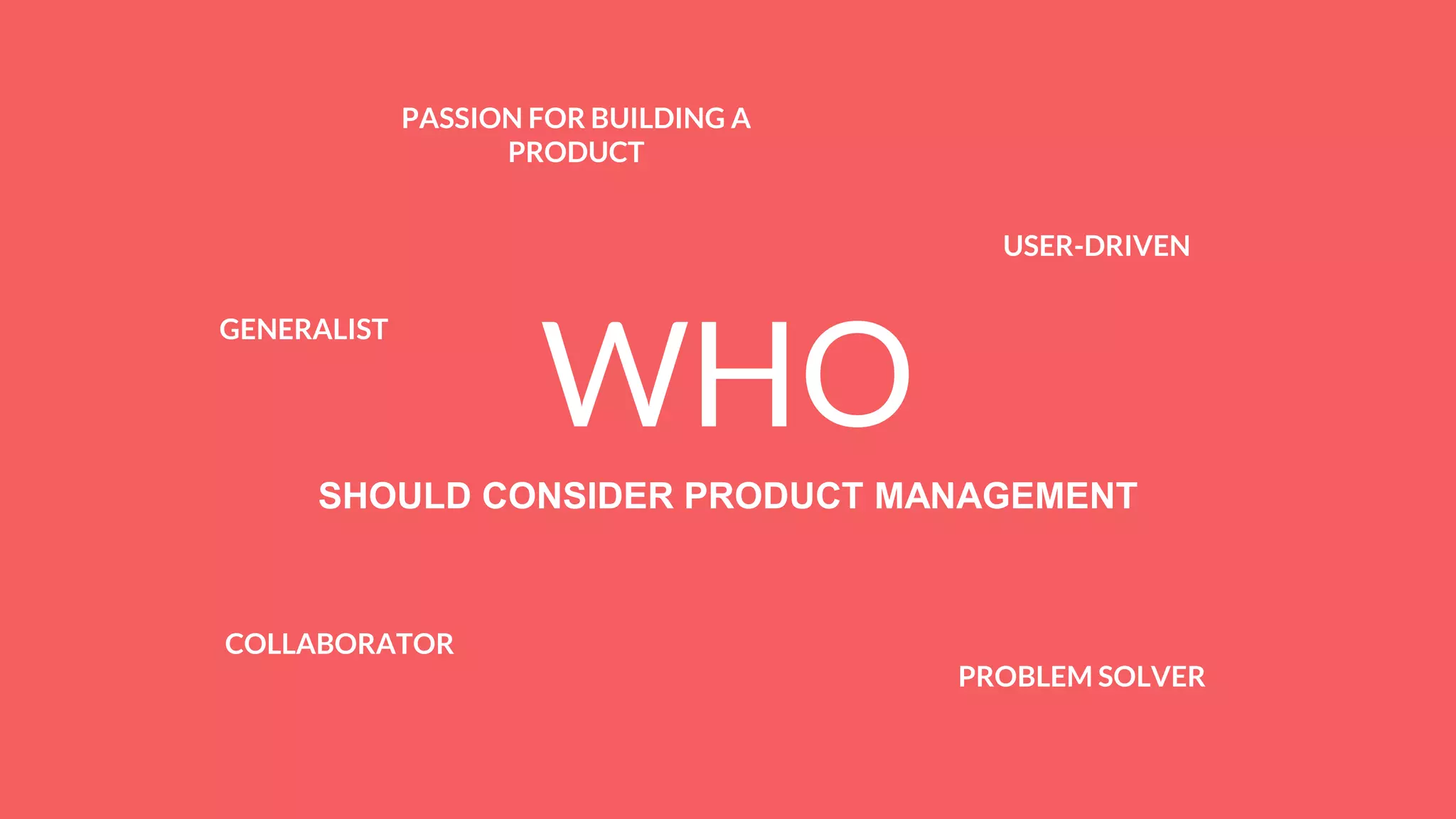
WHO
SHOULD CONSIDER PRODUCT MANAGEMENT
PASSION FOR BUILDING A
PRODUCT
USER-DRIVEN
COLLABORATOR
PROBLEM SOLVER
GENERALIST
WHY
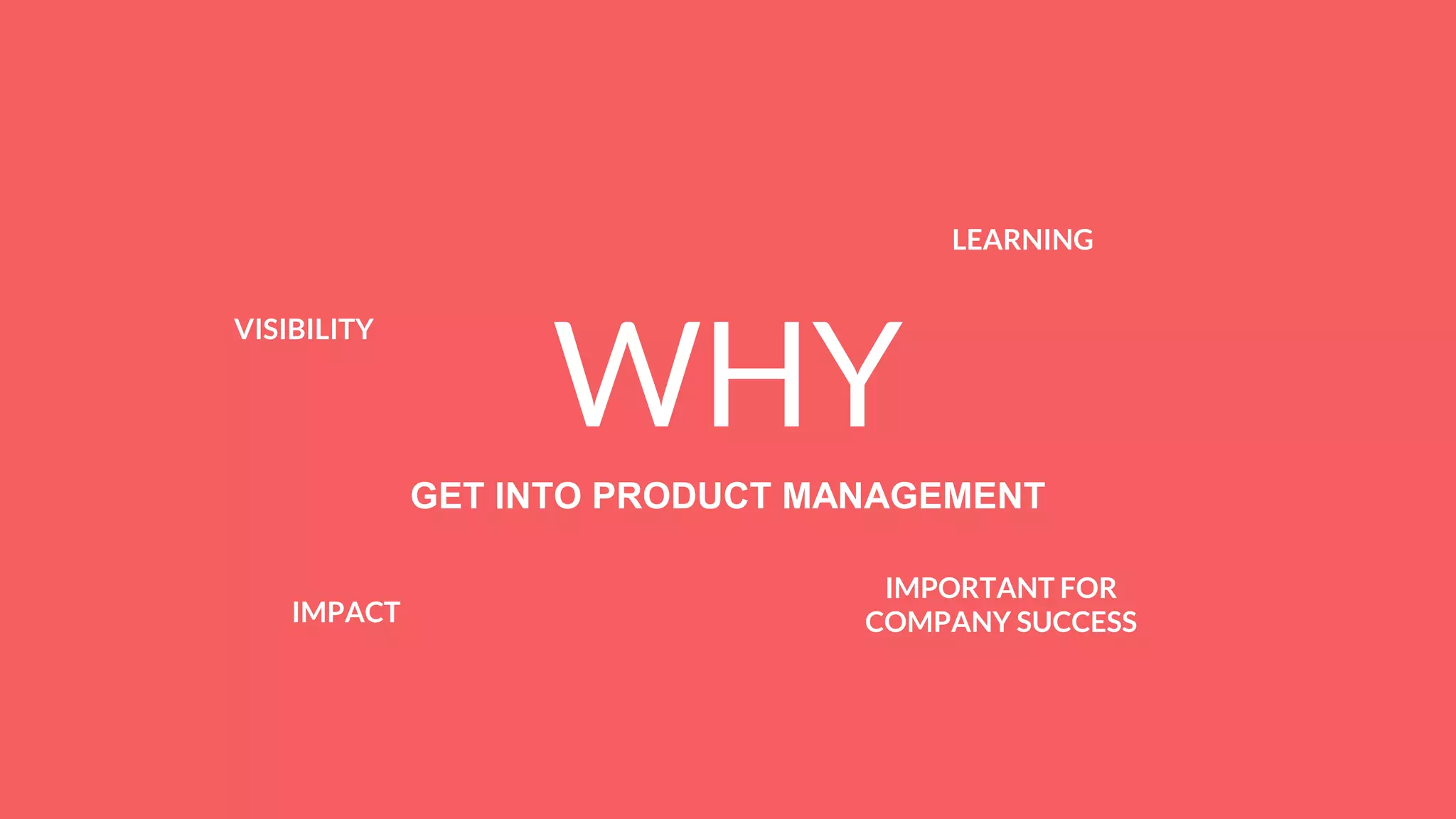
GET INTO PRODUCT MANAGEMENT
VISIBILITY
IMPACT
LEARNING
IMPORTANT FOR
COMPANY SUCCESS
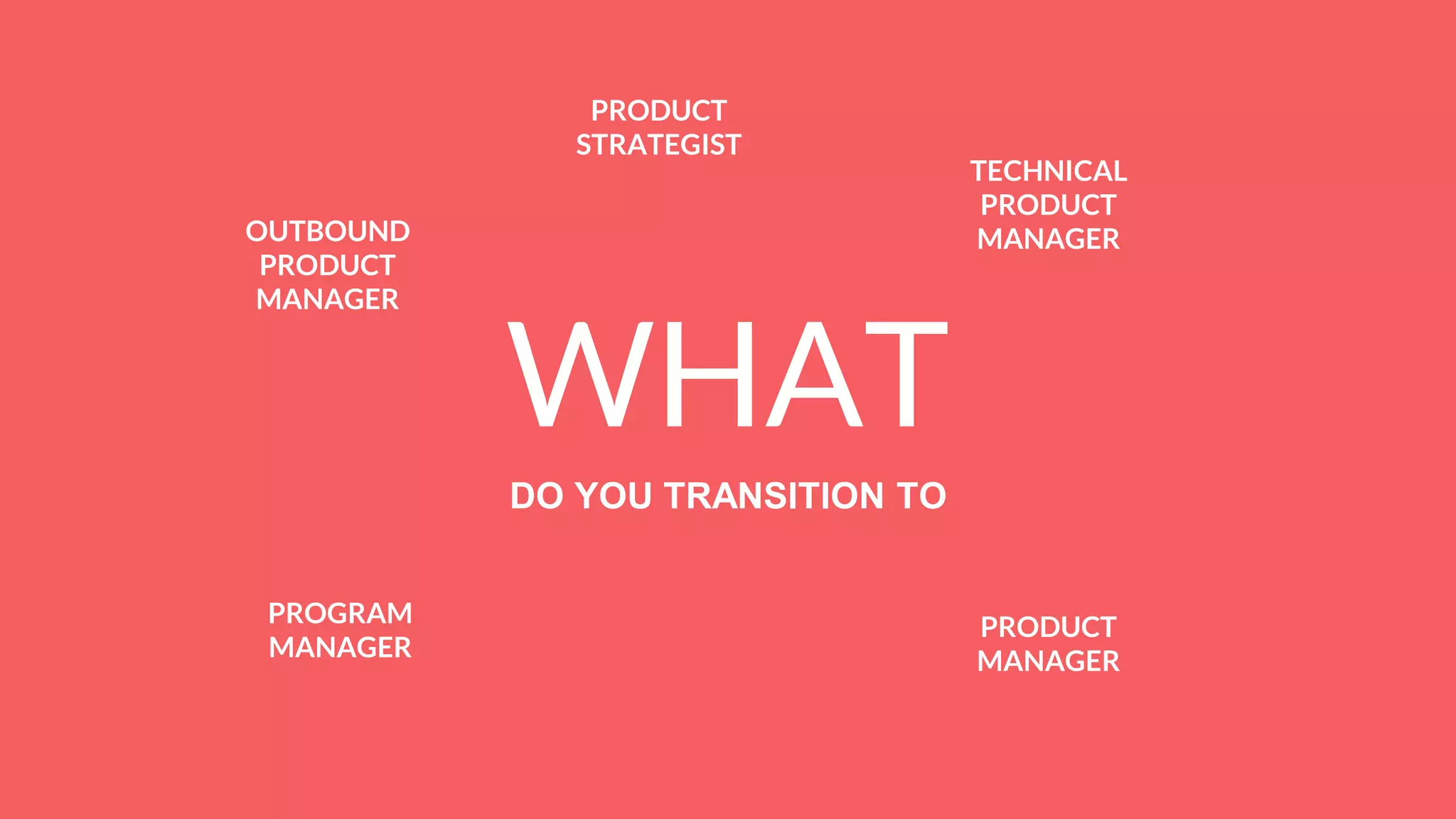
WHAT
DO YOU TRANSITION TO
OUTBOUND
PRODUCT
MANAGER
TECHNICAL
PRODUCT
MANAGER
PROGRAM
MANAGER
PRODUCT
STRATEGIST
PRODUCT
MANAGER
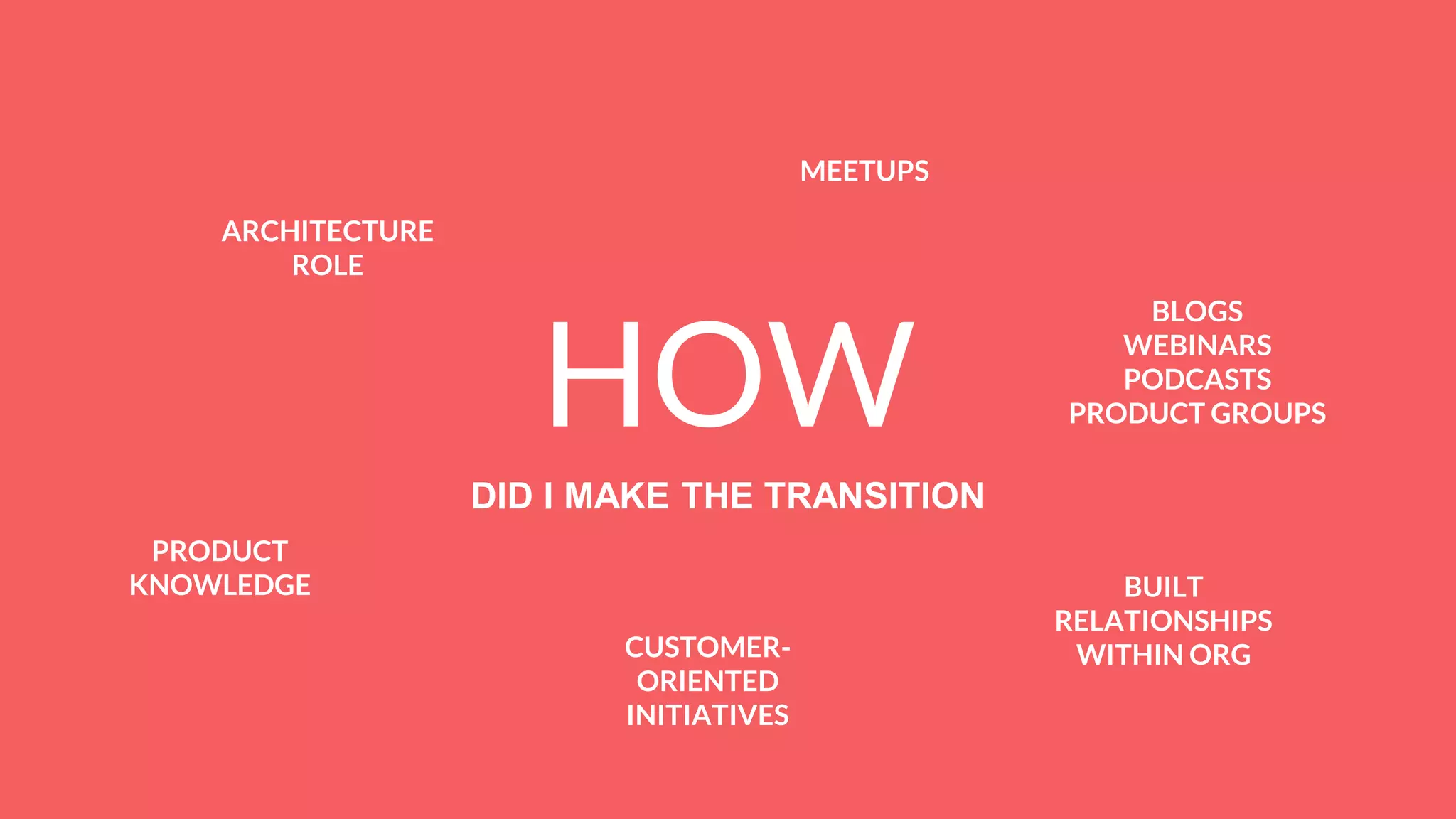
HOW
DID I MAKE THE TRANSITION
ARCHITECTURE
ROLE
MEETUPS
BLOGS
WEBINARS
PODCASTS
PRODUCT GROUPS
PRODUCT
KNOWLEDGE
CUSTOMER-
ORIENTED
INITIATIVES
BUILT
RELATIONSHIPS
WITHIN ORG
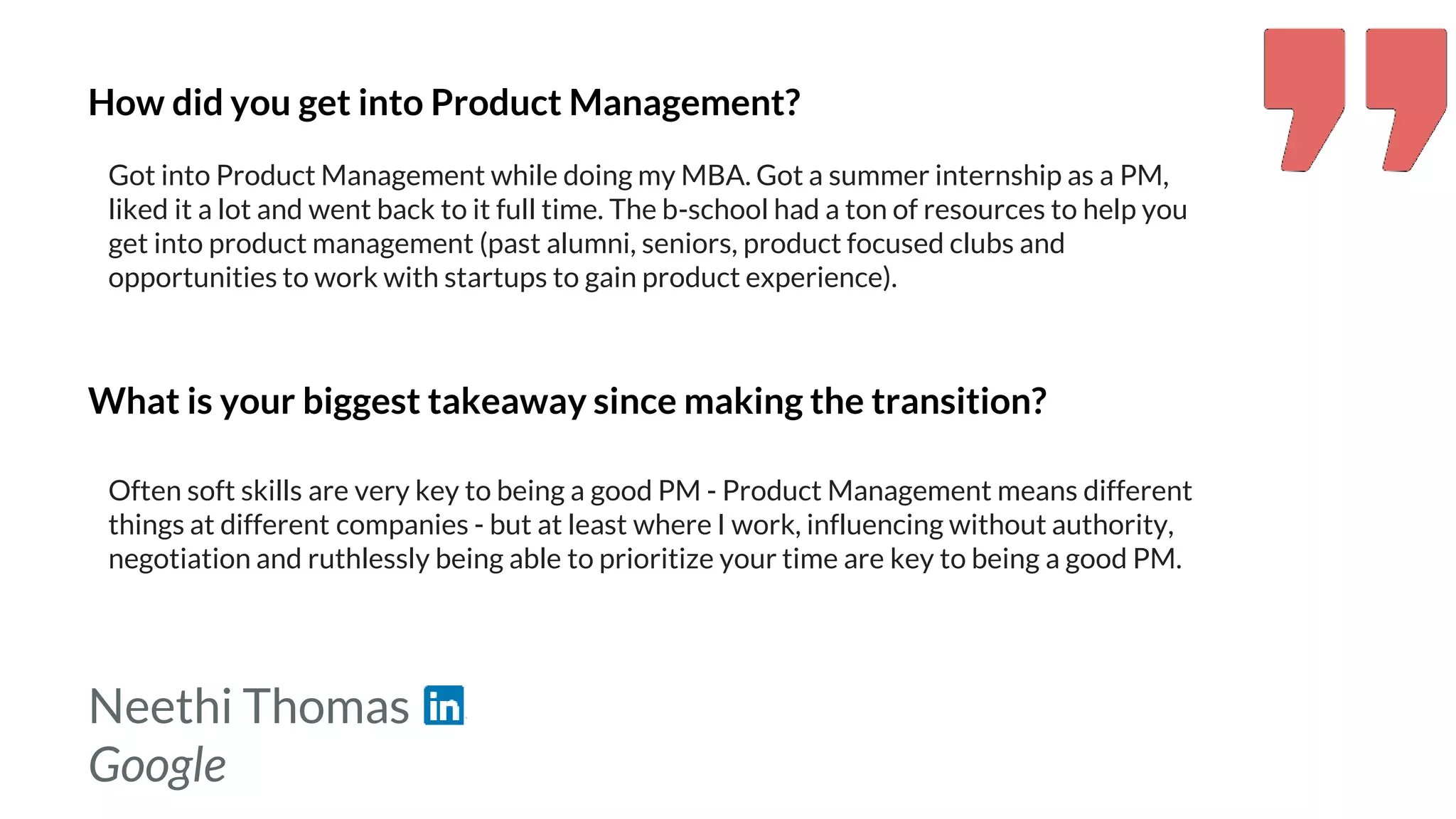
Neethi Thomas
Google
How did you get into Product Management?
Got into Product Management while doing my MBA. Got a summer internship as a PM,
liked it a lot and went back to it full time. The b-school had a ton of resources to help you
get into product management (past alumni, seniors, product focused clubs and
opportunities to work with startups to gain product experience).
What is your biggest takeaway since making the transition?
Often soft skills are very key to being a good PM - Product Management means different
things at different companies - but at least where I work, influencing without authority,
negotiation and ruthlessly being able to prioritize your time are key to being a good PM.
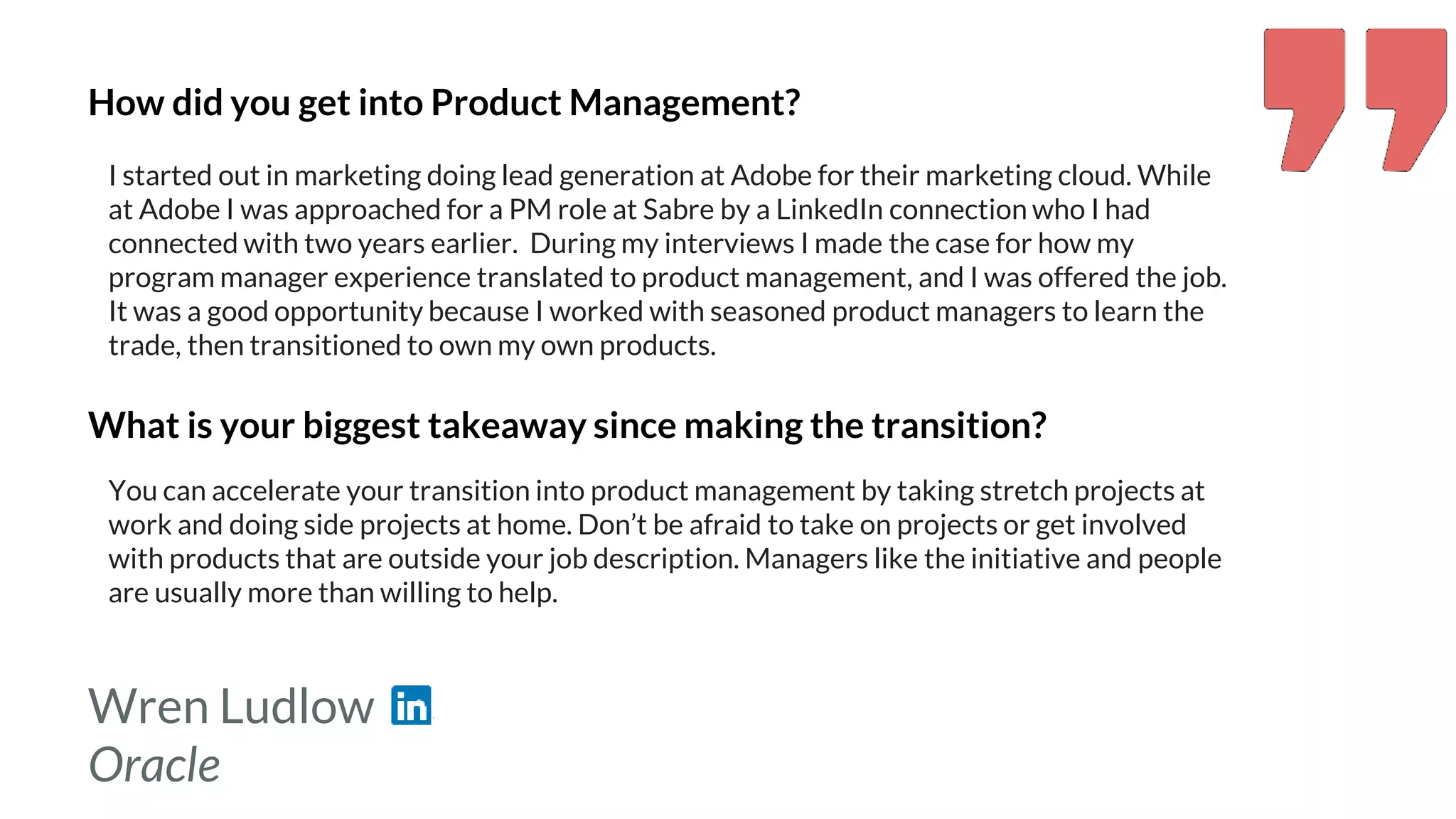
Wren Ludlow
Oracle
How did you get into Product Management?
I started out in marketing doing lead generation at Adobe for their marketing cloud. While
at Adobe I was approached for a PM role at Sabre by a LinkedIn connection who I had
connected with two years earlier. During my interviews I made the case for how my
program manager experience translated to product management, and I was offered the job.
It was a good opportunity because I worked with seasoned product managers to learn the
trade, then transitioned to own my own products.
What is your biggest takeaway since making the transition?
You can accelerate your transition into product management by taking stretch projects at
work and doing side projects at home. Don’t be afraid to take on projects or get involved
with products that are outside your job description. Managers like the initiative and people
are usually more than willing to help.
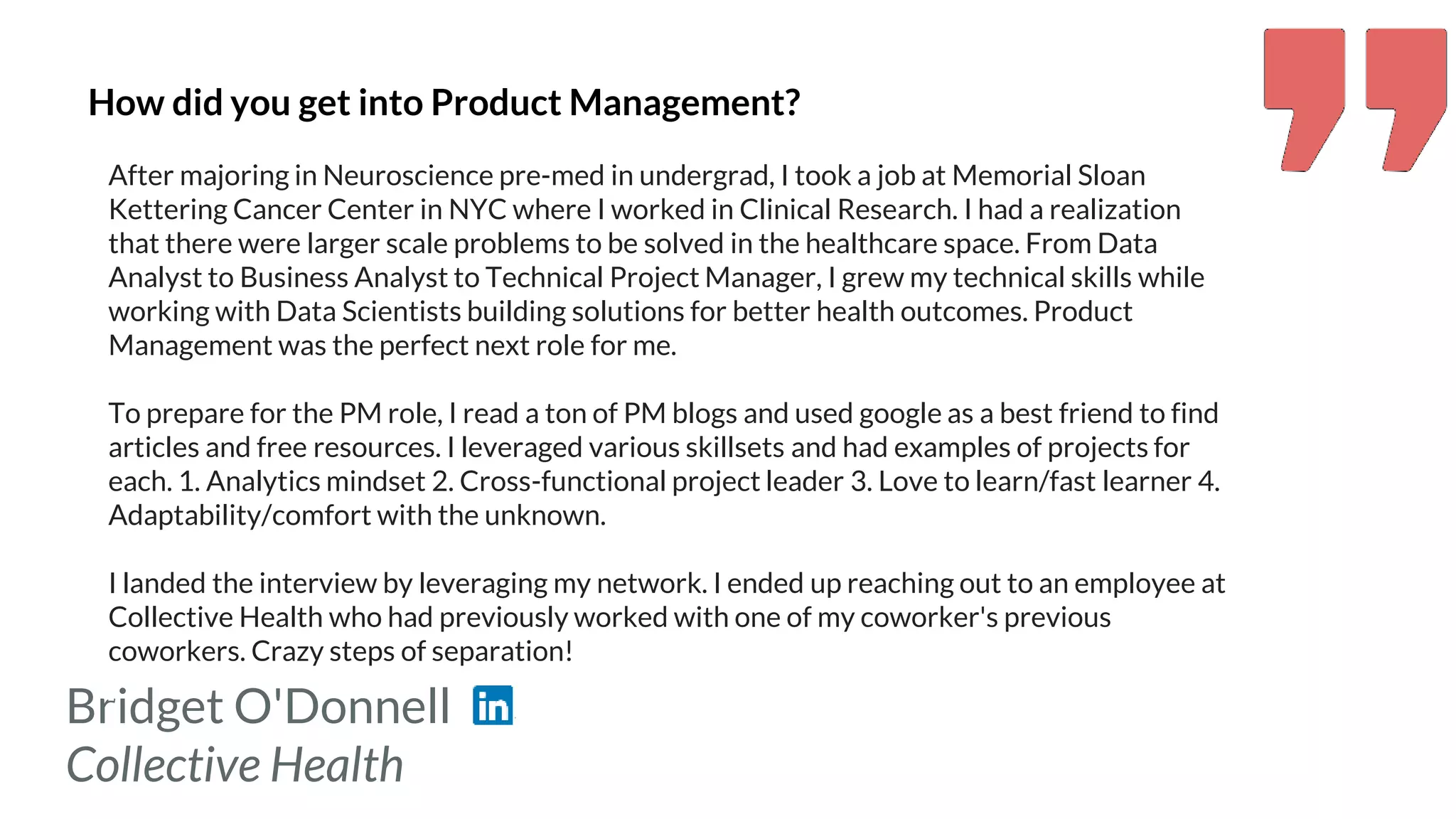
Bridget O'Donnell
Collective Health
How did you get into Product Management?
After majoring in Neuroscience pre-med in undergrad, I took a job at Memorial Sloan
Kettering Cancer Center in NYC where I worked in Clinical Research. I had a realization
that there were larger scale problems to be solved in the healthcare space. From Data
Analyst to Business Analyst to Technical Project Manager, I grew my technical skills while
working with Data Scientists building solutions for better health outcomes. Product
Management was the perfect next role for me.
To prepare for the PM role, I read a ton of PM blogs and used google as a best friend to find
articles and free resources. I leveraged various skillsets and had examples of projects for
each. 1. Analytics mindset 2. Cross-functional project leader 3. Love to learn/fast learner 4.
Adaptability/comfort with the unknown.
I landed the interview by leveraging my network. I ended up reaching out to an employee at
Collective Health who had previously worked with one of my coworker's previous
coworkers. Crazy steps of separation!
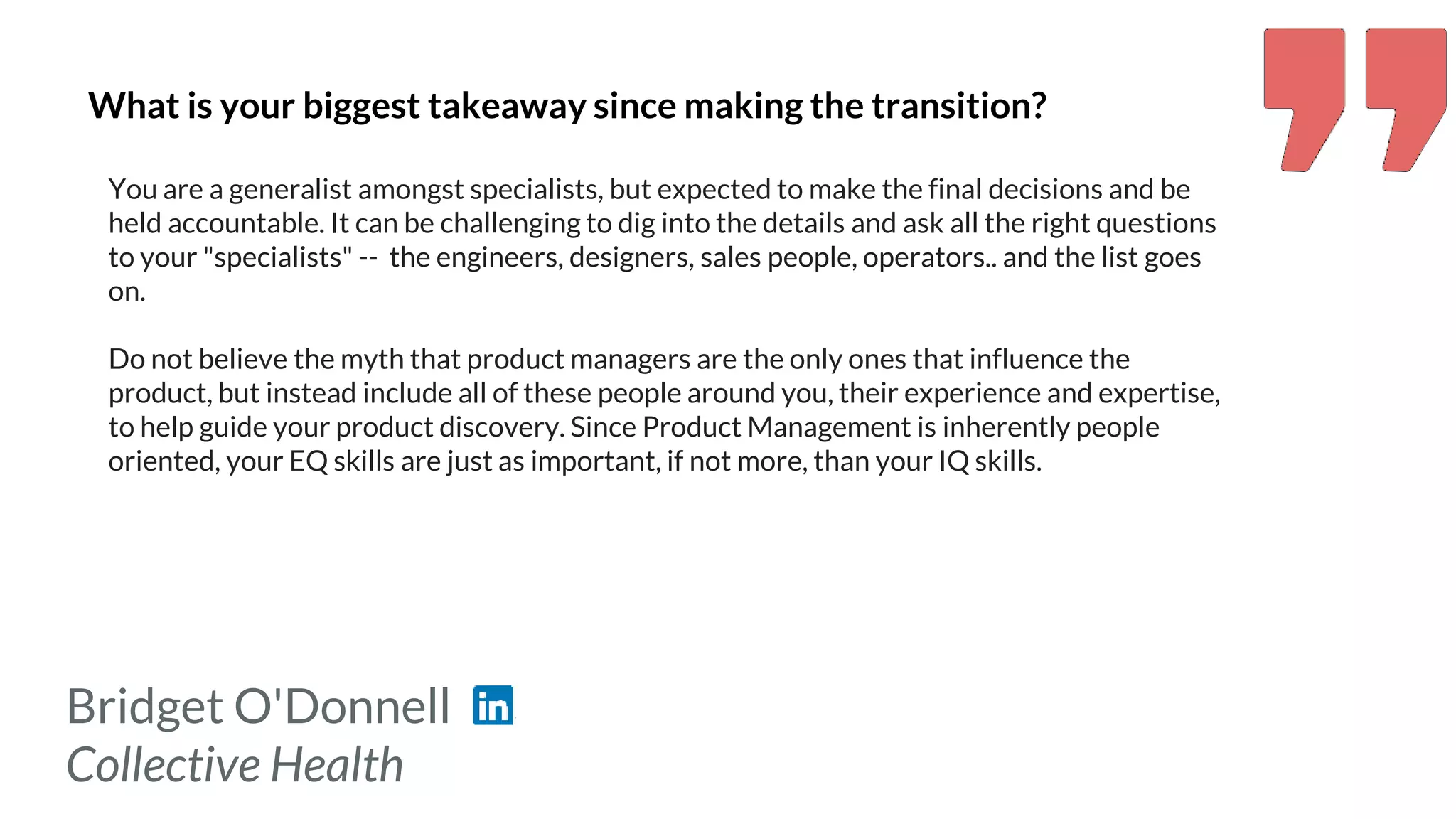
Bridget O'Donnell
Collective Health
What is your biggest takeaway since making the transition?
You are a generalist amongst specialists, but expected to make the final decisions and be
held accountable. It can be challenging to dig into the details and ask all the right questions
to your "specialists" -- the engineers, designers, sales people, operators.. and the list goes
on.
Do not believe the myth that product managers are the only ones that influence the
product, but instead include all of these people around you, their experience and expertise,
to help guide your product discovery. Since Product Management is inherently people
oriented, your EQ skills are just as important, if not more, than your IQ skills.
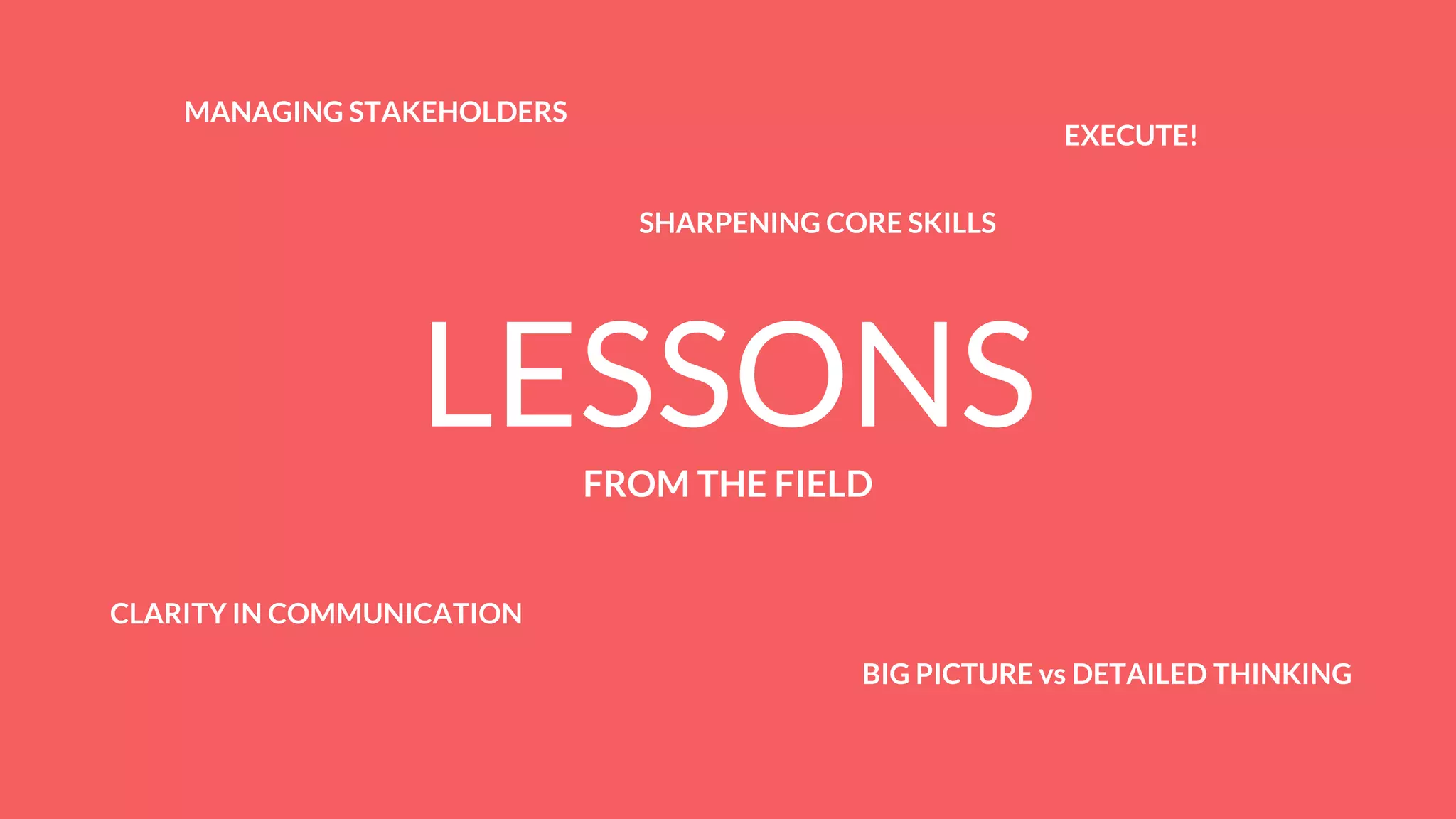
LESSONSFROM THE FIELD
SHARPENING CORE SKILLS
EXECUTE!
CLARITY IN COMMUNICATION
MANAGING STAKEHOLDERS
BIG PICTURE vs DETAILED THINKING
“Luck favors the persistent”
Jim Collins, author of Built to Last

Transitioning to Product Management, and thriving! w/ Mihir Patel

  • 1.
  • 2.
    Overview ● Who ● Why ●What ● How ● Lessons from the field
  • 3.
    But first …who is this guy? Project Lead 2013 Principal Engineer 2015 Product Manager 20172010 Software Engineer
  • 4.
    WHO SHOULD CONSIDER PRODUCTMANAGEMENT PASSION FOR BUILDING A PRODUCT USER-DRIVEN COLLABORATOR PROBLEM SOLVER GENERALIST
  • 5.
    WHY GET INTO PRODUCTMANAGEMENT VISIBILITY IMPACT LEARNING IMPORTANT FOR COMPANY SUCCESS
  • 6.
    WHAT DO YOU TRANSITIONTO OUTBOUND PRODUCT MANAGER TECHNICAL PRODUCT MANAGER PROGRAM MANAGER PRODUCT STRATEGIST PRODUCT MANAGER
  • 7.
    HOW DID I MAKETHE TRANSITION ARCHITECTURE ROLE MEETUPS BLOGS WEBINARS PODCASTS PRODUCT GROUPS PRODUCT KNOWLEDGE CUSTOMER- ORIENTED INITIATIVES BUILT RELATIONSHIPS WITHIN ORG
  • 8.
    Neethi Thomas Google How didyou get into Product Management? Got into Product Management while doing my MBA. Got a summer internship as a PM, liked it a lot and went back to it full time. The b-school had a ton of resources to help you get into product management (past alumni, seniors, product focused clubs and opportunities to work with startups to gain product experience). What is your biggest takeaway since making the transition? Often soft skills are very key to being a good PM - Product Management means different things at different companies - but at least where I work, influencing without authority, negotiation and ruthlessly being able to prioritize your time are key to being a good PM.
  • 9.
    Wren Ludlow Oracle How didyou get into Product Management? I started out in marketing doing lead generation at Adobe for their marketing cloud. While at Adobe I was approached for a PM role at Sabre by a LinkedIn connection who I had connected with two years earlier. During my interviews I made the case for how my program manager experience translated to product management, and I was offered the job. It was a good opportunity because I worked with seasoned product managers to learn the trade, then transitioned to own my own products. What is your biggest takeaway since making the transition? You can accelerate your transition into product management by taking stretch projects at work and doing side projects at home. Don’t be afraid to take on projects or get involved with products that are outside your job description. Managers like the initiative and people are usually more than willing to help.
  • 10.
    Bridget O'Donnell Collective Health Howdid you get into Product Management? After majoring in Neuroscience pre-med in undergrad, I took a job at Memorial Sloan Kettering Cancer Center in NYC where I worked in Clinical Research. I had a realization that there were larger scale problems to be solved in the healthcare space. From Data Analyst to Business Analyst to Technical Project Manager, I grew my technical skills while working with Data Scientists building solutions for better health outcomes. Product Management was the perfect next role for me. To prepare for the PM role, I read a ton of PM blogs and used google as a best friend to find articles and free resources. I leveraged various skillsets and had examples of projects for each. 1. Analytics mindset 2. Cross-functional project leader 3. Love to learn/fast learner 4. Adaptability/comfort with the unknown. I landed the interview by leveraging my network. I ended up reaching out to an employee at Collective Health who had previously worked with one of my coworker's previous coworkers. Crazy steps of separation!
  • 11.
    Bridget O'Donnell Collective Health Whatis your biggest takeaway since making the transition? You are a generalist amongst specialists, but expected to make the final decisions and be held accountable. It can be challenging to dig into the details and ask all the right questions to your "specialists" -- the engineers, designers, sales people, operators.. and the list goes on. Do not believe the myth that product managers are the only ones that influence the product, but instead include all of these people around you, their experience and expertise, to help guide your product discovery. Since Product Management is inherently people oriented, your EQ skills are just as important, if not more, than your IQ skills.
  • 12.
    LESSONSFROM THE FIELD SHARPENINGCORE SKILLS EXECUTE! CLARITY IN COMMUNICATION MANAGING STAKEHOLDERS BIG PICTURE vs DETAILED THINKING
  • 13.
    “Luck favors thepersistent” Jim Collins, author of Built to Last

Editor's Notes

  • #3 I structured the presentation to highlight the basic questions surrounding this topic. Who - should consider product management Why - make the effort to get into product management What - do you transition to How - did I make the transition These are also the same questions I ask myself everyday as a product manager.
  • #4 Grew up in Gandhinagar, Gujarat Freedom to play any sport, participate in all sorts of activities Bachelors and Masters in Computer Science (click) Joined Oracle after finishing my masters degree and since then, this is what I have been up to 3 years as a software engineer, started working on a nascent product at the time 2 years as a project lead, responsibilites included co-ordinating the execution of projects across UX, product management, engineering and QA Got the opportunity to join the newly formed architecture team. The org was expanding rapidly and needed engineers with deep product knowledge to help guide the technical and functional direction On October 1 2017, I officially became a product manager
  • #5 You have a passion for understanding and building products Every task you undertake is driven by user impact, more than anything else Collaborating and leading without authority comes naturally to you Problem solver - people who are highly analytical tend to do really well in product management Generalists - understanding of the big picture
  • #6 Visibility - get to work with smart people from all parts of the business Impact - your decisions, made in collaboration, will drive the direction of the product. You are in a great position to remove roadblocks and help the team be successful. Learn - large or small company, you will learn a LOT at an accelerated pace Important for Company Success – over the years the PM role has increased in importance. Product Managers are tasked with executing on the company’s mission.
  • #7 Same title - different responsibilities at different companies. Outbound Product Manager - spend more time talking to customers, focus on marketing Technical Product Manager - advanced technical knowledge of product, work closely with engineers and dev leads Program Manager - Resolving dependencies across teams, manage execution and scheduling of projects Product Strategist - work closely with customers, vendors, analyze competition, identify key features to make product successful Product Manager - Balanced role with inbound and outbound responsibilities. The most general of all these roles.
  • #8 Architecture role - prepared me well to become a better problem solver During this time, career objectives became clear. My strength lied in me being a generalist. Game plan - Attended meetups and networking events, online events like AMAs and webinars - product community is very good at sharing knowledge Blogs, youtube videos Prepared for transition within Oracle by: Establishing relationships with product people Understanding the complexities of the product, Bringing user-oriented approach to my work Building tools to gain better visibility into customer trends, feature usage, identifying strategic customers When I felt ready, had the conversation with my manager and with the PM team. They worked together to determine a transition plan. That’s my story of transitioning within my own company. But I wanted to make this presentation relatable for people with different in situations than me. So, I reached out to 3 PMs in my network to get their own stories.
  • #9 First, we have Neethi Thomas who is a PM at Google. Neethi had been a business analyst, then an engagement manager before going to Business school. She interned as a PM at Google, and went back full-time. She highlights how schools have a ton of resources at your disposal. I would add that such resources would certainly be available at your company as well. Make sure you take advantage! In her takeaways from the PM job, she lists the keys to being a good PM. I would highly emphasise her last one - “ruthlessly being able to prioritize your time”. As PMs, you have a ton of tasks across all the features you manage, depending on what stage each of them is in. You have to be able to prioritize your time effectively.
  • #10 Next up is Wren Ludlow. He gave an excellent talk in this webinar series on 5 skills a modern Product Manager must have. I highly recommend it, if you haven’t seen it already. Here is what he had to say about how he got his first product job. While working in marketing for Adobe, he got approached for a PM role at Sabre. Notice that this came about because he had taken the effort to network with the person who gave him this opportunity. He showcased how his program manager experience translated well to product management, and got his first break into the PM world. He offers valuable advise for aspiring PMs to take stretch projects at work, and side projects at home. If you take the initiative to go outside your job description, you’ll find people are more than willing to help.
  • #11 Bridget is a great example of how there are infinite paths to product management. She majored in Neuroscience, worked in Clinical Research and got interested in Data Analysis. She went on to be a Business Analyst and later a Technical Project Manager, while remaining focused on her passion for delivering better health outcomes. I would like to highlight 2 steps she took in her search for a PM position: Worked on example projects for each major skillset Networked like crazy!
  • #12 In her takeaways, she mentioned the accountability of PMs, the challenges of asking all the right questions to your specialists and how collaboration is vital. EQ skills are just as important, if not more, than your IQ skills. I wholeheartedly agree.
  • #13 Managing Stakeholders: As a PM, I am the glue which connects cross functional teams. I have to ensure all decisions are made with relevant stakeholders in the loop. I worked on a technically complex feature which was very important for our customers. I thought we were on the right path when I realized I had not involved a key person in the decision making. Big picture vs detailed thinking: Every feature has a big picture objective we are trying to accomplish. It is succinct and specific. While focusing on the details of the design, solutioning the feature and writing the use cases, it is vital to take each decision with the big picture in mind. Sharpening core skills: I was an engineer before becoming a PM. I still code regularly on side projects. It helps me contribute meaningfully in my discussions with engineers. Whatever your core skills are, be it data analysis, sales, marketing, UX … it is what set you up for success as a PM. Ensure that you keep those skills sharp. Clarity in Communication: This is a vital skill as a PM. Whether over email, phone, in person, with internal team members, or with customers, it is vital to listen, and to convey your thoughts well. Execute: Its the one lesson that my mentors have all especially emphasised. As a PM you are in position to tackle roadblocks for your product and relentlessly execute on the company’s goals.
  • #14 And no presentation is complete without a motivational quote! I will leave you with this one that I firmly believe in. Thanks so much for having me!