Power Gen Asia 2-4 October 2013

Small and Medium Size LNG
for Power Generation
• KARI PUNNONEN
• AREA BDM, OIL&GAS BUSINESS, MIDDLE-EAST, ASIA &
AUSTRALIA
• WÄRTSILÄ FINLAND OY

1

© Wärtsilä 13 January 2014 K. Punnonen
FOR INFORMATIONAL PURPOSES ONLY

DISCLAIMER
Disclaimer

2

This document is provided for informational purposes only and may not be
incorporated into any agreement. The information and conclusions in this document
are based upon calculations (including software built-in assumptions), observations,
assumptions, publicly available competitor information, and other information obtained
by Wärtsilä or provided to Wärtsilä by its customers, prospective customers or other
third parties (the ”information”) and is not intended to substitute independent
evaluation. No representation or warranty of any kind is made in respect of any such
information. Wärtsilä expressly disclaims any responsibility for, and does not
guarantee, the correctness or the completeness of the information. The calculations
and assumptions included in the information do not necessarily take into account all
the factors that could be relevant.
Nothing in this document shall be construed as a guarantee or warranty of the
performance of any Wärtsilä equipment or installation or the savings or other benefits
that could be achieved by using Wärtsilä technology, equipment or installations instead
of any or other technology.
All the information contained herein is confidential and may contain Wärtsilä’s
proprietary information and shall not be distributed to any third parties without
Wärtsilä’s prior written consent.
© Wärtsilä 13 January 2014 K. Punnonen
SMALL AND MEDIUM SIZE LNG

AGENDA:
1. Company Profile
2. LNG Supply Chain
3. LNG Terminal with Power Plant
4. LNG Based Feasibility

3

© Wärtsilä 13 January 2014 K. Punnonen
It’s Time for LNG
4 © Wärtsilä

13 January 2014 K. Punnonen
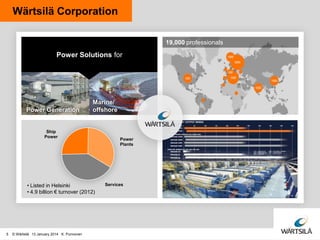
Wärtsilä Corporation
19,000 professionals

Power Solutions for

Power Generation

Marine/
offshore

Ship
Power

• Listed in Helsinki
• 4.9 billion € turnover (2012)

5

© Wärtsilä 13 January 2014 K. Punnonen

Power
Plants

Services
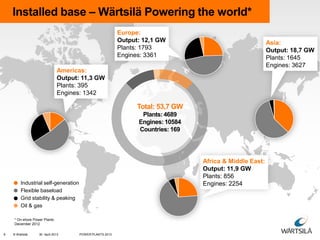
Installed base – Wärtsilä Powering the world*
Europe:
Output: 12,1 GW
Plants: 1793
Engines: 3361

Asia:
Output: 18,7 GW
Plants: 1645
Engines: 3627

Americas:
Output: 11,3 GW
Plants: 395
Engines: 1342

Total: 53,7 GW
Plants: 4689
Engines: 10584
Countries: 169

Africa & Middle East:
Output: 11,9 GW
Plants: 856
Engines: 2254

Industrial self-generation
Flexible baseload
Grid stability & peaking
Oil & gas
* On-shore Power Plants
December 2012
6

© Wärtsilä

30 April 2013

POWER PLANTS 2013
Wärtsilä Hamworthy Gas Excellence
Your perfect match

– WÄRTSILÄ is a global leader in complete lifecycle power solutions for the marine and
energy markets. In addition to being a world class engine manufacturer and supplier,
Wärtsilä is also a recognized EPC contractor in the power generation sector with extensive
references for turn key delivery of onshore power plants and floating power barges.
– HAMWORTHY OIL & GAS SYSTEMS was a leading designer, developer and manufacturer
of advanced gas handling systems for onshore, marine and offshore applications.
Hamworthy has patented LNG technology within LNG liquefaction and is a recognized
provider of technology and systems for various LNG applications worldwide.
– With Hamworthy now being an integrated part of Wärtsilä the two companies’ extensive
project execution experience and technology portfolios are combined into a seamless and
fully accountable one stop shop for complete small and mid scale LNG production facilities.
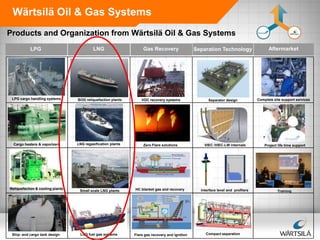
Wärtsilä Oil & Gas Systems
Products and Organization from Wärtsilä Oil & Gas Systems
LPG

LPG cargo handling systems

Cargo heaters & vaporizers

Reliquefaction & cooling plants

Ship- and cargo tank design

LNG

BOG reliquefaction plants

Gas Recovery

Separation Technology

Aftermarket

VOC recovery systems

Separator design

Complete site support services

LNG regasification plants

Zero Flare solutions

VIEC /VIEC-LW internals

Project life time support

Small scale LNG plants

HC blanket gas and recovery

Interface level and profilers

Training

LNG fuel gas systems

Flare gas recovery and ignition

Compact separation
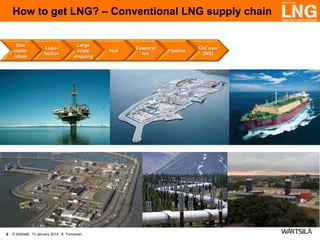
How to get LNG? – Conventional LNG supply chain
Gas
exploration

9

Liquifaction

Large
scale
shipping

© Wärtsilä 13 January 2014 K. Punnonen

Hub

Evaporat
ion

Pipeline

End user
(NG)
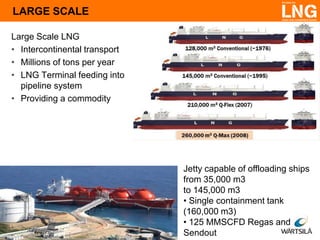
LARGE SCALE
Large Scale LNG
• Intercontinental transport
• Millions of tons per year
• LNG Terminal feeding into
pipeline system
• Providing a commodity

Jetty capable of offloading ships
from 35,000 m3
to 145,000 m3
• Single containment tank
(160,000 m3)
• 125 MMSCFD Regas and
Sendout
How to get LNG? – Mid and Small Size LNG
Gas
exploration

Liquifaction

Large
scale
shipping

Evaporat
ion

Pipeline

End user
(NG)

Small
scale
shipping

Mid
scale
storage

Evaporation

End user
(NG)

Truck
transport

Hub

Small
scale
storage

Ship
bunkering

11

© Wärtsilä 13 January 2014 K. Punnonen

Evaporation

End user
(NG)
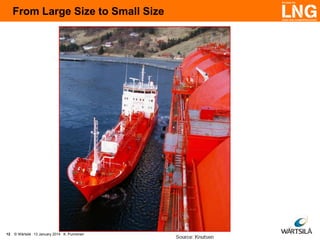
From Large Size to Small Size

12

© Wärtsilä 13 January 2014 K. Punnonen
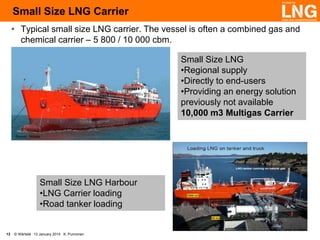
Small Size LNG Carrier
• Typical small size LNG carrier. The vessel is often a combined gas and
chemical carrier – 5 800 / 10 000 cbm.

Small Size LNG
•Regional supply
•Directly to end-users
•Providing an energy solution
previously not available
10,000 m3 Multigas Carrier
Source: Norgas

Small Size LNG Harbour
•LNG Carrier loading
•Road tanker loading
Source: Knutsen
13

© Wärtsilä 13 January 2014 K. Punnonen
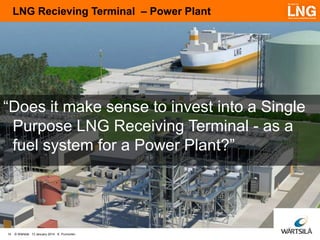
LNG Recieving Terminal – Power Plant

“Does it make sense to invest into a Single
Purpose LNG Receiving Terminal - as a
fuel system for a Power Plant?”

14

© Wärtsilä 13 January 2014 K. Punnonen
LNG Based Power Plant

A Feasibility Analyze was done to evaluate this
question. The results are presented here:

Natural Gas has become the fuel of preference and is
expected to pass coal within a decade or so…
15

© Wärtsilä 13 January 2014 K. Punnonen
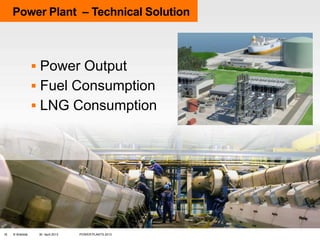
Power Plant – Technical Solution

 Power Output
 Fuel Consumption
 LNG Consumption

16

© Wärtsilä

30 April 2013

POWER PLANTS 2013
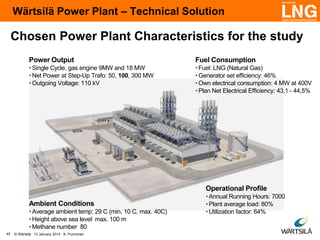
Wärtsilä Power Plant – Technical Solution

Chosen Power Plant Characteristics for the study
Power Output

Fuel Consumption

• Single Cycle, gas engine 9MW and 18 MW
• Net Power at Step-Up Trafo: 50, 100, 300 MW
• Outgoing Voltage: 110 kV

• Fuel: LNG (Natural Gas)
• Generator set efficiency: 46%
• Own electrical consumption: 4 MW at 400V
• Plan Net Electrical Efficiency: 43,1 - 44,5%

Operational Profile
Ambient Conditions
• Average ambient temp: 29 C (min. 10 C, max. 40C)
• Height above sea level: max. 100 m
• Methane number 80
17

© Wärtsilä 13 January 2014 K. Punnonen

• Annual Running Hours: 7000
• Plant average load: 80%
• Utilization factor: 64%
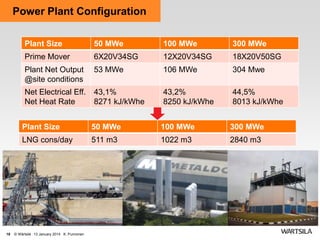
Power Plant Configuration
Plant Size

50 MWe

100 MWe

300 MWe

Prime Mover

6X20V34SG

12X20V34SG

18X20V50SG

Plant Net Output
@site conditions

53 MWe

106 MWe

304 Mwe

Net Electrical Eff.
Net Heat Rate

43,1%
8271 kJ/kWhe

43,2%
8250 kJ/kWhe

44,5%
8013 kJ/kWhe

Plant Size

100 MWe

300 MWe

LNG cons/day

18

50 MWe
511 m3

1022 m3

2840 m3

© Wärtsilä 13 January 2014 K. Punnonen
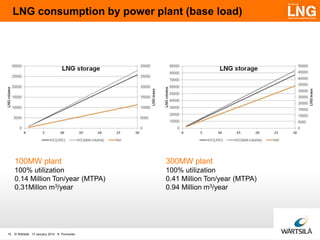
LNG consumption by power plant (base load)

100MW plant
100% utilization
0.14 Million Ton/year (MTPA)
0.31Millon m3/year

19

300MW plant
100% utilization
0.41 Million Ton/year (MTPA)
0.94 Million m3/year

© Wärtsilä 13 January 2014 K. Punnonen
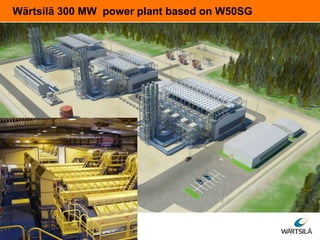
Wärtsilä 300 MW power plant based on W50SG

© Wärtsilä 2011
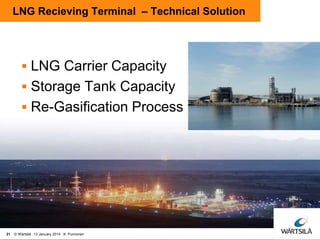
LNG Recieving Terminal – Technical Solution

 LNG Carrier Capacity
 Storage Tank Capacity
 Re-Gasification Process

21

© Wärtsilä 13 January 2014 K. Punnonen
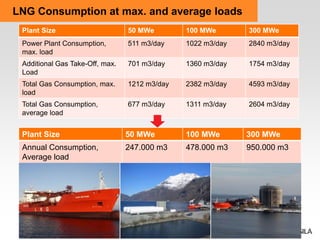
LNG Consumption at max. and average loads
Plant Size

50 MWe

100 MWe

300 MWe

Power Plant Consumption,
max. load

511 m3/day

1022 m3/day

2840 m3/day

Additional Gas Take-Off, max.
Load

701 m3/day

1360 m3/day

1754 m3/day

Total Gas Consumption, max.
load

1212 m3/day

2382 m3/day

4593 m3/day

Total Gas Consumption,
average load

677 m3/day

1311 m3/day

2604 m3/day

Plant Size

50 MWe

100 MWe

300 MWe

Annual Consumption,
Average load

247.000 m3

478.000 m3

950.000 m3
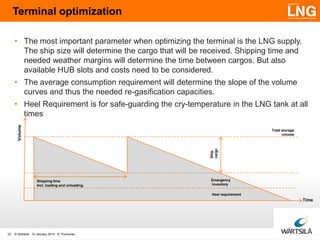
Terminal optimization
• The most important parameter when optimizing the terminal is the LNG supply.
The ship size will determine the cargo that will be received. Shipping time and
needed weather margins will determine the time between cargos. But also
available HUB slots and costs need to be considered.
• The average consumption requirement will determine the slope of the volume
curves and thus the needed re-gasification capacities.

Volume

• Heel Requirement is for safe-guarding the cry-temperature in the LNG tank at all
times
Ship
cargo

Total storage
volume

Shipping time
Incl. loading and unloading

Emergency
Inventory
Heel requirement

Time

23

© Wärtsilä 13 January 2014 K. Punnonen
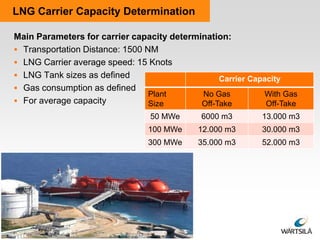
LNG Carrier Capacity Determination
Main Parameters for carrier capacity determination:
 Transportation Distance: 1500 NM
 LNG Carrier average speed: 15 Knots
 LNG Tank sizes as defined
Carrier Capacity
 Gas consumption as defined
Plant
No Gas
With Gas
 For average capacity
Size
Off-Take
Off-Take
50 MWe

6000 m3

13.000 m3

100 MWe

12.000 m3

30.000 m3

300 MWe

35.000 m3

52.000 m3
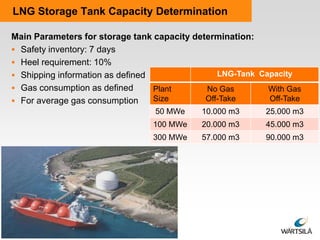
LNG Storage Tank Capacity Determination
Main Parameters for storage tank capacity determination:
 Safety inventory: 7 days
 Heel requirement: 10%
LNG-Tank Capacity
 Shipping information as defined
 Gas consumption as defined
Plant
No Gas
With Gas
Size
Off-Take
Off-Take
 For average gas consumption
50 MWe

10.000 m3

25.000 m3

100 MWe

20.000 m3

45.000 m3

300 MWe

57.000 m3

90.000 m3
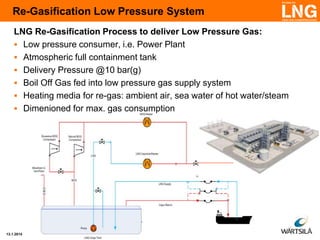
Re-Gasification Low Pressure System
LNG Re-Gasification Process to deliver Low Pressure Gas:
 Low pressure consumer, i.e. Power Plant
 Atmospheric full containment tank
 Delivery Pressure @10 bar(g)
 Boil Off Gas fed into low pressure gas supply system
 Heating media for re-gas: ambient air, sea water of hot water/steam
 Dimenioned for max. gas consumption

13.1.2014
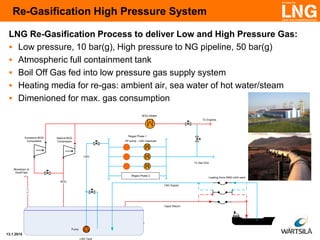
Re-Gasification High Pressure System
LNG Re-Gasification Process to deliver Low and High Pressure Gas:
 Low pressure, 10 bar(g), High pressure to NG pipeline, 50 bar(g)
 Atmospheric full containment tank
 Boil Off Gas fed into low pressure gas supply system
 Heating media for re-gas: ambient air, sea water of hot water/steam
 Dimenioned for max. gas consumption
BOG Heater
To Engines

Excessive BOG
Compressor

Regas Phase 1

Natural BOG
Compressor

HP-pump LNG Vaporizer

LNG
To Gas Grid
Blowdown to
Vent/Flare
Regas Phase 2

Loading Arms 5000 m3/h each

BOG
LNG Supply

Vapor Return

Pump

13.1.2014
LNG Tank
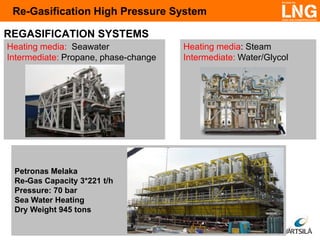
Re-Gasification High Pressure System
REGASIFICATION SYSTEMS
Heating media: Seawater
Intermediate: Propane, phase-change

Petronas Melaka
Re-Gas Capacity 3*221 t/h
Pressure: 70 bar
Sea Water Heating
Dry Weight 945 tons

Heating media: Steam
Intermediate: Water/Glycol
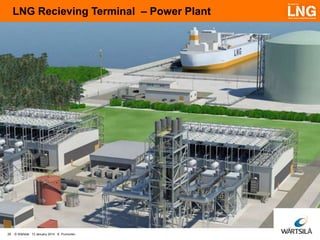
LNG Recieving Terminal – Power Plant

29

© Wärtsilä 13 January 2014 K. Punnonen
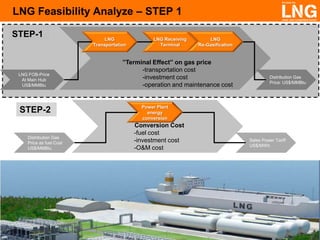
LNG Feasibility Analyze – STEP 1
STEP-1

LNG FOB-Price
At Main Hub
US$/MMBtu

STEP-2
Distribution Gas
Price as fuel Cost
US$/MMBtu

13 January 2014

LNG
Transportation

LNG Receiving
Terminal

LNG
Re-Gasification

”Terminal Effect” on gas price
-transportation cost
-investment cost
-operation and maintenance cost

Distribution Gas
Price: US$/MMBtu

Power Plant
energy
conversion

Conversion Cost
-fuel cost
-investment cost
-O&M cost

Sales Power Tariff
US$/MWh
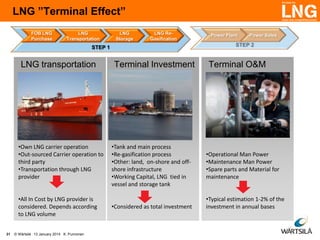
LNG ”Terminal Effect”
FOB LNG
Purchase

LNG
Transportation

LNG
Storage

LNG ReGasification

Power Plant

Power Sales

STEP 1

LNG transportation

•Own LNG carrier operation
•Out-sourced Carrier operation to
third party
•Transportation through LNG
provider
•All In Cost by LNG provider is
considered. Depends according
to LNG volume
31

© Wärtsilä 13 January 2014 K. Punnonen

Terminal Investment

•Tank and main process
•Re-gasification process
•Other: land, on-shore and offshore infrastructure
•Working Capital, LNG tied in
vessel and storage tank
•Considered as total investment

Terminal O&M

•Operational Man Power
•Maintenance Man Power
•Spare parts and Material for
maintenance
•Typical estimation 1-2% of the
investment in annual bases
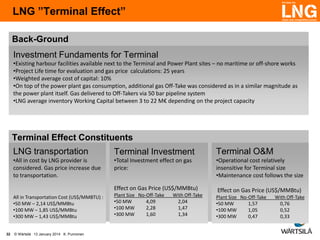
LNG ”Terminal Effect”
Back-Ground
Investment Fundaments for Terminal
•Existing harbour facilities available next to the Terminal and Power Plant sites – no maritime or off-shore works
•Project Life time for evaluation and gas price calculations: 25 years
•Weighted average cost of capital: 10%
•On top of the power plant gas consumption, additional gas Off-Take was considered as in a similar magnitude as
the power plant itself. Gas delivered to Off-Takers via 50 bar pipeline system
•LNG average inventory Working Capital between 3 to 22 M€ depending on the project capacity

Terminal Effect Constituents
LNG transportation

Terminal Investment

Terminal O&M

•All in cost by LNG provider is
considered. Gas price increase due
to transportation.

•Total Investment effect on gas
price:

•Operational cost relatively
insensitive for Terminal size
•Maintenance cost follows the size

Effect on Gas Price (US$/MMBtu)
All in Transportation Cost (US$/MMBTU) :
•50 MW – 2,14 US$/MMBtu
•100 MW – 1,85 US$/MMBtu
•300 MW – 1,43 US$/MMBtu

32

© Wärtsilä 13 January 2014 K. Punnonen

Plant Size No-Off-Take
•50 MW
4,09
•100 MW
2,28
•300 MW
1,60

With Off-Take
2,04
1,47
1,34

Effect on Gas Price (US$/MMBtu)
Plant Size No-Off-Take
•50 MW
1,57
•100 MW
1,05
•300 MW
0,47

With Off-Take
0,76
0,52
0,33
LNG ”Terminal Effect”
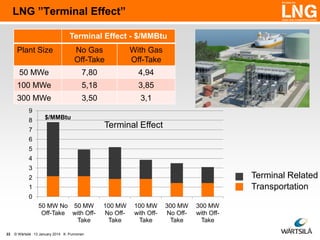
Terminal Effect - $/MMBtu
Plant Size

No Gas
Off-Take

With Gas
Off-Take

50 MWe

7,80

4,94

100 MWe

5,18

3,85

300 MWe

3,50

3,1

9

8

$/MMBtu

Terminal Effect

7
6
5
4
3

Terminal Related
Transportation

2
1
0
50 MW No 50 MW
Off-Take with OffTake
33

© Wärtsilä 13 January 2014 K. Punnonen

100 MW
No OffTake

100 MW
with OffTake

300 MW
No OffTake

300 MW
with OffTake
”Distribution Gas Price”
Plant Size

50 MWe

100 MWe

300 MWe

LNG Consumption

247.000 m3

478.000 m3

950.000 m3

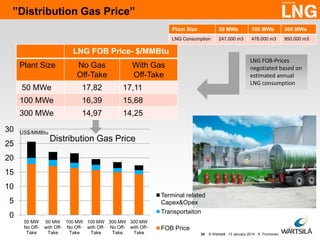
LNG FOB Price- $/MMBtu
Plant Size
50 MWe

17,82
16,39

15,68

300 MWe

14,97

LNG FOB-Prices
negotiated based on
estimated annual
LNG consumption

17,11

100 MWe

30

No Gas
Off-Take

14,25

US$/MMBtu

25

With Gas
Off-Take

Distribution Gas Price

20
15
10
Terminal related
Capex&Opex
Transportaiton

5
0
50 MW
No OffTake

50 MW 100 MW 100 MW 300 MW 300 MW
with Off- No Off- with Off- No Off- with OffTake
Take
Take
Take
Take

FOB Price
34

© Wärtsilä 13 January 2014 K. Punnonen
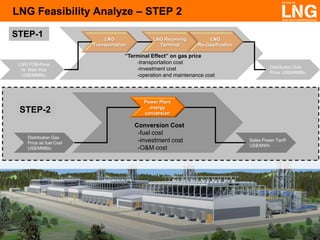
LNG Feasibility Analyze – STEP 2
STEP-1

LNG FOB-Price
At Main Hub
US$/MMBtu

STEP-2
Distribution Gas
Price as fuel Cost
US$/MMBtu

13 January 2014

LNG
Transportation

LNG Receiving
Terminal

LNG
Re-Gasification

”Terminal Effect” on gas price
-transportation cost
-investment cost
-operation and maintenance cost

Distribution Gas
Price: US$/MMBtu

Power Plant
energy
conversion

Conversion Cost
-fuel cost
-investment cost
-O&M cost

Sales Power Tariff
US$/MWh
LNG Based ”Power Tariff”
FOB LNG
Purchase

LNG
Transportation

LNG
Storage

LNG ReGasification

Power Plant

Power Sales

STEP 2

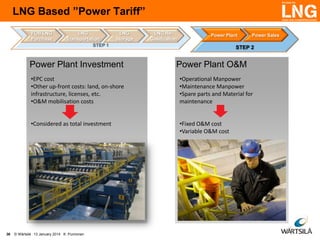
Power Plant Investment

Power Plant O&M

•EPC cost
•Other up-front costs: land, on-shore
infrastructure, licenses, etc.
•O&M mobilisation costs
•Considered as total investment

36

•Operational Manpower
•Maintenance Manpower
•Spare parts and Material for
maintenance
•Fixed O&M cost
•Variable O&M cost

© Wärtsilä 13 January 2014 K. Punnonen
LNG Based ”Power Tariff”
Back-Ground
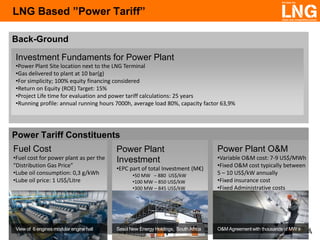
Investment Fundaments for Power Plant
•Power Plant Site location next to the LNG Terminal
•Gas delivered to plant at 10 bar(g)
•For simplicity; 100% equity financing considered
•Return on Equity (ROE) Target: 15%
•Project Life time for evaluation and power tariff calculations: 25 years
•Running profile: annual running hours 7000h, average load 80%, capacity factor 63,9%

Power Tariff Constituents
Fuel Cost
•Fuel cost for power plant as per the
“Distribution Gas Price”
•Lube oil consumption: 0,3 g/kWh
•Lube oil price: 1 US$/Litre

View of 6 engines modular engine hall

Power Plant
Investment
•EPC part of total Investment (M€)
•50 MW – 880 US$/kW
•100 MW – 850 US$/kW
•300 MW – 845 US$/kW

Sasol New Energy Holdings, South Africa

Power Plant O&M
•Variable O&M cost: 7-9 US$/MWh
•Fixed O&M cost typically between
5 – 10 US$/kW annually
•Fixed insurance cost
•Fixed Administrative costs

O&M Agreement with thousands of MW s
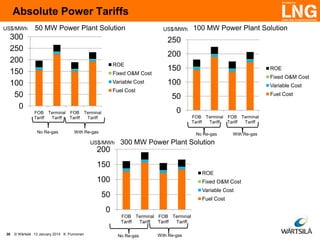
Absolute Power Tariffs
US$/MWh

50 MW Power Plant Solution

300
250
200
150
100
50
0

US$/MWh

100 MW Power Plant Solution

250
200
ROE
Fixed O&M Cost
Variable Cost
Fuel Cost

ROE
Fixed O&M Cost

100

Variable Cost
Fuel Cost

50
0

FOB Terminal FOB Terminal
Tariff
Tariff
Tariff
Tariff
No Re-gas

150

FOB Terminal FOB Terminal
Tariff
Tariff
Tariff
Tariff

With Re-gas

No Re-gas

US$/MWh

With Re-gas

300 MW Power Plant Solution

200
150
ROE

100

Fixed O&M Cost
Variable Cost

50

Fuel Cost

0
FOB Terminal FOB Terminal
Tariff
Tariff
Tariff
Tariff
38

© Wärtsilä 13 January 2014 K. Punnonen

No Re-gas

With Re-gas
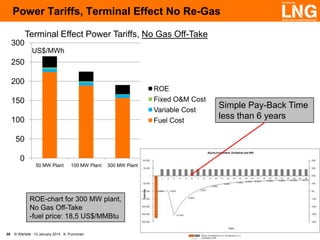
Power Tariffs, Terminal Effect No Re-Gas
Terminal Effect Power Tariffs, No Gas Off-Take
300
US$/MWh

250
200
ROE
Fixed O&M Cost
Variable Cost
Fuel Cost

150
100
50
0
50 MW Plant

100 MW Plant

300 MW Plant

ROE-chart for 300 MW plant,
No Gas Off-Take
-fuel price: 18,5 US$/MMBtu
39

© Wärtsilä 13 January 2014 K. Punnonen

Simple Pay-Back Time
less than 6 years
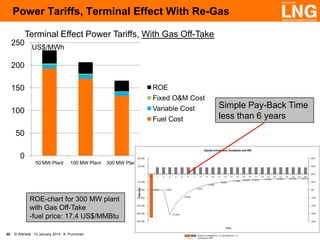
Power Tariffs, Terminal Effect With Re-Gas
Terminal Effect Power Tariffs, With Gas Off-Take
250

US$/MWh

200
ROE
Fixed O&M Cost
Variable Cost
Fuel Cost

150

100
50
0
50 MW Plant

100 MW Plant

300 MW Plant

ROE-chart for 300 MW plant
with Gas Off-Take
-fuel price: 17,4 US$/MMBtu
40

© Wärtsilä 13 January 2014 K. Punnonen

Simple Pay-Back Time
less than 6 years
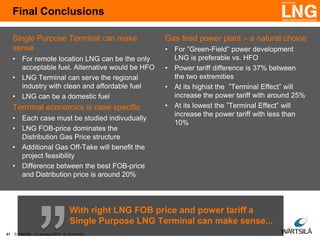
Final Conclusions
Single Purpose Terminal can make
sense
• For remote location LNG can be the only
acceptable fuel. Alternative would be HFO
• LNG Terminal can serve the regional
industry with clean and affordable fuel
• LNG can be a domestic fuel

Terminal economics is case specific
• Each case must be studied indivudually
• LNG FOB-price dominates the
Distribution Gas Price structure
• Additional Gas Off-Take will benefit the
project feasibility
• Difference between the best FOB-price
and Distribution price is around 20%

Gas fired power plant – a natural choice
• For ”Green-Field” power development
LNG is preferable vs. HFO
• Power tariff difference is 37% between
the two extremities
• At its highist the ”Terminal Effect” will
increase the power tariff with around 25%
• At its lowest the ”Terminal Effect” will
increase the power tariff with less than
10%

With right LNG FOB price and power tariff a
Single Purpose LNG Terminal can make sense...
41

© Wärtsilä 13 January 2014 K. Punnonen
WARTSILA.COM

Thank You

Smart Power Generation

See us at Stand F2

Small and medium scale LNG for power generation

  • 1.
    Power Gen Asia2-4 October 2013 Small and Medium Size LNG for Power Generation • KARI PUNNONEN • AREA BDM, OIL&GAS BUSINESS, MIDDLE-EAST, ASIA & AUSTRALIA • WÄRTSILÄ FINLAND OY 1 © Wärtsilä 13 January 2014 K. Punnonen
  • 2.
    FOR INFORMATIONAL PURPOSESONLY DISCLAIMER Disclaimer 2 This document is provided for informational purposes only and may not be incorporated into any agreement. The information and conclusions in this document are based upon calculations (including software built-in assumptions), observations, assumptions, publicly available competitor information, and other information obtained by Wärtsilä or provided to Wärtsilä by its customers, prospective customers or other third parties (the ”information”) and is not intended to substitute independent evaluation. No representation or warranty of any kind is made in respect of any such information. Wärtsilä expressly disclaims any responsibility for, and does not guarantee, the correctness or the completeness of the information. The calculations and assumptions included in the information do not necessarily take into account all the factors that could be relevant. Nothing in this document shall be construed as a guarantee or warranty of the performance of any Wärtsilä equipment or installation or the savings or other benefits that could be achieved by using Wärtsilä technology, equipment or installations instead of any or other technology. All the information contained herein is confidential and may contain Wärtsilä’s proprietary information and shall not be distributed to any third parties without Wärtsilä’s prior written consent. © Wärtsilä 13 January 2014 K. Punnonen
  • 3.
    SMALL AND MEDIUMSIZE LNG AGENDA: 1. Company Profile 2. LNG Supply Chain 3. LNG Terminal with Power Plant 4. LNG Based Feasibility 3 © Wärtsilä 13 January 2014 K. Punnonen
  • 4.
    It’s Time forLNG 4 © Wärtsilä 13 January 2014 K. Punnonen
  • 5.
    Wärtsilä Corporation 19,000 professionals PowerSolutions for Power Generation Marine/ offshore Ship Power • Listed in Helsinki • 4.9 billion € turnover (2012) 5 © Wärtsilä 13 January 2014 K. Punnonen Power Plants Services
  • 6.
    Installed base –Wärtsilä Powering the world* Europe: Output: 12,1 GW Plants: 1793 Engines: 3361 Asia: Output: 18,7 GW Plants: 1645 Engines: 3627 Americas: Output: 11,3 GW Plants: 395 Engines: 1342 Total: 53,7 GW Plants: 4689 Engines: 10584 Countries: 169 Africa & Middle East: Output: 11,9 GW Plants: 856 Engines: 2254 Industrial self-generation Flexible baseload Grid stability & peaking Oil & gas * On-shore Power Plants December 2012 6 © Wärtsilä 30 April 2013 POWER PLANTS 2013
  • 7.
    Wärtsilä Hamworthy GasExcellence Your perfect match – WÄRTSILÄ is a global leader in complete lifecycle power solutions for the marine and energy markets. In addition to being a world class engine manufacturer and supplier, Wärtsilä is also a recognized EPC contractor in the power generation sector with extensive references for turn key delivery of onshore power plants and floating power barges. – HAMWORTHY OIL & GAS SYSTEMS was a leading designer, developer and manufacturer of advanced gas handling systems for onshore, marine and offshore applications. Hamworthy has patented LNG technology within LNG liquefaction and is a recognized provider of technology and systems for various LNG applications worldwide. – With Hamworthy now being an integrated part of Wärtsilä the two companies’ extensive project execution experience and technology portfolios are combined into a seamless and fully accountable one stop shop for complete small and mid scale LNG production facilities.
  • 8.
    Wärtsilä Oil &Gas Systems Products and Organization from Wärtsilä Oil & Gas Systems LPG LPG cargo handling systems Cargo heaters & vaporizers Reliquefaction & cooling plants Ship- and cargo tank design LNG BOG reliquefaction plants Gas Recovery Separation Technology Aftermarket VOC recovery systems Separator design Complete site support services LNG regasification plants Zero Flare solutions VIEC /VIEC-LW internals Project life time support Small scale LNG plants HC blanket gas and recovery Interface level and profilers Training LNG fuel gas systems Flare gas recovery and ignition Compact separation
  • 9.
    How to getLNG? – Conventional LNG supply chain Gas exploration 9 Liquifaction Large scale shipping © Wärtsilä 13 January 2014 K. Punnonen Hub Evaporat ion Pipeline End user (NG)
  • 10.
    LARGE SCALE Large ScaleLNG • Intercontinental transport • Millions of tons per year • LNG Terminal feeding into pipeline system • Providing a commodity Jetty capable of offloading ships from 35,000 m3 to 145,000 m3 • Single containment tank (160,000 m3) • 125 MMSCFD Regas and Sendout
  • 11.
    How to getLNG? – Mid and Small Size LNG Gas exploration Liquifaction Large scale shipping Evaporat ion Pipeline End user (NG) Small scale shipping Mid scale storage Evaporation End user (NG) Truck transport Hub Small scale storage Ship bunkering 11 © Wärtsilä 13 January 2014 K. Punnonen Evaporation End user (NG)
  • 12.
    From Large Sizeto Small Size 12 © Wärtsilä 13 January 2014 K. Punnonen
  • 13.
    Small Size LNGCarrier • Typical small size LNG carrier. The vessel is often a combined gas and chemical carrier – 5 800 / 10 000 cbm. Small Size LNG •Regional supply •Directly to end-users •Providing an energy solution previously not available 10,000 m3 Multigas Carrier Source: Norgas Small Size LNG Harbour •LNG Carrier loading •Road tanker loading Source: Knutsen 13 © Wärtsilä 13 January 2014 K. Punnonen
  • 14.
    LNG Recieving Terminal– Power Plant “Does it make sense to invest into a Single Purpose LNG Receiving Terminal - as a fuel system for a Power Plant?” 14 © Wärtsilä 13 January 2014 K. Punnonen
  • 15.
    LNG Based PowerPlant A Feasibility Analyze was done to evaluate this question. The results are presented here: Natural Gas has become the fuel of preference and is expected to pass coal within a decade or so… 15 © Wärtsilä 13 January 2014 K. Punnonen
  • 16.
    Power Plant –Technical Solution  Power Output  Fuel Consumption  LNG Consumption 16 © Wärtsilä 30 April 2013 POWER PLANTS 2013
  • 17.
    Wärtsilä Power Plant– Technical Solution Chosen Power Plant Characteristics for the study Power Output Fuel Consumption • Single Cycle, gas engine 9MW and 18 MW • Net Power at Step-Up Trafo: 50, 100, 300 MW • Outgoing Voltage: 110 kV • Fuel: LNG (Natural Gas) • Generator set efficiency: 46% • Own electrical consumption: 4 MW at 400V • Plan Net Electrical Efficiency: 43,1 - 44,5% Operational Profile Ambient Conditions • Average ambient temp: 29 C (min. 10 C, max. 40C) • Height above sea level: max. 100 m • Methane number 80 17 © Wärtsilä 13 January 2014 K. Punnonen • Annual Running Hours: 7000 • Plant average load: 80% • Utilization factor: 64%
  • 18.
    Power Plant Configuration PlantSize 50 MWe 100 MWe 300 MWe Prime Mover 6X20V34SG 12X20V34SG 18X20V50SG Plant Net Output @site conditions 53 MWe 106 MWe 304 Mwe Net Electrical Eff. Net Heat Rate 43,1% 8271 kJ/kWhe 43,2% 8250 kJ/kWhe 44,5% 8013 kJ/kWhe Plant Size 100 MWe 300 MWe LNG cons/day 18 50 MWe 511 m3 1022 m3 2840 m3 © Wärtsilä 13 January 2014 K. Punnonen
  • 19.
    LNG consumption bypower plant (base load) 100MW plant 100% utilization 0.14 Million Ton/year (MTPA) 0.31Millon m3/year 19 300MW plant 100% utilization 0.41 Million Ton/year (MTPA) 0.94 Million m3/year © Wärtsilä 13 January 2014 K. Punnonen
  • 20.
    Wärtsilä 300 MWpower plant based on W50SG © Wärtsilä 2011
  • 21.
    LNG Recieving Terminal– Technical Solution  LNG Carrier Capacity  Storage Tank Capacity  Re-Gasification Process 21 © Wärtsilä 13 January 2014 K. Punnonen
  • 22.
    LNG Consumption atmax. and average loads Plant Size 50 MWe 100 MWe 300 MWe Power Plant Consumption, max. load 511 m3/day 1022 m3/day 2840 m3/day Additional Gas Take-Off, max. Load 701 m3/day 1360 m3/day 1754 m3/day Total Gas Consumption, max. load 1212 m3/day 2382 m3/day 4593 m3/day Total Gas Consumption, average load 677 m3/day 1311 m3/day 2604 m3/day Plant Size 50 MWe 100 MWe 300 MWe Annual Consumption, Average load 247.000 m3 478.000 m3 950.000 m3
  • 23.
    Terminal optimization • Themost important parameter when optimizing the terminal is the LNG supply. The ship size will determine the cargo that will be received. Shipping time and needed weather margins will determine the time between cargos. But also available HUB slots and costs need to be considered. • The average consumption requirement will determine the slope of the volume curves and thus the needed re-gasification capacities. Volume • Heel Requirement is for safe-guarding the cry-temperature in the LNG tank at all times Ship cargo Total storage volume Shipping time Incl. loading and unloading Emergency Inventory Heel requirement Time 23 © Wärtsilä 13 January 2014 K. Punnonen
  • 24.
    LNG Carrier CapacityDetermination Main Parameters for carrier capacity determination:  Transportation Distance: 1500 NM  LNG Carrier average speed: 15 Knots  LNG Tank sizes as defined Carrier Capacity  Gas consumption as defined Plant No Gas With Gas  For average capacity Size Off-Take Off-Take 50 MWe 6000 m3 13.000 m3 100 MWe 12.000 m3 30.000 m3 300 MWe 35.000 m3 52.000 m3
  • 25.
    LNG Storage TankCapacity Determination Main Parameters for storage tank capacity determination:  Safety inventory: 7 days  Heel requirement: 10% LNG-Tank Capacity  Shipping information as defined  Gas consumption as defined Plant No Gas With Gas Size Off-Take Off-Take  For average gas consumption 50 MWe 10.000 m3 25.000 m3 100 MWe 20.000 m3 45.000 m3 300 MWe 57.000 m3 90.000 m3
  • 26.
    Re-Gasification Low PressureSystem LNG Re-Gasification Process to deliver Low Pressure Gas:  Low pressure consumer, i.e. Power Plant  Atmospheric full containment tank  Delivery Pressure @10 bar(g)  Boil Off Gas fed into low pressure gas supply system  Heating media for re-gas: ambient air, sea water of hot water/steam  Dimenioned for max. gas consumption 13.1.2014
  • 27.
    Re-Gasification High PressureSystem LNG Re-Gasification Process to deliver Low and High Pressure Gas:  Low pressure, 10 bar(g), High pressure to NG pipeline, 50 bar(g)  Atmospheric full containment tank  Boil Off Gas fed into low pressure gas supply system  Heating media for re-gas: ambient air, sea water of hot water/steam  Dimenioned for max. gas consumption BOG Heater To Engines Excessive BOG Compressor Regas Phase 1 Natural BOG Compressor HP-pump LNG Vaporizer LNG To Gas Grid Blowdown to Vent/Flare Regas Phase 2 Loading Arms 5000 m3/h each BOG LNG Supply Vapor Return Pump 13.1.2014 LNG Tank
  • 28.
    Re-Gasification High PressureSystem REGASIFICATION SYSTEMS Heating media: Seawater Intermediate: Propane, phase-change Petronas Melaka Re-Gas Capacity 3*221 t/h Pressure: 70 bar Sea Water Heating Dry Weight 945 tons Heating media: Steam Intermediate: Water/Glycol
  • 29.
    LNG Recieving Terminal– Power Plant 29 © Wärtsilä 13 January 2014 K. Punnonen
  • 30.
    LNG Feasibility Analyze– STEP 1 STEP-1 LNG FOB-Price At Main Hub US$/MMBtu STEP-2 Distribution Gas Price as fuel Cost US$/MMBtu 13 January 2014 LNG Transportation LNG Receiving Terminal LNG Re-Gasification ”Terminal Effect” on gas price -transportation cost -investment cost -operation and maintenance cost Distribution Gas Price: US$/MMBtu Power Plant energy conversion Conversion Cost -fuel cost -investment cost -O&M cost Sales Power Tariff US$/MWh
  • 31.
    LNG ”Terminal Effect” FOBLNG Purchase LNG Transportation LNG Storage LNG ReGasification Power Plant Power Sales STEP 1 LNG transportation •Own LNG carrier operation •Out-sourced Carrier operation to third party •Transportation through LNG provider •All In Cost by LNG provider is considered. Depends according to LNG volume 31 © Wärtsilä 13 January 2014 K. Punnonen Terminal Investment •Tank and main process •Re-gasification process •Other: land, on-shore and offshore infrastructure •Working Capital, LNG tied in vessel and storage tank •Considered as total investment Terminal O&M •Operational Man Power •Maintenance Man Power •Spare parts and Material for maintenance •Typical estimation 1-2% of the investment in annual bases
  • 32.
    LNG ”Terminal Effect” Back-Ground InvestmentFundaments for Terminal •Existing harbour facilities available next to the Terminal and Power Plant sites – no maritime or off-shore works •Project Life time for evaluation and gas price calculations: 25 years •Weighted average cost of capital: 10% •On top of the power plant gas consumption, additional gas Off-Take was considered as in a similar magnitude as the power plant itself. Gas delivered to Off-Takers via 50 bar pipeline system •LNG average inventory Working Capital between 3 to 22 M€ depending on the project capacity Terminal Effect Constituents LNG transportation Terminal Investment Terminal O&M •All in cost by LNG provider is considered. Gas price increase due to transportation. •Total Investment effect on gas price: •Operational cost relatively insensitive for Terminal size •Maintenance cost follows the size Effect on Gas Price (US$/MMBtu) All in Transportation Cost (US$/MMBTU) : •50 MW – 2,14 US$/MMBtu •100 MW – 1,85 US$/MMBtu •300 MW – 1,43 US$/MMBtu 32 © Wärtsilä 13 January 2014 K. Punnonen Plant Size No-Off-Take •50 MW 4,09 •100 MW 2,28 •300 MW 1,60 With Off-Take 2,04 1,47 1,34 Effect on Gas Price (US$/MMBtu) Plant Size No-Off-Take •50 MW 1,57 •100 MW 1,05 •300 MW 0,47 With Off-Take 0,76 0,52 0,33
  • 33.
    LNG ”Terminal Effect” TerminalEffect - $/MMBtu Plant Size No Gas Off-Take With Gas Off-Take 50 MWe 7,80 4,94 100 MWe 5,18 3,85 300 MWe 3,50 3,1 9 8 $/MMBtu Terminal Effect 7 6 5 4 3 Terminal Related Transportation 2 1 0 50 MW No 50 MW Off-Take with OffTake 33 © Wärtsilä 13 January 2014 K. Punnonen 100 MW No OffTake 100 MW with OffTake 300 MW No OffTake 300 MW with OffTake
  • 34.
    ”Distribution Gas Price” PlantSize 50 MWe 100 MWe 300 MWe LNG Consumption 247.000 m3 478.000 m3 950.000 m3 LNG FOB Price- $/MMBtu Plant Size 50 MWe 17,82 16,39 15,68 300 MWe 14,97 LNG FOB-Prices negotiated based on estimated annual LNG consumption 17,11 100 MWe 30 No Gas Off-Take 14,25 US$/MMBtu 25 With Gas Off-Take Distribution Gas Price 20 15 10 Terminal related Capex&Opex Transportaiton 5 0 50 MW No OffTake 50 MW 100 MW 100 MW 300 MW 300 MW with Off- No Off- with Off- No Off- with OffTake Take Take Take Take FOB Price 34 © Wärtsilä 13 January 2014 K. Punnonen
  • 35.
    LNG Feasibility Analyze– STEP 2 STEP-1 LNG FOB-Price At Main Hub US$/MMBtu STEP-2 Distribution Gas Price as fuel Cost US$/MMBtu 13 January 2014 LNG Transportation LNG Receiving Terminal LNG Re-Gasification ”Terminal Effect” on gas price -transportation cost -investment cost -operation and maintenance cost Distribution Gas Price: US$/MMBtu Power Plant energy conversion Conversion Cost -fuel cost -investment cost -O&M cost Sales Power Tariff US$/MWh
  • 36.
    LNG Based ”PowerTariff” FOB LNG Purchase LNG Transportation LNG Storage LNG ReGasification Power Plant Power Sales STEP 2 Power Plant Investment Power Plant O&M •EPC cost •Other up-front costs: land, on-shore infrastructure, licenses, etc. •O&M mobilisation costs •Considered as total investment 36 •Operational Manpower •Maintenance Manpower •Spare parts and Material for maintenance •Fixed O&M cost •Variable O&M cost © Wärtsilä 13 January 2014 K. Punnonen
  • 37.
    LNG Based ”PowerTariff” Back-Ground Investment Fundaments for Power Plant •Power Plant Site location next to the LNG Terminal •Gas delivered to plant at 10 bar(g) •For simplicity; 100% equity financing considered •Return on Equity (ROE) Target: 15% •Project Life time for evaluation and power tariff calculations: 25 years •Running profile: annual running hours 7000h, average load 80%, capacity factor 63,9% Power Tariff Constituents Fuel Cost •Fuel cost for power plant as per the “Distribution Gas Price” •Lube oil consumption: 0,3 g/kWh •Lube oil price: 1 US$/Litre View of 6 engines modular engine hall Power Plant Investment •EPC part of total Investment (M€) •50 MW – 880 US$/kW •100 MW – 850 US$/kW •300 MW – 845 US$/kW Sasol New Energy Holdings, South Africa Power Plant O&M •Variable O&M cost: 7-9 US$/MWh •Fixed O&M cost typically between 5 – 10 US$/kW annually •Fixed insurance cost •Fixed Administrative costs O&M Agreement with thousands of MW s
  • 38.
    Absolute Power Tariffs US$/MWh 50MW Power Plant Solution 300 250 200 150 100 50 0 US$/MWh 100 MW Power Plant Solution 250 200 ROE Fixed O&M Cost Variable Cost Fuel Cost ROE Fixed O&M Cost 100 Variable Cost Fuel Cost 50 0 FOB Terminal FOB Terminal Tariff Tariff Tariff Tariff No Re-gas 150 FOB Terminal FOB Terminal Tariff Tariff Tariff Tariff With Re-gas No Re-gas US$/MWh With Re-gas 300 MW Power Plant Solution 200 150 ROE 100 Fixed O&M Cost Variable Cost 50 Fuel Cost 0 FOB Terminal FOB Terminal Tariff Tariff Tariff Tariff 38 © Wärtsilä 13 January 2014 K. Punnonen No Re-gas With Re-gas
  • 39.
    Power Tariffs, TerminalEffect No Re-Gas Terminal Effect Power Tariffs, No Gas Off-Take 300 US$/MWh 250 200 ROE Fixed O&M Cost Variable Cost Fuel Cost 150 100 50 0 50 MW Plant 100 MW Plant 300 MW Plant ROE-chart for 300 MW plant, No Gas Off-Take -fuel price: 18,5 US$/MMBtu 39 © Wärtsilä 13 January 2014 K. Punnonen Simple Pay-Back Time less than 6 years
  • 40.
    Power Tariffs, TerminalEffect With Re-Gas Terminal Effect Power Tariffs, With Gas Off-Take 250 US$/MWh 200 ROE Fixed O&M Cost Variable Cost Fuel Cost 150 100 50 0 50 MW Plant 100 MW Plant 300 MW Plant ROE-chart for 300 MW plant with Gas Off-Take -fuel price: 17,4 US$/MMBtu 40 © Wärtsilä 13 January 2014 K. Punnonen Simple Pay-Back Time less than 6 years
  • 41.
    Final Conclusions Single PurposeTerminal can make sense • For remote location LNG can be the only acceptable fuel. Alternative would be HFO • LNG Terminal can serve the regional industry with clean and affordable fuel • LNG can be a domestic fuel Terminal economics is case specific • Each case must be studied indivudually • LNG FOB-price dominates the Distribution Gas Price structure • Additional Gas Off-Take will benefit the project feasibility • Difference between the best FOB-price and Distribution price is around 20% Gas fired power plant – a natural choice • For ”Green-Field” power development LNG is preferable vs. HFO • Power tariff difference is 37% between the two extremities • At its highist the ”Terminal Effect” will increase the power tariff with around 25% • At its lowest the ”Terminal Effect” will increase the power tariff with less than 10% With right LNG FOB price and power tariff a Single Purpose LNG Terminal can make sense... 41 © Wärtsilä 13 January 2014 K. Punnonen
  • 42.
    WARTSILA.COM Thank You Smart PowerGeneration See us at Stand F2