Koya University
Faculty of Engineering
Civil Department - 2nd Stage
Concrete Technology
Test no: 5
Gradation of Fine Aggregate by Sieve Analysis
Student Name: Muhammad Saleem Asaad
Group: B
Expr Date: 31-1-2016
Submission Date:14-2-2016
Introduction
This method covers the determination of the particle size
distribution of fine aggregate by sieving.
Sieve analysis is the name given to the operation of dividing a sample
of aggregate into various fractions, each consisting of particles of the
same size. The sieve analysis is conducted to determine the particle
size distribution in a sample of aggregate, which is called gradation.
This test method is used primarily to determine the grading of
materials proposed for use as aggregates or being used as aggregates.
The results are used to determine compliance of the particle size
distribution with applicable specification requirements and to
provide necessary data for control of the production of various
aggregate products and mixtures containing aggregates. The data
may also be useful in developing relationships concerning porosity
and packing.
Accurate determination of material finer than the 75-μm (No. 200) sieve
cannot be achieved by use of this test method alone.
Apparatus:
1. Sieve set (9.5mm, 4.75mm, 2.36mm, 1.18mm, 600μm, 300μm,
150μm).
2. Mechanical Sieve Shaker.
3. Triple beam balance.
4. Brittle brush.
5. Oven.
Test Procedure:
Prepare a sample of 3000g or more, put it in oven at (110 ̊C) and
dry it to constant mass.
Select sieves with suitable openings to furnish the information
required by the specifications covering the material to be tested. Use
additional sieves as desired or necessary to provide other
information, such as fineness modulus, or to regulate the amount of
material on a sieve.
Determine the empty weight for each sieve and record in a table.
Nest the sieve in descending order from top to bottom and place
1000g sample on the top sieve.
Agitate (shake) the sieve by hand or by mechanical shaker for a
sufficient period (10min.). (Prevent an overload of material on an
individual sieve by splitting the sample into two or more portions,
sieving each portion individually. Combine the masses of the several
portions retained on a specific sieve before calculating the percentage
of the sample on the sieve.)
Open the set of sieve carefully so that no loosing of materials is
expected.
Weigh each sieve with the residue record its weight.
Tabulate your data in a suitable shape.
Make sure that the summation of the residue weights equals to
the original sample weight with a difference not more than 1% of the
original weight
Specifications:
Fineness modulus must be within (2.2 – 3.2)
♦ Fine Sand 2.2 – 2.6
♦ Medium Sand 2.6 – 2.9
♦ Coarse Sand 2.9 – 3.2

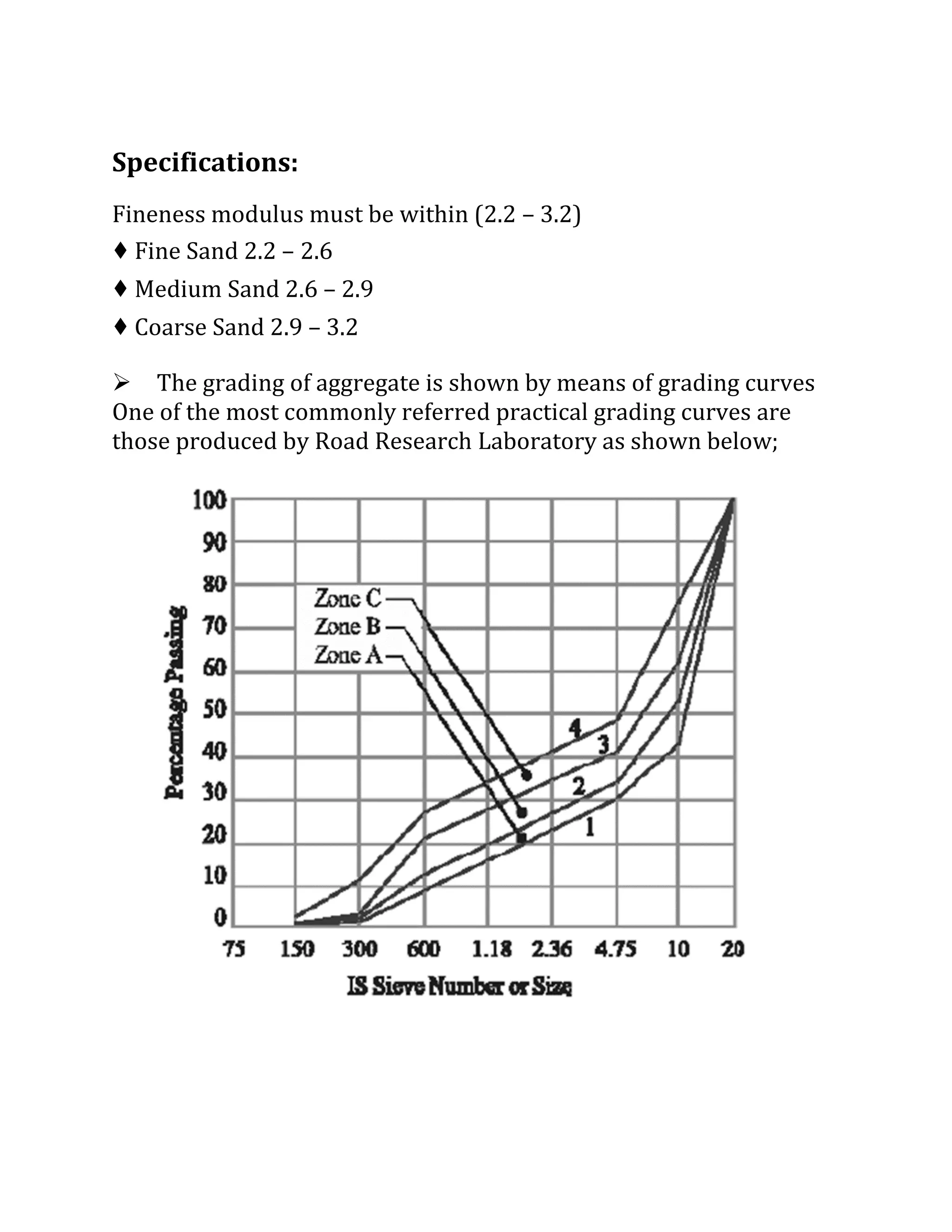
The grading of aggregate is shown by means of grading curves
One of the most commonly referred practical grading curves are
those produced by Road Research Laboratory as shown below;
Calculation:
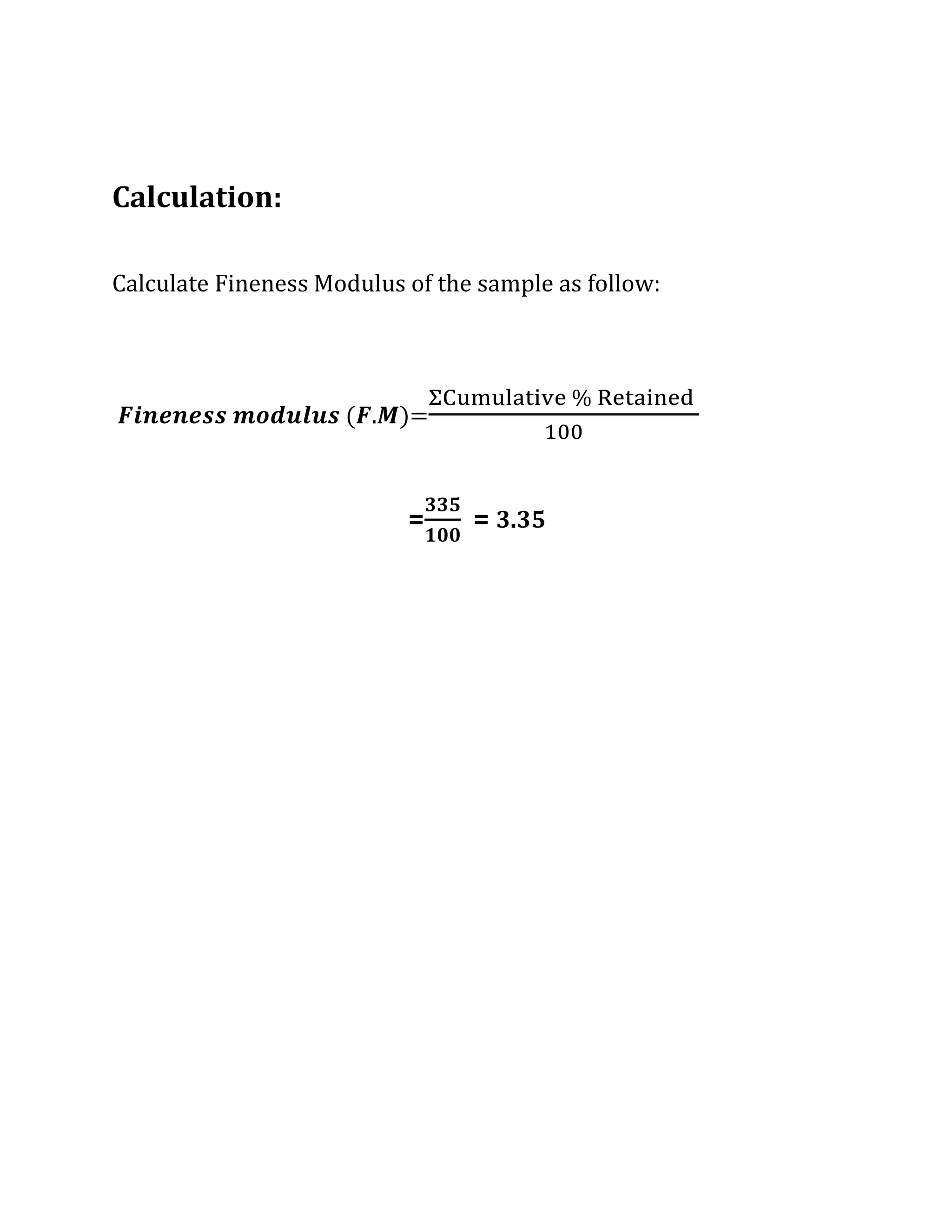
Calculate Fineness Modulus of the sample as follow:
𝑭𝒊𝒏𝒆𝒏𝒆𝒔𝒔 𝒎𝒐𝒅𝒖𝒍𝒖𝒔 (𝑭.𝑴)=
ΣCumulative % Retained
100
=
𝟑𝟑𝟓
𝟏𝟎𝟎
= 3.35
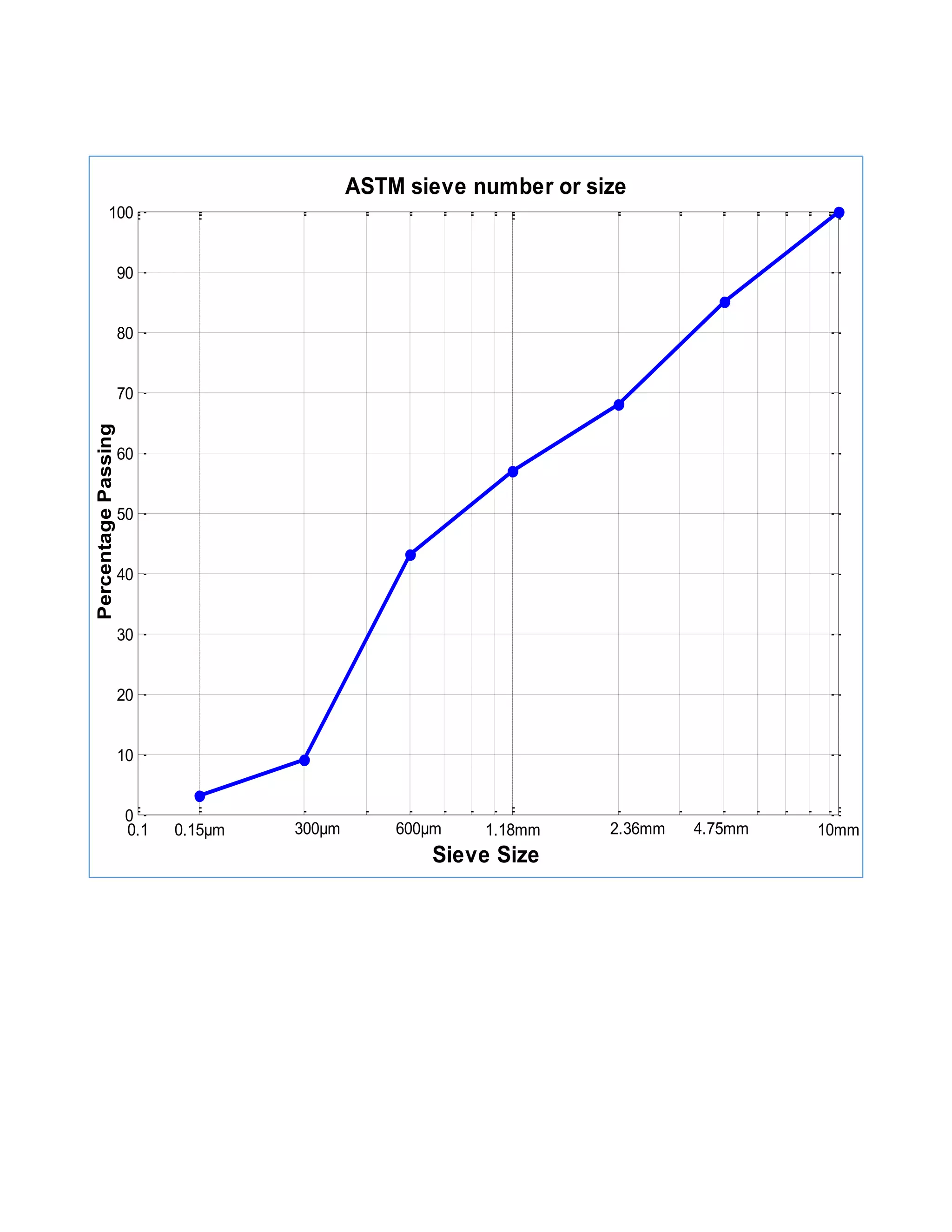
0.1 0.15µm 1.18mm 10mm
0
10
20
30
40
50
60
70
80
90
100
Sieve Size
PercentagePassing
ASTM sieve number or size
2.36mm 4.75mm600µm300µm
Discussion
A sieve analysis (or gradation test) is a practice or procedure
commonly used in civil engineering to assess the particle size
distribution of a granular material. Gradation of aggregates is
determined from sieve analysis, in which a representative sample of
aggregate is passed through a series of sieves in top to bottom and
the weight retained in each sieve – expressed as a percentage of the
sample weight – is compared with the grading limits specified.by this
test we calculate finesse modulus of our aggregate that define as
summing the cumulative percentage retained on the sieves and then
dividing by 100. The result is 3.35 so our aggregate is not according
to specification. It is important for the aggregate gradation to be
within certain gradation limits this is because the aggregate must be
well-graded, instead of gap-graded or uniform-graded When the
aggregate is gap-graded it may be missing a few sizes of aggregate.
during the test may have same errors for example when we use the
balance because balance usually have a small error in reading also
may be some amount of aggregate is on sieves before we start the test,
in conclusion Gradation is usually specified for each engineering
application it is used. For example, in foundations and all building
construction.

Gradation of fine aggregate by sieve analysis

  • 1.
    Koya University Faculty ofEngineering Civil Department - 2nd Stage Concrete Technology Test no: 5 Gradation of Fine Aggregate by Sieve Analysis Student Name: Muhammad Saleem Asaad Group: B Expr Date: 31-1-2016 Submission Date:14-2-2016
  • 2.
    Introduction This method coversthe determination of the particle size distribution of fine aggregate by sieving. Sieve analysis is the name given to the operation of dividing a sample of aggregate into various fractions, each consisting of particles of the same size. The sieve analysis is conducted to determine the particle size distribution in a sample of aggregate, which is called gradation. This test method is used primarily to determine the grading of materials proposed for use as aggregates or being used as aggregates. The results are used to determine compliance of the particle size distribution with applicable specification requirements and to provide necessary data for control of the production of various aggregate products and mixtures containing aggregates. The data may also be useful in developing relationships concerning porosity and packing. Accurate determination of material finer than the 75-μm (No. 200) sieve cannot be achieved by use of this test method alone.
  • 3.
    Apparatus: 1. Sieve set(9.5mm, 4.75mm, 2.36mm, 1.18mm, 600μm, 300μm, 150μm). 2. Mechanical Sieve Shaker. 3. Triple beam balance. 4. Brittle brush. 5. Oven.
  • 4.
    Test Procedure: Prepare asample of 3000g or more, put it in oven at (110 ̊C) and dry it to constant mass. Select sieves with suitable openings to furnish the information required by the specifications covering the material to be tested. Use additional sieves as desired or necessary to provide other information, such as fineness modulus, or to regulate the amount of material on a sieve. Determine the empty weight for each sieve and record in a table. Nest the sieve in descending order from top to bottom and place 1000g sample on the top sieve. Agitate (shake) the sieve by hand or by mechanical shaker for a sufficient period (10min.). (Prevent an overload of material on an individual sieve by splitting the sample into two or more portions, sieving each portion individually. Combine the masses of the several portions retained on a specific sieve before calculating the percentage of the sample on the sieve.) Open the set of sieve carefully so that no loosing of materials is expected. Weigh each sieve with the residue record its weight. Tabulate your data in a suitable shape. Make sure that the summation of the residue weights equals to the original sample weight with a difference not more than 1% of the original weight
  • 5.
    Specifications: Fineness modulus mustbe within (2.2 – 3.2) ♦ Fine Sand 2.2 – 2.6 ♦ Medium Sand 2.6 – 2.9 ♦ Coarse Sand 2.9 – 3.2  The grading of aggregate is shown by means of grading curves One of the most commonly referred practical grading curves are those produced by Road Research Laboratory as shown below;
  • 6.
    Calculation: Calculate Fineness Modulusof the sample as follow: 𝑭𝒊𝒏𝒆𝒏𝒆𝒔𝒔 𝒎𝒐𝒅𝒖𝒍𝒖𝒔 (𝑭.𝑴)= ΣCumulative % Retained 100 = 𝟑𝟑𝟓 𝟏𝟎𝟎 = 3.35
  • 7.
    0.1 0.15µm 1.18mm10mm 0 10 20 30 40 50 60 70 80 90 100 Sieve Size PercentagePassing ASTM sieve number or size 2.36mm 4.75mm600µm300µm
  • 8.
    Discussion A sieve analysis(or gradation test) is a practice or procedure commonly used in civil engineering to assess the particle size distribution of a granular material. Gradation of aggregates is determined from sieve analysis, in which a representative sample of aggregate is passed through a series of sieves in top to bottom and the weight retained in each sieve – expressed as a percentage of the sample weight – is compared with the grading limits specified.by this test we calculate finesse modulus of our aggregate that define as summing the cumulative percentage retained on the sieves and then dividing by 100. The result is 3.35 so our aggregate is not according to specification. It is important for the aggregate gradation to be within certain gradation limits this is because the aggregate must be well-graded, instead of gap-graded or uniform-graded When the aggregate is gap-graded it may be missing a few sizes of aggregate. during the test may have same errors for example when we use the balance because balance usually have a small error in reading also may be some amount of aggregate is on sieves before we start the test, in conclusion Gradation is usually specified for each engineering application it is used. For example, in foundations and all building construction.