

GEOTEXTILE
Md. Mehedi Hasan Riman
ID : 12132107012
Intake : 8th
BUBT
Department of Textile Engineering
• Tensile strength
• Elongation
• Impact strength
• Stress crack resistance
• Heat resistance
• Increased impact strength
• Increasing stiffness or hardness
• Increasing tensile strength
• Increasing modulus
• Increasing chemical resistance
Because of this wide variety, they can be applied in at least five
different ways:
1. Separation
Geotextiles will prevent two soil layers of different particle sizes from mixing with each other, as is illustrated the image
below.
2. Drainage
Geotextiles will efficiently collect superfluous water from structures, such as rainwater or surplus water, from the soil and
discharge it.
3. Filtration
Geotextiles are an ideal interface for reverse filtration in the soil adjacent to the geotextile. In all soils water allows fine
particles to be moved. Part of these particles will be halted at the filter interface; some will be halted within the filter itself
while the rest will pass into the drain. The complex needle-punched structure of the geotextile enables the retention of fine
particles without reducing the permeability of the drain.
4. Reinforcement
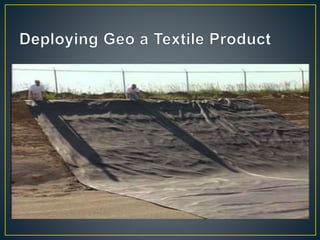
Heavy geotextiles can be used to reinforce earth structures by means of fill materials. Thanks to their high soil fabric friction
coefficient and high tensile strength, they are an ideal reinforcement solution.
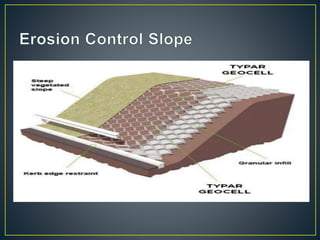
5. Protection
Geotextiles are an ideal protection from erosion of earth embankments by wave action, currents or repeated drawdown. A
layer of geotextiles can be placed so as to prevent leaching of fine material. They can be used for rock beaching or as
mattress structures. They can even easily be placed under water.
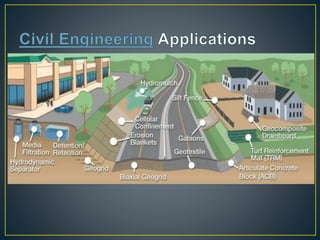
Geotextiles and related products have many applications and
currently support many civil engineering applications including
 Roads
 Airfields
 Railroads
 Embankments
 Retaining structures
 Reservoirs
 Canals
 Dams
 Bank protection
 Coastal engineering and
 Construction site silt fences or geotube ………
GEO TEXTILE
GEO TEXTILE
GEO TEXTILE
GEO TEXTILE
GEO TEXTILE

GEO TEXTILE

  • 1.
  • 2.
    Md. Mehedi HasanRiman ID : 12132107012 Intake : 8th BUBT Department of Textile Engineering
  • 8.
    • Tensile strength •Elongation • Impact strength • Stress crack resistance • Heat resistance • Increased impact strength • Increasing stiffness or hardness • Increasing tensile strength • Increasing modulus • Increasing chemical resistance
  • 9.
    Because of thiswide variety, they can be applied in at least five different ways: 1. Separation Geotextiles will prevent two soil layers of different particle sizes from mixing with each other, as is illustrated the image below. 2. Drainage Geotextiles will efficiently collect superfluous water from structures, such as rainwater or surplus water, from the soil and discharge it. 3. Filtration Geotextiles are an ideal interface for reverse filtration in the soil adjacent to the geotextile. In all soils water allows fine particles to be moved. Part of these particles will be halted at the filter interface; some will be halted within the filter itself while the rest will pass into the drain. The complex needle-punched structure of the geotextile enables the retention of fine particles without reducing the permeability of the drain. 4. Reinforcement Heavy geotextiles can be used to reinforce earth structures by means of fill materials. Thanks to their high soil fabric friction coefficient and high tensile strength, they are an ideal reinforcement solution. 5. Protection Geotextiles are an ideal protection from erosion of earth embankments by wave action, currents or repeated drawdown. A layer of geotextiles can be placed so as to prevent leaching of fine material. They can be used for rock beaching or as mattress structures. They can even easily be placed under water.
  • 10.
    Geotextiles and relatedproducts have many applications and currently support many civil engineering applications including  Roads  Airfields  Railroads  Embankments  Retaining structures  Reservoirs  Canals  Dams  Bank protection  Coastal engineering and  Construction site silt fences or geotube ………