Definitions of Abnormality
• Defining a person or behaviour as ‘abnormal’
  implies something undesirable and requiring
  change
• Therefore, we must be careful how we use the
  term
• Psychologists need methods for distinguishing
  ‘normal’ from ‘abnormal’
Definitions of Abnormality
Our definition of abnormality must be objective:
   – It must not depend on anyone’s opinion or point of view
   – It should produce the same results whoever applies it

It must not be under- or over-inclusive
    – It must not label as ‘abnormal’ or ‘normal’ behaviours or
      traits that aren’t
Definitions of Abnormality
You MUST have an understanding of the
following three definitions for the exam:
   1. Deviation from social norms
   2. Failure to function adequately
   3. Deviation from ideal mental health
You could have an understanding of the
following definition for the exam:
   • Statistical infrequency
Statistical Infrequency
• Under this definition, a person’s trait, thinking
  or behaviour is classified as abnormal if it is
  rare or statistically unusual.
• With this definition it is necessary to be clear
  about how rare a trait or behaviour needs to
  be before we class it as abnormal
Statistical Infrequency
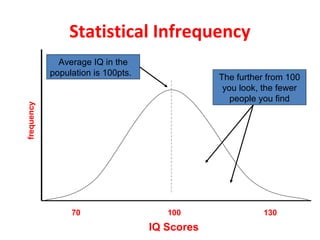
              Average IQ in the
            population is 100pts.               The further from 100
                                                 you look, the fewer
                                                   people you find
frequency


                 70                    100                 130
                                    IQ Scores
Statistical Infrequency
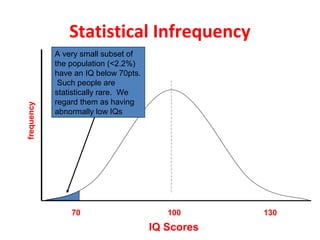
            A very small subset of
            the population (<2.2%)
            have an IQ below 70pts.
             Such people are
            statistically rare. We
            regard them as having
frequency


            abnormally low IQs


                70                       100      130
                                      IQ Scores
Deviation from Social Norms
• Under this definition, a person’s thinking or
  behaviour is classified as abnormal if it violates
  the (unwritten) rules about what is expected or
  acceptable behaviour in a particular social group.
• Their behaviour may:
   – Be incomprehensible to others
   – Make others feel threatened or uncomfortable
Deviation from Social Norms
• With this definition, it is necessary to
  consider:
  – The degree to which a norm is violated, the
    importance of that norm and the value attached
    by the social group to different sorts of violation.
  – E.g. is the violation rude, eccentric, abnormal or
    criminal?
Failure to Function Adequately
• Under this definition, a person is considered
  abnormal if they are unable to cope with the
  demands of everyday life.
• They may be unable to perform the
  behaviours necessary for day-to-day living e.g.
  self-care, hold down a job, interact
  meaningfully with others, make themselves
  understood etc.
Failure to Function Adequately
Rosenhan & Seligman (1989) suggest the following
characteristics:
  –   Suffering
  –   Maladaptiveness (danger to self)
  –   Vividness & unconventionality (stands out)
  –   Unpredictability & loss of control
  –   Irrationality/incomprehensibility
  –   Causes observer discomfort
  –   Violates moral/social standards
Deviation from Ideal Mental health
• Under this definition, rather than defining
  what is abnormal, we define what is
  normal/ideal and anything that deviates from
  this is regarded as abnormal
• This requires us to decide on the
  characteristics we consider necessary to
  mental health
Deviation from Ideal Mental Health

Psychologists vary, but usual characteristics
include:
  •   Positive view of the self
  •   Capability for growth and development
  •   Autonomy and independence
  •   Accurate perception of reality
  •   Positive friendships and relationships
  •   Environmental mastery – able to meet the varying
      demands of day-to-day situations

Slideshare version simple explanations of definitions

  • 1.
    Definitions of Abnormality •Defining a person or behaviour as ‘abnormal’ implies something undesirable and requiring change • Therefore, we must be careful how we use the term • Psychologists need methods for distinguishing ‘normal’ from ‘abnormal’
  • 2.
    Definitions of Abnormality Ourdefinition of abnormality must be objective: – It must not depend on anyone’s opinion or point of view – It should produce the same results whoever applies it It must not be under- or over-inclusive – It must not label as ‘abnormal’ or ‘normal’ behaviours or traits that aren’t
  • 3.
    Definitions of Abnormality YouMUST have an understanding of the following three definitions for the exam: 1. Deviation from social norms 2. Failure to function adequately 3. Deviation from ideal mental health You could have an understanding of the following definition for the exam: • Statistical infrequency
  • 4.
    Statistical Infrequency • Underthis definition, a person’s trait, thinking or behaviour is classified as abnormal if it is rare or statistically unusual. • With this definition it is necessary to be clear about how rare a trait or behaviour needs to be before we class it as abnormal
  • 5.
    Statistical Infrequency Average IQ in the population is 100pts. The further from 100 you look, the fewer people you find frequency 70 100 130 IQ Scores
  • 6.
    Statistical Infrequency A very small subset of the population (<2.2%) have an IQ below 70pts. Such people are statistically rare. We regard them as having frequency abnormally low IQs 70 100 130 IQ Scores
  • 7.
    Deviation from SocialNorms • Under this definition, a person’s thinking or behaviour is classified as abnormal if it violates the (unwritten) rules about what is expected or acceptable behaviour in a particular social group. • Their behaviour may: – Be incomprehensible to others – Make others feel threatened or uncomfortable
  • 8.
    Deviation from SocialNorms • With this definition, it is necessary to consider: – The degree to which a norm is violated, the importance of that norm and the value attached by the social group to different sorts of violation. – E.g. is the violation rude, eccentric, abnormal or criminal?
  • 9.
    Failure to FunctionAdequately • Under this definition, a person is considered abnormal if they are unable to cope with the demands of everyday life. • They may be unable to perform the behaviours necessary for day-to-day living e.g. self-care, hold down a job, interact meaningfully with others, make themselves understood etc.
  • 10.
    Failure to FunctionAdequately Rosenhan & Seligman (1989) suggest the following characteristics: – Suffering – Maladaptiveness (danger to self) – Vividness & unconventionality (stands out) – Unpredictability & loss of control – Irrationality/incomprehensibility – Causes observer discomfort – Violates moral/social standards
  • 11.
    Deviation from IdealMental health • Under this definition, rather than defining what is abnormal, we define what is normal/ideal and anything that deviates from this is regarded as abnormal • This requires us to decide on the characteristics we consider necessary to mental health
  • 12.
    Deviation from IdealMental Health Psychologists vary, but usual characteristics include: • Positive view of the self • Capability for growth and development • Autonomy and independence • Accurate perception of reality • Positive friendships and relationships • Environmental mastery – able to meet the varying demands of day-to-day situations