VLDL
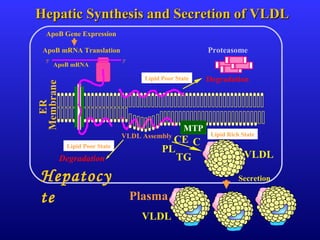
ApoB mRNA Translation
Degradation
ER
Membrane
5' 3'
ApoB mRNA
VLDL Assembly
Degradation
Secretion
MTP
Proteasome
Hepatic Synthesis and Secretion of VLDLHepatic Synthesis and Secretion of VLDL
Lipid Poor State
Lipid Rich State
Lipid Poor State
ApoB Gene Expression
VLDL
Plasma
Hepatocy
te
CE
PL
TG
C
Mechanisms of VLDL OverproductionMechanisms of VLDL Overproduction
in Insulin Resistance (Recent Progress)in Insulin Resistance (Recent Progress)
• Development of a Fructose-Fed Hamster Model of
Insulin Resistance
• Investigations into Mechanisms of Hepatic VLDL
Overproduction
• Investigations into Mechanisms of Intestinal
Lipoprotein Overproduction
• Assessment of the Efficacy of hypolipidemic
agents and insulin sensitizers in ameliorating
metabolic dyslipidemia
Insulin Resistance Model
Fructose-Fed Syrian Golden Hamster
• Lipoprotein metabolism closely resembles that in
humans
• Hamster liver secretes VLDL containing only
apoB100 with a density close to that of human VLDL
• Hamsters develop hyperTG, hyperCHOL, &
atherosclerosis in response to a modest increase in
dietary cholesterol & saturated fat
• Hamster can be made Obese, Hypertriglyceridemic,
Hyperinsulinemic, and Insulin Resistant by
carbohydrate feeding (particularly Fructose)
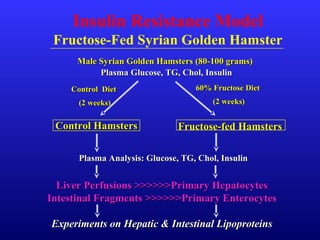
Male Syrian Golden Hamsters (80-100 grams)Male Syrian Golden Hamsters (80-100 grams)
60% Fructose Diet60% Fructose Diet
(2 weeks)(2 weeks)
Control HamstersControl Hamsters
Control DietControl Diet
(2 weeks)(2 weeks)
Fructose-fed HamstersFructose-fed Hamsters
Plasma Analysis: Glucose, TG, Chol, InsulinPlasma Analysis: Glucose, TG, Chol, Insulin
Liver Perfusions >>>>>>Primary HepatocytesLiver Perfusions >>>>>>Primary Hepatocytes
Intestinal Fragments >>>>>>Primary EnterocytesIntestinal Fragments >>>>>>Primary Enterocytes
Experiments on Hepatic & Intestinal LipoproteinsExperiments on Hepatic & Intestinal Lipoproteins
Plasma Glucose, TG, Chol, InsulinPlasma Glucose, TG, Chol, Insulin
Insulin Resistance Model
Fructose-Fed Syrian Golden Hamster
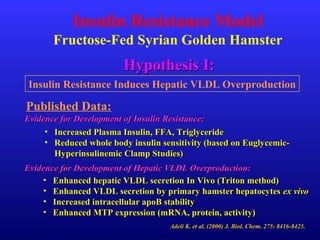
Evidence for Development of Insulin Resistance:Evidence for Development of Insulin Resistance:
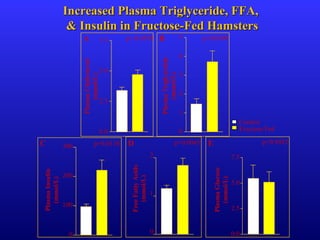
• Increased Plasma Insulin, FFA, TriglycerideIncreased Plasma Insulin, FFA, Triglyceride
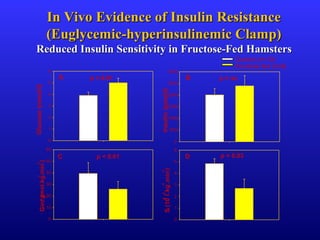
• Reduced whole body insulin sensitivity (based on Euglycemic-Reduced whole body insulin sensitivity (based on Euglycemic-
Hyperinsulinemic Clamp Studies)Hyperinsulinemic Clamp Studies)
Adeli K. et al. (2000) J. Biol. Chem. 275: 8416-8425.
Evidence for Development of Hepatic VLDL Overproduction:Evidence for Development of Hepatic VLDL Overproduction:
• Enhanced hepatic VLDL secretion In Vivo (Triton method)Enhanced hepatic VLDL secretion In Vivo (Triton method)
• Enhanced VLDL secretion by primary hamster hepatocytesEnhanced VLDL secretion by primary hamster hepatocytes ex vivoex vivo
• Increased intracellular apoB stabilityIncreased intracellular apoB stability
• Enhanced MTP expression (mRNA, protein, activity)Enhanced MTP expression (mRNA, protein, activity)
Insulin Resistance Model
Fructose-Fed Syrian Golden Hamster
Hypothesis I:Hypothesis I:
Insulin Resistance Induces Hepatic VLDL Overproduction
Published Data:
0
1
2
Control
Fructose-Fed
FreeFattyAcids
(mmol/L) p=0.0045
0
100
200
300 p=0.0110
PlasmaInsulin
(mmol/L)
0.0
2.5
5.0
7.5
p=0.9452
PlasmaGlucose
(mmol/L)
0
1
2
3
4
5 p=0.0309
PlasmaTriglyceride
(mmol/L)
p= 0.0550
0.0
2.5
5.0
7.5
PlasmaCholesterol
(mmol/L)
A B
C D E
Increased Plasma Triglyceride, FFA,Increased Plasma Triglyceride, FFA,
& Insulin in Fructose-Fed Hamsters& Insulin in Fructose-Fed Hamsters
Glucose(mmol/l)
0
1
2
3
4
5
6
Control (n=10)
Fructose fed (n=9)
Insulin(pmol/l)
0
500
1000
1500
2000
2500
3000
Ginf(µmol.kg
-1
.min
-1
)
0
10
20
30
40
50
60
SI(10
6
l
2
.kg
-1
.min
-1
)
0
1
2
3
4
5
6
p < 0.01
p < 0.01
p = ns
p = 0.03
A B
C D
In Vivo Evidence of Insulin ResistanceIn Vivo Evidence of Insulin Resistance
(Euglycemic-hyperinsulinemic Clamp)(Euglycemic-hyperinsulinemic Clamp)
Reduced Insulin Sensitivity in Fructose-Fed HamstersReduced Insulin Sensitivity in Fructose-Fed Hamsters
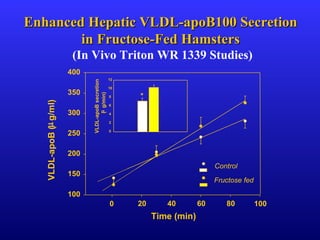
Enhanced Hepatic VLDL-apoB100 SecretionEnhanced Hepatic VLDL-apoB100 Secretion
in Fructose-Fed Hamstersin Fructose-Fed Hamsters
(In Vivo Triton WR 1339 Studies)
Time (min)
0 20 40 60 80 100
VLDL-apoB(µg/ml)
100
150
200
250
300
350
400
VLDL-apoBsecretion
(µg/min)
0
2
4
6
8
10
12
*
Control
Fructose fed
0
100
200
300
400
500
Fructose-FedControl
VLDLapoBSecreted
(%ofcontrol)
ApoB100
*
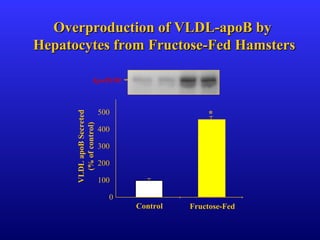
Overproduction of VLDL-apoB byOverproduction of VLDL-apoB by
Hepatocytes from Fructose-Fed HamstersHepatocytes from Fructose-Fed Hamsters
0
50
100
150
200
250
Control Fructose-Fed
MTPActivity
(PercentofControl)
P=0.042
0
5
10
15
20
Control
MTPRNA
P<0.02
0
50
100
200
250
MTPProteinMass
(percentofcontrol)
150
Fructose-Fed
P=0.011
Control
Fructose-Fed
totalRNA/µgpg)(
Protein Mass
mRNA Lipid Transfer Activity
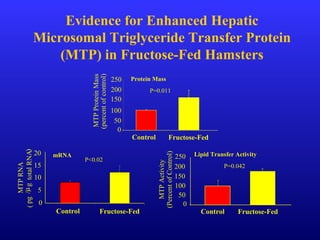
Evidence for Enhanced Hepatic
Microsomal Triglyceride Transfer Protein
(MTP) in Fructose-Fed Hamsters
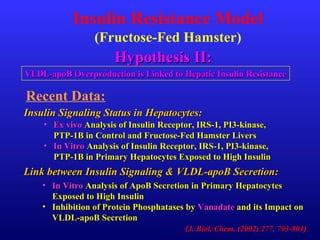
Insulin Signaling Status in Hepatocytes:Insulin Signaling Status in Hepatocytes:
• Ex vivoEx vivo Analysis of Insulin Receptor, IRS-1, PI3-kinase,Analysis of Insulin Receptor, IRS-1, PI3-kinase,
PTP-1B in Control and Fructose-Fed Hamster LiversPTP-1B in Control and Fructose-Fed Hamster Livers
• In VitroIn Vitro Analysis of Insulin Receptor, IRS-1, PI3-kinase,Analysis of Insulin Receptor, IRS-1, PI3-kinase,
PTP-1B in Primary Hepatocytes Exposed to High InsulinPTP-1B in Primary Hepatocytes Exposed to High Insulin
Link between Insulin Signaling & VLDL-apoB Secretion:Link between Insulin Signaling & VLDL-apoB Secretion:
• In VitroIn Vitro Analysis of ApoB Secretion in Primary HepatocytesAnalysis of ApoB Secretion in Primary Hepatocytes
Exposed to High InsulinExposed to High Insulin
• Inhibition of Protein Phosphatases byInhibition of Protein Phosphatases by VanadateVanadate and its Impact onand its Impact on
VLDL-apoB SecretionVLDL-apoB Secretion
(J. Biol. Chem. (2002) 277, 793-803)
Hypothesis II:Hypothesis II:
VLDL-apoB Overproduction is Linked to Hepatic Insulin ResistanceVLDL-apoB Overproduction is Linked to Hepatic Insulin Resistance
Insulin Resistance Model
(Fructose-Fed Hamster)
Recent Data:
Y
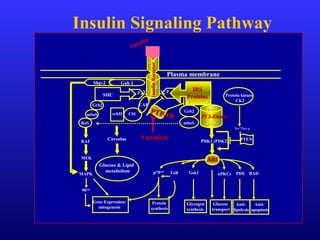
Insulin Signaling Pathway
Insulin
InsulinReceptorInsulinReceptor
αα
ββ
Y PP
IRSIRS
ProteinsProteinsSHC
Grb2
mSoS
Grb2
mSoS
RaS
p85p85
p110p110
PI 3-KinasePI 3-Kinase
PDK1 (PDK2)
AktAkt
PTP-1B
PTP-1B
PP PP
PTEN
aPKCs PDE BAD
Anti-
apoptosis
Anti-
lipolysis
Glucose
transport
Gsk3ToRp70rak
Glycogen
synthesis
Protein
synthesis
RAF
MEK
MAPK
Gene Expression/
mitogenesis
90rak
Plasma membrane
Protein kinase
CK2
Ser/Ther-p
CAP
CblcrkII
Caveolae
Glucose & Lipid
metabolism
Gab 1Shp-2
VanadateVanadate

Slides920

  • 1.
    VLDL ApoB mRNA Translation Degradation ER Membrane 5'3' ApoB mRNA VLDL Assembly Degradation Secretion MTP Proteasome Hepatic Synthesis and Secretion of VLDLHepatic Synthesis and Secretion of VLDL Lipid Poor State Lipid Rich State Lipid Poor State ApoB Gene Expression VLDL Plasma Hepatocy te CE PL TG C
  • 2.
    Mechanisms of VLDLOverproductionMechanisms of VLDL Overproduction in Insulin Resistance (Recent Progress)in Insulin Resistance (Recent Progress) • Development of a Fructose-Fed Hamster Model of Insulin Resistance • Investigations into Mechanisms of Hepatic VLDL Overproduction • Investigations into Mechanisms of Intestinal Lipoprotein Overproduction • Assessment of the Efficacy of hypolipidemic agents and insulin sensitizers in ameliorating metabolic dyslipidemia
  • 3.
    Insulin Resistance Model Fructose-FedSyrian Golden Hamster • Lipoprotein metabolism closely resembles that in humans • Hamster liver secretes VLDL containing only apoB100 with a density close to that of human VLDL • Hamsters develop hyperTG, hyperCHOL, & atherosclerosis in response to a modest increase in dietary cholesterol & saturated fat • Hamster can be made Obese, Hypertriglyceridemic, Hyperinsulinemic, and Insulin Resistant by carbohydrate feeding (particularly Fructose)
  • 4.
    Male Syrian GoldenHamsters (80-100 grams)Male Syrian Golden Hamsters (80-100 grams) 60% Fructose Diet60% Fructose Diet (2 weeks)(2 weeks) Control HamstersControl Hamsters Control DietControl Diet (2 weeks)(2 weeks) Fructose-fed HamstersFructose-fed Hamsters Plasma Analysis: Glucose, TG, Chol, InsulinPlasma Analysis: Glucose, TG, Chol, Insulin Liver Perfusions >>>>>>Primary HepatocytesLiver Perfusions >>>>>>Primary Hepatocytes Intestinal Fragments >>>>>>Primary EnterocytesIntestinal Fragments >>>>>>Primary Enterocytes Experiments on Hepatic & Intestinal LipoproteinsExperiments on Hepatic & Intestinal Lipoproteins Plasma Glucose, TG, Chol, InsulinPlasma Glucose, TG, Chol, Insulin Insulin Resistance Model Fructose-Fed Syrian Golden Hamster
  • 5.
    Evidence for Developmentof Insulin Resistance:Evidence for Development of Insulin Resistance: • Increased Plasma Insulin, FFA, TriglycerideIncreased Plasma Insulin, FFA, Triglyceride • Reduced whole body insulin sensitivity (based on Euglycemic-Reduced whole body insulin sensitivity (based on Euglycemic- Hyperinsulinemic Clamp Studies)Hyperinsulinemic Clamp Studies) Adeli K. et al. (2000) J. Biol. Chem. 275: 8416-8425. Evidence for Development of Hepatic VLDL Overproduction:Evidence for Development of Hepatic VLDL Overproduction: • Enhanced hepatic VLDL secretion In Vivo (Triton method)Enhanced hepatic VLDL secretion In Vivo (Triton method) • Enhanced VLDL secretion by primary hamster hepatocytesEnhanced VLDL secretion by primary hamster hepatocytes ex vivoex vivo • Increased intracellular apoB stabilityIncreased intracellular apoB stability • Enhanced MTP expression (mRNA, protein, activity)Enhanced MTP expression (mRNA, protein, activity) Insulin Resistance Model Fructose-Fed Syrian Golden Hamster Hypothesis I:Hypothesis I: Insulin Resistance Induces Hepatic VLDL Overproduction Published Data:
  • 6.
    0 1 2 Control Fructose-Fed FreeFattyAcids (mmol/L) p=0.0045 0 100 200 300 p=0.0110 PlasmaInsulin (mmol/L) 0.0 2.5 5.0 7.5 p=0.9452 PlasmaGlucose (mmol/L) 0 1 2 3 4 5p=0.0309 PlasmaTriglyceride (mmol/L) p= 0.0550 0.0 2.5 5.0 7.5 PlasmaCholesterol (mmol/L) A B C D E Increased Plasma Triglyceride, FFA,Increased Plasma Triglyceride, FFA, & Insulin in Fructose-Fed Hamsters& Insulin in Fructose-Fed Hamsters
  • 7.
    Glucose(mmol/l) 0 1 2 3 4 5 6 Control (n=10) Fructose fed(n=9) Insulin(pmol/l) 0 500 1000 1500 2000 2500 3000 Ginf(µmol.kg -1 .min -1 ) 0 10 20 30 40 50 60 SI(10 6 l 2 .kg -1 .min -1 ) 0 1 2 3 4 5 6 p < 0.01 p < 0.01 p = ns p = 0.03 A B C D In Vivo Evidence of Insulin ResistanceIn Vivo Evidence of Insulin Resistance (Euglycemic-hyperinsulinemic Clamp)(Euglycemic-hyperinsulinemic Clamp) Reduced Insulin Sensitivity in Fructose-Fed HamstersReduced Insulin Sensitivity in Fructose-Fed Hamsters
  • 8.
    Enhanced Hepatic VLDL-apoB100SecretionEnhanced Hepatic VLDL-apoB100 Secretion in Fructose-Fed Hamstersin Fructose-Fed Hamsters (In Vivo Triton WR 1339 Studies) Time (min) 0 20 40 60 80 100 VLDL-apoB(µg/ml) 100 150 200 250 300 350 400 VLDL-apoBsecretion (µg/min) 0 2 4 6 8 10 12 * Control Fructose fed
  • 9.
    0 100 200 300 400 500 Fructose-FedControl VLDLapoBSecreted (%ofcontrol) ApoB100 * Overproduction of VLDL-apoBbyOverproduction of VLDL-apoB by Hepatocytes from Fructose-Fed HamstersHepatocytes from Fructose-Fed Hamsters
  • 10.
  • 11.
    Insulin Signaling Statusin Hepatocytes:Insulin Signaling Status in Hepatocytes: • Ex vivoEx vivo Analysis of Insulin Receptor, IRS-1, PI3-kinase,Analysis of Insulin Receptor, IRS-1, PI3-kinase, PTP-1B in Control and Fructose-Fed Hamster LiversPTP-1B in Control and Fructose-Fed Hamster Livers • In VitroIn Vitro Analysis of Insulin Receptor, IRS-1, PI3-kinase,Analysis of Insulin Receptor, IRS-1, PI3-kinase, PTP-1B in Primary Hepatocytes Exposed to High InsulinPTP-1B in Primary Hepatocytes Exposed to High Insulin Link between Insulin Signaling & VLDL-apoB Secretion:Link between Insulin Signaling & VLDL-apoB Secretion: • In VitroIn Vitro Analysis of ApoB Secretion in Primary HepatocytesAnalysis of ApoB Secretion in Primary Hepatocytes Exposed to High InsulinExposed to High Insulin • Inhibition of Protein Phosphatases byInhibition of Protein Phosphatases by VanadateVanadate and its Impact onand its Impact on VLDL-apoB SecretionVLDL-apoB Secretion (J. Biol. Chem. (2002) 277, 793-803) Hypothesis II:Hypothesis II: VLDL-apoB Overproduction is Linked to Hepatic Insulin ResistanceVLDL-apoB Overproduction is Linked to Hepatic Insulin Resistance Insulin Resistance Model (Fructose-Fed Hamster) Recent Data:
  • 12.
    Y Insulin Signaling Pathway Insulin InsulinReceptorInsulinReceptor αα ββ YPP IRSIRS ProteinsProteinsSHC Grb2 mSoS Grb2 mSoS RaS p85p85 p110p110 PI 3-KinasePI 3-Kinase PDK1 (PDK2) AktAkt PTP-1B PTP-1B PP PP PTEN aPKCs PDE BAD Anti- apoptosis Anti- lipolysis Glucose transport Gsk3ToRp70rak Glycogen synthesis Protein synthesis RAF MEK MAPK Gene Expression/ mitogenesis 90rak Plasma membrane Protein kinase CK2 Ser/Ther-p CAP CblcrkII Caveolae Glucose & Lipid metabolism Gab 1Shp-2 VanadateVanadate