ARTICLE
Downregulation of Sfrp5 promotes beta cell proliferation
during obesity in the rat
Sandra A. Rebuffat & Joana M. Oliveira & Jordi Altirriba &
Nuria Palau & Ainhoa Garcia & Yaiza Esteban &
Belen Nadal & Ramon Gomis
Received: 3 April 2013 /Accepted: 25 July 2013 /Published online: 5 September 2013
# Springer-Verlag Berlin Heidelberg 2013
Abstract
Aims/hypothesis During obesity, the increment in beta
cell mass in response to the rising demand for insulin
is essential to maintain normal glucose homeostasis.
However, the precise cellular and molecular mechanisms
involved in beta cell mass plasticity remain poorly un-
derstood. The Wnt signalling pathway has been sug-
gested as one possible modulator of beta cell prolifera-
tion, which represents the principal process involved in
beta cell mass expansion. Here, we sought to determine
the mechanisms involved in beta cell mass proliferation
using diet-induced obese rats.
Methods Wistar rats aged 8 weeks old were fed a standard or
cafeteria diet. Global transcriptomic analysis of pancreatic rat
islets was performed using microarray analysis. Genetic loss-
of-function approaches were performed in dispersed primary
rat islets and the beta cell line INS1E. Gene expression was
measured by real-time PCR, protein levels by immunoblot
analysis, proliferation rates by ELISA and apoptosis by flow
cytometry.
Results Sfrp5, coding for secreted frizzled-related protein 5, is
downregulated in the pancreatic islets of cafeteria-diet-fed rats
as well as in the pancreatic islets of human obese patients. We
demonstrate that silencing Sfrp5 increases beta cell prolifera-
tion, which correlates with activation of Wnt signalling and
enhanced levels of proliferation markers. In addition, we show
that expression of Sfrp5 in beta cells is modulated by IGF
binding protein 3 (IGFBP3) secreted from visceral adipose
tissue.
Conclusions/interpretation Together, these findings reveal an
important role for SFRP5 and Wnt signalling in the regulation
of beta cell proliferation in obesity.
Keywords IGF binding protein 3 . Obesity . Pancreatic beta
cells . Proliferation . Secreted frizzled-related protein 5 . Wnt
signalling pathway
Abbreviations
CAF Cafeteria diet
IDIBAPS Institut d’Investigacions Biomèdiques August
Pi i Sunyer
IGFBP3 IGF binding protein 3
MAPK Mitogen-activated protein kinase p44/42
PCNA Proliferating cell nuclear antigen
PI3K Phosphatidylinositide 3-kinase
SFRP5 Secreted frizzled-related protein 5
Si Small interfering
STD Standard chow diet
TCF7L2 Transcription factor 7-like 2
WAT White adipose tissue
Electronic supplementary material The online version of this article
(doi:10.1007/s00125-013-3030-x) contains peer-reviewed but unedited
supplementary material, which is available to authorised users.
S. A. Rebuffat :J. M. Oliveira :J. Altirriba :N. Palau :A. Garcia :
Y. Esteban :B. Nadal :R. Gomis (*)
Diabetes and Obesity Research Laboratory, Institut d’Investigacions
Biomèdiques August Pi i Sunyer (IDIBAPS), c/Rosselló, 149–153,
08036 Barcelona, Spain
e-mail: rgomis@clinic.ub.es
S. A. Rebuffat :J. M. Oliveira :J. Altirriba :N. Palau :A. Garcia :
Y. Esteban :B. Nadal :R. Gomis
Centro de Investigación Biomédica en Red de Diabetes y
Enfermedades Metabólicas Asociadas (CIBERDEM), Spain
URL: www.ciberdem.org/
B. Nadal :R. Gomis
Universitat de Barcelona, Barcelona, Spain
R. Gomis
Department of Endocrinology and Nutrition,
Hospital Clinic de Barcelona, Barcelona, Spain
Diabetologia (2013) 56:2446–2455
DOI 10.1007/s00125-013-3030-x
Introduction
Obesity has reached epidemic proportions in western civilisa-
tion and is a predisposing factor for metabolic disorders, such
as type 2 diabetes [1, 2]. There is growing evidence suggesting
that adipose tissue influences pancreatic beta cell mass plas-
ticity, which is the capacity of the beta cell to flexibly adapt its
mass to increased insulin demands [3]. Several mechanisms
have been implicated in adult beta cell mass expansion, with
the proliferation of differentiated beta cells proving to be the
most important one, at least in rodents [4–6]. However, the
factors and mechanisms regulating the proliferation of pan-
creatic beta cells remain to be fully clarified.
Wnt signalling is critically important for organogenesis and
for the determination of cell fate. The transcription factor
7-like 2 (TCF7L2)-dependent Wnt signalling pathway (ca-
nonical pathway) is involved in pancreas development, islet
function and insulin production and secretion [7–9]. Recent
work has also suggested the participation of Wnt signalling in
beta cell proliferation [10]. Canonical Wnt signalling starts
with the binding of Wnt proteins to the frizzled receptors,
which allows the activation of β-catenin and its translocation
into the nucleus, where it interacts with transcription factors,
such as TCF7L2, to regulate the expression of several genes
[11]. The activity of Wnt signalling is often inhibited by
different modulators, such as dickkopfs, Wnt inhibitory factor
1 (WIF1) and secreted frizzled-related proteins (SFRPs). Of
these, SFRPs sequester Wnt proteins in the extracellular space
and prevent them from binding to their receptors. SFRPs have
been extensively studied in the context of cancer [11, 12] and,
more recently, in the context of adipose tissue [13]. Several
reports have implicated members of the SFRP family, includ-
ing SFRP5, in adipocyte dysfunction during obesity. For
instance, Sfrp5 was reported as highly induced in white adi-
pose tissue (WAT) during genetic and/or diet-induced obesity,
whereas others studies described the suppression of Sfrp5
under these conditions [14, 15]. In contrast, recent findings
suggest that SFRP5 is neither regulated by obesity nor active-
ly secreted from human WAT [13]. At any rate, little is known
about the role of SFRP5 in the control of Wnt signalling in
pancreatic beta cells. Only one recent study reported another
SFRP gene, SFRP4, as overexpressed in pancreatic islets
taken from type 2 diabetic patients, but the authors did not
find any changes in SFRP5 [16].
In the present study, we explored the mechanisms involved
in beta cell proliferation in the context of obesity by using a
diet-induced obese model, namely, rats fed a cafeteria diet
(CAF). As previously described, this model presents an incre-
ment in beta cell mass, which is partly ascribed to increased
beta cell proliferation [17]. By analysing global gene expres-
sion, we identified the downregulation of Sfrp5 in pancreatic
islets from CAF-fed rats relative to rats fed standard chow.
Our results show that SFRP5 knockdown promotes beta cell
proliferation, which we correlated with activation of the ca-
nonical Wnt signalling pathway. Thus, our study demonstrates
an important role for SFRP5 in pancreatic islets and provides a
link between SFRP5 and beta cell proliferation during expan-
sion of beta cell mass in obesity.
Methods
Animals The principles of laboratory animal care were
followed (European and local government guidelines), and
protocols were approved by the Animal Research Committee
of the University of Barcelona (Barcelona, Spain). Seven-
week-old male Wistar rats, Zucker rats and ob/ob mice were
purchased from Charles River (Wilmington, MA, USA).
Wistar rats were caged individually and divided into two
dietary sets: one group was fed with a CAF as previously
described, while another group was fed with standard chow
diet (STD) [17, 18]. The diet was fed for 30 days unless
otherwise stated. The animals were allowed to eat and drink
ad libitum. At the end of the experiment, animals were
anaesthetised and killed by decapitation.
Pancreatic islet isolation Pancreatic islets were isolated from
STD- and CAF-fed rats, Zucker rats and ob/ob mice by
collagenase digestion [19]. Briefly, pancreases were digested
with collagenase (Roche, Basel, Switzerland) and islets were
purified from exocrine tissue with Histopaque density gradi-
ents (Sigma-Aldrich, St Louis, MO, USA). Islets were
handpicked under a stereomicroscope and kept frozen at
−80°C until used. Pancreatic human islets were purified from
cadaver organ donors (four obese donors and six non-obese
donors) from the Transplant Services Foundation of the Hos-
pital Clinic (Barcelona, Spain) and kept at the Biobank of the
Hospital Clinic-Institut d’Investigations Biomediques August
Pi i Sunyer ([IDIBAPS], Barcelona, Spain), following in-
formed consent from donors’ families and approval by the
hospital’s ethics committee. Human islets were isolated as
previously described [20]. Inclusion criteria were 50–60 years
of age with BMI>35 kg/m2
for obese and BMI<25 kg/m2
for
non-obese donors.
RNA isolation Total RNA was extracted from frozen islets,
transfected INS1E beta cells and dispersed cells from islets
using the RNeasy MiniKit (Qiagen, Hilden, Germany),
according to the manufacturer’s instructions. RNA integrity
was analysed using a Lab-On-A-Chip in a 2100 Bioanalyzer
(Agilent Technologies, Santa Clara, CA, USA).
Global transcriptomic analysis Total RNAwas obtained from
islets of rats fed the STD or CAF for 10 and 30 days (four to
five animals per group). Total RNA, 10 μg, was converted
into cRNA, biotinylated, fragmented and hybridised to
Diabetologia (2013) 56:2446–2455 2447
GeneChip Rat Genome 230 2.0 (Affymetrix, Santa Clara, CA,
USA). Background adjustment, normalisation and data
summarisation of raw data were performed by MAS5.0 algo-
rithm using the Simpleaffy package [21] from bioconductor
[22] on R language [23]. Samples from 10 and 30 days of diet
were analysed separately. Raw and processed data successful-
ly passed several quality controls as described previously [17].
In order to increase the sensitivity of the analysis and reduce
background noise, those genes that were called absent (calcu-
lated with the MAS5.0 algorithm from the Simpleaffy pack-
age [21]) in at least two microarrays using both experimental
groups (STD- and CAF-fed groups) were removed. Differen-
tially expressed genes were considered when presenting fold
change >1.5 or <−1.5 and Student’s t test p value ≤0.05 in
both comparisons (STD 10 days vs CAF 10 days and STD
30 days vs CAF 30 days). Raw and processed data were
deposited in the GEO database with the accession number
GSE44047.
Real-time PCR Total RNA was retrotranscribed with Super-
script III (Invitrogen, Carlsbad, CA, USA). Real-time PCR
was carried out in a 7900 HT Real Time System (Applied
Biosystems, Foster City, CA, USA) using a SYBR Green
fluorophore. A standard curve of each primer set (rat, human
and mouse Sfrp5 primers from Super Array Biosciences,
Qiagen) was generated from serial dilutions of cDNA. Ex-
pression levels obtained were normalised with a housekeeping
gene (TATA box binding protein, Tbp).
Rat Wnt signalling pathway The Rat WNT Signalling Path-
way RT2
Profiler PCR Array (Qiagen) targets 84 genes related
to WNT-mediated signal transduction. Total RNA isolated
from islets from either CAF- or STD-fed rats was reverse-
transcribed into cDNA using the RT2
First Strand Kit
(Qiagen), mixed with RT2
qPCR Mastermix containing
SYBR Green (Qiagen), and aliquoted in equal volumes to
each well of the real-time PCR arrays. The real-time PCR
cycling program was run on a Roche Light Cycler 480. The
threshold cycle (Ct) of each gene was determined and subse-
quently analysed by RT2
Profiler PCR Array Data Analysis
software (http://pcrdataanalysis.sabiosciences.com/pcr/
arrayanalysis.php). Expression profiles were obtained from
four independent experiments.
Preparation of dispersed islet cells Handpicked islets isolated
from STD-fed rats were transferred to Petri dishes and pre-
cultured overnight in RPMI 1640 medium (Gibco-BRL, Pais-
ley, UK) containing 11.1 mmol/l glucose and supplemented
with 10% FBS (vol./vol.), 2 mmol/l L-glutamine, 100 U/ml
penicillin, and 100 μg/ml streptomycin at 37°C with 5% CO2.
The protocol for the isolation of single islet cells has been
published previously [24]. Islets were digested in PBS con-
taining 0.125 mg/ml trypsin and 0.05 mg/ml EDTA (Gibco-
BRL) at 37°C and for an additional 5 min on ice to allow islets
to sediment. The cell suspension was cycled for 5 min. Then,
the supernatant fraction containing the single cells was re-
moved and placed in 1 ml FBS (Gibco-BRL). To obtain
additional single islet cells, the digestion process was repeated
a maximum of four times. Once obtained, single islet cells
were cultured in RPMI 1640 medium supplemented as de-
tailed before but containing 5.5 mmol/l glucose.
INS1E cells culture INS1E cells were maintained in RPMI
1640 containing 5.5 mmol/l glucose and supplemented with
10% FBS (vol./vol.), 1 mmol/l sodium pyruvate, 50 μmol/l 2-
mercaptoethanol, 2 mmol/l glutamine, 10 mmol/l HEPES,
100 U/ml penicillin, 100 μg/ml streptomycin and 0.1% BSA
(Sigma-Aldrich). For stimulation experiments, cells were cul-
tured on microplates for 24 h in a culture medium containing:
(1) an aliquot of peripancreatic adipose tissue secretome
(diluted 1:3 in INS1E cell medium); (2) IGF binding protein
3 (IGFBP3) antibody (Santa Cruz Biotechnology, Santa Cruz,
CA, USA) added to the culture medium at 0.1 and 10 μg/ml;
and (3) IGFBP3 protein (R&D Systems, Minneapolis, MN,
USA) added to the culture medium at 0.5 μg/ml and 10 μg/ml.
Peripancreatic adipose tissue secretome was prepared as pre-
viously described [17, 25].
Small interfering RNA transfection INS1E cells and single rat
islet cells were grown on tissue culture test plates in the media
previously described. Cells were transfected using
Metafectene Pro (Biontex, Martinsried, Germany) at a 1/2
(wt/vol.) ratio with Sfrp5 small interfering (si)RNA (silencer
select siRNA) or negative control siRNA (Ambion, Austin,
TX, USA), according to the manufacturer’s protocol. RNA
and protein were extracted at 48 h for INS1E cells and 72 h for
single islet cells, after transfection. The efficiency of Sfrp5
silencing was examined by real-time PCR using Sfrp5 primer
set (Qiagen), and by western blot analysis using primary
antibodies against SFRP5 (1:50, Santa Cruz Biotechnology,
Santa Cruz, CA, USA) and actin (1:1,000; Sigma-Aldrich).
Immunofluorescence Experiments were performed using pri-
mary antibodies against SFRP5 (1:50; Abcam, Cambridge,
UK and 1:50; Santa Cruz Biotechnology), insulin and glucagon
(1:500; Dako, Glostrup, Denmark). Anti-rabbit-phycoerythrin,
anti-guinea pig-Cy2, anti-goat-Cy3 (1:500, Santa Cruz Bio-
technology)-conjugated, and aminomethylcoumarin acetate
(AMCA) anti-guinea pig (1:200; Jackson ImmunoResearch,
Newmarket, UK) antibodies were used as secondary antibod-
ies. Fluorescence images were analysed with a Leica confocal
scanning laser microscope (Leica Microsystems, Wetzlar,
Germany).
Proliferation and cell growth assays The proliferation of
INS1E and dispersed islet cells was assessed at 48 h
2448 Diabetologia (2013) 56:2446–2455
(INS1E) or 72 h (single islets cells) following siRNA trans-
fection, using the cell BrdU Proliferation Kit (Roche) and
following the manufacturer’s protocol. BrdU was added over
24 h. Irrelevant IgG (Dako), SFRP5 antibody (Abcam) and
IGFBP3 antibody (Santa Cruz Biotechnology) were added to
the media at 0.1 μg/ml. SFRP5 recombinant protein (R&D
Systems) was added to the media at 0.1 μg/ml. Cell growth
was measured by cell counting. Briefly, 150×103
INS1E cells
were plated on 12-well tissue culture plates, transfected with
siRNAs as previously described and counted in a Countess
automated cell counter (Invitrogen) 48 h after transfection.
Protein extraction and western blot Islets and transfected
cells were homogenised in lysis buffer containing 50 mmol/l
Tris–HCl, pH 7.3, 150 mmol/l NaCl, 5 mmol/l EDTA, 10%
glycerol, 1% Triton X-100 and protease inhibitors (Roche).
Homogenates were subjected to two freeze–thaw cycles. After
centrifugation, supernatant fractions were recovered and kept
at −80°C. Protein concentrations were determined with the
BCA protein assay (Pierce). Proteins were separated by SDS-
PAGE and transferred to polyvinylidene difluoride (PVDF)
membranes using standard protocols. The membranes were
blocked for 1 h in PBS containing 0.05% Tween-20 and 5%
skimmed milk. They were then incubated overnight at 4°C
with antibodies against SFRP5 (1:500; Santa Cruz Biotech-
nology), dephosphorylated β-catenin (1:1,000; Millipore,
Bedford, MA, USA), β-catenin (1:1,000; Cell Signaling,
Beverly, MA, USA), Akt and proliferating cell nuclear antigen
(PCNA) (1:500 and 1:1,000, respectively; Santa Cruz Biotech-
nology), cleaved caspase 3, mitogen-activated protein kinase
p44/42 (MAPK), phospho-MAPK, phospho-Akt and
phosphatidylinositide 3-kinase (PI3K) (1:1,000; Cell Signaling),
TCF7L2 (1:5,000; Abcam) and actin (1:1,000; Sigma-Aldrich).
Horseradish peroxidase-conjugated anti-rabbit and anti-mouse
antibodies were used as secondary antibodies (1:2,000;
Amersham, Biosciences, Buckinghamshire, UK). The complex
was visualised with enhanced chemiluminescence (ECL,
Amersham Biosciences) on a Luminescent Image Analyzer
(Image Quant LAS 4000). Intensity values were obtained with
Image J software, version 1.47 (http://rsbweb.nih.gov/ij/).
Statistical analysis All data are expressed as means ± SEM.
Differences were analysed by Student’s paired or unpaired
t test. A value of p<0.05 was accepted as statistically
significant.
Results
Sfrp5 is downregulated in pancreatic islets from obese rodents
and humans In order to investigate the molecular mecha-
nisms altered in pancreatic islets during the development of
obesity, we compared the islet transcriptome of CAF- and
STD-fed rats. Among the differentially expressed genes, we
identified the gene encoding SFRP5, which was
downregulated in CAF-fed relative to STD-fed rat islets (elec-
tronic supplementary material [ESM] Table 1). Decreased
SFRP5 expression in CAF-fed islets was confirmed at both
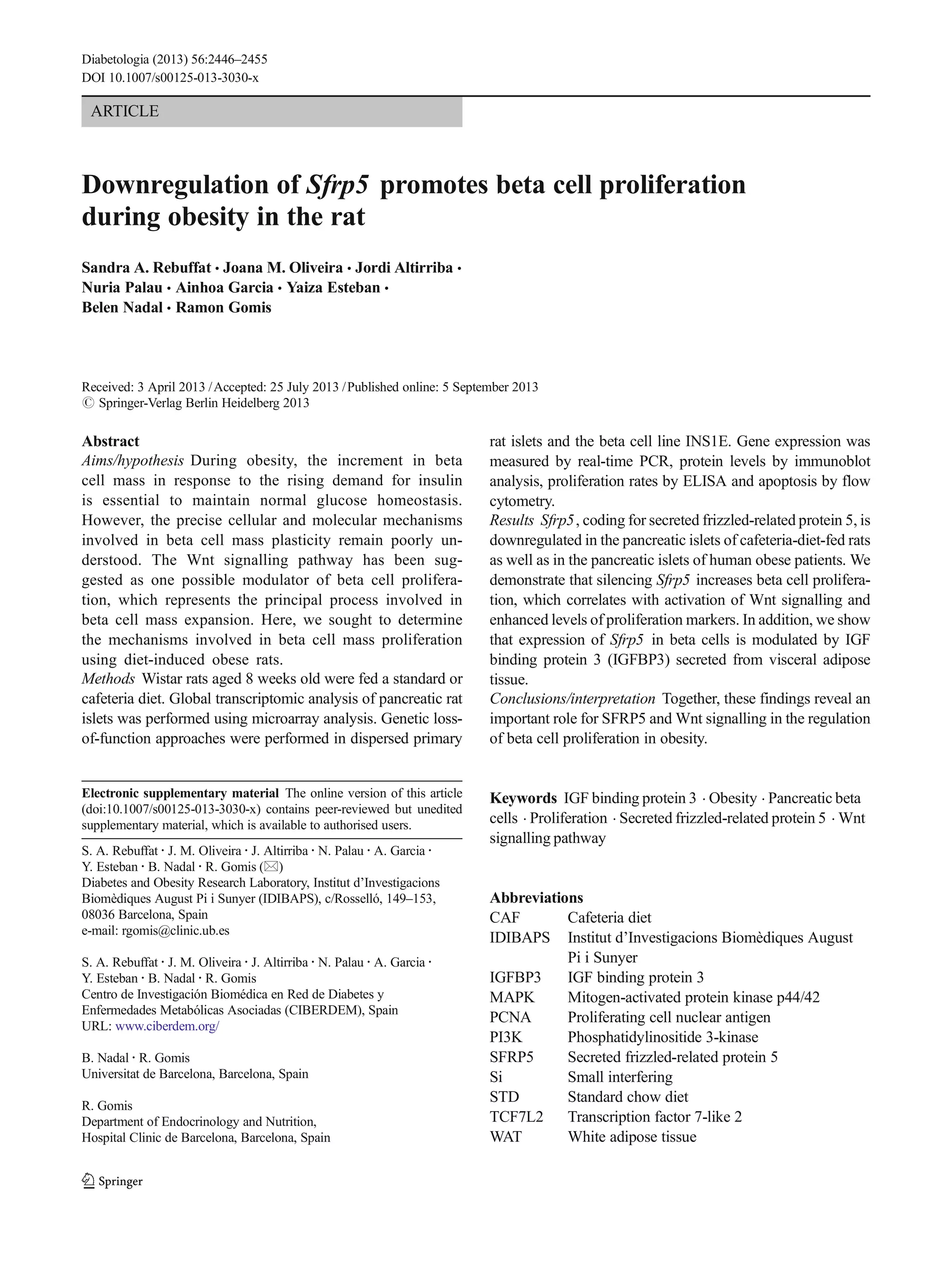
the mRNA (Fig. 1a) and protein levels (Fig. 1b). The mRNA
expression of Sfrp5 was also found to be lower in the pancre-
atic islets from two different models of obesity, ob/ob mice
and Zucker rats (Fig. 1c), further corroborating altered islet
Sfrp5 expression in obesity. Finally, we confirmed these re-
sults in isolated islets from human obese patients, which
showed decreased levels of SFRP5 mRNA compared with
control patients (Fig. 1d, 0.56±0.20 vs 1.02±0.08; p<0.01).
Taken together, these data provide evidence that islets exhibit
decreased Sfrp5 expression in obese states.
The silencing of Sfrp5 promotes proliferation in primary islet
cells and in the beta cell line INS1E SFRP5 is an inhibitor of
Wnt signalling, and the Wnt signalling pathway is known to
regulate beta cell proliferation [10, 12]. Hence, we
hypothesised that the downregulation of Sfrp5 expression
might be involved in enhanced beta cell proliferation in islets
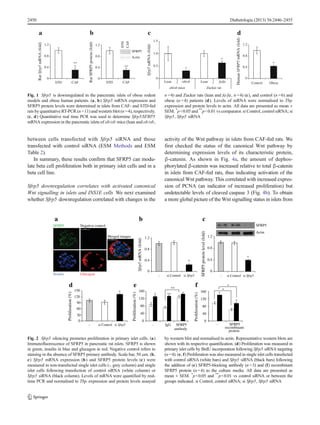
from CAF-fed rats. As an initial step, we performed staining
with an antibody against SFRP5 in fixed pancreatic tissue
from control rats and found co-localisation of SFRP5 with
insulin (Fig. 2a), thus confirming the presence of SFRP5 in
beta cells. Next, to investigate the role of SFRP5 in prolifer-
ation, we assessed BrdU incorporation in dispersed pancreatic
islet cells transfected with an siRNA targeting Sfrp5. The
efficiency of the siRNA knockdown was validated for both
mRNA and protein (Fig. 2b, c). The percentage of cells
positive for BrdU increased significantly when we silenced
Sfrp5 (Fig. 2d, 132.40%±4.60; p<0.05 vs control siRNA)
without any detectable effect on apoptosis, as measured by
annexin Vand propidium iodide labelling (ESM Methods and
ESM Table 2). Furthermore, blocking SFRP5 protein with an
antibody induced the same increase in proliferation as seen
when Sfrp5 was silenced with siRNA (Fig. 2e). Conversely,
incubation with an SFRP5 recombinant protein resulted in
decreased proliferation (Fig. 2f).
As single islet cell cultures contain several endocrine types,
we performed additional experiments using the rat beta cell
line INS1E. INS1E cells transfected with the siRNA against
Sfrp5 exhibited lower Sfrp5 mRNA expression and decreased
SFRP5 protein levels compared with cells transfected with
control siRNA (Fig. 3a–c). As we had seen in dispersed islet
cells, SFRP5 knockdown led to a significant increase in
proliferation rates in INS1E cells (Fig. 3d, 151.13%±9.60;
p<0.05 vs control siRNA), which correlated with higher cell
number in Sfrp5 siRNA transfections compared with control
siRNA (Fig. 3e; p<0.01). We also determined the effect of
Sfrp5 silencing on beta cell apoptosis but found no difference
Diabetologia (2013) 56:2446–2455 2449
between cells transfected with Sfrp5 siRNA and those
transfected with control siRNA (ESM Methods and ESM
Table 2).
In summary, these results confirm that SFRP5 can modu-
late beta cell proliferation both in primary islet cells and in a
beta cell line.
Sfrp5 downregulation correlates with activated canonical
Wnt signalling in islets and INS1E cells We next examined
whether Sfrp5 downregulation correlated with changes in the
activity of the Wnt pathway in islets from CAF-fed rats. We
first checked the status of the canonical Wnt pathway by
determining expression levels of its characteristic protein,
β-catenin. As shown in Fig. 4a, the amount of dephos-
phorylated β-catenin was increased relative to total β-catenin
in islets from CAF-fed rats, thus indicating activation of the
canonical Wnt pathway. This correlated with increased expres-
sion of PCNA (an indicator of increased proliferation) but
undetectable levels of cleaved caspase 3 (Fig. 4b). To obtain
a more global picture of the Wnt signalling status in islets from
ba
RatSfrp5mRNA(fold)
**
1.2
0.8
0.4
0
d
HumanSFRP5mRNA(fold)
1.2
0.8
0.4
0
*
c
RatSFRP5protein(fold)
1.2
0.8
0.4
0
Sfrp5mRNA(fold)
*
1.5
1.0
0.5
0
*
STD CAF STD CAF Lean ob/ob Lean fa/fa Control Obese
SFRP5
STD
CAF
Actin
**
ob/ob mice Zucker rat
Fig. 1 Sfrp5 is downregulated in the pancreatic islets of obese rodent
models and obese human patients. (a, b) Sfrp5 mRNA expression and
SFRP5 protein levels were determined in islets from CAF- and STD-fed
rats by quantitative RT-PCR (n =11) and western blot (n =4), respectively.
(c, d) Quantitative real time PCR was used to determine Sfrp5/SFRP5
mRNA expression in the pancreatic islets of ob/ob mice (lean and ob/ob,
n =4) and Zucker rats (lean and fa/fa, n =4) (c), and control (n =6) and
obese (n =4) patients (d). Levels of mRNA were normalised to Tbp
expression and protein levels to actin. All data are presented as mean ±
SEM. *
p<0.05 and **
p<0.01 vs comparator. si Control, control siRNA; si
Sfrp5, Sfrp5 siRNA
Proliferation(%)
-
b
d
150
120
90
60
0
*
*0.4
0.8
1.2
0
c
fe
0
40
80
120
160
-
antibody
Proliferation(%)
0
40
80
120
160
-
recombinant
protein
Proliferation(%)
*
*
*
*
**
* **
SFRP5proteinlevel(fold)
0.4
0.8
1.2
0
30
*
si Control si Sfrp5 - si Control si Sfrp5
Sfrp5mRNA(fold)
- si Control si Sfrp5 IgG SFRP5 SFRP5
SFRP5
Insulin Glucagon
50 µ m50 µ m
50 µ m50 µ m50 µ m
Negative control
a
Actin
SFRP5
Merged images
Fig. 2 Sfrp5 silencing promotes proliferation in primary islet cells. (a)
Immunofluorescence of SFRP5 in pancreatic rat islets. SFRP5 is shown
in green, insulin in blue and glucagon in red. Negative control refers to
staining in the absence of SFRP5 primary antibody. Scale bar, 50 μm. (b,
c) Sfrp5 mRNA expression (b) and SFRP5 protein levels (c) were
measured in non-transfected single islet cells (-, grey column) and single
islet cells following transfection of control siRNA (white column) or
Sfrp5 siRNA (black column). Levels of mRNA were quantified by real-
time PCR and normalised to Tbp expression and protein levels assayed
by western blot and normalised to actin. Representative western blots are
shown with its respective quantification. (d) Proliferation was measured in
primary islet cells by BrdU incorporation following Sfrp5 siRNA targeting
(n =4). (e, f) Proliferation was also measured in single islet cells transfected
with control siRNA (white bars) and Sfrp5 siRNA (black bars) following
the addition of (e) SFRP5-blocking antibody (n =3) and (f) recombinant
SFRP5 protein (n =4) to the culture media. All data are presented as
mean ± SEM. *
p<0.05 and **
p<0.01 vs control siRNA or between the
groups indicated. si Control, control siRNA; si Sfrp5, Sfrp5 siRNA
2450 Diabetologia (2013) 56:2446–2455
CAF-fed rats, we examined expression of a panel of genes
related to this pathway in islets from CAF- and STD-fed rats.
We observed an increase in the expression of several genes in
CAF-fed rats (Table 1) including Wnt ligands, Wnt receptors,
Tcf7 and target genes such as cyclin D1 and Myc.
To establish a direct role of SFRP5 on the activation of the
canonical Wnt pathway in beta cells, we assessed whether
Sfrp5 silencing impacted this pathway in INSE cells. We
found increased levels of β-catenin (dephosphorylated form)
and TCF7L2 by western blot analysis in Sfrp5 siRNA-
transfected cells compared with control cells (Fig. 4c). In
addition, we observed translocation of β-catenin to the nucle-
us in SFRP5 knockdown cells, whereas β-catenin was found
mainly located in the cytoplasm of control cells (ESM
Methods and ESM Fig. 1). Together, these data link Sfrp5
downregulation with activated canonical Wnt signalling in
beta cells.
Next we evaluated whether SFRP5 could influence other
signalling pathways known to regulate beta cell proliferation.
INS1E transfected with Sfrp5 siRNA presented increased
levels of phospho-Akt, PI3K and phospho-MAPK (Fig. 5a),
thus suggesting that these other pathways could also contrib-
ute to enhanced proliferative capacity of SFRP5 knockdown
cells. Last, we determined the status of these pathways in islets
from CAF-fed rats and found similar results (Fig. 5b).
Sfrp5 expression is modulated by IGFBP3 We previously
showed that the visceral adipose tissue of CAF-fed rats exerts
pro-proliferative effects on beta cells in vitro, thus providing
evidence for the involvement of adipose-derived signals in
beta cell mass expansion in obesity [3]. To determine whether
Sfrp5 expression in pancreatic islets could be influenced by
secreted factors from adipose tissue, we investigated the effect
of the secretome obtained from the peripancreatic adipose
tissue of CAF- and STD-fed rats on INS1E cells. We observed
that Sfrp5 mRNA levels decreased in INS1E cells exposed to
Sfrp5mRNA(fold)
a
INS1E
-
INS1E
si Sfrp5
INS1E
si Control
0.0
0.4
0.8
1.2
SFRP5proteinlevel(fold)
Actin
SFRP5
b
0.0
0.4
0.8
1.2
INS1E
-
INS1E
si Sfrp5
INS1E
si Control
e
c si Sfrp5si Control
Proliferation(%)
d
INS1E
-
INS1E
si Sfrp5
INS1E
si Control
60
90
120
150
180
0
30
*
*
* *
Numberofcells(fold)
INS1E
-
INS1E
si Sfrp5
INS1E
si Control
0.0
0.5
1.0
1.5
2.0
2.5
Fig. 3 Sfrp5 silencing promotes beta cell proliferation in INS1E cells.
(a, b) Sfrp5 mRNA expression and SFRP5 protein levels were deter-
mined by quantitative RT-PCR and western blot, respectively, in non-
transfected INS1E cells (grey column) and in INS1E cells transfected
with the control siRNA (white column) or siRNA against Sfrp5 (black
column). Levels of mRNA were normalised to Tbp expression and
protein levels to actin. Representative western blots are shown and
quantified. (c) Immunofluorescence of SFRP5 in siRNA-transfected
INS1E cells. SFRP5 is shown in red (magnification, x40) (d) INS1E
cell proliferation was measured following Sfrp5 siRNA transfection by
BrdU incorporation (n =6). (e) Cell numbers before and after transfection
were determined (n =4) and values expressed as fold increase between
time 48 h and time 0. All data are presented as mean ± SEM. *
p<0.05 vs
siRNA control. si Control, control siRNA; si Sfrp5, Sfrp5 siRNA
STD
CAF
0
1
2
3
PCNA
Proteinlevel(fold)
caspase 3
*
Cleaved
Total β-catenin
Actin
0.0
1.0
2.0
3.0
STD CAF
Dephosphorylated
/totalβ-catenin
a
b
*
c
0.0
1.5
3.0
4.5
siControl
siSfrp5
Dephosphorylated β-catenin
Actin
Total β-catenin
siControlsiSfrp5
*
STD
CAF
Cleaved caspase 3
Actin
PCNA
TCF7L2
Actin
*
Dephosphorylated β-catenin
Dephosphorylated
/totalβ-catenin
Fig. 4 The canonical Wnt signalling pathway is activated in islets from
CAF-fed rats. (a, c) Levels of dephosphorylated and total β-catenin were
analysed in pancreatic islets isolated from CAF- and STD-fed rats (n =3–5)
and in INS1E cells transfected with control siRNA and Sfrp5
siRNA (n =4). Bands were quantified by densitometry and values
expressed as ratio of dephosphorylated β-catenin relative to total β-catenin.
(b) PCNA and cleaved caspase 3 levels were determined in CAF-fed
(black bars) vs STD-fed (white bars) islets. Protein levels were normalised
to actin. All data are presented as mean ± SEM. *
p <0.05 vs STD-fed or
siRNA control. si Control, control siRNA; si Sfrp5, Sfrp5 siRNA
Diabetologia (2013) 56:2446–2455 2451
the adipose-derived secretome from CAF-fed rats but not that
from STD-fed rats (Fig. 6a), indicating that adipose-derived
signals can influence beta cell expression of this Wnt compo-
nent. IGFBP3 is decreased in the secretome of peripancreatic
adipose tissue and may be involved in pancreatic beta cell
proliferation in obese states [17]. Thus, here we investigated if
IGFBP3 modulated the expression of Sfrp5 in beta cells. To
this aim, we cultured INS1E cells in the presence of IGFBP3
recombinant protein or an antibody against IGFBP3 (which
sequesters IGFBP3 protein). Exogenous IGFP3 significantly
increased Sfrp5 mRNA levels, whereas the IGFBP3 antibody
lowered Sfrp5 mRNA expression in INS1E cells (Fig. 6a).
Finally, we measured the effects of recombinant IGFBP3 and
the IGFBP3 antibody on cell proliferation in single islet cell
cultures transfected with the siRNA against Sfrp5 or the
control siRNA. We observed further enhancement in prolifer-
ation when Sfrp5 was silenced in the presence of IGFBP3
antibody compared with cells that were transfected with con-
trol siRNA and treated with the same antibody (Fig. 6b).
Therefore, our data demonstrate that IGFBP3 can modulate
Sfrp5 expression and beta cell proliferation and thus reveal a
possible link between adipose-derived signals and intrinsic
beta cell proliferative pathways.
Discussion
Lifelong maintenance of appropriate beta cell mass is essential
for normal glucose homeostasis. Consequently, there is grow-
ing interest in understanding the mechanisms that control beta
cell expansion during times of increased metabolic demand
such as during obesity [26]. Several studies have demonstrated
that beta cell mass is increased in rodent obese models, mainly
due to increased beta cell proliferation. However, the mecha-
nisms underlining enhanced proliferation in obesity remain
poorly understood. Here, we show that the Sfrp5 gene is
downregulated in the islets of CAF-fed rats as well as in other
obese rodent models. Importantly, we find that SFRP5 mRNA
levels are also decreased in pancreatic islets from obese human
donors. Using cell-based assays, we demonstrate that Sfrp5
silencing promotes beta cell proliferation and activation of the
canonical Wnt signalling pathway. Finally, we provide evi-
dence of the modulation of Sfrp5 expression and beta cell
proliferation through IGFBP3 availability.
Table 1 Expression changes in Wnt-pathway-related genes in islets from
CAF- and STD-fed rats
Gene Fold change (CAF vs STD)
Downregulated
Apc 2.25
Csnk1α1 1.35
Ep300 1.50
Wif1 2.17
Sfrp5 1.45
Upregulated
Dvl2 1.35
Wisp1 1.31
Tcf7 1.31
Ccnd1 1.39
Myc 1.33
Fzd1 1.77
Fzd2 1.45
Wnt1 1.56
Wnt11 2.02
Wnt2b 2.32
Wnt5a 1.33
Wnt5b 1.62
Wnt7a 1.34
Wnt7b 1.36
Wnt9a 2.05
Wnt-signalling-related gene expression was studied in isolated islets from
STD- and CAF-fed rats. Genes shown in this table were differentially
expressed between STD- and CAF-fed islets with a fold change > ± 1.3
and p value <0.05 (n =4)
STD
CAF
0
2
4
6
8
Proteinlevel(fold)
*
*
*
b
a
p-Akt PI3K p-MAPK
MAPK
pathway
PI3K/Akt
pathway
-
siSfrp5
siControl
p-Akt
PI3K
pathway
PI3K/Akt
pathway
MAPK p-MAPK
Actin
Actin
MAPK
p-MAPK
p-Akt
PI3K
Akt
0
1
2
3
4
5
6
Proteinlevel(fold)
p-Akt
pPI3K
MAPK
p-MAPK
Akt
*
*
*
INS1E
Fig. 5 SFRP5 downregulation stimulates several signalling pathways
involved in cell proliferation. Levels of the indicated proteins were
assayed by western blot analysis in (a) INS1E cells transfected with
control siRNA and Sfrp5 siRNA (n =5) and (b) pancreatic islets isolated
from CAF- and STD-fed rats (n =3). Representative western blots are
shown. Bands were quantified and protein levels were normalised to actin
expression. *
p<0.05 vs STD-fed or siRNA control. si Control, control
siRNA; si Sfrp5, Sfrp5 siRNA
2452 Diabetologia (2013) 56:2446–2455
There is strong evidence that the Wnt signalling pathway
regulates prenatal and postnatal beta cell development in mice
as well as glucose sensing in pancreatic beta cells [27, 28].
Also, the activation of Wnt signalling in beta cell lines or in
isolated islets has been shown to enhance beta cell prolifera-
tion [10, 29–31]. Thus, increased β-catenin levels in islets
caused an expansion of beta cell mass, whereas the depletion
of TCF7L2 reduced proliferation in human islets [10, 30]. In
the current study, we show that Sfrp5 silencing activates
proliferation in INS1E and dispersed islet cells, which is
accompanied by increased β-catenin and TCF7L2 levels in
both cellular models. Together, this evidence supports the
notion that Sfrp5 can regulate the canonical Wnt pathway in
beta cells. Correlating with these data, islets from CAF-fed
rats exhibit upregulation of several genes involved in the Wnt
pathway, as well as of well-known Wnt targets implicated in
cell cycle progression such as cyclin D1 and Myc [32].
Recent observations have offered a new perspective on
SFRP family functions and mechanisms of action in both
pancreatic development and disease [11, 12]. Ouchi et al
reported that two independent mouse models of obesity
exhibited reduced SFRP5 in adipose tissue, suggesting that
this molecule could be involved in the development of obesity
[15]. According to Schulte et al, SFRP5 represents a new
regulatory system in low-grade inflammation in obesity,
which could be influenced by nutritional therapy [33]. Re-
cently, in contrast to these findings, SFRP5 expression was
found unchanged in human WAT [13]. In agreement with this
study, we found no changes in circulating SFRP5 levels or in
Sfrp5 expression in peripancreatic adipose tissue between
CAF- and STD-fed rats (data not shown). Therefore, its im-
plication in metabolic dysfunction remains controversial
[34–36]. Importantly, our study demonstrates a novel auto-
crine role for SFRP5 in beta cell proliferation.
Several Wnt proteins appear to have both canonical and
non-canonical properties [12]. Our results show that, in addi-
tion to β-catenin-dependent signalling, SFRP5 has effects on
the MAPK and PI3K pathways. Information available on
SFRP5 is limited, thus we cannot rule out multiple effects of
this protein. However, it is possible that these additional
activation events are consequent of the crosstalk between the
Wnt pathway and MAPK or PI3K, described elsewhere [37,
38]. Recently, Gherzi et al reported that the half-life of
β-catenin mRNA is prolonged not only by Wnt but also by
PI3K–Akt signalling, adding further complexity to the poten-
tial mechanisms by which insulin/IGF-1 could interact with
Wnt signalling [39]. With the data available, we cannot dis-
miss the possibility that these different signalling events could
converge to activate beta cell proliferation.
Recently, we described that reduced IGFBP3 secretion by
the peripancreatic adipose tissue of CAF-fed rats induced beta
cell proliferation. Our data reveal that decreased IGFBP3
leads to a reduction in Sfrp5 mRNA expression. These find-
ings are in line with the increased beta cell proliferation
previously described in CAF-fed rats and provide additional
proof of the existence of a crosstalk between adipose tissue
(IGFBP3) and beta cells (SFRP5). Remarkably, the increment
in beta cell proliferation observed in SFRP5-knockdown beta
cells can be further enhanced by blocking exogenous IGFBP3
levels, which suggests a synergic effect of decreased IGFBP3
and SFRP5 on beta cell proliferation. Little is known regard-
ing the regulation of Sfrp5 expression. Of note, insulin, IGF-1
and other hormonal factors have been shown to activate the
canonical Wnt signalling by increasing nuclear β-catenin
content and binding of β-catenin/TCF to Wnt target gene
promoters [39–41]. Thus, it is plausible that IGFBP3 and
SFRP5 are two of the molecules mediating the crosstalk
between the Wnt and insulin/IGF-1 signalling pathways
-
Sfrp5mRNA(fold)
a
3.5
3.0
2.5
2.0
1.5
1.0
0.5
0
(0.5 µg/ml) (1 µg/ml) (0.1 µg/ml) (1 µg/ml)
**
*
*
*
**
b
protein
IGFBP3 antibodyCAF
Secretome
STD
**
*
0
40
80
120
160
200
IgG
Proliferation(%)
**
IGFBP3
antibody
IGFBP3 recombinant
**
Fig. 6 Effect of IGFBP3-blocking antibody on Sfrp5 mRNA expression
and beta cell proliferation. (a) Sfrp5 mRNA expression was measured in
INS1E cells after 24 h in normal medium alone (-) or supplemented with
secretome obtained from peripancreatic adipose tissue of STD- or CAF-
fed rats (diluted 1:3 in culture medium). The modulation of Sfrp5 mRNA
expression was also detected after stimulation with IGFBP3 recombinant
protein (0.5 and 1 μg/ml) or IGFBP3 antibody (0.1 and 1 μg/ml) added to
the culture medium. (b) Measurement of proliferation in Sfrp5 siRNA-
transfected primary islet cells (black bars) compared with control siRNA-
transfected cells (white bars) in the presence of IGFBP3 antibody. Data
are presented as mean ± SEM of three independent experiments. *
p<0.05,
**
p<0.01 compared to cells cultivated in normal medium alone in (a) or
between the groups indicated in (b)
Diabetologia (2013) 56:2446–2455 2453
at the level of pancreatic beta cells in the context of
diet-induced obesity. These findings deserve further
investigation.
In summary, our results offer an improved understand-
ing of the mechanisms underlying beta cell proliferation
in obesity, pointing to the downregulation of Sfrp5 ex-
pression as one crucial mechanism that may represent a
new therapeutic target for the modulation of pancreatic
beta cell mass expansion.
Acknowledgements We are indebted to the Cytomics Unit of IDIBAPS
for technical help. We thank Rosa Gasa (IDIBAPS) for critical reading and
discussion of the manuscript, Marcelina Párrizas (IDIBAPS) for invalu-
able guidance during the transfection experiments and Kimberley Katte
(CIBERDEM) for revising the manuscript.
Funding JMO was the recipient of a doctoral research fellowship
(SFRH/BD/45845/2008) supported by the Portuguese Foundation for
Science and Technology (FCT) and funding by the Operational Program
for Human Potential (POPH/ESF), and JA was the recipient of a grant
from IDIBAPS. This work was developed at the Centro Esther
Koplowitz, Barcelona, Spain. This work was sponsored by the Spanish
Ministry of Science and Innovation (under grant agreement number SAF
2010-19527), the Government of Catalonia (under grant agreement num-
ber 2009 SGR 1426), the Botín Foundation (project 08/351) and the
European Community’s Seventh Framework Programme (FP7/2007-
2013) under grant agreement numbers 218130 and 267248. CIBERDEM
is an initiative of the Spanish Ministry of Science and Innovation (ISCIII).
This research project was also supported by a Marie Curie People Cofund
Fellowship of the Seventh Framework Programme of the European
Commission under grant agreement number 267248: DIATRAIN.
Duality of interest The authors declare that there is no duality of
interest associated with this manuscript.
Contribution statement SAR and RG designed the study. All authors
contributed to acquisition or interpretation of data, drafted the article or
revised it critically for important intellectual content the paper. All authors
approved the final version of the manuscript to be published.
References
1. Stumvoll M, Goldstein BJ, van Haeften TW (2005) Type 2 diabetes:
principles of pathogenesis and therapy. Lancet 365:1333–1346
2. Chan JM, Rimm EB, Colditz GA, Stampfer MJ, Willett WC (1994)
Obesity, fat distribution, and weight gain as risk factors for clinical
diabetes in men. Diabetes Care 17:961–969
3. Kershaw EE, Flier JS (2004) Adipose tissue as an endocrine organ.
J Clin Endocrinol Metab 89:2548–2556
4. Bonner-Weir S (2000) Life and death of the pancreatic beta cells.
Trends Endocrinol Metab 11:375–378
5. Bonner-Weir S (2000) Islet growth and development in the adult.
J Mol Endocrinol 24:297–302
6. Dor Y, Brown J, Martinez OI, Melton DA (2004) Adult pancreatic
beta cells are formed by self-duplication rather than stem-cell differ-
entiation. Nature 429:41–46
7. Liu Z, Habener JF (2010) Wnt signalling in pancreatic islets.
Adv Exp Med Biol 654:391–419
8. Logan CY, Nusse R (2004) The Wnt signalling pathway in develop-
ment and disease. Annu Rev Cell Dev Biol 20:781–810
9. Niehrs C, Acebron SP (2012) Mitotic and mitogenic Wnt signalling.
EMBO J 31:2705–2713
10. Rulifson IC, Karnik SK, Heiser PW et al (2007) Wnt signalling
regulates pancreatic beta cell proliferation. Proc Natl Acad Sci U S A
104:6247–6252
11. Bovolenta P, Esteve P, Ruiz JM, Cisneros E, Lopez-Rios J (2008)
Beyond Wnt inhibition: new functions of secreted Frizzled-related
proteins in development and disease. J Cell Sci 121:737–746
12. Kawano Y, Kypta R (2003) Secreted antagonists of the Wnt signal-
ling pathway. J Cell Sci 116:2627–2634
13. Ehrlund A, Mejhert N, Lorente-Cebrian S et al (2013) Char-
acterization of the Wnt inhibitors secreted frizzled-related pro-
teins (SFRPs) in human adipose tissue. J Clin Endocrinol
Metab 98:E503–E508
14. Lv C, Jiang Y, Wang H, Chen B (2012) Sfrp5 expression and
secretion in adipocyte are upregulated during the differentiation and
are negatively correlated with insulin resistance. Cell Biol Int
36:851–855
15. Ouchi N, Higuchi A, Ohashi K et al (2010) Sfrp5 is an anti-
inflammatory adipokine that modulates metabolic dysfunction in
obesity. Science 329:454–457
16. Mahdi T, Hanzelmann S, Salehi A et al (2012) Secreted frizzled-
related protein 4 reduces insulin secretion and is overexpressed in
type 2 diabetes. Cell Metab 16:625–633
17. Palau N, Rebuffat SA, Altirriba J et al (2012) Role of IGFBP-3 in the
regulation of beta cell mass during obesity: adipose tissue/beta cell
cross talk. Endocrinology 153:177–187
18. Claret M, Corominola H, Canals I et al (2005) Tungstate decreases
weight gain and adiposity in obese rats through increased thermo-
genesis and lipid oxidation. Endocrinology 146:4362–4369
19. Lacy PE, Kostianovsky M (1967) Method for the isolation of
intact islets of Langerhans from the rat pancreas. Diabetes
16:35–39
20. Casas S, Gomis R, Gribble FM, Altirriba J, Knuutila S, Novials A
(2007) Impairment of the ubiquitin-proteasome pathway is a down-
stream endoplasmic reticulum stress response induced by extracellu-
lar human islet amyloid polypeptide and contributes to pancreatic
beta cell apoptosis. Diabetes 56:2284–2294
21. Wilson CL, Miller CJ (2005) Simpleaffy: a BioConductor package
for Affymetrix Quality Control and data analysis. Bioinformatics
21:3683–3685
22. Gentleman RC, Carey VJ, Bates DM et al (2004) Bioconductor: open
software development for computational biology and bioinformatics.
Genome Biol 5:R80
23. R Development Core Team (2012) R: A language and environment
for statistical computing. R Foundation for Statistical Computing,
Vienna
24. Coronado-Pons I, Novials A, Casas S, Clark A, Gomis R (2004)
Identification of iduronate-2-sulfatase in mouse pancreatic islets.
Am J Physiol Endocrinol Metab 287:E983–E990
25. Marques BG, Hausman DB, Martin RJ (1998) Association of fat cell
size and paracrine growth factors in development of hyperplastic
obesity. Am J Physiol 275:R1898–R1908
26. Rieck S, Kaestner KH (2010) Expansion of beta cell mass in response
to pregnancy. Trends Endocrinol Metab 21:151–158
27. Papadopoulou S, Edlund H (2005) Attenuated Wnt signalling
perturbs pancreatic growth but not pancreatic function. Diabetes
54:2844–2851
28. Fujino T, Asaba H, Kang MJ et al (2003) Low-density lipoprotein
receptor-related protein 5 (LRP5) is essential for normal cholesterol
metabolism and glucose-induced insulin secretion. Proc Natl Acad
Sci U S A 100:229–234
29. Figeac F, Uzan B, Faro M, Chelali N, Portha B, Movassat J (2010)
Neonatal growth and regeneration of beta cells are regulated by the
Wnt/beta-catenin signalling in normal and diabetic rats. Am J Physiol
Endocrinol Metab 298:E245–E256
2454 Diabetologia (2013) 56:2446–2455
30. Schinner S, Ulgen F, Papewalis C et al (2008) Regulation of insulin
secretion, glucokinase gene transcription and beta cell proliferation
by adipocyte-derived Wnt signalling molecules. Diabetologia
51:147–154
31. Liu Z, Habener JF (2008) Glucagon-like peptide-1 activation of
TCF7L2-dependent Wnt signalling enhances pancreatic beta cell
proliferation. J Biol Chem 283:8723–8735
32. Cozar-Castellano I, Fiaschi-Taesch N, Bigatel TA et al (2006)
Molecular control of cell cycle progression in the pancreatic beta
cell. Endocr Rev 27:356–370
33. Schulte DM, Muller N, Neumann K et al (2012) Pro-
inflammatory wnt5a and anti-inflammatory sFRP5 are differ-
entially regulated by nutritional factors in obese human sub-
jects. PloS One 7:e32437
34. Ross SE, Hemati N, Longo KA et al (2000) Inhibition of
adipogenesis by Wnt signalling. Science 289:950–953
35. Prestwich TC, Macdougald OA (2007) Wnt/beta-catenin sig-
nalling in adipogenesis and metabolism. Curr Opin Cell Biol
19:612–617
36. Lagathu C, Christodoulides C, Virtue S et al (2009) Dact1, a nutri-
tionally regulated preadipocyte gene, controls adipogenesis by coor-
dinating the Wnt/beta-catenin signalling network. Diabetes 58:609–
619
37. Guardavaccaro D, Clevers H (2012) Wnt/β-catenin and MAPK
signalling: allies and enemies in different battlefields. Sci Signal
5:pe15
38. Gui S, Yuan G, Wang L et al (2013) Wnt3a regulates proliferation,
apoptosis and function of pancreatic NIT-1 beta cells via activation of
IRS2/PI3K signalling. J Cell Biochem 114:1488–1497
39. Gherzi R, Trabucchi M, Ponassi M et al (2006) The RNA-binding
protein KSRP promotes decay of beta-catenin mRNA and is
inactivated by PI3K-AKT signalling. PLoS Biol 5:e5
40. Jin T, George Fantus I, Sun J (2008) Wnt and beyond Wnt: multiple
mechanisms control the transcriptional property of beta-catenin. Cell
Signal 20:1697–1704
41. Yi F, Sun J, Lim GE et al (2008) Cross talk between the insulin and
Wnt signalling pathways: evidence from intestinal endocrine L cells.
Endocrinology 149:2341–2351
Diabetologia (2013) 56:2446–2455 2455

art%3A10.1007%2Fs00125-013-3030-x

  • 1.
    ARTICLE Downregulation of Sfrp5promotes beta cell proliferation during obesity in the rat Sandra A. Rebuffat & Joana M. Oliveira & Jordi Altirriba & Nuria Palau & Ainhoa Garcia & Yaiza Esteban & Belen Nadal & Ramon Gomis Received: 3 April 2013 /Accepted: 25 July 2013 /Published online: 5 September 2013 # Springer-Verlag Berlin Heidelberg 2013 Abstract Aims/hypothesis During obesity, the increment in beta cell mass in response to the rising demand for insulin is essential to maintain normal glucose homeostasis. However, the precise cellular and molecular mechanisms involved in beta cell mass plasticity remain poorly un- derstood. The Wnt signalling pathway has been sug- gested as one possible modulator of beta cell prolifera- tion, which represents the principal process involved in beta cell mass expansion. Here, we sought to determine the mechanisms involved in beta cell mass proliferation using diet-induced obese rats. Methods Wistar rats aged 8 weeks old were fed a standard or cafeteria diet. Global transcriptomic analysis of pancreatic rat islets was performed using microarray analysis. Genetic loss- of-function approaches were performed in dispersed primary rat islets and the beta cell line INS1E. Gene expression was measured by real-time PCR, protein levels by immunoblot analysis, proliferation rates by ELISA and apoptosis by flow cytometry. Results Sfrp5, coding for secreted frizzled-related protein 5, is downregulated in the pancreatic islets of cafeteria-diet-fed rats as well as in the pancreatic islets of human obese patients. We demonstrate that silencing Sfrp5 increases beta cell prolifera- tion, which correlates with activation of Wnt signalling and enhanced levels of proliferation markers. In addition, we show that expression of Sfrp5 in beta cells is modulated by IGF binding protein 3 (IGFBP3) secreted from visceral adipose tissue. Conclusions/interpretation Together, these findings reveal an important role for SFRP5 and Wnt signalling in the regulation of beta cell proliferation in obesity. Keywords IGF binding protein 3 . Obesity . Pancreatic beta cells . Proliferation . Secreted frizzled-related protein 5 . Wnt signalling pathway Abbreviations CAF Cafeteria diet IDIBAPS Institut d’Investigacions Biomèdiques August Pi i Sunyer IGFBP3 IGF binding protein 3 MAPK Mitogen-activated protein kinase p44/42 PCNA Proliferating cell nuclear antigen PI3K Phosphatidylinositide 3-kinase SFRP5 Secreted frizzled-related protein 5 Si Small interfering STD Standard chow diet TCF7L2 Transcription factor 7-like 2 WAT White adipose tissue Electronic supplementary material The online version of this article (doi:10.1007/s00125-013-3030-x) contains peer-reviewed but unedited supplementary material, which is available to authorised users. S. A. Rebuffat :J. M. Oliveira :J. Altirriba :N. Palau :A. Garcia : Y. Esteban :B. Nadal :R. Gomis (*) Diabetes and Obesity Research Laboratory, Institut d’Investigacions Biomèdiques August Pi i Sunyer (IDIBAPS), c/Rosselló, 149–153, 08036 Barcelona, Spain e-mail: rgomis@clinic.ub.es S. A. Rebuffat :J. M. Oliveira :J. Altirriba :N. Palau :A. Garcia : Y. Esteban :B. Nadal :R. Gomis Centro de Investigación Biomédica en Red de Diabetes y Enfermedades Metabólicas Asociadas (CIBERDEM), Spain URL: www.ciberdem.org/ B. Nadal :R. Gomis Universitat de Barcelona, Barcelona, Spain R. Gomis Department of Endocrinology and Nutrition, Hospital Clinic de Barcelona, Barcelona, Spain Diabetologia (2013) 56:2446–2455 DOI 10.1007/s00125-013-3030-x
  • 2.
    Introduction Obesity has reachedepidemic proportions in western civilisa- tion and is a predisposing factor for metabolic disorders, such as type 2 diabetes [1, 2]. There is growing evidence suggesting that adipose tissue influences pancreatic beta cell mass plas- ticity, which is the capacity of the beta cell to flexibly adapt its mass to increased insulin demands [3]. Several mechanisms have been implicated in adult beta cell mass expansion, with the proliferation of differentiated beta cells proving to be the most important one, at least in rodents [4–6]. However, the factors and mechanisms regulating the proliferation of pan- creatic beta cells remain to be fully clarified. Wnt signalling is critically important for organogenesis and for the determination of cell fate. The transcription factor 7-like 2 (TCF7L2)-dependent Wnt signalling pathway (ca- nonical pathway) is involved in pancreas development, islet function and insulin production and secretion [7–9]. Recent work has also suggested the participation of Wnt signalling in beta cell proliferation [10]. Canonical Wnt signalling starts with the binding of Wnt proteins to the frizzled receptors, which allows the activation of β-catenin and its translocation into the nucleus, where it interacts with transcription factors, such as TCF7L2, to regulate the expression of several genes [11]. The activity of Wnt signalling is often inhibited by different modulators, such as dickkopfs, Wnt inhibitory factor 1 (WIF1) and secreted frizzled-related proteins (SFRPs). Of these, SFRPs sequester Wnt proteins in the extracellular space and prevent them from binding to their receptors. SFRPs have been extensively studied in the context of cancer [11, 12] and, more recently, in the context of adipose tissue [13]. Several reports have implicated members of the SFRP family, includ- ing SFRP5, in adipocyte dysfunction during obesity. For instance, Sfrp5 was reported as highly induced in white adi- pose tissue (WAT) during genetic and/or diet-induced obesity, whereas others studies described the suppression of Sfrp5 under these conditions [14, 15]. In contrast, recent findings suggest that SFRP5 is neither regulated by obesity nor active- ly secreted from human WAT [13]. At any rate, little is known about the role of SFRP5 in the control of Wnt signalling in pancreatic beta cells. Only one recent study reported another SFRP gene, SFRP4, as overexpressed in pancreatic islets taken from type 2 diabetic patients, but the authors did not find any changes in SFRP5 [16]. In the present study, we explored the mechanisms involved in beta cell proliferation in the context of obesity by using a diet-induced obese model, namely, rats fed a cafeteria diet (CAF). As previously described, this model presents an incre- ment in beta cell mass, which is partly ascribed to increased beta cell proliferation [17]. By analysing global gene expres- sion, we identified the downregulation of Sfrp5 in pancreatic islets from CAF-fed rats relative to rats fed standard chow. Our results show that SFRP5 knockdown promotes beta cell proliferation, which we correlated with activation of the ca- nonical Wnt signalling pathway. Thus, our study demonstrates an important role for SFRP5 in pancreatic islets and provides a link between SFRP5 and beta cell proliferation during expan- sion of beta cell mass in obesity. Methods Animals The principles of laboratory animal care were followed (European and local government guidelines), and protocols were approved by the Animal Research Committee of the University of Barcelona (Barcelona, Spain). Seven- week-old male Wistar rats, Zucker rats and ob/ob mice were purchased from Charles River (Wilmington, MA, USA). Wistar rats were caged individually and divided into two dietary sets: one group was fed with a CAF as previously described, while another group was fed with standard chow diet (STD) [17, 18]. The diet was fed for 30 days unless otherwise stated. The animals were allowed to eat and drink ad libitum. At the end of the experiment, animals were anaesthetised and killed by decapitation. Pancreatic islet isolation Pancreatic islets were isolated from STD- and CAF-fed rats, Zucker rats and ob/ob mice by collagenase digestion [19]. Briefly, pancreases were digested with collagenase (Roche, Basel, Switzerland) and islets were purified from exocrine tissue with Histopaque density gradi- ents (Sigma-Aldrich, St Louis, MO, USA). Islets were handpicked under a stereomicroscope and kept frozen at −80°C until used. Pancreatic human islets were purified from cadaver organ donors (four obese donors and six non-obese donors) from the Transplant Services Foundation of the Hos- pital Clinic (Barcelona, Spain) and kept at the Biobank of the Hospital Clinic-Institut d’Investigations Biomediques August Pi i Sunyer ([IDIBAPS], Barcelona, Spain), following in- formed consent from donors’ families and approval by the hospital’s ethics committee. Human islets were isolated as previously described [20]. Inclusion criteria were 50–60 years of age with BMI>35 kg/m2 for obese and BMI<25 kg/m2 for non-obese donors. RNA isolation Total RNA was extracted from frozen islets, transfected INS1E beta cells and dispersed cells from islets using the RNeasy MiniKit (Qiagen, Hilden, Germany), according to the manufacturer’s instructions. RNA integrity was analysed using a Lab-On-A-Chip in a 2100 Bioanalyzer (Agilent Technologies, Santa Clara, CA, USA). Global transcriptomic analysis Total RNAwas obtained from islets of rats fed the STD or CAF for 10 and 30 days (four to five animals per group). Total RNA, 10 μg, was converted into cRNA, biotinylated, fragmented and hybridised to Diabetologia (2013) 56:2446–2455 2447
  • 3.
    GeneChip Rat Genome230 2.0 (Affymetrix, Santa Clara, CA, USA). Background adjustment, normalisation and data summarisation of raw data were performed by MAS5.0 algo- rithm using the Simpleaffy package [21] from bioconductor [22] on R language [23]. Samples from 10 and 30 days of diet were analysed separately. Raw and processed data successful- ly passed several quality controls as described previously [17]. In order to increase the sensitivity of the analysis and reduce background noise, those genes that were called absent (calcu- lated with the MAS5.0 algorithm from the Simpleaffy pack- age [21]) in at least two microarrays using both experimental groups (STD- and CAF-fed groups) were removed. Differen- tially expressed genes were considered when presenting fold change >1.5 or <−1.5 and Student’s t test p value ≤0.05 in both comparisons (STD 10 days vs CAF 10 days and STD 30 days vs CAF 30 days). Raw and processed data were deposited in the GEO database with the accession number GSE44047. Real-time PCR Total RNA was retrotranscribed with Super- script III (Invitrogen, Carlsbad, CA, USA). Real-time PCR was carried out in a 7900 HT Real Time System (Applied Biosystems, Foster City, CA, USA) using a SYBR Green fluorophore. A standard curve of each primer set (rat, human and mouse Sfrp5 primers from Super Array Biosciences, Qiagen) was generated from serial dilutions of cDNA. Ex- pression levels obtained were normalised with a housekeeping gene (TATA box binding protein, Tbp). Rat Wnt signalling pathway The Rat WNT Signalling Path- way RT2 Profiler PCR Array (Qiagen) targets 84 genes related to WNT-mediated signal transduction. Total RNA isolated from islets from either CAF- or STD-fed rats was reverse- transcribed into cDNA using the RT2 First Strand Kit (Qiagen), mixed with RT2 qPCR Mastermix containing SYBR Green (Qiagen), and aliquoted in equal volumes to each well of the real-time PCR arrays. The real-time PCR cycling program was run on a Roche Light Cycler 480. The threshold cycle (Ct) of each gene was determined and subse- quently analysed by RT2 Profiler PCR Array Data Analysis software (http://pcrdataanalysis.sabiosciences.com/pcr/ arrayanalysis.php). Expression profiles were obtained from four independent experiments. Preparation of dispersed islet cells Handpicked islets isolated from STD-fed rats were transferred to Petri dishes and pre- cultured overnight in RPMI 1640 medium (Gibco-BRL, Pais- ley, UK) containing 11.1 mmol/l glucose and supplemented with 10% FBS (vol./vol.), 2 mmol/l L-glutamine, 100 U/ml penicillin, and 100 μg/ml streptomycin at 37°C with 5% CO2. The protocol for the isolation of single islet cells has been published previously [24]. Islets were digested in PBS con- taining 0.125 mg/ml trypsin and 0.05 mg/ml EDTA (Gibco- BRL) at 37°C and for an additional 5 min on ice to allow islets to sediment. The cell suspension was cycled for 5 min. Then, the supernatant fraction containing the single cells was re- moved and placed in 1 ml FBS (Gibco-BRL). To obtain additional single islet cells, the digestion process was repeated a maximum of four times. Once obtained, single islet cells were cultured in RPMI 1640 medium supplemented as de- tailed before but containing 5.5 mmol/l glucose. INS1E cells culture INS1E cells were maintained in RPMI 1640 containing 5.5 mmol/l glucose and supplemented with 10% FBS (vol./vol.), 1 mmol/l sodium pyruvate, 50 μmol/l 2- mercaptoethanol, 2 mmol/l glutamine, 10 mmol/l HEPES, 100 U/ml penicillin, 100 μg/ml streptomycin and 0.1% BSA (Sigma-Aldrich). For stimulation experiments, cells were cul- tured on microplates for 24 h in a culture medium containing: (1) an aliquot of peripancreatic adipose tissue secretome (diluted 1:3 in INS1E cell medium); (2) IGF binding protein 3 (IGFBP3) antibody (Santa Cruz Biotechnology, Santa Cruz, CA, USA) added to the culture medium at 0.1 and 10 μg/ml; and (3) IGFBP3 protein (R&D Systems, Minneapolis, MN, USA) added to the culture medium at 0.5 μg/ml and 10 μg/ml. Peripancreatic adipose tissue secretome was prepared as pre- viously described [17, 25]. Small interfering RNA transfection INS1E cells and single rat islet cells were grown on tissue culture test plates in the media previously described. Cells were transfected using Metafectene Pro (Biontex, Martinsried, Germany) at a 1/2 (wt/vol.) ratio with Sfrp5 small interfering (si)RNA (silencer select siRNA) or negative control siRNA (Ambion, Austin, TX, USA), according to the manufacturer’s protocol. RNA and protein were extracted at 48 h for INS1E cells and 72 h for single islet cells, after transfection. The efficiency of Sfrp5 silencing was examined by real-time PCR using Sfrp5 primer set (Qiagen), and by western blot analysis using primary antibodies against SFRP5 (1:50, Santa Cruz Biotechnology, Santa Cruz, CA, USA) and actin (1:1,000; Sigma-Aldrich). Immunofluorescence Experiments were performed using pri- mary antibodies against SFRP5 (1:50; Abcam, Cambridge, UK and 1:50; Santa Cruz Biotechnology), insulin and glucagon (1:500; Dako, Glostrup, Denmark). Anti-rabbit-phycoerythrin, anti-guinea pig-Cy2, anti-goat-Cy3 (1:500, Santa Cruz Bio- technology)-conjugated, and aminomethylcoumarin acetate (AMCA) anti-guinea pig (1:200; Jackson ImmunoResearch, Newmarket, UK) antibodies were used as secondary antibod- ies. Fluorescence images were analysed with a Leica confocal scanning laser microscope (Leica Microsystems, Wetzlar, Germany). Proliferation and cell growth assays The proliferation of INS1E and dispersed islet cells was assessed at 48 h 2448 Diabetologia (2013) 56:2446–2455
  • 4.
    (INS1E) or 72h (single islets cells) following siRNA trans- fection, using the cell BrdU Proliferation Kit (Roche) and following the manufacturer’s protocol. BrdU was added over 24 h. Irrelevant IgG (Dako), SFRP5 antibody (Abcam) and IGFBP3 antibody (Santa Cruz Biotechnology) were added to the media at 0.1 μg/ml. SFRP5 recombinant protein (R&D Systems) was added to the media at 0.1 μg/ml. Cell growth was measured by cell counting. Briefly, 150×103 INS1E cells were plated on 12-well tissue culture plates, transfected with siRNAs as previously described and counted in a Countess automated cell counter (Invitrogen) 48 h after transfection. Protein extraction and western blot Islets and transfected cells were homogenised in lysis buffer containing 50 mmol/l Tris–HCl, pH 7.3, 150 mmol/l NaCl, 5 mmol/l EDTA, 10% glycerol, 1% Triton X-100 and protease inhibitors (Roche). Homogenates were subjected to two freeze–thaw cycles. After centrifugation, supernatant fractions were recovered and kept at −80°C. Protein concentrations were determined with the BCA protein assay (Pierce). Proteins were separated by SDS- PAGE and transferred to polyvinylidene difluoride (PVDF) membranes using standard protocols. The membranes were blocked for 1 h in PBS containing 0.05% Tween-20 and 5% skimmed milk. They were then incubated overnight at 4°C with antibodies against SFRP5 (1:500; Santa Cruz Biotech- nology), dephosphorylated β-catenin (1:1,000; Millipore, Bedford, MA, USA), β-catenin (1:1,000; Cell Signaling, Beverly, MA, USA), Akt and proliferating cell nuclear antigen (PCNA) (1:500 and 1:1,000, respectively; Santa Cruz Biotech- nology), cleaved caspase 3, mitogen-activated protein kinase p44/42 (MAPK), phospho-MAPK, phospho-Akt and phosphatidylinositide 3-kinase (PI3K) (1:1,000; Cell Signaling), TCF7L2 (1:5,000; Abcam) and actin (1:1,000; Sigma-Aldrich). Horseradish peroxidase-conjugated anti-rabbit and anti-mouse antibodies were used as secondary antibodies (1:2,000; Amersham, Biosciences, Buckinghamshire, UK). The complex was visualised with enhanced chemiluminescence (ECL, Amersham Biosciences) on a Luminescent Image Analyzer (Image Quant LAS 4000). Intensity values were obtained with Image J software, version 1.47 (http://rsbweb.nih.gov/ij/). Statistical analysis All data are expressed as means ± SEM. Differences were analysed by Student’s paired or unpaired t test. A value of p<0.05 was accepted as statistically significant. Results Sfrp5 is downregulated in pancreatic islets from obese rodents and humans In order to investigate the molecular mecha- nisms altered in pancreatic islets during the development of obesity, we compared the islet transcriptome of CAF- and STD-fed rats. Among the differentially expressed genes, we identified the gene encoding SFRP5, which was downregulated in CAF-fed relative to STD-fed rat islets (elec- tronic supplementary material [ESM] Table 1). Decreased SFRP5 expression in CAF-fed islets was confirmed at both the mRNA (Fig. 1a) and protein levels (Fig. 1b). The mRNA expression of Sfrp5 was also found to be lower in the pancre- atic islets from two different models of obesity, ob/ob mice and Zucker rats (Fig. 1c), further corroborating altered islet Sfrp5 expression in obesity. Finally, we confirmed these re- sults in isolated islets from human obese patients, which showed decreased levels of SFRP5 mRNA compared with control patients (Fig. 1d, 0.56±0.20 vs 1.02±0.08; p<0.01). Taken together, these data provide evidence that islets exhibit decreased Sfrp5 expression in obese states. The silencing of Sfrp5 promotes proliferation in primary islet cells and in the beta cell line INS1E SFRP5 is an inhibitor of Wnt signalling, and the Wnt signalling pathway is known to regulate beta cell proliferation [10, 12]. Hence, we hypothesised that the downregulation of Sfrp5 expression might be involved in enhanced beta cell proliferation in islets from CAF-fed rats. As an initial step, we performed staining with an antibody against SFRP5 in fixed pancreatic tissue from control rats and found co-localisation of SFRP5 with insulin (Fig. 2a), thus confirming the presence of SFRP5 in beta cells. Next, to investigate the role of SFRP5 in prolifer- ation, we assessed BrdU incorporation in dispersed pancreatic islet cells transfected with an siRNA targeting Sfrp5. The efficiency of the siRNA knockdown was validated for both mRNA and protein (Fig. 2b, c). The percentage of cells positive for BrdU increased significantly when we silenced Sfrp5 (Fig. 2d, 132.40%±4.60; p<0.05 vs control siRNA) without any detectable effect on apoptosis, as measured by annexin Vand propidium iodide labelling (ESM Methods and ESM Table 2). Furthermore, blocking SFRP5 protein with an antibody induced the same increase in proliferation as seen when Sfrp5 was silenced with siRNA (Fig. 2e). Conversely, incubation with an SFRP5 recombinant protein resulted in decreased proliferation (Fig. 2f). As single islet cell cultures contain several endocrine types, we performed additional experiments using the rat beta cell line INS1E. INS1E cells transfected with the siRNA against Sfrp5 exhibited lower Sfrp5 mRNA expression and decreased SFRP5 protein levels compared with cells transfected with control siRNA (Fig. 3a–c). As we had seen in dispersed islet cells, SFRP5 knockdown led to a significant increase in proliferation rates in INS1E cells (Fig. 3d, 151.13%±9.60; p<0.05 vs control siRNA), which correlated with higher cell number in Sfrp5 siRNA transfections compared with control siRNA (Fig. 3e; p<0.01). We also determined the effect of Sfrp5 silencing on beta cell apoptosis but found no difference Diabetologia (2013) 56:2446–2455 2449
  • 5.
    between cells transfectedwith Sfrp5 siRNA and those transfected with control siRNA (ESM Methods and ESM Table 2). In summary, these results confirm that SFRP5 can modu- late beta cell proliferation both in primary islet cells and in a beta cell line. Sfrp5 downregulation correlates with activated canonical Wnt signalling in islets and INS1E cells We next examined whether Sfrp5 downregulation correlated with changes in the activity of the Wnt pathway in islets from CAF-fed rats. We first checked the status of the canonical Wnt pathway by determining expression levels of its characteristic protein, β-catenin. As shown in Fig. 4a, the amount of dephos- phorylated β-catenin was increased relative to total β-catenin in islets from CAF-fed rats, thus indicating activation of the canonical Wnt pathway. This correlated with increased expres- sion of PCNA (an indicator of increased proliferation) but undetectable levels of cleaved caspase 3 (Fig. 4b). To obtain a more global picture of the Wnt signalling status in islets from ba RatSfrp5mRNA(fold) ** 1.2 0.8 0.4 0 d HumanSFRP5mRNA(fold) 1.2 0.8 0.4 0 * c RatSFRP5protein(fold) 1.2 0.8 0.4 0 Sfrp5mRNA(fold) * 1.5 1.0 0.5 0 * STD CAF STD CAF Lean ob/ob Lean fa/fa Control Obese SFRP5 STD CAF Actin ** ob/ob mice Zucker rat Fig. 1 Sfrp5 is downregulated in the pancreatic islets of obese rodent models and obese human patients. (a, b) Sfrp5 mRNA expression and SFRP5 protein levels were determined in islets from CAF- and STD-fed rats by quantitative RT-PCR (n =11) and western blot (n =4), respectively. (c, d) Quantitative real time PCR was used to determine Sfrp5/SFRP5 mRNA expression in the pancreatic islets of ob/ob mice (lean and ob/ob, n =4) and Zucker rats (lean and fa/fa, n =4) (c), and control (n =6) and obese (n =4) patients (d). Levels of mRNA were normalised to Tbp expression and protein levels to actin. All data are presented as mean ± SEM. * p<0.05 and ** p<0.01 vs comparator. si Control, control siRNA; si Sfrp5, Sfrp5 siRNA Proliferation(%) - b d 150 120 90 60 0 * *0.4 0.8 1.2 0 c fe 0 40 80 120 160 - antibody Proliferation(%) 0 40 80 120 160 - recombinant protein Proliferation(%) * * * * ** * ** SFRP5proteinlevel(fold) 0.4 0.8 1.2 0 30 * si Control si Sfrp5 - si Control si Sfrp5 Sfrp5mRNA(fold) - si Control si Sfrp5 IgG SFRP5 SFRP5 SFRP5 Insulin Glucagon 50 µ m50 µ m 50 µ m50 µ m50 µ m Negative control a Actin SFRP5 Merged images Fig. 2 Sfrp5 silencing promotes proliferation in primary islet cells. (a) Immunofluorescence of SFRP5 in pancreatic rat islets. SFRP5 is shown in green, insulin in blue and glucagon in red. Negative control refers to staining in the absence of SFRP5 primary antibody. Scale bar, 50 μm. (b, c) Sfrp5 mRNA expression (b) and SFRP5 protein levels (c) were measured in non-transfected single islet cells (-, grey column) and single islet cells following transfection of control siRNA (white column) or Sfrp5 siRNA (black column). Levels of mRNA were quantified by real- time PCR and normalised to Tbp expression and protein levels assayed by western blot and normalised to actin. Representative western blots are shown with its respective quantification. (d) Proliferation was measured in primary islet cells by BrdU incorporation following Sfrp5 siRNA targeting (n =4). (e, f) Proliferation was also measured in single islet cells transfected with control siRNA (white bars) and Sfrp5 siRNA (black bars) following the addition of (e) SFRP5-blocking antibody (n =3) and (f) recombinant SFRP5 protein (n =4) to the culture media. All data are presented as mean ± SEM. * p<0.05 and ** p<0.01 vs control siRNA or between the groups indicated. si Control, control siRNA; si Sfrp5, Sfrp5 siRNA 2450 Diabetologia (2013) 56:2446–2455
  • 6.
    CAF-fed rats, weexamined expression of a panel of genes related to this pathway in islets from CAF- and STD-fed rats. We observed an increase in the expression of several genes in CAF-fed rats (Table 1) including Wnt ligands, Wnt receptors, Tcf7 and target genes such as cyclin D1 and Myc. To establish a direct role of SFRP5 on the activation of the canonical Wnt pathway in beta cells, we assessed whether Sfrp5 silencing impacted this pathway in INSE cells. We found increased levels of β-catenin (dephosphorylated form) and TCF7L2 by western blot analysis in Sfrp5 siRNA- transfected cells compared with control cells (Fig. 4c). In addition, we observed translocation of β-catenin to the nucle- us in SFRP5 knockdown cells, whereas β-catenin was found mainly located in the cytoplasm of control cells (ESM Methods and ESM Fig. 1). Together, these data link Sfrp5 downregulation with activated canonical Wnt signalling in beta cells. Next we evaluated whether SFRP5 could influence other signalling pathways known to regulate beta cell proliferation. INS1E transfected with Sfrp5 siRNA presented increased levels of phospho-Akt, PI3K and phospho-MAPK (Fig. 5a), thus suggesting that these other pathways could also contrib- ute to enhanced proliferative capacity of SFRP5 knockdown cells. Last, we determined the status of these pathways in islets from CAF-fed rats and found similar results (Fig. 5b). Sfrp5 expression is modulated by IGFBP3 We previously showed that the visceral adipose tissue of CAF-fed rats exerts pro-proliferative effects on beta cells in vitro, thus providing evidence for the involvement of adipose-derived signals in beta cell mass expansion in obesity [3]. To determine whether Sfrp5 expression in pancreatic islets could be influenced by secreted factors from adipose tissue, we investigated the effect of the secretome obtained from the peripancreatic adipose tissue of CAF- and STD-fed rats on INS1E cells. We observed that Sfrp5 mRNA levels decreased in INS1E cells exposed to Sfrp5mRNA(fold) a INS1E - INS1E si Sfrp5 INS1E si Control 0.0 0.4 0.8 1.2 SFRP5proteinlevel(fold) Actin SFRP5 b 0.0 0.4 0.8 1.2 INS1E - INS1E si Sfrp5 INS1E si Control e c si Sfrp5si Control Proliferation(%) d INS1E - INS1E si Sfrp5 INS1E si Control 60 90 120 150 180 0 30 * * * * Numberofcells(fold) INS1E - INS1E si Sfrp5 INS1E si Control 0.0 0.5 1.0 1.5 2.0 2.5 Fig. 3 Sfrp5 silencing promotes beta cell proliferation in INS1E cells. (a, b) Sfrp5 mRNA expression and SFRP5 protein levels were deter- mined by quantitative RT-PCR and western blot, respectively, in non- transfected INS1E cells (grey column) and in INS1E cells transfected with the control siRNA (white column) or siRNA against Sfrp5 (black column). Levels of mRNA were normalised to Tbp expression and protein levels to actin. Representative western blots are shown and quantified. (c) Immunofluorescence of SFRP5 in siRNA-transfected INS1E cells. SFRP5 is shown in red (magnification, x40) (d) INS1E cell proliferation was measured following Sfrp5 siRNA transfection by BrdU incorporation (n =6). (e) Cell numbers before and after transfection were determined (n =4) and values expressed as fold increase between time 48 h and time 0. All data are presented as mean ± SEM. * p<0.05 vs siRNA control. si Control, control siRNA; si Sfrp5, Sfrp5 siRNA STD CAF 0 1 2 3 PCNA Proteinlevel(fold) caspase 3 * Cleaved Total β-catenin Actin 0.0 1.0 2.0 3.0 STD CAF Dephosphorylated /totalβ-catenin a b * c 0.0 1.5 3.0 4.5 siControl siSfrp5 Dephosphorylated β-catenin Actin Total β-catenin siControlsiSfrp5 * STD CAF Cleaved caspase 3 Actin PCNA TCF7L2 Actin * Dephosphorylated β-catenin Dephosphorylated /totalβ-catenin Fig. 4 The canonical Wnt signalling pathway is activated in islets from CAF-fed rats. (a, c) Levels of dephosphorylated and total β-catenin were analysed in pancreatic islets isolated from CAF- and STD-fed rats (n =3–5) and in INS1E cells transfected with control siRNA and Sfrp5 siRNA (n =4). Bands were quantified by densitometry and values expressed as ratio of dephosphorylated β-catenin relative to total β-catenin. (b) PCNA and cleaved caspase 3 levels were determined in CAF-fed (black bars) vs STD-fed (white bars) islets. Protein levels were normalised to actin. All data are presented as mean ± SEM. * p <0.05 vs STD-fed or siRNA control. si Control, control siRNA; si Sfrp5, Sfrp5 siRNA Diabetologia (2013) 56:2446–2455 2451
  • 7.
    the adipose-derived secretomefrom CAF-fed rats but not that from STD-fed rats (Fig. 6a), indicating that adipose-derived signals can influence beta cell expression of this Wnt compo- nent. IGFBP3 is decreased in the secretome of peripancreatic adipose tissue and may be involved in pancreatic beta cell proliferation in obese states [17]. Thus, here we investigated if IGFBP3 modulated the expression of Sfrp5 in beta cells. To this aim, we cultured INS1E cells in the presence of IGFBP3 recombinant protein or an antibody against IGFBP3 (which sequesters IGFBP3 protein). Exogenous IGFP3 significantly increased Sfrp5 mRNA levels, whereas the IGFBP3 antibody lowered Sfrp5 mRNA expression in INS1E cells (Fig. 6a). Finally, we measured the effects of recombinant IGFBP3 and the IGFBP3 antibody on cell proliferation in single islet cell cultures transfected with the siRNA against Sfrp5 or the control siRNA. We observed further enhancement in prolifer- ation when Sfrp5 was silenced in the presence of IGFBP3 antibody compared with cells that were transfected with con- trol siRNA and treated with the same antibody (Fig. 6b). Therefore, our data demonstrate that IGFBP3 can modulate Sfrp5 expression and beta cell proliferation and thus reveal a possible link between adipose-derived signals and intrinsic beta cell proliferative pathways. Discussion Lifelong maintenance of appropriate beta cell mass is essential for normal glucose homeostasis. Consequently, there is grow- ing interest in understanding the mechanisms that control beta cell expansion during times of increased metabolic demand such as during obesity [26]. Several studies have demonstrated that beta cell mass is increased in rodent obese models, mainly due to increased beta cell proliferation. However, the mecha- nisms underlining enhanced proliferation in obesity remain poorly understood. Here, we show that the Sfrp5 gene is downregulated in the islets of CAF-fed rats as well as in other obese rodent models. Importantly, we find that SFRP5 mRNA levels are also decreased in pancreatic islets from obese human donors. Using cell-based assays, we demonstrate that Sfrp5 silencing promotes beta cell proliferation and activation of the canonical Wnt signalling pathway. Finally, we provide evi- dence of the modulation of Sfrp5 expression and beta cell proliferation through IGFBP3 availability. Table 1 Expression changes in Wnt-pathway-related genes in islets from CAF- and STD-fed rats Gene Fold change (CAF vs STD) Downregulated Apc 2.25 Csnk1α1 1.35 Ep300 1.50 Wif1 2.17 Sfrp5 1.45 Upregulated Dvl2 1.35 Wisp1 1.31 Tcf7 1.31 Ccnd1 1.39 Myc 1.33 Fzd1 1.77 Fzd2 1.45 Wnt1 1.56 Wnt11 2.02 Wnt2b 2.32 Wnt5a 1.33 Wnt5b 1.62 Wnt7a 1.34 Wnt7b 1.36 Wnt9a 2.05 Wnt-signalling-related gene expression was studied in isolated islets from STD- and CAF-fed rats. Genes shown in this table were differentially expressed between STD- and CAF-fed islets with a fold change > ± 1.3 and p value <0.05 (n =4) STD CAF 0 2 4 6 8 Proteinlevel(fold) * * * b a p-Akt PI3K p-MAPK MAPK pathway PI3K/Akt pathway - siSfrp5 siControl p-Akt PI3K pathway PI3K/Akt pathway MAPK p-MAPK Actin Actin MAPK p-MAPK p-Akt PI3K Akt 0 1 2 3 4 5 6 Proteinlevel(fold) p-Akt pPI3K MAPK p-MAPK Akt * * * INS1E Fig. 5 SFRP5 downregulation stimulates several signalling pathways involved in cell proliferation. Levels of the indicated proteins were assayed by western blot analysis in (a) INS1E cells transfected with control siRNA and Sfrp5 siRNA (n =5) and (b) pancreatic islets isolated from CAF- and STD-fed rats (n =3). Representative western blots are shown. Bands were quantified and protein levels were normalised to actin expression. * p<0.05 vs STD-fed or siRNA control. si Control, control siRNA; si Sfrp5, Sfrp5 siRNA 2452 Diabetologia (2013) 56:2446–2455
  • 8.
    There is strongevidence that the Wnt signalling pathway regulates prenatal and postnatal beta cell development in mice as well as glucose sensing in pancreatic beta cells [27, 28]. Also, the activation of Wnt signalling in beta cell lines or in isolated islets has been shown to enhance beta cell prolifera- tion [10, 29–31]. Thus, increased β-catenin levels in islets caused an expansion of beta cell mass, whereas the depletion of TCF7L2 reduced proliferation in human islets [10, 30]. In the current study, we show that Sfrp5 silencing activates proliferation in INS1E and dispersed islet cells, which is accompanied by increased β-catenin and TCF7L2 levels in both cellular models. Together, this evidence supports the notion that Sfrp5 can regulate the canonical Wnt pathway in beta cells. Correlating with these data, islets from CAF-fed rats exhibit upregulation of several genes involved in the Wnt pathway, as well as of well-known Wnt targets implicated in cell cycle progression such as cyclin D1 and Myc [32]. Recent observations have offered a new perspective on SFRP family functions and mechanisms of action in both pancreatic development and disease [11, 12]. Ouchi et al reported that two independent mouse models of obesity exhibited reduced SFRP5 in adipose tissue, suggesting that this molecule could be involved in the development of obesity [15]. According to Schulte et al, SFRP5 represents a new regulatory system in low-grade inflammation in obesity, which could be influenced by nutritional therapy [33]. Re- cently, in contrast to these findings, SFRP5 expression was found unchanged in human WAT [13]. In agreement with this study, we found no changes in circulating SFRP5 levels or in Sfrp5 expression in peripancreatic adipose tissue between CAF- and STD-fed rats (data not shown). Therefore, its im- plication in metabolic dysfunction remains controversial [34–36]. Importantly, our study demonstrates a novel auto- crine role for SFRP5 in beta cell proliferation. Several Wnt proteins appear to have both canonical and non-canonical properties [12]. Our results show that, in addi- tion to β-catenin-dependent signalling, SFRP5 has effects on the MAPK and PI3K pathways. Information available on SFRP5 is limited, thus we cannot rule out multiple effects of this protein. However, it is possible that these additional activation events are consequent of the crosstalk between the Wnt pathway and MAPK or PI3K, described elsewhere [37, 38]. Recently, Gherzi et al reported that the half-life of β-catenin mRNA is prolonged not only by Wnt but also by PI3K–Akt signalling, adding further complexity to the poten- tial mechanisms by which insulin/IGF-1 could interact with Wnt signalling [39]. With the data available, we cannot dis- miss the possibility that these different signalling events could converge to activate beta cell proliferation. Recently, we described that reduced IGFBP3 secretion by the peripancreatic adipose tissue of CAF-fed rats induced beta cell proliferation. Our data reveal that decreased IGFBP3 leads to a reduction in Sfrp5 mRNA expression. These find- ings are in line with the increased beta cell proliferation previously described in CAF-fed rats and provide additional proof of the existence of a crosstalk between adipose tissue (IGFBP3) and beta cells (SFRP5). Remarkably, the increment in beta cell proliferation observed in SFRP5-knockdown beta cells can be further enhanced by blocking exogenous IGFBP3 levels, which suggests a synergic effect of decreased IGFBP3 and SFRP5 on beta cell proliferation. Little is known regard- ing the regulation of Sfrp5 expression. Of note, insulin, IGF-1 and other hormonal factors have been shown to activate the canonical Wnt signalling by increasing nuclear β-catenin content and binding of β-catenin/TCF to Wnt target gene promoters [39–41]. Thus, it is plausible that IGFBP3 and SFRP5 are two of the molecules mediating the crosstalk between the Wnt and insulin/IGF-1 signalling pathways - Sfrp5mRNA(fold) a 3.5 3.0 2.5 2.0 1.5 1.0 0.5 0 (0.5 µg/ml) (1 µg/ml) (0.1 µg/ml) (1 µg/ml) ** * * * ** b protein IGFBP3 antibodyCAF Secretome STD ** * 0 40 80 120 160 200 IgG Proliferation(%) ** IGFBP3 antibody IGFBP3 recombinant ** Fig. 6 Effect of IGFBP3-blocking antibody on Sfrp5 mRNA expression and beta cell proliferation. (a) Sfrp5 mRNA expression was measured in INS1E cells after 24 h in normal medium alone (-) or supplemented with secretome obtained from peripancreatic adipose tissue of STD- or CAF- fed rats (diluted 1:3 in culture medium). The modulation of Sfrp5 mRNA expression was also detected after stimulation with IGFBP3 recombinant protein (0.5 and 1 μg/ml) or IGFBP3 antibody (0.1 and 1 μg/ml) added to the culture medium. (b) Measurement of proliferation in Sfrp5 siRNA- transfected primary islet cells (black bars) compared with control siRNA- transfected cells (white bars) in the presence of IGFBP3 antibody. Data are presented as mean ± SEM of three independent experiments. * p<0.05, ** p<0.01 compared to cells cultivated in normal medium alone in (a) or between the groups indicated in (b) Diabetologia (2013) 56:2446–2455 2453
  • 9.
    at the levelof pancreatic beta cells in the context of diet-induced obesity. These findings deserve further investigation. In summary, our results offer an improved understand- ing of the mechanisms underlying beta cell proliferation in obesity, pointing to the downregulation of Sfrp5 ex- pression as one crucial mechanism that may represent a new therapeutic target for the modulation of pancreatic beta cell mass expansion. Acknowledgements We are indebted to the Cytomics Unit of IDIBAPS for technical help. We thank Rosa Gasa (IDIBAPS) for critical reading and discussion of the manuscript, Marcelina Párrizas (IDIBAPS) for invalu- able guidance during the transfection experiments and Kimberley Katte (CIBERDEM) for revising the manuscript. Funding JMO was the recipient of a doctoral research fellowship (SFRH/BD/45845/2008) supported by the Portuguese Foundation for Science and Technology (FCT) and funding by the Operational Program for Human Potential (POPH/ESF), and JA was the recipient of a grant from IDIBAPS. This work was developed at the Centro Esther Koplowitz, Barcelona, Spain. This work was sponsored by the Spanish Ministry of Science and Innovation (under grant agreement number SAF 2010-19527), the Government of Catalonia (under grant agreement num- ber 2009 SGR 1426), the Botín Foundation (project 08/351) and the European Community’s Seventh Framework Programme (FP7/2007- 2013) under grant agreement numbers 218130 and 267248. CIBERDEM is an initiative of the Spanish Ministry of Science and Innovation (ISCIII). This research project was also supported by a Marie Curie People Cofund Fellowship of the Seventh Framework Programme of the European Commission under grant agreement number 267248: DIATRAIN. Duality of interest The authors declare that there is no duality of interest associated with this manuscript. Contribution statement SAR and RG designed the study. All authors contributed to acquisition or interpretation of data, drafted the article or revised it critically for important intellectual content the paper. All authors approved the final version of the manuscript to be published. References 1. Stumvoll M, Goldstein BJ, van Haeften TW (2005) Type 2 diabetes: principles of pathogenesis and therapy. Lancet 365:1333–1346 2. Chan JM, Rimm EB, Colditz GA, Stampfer MJ, Willett WC (1994) Obesity, fat distribution, and weight gain as risk factors for clinical diabetes in men. Diabetes Care 17:961–969 3. Kershaw EE, Flier JS (2004) Adipose tissue as an endocrine organ. J Clin Endocrinol Metab 89:2548–2556 4. Bonner-Weir S (2000) Life and death of the pancreatic beta cells. Trends Endocrinol Metab 11:375–378 5. Bonner-Weir S (2000) Islet growth and development in the adult. J Mol Endocrinol 24:297–302 6. Dor Y, Brown J, Martinez OI, Melton DA (2004) Adult pancreatic beta cells are formed by self-duplication rather than stem-cell differ- entiation. Nature 429:41–46 7. Liu Z, Habener JF (2010) Wnt signalling in pancreatic islets. Adv Exp Med Biol 654:391–419 8. Logan CY, Nusse R (2004) The Wnt signalling pathway in develop- ment and disease. Annu Rev Cell Dev Biol 20:781–810 9. Niehrs C, Acebron SP (2012) Mitotic and mitogenic Wnt signalling. EMBO J 31:2705–2713 10. Rulifson IC, Karnik SK, Heiser PW et al (2007) Wnt signalling regulates pancreatic beta cell proliferation. Proc Natl Acad Sci U S A 104:6247–6252 11. Bovolenta P, Esteve P, Ruiz JM, Cisneros E, Lopez-Rios J (2008) Beyond Wnt inhibition: new functions of secreted Frizzled-related proteins in development and disease. J Cell Sci 121:737–746 12. Kawano Y, Kypta R (2003) Secreted antagonists of the Wnt signal- ling pathway. J Cell Sci 116:2627–2634 13. Ehrlund A, Mejhert N, Lorente-Cebrian S et al (2013) Char- acterization of the Wnt inhibitors secreted frizzled-related pro- teins (SFRPs) in human adipose tissue. J Clin Endocrinol Metab 98:E503–E508 14. Lv C, Jiang Y, Wang H, Chen B (2012) Sfrp5 expression and secretion in adipocyte are upregulated during the differentiation and are negatively correlated with insulin resistance. Cell Biol Int 36:851–855 15. Ouchi N, Higuchi A, Ohashi K et al (2010) Sfrp5 is an anti- inflammatory adipokine that modulates metabolic dysfunction in obesity. Science 329:454–457 16. Mahdi T, Hanzelmann S, Salehi A et al (2012) Secreted frizzled- related protein 4 reduces insulin secretion and is overexpressed in type 2 diabetes. Cell Metab 16:625–633 17. Palau N, Rebuffat SA, Altirriba J et al (2012) Role of IGFBP-3 in the regulation of beta cell mass during obesity: adipose tissue/beta cell cross talk. Endocrinology 153:177–187 18. Claret M, Corominola H, Canals I et al (2005) Tungstate decreases weight gain and adiposity in obese rats through increased thermo- genesis and lipid oxidation. Endocrinology 146:4362–4369 19. Lacy PE, Kostianovsky M (1967) Method for the isolation of intact islets of Langerhans from the rat pancreas. Diabetes 16:35–39 20. Casas S, Gomis R, Gribble FM, Altirriba J, Knuutila S, Novials A (2007) Impairment of the ubiquitin-proteasome pathway is a down- stream endoplasmic reticulum stress response induced by extracellu- lar human islet amyloid polypeptide and contributes to pancreatic beta cell apoptosis. Diabetes 56:2284–2294 21. Wilson CL, Miller CJ (2005) Simpleaffy: a BioConductor package for Affymetrix Quality Control and data analysis. Bioinformatics 21:3683–3685 22. Gentleman RC, Carey VJ, Bates DM et al (2004) Bioconductor: open software development for computational biology and bioinformatics. Genome Biol 5:R80 23. R Development Core Team (2012) R: A language and environment for statistical computing. R Foundation for Statistical Computing, Vienna 24. Coronado-Pons I, Novials A, Casas S, Clark A, Gomis R (2004) Identification of iduronate-2-sulfatase in mouse pancreatic islets. Am J Physiol Endocrinol Metab 287:E983–E990 25. Marques BG, Hausman DB, Martin RJ (1998) Association of fat cell size and paracrine growth factors in development of hyperplastic obesity. Am J Physiol 275:R1898–R1908 26. Rieck S, Kaestner KH (2010) Expansion of beta cell mass in response to pregnancy. Trends Endocrinol Metab 21:151–158 27. Papadopoulou S, Edlund H (2005) Attenuated Wnt signalling perturbs pancreatic growth but not pancreatic function. Diabetes 54:2844–2851 28. Fujino T, Asaba H, Kang MJ et al (2003) Low-density lipoprotein receptor-related protein 5 (LRP5) is essential for normal cholesterol metabolism and glucose-induced insulin secretion. Proc Natl Acad Sci U S A 100:229–234 29. Figeac F, Uzan B, Faro M, Chelali N, Portha B, Movassat J (2010) Neonatal growth and regeneration of beta cells are regulated by the Wnt/beta-catenin signalling in normal and diabetic rats. Am J Physiol Endocrinol Metab 298:E245–E256 2454 Diabetologia (2013) 56:2446–2455
  • 10.
    30. Schinner S,Ulgen F, Papewalis C et al (2008) Regulation of insulin secretion, glucokinase gene transcription and beta cell proliferation by adipocyte-derived Wnt signalling molecules. Diabetologia 51:147–154 31. Liu Z, Habener JF (2008) Glucagon-like peptide-1 activation of TCF7L2-dependent Wnt signalling enhances pancreatic beta cell proliferation. J Biol Chem 283:8723–8735 32. Cozar-Castellano I, Fiaschi-Taesch N, Bigatel TA et al (2006) Molecular control of cell cycle progression in the pancreatic beta cell. Endocr Rev 27:356–370 33. Schulte DM, Muller N, Neumann K et al (2012) Pro- inflammatory wnt5a and anti-inflammatory sFRP5 are differ- entially regulated by nutritional factors in obese human sub- jects. PloS One 7:e32437 34. Ross SE, Hemati N, Longo KA et al (2000) Inhibition of adipogenesis by Wnt signalling. Science 289:950–953 35. Prestwich TC, Macdougald OA (2007) Wnt/beta-catenin sig- nalling in adipogenesis and metabolism. Curr Opin Cell Biol 19:612–617 36. Lagathu C, Christodoulides C, Virtue S et al (2009) Dact1, a nutri- tionally regulated preadipocyte gene, controls adipogenesis by coor- dinating the Wnt/beta-catenin signalling network. Diabetes 58:609– 619 37. Guardavaccaro D, Clevers H (2012) Wnt/β-catenin and MAPK signalling: allies and enemies in different battlefields. Sci Signal 5:pe15 38. Gui S, Yuan G, Wang L et al (2013) Wnt3a regulates proliferation, apoptosis and function of pancreatic NIT-1 beta cells via activation of IRS2/PI3K signalling. J Cell Biochem 114:1488–1497 39. Gherzi R, Trabucchi M, Ponassi M et al (2006) The RNA-binding protein KSRP promotes decay of beta-catenin mRNA and is inactivated by PI3K-AKT signalling. PLoS Biol 5:e5 40. Jin T, George Fantus I, Sun J (2008) Wnt and beyond Wnt: multiple mechanisms control the transcriptional property of beta-catenin. Cell Signal 20:1697–1704 41. Yi F, Sun J, Lim GE et al (2008) Cross talk between the insulin and Wnt signalling pathways: evidence from intestinal endocrine L cells. Endocrinology 149:2341–2351 Diabetologia (2013) 56:2446–2455 2455