DEFINITION
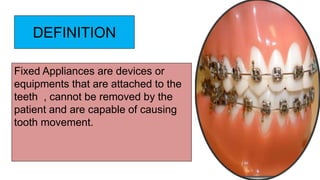
Fixed Appliances are devices or
equipments that are attached to the
teeth , cannot be removed by the
patient and are capable of causing
tooth movement.
INDICATIONS
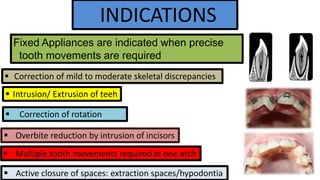
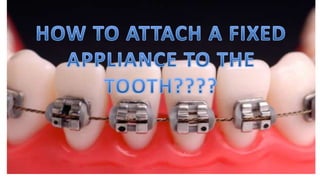
Fixed Appliances are indicated when precise
tooth movements are required
 Correction of mild to moderate skeletal discrepancies
 Intrusion/ Extrusion of teeh


Correction of rotation

 Overbite reduction by intrusion of incisors

 Multiple tooth movements required in one arch
 Active closure of spaces: extraction spaces/hypodontia
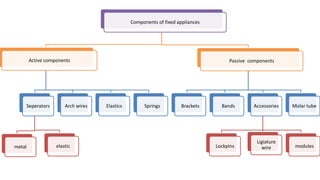
Components of fixed appliances

Active components

Seperators

metal

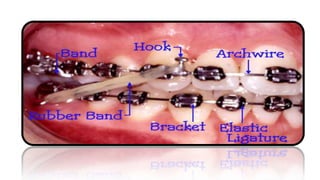
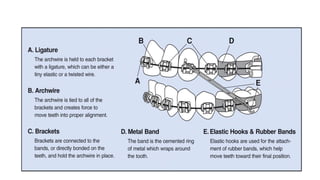
Arch wires

elastic

Passive components

Elastics

Springs

Brackets

Bands

Lockpins

Accessories

Molar tube

Ligiature
wire

modules
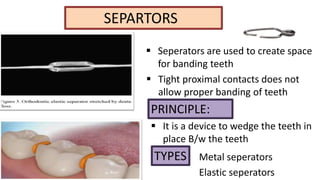
SEPARTORS
 Seperators are used to create space
for banding teeth
 Tight proximal contacts does not
allow proper banding of teeth

PRINCIPLE:
 It is a device to wedge the teeth in
place B/w the teeth

TYPES Metal seperators
Elastic seperators
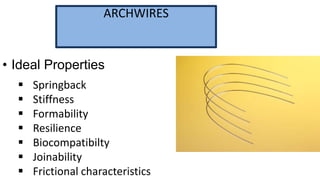
ARCHWIRES

• Ideal Properties








Springback
Stiffness
Formability
Resilience
Biocompatibilty
Joinability
Frictional characteristics
Materials
•
•
•
•
•

Stainless steel/ Cobalt chromium
Precious metal
Nickel-Titanium
Beta-Titanium
Composite Plastics
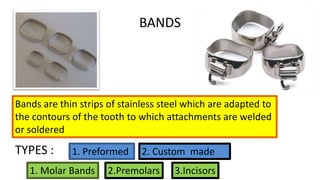
BANDS

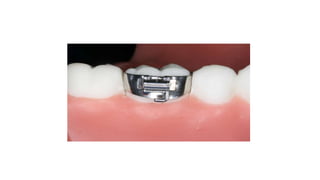
Bands are thin strips of stainless steel which are adapted to
the contours of the tooth to which attachments are welded
or soldered

TYPES :

1. Preformed

1. Molar Bands

2. Custom made

2.Premolars

3.Incisors
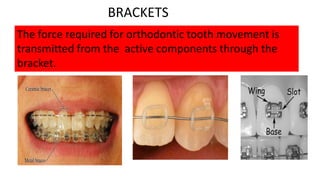
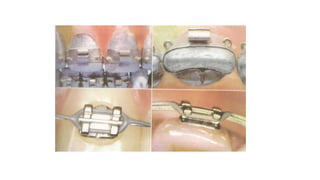
BRACKETS
The force required for orthodontic tooth movement is
transmitted from the active components through the
bracket.
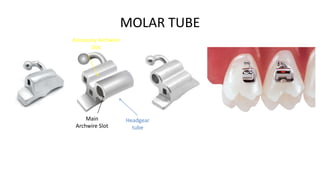
MOLAR TUBE
Accessory Archwire
Slot

Main
Archwire Slot

Headgear
tube
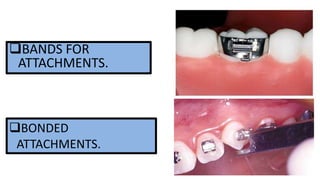
BANDS FOR
ATTACHMENTS.

BONDED
ATTACHMENTS.
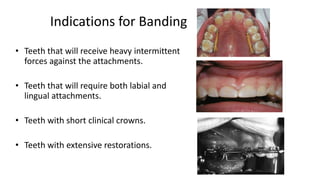
Indications for Banding
• Teeth that will receive heavy intermittent
forces against the attachments.
• Teeth that will require both labial and
lingual attachments.
• Teeth with short clinical crowns.

• Teeth with extensive restorations.
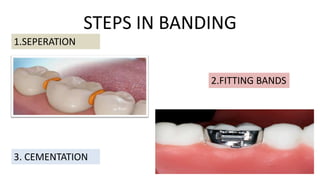
STEPS IN BANDING
1.SEPERATION

2.FITTING BANDS

3. CEMENTATION
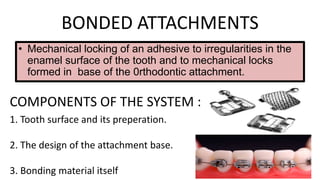
BONDED ATTACHMENTS
• Mechanical locking of an adhesive to irregularities in the
enamel surface of the tooth and to mechanical locks
formed in base of the 0rthodontic attachment.

COMPONENTS OF THE SYSTEM :
1. Tooth surface and its preperation.
2. The design of the attachment base.
3. Bonding material itself
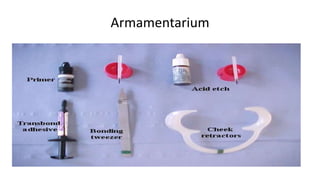
Armamentarium
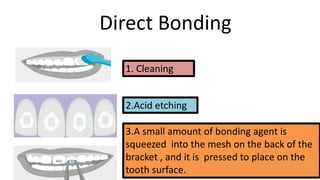
Direct Bonding
1. Cleaning
2.Acid etching
3.A small amount of bonding agent is
squeezed into the mesh on the back of the
bracket , and it is pressed to place on the
tooth surface.
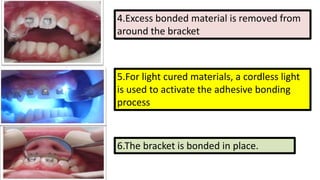
4.Excess bonded material is removed from
around the bracket

5.For light cured materials, a cordless light
is used to activate the adhesive bonding
process

6.The bracket is bonded in place.
Indirect Bonding
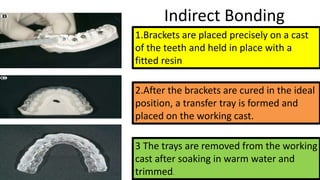
1.Brackets are placed precisely on a cast
of the teeth and held in place with a
fitted resin

2.After the brackets are cured in the ideal
position, a transfer tray is formed and
placed on the working cast.
3 The trays are removed from the working
cast after soaking in warm water and
trimmed.
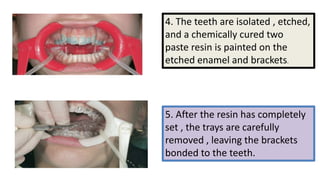
4. The teeth are isolated , etched,
and a chemically cured two
paste resin is painted on the
etched enamel and brackets.

5. After the resin has completely
set , the trays are carefully
removed , leaving the brackets
bonded to the teeth.
ACCURACY IN PLACEMENT!
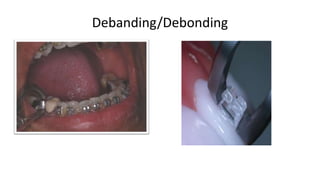
Debanding/Debonding
RULES!!!!!!
 Bonded attachements are almost always preferred for anterior
teeth and premolars .
 Bands usually are preferred for first molars , especially if both buccal
and lingual attachments are needed.
 Second molars are bonded if exposure of crown allows it , banded if
not.
 There is an increasing trend towards bonded attachments on all the
teeth ,however, especially in older patients who have longer clinical
crown and tighter contacts .
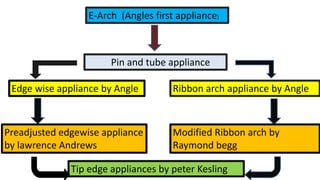
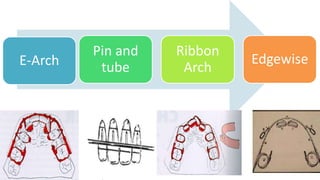
E-Arch (Angles first appliance)

Pin and tube appliance
Edge wise appliance by Angle

Preadjusted edgewise appliance
by lawrence Andrews

Ribbon arch appliance by Angle

Modified Ribbon arch by
Raymond begg

Tip edge appliances by peter Kesling
E-Arch

Pin and
tube

Ribbon
Arch

Edgewise
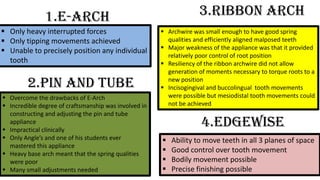
3.Ribbon Arch

1.E-Arch
 Only heavy interrupted forces
 Only tipping movements achieved
 Unable to precisely position any individual
tooth

2.Pin and Tube
 Overcome the drawbacks of E-Arch
 Incredible degree of craftsmanship was involved in
constructing and adjusting the pin and tube
appliance
 Impractical clinically
 Only Angle’s and one of his students ever
mastered this appliance
 Heavy base arch meant that the spring qualities
were poor
 Many small adjustments needed

 Archwire was small enough to have good spring
qualities and efficiently aligned malposed teeth
 Major weakness of the appliance was that it provided
relatively poor control of root position
 Resiliency of the ribbon archwire did not allow
generation of moments necessary to torque roots to a
new position
 Incisogingival and buccolingual tooth movements
were possible but mesiodistal tooth movements could
not be achieved

4.Edgewise





Ability to move teeth in all 3 planes of space
Good control over tooth movement
Bodily movement possible
Precise finishing possible
Bends

1st order

2nd order

3rd order
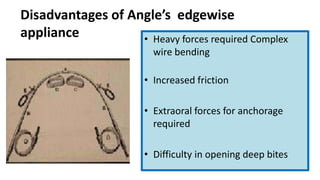
Disadvantages of Angle’s edgewise
appliance
• Heavy forces required Complex
wire bending
• Increased friction
• Extraoral forces for anchorage
required
• Difficulty in opening deep bites
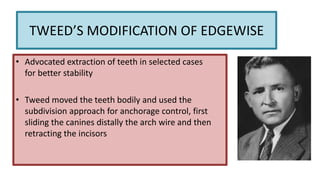
TWEED’S MODIFICATION OF EDGEWISE
• Advocated extraction of teeth in selected cases
for better stability
• Tweed moved the teeth bodily and used the
subdivision approach for anchorage control, first
sliding the canines distally the arch wire and then
retracting the incisors
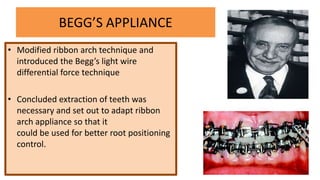
BEGG’S APPLIANCE
• Modified ribbon arch technique and
introduced the Begg’s light wire
differential force technique
• Concluded extraction of teeth was
necessary and set out to adapt ribbon
arch appliance so that it
could be used for better root positioning
control.
• Begg’s adaptation took 3 forms:
1. Replaced precious metal wire with high strength 16 mil stainless steel

2. Retained the original ribbon arch bracket but turned it upside down so that the
bracket slot pointed gingivally rather than occlusally
3. He added auxillary springs to the appliance for the control of root position
• Resulting in reduced friction as the area of contact between the narrow ribbon
arch bracket and the archwire was very small and the force of the wire was also
small
• Begg’s strategy for anchorage control was tipping/uprighting
LABIOLINGUAL, TWIN WIRE
• First half of the 20th century, Labiolingual appliance & Twinwire appliance
were major competing appliances for repositioning teeth

• Bands on first molars and a combination of heavy lingual and labial
archwires to which fingersprings were soldered to move individual teeth
 Labiolingual appliance
• Twin wire appliance used bands on incisors as well as
molars and featured twin 10mil steel archwires for
alignment of the incisor teeth.
• Delicate wires were protected with long tubes that
extended forward from the molars to the vicinity of
canines.

• None of these appliances were capable of more than
tipping
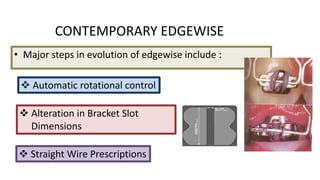
CONTEMPORARY EDGEWISE
• Major steps in evolution of edgewise include :
 Automatic rotational control
 Alteration in Bracket Slot
Dimensions
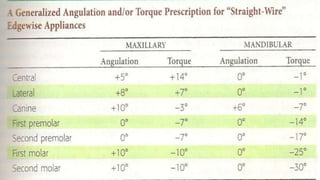
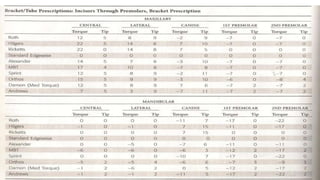
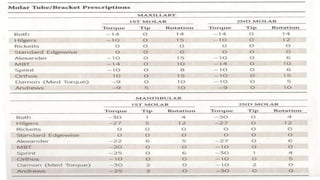
 Straight Wire Prescriptions
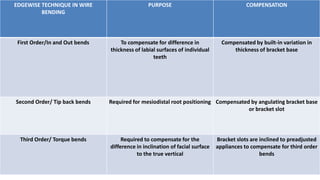
EDGEWISE TECHNIQUE IN WIRE
BENDING

PURPOSE

COMPENSATION

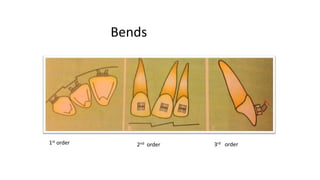
First Order/In and Out bends

To compensate for difference in
thickness of labial surfaces of individual
teeth

Compensated by built-in variation in
thickness of bracket base

Second Order/ Tip back bends

Required for mesiodistal root positioning Compensated by angulating bracket base
or bracket slot

Third Order/ Torque bends

Required to compensate for the
difference in inclination of facial surface
to the true vertical

Bracket slots are inclined to preadjusted
appliances to compensate for third order
bends
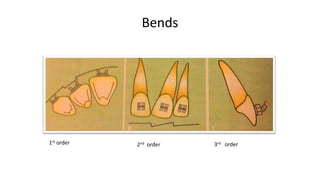
Bends

1st order

2nd order

3rd order
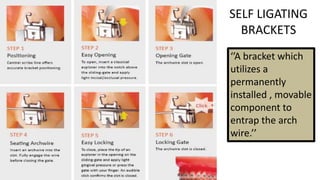
SELF LIGATING
BRACKETS
‘’A bracket which
utilizes a
permanently
installed , movable
component to
entrap the arch
wire.’’
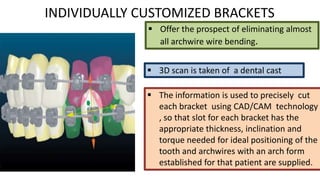
INDIVIDUALLY CUSTOMIZED BRACKETS
 Offer the prospect of eliminating almost
all archwire wire bending.
 3D scan is taken of a dental cast

 The information is used to precisely cut
each bracket using CAD/CAM technology
, so that slot for each bracket has the
appropriate thickness, inclination and
torque needed for ideal positioning of the
tooth and archwires with an arch form
established for that patient are supplied.
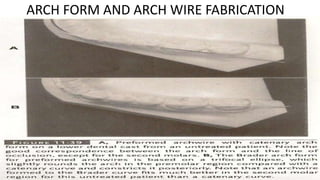
ARCH FORM AND ARCH WIRE FABRICATION
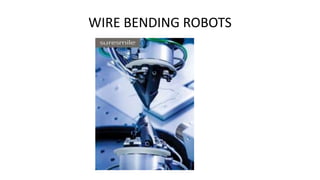
WIRE BENDING ROBOTS
ANY QUESTIONS???
Fixed appliances in orthodontics

Fixed appliances in orthodontics

  • 3.
    DEFINITION Fixed Appliances aredevices or equipments that are attached to the teeth , cannot be removed by the patient and are capable of causing tooth movement.
  • 4.
    INDICATIONS Fixed Appliances areindicated when precise tooth movements are required  Correction of mild to moderate skeletal discrepancies  Intrusion/ Extrusion of teeh  Correction of rotation  Overbite reduction by intrusion of incisors  Multiple tooth movements required in one arch  Active closure of spaces: extraction spaces/hypodontia
  • 6.
    Components of fixedappliances Active components Seperators metal Arch wires elastic Passive components Elastics Springs Brackets Bands Lockpins Accessories Molar tube Ligiature wire modules
  • 9.
    SEPARTORS  Seperators areused to create space for banding teeth  Tight proximal contacts does not allow proper banding of teeth PRINCIPLE:  It is a device to wedge the teeth in place B/w the teeth TYPES Metal seperators Elastic seperators
  • 10.
  • 11.
    Materials • • • • • Stainless steel/ Cobaltchromium Precious metal Nickel-Titanium Beta-Titanium Composite Plastics
  • 12.
    BANDS Bands are thinstrips of stainless steel which are adapted to the contours of the tooth to which attachments are welded or soldered TYPES : 1. Preformed 1. Molar Bands 2. Custom made 2.Premolars 3.Incisors
  • 14.
    BRACKETS The force requiredfor orthodontic tooth movement is transmitted from the active components through the bracket.
  • 15.
  • 17.
  • 18.
    Indications for Banding •Teeth that will receive heavy intermittent forces against the attachments. • Teeth that will require both labial and lingual attachments. • Teeth with short clinical crowns. • Teeth with extensive restorations.
  • 19.
  • 20.
    BONDED ATTACHMENTS • Mechanicallocking of an adhesive to irregularities in the enamel surface of the tooth and to mechanical locks formed in base of the 0rthodontic attachment. COMPONENTS OF THE SYSTEM : 1. Tooth surface and its preperation. 2. The design of the attachment base. 3. Bonding material itself
  • 21.
  • 22.
    Direct Bonding 1. Cleaning 2.Acidetching 3.A small amount of bonding agent is squeezed into the mesh on the back of the bracket , and it is pressed to place on the tooth surface.
  • 23.
    4.Excess bonded materialis removed from around the bracket 5.For light cured materials, a cordless light is used to activate the adhesive bonding process 6.The bracket is bonded in place.
  • 24.
    Indirect Bonding 1.Brackets areplaced precisely on a cast of the teeth and held in place with a fitted resin 2.After the brackets are cured in the ideal position, a transfer tray is formed and placed on the working cast. 3 The trays are removed from the working cast after soaking in warm water and trimmed.
  • 25.
    4. The teethare isolated , etched, and a chemically cured two paste resin is painted on the etched enamel and brackets. 5. After the resin has completely set , the trays are carefully removed , leaving the brackets bonded to the teeth.
  • 26.
  • 27.
  • 28.
    RULES!!!!!!  Bonded attachementsare almost always preferred for anterior teeth and premolars .  Bands usually are preferred for first molars , especially if both buccal and lingual attachments are needed.  Second molars are bonded if exposure of crown allows it , banded if not.  There is an increasing trend towards bonded attachments on all the teeth ,however, especially in older patients who have longer clinical crown and tighter contacts .
  • 30.
    E-Arch (Angles firstappliance) Pin and tube appliance Edge wise appliance by Angle Preadjusted edgewise appliance by lawrence Andrews Ribbon arch appliance by Angle Modified Ribbon arch by Raymond begg Tip edge appliances by peter Kesling
  • 32.
  • 33.
    3.Ribbon Arch 1.E-Arch  Onlyheavy interrupted forces  Only tipping movements achieved  Unable to precisely position any individual tooth 2.Pin and Tube  Overcome the drawbacks of E-Arch  Incredible degree of craftsmanship was involved in constructing and adjusting the pin and tube appliance  Impractical clinically  Only Angle’s and one of his students ever mastered this appliance  Heavy base arch meant that the spring qualities were poor  Many small adjustments needed  Archwire was small enough to have good spring qualities and efficiently aligned malposed teeth  Major weakness of the appliance was that it provided relatively poor control of root position  Resiliency of the ribbon archwire did not allow generation of moments necessary to torque roots to a new position  Incisogingival and buccolingual tooth movements were possible but mesiodistal tooth movements could not be achieved 4.Edgewise     Ability to move teeth in all 3 planes of space Good control over tooth movement Bodily movement possible Precise finishing possible
  • 34.
  • 36.
    Disadvantages of Angle’sedgewise appliance • Heavy forces required Complex wire bending • Increased friction • Extraoral forces for anchorage required • Difficulty in opening deep bites
  • 37.
    TWEED’S MODIFICATION OFEDGEWISE • Advocated extraction of teeth in selected cases for better stability • Tweed moved the teeth bodily and used the subdivision approach for anchorage control, first sliding the canines distally the arch wire and then retracting the incisors
  • 38.
    BEGG’S APPLIANCE • Modifiedribbon arch technique and introduced the Begg’s light wire differential force technique • Concluded extraction of teeth was necessary and set out to adapt ribbon arch appliance so that it could be used for better root positioning control.
  • 39.
    • Begg’s adaptationtook 3 forms: 1. Replaced precious metal wire with high strength 16 mil stainless steel 2. Retained the original ribbon arch bracket but turned it upside down so that the bracket slot pointed gingivally rather than occlusally 3. He added auxillary springs to the appliance for the control of root position • Resulting in reduced friction as the area of contact between the narrow ribbon arch bracket and the archwire was very small and the force of the wire was also small • Begg’s strategy for anchorage control was tipping/uprighting
  • 40.
    LABIOLINGUAL, TWIN WIRE •First half of the 20th century, Labiolingual appliance & Twinwire appliance were major competing appliances for repositioning teeth • Bands on first molars and a combination of heavy lingual and labial archwires to which fingersprings were soldered to move individual teeth  Labiolingual appliance
  • 41.
    • Twin wireappliance used bands on incisors as well as molars and featured twin 10mil steel archwires for alignment of the incisor teeth. • Delicate wires were protected with long tubes that extended forward from the molars to the vicinity of canines. • None of these appliances were capable of more than tipping
  • 42.
    CONTEMPORARY EDGEWISE • Majorsteps in evolution of edgewise include :  Automatic rotational control  Alteration in Bracket Slot Dimensions  Straight Wire Prescriptions
  • 43.
    EDGEWISE TECHNIQUE INWIRE BENDING PURPOSE COMPENSATION First Order/In and Out bends To compensate for difference in thickness of labial surfaces of individual teeth Compensated by built-in variation in thickness of bracket base Second Order/ Tip back bends Required for mesiodistal root positioning Compensated by angulating bracket base or bracket slot Third Order/ Torque bends Required to compensate for the difference in inclination of facial surface to the true vertical Bracket slots are inclined to preadjusted appliances to compensate for third order bends
  • 44.
  • 48.
    SELF LIGATING BRACKETS ‘’A bracketwhich utilizes a permanently installed , movable component to entrap the arch wire.’’
  • 49.
    INDIVIDUALLY CUSTOMIZED BRACKETS Offer the prospect of eliminating almost all archwire wire bending.  3D scan is taken of a dental cast  The information is used to precisely cut each bracket using CAD/CAM technology , so that slot for each bracket has the appropriate thickness, inclination and torque needed for ideal positioning of the tooth and archwires with an arch form established for that patient are supplied.
  • 50.
    ARCH FORM ANDARCH WIRE FABRICATION
  • 51.
  • 52.