Presented by:
Deeksha Bhanotia
PG II year
Department of Orthodontics & Dentofacial Orthopaedics
Guided by:
Dr. Mridula Trehan
Professor & Head
Contents
 Hand - Wrist Radiographs
 Cervical Vertebrae
 Frontal Sinus
 Mandibular Canine Calcification
 Mid-palatal Suture
• Bjork, Grave, Brown
Method
• Fishman Method
• Hagg and Taranger
Method
Introduction
Phulari BS, Orthodontics Principles and Practice, Edition 1;205-15
•Hagg andTaranger
Phulari BS, Orthodontics Principles and Practice, Edition 1;205-15
What is Growth?
&
Why to assess it?
“biologically and histologically is a
composite of morphogenetic and
histogenetic change occurring continuously
over a period of time in response to genetic
coding and environmental influences”.
Growth
Phulari BS, Orthodontics Principles and Practice, Edition 1;205-15
“To take advantage of the growth, we must have
some idea, first, of its amount, second of its
direction and third the element of timing”
Ricketts:
Along with this we need to know when the major growth
increments are likely to occur
Phulari BS, Orthodontics Principles and Practice, Edition 1;205-15
Combination
Why to Assess?
Growth is a critical factor in
Orthodontic and Orthopaedic Diagnosis Treatment Planning
&
Orthopaedic Intervention
OrthodonticTherapy
Orthognathic Surgery
Phulari BS, Orthodontics Principles and Practice, Edition 1;205-15
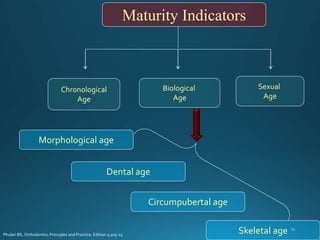
Biological
Age
Chronological
Age
Sexual
Age
Maturity Indicators
Morphological age
Dental age
Circumpubertal age
Skeletal age
Phulari BS, Orthodontics Principles and Practice, Edition 1;205-15
“Biological Clock”.
Phulari BS, Orthodontics Principles and Practice, Edition 1;205-15
 Hand - Wrist Radiographs
 Cervical Vertebrae
 Frontal Sinus
 Mandibular Canine Calcification
 Mid-palatal Suture
Phulari BS, Orthodontics Principles and Practice, Edition 1;205-15
• Todd Greulich & Pyle
• Bjork 8 development stages
• Grave and Brown 6 ossification centers
Phulari BS, Orthodontics Principles and Practice, Edition 1;205-15
• Fishman
• Hagg and Taranger 5 Stages of MP3 growth
• Tanner et al, Houston et al, Chapman Rajagopal et al,
Madhu et al
Phulari BS, Orthodontics Principles and Practice, Edition 1;205-15
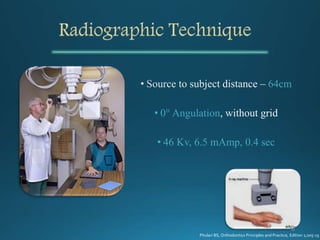
64cm
• 0° Angulation
• 46 Kv, 6.5 mAmp, 0.4 sec
Phulari BS, Orthodontics Principles and Practice, Edition 1;205-15
Bones of
Hand and
Wrist
Phulari BS, Orthodontics Principles and Practice, Edition 1;205-15
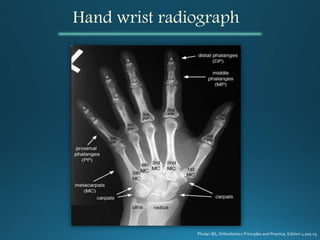
Hand wrist radiographs
• Hand wrist region:
- Made up of numerous small bones
• These bones show:
-Predictable & scheduled pattern of
appearance
-Ossification
-& union from birth to maturity.
Phulari BS, Orthodontics Principles and Practice, Edition 1;205-15
• Thus by merely comparing a patient’s hand wrist
radiograph with standard radiographs that represent
different skeletal ages, we will be able to determine the
skeletal maturation status of that individual.
Phulari BS, Orthodontics Principles and Practice, Edition 1;205-15
Hand wrist radiograph
Phulari BS, Orthodontics Principles and Practice, Edition 1;205-15
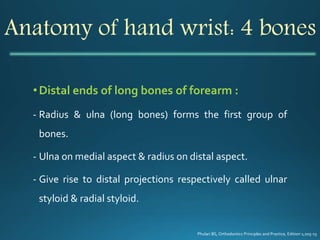
Anatomy of hand wrist: 4 bones
•Distal ends of long bones of forearm :
- Radius & ulna (long bones) forms the first group of
bones.
- Ulna on medial aspect & radius on distal aspect.
- Give rise to distal projections respectively called ulnar
styloid & radial styloid.
Phulari BS, Orthodontics Principles and Practice, Edition 1;205-15
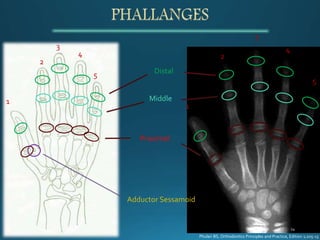
1
3
2
4
5
1
3
2
4
5
Proximal
Middle
Distal
Adductor Sessamoid
Phulari BS, Orthodontics Principles and Practice, Edition 1;205-15
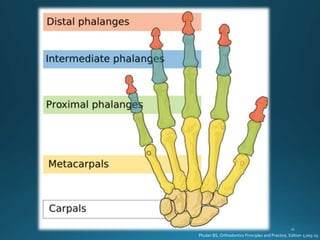
Phalanges
- Small bones forming the fingers.
- 3 in number in each finger, except thumb which has two
phalanges.
- The phalanges have a pattern of ossification which can be
divided in to three stages:
Stage 1: epiphysis and diaphysis are equal
Stage 2 : epiphysis caps diaphysis
Stage 3 : fusion occurs between epiphysis and diaphysis.
Phulari BS, Orthodontics Principles and Practice, Edition 1;205-15
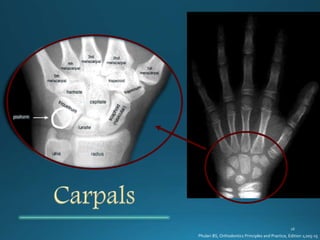
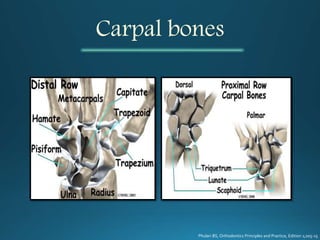
Carpal bones
Phulari BS, Orthodontics Principles and Practice, Edition 1;205-15
The Carpals
- 8 small, irregularly placed bones arranged in a proximal &
a distal row.
- Bones of proximal row: scaphoid, lunate, triquetral &
pisiform.
- Bones of distal row: trapezium, trapezoid, capitate &
hamate.
All these ossifies from one primary center.
Phulari BS, Orthodontics Principles and Practice, Edition 1;205-15
- 5 miniature long bones
- Forms the skeletal framework of palm of hand.
- 1 to 5 in number, thumb to little finger.
- Each metacarpal ossify from one primary center ( in its shaft)
& secondary center on distal end.
Metacarpals
Phulari BS, Orthodontics Principles and Practice, Edition 1;205-15
Indications of hand
wrist radiographs
Phulari BS, Orthodontics Principles and Practice, Edition 1;205-15
Commonly used methods are:
• Atlas Method by Greulich and Pyle
• Bjork, Grave and Brown Method
• Singer’s Method ofAssessment
• Fishman’s Skeletal Maturity Indicator
• Hagg andTaranger Method
Phulari BS, Orthodontics Principles and Practice, Edition 1;205-15
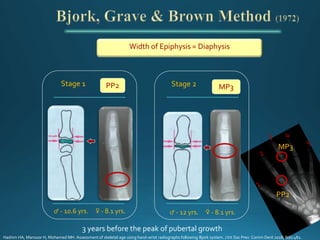
Width of Epiphysis = Diaphysis
PP2
Stage 1 MP3
Stage 2
PP2
MP3
3 years before the peak of pubertal growth
♂ - 10.6 yrs. ♀ - 8.1 yrs. ♂ - 12 yrs. ♀ - 8.1 yrs.
Hashim HA, Mansoor H, Mohamed MH. Assessment of skeletal age using hand-wrist radiographs following Bjork system. J Int Soc Prev Comm Dent 2018; 8(6):482.
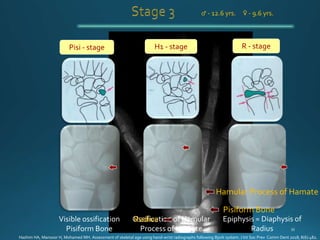
H1 - stage
Visible ossification
Pisiform Bone
Pisi - stage R - stage
Ossification of Hamular
Process of Hamate
Epiphysis = Diaphysis of
Radius
♂ - 12.6 yrs. ♀ - 9.6 yrs.
Pisiform Bone
Hamular Process of Hamate
Radius
Hashim HA, Mansoor H, Mohamed MH. Assessment of skeletal age using hand-wrist radiographs following Bjork system. J Int Soc Prev Comm Dent 2018; 8(6):482.
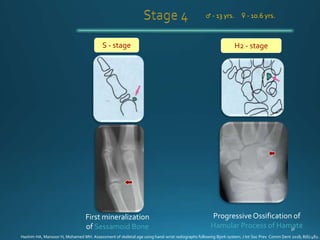
H2 - stage
First mineralization
of Sessamoid Bone
S - stage
ProgressiveOssification of
Hamular Process of Hamate
♂ - 13 yrs. ♀ - 10.6 yrs.
Hashim HA, Mansoor H, Mohamed MH. Assessment of skeletal age using hand-wrist radiographs following Bjork system. J Int Soc Prev Comm Dent 2018; 8(6):482.
1
3
2
4
5
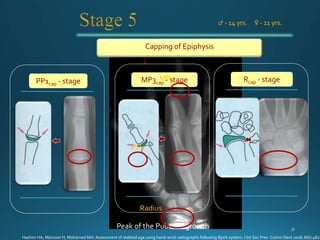
Capping of Epiphysis
PP1cap - stage MP3cap - stage
Peak of the Pubertal growth
♂ - 14 yrs. ♀ - 11 yrs.
Rcap - stage
PP1
MP3
Radius
Hashim HA, Mansoor H, Mohamed MH. Assessment of skeletal age using hand-wrist radiographs following Bjork system. J Int Soc Prev Comm Dent 2018; 8(6):482.
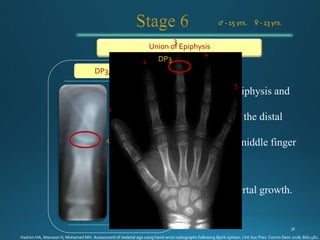
Union of Epiphysis
♂ - 15 yrs. ♀ - 13 yrs.
DP3u - stage
1
3
2
4
5
DP3
Hashim HA, Mansoor H, Mohamed MH. Assessment of skeletal age using hand-wrist radiographs following Bjork system. J Int Soc Prev Comm Dent 2018; 8(6):482.
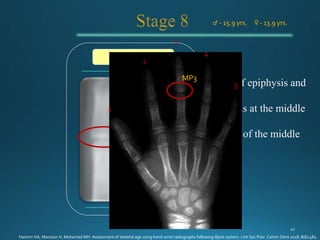
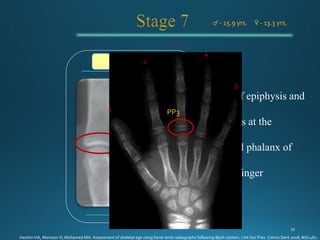
♂ - 15.9 yrs. ♀ - 13.3 yrs.
PP3u - stage
1
3
2
4
5
PP3
Hashim HA, Mansoor H, Mohamed MH. Assessment of skeletal age using hand-wrist radiographs following Bjork system. J Int Soc Prev Comm Dent 2018; 8(6):482.
♂ - 15.9 yrs. ♀ - 13.9 yrs.
MP3u - stage
1
3
2
4
5
MP3
Hashim HA, Mansoor H, Mohamed MH. Assessment of skeletal age using hand-wrist radiographs following Bjork system. J Int Soc Prev Comm Dent 2018; 8(6):482.
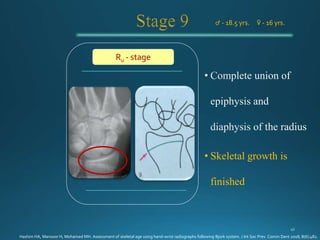
• Skeletal growth is
finished
♂ - 18.5 yrs. ♀ - 16 yrs.
Ru - stage
Hashim HA, Mansoor H, Mohamed MH. Assessment of skeletal age using hand-wrist radiographs following Bjork system. J Int Soc Prev Comm Dent 2018; 8(6):482.
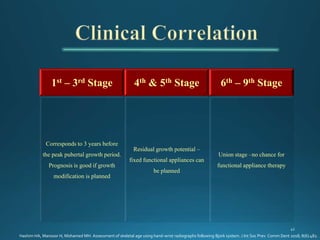
1st – 3rd Stage 4th & 5th Stage 6th – 9th Stage
Corresponds to 3 years before
the peak pubertal growth period.
Prognosis is good if growth
modification is planned
Residual growth potential –
fixed functional appliances can
be planned
Union stage –no chance for
functional appliance therapy
Hashim HA, Mansoor H, Mohamed MH. Assessment of skeletal age using hand-wrist radiographs following Bjork system. J Int Soc Prev Comm Dent 2018; 8(6):482.
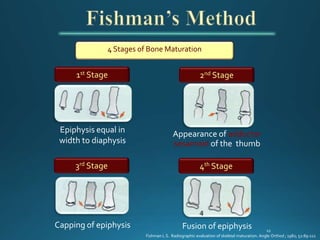
4 Stages of Bone Maturation
Epiphysis equal in
width to diaphysis
Appearance of adductor
sesamoid of the thumb
Capping of epiphysis Fusion of epiphysis
1st Stage 2nd Stage
3rd Stage 4th Stage
Fishman L S. Radiographic evaluation of skeletal maturation. Angle Orthod ; 1982; 52:89-111
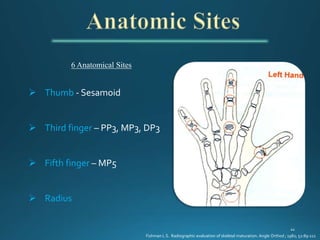
6 Anatomical Sites
 Thumb - Sesamoid
 Third finger – PP3, MP3, DP3
 Fifth finger – MP5
 Radius
Fishman L S. Radiographic evaluation of skeletal maturation. Angle Orthod ; 1982; 52:89-111
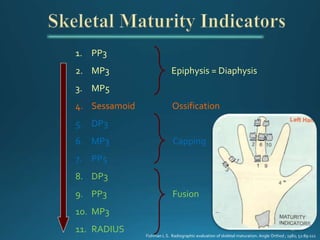
1. PP3
2. MP3 Epiphysis = Diaphysis
3. MP5
4. Sessamoid Ossification
5. DP3
6. MP3 Capping
7. PP5
8. DP3
9. PP3 Fusion
10. MP3
11. RADIUS
Fishman L S. Radiographic evaluation of skeletal maturation. Angle Orthod ; 1982; 52:89-111
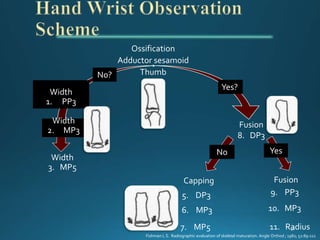
Ossification
Adductor sesamoid
Thumb
No?
Width
1. PP3
Width
2. MP3
Width
3. MP5
Yes?
Fusion
8. DP3
Capping Fusion
5. DP3
6. MP3
7. MP5
9. PP3
10. MP3
11. Radius
No Yes
Fishman L S. Radiographic evaluation of skeletal maturation. Angle Orthod ; 1982; 52:89-111
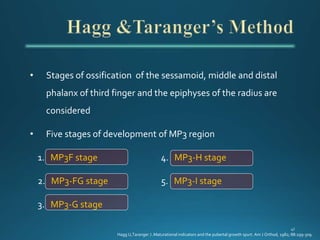
• Stages of ossification of the sessamoid, middle and distal
phalanx of third finger and the epiphyses of the radius are
considered
• Five stages of development of MP3 region
1. MP3F stage 4. MP3-H stage
2. MP3-FG stage 5. MP3-I stage
3. MP3-G stage
Hagg U,Taranger J .Maturational indicators and the pubertal growth spurt. Am J Orthod, 1982; 88:299-309.
Modified Hagg and Taranger
A comparison between cervical vertebrae and modified MP3 stages for the assessment of skeletal maturity J Nat Sci Bio Med 4(1):74-80
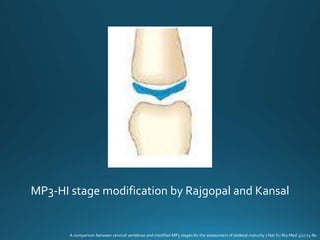
MP3-HI stage modification by Rajgopal and Kansal
A comparison between cervical vertebrae and modified MP3 stages for the assessment of skeletal maturity J Nat Sci Bio Med 4(1):74-80
Method by Greulich
and Pyle
• In 1937, an atlas, “Atlas of Skeletal Maturation of the Hand”
published byTodd.
• Greulich and Pyle based their atlas partly on the atlas by
Todd.
• Since their atlas was first published in 1950 they were able
to use all the radiographs obtained in the original study.
Widek T, Genet P, Ehammer T, Schwark T, Urschler M. Bone age estimation with the Greulich-Pyle atlas using 3T MR images of hand and wrist. Foren Sci Int 2021 ;319:110654.
• In order to determine the skeletal age using the modified Greulich
and Pyle method one uses the atlas that they have developed.
• The sex of the patient is one of the most important pieces of
information, because females develop quicker than males.
• The atlas is divided into two parts, one for the male patients and
one for the female patients.
• Each part contains standard radiographic images of the left hand
of children ordered by chronological age.
Widek T, Genet P, Ehammer T, Schwark T, Urschler M. Bone age estimation with the Greulich-Pyle atlas using 3T MR images of hand and wrist. Foren Sci Int 2021 ;319:110654.
• The first step in an analysis is to compare the given
radiograph with the image in the atlas that corresponds
closest with the chronological age of the patient.
• Next one should compare it with adjacent images
representing both younger and older children.
• When comparing the radiograph against an image in the
atlas there are certain features a physician should use as
maturity indicators.
Widek T, Genet P, Ehammer T, Schwark T, Urschler M. Bone age estimation with the Greulich-Pyle atlas using 3T MR images of hand and wrist. Foren Sci Int 2021 ;319:110654.
Singer’s method of assessment
- Stage1: (early):
- Stage 2: (prepubertal):
Singer J. Physiologic timing of orthodontic treatment. Angle Orthod 1980; 50:320-333.
- Stage 3: (pubertal onset):
- Stage 4: (pubertal
- Stage 5: (pubertal deaceleration):
- Stage 6: (growth completion
Singer J. Physiologic timing of orthodontic treatment. Angle Orthod 1980; 50:320-333.
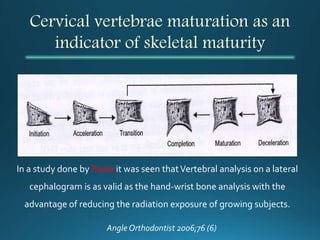
Cervical vertebrae maturation as an
indicator of skeletal maturity
In a study done by Paola it was seen thatVertebral analysis on a lateral
cephalogram is as valid as the hand-wrist bone analysis with the
advantage of reducing the radiation exposure of growing subjects.
Angle Orthodontist 2006;76 (6)
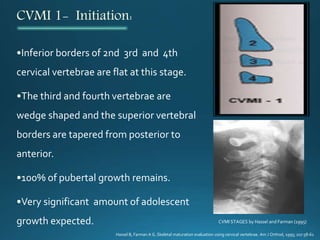
CVMI 1- Initiation:
•Inferior borders of 2nd 3rd and 4th
cervical vertebrae are flat at this stage.
•The third and fourth vertebrae are
wedge shaped and the superior vertebral
borders are tapered from posterior to
anterior.
•100% of pubertal growth remains.
•Very significant amount of adolescent
growth expected. CVMI STAGES by Hassel and Farman (1995)
Hassel B, Farman A G. Skeletal maturation evaluation using cervical vertebrae. Am J Orthod, 1995; 107:58-61
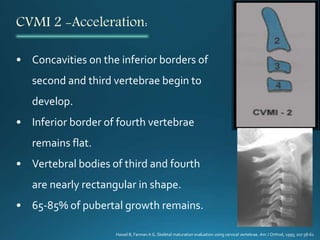
CVMI 2 -Acceleration:
• Concavities on the inferior borders of
second and third vertebrae begin to
develop.
• Inferior border of fourth vertebrae
remains flat.
• Vertebral bodies of third and fourth
are nearly rectangular in shape.
• 65-85% of pubertal growth remains.
Hassel B, Farman A G. Skeletal maturation evaluation using cervical vertebrae. Am J Orthod, 1995; 107:58-61
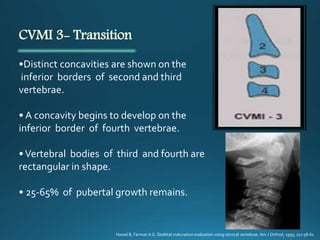
CVMI 3- Transition
•Distinct concavities are shown on the
inferior borders of second and third
vertebrae.
• A concavity begins to develop on the
inferior border of fourth vertebrae.
•Vertebral bodies of third and fourth are
rectangular in shape.
• 25-65% of pubertal growth remains.
Hassel B, Farman A G. Skeletal maturation evaluation using cervical vertebrae. Am J Orthod, 1995; 107:58-61
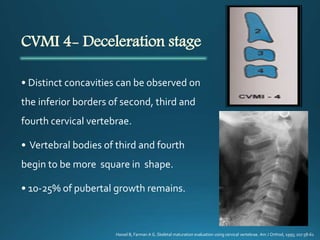
CVMI 4- Deceleration stage
• Distinct concavities can be observed on
the inferior borders of second, third and
fourth cervical vertebrae.
• Vertebral bodies of third and fourth
begin to be more square in shape.
• 10-25% of pubertal growth remains.
Hassel B, Farman A G. Skeletal maturation evaluation using cervical vertebrae. Am J Orthod, 1995; 107:58-61
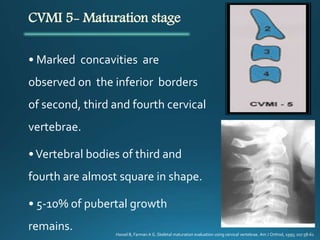
CVMI 5- Maturation stage
• Marked concavities are
observed on the inferior borders
of second, third and fourth cervical
vertebrae.
•Vertebral bodies of third and
fourth are almost square in shape.
• 5-10% of pubertal growth
remains. Hassel B, Farman A G. Skeletal maturation evaluation using cervical vertebrae. Am J Orthod, 1995; 107:58-61
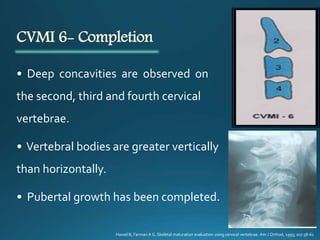
CVMI 6- Completion
• Deep concavities are observed on
the second, third and fourth cervical
vertebrae.
• Vertebral bodies are greater vertically
than horizontally.
• Pubertal growth has been completed.
Hassel B, Farman A G. Skeletal maturation evaluation using cervical vertebrae. Am J Orthod, 1995; 107:58-61
Frontal sinus development as an
indicator for somatic maturity at
puberty
Ruf and Pancherz (1996)
Sabine Ruf and Hans Pancherz evaluated the development of
the frontal sinus to the longitudinal data of the subject’s growth
charts.
Results showed that Frontal sinus growth velocity at puberty is
closely related to body height growth velocity.
Ruf S, Pancherz H. Frontal sinus development as an indicator for somatic maturity at puberty?. Am J Orthod Dentofac Orthop 1996 1;110(5):476-82.
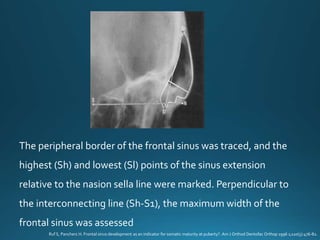
The peripheral border of the frontal sinus was traced, and the
highest (Sh) and lowest (Sl) points of the sinus extension
relative to the nasion sella line were marked. Perpendicular to
the interconnecting line (Sh-S1), the maximum width of the
frontal sinus was assessed
Ruf S, Pancherz H. Frontal sinus development as an indicator for somatic maturity at puberty?. Am J Orthod Dentofac Orthop 1996 1;110(5):476-82.
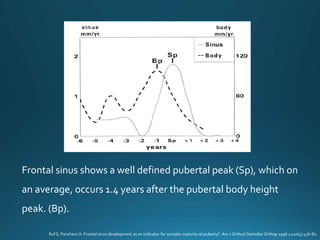
Frontal sinus shows a well defined pubertal peak (Sp), which on
an average, occurs 1.4 years after the pubertal body height
peak. (Bp).
Ruf S, Pancherz H. Frontal sinus development as an indicator for somatic maturity at puberty?. Am J Orthod Dentofac Orthop 1996 1;110(5):476-82.
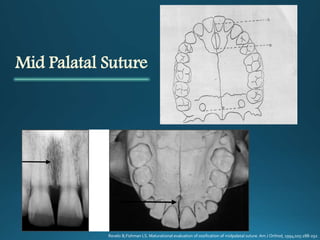
Mid Palatal Suture
Revelo B,Fishman LS. Maturational evaluation of ossification of midpalatal suture. Am J Orthod, 1994;105:288-292
 The purpose of this study was to determine whether a
positive correlation exists between adolescent
maturational development and the approximation of the
mid palatal suture
 The mid palatal suture is formed by three parts.These
include :
-Interpremaxillary
-Maxillary
-Interpalatine
Revelo B,Fishman LS. Maturational evaluation of ossification of midpalatal suture. Am J Orthod, 1994;105:288-292
 The following key landmarks and planes were
identified :
 Point A – most ant. point of the premaxilla
 Point B – most post. point on the posterior wall of
incisive foramen
 Point P – point tangent to a line connecting the
posterior walls of the greater palatine foramens
Revelo B,Fishman LS. Maturational evaluation of ossification of midpalatal suture. Am J Orthod, 1994;105:288-292
Result
 Stages of ossification of the midpalatal suture were
compared with the Fishman’s standards of skeletal
maturation indicators.
 Very little mid palatal approx. existed during SMI 1 – 2.
Revelo B,Fishman LS. Maturational evaluation of ossification of midpalatal suture. Am J Orthod, 1994;105:288-292
 Very large increases in approximation from SMI 8 –
11
 Maturational development is related to mid palatal
fusion in ways that can provide information to better
time maxillary expansion
 It is best to accomplish this before SMI 9 and ideal
time to initiate it is between SMI 1 – 4
Revelo B,Fishman LS. Maturational evaluation of ossification of midpalatal suture. Am J Orthod, 1994;105:288-292
References
• Fishman L S,” Radiographic evaluation of skeletal maturation”.Angle
Orthod ; 1982; 52:89-111
• A comparison between cervical vertebrae and modified MP3 stages for the
assessment of skeletal maturity. Journal of Natural Science Biology and
Medicine 4(1):74-80
• Hashim HA, Mansoor H, Mohamed MH. Assessment of skeletal age using
hand-wrist radiographs following Bjork system. J Int Soc Prev Comm Dent
2018; 8(6):482.
• Ruf S, Pancherz H. Frontal sinus development as an indicator for somatic
maturity at puberty?. Am J Orthod DentofacOrthop 1996 1;110(5):476-82.
• WidekT, Genet P, EhammerT, SchwarkT, Urschler M, Scheurer E. Bone age
estimation with the Greulich-Pyle atlas using 3T MR images of hand and
wrist. Foren Sci Int 2021 ;319:110654.
ThankYou

Hand Wrist Radiography

  • 1.
    Presented by: Deeksha Bhanotia PGII year Department of Orthodontics & Dentofacial Orthopaedics Guided by: Dr. Mridula Trehan Professor & Head
  • 2.
    Contents  Hand -Wrist Radiographs  Cervical Vertebrae  Frontal Sinus  Mandibular Canine Calcification  Mid-palatal Suture • Bjork, Grave, Brown Method • Fishman Method • Hagg and Taranger Method
  • 3.
    Introduction Phulari BS, OrthodonticsPrinciples and Practice, Edition 1;205-15
  • 4.
    Phulari BS, OrthodonticsPrinciples and Practice, Edition 1;205-15
  • 5.
    Phulari BS, OrthodonticsPrinciples and Practice, Edition 1;205-15
  • 6.
    •Hagg andTaranger Phulari BS,Orthodontics Principles and Practice, Edition 1;205-15
  • 7.
    What is Growth? & Whyto assess it?
  • 8.
    “biologically and histologicallyis a composite of morphogenetic and histogenetic change occurring continuously over a period of time in response to genetic coding and environmental influences”. Growth Phulari BS, Orthodontics Principles and Practice, Edition 1;205-15
  • 9.
    “To take advantageof the growth, we must have some idea, first, of its amount, second of its direction and third the element of timing” Ricketts: Along with this we need to know when the major growth increments are likely to occur Phulari BS, Orthodontics Principles and Practice, Edition 1;205-15
  • 10.
    Combination Why to Assess? Growthis a critical factor in Orthodontic and Orthopaedic Diagnosis Treatment Planning & Orthopaedic Intervention OrthodonticTherapy Orthognathic Surgery Phulari BS, Orthodontics Principles and Practice, Edition 1;205-15
  • 11.
    Biological Age Chronological Age Sexual Age Maturity Indicators Morphological age Dentalage Circumpubertal age Skeletal age Phulari BS, Orthodontics Principles and Practice, Edition 1;205-15
  • 12.
    Phulari BS, OrthodonticsPrinciples and Practice, Edition 1;205-15
  • 13.
    “Biological Clock”. Phulari BS,Orthodontics Principles and Practice, Edition 1;205-15
  • 14.
     Hand -Wrist Radiographs  Cervical Vertebrae  Frontal Sinus  Mandibular Canine Calcification  Mid-palatal Suture Phulari BS, Orthodontics Principles and Practice, Edition 1;205-15
  • 15.
    • Todd Greulich& Pyle • Bjork 8 development stages • Grave and Brown 6 ossification centers Phulari BS, Orthodontics Principles and Practice, Edition 1;205-15
  • 16.
    • Fishman • Haggand Taranger 5 Stages of MP3 growth • Tanner et al, Houston et al, Chapman Rajagopal et al, Madhu et al Phulari BS, Orthodontics Principles and Practice, Edition 1;205-15
  • 17.
    64cm • 0° Angulation •46 Kv, 6.5 mAmp, 0.4 sec Phulari BS, Orthodontics Principles and Practice, Edition 1;205-15
  • 18.
    Bones of Hand and Wrist PhulariBS, Orthodontics Principles and Practice, Edition 1;205-15
  • 19.
    Hand wrist radiographs •Hand wrist region: - Made up of numerous small bones • These bones show: -Predictable & scheduled pattern of appearance -Ossification -& union from birth to maturity. Phulari BS, Orthodontics Principles and Practice, Edition 1;205-15
  • 20.
    • Thus bymerely comparing a patient’s hand wrist radiograph with standard radiographs that represent different skeletal ages, we will be able to determine the skeletal maturation status of that individual. Phulari BS, Orthodontics Principles and Practice, Edition 1;205-15
  • 21.
    Phulari BS, OrthodonticsPrinciples and Practice, Edition 1;205-15
  • 22.
    Hand wrist radiograph PhulariBS, Orthodontics Principles and Practice, Edition 1;205-15
  • 23.
    Anatomy of handwrist: 4 bones •Distal ends of long bones of forearm : - Radius & ulna (long bones) forms the first group of bones. - Ulna on medial aspect & radius on distal aspect. - Give rise to distal projections respectively called ulnar styloid & radial styloid. Phulari BS, Orthodontics Principles and Practice, Edition 1;205-15
  • 24.
    1 3 2 4 5 1 3 2 4 5 Proximal Middle Distal Adductor Sessamoid Phulari BS,Orthodontics Principles and Practice, Edition 1;205-15
  • 25.
    Phalanges - Small bonesforming the fingers. - 3 in number in each finger, except thumb which has two phalanges. - The phalanges have a pattern of ossification which can be divided in to three stages: Stage 1: epiphysis and diaphysis are equal Stage 2 : epiphysis caps diaphysis Stage 3 : fusion occurs between epiphysis and diaphysis. Phulari BS, Orthodontics Principles and Practice, Edition 1;205-15
  • 26.
    Phulari BS, OrthodonticsPrinciples and Practice, Edition 1;205-15
  • 27.
    Carpal bones Phulari BS,Orthodontics Principles and Practice, Edition 1;205-15
  • 28.
    The Carpals - 8small, irregularly placed bones arranged in a proximal & a distal row. - Bones of proximal row: scaphoid, lunate, triquetral & pisiform. - Bones of distal row: trapezium, trapezoid, capitate & hamate. All these ossifies from one primary center. Phulari BS, Orthodontics Principles and Practice, Edition 1;205-15
  • 29.
    - 5 miniaturelong bones - Forms the skeletal framework of palm of hand. - 1 to 5 in number, thumb to little finger. - Each metacarpal ossify from one primary center ( in its shaft) & secondary center on distal end. Metacarpals Phulari BS, Orthodontics Principles and Practice, Edition 1;205-15
  • 30.
    Indications of hand wristradiographs Phulari BS, Orthodontics Principles and Practice, Edition 1;205-15
  • 31.
    Phulari BS, OrthodonticsPrinciples and Practice, Edition 1;205-15
  • 32.
    Phulari BS, OrthodonticsPrinciples and Practice, Edition 1;205-15
  • 33.
    Commonly used methodsare: • Atlas Method by Greulich and Pyle • Bjork, Grave and Brown Method • Singer’s Method ofAssessment • Fishman’s Skeletal Maturity Indicator • Hagg andTaranger Method Phulari BS, Orthodontics Principles and Practice, Edition 1;205-15
  • 34.
    Width of Epiphysis= Diaphysis PP2 Stage 1 MP3 Stage 2 PP2 MP3 3 years before the peak of pubertal growth ♂ - 10.6 yrs. ♀ - 8.1 yrs. ♂ - 12 yrs. ♀ - 8.1 yrs. Hashim HA, Mansoor H, Mohamed MH. Assessment of skeletal age using hand-wrist radiographs following Bjork system. J Int Soc Prev Comm Dent 2018; 8(6):482.
  • 35.
    H1 - stage Visibleossification Pisiform Bone Pisi - stage R - stage Ossification of Hamular Process of Hamate Epiphysis = Diaphysis of Radius ♂ - 12.6 yrs. ♀ - 9.6 yrs. Pisiform Bone Hamular Process of Hamate Radius Hashim HA, Mansoor H, Mohamed MH. Assessment of skeletal age using hand-wrist radiographs following Bjork system. J Int Soc Prev Comm Dent 2018; 8(6):482.
  • 36.
    H2 - stage Firstmineralization of Sessamoid Bone S - stage ProgressiveOssification of Hamular Process of Hamate ♂ - 13 yrs. ♀ - 10.6 yrs. Hashim HA, Mansoor H, Mohamed MH. Assessment of skeletal age using hand-wrist radiographs following Bjork system. J Int Soc Prev Comm Dent 2018; 8(6):482.
  • 37.
    1 3 2 4 5 Capping of Epiphysis PP1cap- stage MP3cap - stage Peak of the Pubertal growth ♂ - 14 yrs. ♀ - 11 yrs. Rcap - stage PP1 MP3 Radius Hashim HA, Mansoor H, Mohamed MH. Assessment of skeletal age using hand-wrist radiographs following Bjork system. J Int Soc Prev Comm Dent 2018; 8(6):482.
  • 38.
    Union of Epiphysis ♂- 15 yrs. ♀ - 13 yrs. DP3u - stage 1 3 2 4 5 DP3 Hashim HA, Mansoor H, Mohamed MH. Assessment of skeletal age using hand-wrist radiographs following Bjork system. J Int Soc Prev Comm Dent 2018; 8(6):482.
  • 39.
    ♂ - 15.9yrs. ♀ - 13.3 yrs. PP3u - stage 1 3 2 4 5 PP3 Hashim HA, Mansoor H, Mohamed MH. Assessment of skeletal age using hand-wrist radiographs following Bjork system. J Int Soc Prev Comm Dent 2018; 8(6):482.
  • 40.
    ♂ - 15.9yrs. ♀ - 13.9 yrs. MP3u - stage 1 3 2 4 5 MP3 Hashim HA, Mansoor H, Mohamed MH. Assessment of skeletal age using hand-wrist radiographs following Bjork system. J Int Soc Prev Comm Dent 2018; 8(6):482.
  • 41.
    • Skeletal growthis finished ♂ - 18.5 yrs. ♀ - 16 yrs. Ru - stage Hashim HA, Mansoor H, Mohamed MH. Assessment of skeletal age using hand-wrist radiographs following Bjork system. J Int Soc Prev Comm Dent 2018; 8(6):482.
  • 42.
    1st – 3rdStage 4th & 5th Stage 6th – 9th Stage Corresponds to 3 years before the peak pubertal growth period. Prognosis is good if growth modification is planned Residual growth potential – fixed functional appliances can be planned Union stage –no chance for functional appliance therapy Hashim HA, Mansoor H, Mohamed MH. Assessment of skeletal age using hand-wrist radiographs following Bjork system. J Int Soc Prev Comm Dent 2018; 8(6):482.
  • 43.
    4 Stages ofBone Maturation Epiphysis equal in width to diaphysis Appearance of adductor sesamoid of the thumb Capping of epiphysis Fusion of epiphysis 1st Stage 2nd Stage 3rd Stage 4th Stage Fishman L S. Radiographic evaluation of skeletal maturation. Angle Orthod ; 1982; 52:89-111
  • 44.
    6 Anatomical Sites Thumb - Sesamoid  Third finger – PP3, MP3, DP3  Fifth finger – MP5  Radius Fishman L S. Radiographic evaluation of skeletal maturation. Angle Orthod ; 1982; 52:89-111
  • 45.
    1. PP3 2. MP3Epiphysis = Diaphysis 3. MP5 4. Sessamoid Ossification 5. DP3 6. MP3 Capping 7. PP5 8. DP3 9. PP3 Fusion 10. MP3 11. RADIUS Fishman L S. Radiographic evaluation of skeletal maturation. Angle Orthod ; 1982; 52:89-111
  • 46.
    Ossification Adductor sesamoid Thumb No? Width 1. PP3 Width 2.MP3 Width 3. MP5 Yes? Fusion 8. DP3 Capping Fusion 5. DP3 6. MP3 7. MP5 9. PP3 10. MP3 11. Radius No Yes Fishman L S. Radiographic evaluation of skeletal maturation. Angle Orthod ; 1982; 52:89-111
  • 47.
    • Stages ofossification of the sessamoid, middle and distal phalanx of third finger and the epiphyses of the radius are considered • Five stages of development of MP3 region 1. MP3F stage 4. MP3-H stage 2. MP3-FG stage 5. MP3-I stage 3. MP3-G stage Hagg U,Taranger J .Maturational indicators and the pubertal growth spurt. Am J Orthod, 1982; 88:299-309.
  • 48.
    Modified Hagg andTaranger A comparison between cervical vertebrae and modified MP3 stages for the assessment of skeletal maturity J Nat Sci Bio Med 4(1):74-80
  • 49.
    A comparison betweencervical vertebrae and modified MP3 stages for the assessment of skeletal maturity J Nat Sci Bio Med 4(1):74-80
  • 50.
    MP3-HI stage modificationby Rajgopal and Kansal A comparison between cervical vertebrae and modified MP3 stages for the assessment of skeletal maturity J Nat Sci Bio Med 4(1):74-80
  • 51.
    Method by Greulich andPyle • In 1937, an atlas, “Atlas of Skeletal Maturation of the Hand” published byTodd. • Greulich and Pyle based their atlas partly on the atlas by Todd. • Since their atlas was first published in 1950 they were able to use all the radiographs obtained in the original study. Widek T, Genet P, Ehammer T, Schwark T, Urschler M. Bone age estimation with the Greulich-Pyle atlas using 3T MR images of hand and wrist. Foren Sci Int 2021 ;319:110654.
  • 52.
    • In orderto determine the skeletal age using the modified Greulich and Pyle method one uses the atlas that they have developed. • The sex of the patient is one of the most important pieces of information, because females develop quicker than males. • The atlas is divided into two parts, one for the male patients and one for the female patients. • Each part contains standard radiographic images of the left hand of children ordered by chronological age. Widek T, Genet P, Ehammer T, Schwark T, Urschler M. Bone age estimation with the Greulich-Pyle atlas using 3T MR images of hand and wrist. Foren Sci Int 2021 ;319:110654.
  • 53.
    • The firststep in an analysis is to compare the given radiograph with the image in the atlas that corresponds closest with the chronological age of the patient. • Next one should compare it with adjacent images representing both younger and older children. • When comparing the radiograph against an image in the atlas there are certain features a physician should use as maturity indicators. Widek T, Genet P, Ehammer T, Schwark T, Urschler M. Bone age estimation with the Greulich-Pyle atlas using 3T MR images of hand and wrist. Foren Sci Int 2021 ;319:110654.
  • 54.
    Singer’s method ofassessment - Stage1: (early): - Stage 2: (prepubertal): Singer J. Physiologic timing of orthodontic treatment. Angle Orthod 1980; 50:320-333.
  • 55.
    - Stage 3:(pubertal onset): - Stage 4: (pubertal - Stage 5: (pubertal deaceleration): - Stage 6: (growth completion Singer J. Physiologic timing of orthodontic treatment. Angle Orthod 1980; 50:320-333.
  • 56.
    Cervical vertebrae maturationas an indicator of skeletal maturity In a study done by Paola it was seen thatVertebral analysis on a lateral cephalogram is as valid as the hand-wrist bone analysis with the advantage of reducing the radiation exposure of growing subjects. Angle Orthodontist 2006;76 (6)
  • 57.
    CVMI 1- Initiation: •Inferiorborders of 2nd 3rd and 4th cervical vertebrae are flat at this stage. •The third and fourth vertebrae are wedge shaped and the superior vertebral borders are tapered from posterior to anterior. •100% of pubertal growth remains. •Very significant amount of adolescent growth expected. CVMI STAGES by Hassel and Farman (1995) Hassel B, Farman A G. Skeletal maturation evaluation using cervical vertebrae. Am J Orthod, 1995; 107:58-61
  • 58.
    CVMI 2 -Acceleration: •Concavities on the inferior borders of second and third vertebrae begin to develop. • Inferior border of fourth vertebrae remains flat. • Vertebral bodies of third and fourth are nearly rectangular in shape. • 65-85% of pubertal growth remains. Hassel B, Farman A G. Skeletal maturation evaluation using cervical vertebrae. Am J Orthod, 1995; 107:58-61
  • 59.
    CVMI 3- Transition •Distinctconcavities are shown on the inferior borders of second and third vertebrae. • A concavity begins to develop on the inferior border of fourth vertebrae. •Vertebral bodies of third and fourth are rectangular in shape. • 25-65% of pubertal growth remains. Hassel B, Farman A G. Skeletal maturation evaluation using cervical vertebrae. Am J Orthod, 1995; 107:58-61
  • 60.
    CVMI 4- Decelerationstage • Distinct concavities can be observed on the inferior borders of second, third and fourth cervical vertebrae. • Vertebral bodies of third and fourth begin to be more square in shape. • 10-25% of pubertal growth remains. Hassel B, Farman A G. Skeletal maturation evaluation using cervical vertebrae. Am J Orthod, 1995; 107:58-61
  • 61.
    CVMI 5- Maturationstage • Marked concavities are observed on the inferior borders of second, third and fourth cervical vertebrae. •Vertebral bodies of third and fourth are almost square in shape. • 5-10% of pubertal growth remains. Hassel B, Farman A G. Skeletal maturation evaluation using cervical vertebrae. Am J Orthod, 1995; 107:58-61
  • 62.
    CVMI 6- Completion •Deep concavities are observed on the second, third and fourth cervical vertebrae. • Vertebral bodies are greater vertically than horizontally. • Pubertal growth has been completed. Hassel B, Farman A G. Skeletal maturation evaluation using cervical vertebrae. Am J Orthod, 1995; 107:58-61
  • 63.
    Frontal sinus developmentas an indicator for somatic maturity at puberty Ruf and Pancherz (1996) Sabine Ruf and Hans Pancherz evaluated the development of the frontal sinus to the longitudinal data of the subject’s growth charts. Results showed that Frontal sinus growth velocity at puberty is closely related to body height growth velocity. Ruf S, Pancherz H. Frontal sinus development as an indicator for somatic maturity at puberty?. Am J Orthod Dentofac Orthop 1996 1;110(5):476-82.
  • 64.
    The peripheral borderof the frontal sinus was traced, and the highest (Sh) and lowest (Sl) points of the sinus extension relative to the nasion sella line were marked. Perpendicular to the interconnecting line (Sh-S1), the maximum width of the frontal sinus was assessed Ruf S, Pancherz H. Frontal sinus development as an indicator for somatic maturity at puberty?. Am J Orthod Dentofac Orthop 1996 1;110(5):476-82.
  • 65.
    Frontal sinus showsa well defined pubertal peak (Sp), which on an average, occurs 1.4 years after the pubertal body height peak. (Bp). Ruf S, Pancherz H. Frontal sinus development as an indicator for somatic maturity at puberty?. Am J Orthod Dentofac Orthop 1996 1;110(5):476-82.
  • 66.
    Mid Palatal Suture ReveloB,Fishman LS. Maturational evaluation of ossification of midpalatal suture. Am J Orthod, 1994;105:288-292
  • 67.
     The purposeof this study was to determine whether a positive correlation exists between adolescent maturational development and the approximation of the mid palatal suture  The mid palatal suture is formed by three parts.These include : -Interpremaxillary -Maxillary -Interpalatine Revelo B,Fishman LS. Maturational evaluation of ossification of midpalatal suture. Am J Orthod, 1994;105:288-292
  • 68.
     The followingkey landmarks and planes were identified :  Point A – most ant. point of the premaxilla  Point B – most post. point on the posterior wall of incisive foramen  Point P – point tangent to a line connecting the posterior walls of the greater palatine foramens Revelo B,Fishman LS. Maturational evaluation of ossification of midpalatal suture. Am J Orthod, 1994;105:288-292
  • 69.
    Result  Stages ofossification of the midpalatal suture were compared with the Fishman’s standards of skeletal maturation indicators.  Very little mid palatal approx. existed during SMI 1 – 2. Revelo B,Fishman LS. Maturational evaluation of ossification of midpalatal suture. Am J Orthod, 1994;105:288-292
  • 70.
     Very largeincreases in approximation from SMI 8 – 11  Maturational development is related to mid palatal fusion in ways that can provide information to better time maxillary expansion  It is best to accomplish this before SMI 9 and ideal time to initiate it is between SMI 1 – 4 Revelo B,Fishman LS. Maturational evaluation of ossification of midpalatal suture. Am J Orthod, 1994;105:288-292
  • 71.
  • 72.
    • Fishman LS,” Radiographic evaluation of skeletal maturation”.Angle Orthod ; 1982; 52:89-111 • A comparison between cervical vertebrae and modified MP3 stages for the assessment of skeletal maturity. Journal of Natural Science Biology and Medicine 4(1):74-80 • Hashim HA, Mansoor H, Mohamed MH. Assessment of skeletal age using hand-wrist radiographs following Bjork system. J Int Soc Prev Comm Dent 2018; 8(6):482. • Ruf S, Pancherz H. Frontal sinus development as an indicator for somatic maturity at puberty?. Am J Orthod DentofacOrthop 1996 1;110(5):476-82. • WidekT, Genet P, EhammerT, SchwarkT, Urschler M, Scheurer E. Bone age estimation with the Greulich-Pyle atlas using 3T MR images of hand and wrist. Foren Sci Int 2021 ;319:110654.
  • 73.