Changing
Learning
Environments
 In those schools and teacher education
institutions in the region that have fully
embraced e-learning, continuing new
developments in ICT are bringing about
yet further changes in delivery of
education, in pedagogy and student
approaches to learning
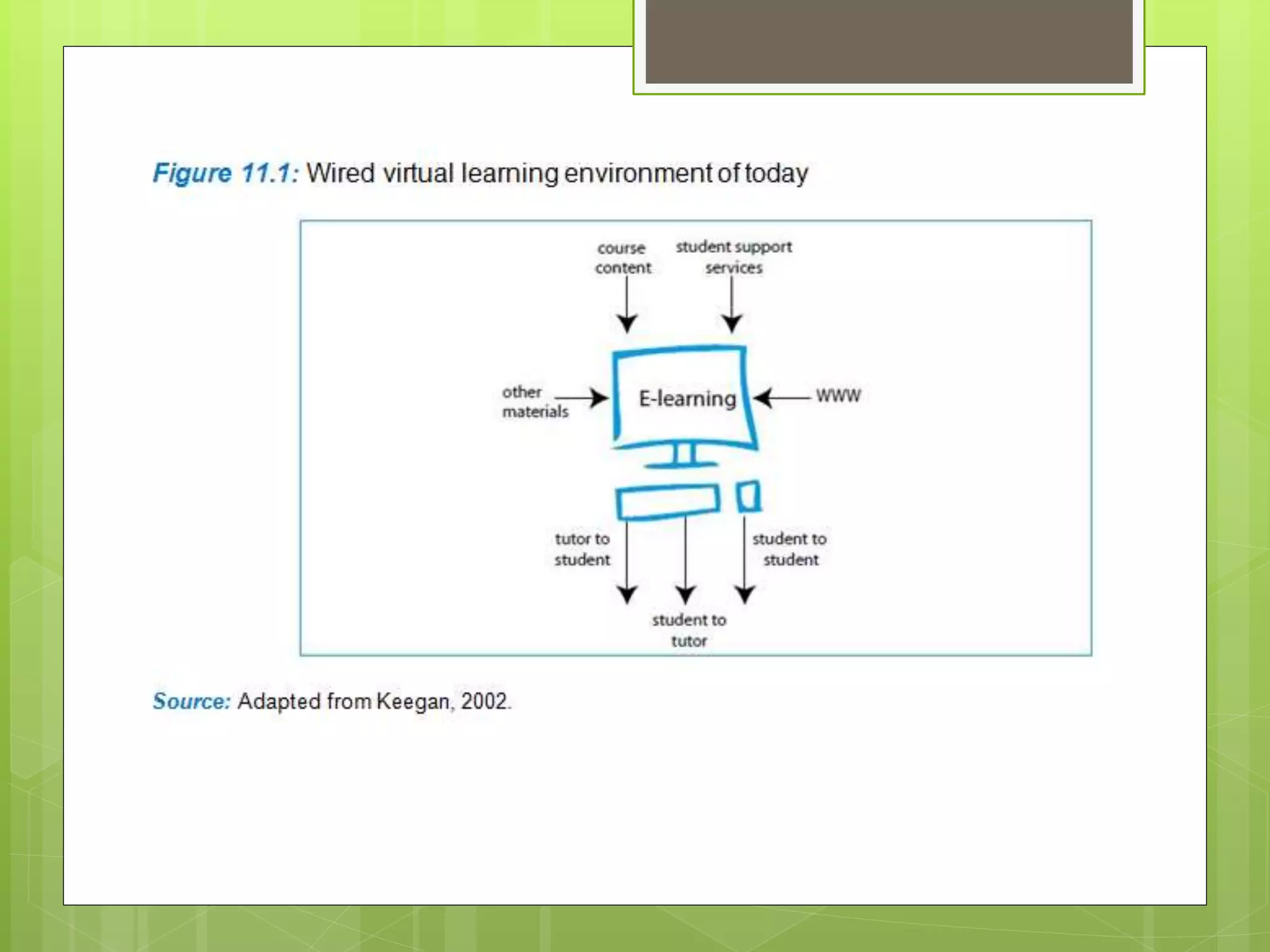
Figure
11.1 depicts this learning environment of today in
educational institutions that are well
advanced along the pathway of ICT integration
 Communication between tutor and student,
between student and tutor, and between student
and student is a combination of online and face-to-
face, whichever is the more appropriate for
particular occasions.
 The learning environment is characterized as
“wired” with students accessing workstations in
generally fixed locations, within educational
institutions and at home, in both cases with fixed
links to internet service providers
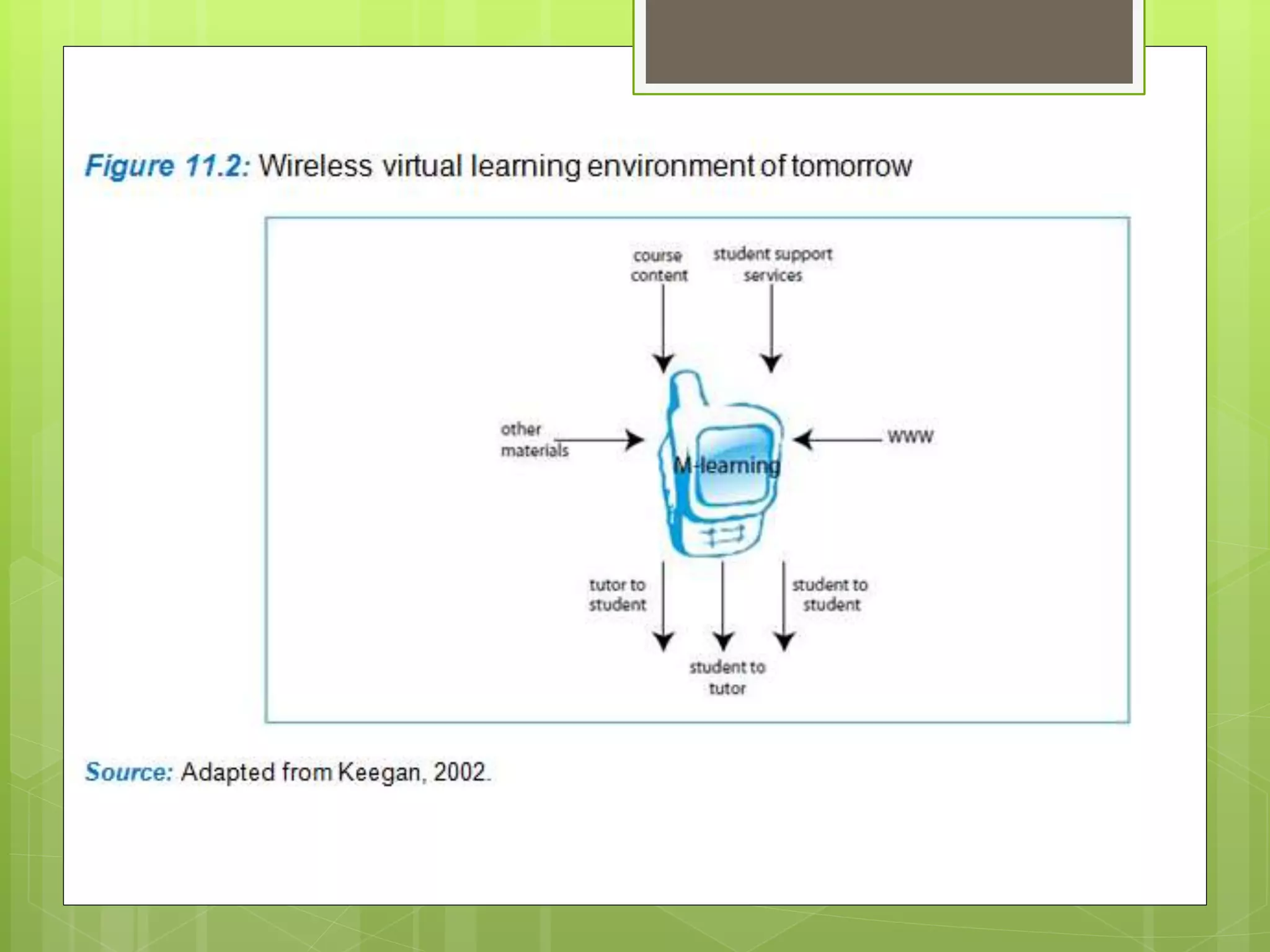
depicted in
Figure 11.2, has a richer mix
 Overlaid on all that is occurring today is a
proliferation of mobile learning-enabled
technologies
 In some educational institutions in the Asia-
Pacific region, the picture of tomorrow shown
in Figure 11.2 is already happening
 The learning environment here is
characterized as wireless, as students access
learning materials from the web and other
sources, and communicate with tutors and
fellow students from wherever they happen to
be and at whatever times they wish.
LEARNING
ENVIRONMENT BROUGHT ABOUT BY NEW
DEVELOPMENTS IN ICT AND CHANGING
PEDAGOGICAL
PRACTICES, CONCLUDING WITH OUR VIEW OF
WHAT IS REQUIRED TO TRANSFORM
CLASSROOM AND SCHOOL
PRACTICE.
Interactive learning with
whiteboards
 Blackboards have been a standard feature in
classrooms since they were invented in 1801.
 Then the whiteboard was introduced with its
marker pens that eliminated messy chalk.
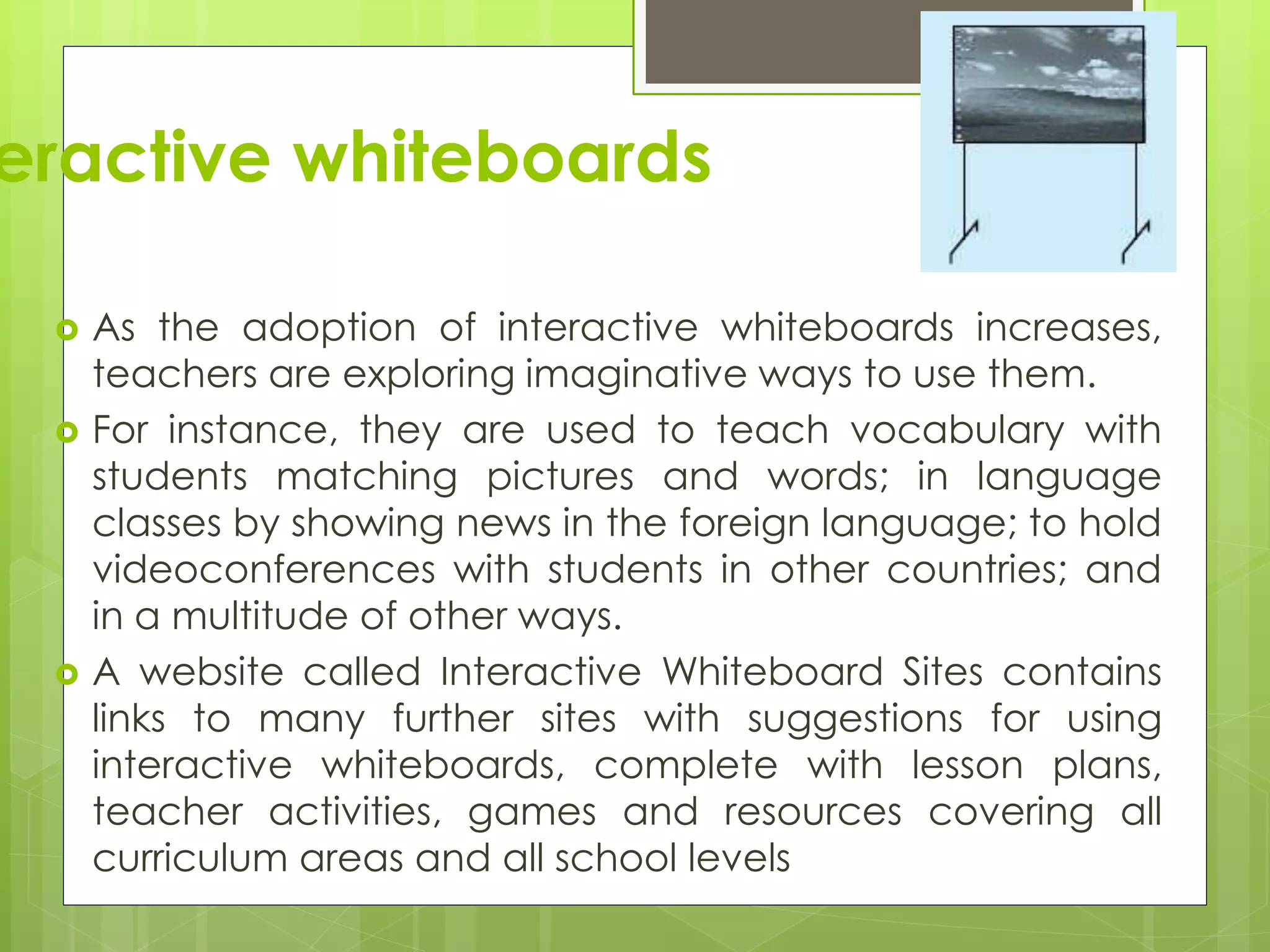
 Classrooms of tomorrow are installing
interactive whiteboards, connected to a
computer and projector (see clipped insert).
These new ICT tools allow further kinds of
interactive learning.
eractive whiteboards
 As the adoption of interactive whiteboards increases,
teachers are exploring imaginative ways to use them.
 For instance, they are used to teach vocabulary with
students matching pictures and words; in language
classes by showing news in the foreign language; to hold
videoconferences with students in other countries; and
in a multitude of other ways.
 A website called Interactive Whiteboard Sites contains
links to many further sites with suggestions for using
interactive whiteboards, complete with lesson plans,
teacher activities, games and resources covering all
curriculum areas and all school levels
 One of the major benefits of using IWB is that it
increases interaction throughout the class.
 the IWB teaching style better enhances interactive
learning between students, and between students
and teachers.
 Time management in class is much better, too,
allowing more time for discussions and creative
thinking.
 A visual demonstration of abstract concepts, for
instance, helps students more quickly understand
what’s involved so they can more easily apply
theory to a real example.
 increased flexibility and convenience inherent in
IWB make it easier for teachers to develop networks
with other teachers.
Virtual excursionsNow, with the aid of ICT, students can go on virtual
excursions or virtual field trips to explore actual sites or
those from the past, to investigate particular topics or
view specimens and artefacts, all without leaving the
classroom
Virtual excursions, virtual field
trips, web tours
 Virtual excursions, virtual field trips, and web tours
are various terms used to describe organized
student online learning experiences around visits
to different places or different time periods. As
part of a guided exploration activity, students
commonly connect with other places and people,
collect information and report their findings in
electronic form using text and images. Sometimes
such virtual learning explorations and
investigations are conducted in real time with the
aid of audioconferencing or videoconferencing
facilities that allow students in one location to
meet with and hold discussions with others in a
remote location
Videoconferencing
Videoconferencing is the use of computer
hardware and software to enable
individuals in separate locations to see and
hear one another as in a conference
setting. A form of videoconferencing,
sometimes called desktop conferencing,
can be carried out using a webcam and PC
with software such as Skype
Videoconferencing and virtual
excursions
 As videoconferencing has entered schools and
classrooms of the 21st century, a unique opportunity for
new learning experiences, previously out of reach, has
arrived.
 Virtual excursions involve students visiting locations via
an internet link using videoconferencing systems, and
are becoming increasingly available in major locations
of interest worldwide.
 Someaims of the use of this new technology in schools
are to:
 assist geographically dispersed, and often isolated,
schools and their teachers to offer students
experiential education activities;
 facilitate the teaching of curriculum previously
M-learning and u-learning The mobile learning-enabled technologies that characterize wireless
learning environments are brought about by a new communications
device that is widely accepted and is being taken up at a faster rate
than occurred with the PC.
 As users embrace this new, highly popular device, it appears to offer
potential for education.
 The new portable tool is, of course, the mobile or cellular phone. Vinci
and Cucchi (2007, p. 1) say that the mobile phone “represents a
revolution in education as it gives the opportunity to learn ‘in motion’,
making the learning process more appealing, interesting and
motivating”.
 The mobility provided by hand-held, portable devices like smart mobile
phones and other mobile technologies removes some of the limitations of
learning in fixed locations. This increased mobility for learners gives rise to
yet another term, ubiquitous learning or u-learning, where opportunities
for learning are expanded even further
M-learning for distance
education
 Mobile learning, or m-learning, is novel in that it facilitates delivery
of learning to the right person, at the right time, in the right place,
using portable electronic devices.
 In the near future, m-learning could become a normal part of open
and distance learning for lifelong education and self-directed
learning.
 M-learning is a ubiquitous learning system for distance education
where anyone
 who wants to study can study anywhere, anytime, with the internet
and multimedia.
 Mobile learning was introduced as a more advanced system of
learning after several projects were under taken to evaluate the
efficiency of e-learning courses and to suggest a future of more
ubiquitous learning.
 In future knowledge based societies where educational
circumstances and paradigms change rapidly, distance education
using ICT technology can satisfy the educational desires of various
levels of learners.

Slide 1 ict kelompok 5

  • 1.
  • 2.
     In thoseschools and teacher education institutions in the region that have fully embraced e-learning, continuing new developments in ICT are bringing about yet further changes in delivery of education, in pedagogy and student approaches to learning
  • 4.
    Figure 11.1 depicts thislearning environment of today in educational institutions that are well advanced along the pathway of ICT integration  Communication between tutor and student, between student and tutor, and between student and student is a combination of online and face-to- face, whichever is the more appropriate for particular occasions.  The learning environment is characterized as “wired” with students accessing workstations in generally fixed locations, within educational institutions and at home, in both cases with fixed links to internet service providers
  • 6.
    depicted in Figure 11.2,has a richer mix  Overlaid on all that is occurring today is a proliferation of mobile learning-enabled technologies  In some educational institutions in the Asia- Pacific region, the picture of tomorrow shown in Figure 11.2 is already happening  The learning environment here is characterized as wireless, as students access learning materials from the web and other sources, and communicate with tutors and fellow students from wherever they happen to be and at whatever times they wish.
  • 7.
    LEARNING ENVIRONMENT BROUGHT ABOUTBY NEW DEVELOPMENTS IN ICT AND CHANGING PEDAGOGICAL PRACTICES, CONCLUDING WITH OUR VIEW OF WHAT IS REQUIRED TO TRANSFORM CLASSROOM AND SCHOOL PRACTICE.
  • 8.
    Interactive learning with whiteboards Blackboards have been a standard feature in classrooms since they were invented in 1801.  Then the whiteboard was introduced with its marker pens that eliminated messy chalk.  Classrooms of tomorrow are installing interactive whiteboards, connected to a computer and projector (see clipped insert). These new ICT tools allow further kinds of interactive learning.
  • 9.
    eractive whiteboards  Asthe adoption of interactive whiteboards increases, teachers are exploring imaginative ways to use them.  For instance, they are used to teach vocabulary with students matching pictures and words; in language classes by showing news in the foreign language; to hold videoconferences with students in other countries; and in a multitude of other ways.  A website called Interactive Whiteboard Sites contains links to many further sites with suggestions for using interactive whiteboards, complete with lesson plans, teacher activities, games and resources covering all curriculum areas and all school levels
  • 10.
     One ofthe major benefits of using IWB is that it increases interaction throughout the class.  the IWB teaching style better enhances interactive learning between students, and between students and teachers.  Time management in class is much better, too, allowing more time for discussions and creative thinking.  A visual demonstration of abstract concepts, for instance, helps students more quickly understand what’s involved so they can more easily apply theory to a real example.  increased flexibility and convenience inherent in IWB make it easier for teachers to develop networks with other teachers.
  • 11.
    Virtual excursionsNow, withthe aid of ICT, students can go on virtual excursions or virtual field trips to explore actual sites or those from the past, to investigate particular topics or view specimens and artefacts, all without leaving the classroom
  • 12.
    Virtual excursions, virtualfield trips, web tours  Virtual excursions, virtual field trips, and web tours are various terms used to describe organized student online learning experiences around visits to different places or different time periods. As part of a guided exploration activity, students commonly connect with other places and people, collect information and report their findings in electronic form using text and images. Sometimes such virtual learning explorations and investigations are conducted in real time with the aid of audioconferencing or videoconferencing facilities that allow students in one location to meet with and hold discussions with others in a remote location
  • 13.
    Videoconferencing Videoconferencing is theuse of computer hardware and software to enable individuals in separate locations to see and hear one another as in a conference setting. A form of videoconferencing, sometimes called desktop conferencing, can be carried out using a webcam and PC with software such as Skype
  • 14.
    Videoconferencing and virtual excursions As videoconferencing has entered schools and classrooms of the 21st century, a unique opportunity for new learning experiences, previously out of reach, has arrived.  Virtual excursions involve students visiting locations via an internet link using videoconferencing systems, and are becoming increasingly available in major locations of interest worldwide.  Someaims of the use of this new technology in schools are to:  assist geographically dispersed, and often isolated, schools and their teachers to offer students experiential education activities;  facilitate the teaching of curriculum previously
  • 15.
    M-learning and u-learningThe mobile learning-enabled technologies that characterize wireless learning environments are brought about by a new communications device that is widely accepted and is being taken up at a faster rate than occurred with the PC.  As users embrace this new, highly popular device, it appears to offer potential for education.  The new portable tool is, of course, the mobile or cellular phone. Vinci and Cucchi (2007, p. 1) say that the mobile phone “represents a revolution in education as it gives the opportunity to learn ‘in motion’, making the learning process more appealing, interesting and motivating”.  The mobility provided by hand-held, portable devices like smart mobile phones and other mobile technologies removes some of the limitations of learning in fixed locations. This increased mobility for learners gives rise to yet another term, ubiquitous learning or u-learning, where opportunities for learning are expanded even further
  • 16.
    M-learning for distance education Mobile learning, or m-learning, is novel in that it facilitates delivery of learning to the right person, at the right time, in the right place, using portable electronic devices.  In the near future, m-learning could become a normal part of open and distance learning for lifelong education and self-directed learning.  M-learning is a ubiquitous learning system for distance education where anyone  who wants to study can study anywhere, anytime, with the internet and multimedia.  Mobile learning was introduced as a more advanced system of learning after several projects were under taken to evaluate the efficiency of e-learning courses and to suggest a future of more ubiquitous learning.  In future knowledge based societies where educational circumstances and paradigms change rapidly, distance education using ICT technology can satisfy the educational desires of various levels of learners.