ENGLISH 2.0
Conventional
Teacher – Speaker
Students - Listeners
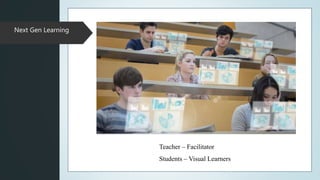
Next Gen Learning
Teacher – Facilitator
Students – Visual Learners
English outside
the textbooks
and Classroom
Interviw
Click Here
Information and Communication Technology (ICT)
ICT is the mode of education that uses information and communication technology to support,
enhance, and optimize the delivery of information to improve student learning and provide better
teaching methods.
Features –
 Convenience
 Visualization
 Omnipresence
 Effectiveness
 Becoming economic.
Tools -
 CAI (Computer Assisted Learning)
 CALA (Computer Assisted Language Assessment)
 CALL (Computer Assisted Language Learning)
 MALL (Mobile Assisted Language Learning)
 TELL (Technology Enhanced Language Learning)
Click here
MULTIMEDIA
Click Here
Learning and teaching through Memes
Language Through Videos
Language through Audio
Audio Recordings Songs/ Albums
Artificial Intelligence
Artificial intelligence (AI), the ability of a digital computer or computer-controlled
robot to perform tasks commonly associated with intelligent beings.
 AI Grading
 Educational software
 Course improvements
 Smart interactive classrooms
 Data powered and error-free
Potential
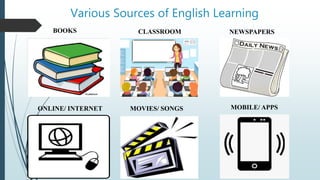
Various Sources of English Learning
BOOKS CLASSROOM NEWSPAPERS
ONLINE/ INTERNET MOVIES/ SONGS MOBILE/ APPS
Blog Literature
A blog (a truncation of "weblog") is a discussion or informational
website published on the World Wide Web consisting of discrete, often
informal diary-style text entries (posts).
Types
 Texts
 Videos (Vlog)
Twitterature
Twitterature (a portmanteau of Twitter and literature) is a literary
use of the microblogging service of Twitter. It includes various
genres, including aphorisms, poetry, and fiction (or some
combination thereof) written by individuals or collaboratively.
Language through Google
GOOGLE TRANSLATE
• Dr. APJ Abdul Kalam
• Chetan Bhagat
• Varun Agarwal
• Anand Neelakantan
• Ravinder Singh
• Sudha Murthy
• Sudeep Nagarkar
• Sharath Komarraju
• Durjoy Dutta
• Harsh Snehanshu
Engineer Turned Writers
Popular
Literature
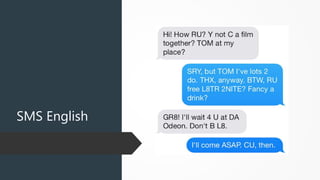
SMS English
Teacher Facilitator
Transformation
THANK YOU!
Appendix
 CAI is an interactive instruction technique where computer is used to present the instructional
material for the learning that takes place. (BYJU’S)
 Computer-assisted language assessment (CALA) employs the use of technology to facilitate,
contextualize, and enhance the assessment of linguistic abilities. CALA is becoming
normalized, concomitant with advances in technology and its propagation in language learning
contexts (BEC)
 Computer-assisted language Learning (CALL) is an approach to teaching and learning in which
the computer and computer-based resources such as the Internet are used to present, reinforce
and assess material to be learned. It usually includes a substantial interactive element. (PPT,
Video conferencing)
 Mobile-assisted language learning (MALL) is language learning that is assisted or enhanced
through the use of a handheld mobile device. MALL is a subset of both Mobile Learning and
computer-assisted language learning. (Applications, Dictionaries, Google Translate)
 Technology-enhanced language learning (TELL) refers to the use of the computer as a
technological innovation to display multimedia as a means of complementing a teaching
method language teacher. It’s important to note is that TELL is not a teaching method but rather
an approach that can be used alongside a teaching method to help teach. (Audio, video, online
journals)

Artificial Intelligence English 2.0

  • 1.
  • 2.
  • 3.
    Next Gen Learning Teacher– Facilitator Students – Visual Learners
  • 4.
  • 5.
  • 6.
    Information and CommunicationTechnology (ICT) ICT is the mode of education that uses information and communication technology to support, enhance, and optimize the delivery of information to improve student learning and provide better teaching methods. Features –  Convenience  Visualization  Omnipresence  Effectiveness  Becoming economic. Tools -  CAI (Computer Assisted Learning)  CALA (Computer Assisted Language Assessment)  CALL (Computer Assisted Language Learning)  MALL (Mobile Assisted Language Learning)  TELL (Technology Enhanced Language Learning)
  • 7.
  • 8.
  • 9.
  • 10.
    Learning and teachingthrough Memes
  • 11.
  • 12.
    Language through Audio AudioRecordings Songs/ Albums
  • 13.
    Artificial Intelligence Artificial intelligence(AI), the ability of a digital computer or computer-controlled robot to perform tasks commonly associated with intelligent beings.  AI Grading  Educational software  Course improvements  Smart interactive classrooms  Data powered and error-free Potential
  • 15.
    Various Sources ofEnglish Learning BOOKS CLASSROOM NEWSPAPERS ONLINE/ INTERNET MOVIES/ SONGS MOBILE/ APPS
  • 16.
    Blog Literature A blog(a truncation of "weblog") is a discussion or informational website published on the World Wide Web consisting of discrete, often informal diary-style text entries (posts). Types  Texts  Videos (Vlog)
  • 17.
    Twitterature Twitterature (a portmanteauof Twitter and literature) is a literary use of the microblogging service of Twitter. It includes various genres, including aphorisms, poetry, and fiction (or some combination thereof) written by individuals or collaboratively.
  • 18.
  • 19.
    • Dr. APJAbdul Kalam • Chetan Bhagat • Varun Agarwal • Anand Neelakantan • Ravinder Singh • Sudha Murthy • Sudeep Nagarkar • Sharath Komarraju • Durjoy Dutta • Harsh Snehanshu Engineer Turned Writers
  • 20.
  • 21.
  • 22.
  • 23.
  • 24.
    Appendix  CAI isan interactive instruction technique where computer is used to present the instructional material for the learning that takes place. (BYJU’S)  Computer-assisted language assessment (CALA) employs the use of technology to facilitate, contextualize, and enhance the assessment of linguistic abilities. CALA is becoming normalized, concomitant with advances in technology and its propagation in language learning contexts (BEC)  Computer-assisted language Learning (CALL) is an approach to teaching and learning in which the computer and computer-based resources such as the Internet are used to present, reinforce and assess material to be learned. It usually includes a substantial interactive element. (PPT, Video conferencing)  Mobile-assisted language learning (MALL) is language learning that is assisted or enhanced through the use of a handheld mobile device. MALL is a subset of both Mobile Learning and computer-assisted language learning. (Applications, Dictionaries, Google Translate)  Technology-enhanced language learning (TELL) refers to the use of the computer as a technological innovation to display multimedia as a means of complementing a teaching method language teacher. It’s important to note is that TELL is not a teaching method but rather an approach that can be used alongside a teaching method to help teach. (Audio, video, online journals)