Brush up on blood sugar
Mary Friesz, PhD, RD, CDE
August 24, 2016
What is Diabetes?
• A group of conditions characterized by high levels of
blood glucose, which results from problems with
insulin production, cell sensitivity to insulin, or both.
• If there is not enough insulin or the insulin does not
work as well, glucose stays in the blood resulting in
high blood glucose levels
Types of Diabetes
•Type 1 Diabetes
•Auto-immune disorder
•No insulin produced
•Juvenile or IDDM
•5 to 10% of those with DM
•Type 2 Diabetes
•Inadequate insulin production &/or it doesn’t work well
•Adult-onset or NIDDM
•90 to 95% of those with DM
• Gestational Diabetes
Only during pregnancy but indicates higher risk for Type 2 DM
What’s blood glucose?
• Glucose isn’t a bad thing – it’s the body’s main
energy source – it becomes “bad” when there’s too
much in the blood
• Insulin is required in order for cells to get glucose
from the blood
• If there is not enough insulin or the insulin does not
work as well, glucose stays in the blood resulting in
higher than normal blood glucose levels, which can
lead to a host of medical problems
What can you do?
Adopt a Healthy Lifestyle!
Ok – but what does that mean??
What can you do?
Adopt a Healthy Lifestyle!
• Achieve & maintain a healthy weight
What can you do?
Adopt a Healthy Lifestyle!
• Achieve & maintain a healthy weight
• Balance the nutrients in your meals
What can you do?
Adopt a Healthy Lifestyle!
• Achieve & maintain a healthy weight
• Balance the nutrients in your meals
• Be aware of portions
What can you do?
Adopt a Healthy Lifestyle!
• Achieve & maintain a healthy weight
• Balance the nutrients in your meals
• Be aware of portions
• Eat slowly & savor your meals
What can you do?
Adopt a Healthy Lifestyle!
• Achieve & maintain a healthy weight
• Balance the nutrients in your meals
• Be aware of portions
• Eat slowly & savor your meals
• Be active on a regular basis
What can you do?
Adopt a Healthy Lifestyle!
• Achieve & maintain a healthy weight
• Balance the nutrients in your meals
• Be aware of portions
• Eat slowly & savor your meals
• Be active on a regular basis
• Manage your stress
What can you do?
Adopt a Healthy Lifestyle!
• Achieve & maintain a healthy weight
• Balance the nutrients in your meals
• Be aware of portions
• Eat slowly & savor your meals
• Be active on a regular basis
• Manage your stress
• Keep motivated
Unfortunately, there’s no magic pill or potion
Helpful pills & potions??
• Cinnamon
• Turmeric
• Berberine
• Fish oil
• Chromium picolinate
• Garcinia cambogia
• Magic Mushroom??
Be very cautious with advertising…
There’s no magic formula for good health
Achieve a Healthy Weight
• Why does weight matter?
 If one is overweight, losing just 5 to 7% of body
weight can help manage Type 2 Diabetes
*5 to 7% is just 10 to 14 lbs. for someone who weighs 200 lbs.
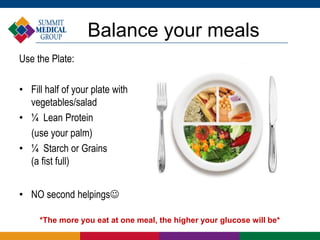
Balance your meals
Use the Plate:
• Fill half of your plate with
vegetables/salad
• ¼ Lean Protein
(use your palm)
• ¼ Starch or Grains
(a fist full)
• NO second helpings
*The more you eat at one meal, the higher your glucose will be*
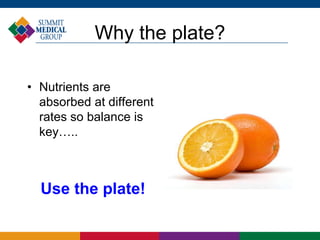
Why the plate?
• Nutrients are
absorbed at different
rates so balance is
key…..
Use the plate!
Choose your foods wisely
 Build meals around more vegetables, whole
grains, legumes, fish, lean meats & skim dairy
products
 Limit added fats (ie: butter, margarine, mayo,
cooking oils); instead, choose healthy fats in
moderation (nuts, olives, avocado)
 Limit simple sugars (ie: juice, soda, sweet
drinks)
 Limit processed foods; choose foods closer to
their natural states
Be aware of portions
• 1 cup = size of a baseball or a small fist
(potato, rice, pasta, cooked veggies)
• 2 to 3 cups = size of your open hands
(salad, raw veggies)
• 1 T = size of a small thumb (salad dressings, spreads)
• 2 Tb = size of a golf ball (dips, whipped topping)
• 3 ounces = size of a deck of cards (meat, chicken, fish)
Some extra tips
• Don’t wait until you’re starving to eat
• Pay attention to your food - & not other things
- when you eat
• Eat slowly & savor the flavors
• Chew each mouthful 10 times
• Stop eating before you feel full
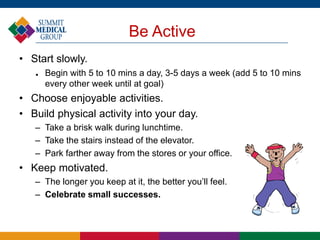
Be Active
• Start slowly.
 Begin with 5 to 10 mins a day, 3-5 days a week (add 5 to 10 mins
every other week until at goal)
• Choose enjoyable activities.
• Build physical activity into your day.
– Take a brisk walk during lunchtime.
– Take the stairs instead of the elevator.
– Park farther away from the stores or your office.
• Keep motivated.
– The longer you keep at it, the better you’ll feel.
– Celebrate small successes.
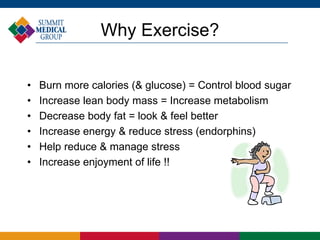
Why Exercise?
• Burn more calories (& glucose) = Control blood sugar
• Increase lean body mass = Increase metabolism
• Decrease body fat = look & feel better
• Increase energy & reduce stress (endorphins)
• Help reduce & manage stress
• Increase enjoyment of life !!
Stay Motivated
• Remind yourself of the benefits
• Think “I want to”, not “ I have to”
• Have a variety of choices in food & activity
• Enlist a partner, if necessary
• Set realistic goals, with rewards
Make it a lifestyle
In Summary
Adopt a Healthy Lifestyle by:
• Achieving/maintaining a healthy weight
• Balancing the nutrients in your meals
• Being aware of portions
• Eating slowly & savoring your meals
• Being active on a regular basis
• Managing your stress
• Being wary of advertising…. &
• Staying motivated
Questions?

High Blood Pressure? Dial It Down

  • 1.
    Brush up onblood sugar Mary Friesz, PhD, RD, CDE August 24, 2016
  • 2.
    What is Diabetes? •A group of conditions characterized by high levels of blood glucose, which results from problems with insulin production, cell sensitivity to insulin, or both. • If there is not enough insulin or the insulin does not work as well, glucose stays in the blood resulting in high blood glucose levels
  • 3.
    Types of Diabetes •Type1 Diabetes •Auto-immune disorder •No insulin produced •Juvenile or IDDM •5 to 10% of those with DM •Type 2 Diabetes •Inadequate insulin production &/or it doesn’t work well •Adult-onset or NIDDM •90 to 95% of those with DM • Gestational Diabetes Only during pregnancy but indicates higher risk for Type 2 DM
  • 4.
    What’s blood glucose? •Glucose isn’t a bad thing – it’s the body’s main energy source – it becomes “bad” when there’s too much in the blood • Insulin is required in order for cells to get glucose from the blood • If there is not enough insulin or the insulin does not work as well, glucose stays in the blood resulting in higher than normal blood glucose levels, which can lead to a host of medical problems
  • 5.
    What can youdo? Adopt a Healthy Lifestyle! Ok – but what does that mean??
  • 6.
    What can youdo? Adopt a Healthy Lifestyle! • Achieve & maintain a healthy weight
  • 7.
    What can youdo? Adopt a Healthy Lifestyle! • Achieve & maintain a healthy weight • Balance the nutrients in your meals
  • 8.
    What can youdo? Adopt a Healthy Lifestyle! • Achieve & maintain a healthy weight • Balance the nutrients in your meals • Be aware of portions
  • 9.
    What can youdo? Adopt a Healthy Lifestyle! • Achieve & maintain a healthy weight • Balance the nutrients in your meals • Be aware of portions • Eat slowly & savor your meals
  • 10.
    What can youdo? Adopt a Healthy Lifestyle! • Achieve & maintain a healthy weight • Balance the nutrients in your meals • Be aware of portions • Eat slowly & savor your meals • Be active on a regular basis
  • 11.
    What can youdo? Adopt a Healthy Lifestyle! • Achieve & maintain a healthy weight • Balance the nutrients in your meals • Be aware of portions • Eat slowly & savor your meals • Be active on a regular basis • Manage your stress
  • 12.
    What can youdo? Adopt a Healthy Lifestyle! • Achieve & maintain a healthy weight • Balance the nutrients in your meals • Be aware of portions • Eat slowly & savor your meals • Be active on a regular basis • Manage your stress • Keep motivated Unfortunately, there’s no magic pill or potion
  • 13.
    Helpful pills &potions?? • Cinnamon • Turmeric • Berberine • Fish oil • Chromium picolinate • Garcinia cambogia • Magic Mushroom?? Be very cautious with advertising… There’s no magic formula for good health
  • 14.
    Achieve a HealthyWeight • Why does weight matter?  If one is overweight, losing just 5 to 7% of body weight can help manage Type 2 Diabetes *5 to 7% is just 10 to 14 lbs. for someone who weighs 200 lbs.
  • 15.
    Balance your meals Usethe Plate: • Fill half of your plate with vegetables/salad • ¼ Lean Protein (use your palm) • ¼ Starch or Grains (a fist full) • NO second helpings *The more you eat at one meal, the higher your glucose will be*
  • 16.
    Why the plate? •Nutrients are absorbed at different rates so balance is key….. Use the plate!
  • 17.
    Choose your foodswisely  Build meals around more vegetables, whole grains, legumes, fish, lean meats & skim dairy products  Limit added fats (ie: butter, margarine, mayo, cooking oils); instead, choose healthy fats in moderation (nuts, olives, avocado)  Limit simple sugars (ie: juice, soda, sweet drinks)  Limit processed foods; choose foods closer to their natural states
  • 18.
    Be aware ofportions • 1 cup = size of a baseball or a small fist (potato, rice, pasta, cooked veggies) • 2 to 3 cups = size of your open hands (salad, raw veggies) • 1 T = size of a small thumb (salad dressings, spreads) • 2 Tb = size of a golf ball (dips, whipped topping) • 3 ounces = size of a deck of cards (meat, chicken, fish)
  • 19.
    Some extra tips •Don’t wait until you’re starving to eat • Pay attention to your food - & not other things - when you eat • Eat slowly & savor the flavors • Chew each mouthful 10 times • Stop eating before you feel full
  • 20.
    Be Active • Startslowly.  Begin with 5 to 10 mins a day, 3-5 days a week (add 5 to 10 mins every other week until at goal) • Choose enjoyable activities. • Build physical activity into your day. – Take a brisk walk during lunchtime. – Take the stairs instead of the elevator. – Park farther away from the stores or your office. • Keep motivated. – The longer you keep at it, the better you’ll feel. – Celebrate small successes.
  • 21.
    Why Exercise? • Burnmore calories (& glucose) = Control blood sugar • Increase lean body mass = Increase metabolism • Decrease body fat = look & feel better • Increase energy & reduce stress (endorphins) • Help reduce & manage stress • Increase enjoyment of life !!
  • 22.
    Stay Motivated • Remindyourself of the benefits • Think “I want to”, not “ I have to” • Have a variety of choices in food & activity • Enlist a partner, if necessary • Set realistic goals, with rewards Make it a lifestyle
  • 23.
    In Summary Adopt aHealthy Lifestyle by: • Achieving/maintaining a healthy weight • Balancing the nutrients in your meals • Being aware of portions • Eating slowly & savoring your meals • Being active on a regular basis • Managing your stress • Being wary of advertising…. & • Staying motivated
  • 24.

Editor's Notes

  • #3 Diabetes is a group of diseases characterized by high levels of blood glucose (or blood sugar) which results from problems with insulin production, insulin action, or both. Diabetes can lead to serious problems and complications, such as heart disease, blindness, kidney failure, lower-limb amputations, and premature death.
  • #4 In type 1 diabetes, the body makes little or no insulin. So people with type 1 diabetes must take insulin every day. Type 1 diabetes usually occurs in children and young adults, but it can also appear in older adults. Type 1 diabetes is an auto-immune disease that develops when the body’s immune system destroys pancreatic beta cells—the only cells in the body that make the hormone insulin that regulates blood glucose. People with type 1 diabetes must take insulin every day either by injection or pump. Inhalable insulin is also available. Type 1 diabetes accounts for 5% to 10% of all diagnosed cases of diabetes and usually affects children and young adults, although the disease can occur at any age. There is no known way to prevent type 1 diabetes. In type 2 diabetes, your body prevents the insulin it does make from working right. Your body may make some insulin but not enough. Most people with diabetes – about 90% to 95% – have type 2. This kind of diabetes usually happens in people who are older or in those who are overweight. In fact, about 8 out of 10 people with type 2 diabetes are overweight. Type 2 diabetes usually begins as insulin resistance—a disorder in which cells do not use insulin properly. As the need for insulin rises, the pancreas gradually loses its ability to produce it. Insulin resistance and abnormal beta cell function may occur long before type 2 diabetes is diagnosed. Type 2 diabetes accounts for about 90% to 95% of all diagnosed cases of diabetes. It is associated with older age, obesity, family history of diabetes, history of gestational diabetes, impaired glucose metabolism, physical inactivity, and race/ethnicity. African Americans, Hispanic/Latino Americans, American Indians, and some Asian Americans and Native Hawaiians and other Pacific Islanders are at particularly high risk for type 2 diabetes and its complications. Although still rare, type 2 diabetes is being diagnosed more frequently in children and adolescents. Gestational diabetes is only present in pregnancy; it disappears once the baby is born BUT it does put women at a higher risk for developing type 2 DM in later years
  • #5 Mention glass of water & adding sugar to water – which is what increases the risk for complications If one can keep DM controlled, the risk for complications decreases immensely
  • #14 I understand the informative blurb for this presentation mentioned cinnamon & other possible food stuffs that may help manage diabetes. The problem is – even with cinnamon, there are just as many studies that show it has no effect on helping manage diabetes than those that show it might help. The same holds for things, such as turmeric, fish oil & so on – especially when people are consuming such things as pills, instead of the real thing. If you like cinnamon & turmeric, use them in your meals as the spices they really are. The FDA doesn’t oversee nutrition supplements, so many of the pills & potions people buy aren’t what they appear to be. In fact, in doing research for this presentation, I found that there have been many charges placed against companies because their supplements either don’t have all of the compounds listed on the label in the product, the quality is poor, &/or there are things within the supplements that aren’t listed on the label. Again – though we’d all love to be able to wave a magic wand & be perfect……. There’s no magic formula! So…… what do we do?
  • #15 Talk about the fat cells making it more difficult for insulin to do its job due to insulin resistance
  • #16 I wish I had a quarter for every time I hear ?  My so and so (fill in the blank) said I can't eat bread because it turns to sugar!"  Well guess what?  **Everything you eat turns to sugar (AKA glucose).** It's supposed to.  The purpose of food is to give you energy and nutrients so your body can function.   Glucose or "sugar" is your body's energy.  Without it, you wouldn't survive.  Giving up sugar, bread & pasta won't do anything magical except make you feel depressed & deprived.  The trick to planning meals for diabetes is balance. Believe it or not, eating well for diabetes is really no different than eating for a healthy lifestyle.  Diabetes or not, everyone should eat a well-balanced, nutritious menu, participate in exercise on a regular basis & manage their stress.  Having diabetes is a very strong motivator to get you on the road to wellness ASAP. Fact: everything you eat turns to sugar because food has calories & calories provide energy.   Remember this simple equation:  Food = calories = energy = glucose = "sugar"  Looking at this in more simple terms:  "The more calories you eat at a meal, the higher your blood sugar will be after the meal.
  • #17 When you have diabetes, it’s beneficial to realize that different foods get converted to glucose at different rates. For example, table sugar & jelly beans are simple carbohydrates, whereas brown rice & vegetables are complex carbohydrates.  When you eat (or drink) simple carbohydrates, such as honey, jelly beans or fruit juice, they are converted to glucose rather quickly & cause your blood glucose to rise quickly, too. Complex carbs, such as whole grains, legumes & vegetables, take a bit longer to digest & absorb, so while they do increase your glucose, they won’t do so as quickly as jelly beans or orange juice. Protein, such as chicken, fish or eggs, are digested even slower - & the higher the fat content, the slower the digestion & absorption & subsequently, the rise in glucose Finally, fats, such as butter, margarine, & peanut butter, take the longest to digest, so they won’t influence your blood glucose as quickly. They will, however, still influence your blood sugar. Does this make sense? Think about red & blue – separately they have 2 different effects on paper but together they create purple Thus, the best way to plan a meal – or even a snack – is to have a little bit from each of the food groups.
  • #18 I wish I had a quarter for every time I hear ?  My so and so (fill in the blank) said I can't eat bread because it turns to sugar!"  Well guess what?  **Everything you eat turns to sugar (AKA glucose).** It's supposed to.  The purpose of food is to give you energy and nutrients so your body can function.   Glucose or "sugar" is your body's energy.  Without it, you wouldn't survive.  Giving up sugar, bread & pasta won't do anything magical except make you feel depressed & deprived.  The trick to planning meals for diabetes is balance.
  • #21 20