Bleaching preparation
P.Vishal Kumar
B.Pharmacy 4th year
Section : B
HT NO.256211881115
Mall reddy college of pharmacy
CONTENTS
 Definitions
 Skin bleaching and whitening agents
 Formulations
 Manufacturing
 References
Definition:
 Bleaching or skin lightening creams or ointments are widely used worldwide
either to attempt to remove localised dark patches (e.g. melasma )or as a
fashion trend aiming to reduce normal melanin in the skin.
 An importing colour to the skin, the most important role is played by
pigments, carotenes and melanins.
 Melanins are responsible for racial difference.
 Skin lightening (bleaching) cosmetics and toiletries are used to lighten the
colour of darker skin.
 By definition, cosmetics are meant to improve the appearance of the skin or
enhance the attractiveness of users, not to alter the basic structure of the
skin.
Skin bleaching/whitening agents:
 Most commonly used skin bleaching agents are:
1) Mercury compounds
2) Hydroquinones
3) Catechol and its derivatives
4) Ascorbic acid and its derivatives
5) Oxidizing agents
6) Kojic acid
7) Opaque covering agents
1)Mercury compounds:
 Mercury compounds such as mercury chloride,red mercuric oxide and
ammoniated mercury have been used skin bleaching effect.
 Out of these ammoniated mercury was extensively used.
 But now, the mercury compounds are prohibited for use in cosmetics and are
no more used.
 mercury has been banned in most countries for use in skin whitening (1976 in
Europe, 1990 in the USA) because it accumulates on skin and it can have the
opposite results in the long term.
2)Hydroquinones:
 Hydroquinones is the Most favourite material which has been used.
 A concentration of 1.5-2.0% produces temporary lightening of the skin.
 A concentration of 5% can produces redness and burning.
 The skin lightening effect of hydroquinones can be reversed by exposure to
sunlight.
3) Catechol and its derivatives
 Some Catechols exhibited skin lightening effect .
 but these were less effective than hydroquinone.
 4-isopropyl catechol is the most potent depigmenting agent.
 Concentration of 3% or more caused irritation and sensitizing reaction and
therefore, are not used in fairness prepartions.
4)Ascorbic acid and its derivatives
 Ascorbic acid,through Very safe, do not seem to be very effective as
pigmenting agents.
 Used in skin bleaching cream containing hydroquinone as stabilizer(anti-
oxidant).
 Use of ascorbyl oleate has been reported in concentration of 3% and 5% in
creams for bleaching freckles in human skin.
5)Oxidizing agents:
 Hydrogen peroxide has been used in skin bleach cream.
 Zinc peroxide has been used in anhydrous ointments as bleaching agents but
its properties have not been proved.
6)Kojic acid:
 It γ (Gama) pyrone compound.
 Commercialy it is produced by microbial fermentation using aspergillus and
pencillium spp.
 Both types of experiments i.e. in vivo and in vitro have shown that kojic acid
inhibits production of melanin.
 This inhibition has been shown to be due to chelation of copper, a prosthetic
group in tyrosinase.
 which is used in cosmetics for its excellent whitening effect.
7)Opaque covering agents:
 Make-up products containg white or pale pigments such as titanium dioxide,
zinc oxide, talc, kaolin, bismuth pigments can achieve remarkable temporary
change in the colour of skin and hence these material have been mentioned
here.
FORMULATIONS
SKIN LIGHTENING CREAMS
 Hydroquinone is white crystalline material having melting point, 170-
171˚c.
 It is soluble in water in the ratio of 1:14 but freely soluble in alcohol
and ether.
 Its solutions become brown on exposure to air.
 Oxidation is much faster in alkaline solutions.
 Therefore, it is necessary to stabilized with anti-oxidants like ascorbic
acid and potassium metabisulphite.
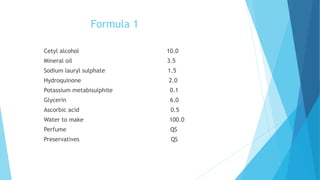
Formula 1
Cetyl alcohol 10.0
Mineral oil 3.5
Sodium lauryl sulphate 1.5
Hydroquinone 2.0
Potassium metabisulphite 0.1
Glycerin 6.0
Ascorbic acid 0.5
Water to make 100.0
Perfume QS
Preservatives QS
Formula 2
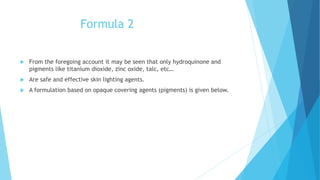
 From the foregoing account it may be seen that only hydroquinone and
pigments like titanium dioxide, zinc oxide, talc, etc…
 Are safe and effective skin lighting agents.
 A formulation based on opaque covering agents (pigments) is given below.
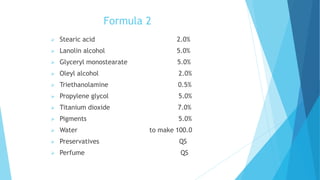
Formula 2
 Stearic acid 2.0%
 Lanolin alcohol 5.0%
 Glyceryl monostearate 5.0%
 Oleyl alcohol 2.0%
 Triethanolamine 0.5%
 Propylene glycol 5.0%
 Titanium dioxide 7.0%
 Pigments 5.0%
 Water to make 100.0
 Preservatives QS
 Perfume QS
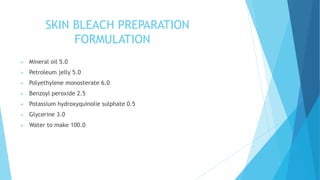
SKIN BLEACH PREPARATION
FORMULATION
 Mineral oil 5.0
 Petroleum jelly 5.0
 Polyethylene monosterate 6.0
 Benzoyl peroxide 2.5
 Potassium hydroxyquinolie sulphate 0.5
 Glycerine 3.0
 Water to make 100.0
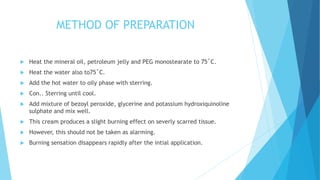
METHOD OF PREPARATION
 Heat the mineral oil, petroleum jelly and PEG monostearate to 75˚C.
 Heat the water also to75˚C.
 Add the hot water to oily phase with sterring.
 Con.. Sterring until cool.
 Add mixture of bezoyl peroxide, glycerine and potassium hydroxiquinoline
sulphate and mix well.
 This cream produces a slight burning effect on severly scarred tissue.
 However, this should not be taken as alarming.
 Burning sensation disappears rapidly after the intial application.
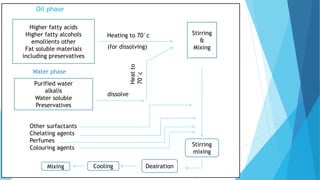
Water phase
Oil phase
Higher fatty acids
Higher fatty alcohols
emollients other
Fat soluble materials
including preservatives
Purified water
alkalis
Water soluble
Preservatives
Heating to 70°c
(for dissolving)
Stirring
&
Mixing
dissolve
Heatto
70°c
Other surfactants
Chelating agents
Perfumes
Colouring agents
Stirring
mixing
DeairationCoolingMixing
Water phase
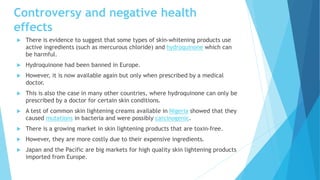
Controversy and negative health
effects
 There is evidence to suggest that some types of skin-whitening products use
active ingredients (such as mercurous chloride) and hydroquinone which can
be harmful.
 Hydroquinone had been banned in Europe.
 However, it is now available again but only when prescribed by a medical
doctor.
 This is also the case in many other countries, where hydroquinone can only be
prescribed by a doctor for certain skin conditions.
 A test of common skin lightening creams available in Nigeria showed that they
caused mutations in bacteria and were possibly carcinogenic.
 There is a growing market in skin lightening products that are toxin-free.
 However, they are more costly due to their expensive ingredients.
 Japan and the Pacific are big markets for high quality skin lightening products
imported from Europe.
References
 Cosmetics- formulations, manufacturing & quality control
P.P. Sharma
 Poucher’s Perfumes, Cosmetics and Soaps by H. Butler, Chapman & HALL, London.
Guidance
 Mrs. D. Nirmala Madam
M.Pharm phD
Bleaching preparation

Bleaching preparation

  • 2.
    Bleaching preparation P.Vishal Kumar B.Pharmacy4th year Section : B HT NO.256211881115 Mall reddy college of pharmacy
  • 3.
    CONTENTS  Definitions  Skinbleaching and whitening agents  Formulations  Manufacturing  References
  • 4.
    Definition:  Bleaching orskin lightening creams or ointments are widely used worldwide either to attempt to remove localised dark patches (e.g. melasma )or as a fashion trend aiming to reduce normal melanin in the skin.  An importing colour to the skin, the most important role is played by pigments, carotenes and melanins.  Melanins are responsible for racial difference.  Skin lightening (bleaching) cosmetics and toiletries are used to lighten the colour of darker skin.  By definition, cosmetics are meant to improve the appearance of the skin or enhance the attractiveness of users, not to alter the basic structure of the skin.
  • 5.
    Skin bleaching/whitening agents: Most commonly used skin bleaching agents are: 1) Mercury compounds 2) Hydroquinones 3) Catechol and its derivatives 4) Ascorbic acid and its derivatives 5) Oxidizing agents 6) Kojic acid 7) Opaque covering agents
  • 6.
    1)Mercury compounds:  Mercurycompounds such as mercury chloride,red mercuric oxide and ammoniated mercury have been used skin bleaching effect.  Out of these ammoniated mercury was extensively used.  But now, the mercury compounds are prohibited for use in cosmetics and are no more used.  mercury has been banned in most countries for use in skin whitening (1976 in Europe, 1990 in the USA) because it accumulates on skin and it can have the opposite results in the long term.
  • 7.
    2)Hydroquinones:  Hydroquinones isthe Most favourite material which has been used.  A concentration of 1.5-2.0% produces temporary lightening of the skin.  A concentration of 5% can produces redness and burning.  The skin lightening effect of hydroquinones can be reversed by exposure to sunlight.
  • 8.
    3) Catechol andits derivatives  Some Catechols exhibited skin lightening effect .  but these were less effective than hydroquinone.  4-isopropyl catechol is the most potent depigmenting agent.  Concentration of 3% or more caused irritation and sensitizing reaction and therefore, are not used in fairness prepartions.
  • 9.
    4)Ascorbic acid andits derivatives  Ascorbic acid,through Very safe, do not seem to be very effective as pigmenting agents.  Used in skin bleaching cream containing hydroquinone as stabilizer(anti- oxidant).  Use of ascorbyl oleate has been reported in concentration of 3% and 5% in creams for bleaching freckles in human skin.
  • 10.
    5)Oxidizing agents:  Hydrogenperoxide has been used in skin bleach cream.  Zinc peroxide has been used in anhydrous ointments as bleaching agents but its properties have not been proved.
  • 11.
    6)Kojic acid:  Itγ (Gama) pyrone compound.  Commercialy it is produced by microbial fermentation using aspergillus and pencillium spp.  Both types of experiments i.e. in vivo and in vitro have shown that kojic acid inhibits production of melanin.  This inhibition has been shown to be due to chelation of copper, a prosthetic group in tyrosinase.  which is used in cosmetics for its excellent whitening effect.
  • 12.
    7)Opaque covering agents: Make-up products containg white or pale pigments such as titanium dioxide, zinc oxide, talc, kaolin, bismuth pigments can achieve remarkable temporary change in the colour of skin and hence these material have been mentioned here.
  • 13.
  • 14.
    SKIN LIGHTENING CREAMS Hydroquinone is white crystalline material having melting point, 170- 171˚c.  It is soluble in water in the ratio of 1:14 but freely soluble in alcohol and ether.  Its solutions become brown on exposure to air.  Oxidation is much faster in alkaline solutions.  Therefore, it is necessary to stabilized with anti-oxidants like ascorbic acid and potassium metabisulphite.
  • 15.
    Formula 1 Cetyl alcohol10.0 Mineral oil 3.5 Sodium lauryl sulphate 1.5 Hydroquinone 2.0 Potassium metabisulphite 0.1 Glycerin 6.0 Ascorbic acid 0.5 Water to make 100.0 Perfume QS Preservatives QS
  • 16.
    Formula 2  Fromthe foregoing account it may be seen that only hydroquinone and pigments like titanium dioxide, zinc oxide, talc, etc…  Are safe and effective skin lighting agents.  A formulation based on opaque covering agents (pigments) is given below.
  • 17.
    Formula 2  Stearicacid 2.0%  Lanolin alcohol 5.0%  Glyceryl monostearate 5.0%  Oleyl alcohol 2.0%  Triethanolamine 0.5%  Propylene glycol 5.0%  Titanium dioxide 7.0%  Pigments 5.0%  Water to make 100.0  Preservatives QS  Perfume QS
  • 18.
    SKIN BLEACH PREPARATION FORMULATION Mineral oil 5.0  Petroleum jelly 5.0  Polyethylene monosterate 6.0  Benzoyl peroxide 2.5  Potassium hydroxyquinolie sulphate 0.5  Glycerine 3.0  Water to make 100.0
  • 19.
    METHOD OF PREPARATION Heat the mineral oil, petroleum jelly and PEG monostearate to 75˚C.  Heat the water also to75˚C.  Add the hot water to oily phase with sterring.  Con.. Sterring until cool.  Add mixture of bezoyl peroxide, glycerine and potassium hydroxiquinoline sulphate and mix well.  This cream produces a slight burning effect on severly scarred tissue.  However, this should not be taken as alarming.  Burning sensation disappears rapidly after the intial application.
  • 21.
    Water phase Oil phase Higherfatty acids Higher fatty alcohols emollients other Fat soluble materials including preservatives Purified water alkalis Water soluble Preservatives Heating to 70°c (for dissolving) Stirring & Mixing dissolve Heatto 70°c Other surfactants Chelating agents Perfumes Colouring agents Stirring mixing DeairationCoolingMixing Water phase
  • 22.
    Controversy and negativehealth effects  There is evidence to suggest that some types of skin-whitening products use active ingredients (such as mercurous chloride) and hydroquinone which can be harmful.  Hydroquinone had been banned in Europe.  However, it is now available again but only when prescribed by a medical doctor.  This is also the case in many other countries, where hydroquinone can only be prescribed by a doctor for certain skin conditions.  A test of common skin lightening creams available in Nigeria showed that they caused mutations in bacteria and were possibly carcinogenic.  There is a growing market in skin lightening products that are toxin-free.  However, they are more costly due to their expensive ingredients.  Japan and the Pacific are big markets for high quality skin lightening products imported from Europe.
  • 23.
    References  Cosmetics- formulations,manufacturing & quality control P.P. Sharma  Poucher’s Perfumes, Cosmetics and Soaps by H. Butler, Chapman & HALL, London.
  • 24.
    Guidance  Mrs. D.Nirmala Madam M.Pharm phD