International Journal of Management (IJM), ISSN 0976 – 6502(Print), ISSN 0976 - 6510(Online),
Volume 6, Issue 6, June (2015), pp. 07-11 © IAEME
7
COMPETENCE AND CAPABILITY - A NEW LOOK
R.Nagarajan1
, Dr. R.Prabhu2
1
Research and Development Centre, Bharathiar University, Coimbatore – 641 046
2
Government Arts College, Coimbatore - 641 018
ABSTRACT
Competence, Competency, Capability, Capacity are few frequently referred terms during any
discussion related to Talent, Performance, Potential of individuals. Even though these are quit
common among the other functions, it is now noticed among HR professionals too. This papers
discuss about the differences and uniqueness among the two terms viz., Competence and Capability.
Key words: Competence, Capability
The Terms Competency and Capabilities are linked and often used interchangeably at
different occasions by the business professionals.
“Competence” as a word has its origins in 1632 from the French word “competence”, which means
'sufficient living in ease' and further in the Latin word “competentia”, which means agreement or
symmetry. “Competence” is the state or quality of an individual’s work. A person and his work can
be evaluated as competent if the performance is considered as “satisfactory”. Competence is the
proven abilities and improved capabilities. Competence can include a combination of knowledge,
basic requirements, skills, abilities, behaviour and attitude.
McClelland and Boyatzis (1980), define Competencies as “a generic body of knowledge,
motives, traits, self images, social roles and skills that are causally related to superior of effective
performance in the job” Others define competence as a combination of knowledge, experience,
productive attitudes / attributes and right combination of functional and technical skills to make
things happen (Campion et.al 2011, Yusoff & Armstrong, 2012). when it comes to organization, it
was called as core competencies. Core competencies are those primary competencies that a firm
leverage’s to compete. (Prahalad & Hamel, 1990)
Competence is an essential ingredient of being capable and competencies are often seen as
tools to enable someone to do a job. The definition of Competency is the possession of the skills,
knowledge and capacity to fulfil Current needs.
“Capability” came from the middle French Word 'capabilite' and late Latin word “capabili”. The
word was first used in 1587. Capability is an integration of knowledge skills and personal qualities
INTERNATIONAL JOURNAL OF MANAGEMENT (IJM)
ISSN 0976-6502 (Print)
ISSN 0976-6510 (Online)
Volume 6, Issue 6, June (2015), pp. 07-11
© IAEME: http://www.iaeme.com/IJM.asp
Journal Impact Factor (2015): 7.9270 (Calculated by GISI)
www.jifactor.com
IJM
© I A E M E
International Journal of Management (IJM), ISSN 0976 – 6502(Print), ISSN 0976 - 6510(Online),
Volume 6, Issue 6, June (2015), pp. 07-11 © IAEME
8
used effectively and appropriately in response to varied, familiar and unfamiliar circumstances. This
holistic view of capability is consistent with Toby Weaver's six Cs of Capability., viz culture,
comprehension, competence, communion, creativity and coping (John Stephenson, 1994)
The definition of capability is the qualities, abilities, capacity, and potential to be developed.
While competence deals with current state, capability focuses on the ability to develop and flex to
meet Future needs.
A person with a capability has a potential to acquire a specific ability or skill that will be
helpful in a task. The learned skill or ability adds to a person's knowledge bank or skill set.
Capabilities also increase the functions of a person which can lead to more productive. In time and
continuous practice, capabilities can develop into competencies.
Capable people are more than competent, they are creative, know how to learn, have a high
level of self-efficacy, can use competencies in novel as well as familiar situations and work well in
teams and also they are more likely to be able to deal effectively with the turbulent environment in
which they live by possessing this “all round” capacity. (Hase.S and Davis.L 1999). Capabilities tend
to be seen as infrastructure to achieve an outcome. In other wordsthe extent to which individuals can
adapt to change, generate new knowledge, and continue to improve their performance.
According to John Stephenson (1994) Capability may be one of those human characteristics
which is more easily recognised than measured does not release us from the obligation to develop
our understanding of its nature. The more we understand the nature of capability the more readily we
can help to develop it in ourselves and in others. There is an emerging consensus that capability
embraces many facets of human nature.
The notion of capability has been extended into that of dynamic capabilities (Eisenhardt and
Martin, 2000; Teece et al., 1997). An example is human and intellectual capital (Barney, 1991). This
is enhanced by the development of people’s information, knowledge, and ideas (Pfeffer, 1994), and
these in turn help to create dynamic flexibility (Hitt et al., 1998)
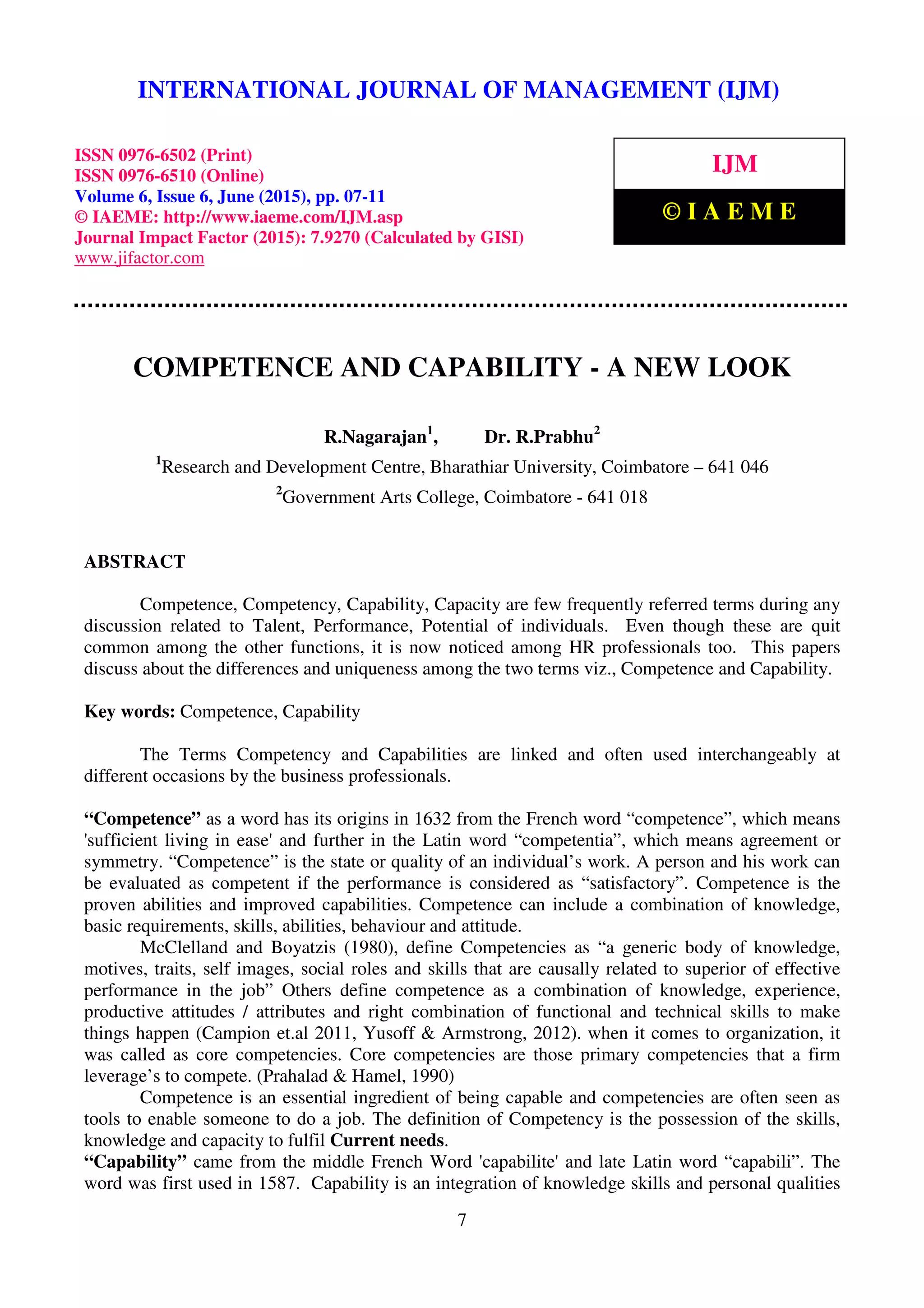
It seems like we need more than competence to set our aspirations to excellence. While
competence can deal with the simple and the straightforward, we need capability to cope with
complexity. And life, we know, is anything but simple.
So what is capability? Is a capable individual one step closer to excellence. When we read the
description of capability we can see that it aligns very closely to analysis, evaluation and synthesis. It
also talks about adapting to change, generating new knowledge and continually improving
performance- this sounds like a good path towards excellence.
COMPETENCE VERSUS CAPABILITY
International Journal of Management (IJM), ISSN 0976 – 6502(Print), ISSN 0976 - 6510(Online),
Volume 6, Issue 6, June (2015), pp. 07-11 © IAEME
9
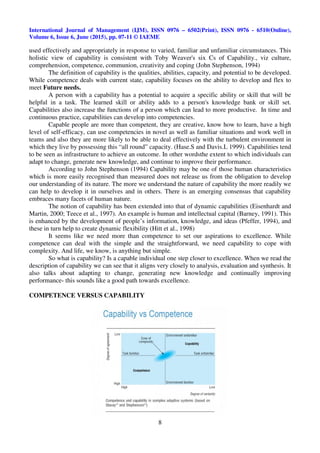
According to John Holt and Simon A.Perry (2011). there is often some confusion between
the terms ‘capability’ and ‘competence’ as they are inherently very closely related to each other.
However, there are subtle differences between the two, so, for the purposes of this discussion, the
definitions will be as follows:
Capability sometimes used to describes the ability of an organisation or organisational unit.
But Competence is always used to describes the ability of an individual to do something.
When we talk about capability in the sense defined here, we are talking about the ability to deliver a
product or service. This ability is demonstrated through the use of effective processes. Indeed, when
it comes to assessing capability, the established approach is to assess the process which provides an
indication of the capability and its maturity. Examples of such capability determination include: the
Capability Maturity Model Integrated (CMMI) (and its family) and Software Process Improvement
and Capability determination (SPICE).
Capability has been an increasingly important subject over the last one decade or so as many
large project tenders are now awarded on the basis of capability. For example, as part of a tender,
bidders will be asked not only to provide an overview of their solution but also will be asked to
demonstrate that they have the capability to deliver that solution. One of the problems associated
with such an approach is that capability can be demonstrated in an organisation, but in order to
realise that capability, it is necessary to have staff with appropriate competence. Many large
organisations will bid for projects without having enough staff to carry out the work and will then
recruit new staff once they have won the contract. In many cases, this will involve employing people,
known as contractors, on a contractual basis. Many contractors, as is the nature of the job, will
change employers and projects, depending on where their skills are required. (John Holt and Simon
A.Perry (2011)
As a result of this type of activity happening time and time again, companies are coming
around to realising that not only is the capability important, but also the competencies of the staff
needed to realise that capability.
In order to inspire confidence, we need to demonstrate both the capability (ability of the
business) and the competence (ability of the individuals). This demonstration is crucial in order to
International Journal of Management (IJM), ISSN 0976 – 6502(Print), ISSN 0976 - 6510(Online),
Volume 6, Issue 6, June (2015), pp. 07-11 © IAEME
10
inspire confidence. It is no good simply having ways to define and measure capability and
competence if they are never applied; confidence comes from the active demonstration of both
capability and competence.
When we need to demonstrate capability, we need best-practice models against which to
compare our processes, usually in the form of standards. When we need to demonstrate competence,
we also need best-practice models, which are usually in the form of competency frameworks.
To Conclude
• Capability and Competence are two manifestations of human abilities and skills.
• ‘capability’ and ‘competence’ are inherently very closely related to each other, however, there
are subtle differences between the two.
• Competencies as “a generic body of knowledge, motives, traits, self images, social roles and
skills that are causally related to superior of effective performance in the job” - McClelland
and Boyatzis (1980)
• Capability is the condition of having the capacity to do something and competence is the
improved version of capability.
• Capability sometime used to describes the ability of an organisation or organisational unit. But
Competence always describes the ability of an individual to do something
• Capabilities are seen as generic, on the other hand competence is more in the field of
Specialist. Competence is an essential ingredient of being capable.
• “Competence” is the state or quality of an individual’s work, Capable people are more than
competent.
• Competency is the possession of the skills, knowledge and capacity to fulfil Current needs
and capability focuses on the ability to develop and flex to meet Future needs.
• One need more than competence to set his /her aspirations to excellence.
• Capable people are more likely to be able to deal effectively with the turbulent environment in
which they live by possessing this 'all round' capacity.
REFERENCES
1. Barney, J.B. 1991. Firm resources and sustained competitive advantage. Journal of
Management 17 (1): 99-120.
2. Brown. S and Brian Squire, 2007 “Capabilities and Competencies – Toward Strategic
Resonance between operations and strategy process within firms”. University of Exeter
Discussion Papers in Management Paper number 07/16 ISSN 1472-2939
3. Campion M.A, Fink A.A, Ruggeberg B.J.Carr.L.Philips G.M, Odman R.B (2011). Doing
Competencies well: Best practices in Competency Modelling. Personnel Psychology, 64(1),
225-262
4. Eisenhardt, K. M. & Martin, J. A. 2000. Dynamic capabilities: what are they? Strategic
Management Journal, 21 (10/11): 1105-1122.
5. Hase, S and Davis, L (1999), From Competence to Capability: The implications for human
resource development and management, Association of International Management, 17th
Annual Conference, San Diego, August.
6. Hitt, M.A. Keats, B.W. & DeMarie, S.M. 1998. Navigating in the new competitive
landscape: Building strategic flexibility and competitive advantage in the twenty-first
century. Academy of Management Executive. 12 (4) 22-43.
7. Holt.J and Simon A.Perry (2011), Ä Pragmatic guide to Competency, Tools, Frameworks and
assessments, British Informatics Society Ltd.(BISL) – ISBN 978-1-906124-70-0. Page 5
International Journal of Management (IJM), ISSN 0976 – 6502(Print), ISSN 0976 - 6510(Online),
Volume 6, Issue 6, June (2015), pp. 07-11 © IAEME
11
8. McClelland D.C & Boyatziz R.E (1980), Opportunities for counsellors from the competency
assessment movement. Personnel and Guidance Journal ( Jan)
9. Pfeffer, J. 1994 Competitive advantage through people Boston MA: Harvard Business School
Press.
10. Prahalad C.K & Hamel.G (1990). The Core Competence of the Corporation. Harvard
Business Review 68(3), 79-91.
11. Stephenson J. 1994 , Capability Opinion Capability and Competence, are they same and does
it matter?, Capability Volume1(1) 1994
12. Yusoff.W.F.W & Armstrong.A (2012). What Competencies Should Directors Possess?
Malaysia Perspective. International Journal of Business and Management 7(2) 142-149.
13. R.Nagarajan and Dr.R.Prabhu, “Tacit Knowledge – A Review” International Journal of
Marketing & Human Resource Management (IJMHRM), Volume 6, Issue 2, 2015, pp. 1 - 7,
ISSN Print: 0976 – 6421, ISSN Online: 0976- 643X.

Competence and capability a new look

  • 1.
    International Journal ofManagement (IJM), ISSN 0976 – 6502(Print), ISSN 0976 - 6510(Online), Volume 6, Issue 6, June (2015), pp. 07-11 © IAEME 7 COMPETENCE AND CAPABILITY - A NEW LOOK R.Nagarajan1 , Dr. R.Prabhu2 1 Research and Development Centre, Bharathiar University, Coimbatore – 641 046 2 Government Arts College, Coimbatore - 641 018 ABSTRACT Competence, Competency, Capability, Capacity are few frequently referred terms during any discussion related to Talent, Performance, Potential of individuals. Even though these are quit common among the other functions, it is now noticed among HR professionals too. This papers discuss about the differences and uniqueness among the two terms viz., Competence and Capability. Key words: Competence, Capability The Terms Competency and Capabilities are linked and often used interchangeably at different occasions by the business professionals. “Competence” as a word has its origins in 1632 from the French word “competence”, which means 'sufficient living in ease' and further in the Latin word “competentia”, which means agreement or symmetry. “Competence” is the state or quality of an individual’s work. A person and his work can be evaluated as competent if the performance is considered as “satisfactory”. Competence is the proven abilities and improved capabilities. Competence can include a combination of knowledge, basic requirements, skills, abilities, behaviour and attitude. McClelland and Boyatzis (1980), define Competencies as “a generic body of knowledge, motives, traits, self images, social roles and skills that are causally related to superior of effective performance in the job” Others define competence as a combination of knowledge, experience, productive attitudes / attributes and right combination of functional and technical skills to make things happen (Campion et.al 2011, Yusoff & Armstrong, 2012). when it comes to organization, it was called as core competencies. Core competencies are those primary competencies that a firm leverage’s to compete. (Prahalad & Hamel, 1990) Competence is an essential ingredient of being capable and competencies are often seen as tools to enable someone to do a job. The definition of Competency is the possession of the skills, knowledge and capacity to fulfil Current needs. “Capability” came from the middle French Word 'capabilite' and late Latin word “capabili”. The word was first used in 1587. Capability is an integration of knowledge skills and personal qualities INTERNATIONAL JOURNAL OF MANAGEMENT (IJM) ISSN 0976-6502 (Print) ISSN 0976-6510 (Online) Volume 6, Issue 6, June (2015), pp. 07-11 © IAEME: http://www.iaeme.com/IJM.asp Journal Impact Factor (2015): 7.9270 (Calculated by GISI) www.jifactor.com IJM © I A E M E
  • 2.
    International Journal ofManagement (IJM), ISSN 0976 – 6502(Print), ISSN 0976 - 6510(Online), Volume 6, Issue 6, June (2015), pp. 07-11 © IAEME 8 used effectively and appropriately in response to varied, familiar and unfamiliar circumstances. This holistic view of capability is consistent with Toby Weaver's six Cs of Capability., viz culture, comprehension, competence, communion, creativity and coping (John Stephenson, 1994) The definition of capability is the qualities, abilities, capacity, and potential to be developed. While competence deals with current state, capability focuses on the ability to develop and flex to meet Future needs. A person with a capability has a potential to acquire a specific ability or skill that will be helpful in a task. The learned skill or ability adds to a person's knowledge bank or skill set. Capabilities also increase the functions of a person which can lead to more productive. In time and continuous practice, capabilities can develop into competencies. Capable people are more than competent, they are creative, know how to learn, have a high level of self-efficacy, can use competencies in novel as well as familiar situations and work well in teams and also they are more likely to be able to deal effectively with the turbulent environment in which they live by possessing this “all round” capacity. (Hase.S and Davis.L 1999). Capabilities tend to be seen as infrastructure to achieve an outcome. In other wordsthe extent to which individuals can adapt to change, generate new knowledge, and continue to improve their performance. According to John Stephenson (1994) Capability may be one of those human characteristics which is more easily recognised than measured does not release us from the obligation to develop our understanding of its nature. The more we understand the nature of capability the more readily we can help to develop it in ourselves and in others. There is an emerging consensus that capability embraces many facets of human nature. The notion of capability has been extended into that of dynamic capabilities (Eisenhardt and Martin, 2000; Teece et al., 1997). An example is human and intellectual capital (Barney, 1991). This is enhanced by the development of people’s information, knowledge, and ideas (Pfeffer, 1994), and these in turn help to create dynamic flexibility (Hitt et al., 1998) It seems like we need more than competence to set our aspirations to excellence. While competence can deal with the simple and the straightforward, we need capability to cope with complexity. And life, we know, is anything but simple. So what is capability? Is a capable individual one step closer to excellence. When we read the description of capability we can see that it aligns very closely to analysis, evaluation and synthesis. It also talks about adapting to change, generating new knowledge and continually improving performance- this sounds like a good path towards excellence. COMPETENCE VERSUS CAPABILITY
  • 3.
    International Journal ofManagement (IJM), ISSN 0976 – 6502(Print), ISSN 0976 - 6510(Online), Volume 6, Issue 6, June (2015), pp. 07-11 © IAEME 9 According to John Holt and Simon A.Perry (2011). there is often some confusion between the terms ‘capability’ and ‘competence’ as they are inherently very closely related to each other. However, there are subtle differences between the two, so, for the purposes of this discussion, the definitions will be as follows: Capability sometimes used to describes the ability of an organisation or organisational unit. But Competence is always used to describes the ability of an individual to do something. When we talk about capability in the sense defined here, we are talking about the ability to deliver a product or service. This ability is demonstrated through the use of effective processes. Indeed, when it comes to assessing capability, the established approach is to assess the process which provides an indication of the capability and its maturity. Examples of such capability determination include: the Capability Maturity Model Integrated (CMMI) (and its family) and Software Process Improvement and Capability determination (SPICE). Capability has been an increasingly important subject over the last one decade or so as many large project tenders are now awarded on the basis of capability. For example, as part of a tender, bidders will be asked not only to provide an overview of their solution but also will be asked to demonstrate that they have the capability to deliver that solution. One of the problems associated with such an approach is that capability can be demonstrated in an organisation, but in order to realise that capability, it is necessary to have staff with appropriate competence. Many large organisations will bid for projects without having enough staff to carry out the work and will then recruit new staff once they have won the contract. In many cases, this will involve employing people, known as contractors, on a contractual basis. Many contractors, as is the nature of the job, will change employers and projects, depending on where their skills are required. (John Holt and Simon A.Perry (2011) As a result of this type of activity happening time and time again, companies are coming around to realising that not only is the capability important, but also the competencies of the staff needed to realise that capability. In order to inspire confidence, we need to demonstrate both the capability (ability of the business) and the competence (ability of the individuals). This demonstration is crucial in order to
  • 4.
    International Journal ofManagement (IJM), ISSN 0976 – 6502(Print), ISSN 0976 - 6510(Online), Volume 6, Issue 6, June (2015), pp. 07-11 © IAEME 10 inspire confidence. It is no good simply having ways to define and measure capability and competence if they are never applied; confidence comes from the active demonstration of both capability and competence. When we need to demonstrate capability, we need best-practice models against which to compare our processes, usually in the form of standards. When we need to demonstrate competence, we also need best-practice models, which are usually in the form of competency frameworks. To Conclude • Capability and Competence are two manifestations of human abilities and skills. • ‘capability’ and ‘competence’ are inherently very closely related to each other, however, there are subtle differences between the two. • Competencies as “a generic body of knowledge, motives, traits, self images, social roles and skills that are causally related to superior of effective performance in the job” - McClelland and Boyatzis (1980) • Capability is the condition of having the capacity to do something and competence is the improved version of capability. • Capability sometime used to describes the ability of an organisation or organisational unit. But Competence always describes the ability of an individual to do something • Capabilities are seen as generic, on the other hand competence is more in the field of Specialist. Competence is an essential ingredient of being capable. • “Competence” is the state or quality of an individual’s work, Capable people are more than competent. • Competency is the possession of the skills, knowledge and capacity to fulfil Current needs and capability focuses on the ability to develop and flex to meet Future needs. • One need more than competence to set his /her aspirations to excellence. • Capable people are more likely to be able to deal effectively with the turbulent environment in which they live by possessing this 'all round' capacity. REFERENCES 1. Barney, J.B. 1991. Firm resources and sustained competitive advantage. Journal of Management 17 (1): 99-120. 2. Brown. S and Brian Squire, 2007 “Capabilities and Competencies – Toward Strategic Resonance between operations and strategy process within firms”. University of Exeter Discussion Papers in Management Paper number 07/16 ISSN 1472-2939 3. Campion M.A, Fink A.A, Ruggeberg B.J.Carr.L.Philips G.M, Odman R.B (2011). Doing Competencies well: Best practices in Competency Modelling. Personnel Psychology, 64(1), 225-262 4. Eisenhardt, K. M. & Martin, J. A. 2000. Dynamic capabilities: what are they? Strategic Management Journal, 21 (10/11): 1105-1122. 5. Hase, S and Davis, L (1999), From Competence to Capability: The implications for human resource development and management, Association of International Management, 17th Annual Conference, San Diego, August. 6. Hitt, M.A. Keats, B.W. & DeMarie, S.M. 1998. Navigating in the new competitive landscape: Building strategic flexibility and competitive advantage in the twenty-first century. Academy of Management Executive. 12 (4) 22-43. 7. Holt.J and Simon A.Perry (2011), Ä Pragmatic guide to Competency, Tools, Frameworks and assessments, British Informatics Society Ltd.(BISL) – ISBN 978-1-906124-70-0. Page 5
  • 5.
    International Journal ofManagement (IJM), ISSN 0976 – 6502(Print), ISSN 0976 - 6510(Online), Volume 6, Issue 6, June (2015), pp. 07-11 © IAEME 11 8. McClelland D.C & Boyatziz R.E (1980), Opportunities for counsellors from the competency assessment movement. Personnel and Guidance Journal ( Jan) 9. Pfeffer, J. 1994 Competitive advantage through people Boston MA: Harvard Business School Press. 10. Prahalad C.K & Hamel.G (1990). The Core Competence of the Corporation. Harvard Business Review 68(3), 79-91. 11. Stephenson J. 1994 , Capability Opinion Capability and Competence, are they same and does it matter?, Capability Volume1(1) 1994 12. Yusoff.W.F.W & Armstrong.A (2012). What Competencies Should Directors Possess? Malaysia Perspective. International Journal of Business and Management 7(2) 142-149. 13. R.Nagarajan and Dr.R.Prabhu, “Tacit Knowledge – A Review” International Journal of Marketing & Human Resource Management (IJMHRM), Volume 6, Issue 2, 2015, pp. 1 - 7, ISSN Print: 0976 – 6421, ISSN Online: 0976- 643X.