DESIGN AND
REDESIGN OF WORK
SYSTEM
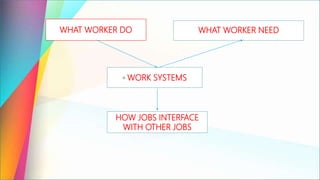
WHAT WORKER DO
◦ WORK SYSTEMS
WHAT WORKER NEED
HOW JOBS INTERFACE
WITH OTHER JOBS
1. What Workers Do
 One of more challenge tasks in organization is allocating specific tasks and job
responsibilities to employees
 Job specilialization
 Can be viable strategy for the design of work systems in organization that require
high level of efficiency and cost minimized in order to compete effictively
ex: United Parcel Service
 Job Enlargement
 Initial efforts to relieve boredom and more stimulating work for employees
focused on providing them with tasks oustside the scope of their previously
narrowly defined jobs.
Ex : a teller employee is asked to be a customer service at one time
Job rotation
Job rotation has become increasingly popular in recent years as a key
tool by which employees are developed through exposure to different
roles and functions within in organization.
◦ Job enrichment:
◦ Initiates involve going beyond merely adding tasks to employee’s
job. Job enrichment involves increasing the amount of
responsibility employee.
◦ Ex : a technician who uses a machine, is then assigned to install a
more complex machine.
◦ Job enrichment:
◦ Initiates involve going beyond merely adding tasks to employee’s job.
Job enrichment involves increasing the amount of responsibility
employee.
◦ Ex : a technician who uses a machine, is then assigned to install a more
complex machine.
◦ Vertical loading
Initiates involve the task before the formally done by supervisor as
reassigned to the employees.
Core job characteristic
◦ Job characteristic models show that five core characteristics can have an
impact on certain psychological conditions of employees which will
have an impact on work-related outcomes
1. Skill variety
The work allows the employees use a variety of a skill in the jobs
2. Task Identity
Extend to which work allows employee to complete whole or
Identifiatiable piece of work
3. Task Significance
the extent to which the employees perceive that his on her work is
important and meaningful to those the organization or those outside of
the organization
◦ 4. Autonomy
◦ The extent to which the employee is able to work on her own
and determine work procedures at her or his own direction,
free of supervision
◦ 5. Feedback
◦ The extent to which the work allows the employee to gain a
sense of how well the job responsibilities are being met.
2. What worker need
The design work of system also need to consider what working
need and want in order to carry out their job responsibilities.
Workers must consider some a number of important universal
consideration in designing work system to ensure that workers
are motivated, productive and happy.
a. Changing demographics and lifestyle of the labor market
b. Work/Life Balance
c. Ensuring the employees has some representative has some form of
representative or voice.
They expect to use their training and experience to make a contribution to
the organization and they expect to the organization to listen in their
concerns.
d. Workers safety
◦ Dealing with hazardous product and unsafe physical may dangerous
to the employees. Organization should aware about the safety of the
employees. The employees who spend significant amount of time at their
desks with computer may also be affected in long term. Ergonomics
design of worksites needs to be implementing in design job. Work
system and jobs need to be designed to be consistent with employee’s
physical abilites and allow them to perform their jobs without any undue
risks.
3. How jobs interface with other job
◦ The final component in job design is understanding how an individual's work might
be related to other work.
◦ There are three traditional types of task interpendence: Pooled, sequintal and
reciprocal
◦ A. POOLED
◦ Individual workers can work independently of each other in performing their tasks but
utilize use some coordination in their activities, for example bank officers, shared staff
or shared facilities (eg manufacturing, research and development)
◦ B. SEQUINTAL
◦ Sequintal refers to work that flows from one individual to another, where one
individual depends on the timely completion of quality work from coworkers.
Assembly workers use this method. The output from one worker is the input for other
workers. E
◦ C. Reciprocal
◦ Reciprocal occurs when the workflow is not linear (as in sequintal) but is
random. Employees can process work so that the flow is not necessarily
predictable and i often spontaneous according to suit an the immediate
situation
Strategi redesain dalam implementasi
◦ Outsourcing activity is the activity of contracting a non-core work (side job)
organization to third parties who have special expertise on the work so that the
work can be completed more effectively with costs that are usually lower than
if the work was completed with employee overtime.
◦ Using outsourcing for strategic competitiveness in small and medium sized
firms how outsourcing can provide strategic advantage for small organization,
which may allow the to compete more efffectively with their lager rivals.
Design and redesign work system

Design and redesign work system

  • 1.
  • 2.
    WHAT WORKER DO ◦WORK SYSTEMS WHAT WORKER NEED HOW JOBS INTERFACE WITH OTHER JOBS
  • 3.
    1. What WorkersDo  One of more challenge tasks in organization is allocating specific tasks and job responsibilities to employees  Job specilialization  Can be viable strategy for the design of work systems in organization that require high level of efficiency and cost minimized in order to compete effictively ex: United Parcel Service  Job Enlargement  Initial efforts to relieve boredom and more stimulating work for employees focused on providing them with tasks oustside the scope of their previously narrowly defined jobs. Ex : a teller employee is asked to be a customer service at one time
  • 4.
    Job rotation Job rotationhas become increasingly popular in recent years as a key tool by which employees are developed through exposure to different roles and functions within in organization. ◦ Job enrichment: ◦ Initiates involve going beyond merely adding tasks to employee’s job. Job enrichment involves increasing the amount of responsibility employee. ◦ Ex : a technician who uses a machine, is then assigned to install a more complex machine.
  • 5.
    ◦ Job enrichment: ◦Initiates involve going beyond merely adding tasks to employee’s job. Job enrichment involves increasing the amount of responsibility employee. ◦ Ex : a technician who uses a machine, is then assigned to install a more complex machine. ◦ Vertical loading Initiates involve the task before the formally done by supervisor as reassigned to the employees.
  • 6.
    Core job characteristic ◦Job characteristic models show that five core characteristics can have an impact on certain psychological conditions of employees which will have an impact on work-related outcomes 1. Skill variety The work allows the employees use a variety of a skill in the jobs 2. Task Identity Extend to which work allows employee to complete whole or Identifiatiable piece of work 3. Task Significance the extent to which the employees perceive that his on her work is important and meaningful to those the organization or those outside of the organization
  • 7.
    ◦ 4. Autonomy ◦The extent to which the employee is able to work on her own and determine work procedures at her or his own direction, free of supervision ◦ 5. Feedback ◦ The extent to which the work allows the employee to gain a sense of how well the job responsibilities are being met.
  • 8.
    2. What workerneed The design work of system also need to consider what working need and want in order to carry out their job responsibilities. Workers must consider some a number of important universal consideration in designing work system to ensure that workers are motivated, productive and happy. a. Changing demographics and lifestyle of the labor market b. Work/Life Balance
  • 9.
    c. Ensuring theemployees has some representative has some form of representative or voice. They expect to use their training and experience to make a contribution to the organization and they expect to the organization to listen in their concerns. d. Workers safety ◦ Dealing with hazardous product and unsafe physical may dangerous to the employees. Organization should aware about the safety of the employees. The employees who spend significant amount of time at their desks with computer may also be affected in long term. Ergonomics design of worksites needs to be implementing in design job. Work system and jobs need to be designed to be consistent with employee’s physical abilites and allow them to perform their jobs without any undue risks.
  • 10.
    3. How jobsinterface with other job ◦ The final component in job design is understanding how an individual's work might be related to other work. ◦ There are three traditional types of task interpendence: Pooled, sequintal and reciprocal ◦ A. POOLED ◦ Individual workers can work independently of each other in performing their tasks but utilize use some coordination in their activities, for example bank officers, shared staff or shared facilities (eg manufacturing, research and development) ◦ B. SEQUINTAL ◦ Sequintal refers to work that flows from one individual to another, where one individual depends on the timely completion of quality work from coworkers. Assembly workers use this method. The output from one worker is the input for other workers. E
  • 11.
    ◦ C. Reciprocal ◦Reciprocal occurs when the workflow is not linear (as in sequintal) but is random. Employees can process work so that the flow is not necessarily predictable and i often spontaneous according to suit an the immediate situation
  • 12.
    Strategi redesain dalamimplementasi ◦ Outsourcing activity is the activity of contracting a non-core work (side job) organization to third parties who have special expertise on the work so that the work can be completed more effectively with costs that are usually lower than if the work was completed with employee overtime. ◦ Using outsourcing for strategic competitiveness in small and medium sized firms how outsourcing can provide strategic advantage for small organization, which may allow the to compete more efffectively with their lager rivals.