
 A Competency is an underlying characteristic of a
  person which enables him /her to deliver superior
  performance in a given job, role or a situation.
            OR
 Any underlying characteristic ofan individual,an
  operative thought or behaviour, causally related to
  superior performance on the job.
  •Observable
  •Measurable
  •Consistent
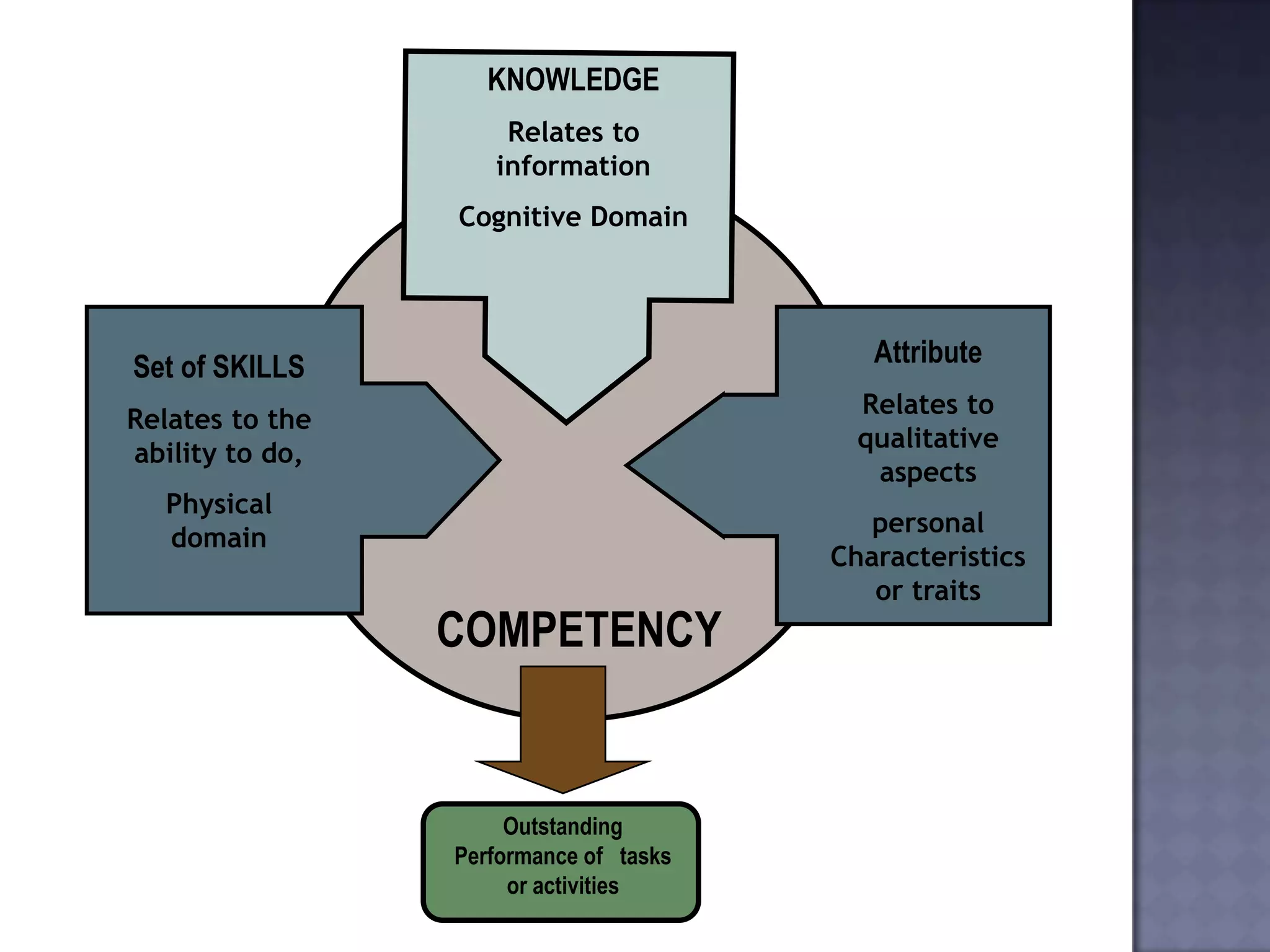
KNOWLEDGE
                     Relates to
                    information
                 Cognitive Domain


Set of SKILLS                              Attribute
                                          Relates to
Relates to the
                                          qualitative
ability to do,
                                           aspects
  Physical
                                           personal
  domain
                                        Characteristics
                                           or traits
                 COMPETENCY


                      Outstanding
                 Performance of tasks
                      or activities
 Independently researches for   information and
  finds solutions to issues
 Ability to know what needs to be done or find out
  (research) and take steps to get it done
 Asks questions when not sure of what the
  problem is or to gain more information
 Able to identify the underlying or main problem
 Shows willingness to experiment with new things
 Develops a list of decision making guidelines to
  help arrive at logical solutions
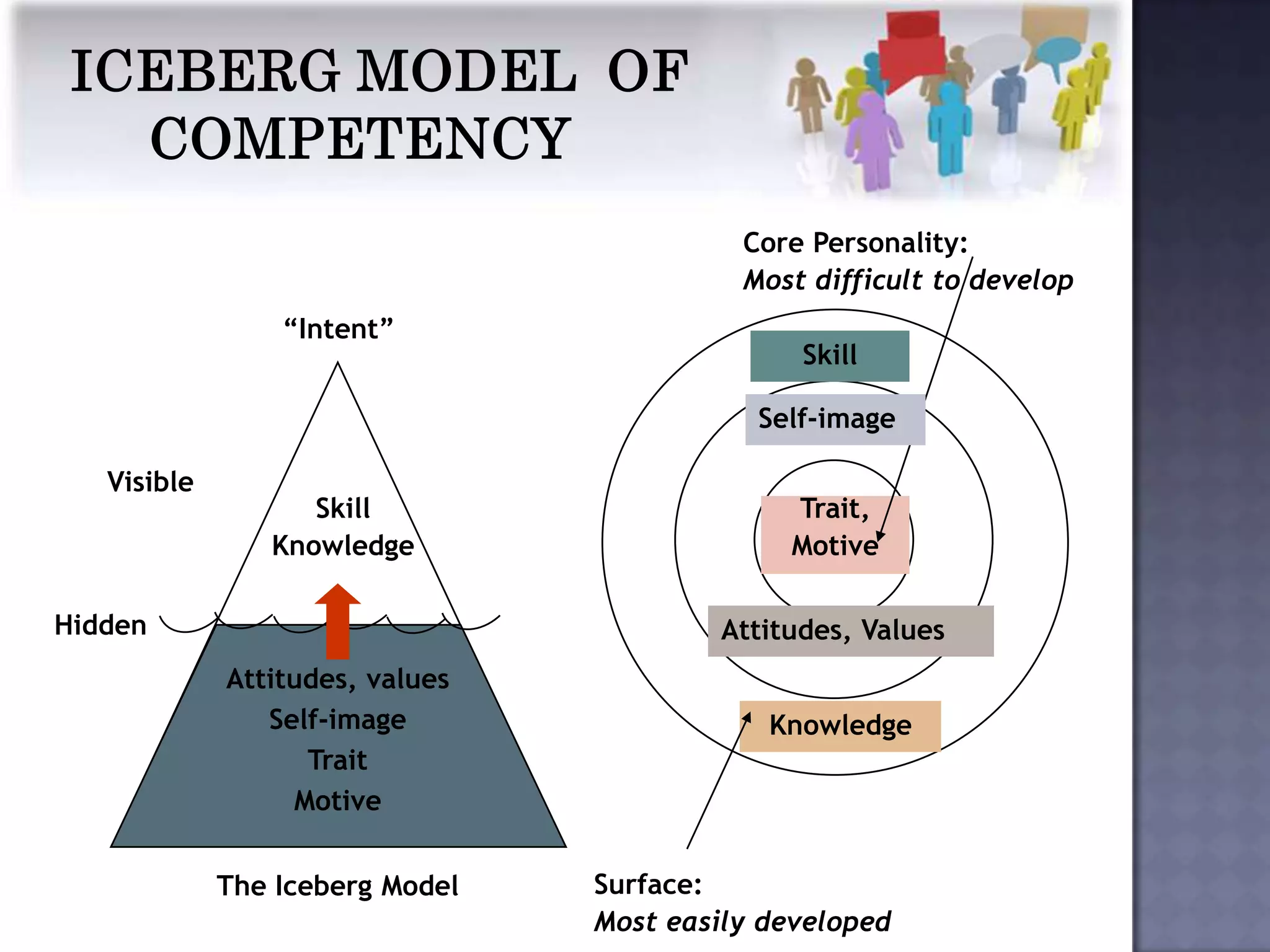
Core Personality:
                                           Most difficult to develop
                 “Intent”
                                               Skill

                                            Self-image

   Visible
                   Skill                      Trait,
                Knowledge                     Motive

Hidden                                   Attitudes, Values
             Attitudes, values
                Self-image                   Knowledge
                   Trait
                  Motive


             The Iceberg Model   Surface:
                                 Most easily developed
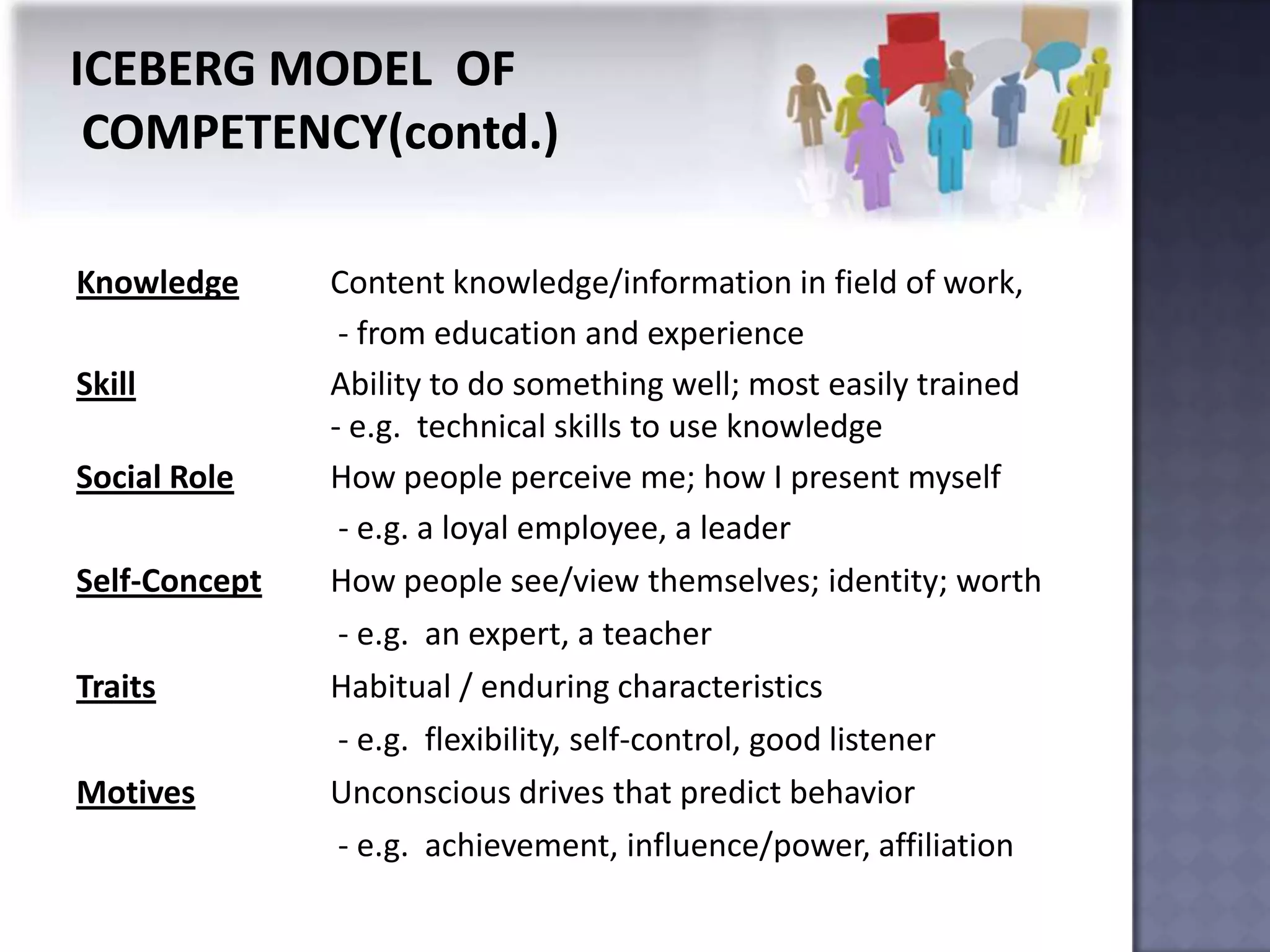
(contd.)

Knowledge      Content knowledge/information in field of work,
                - from education and experience
Skill          Ability to do something well; most easily trained
               - e.g. technical skills to use knowledge
Social Role    How people perceive me; how I present myself
                - e.g. a loyal employee, a leader
Self-Concept   How people see/view themselves; identity; worth
                - e.g. an expert, a teacher
Traits         Habitual / enduring characteristics
                - e.g. flexibility, self-control, good listener
Motives        Unconscious drives that predict behavior
                - e.g. achievement, influence/power, affiliation
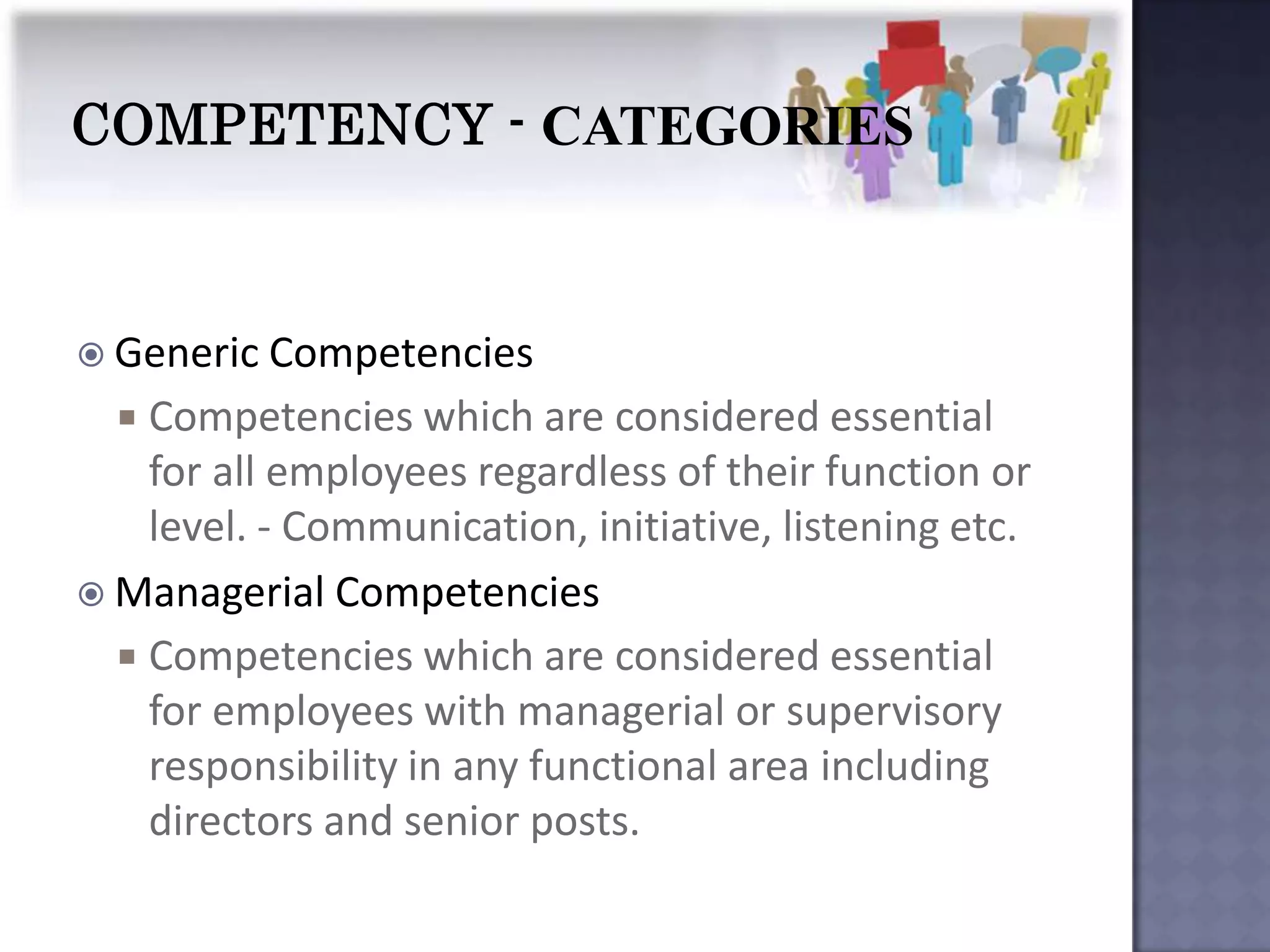
 Generic Competencies
   Competencies which are considered essential
    for all employees regardless of their function or
    level. - Communication, initiative, listening etc.
 Managerial Competencies
   Competencies which are considered essential
    for employees with managerial or supervisory
    responsibility in any functional area including
    directors and senior posts.
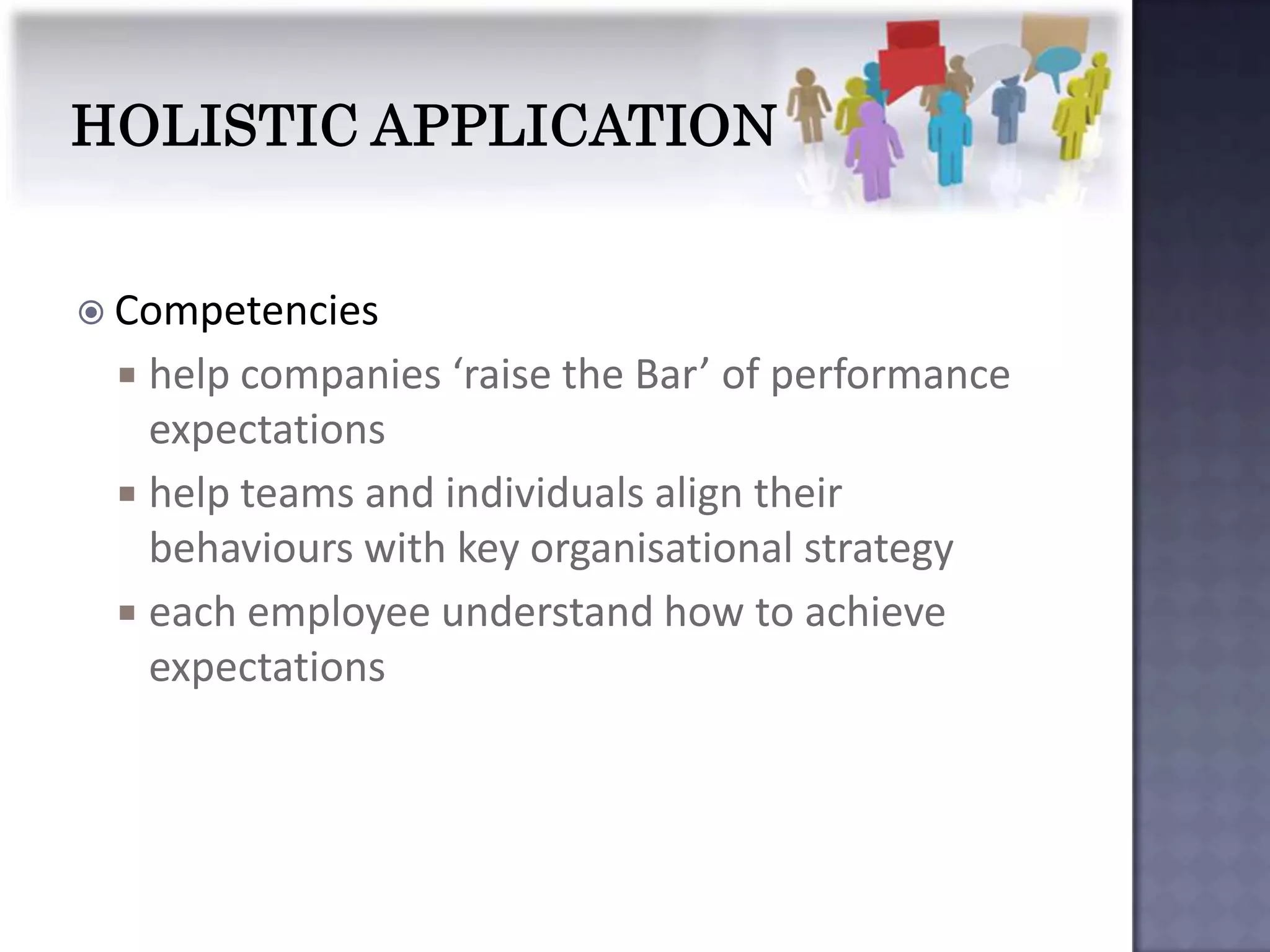
 Competencies
  help companies ‘raise the Bar’ of performance
   expectations
  help teams and individuals align their
   behaviours with key organisational strategy
  each employee understand how to achieve
   expectations
 Threshold competencies

 Those characteristics which any job holder needs
 to have to do the job effectively – but do not
 distinguish the average from superior performer.
 E.g. language skills, computer skills etc.
 Differentiating competencies

 Those characteristics which superior performers
 have but are not present in the average
 performers. E.g. empathy, ability to scan the
 environment for opportunities, etc.
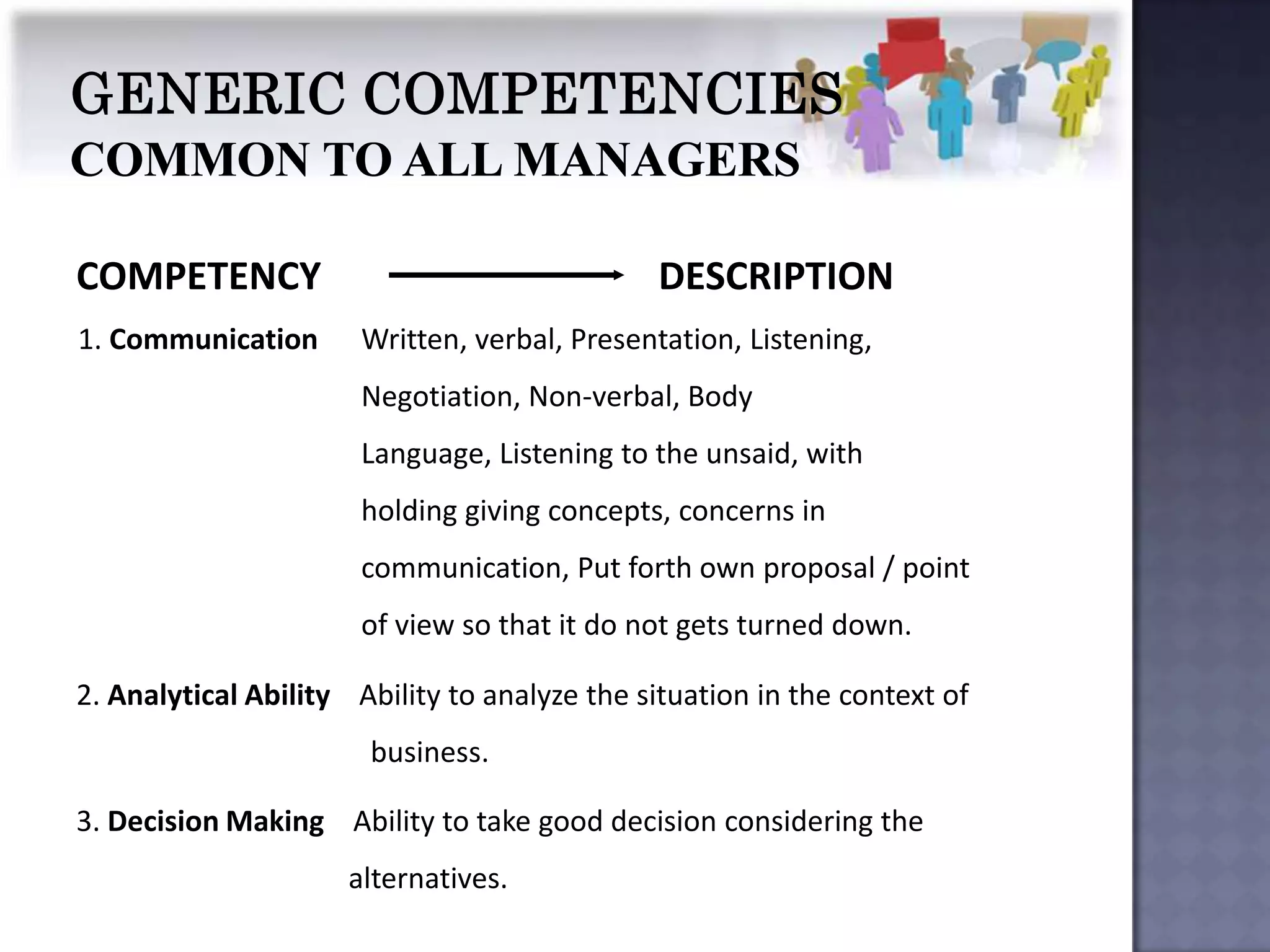
COMPETENCY                                    DESCRIPTION
1. Communication      Written, verbal, Presentation, Listening,
                      Negotiation, Non-verbal, Body
                      Language, Listening to the unsaid, with
                      holding giving concepts, concerns in
                      communication, Put forth own proposal / point
                      of view so that it do not gets turned down.

2. Analytical Ability Ability to analyze the situation in the context of
                       business.

3. Decision Making Ability to take good decision considering the
                     alternatives.
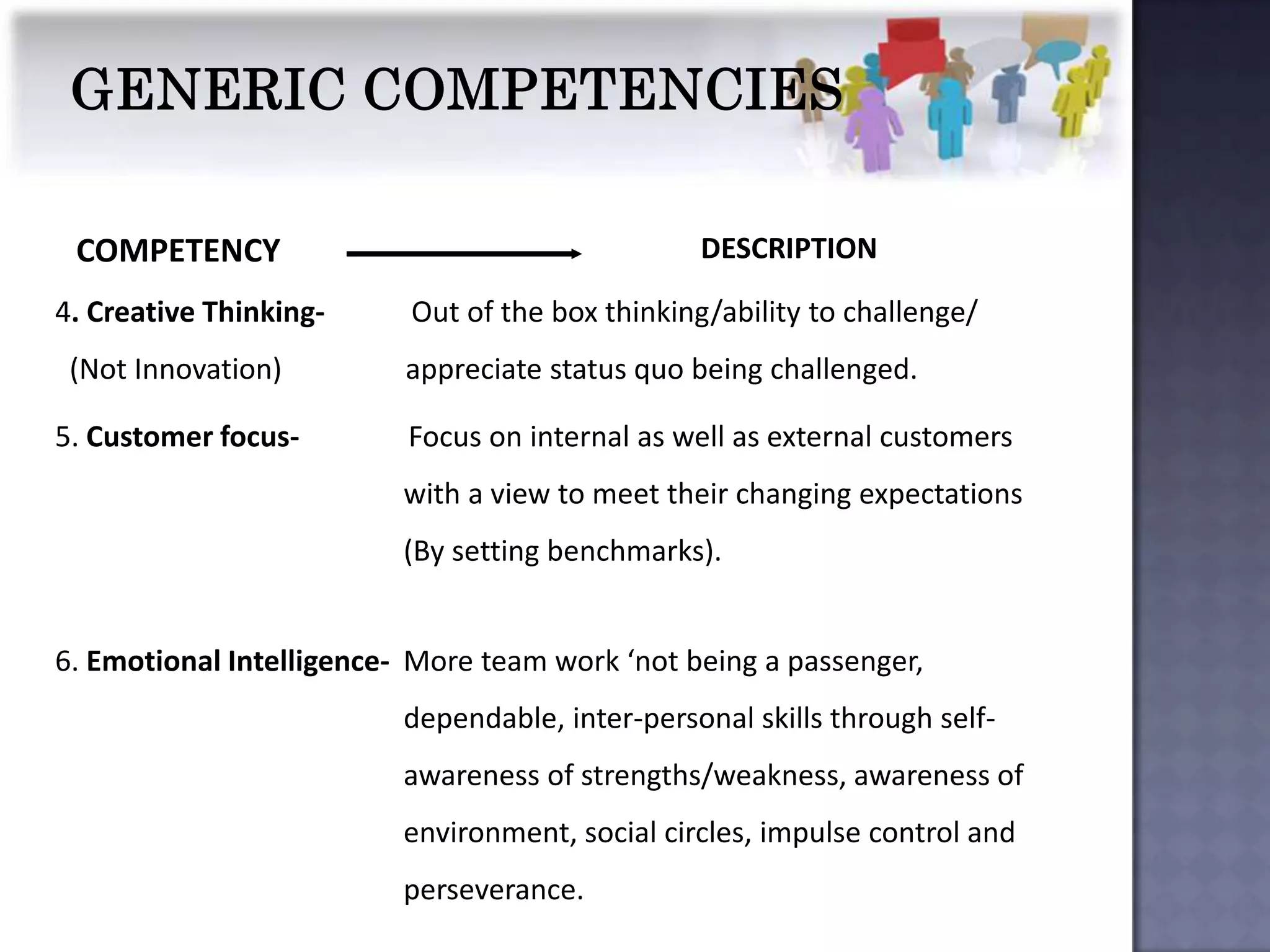
COMPETENCY                                      DESCRIPTION

4. Creative Thinking-     Out of the box thinking/ability to challenge/
 (Not Innovation)         appreciate status quo being challenged.

5. Customer focus-        Focus on internal as well as external customers
                          with a view to meet their changing expectations
                          (By setting benchmarks).


6. Emotional Intelligence- More team work ‘not being a passenger,
                          dependable, inter-personal skills through self-
                          awareness of strengths/weakness, awareness of
                          environment, social circles, impulse control and
                          perseverance.
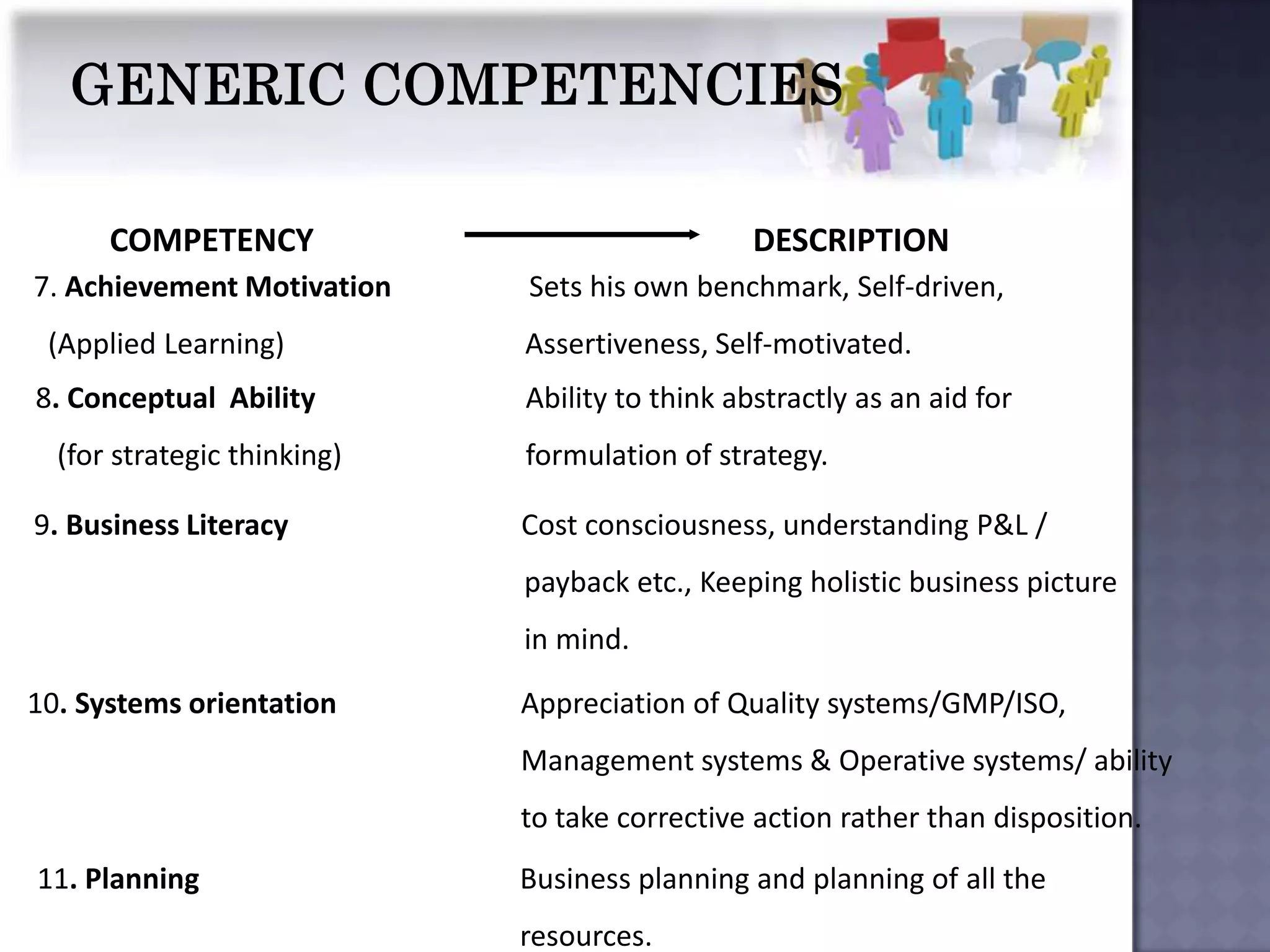
COMPETENCY                                DESCRIPTION
7. Achievement Motivation    Sets his own benchmark, Self-driven,
 (Applied Learning)          Assertiveness, Self-motivated.
8. Conceptual Ability        Ability to think abstractly as an aid for
  (for strategic thinking)   formulation of strategy.

9. Business Literacy         Cost consciousness, understanding P&L /
                             payback etc., Keeping holistic business picture
                             in mind.

10. Systems orientation      Appreciation of Quality systems/GMP/ISO,
                             Management systems & Operative systems/ ability
                             to take corrective action rather than disposition.
11. Planning                 Business planning and planning of all the
                             resources.
   The ultimate aim of the exercise is performance –
    the individual’s & the organization’s
   All organization members must have a reasonable
    proficiency in a few key competencies determined
    by its business and strategy
   A majority of key competencies are generic in
    nature, with a few knowledge competencies
    specific to the nature of business
   A clear understanding of every member’s job
    profile is crucial to competency mapping
 Competency Measurement


 Competency Measuring Methods
Why Competency Measurement ?

      Cost of Manpower
      Cost of Incompetence
      Planned Competency Development
      Employee Engagement
 A competency measurement is a valid, observable, and
  measurable list of the knowledge, skills, and attributes
  demonstrated through behavior that results in
  outstanding performance in a particular work context.
 The process of identification of the competencies
  required to perform successfully a given job or role or
  a set of tasks at a given point in time.
 It consists of breaking a given role or job into its
  constituent tasks or activities and identifying the
  competencies needed to perform the same successfully
•   Expert panels


•   Focus groups


•   Surveys


•   Psychometric tests
 Evaluation of the extent to which a given
 individual or a set of individuals possess these
 competencies required by a given role or set of
 roles or levels of jobs.
•   Assessment Centers


•   360 degrees feedback


•   Psychometric tests
•   Use multiple methods and multiple assessors to enhance
    objectivity.


•   Use psychometric tests, stimulation
    exercises, presentations, in basket exercises, interviews, role
    plays, group discussions etc.


•   Methods used depend on nature of competencies
•   Competencies can be identified by experts, HR
    specialists, job analysts, psychologists etc.. in consultation
    with line managers, current and past role
    holders, supervisors, internal customers and subordinates.
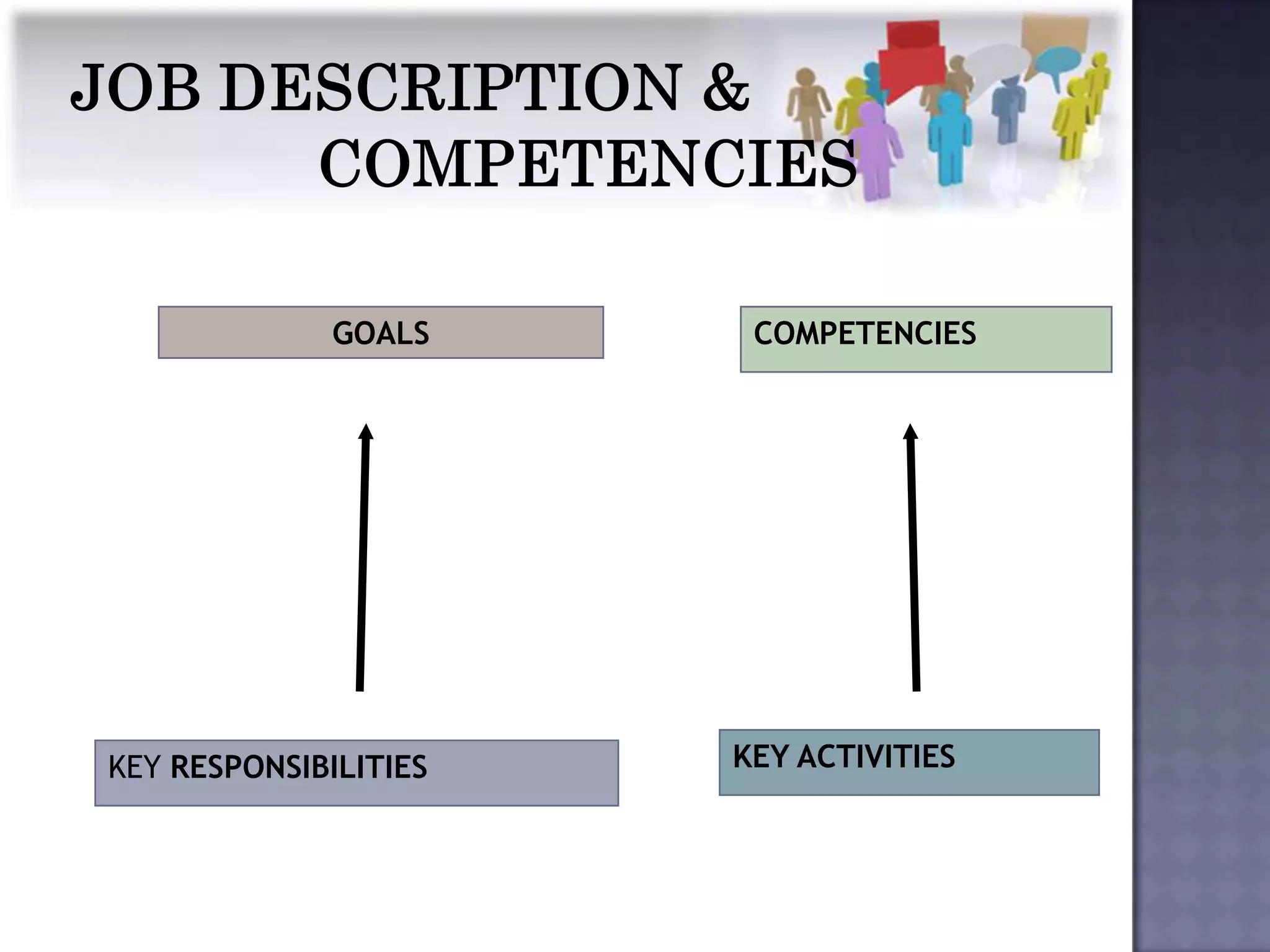
GOALS     COMPETENCIES


KEY RESPONSIBILITIES   KEY ACTIVITIES
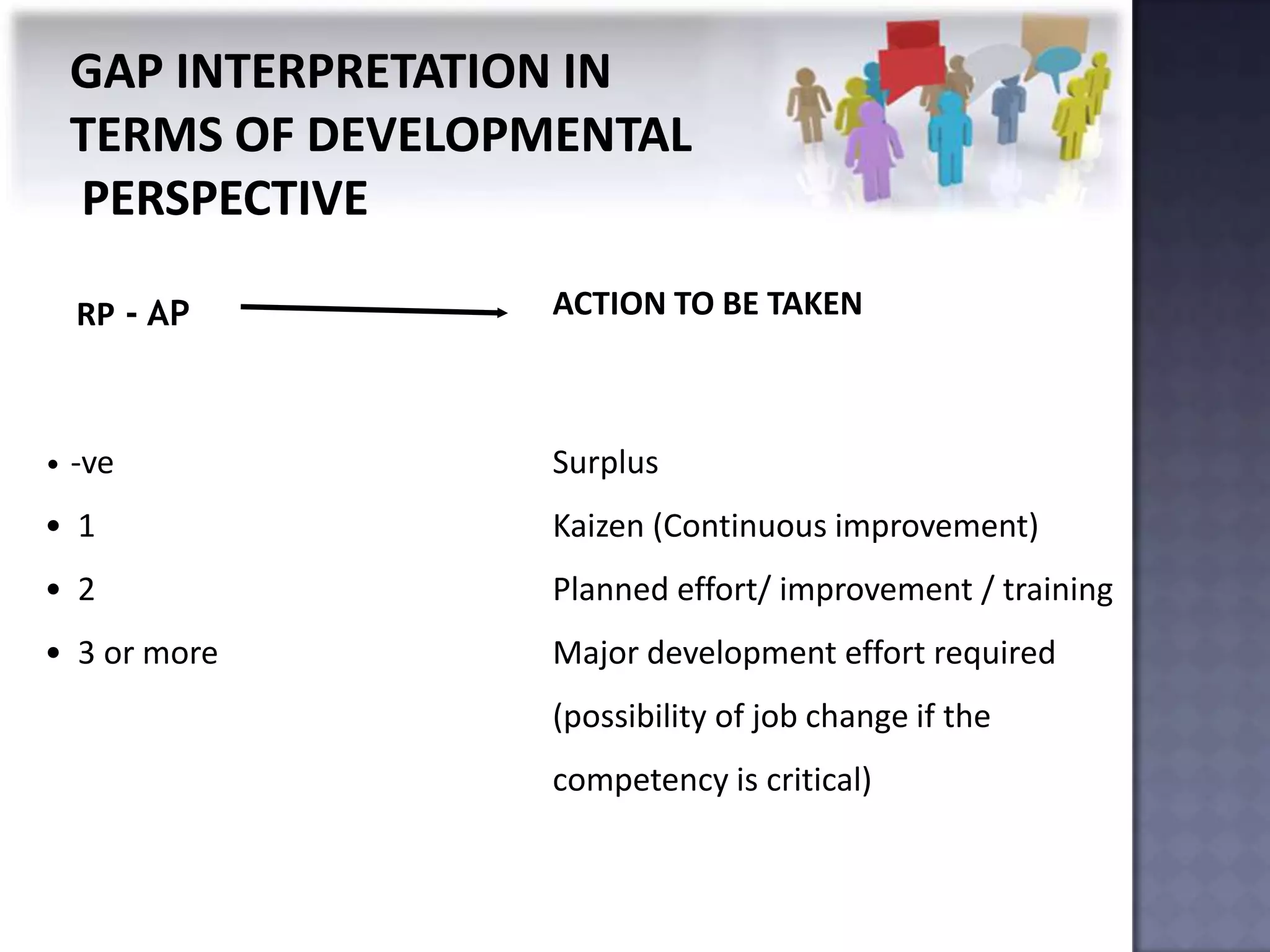
RP - AP     ACTION TO BE TAKEN


• -ve         Surplus
• 1           Kaizen (Continuous improvement)
• 2           Planned effort/ improvement / training
• 3 or more   Major development effort required
              (possibility of job change if the
              competency is critical)
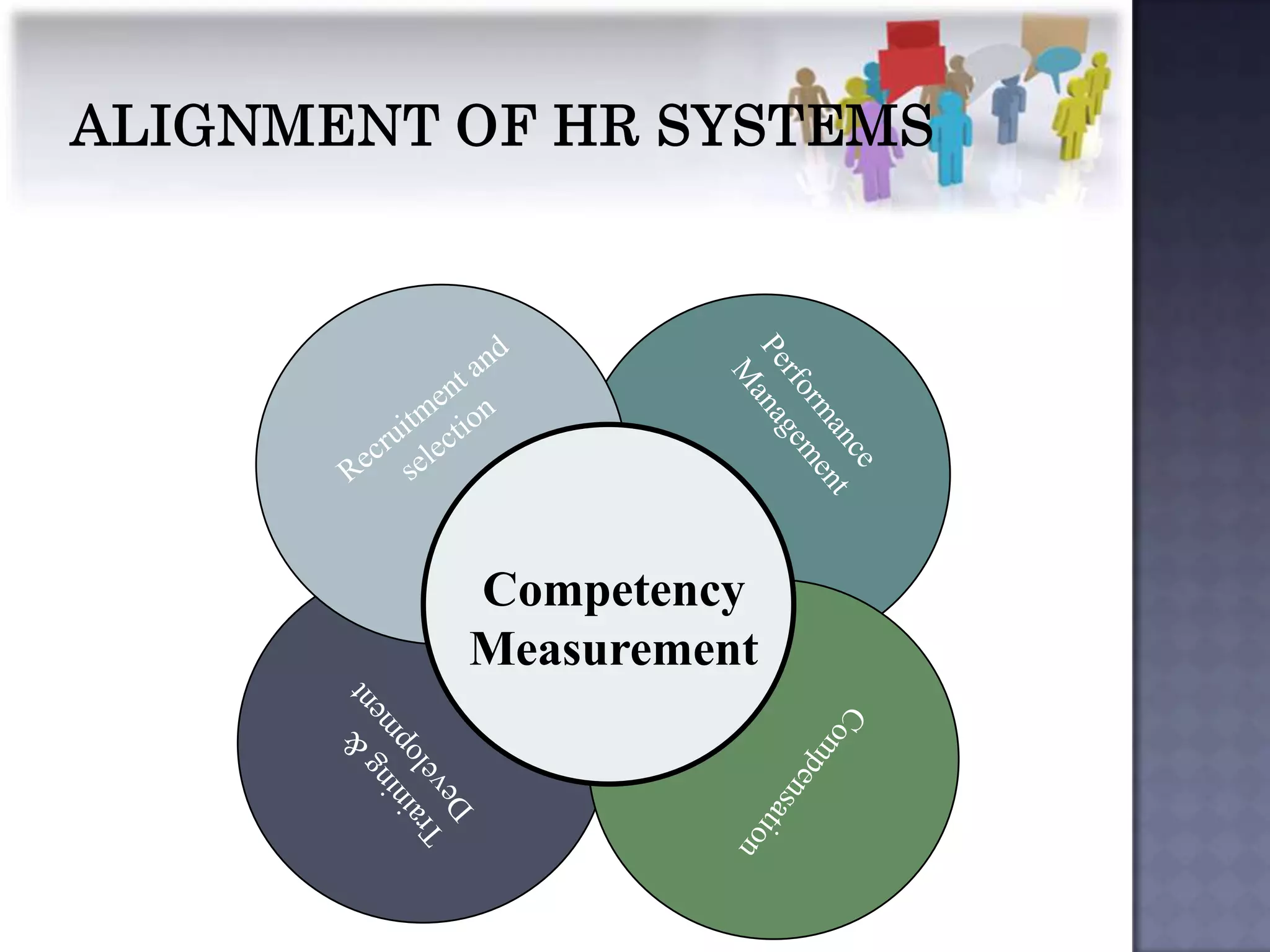
Competency
Measurement
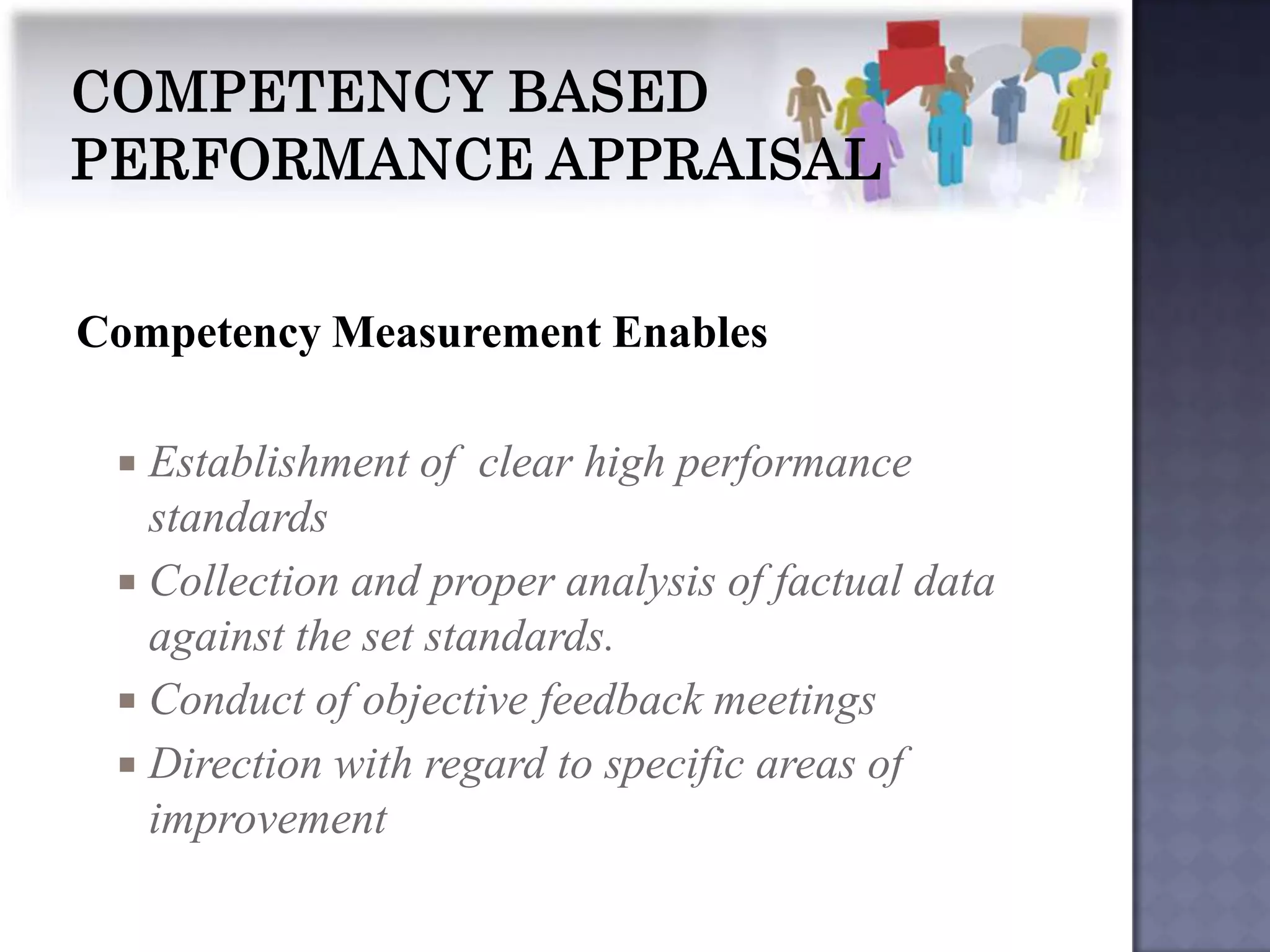
Competency Measurement Enables

  Establishment of clear high performance
   standards
  Collection and proper analysis of factual data
   against the set standards.
  Conduct of objective feedback meetings
  Direction with regard to specific areas of
   improvement
Competency Measurement Acts as a Basis for...

        Performance Management
        Continuous Learning & Development
        New Assignment / Project Allocation
        Job Rotation
        Promotion
        Compensation
        Career Development
        Selection
Competancy

Competancy

  • 2.
     A Competencyis an underlying characteristic of a person which enables him /her to deliver superior performance in a given job, role or a situation. OR  Any underlying characteristic ofan individual,an operative thought or behaviour, causally related to superior performance on the job. •Observable •Measurable •Consistent
  • 3.
    KNOWLEDGE Relates to information Cognitive Domain Set of SKILLS Attribute Relates to Relates to the qualitative ability to do, aspects Physical personal domain Characteristics or traits COMPETENCY Outstanding Performance of tasks or activities
  • 4.
     Independently researchesfor information and finds solutions to issues  Ability to know what needs to be done or find out (research) and take steps to get it done  Asks questions when not sure of what the problem is or to gain more information  Able to identify the underlying or main problem  Shows willingness to experiment with new things  Develops a list of decision making guidelines to help arrive at logical solutions
  • 5.
    Core Personality: Most difficult to develop “Intent” Skill Self-image Visible Skill Trait, Knowledge Motive Hidden Attitudes, Values Attitudes, values Self-image Knowledge Trait Motive The Iceberg Model Surface: Most easily developed
  • 6.
    (contd.) Knowledge Content knowledge/information in field of work, - from education and experience Skill Ability to do something well; most easily trained - e.g. technical skills to use knowledge Social Role How people perceive me; how I present myself - e.g. a loyal employee, a leader Self-Concept How people see/view themselves; identity; worth - e.g. an expert, a teacher Traits Habitual / enduring characteristics - e.g. flexibility, self-control, good listener Motives Unconscious drives that predict behavior - e.g. achievement, influence/power, affiliation
  • 7.
     Generic Competencies  Competencies which are considered essential for all employees regardless of their function or level. - Communication, initiative, listening etc.  Managerial Competencies  Competencies which are considered essential for employees with managerial or supervisory responsibility in any functional area including directors and senior posts.
  • 8.
     Competencies help companies ‘raise the Bar’ of performance expectations  help teams and individuals align their behaviours with key organisational strategy  each employee understand how to achieve expectations
  • 9.
     Threshold competencies Those characteristics which any job holder needs to have to do the job effectively – but do not distinguish the average from superior performer. E.g. language skills, computer skills etc.  Differentiating competencies Those characteristics which superior performers have but are not present in the average performers. E.g. empathy, ability to scan the environment for opportunities, etc.
  • 10.
    COMPETENCY DESCRIPTION 1. Communication Written, verbal, Presentation, Listening, Negotiation, Non-verbal, Body Language, Listening to the unsaid, with holding giving concepts, concerns in communication, Put forth own proposal / point of view so that it do not gets turned down. 2. Analytical Ability Ability to analyze the situation in the context of business. 3. Decision Making Ability to take good decision considering the alternatives.
  • 11.
    COMPETENCY DESCRIPTION 4. Creative Thinking- Out of the box thinking/ability to challenge/ (Not Innovation) appreciate status quo being challenged. 5. Customer focus- Focus on internal as well as external customers with a view to meet their changing expectations (By setting benchmarks). 6. Emotional Intelligence- More team work ‘not being a passenger, dependable, inter-personal skills through self- awareness of strengths/weakness, awareness of environment, social circles, impulse control and perseverance.
  • 12.
    COMPETENCY DESCRIPTION 7. Achievement Motivation Sets his own benchmark, Self-driven, (Applied Learning) Assertiveness, Self-motivated. 8. Conceptual Ability Ability to think abstractly as an aid for (for strategic thinking) formulation of strategy. 9. Business Literacy Cost consciousness, understanding P&L / payback etc., Keeping holistic business picture in mind. 10. Systems orientation Appreciation of Quality systems/GMP/ISO, Management systems & Operative systems/ ability to take corrective action rather than disposition. 11. Planning Business planning and planning of all the resources.
  • 13.
    The ultimate aim of the exercise is performance – the individual’s & the organization’s  All organization members must have a reasonable proficiency in a few key competencies determined by its business and strategy  A majority of key competencies are generic in nature, with a few knowledge competencies specific to the nature of business  A clear understanding of every member’s job profile is crucial to competency mapping
  • 14.
     Competency Measurement Competency Measuring Methods
  • 15.
    Why Competency Measurement? Cost of Manpower Cost of Incompetence Planned Competency Development Employee Engagement
  • 16.
     A competencymeasurement is a valid, observable, and measurable list of the knowledge, skills, and attributes demonstrated through behavior that results in outstanding performance in a particular work context.  The process of identification of the competencies required to perform successfully a given job or role or a set of tasks at a given point in time.  It consists of breaking a given role or job into its constituent tasks or activities and identifying the competencies needed to perform the same successfully
  • 17.
    Expert panels • Focus groups • Surveys • Psychometric tests
  • 18.
     Evaluation ofthe extent to which a given individual or a set of individuals possess these competencies required by a given role or set of roles or levels of jobs.
  • 19.
    Assessment Centers • 360 degrees feedback • Psychometric tests
  • 20.
    Use multiple methods and multiple assessors to enhance objectivity. • Use psychometric tests, stimulation exercises, presentations, in basket exercises, interviews, role plays, group discussions etc. • Methods used depend on nature of competencies • Competencies can be identified by experts, HR specialists, job analysts, psychologists etc.. in consultation with line managers, current and past role holders, supervisors, internal customers and subordinates.
  • 21.
    GOALS COMPETENCIES KEY RESPONSIBILITIES KEY ACTIVITIES
  • 22.
    RP - AP ACTION TO BE TAKEN • -ve Surplus • 1 Kaizen (Continuous improvement) • 2 Planned effort/ improvement / training • 3 or more Major development effort required (possibility of job change if the competency is critical)
  • 23.
  • 24.
    Competency Measurement Enables  Establishment of clear high performance standards  Collection and proper analysis of factual data against the set standards.  Conduct of objective feedback meetings  Direction with regard to specific areas of improvement
  • 25.
    Competency Measurement Actsas a Basis for...  Performance Management  Continuous Learning & Development  New Assignment / Project Allocation  Job Rotation  Promotion  Compensation  Career Development  Selection