Group Leader :Group Members :-

Anamika Chauhan
Yashika Vala
Barot Shital
Sumitra Thakor
Krunal Khatri
Afzal Khan
Iqbal Baluch


Workers‟ participation in management is an essential
ingredient of Industrial democracy. The concept of
workers‟ participation in management is based on
Human Relations approach to Management which
brought about a new set of values to labour and
management.



Traditionally the concept of Workers‟ Participation in
Management (WPM) refers to participation of nonmanagerial employees in the decision-making process
of the organization.



Workers‟ participation is also
participation‟
or
„employee
management.

known as „labour
participation‟
in


The International Labour Organization has been
encouraging member nations to promote the scheme of
Workers‟ Participation in Management.



Workers‟ participation in management implies mental
and emotional involvement of workers in the
management of Enterprise. It is considered as a
mechanism where workers have a say in the decisionThe philosophy underlying workers‟ participation
stresses :-

A. Democratic Participation In Decision-making;
B. Maximum Employer-employee Collaboration;
C. Minimum State Intervention;
D. Realisation Of A Greater Measure Of Social Justice;
E. Greater Industrial Efficiency; And
F. Higher Level Of Organisational Health And

Effectiveness.
Workers‟ participation, may broadly be taken to cover all
terms of association of workers and their representatives
with the decision-making process, ranging from exchange
of information, consultations, decisions and negotiations,
to more institutionalized forms such as the presence of
workers‟ member on management or supervisory boards
or
even
management
by
workers
themselves
The main implications of workers‟ participation in
management as summarized by ILO:
Workers have ideas which can be useful;

Workers may work more intelligently if they are
informed about the reasons for and then intention of
decisions that are taken in a participative atmosphere


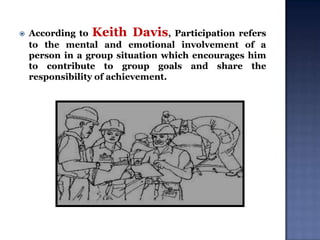
According to Keith Davis, Participation refers
to the mental and emotional involvement of a
person in a group situation which encourages him
to contribute to group goals and share the
responsibility of achievement.
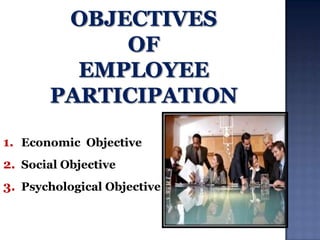
1. Economic Objective
2. Social Objective

3. Psychological Objective
A. Before Participation
B. After Participation
C. Directive Principle of State Policy
Article – 43 A
 The Indian Labour Conference, 1957
 Second Seminar on Labour Management Co-operation was held in
1960
 Standing Committee, 1961
 The New Scheme (1984)
 The 1990 Bill
 Collective Bargaining

 Works Committees
 Profit Sharing
 Workers‟ co-partnership
 Suggestions Scheme
 Joint Management Councils and Committees

 Employee‟s Representation on the Board of
Directors


Collective bargaining results in collective agreements
which lay down certain rules and conditions of service in
an establishment. Such agreements are normally binding
on the parties.



Theoretically, collective bargaining is based on the
principle of balance of power, but, in actual practice, each
party tries to outbid the other and get maximum
advantage by using, if necessary, threats and
counterthreats like; strikes, lockouts and other direct
actions. Joint consultation, on the other hand, is a
particular technique which is intended to achieve a
greater degree of harmony and cooperation by
emphasising matters of common interest.



Workers prefer to use the instrument of collective
bargaining rather than ask for a share in management.
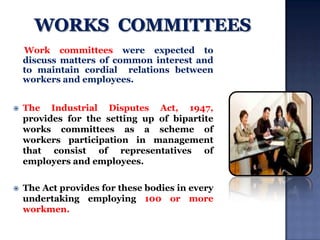
Work committees were expected to
discuss matters of common interest and
to maintain cordial relations between
workers and employees.


The Industrial Disputes Act, 1947,
provides for the setting up of bipartite
works committees as a scheme of
workers participation in management
that consist of representatives of
employers and employees.



The Act provides for these bodies in every
undertaking employing 100 or more
workmen.
 Profit Sharing implies payment of a specified share

to the works in the annual profit of the firm where he
is employed.


In Profit sharing “a certain percentage as the profit is
distributed at fixed intervals , usually annually in
some definite ratio to all employees who have been in
the employment of the firm for a status term.”
-- Kimball and Kimball


This method is wider scope than profit sharing
under this method a worker receives some share in
the final profits of the firm over and above his
standard wages and other benefits.



Thus they become shareholders of the firm and
gain all the rights and responsibilities of the
shareholders.


Under this method suggestion boxes are installed in
all departments and it is publicly announced that all
the employees are invited to suggest or the
improvement in the method or technique of
working department into the suggestion boxes
installed in their respective departments.



A suitable reward of prize is also announced for the
really original & useful suggestion.



In India the Tata Iron & Steel Co., Jamshedpur was
the first to employ this method with much success.
They have given it name of „partnership for
Progress‟.


Mainly these bodies are consultative and advisory,
with decision-making being left to the top
management. This system of participation is
prevalent in many countries, including Britain and
India. As they are consultative and advisory,
neither the managements nor the workers take
them seriously.


It recommended the appointments
of workers
representatives on the board of management.



The role of a worker representative in the board of
directors is essentially one of negotiating the
worker‟s interest with the other members of the
board.
At times, this may result in tension and friction
inside the board room. The effectiveness of workers‟
representative at the board depend upon his ability to
participate in decision-making, his knowledge of the
company affairs, his educational background, his
level of understanding and also on the number of
worker representatives in the Board.


 Managerial
 Union

Attitude

Cooperation

 Meaningful
 Workers‟

Participation

Attitude
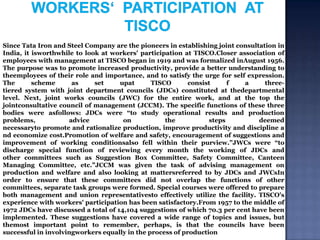
Since Tata Iron and Steel Company are the pioneers in establishing joint consultation in
India, it isworthwhile to look at workers' participation at TISCO.Closer association of
employees with management at TISCO began in 1919 and was formalized inAugust 1956.
The purpose was to promote increased productivity, provide a better understanding to
theemployees of their role and importance, and to satisfy the urge for self expression.
The
scheme
as
set
upat
TISCO
consist
f
a
threetiered system with joint department councils (JDCs) constituted at thedepartmental
level. Next, joint works councils (JWC) for the entire work, and at the top the
jointconsultative council of management (JCCM). The specific functions of these three
bodies were asfollows: JDCs were “to study operational results and production
problems,
advice
on
the
steps
deemed
necessaryto promote and rationalize production, improve productivity and discipline a
nd economize cost.Promotion of welfare and safety, encouragement of suggestions and
improvement of working conditionsalso fell within their purview.”JWCs were “to
discharge special function of reviewing every month the working of JDCs and
other committees such as Suggestion Box Committee, Safety Committee, Canteen
Managing Committee, etc.”JCCM was given the task of advising management on
production and welfare and also looking at mattersreferred to by JDCs and JWCsIn
order to ensure that these committees did not overlap the functions of other
committees, separate task groups were formed. Special courses were offered to prepare
both management and union representativesto effectively utilize the facility. TISCO's
experience with workers' participation has been satisfactory.From 1957 to the middle of
1972 JDCs have discussed a total of 14,104 suggestions of which 70.3 per cent have been
implemented. These suggestions have covered a wide range of topics and issues, but
themost important point to remember, perhaps, is that the councils have been
successful in involvingworkers equally in the process of production


Prof. Santosh Gupta & Sachin Gupta, Human
Resource Development,Concepts and Practices,
Second Edition (2008).



Dr. Ratna Sen , ILO ,Employee participation in
India ( 2012 )



K .Ashwathapa: “human Resource Management.
Text And Cases, Sixth Edition (2011)
 http://www.whatishumanresource.com

 http://www.scribd.com
employee participation

employee participation

  • 1.
    Group Leader :GroupMembers :- Anamika Chauhan Yashika Vala Barot Shital Sumitra Thakor Krunal Khatri Afzal Khan Iqbal Baluch
  • 3.
     Workers‟ participation inmanagement is an essential ingredient of Industrial democracy. The concept of workers‟ participation in management is based on Human Relations approach to Management which brought about a new set of values to labour and management.  Traditionally the concept of Workers‟ Participation in Management (WPM) refers to participation of nonmanagerial employees in the decision-making process of the organization.  Workers‟ participation is also participation‟ or „employee management. known as „labour participation‟ in
  • 4.
     The International LabourOrganization has been encouraging member nations to promote the scheme of Workers‟ Participation in Management.  Workers‟ participation in management implies mental and emotional involvement of workers in the management of Enterprise. It is considered as a mechanism where workers have a say in the decisionThe philosophy underlying workers‟ participation stresses :- A. Democratic Participation In Decision-making; B. Maximum Employer-employee Collaboration; C. Minimum State Intervention; D. Realisation Of A Greater Measure Of Social Justice; E. Greater Industrial Efficiency; And F. Higher Level Of Organisational Health And Effectiveness.
  • 6.
    Workers‟ participation, maybroadly be taken to cover all terms of association of workers and their representatives with the decision-making process, ranging from exchange of information, consultations, decisions and negotiations, to more institutionalized forms such as the presence of workers‟ member on management or supervisory boards or even management by workers themselves The main implications of workers‟ participation in management as summarized by ILO: Workers have ideas which can be useful; Workers may work more intelligently if they are informed about the reasons for and then intention of decisions that are taken in a participative atmosphere
  • 7.
     According to KeithDavis, Participation refers to the mental and emotional involvement of a person in a group situation which encourages him to contribute to group goals and share the responsibility of achievement.
  • 8.
    1. Economic Objective 2.Social Objective 3. Psychological Objective
  • 9.
    A. Before Participation B.After Participation C. Directive Principle of State Policy Article – 43 A  The Indian Labour Conference, 1957  Second Seminar on Labour Management Co-operation was held in 1960  Standing Committee, 1961  The New Scheme (1984)  The 1990 Bill
  • 10.
     Collective Bargaining Works Committees  Profit Sharing  Workers‟ co-partnership  Suggestions Scheme  Joint Management Councils and Committees  Employee‟s Representation on the Board of Directors
  • 11.
     Collective bargaining resultsin collective agreements which lay down certain rules and conditions of service in an establishment. Such agreements are normally binding on the parties.  Theoretically, collective bargaining is based on the principle of balance of power, but, in actual practice, each party tries to outbid the other and get maximum advantage by using, if necessary, threats and counterthreats like; strikes, lockouts and other direct actions. Joint consultation, on the other hand, is a particular technique which is intended to achieve a greater degree of harmony and cooperation by emphasising matters of common interest.  Workers prefer to use the instrument of collective bargaining rather than ask for a share in management.
  • 12.
    Work committees wereexpected to discuss matters of common interest and to maintain cordial relations between workers and employees.  The Industrial Disputes Act, 1947, provides for the setting up of bipartite works committees as a scheme of workers participation in management that consist of representatives of employers and employees.  The Act provides for these bodies in every undertaking employing 100 or more workmen.
  • 13.
     Profit Sharingimplies payment of a specified share to the works in the annual profit of the firm where he is employed.  In Profit sharing “a certain percentage as the profit is distributed at fixed intervals , usually annually in some definite ratio to all employees who have been in the employment of the firm for a status term.” -- Kimball and Kimball
  • 14.
     This method iswider scope than profit sharing under this method a worker receives some share in the final profits of the firm over and above his standard wages and other benefits.  Thus they become shareholders of the firm and gain all the rights and responsibilities of the shareholders.
  • 15.
     Under this methodsuggestion boxes are installed in all departments and it is publicly announced that all the employees are invited to suggest or the improvement in the method or technique of working department into the suggestion boxes installed in their respective departments.  A suitable reward of prize is also announced for the really original & useful suggestion.  In India the Tata Iron & Steel Co., Jamshedpur was the first to employ this method with much success. They have given it name of „partnership for Progress‟.
  • 16.
     Mainly these bodiesare consultative and advisory, with decision-making being left to the top management. This system of participation is prevalent in many countries, including Britain and India. As they are consultative and advisory, neither the managements nor the workers take them seriously.
  • 17.
     It recommended theappointments of workers representatives on the board of management.  The role of a worker representative in the board of directors is essentially one of negotiating the worker‟s interest with the other members of the board. At times, this may result in tension and friction inside the board room. The effectiveness of workers‟ representative at the board depend upon his ability to participate in decision-making, his knowledge of the company affairs, his educational background, his level of understanding and also on the number of worker representatives in the Board. 
  • 19.
     Managerial  Union Attitude Cooperation Meaningful  Workers‟ Participation Attitude
  • 20.
    Since Tata Ironand Steel Company are the pioneers in establishing joint consultation in India, it isworthwhile to look at workers' participation at TISCO.Closer association of employees with management at TISCO began in 1919 and was formalized inAugust 1956. The purpose was to promote increased productivity, provide a better understanding to theemployees of their role and importance, and to satisfy the urge for self expression. The scheme as set upat TISCO consist f a threetiered system with joint department councils (JDCs) constituted at thedepartmental level. Next, joint works councils (JWC) for the entire work, and at the top the jointconsultative council of management (JCCM). The specific functions of these three bodies were asfollows: JDCs were “to study operational results and production problems, advice on the steps deemed necessaryto promote and rationalize production, improve productivity and discipline a nd economize cost.Promotion of welfare and safety, encouragement of suggestions and improvement of working conditionsalso fell within their purview.”JWCs were “to discharge special function of reviewing every month the working of JDCs and other committees such as Suggestion Box Committee, Safety Committee, Canteen Managing Committee, etc.”JCCM was given the task of advising management on production and welfare and also looking at mattersreferred to by JDCs and JWCsIn order to ensure that these committees did not overlap the functions of other committees, separate task groups were formed. Special courses were offered to prepare both management and union representativesto effectively utilize the facility. TISCO's experience with workers' participation has been satisfactory.From 1957 to the middle of 1972 JDCs have discussed a total of 14,104 suggestions of which 70.3 per cent have been implemented. These suggestions have covered a wide range of topics and issues, but themost important point to remember, perhaps, is that the councils have been successful in involvingworkers equally in the process of production
  • 21.
     Prof. Santosh Gupta& Sachin Gupta, Human Resource Development,Concepts and Practices, Second Edition (2008).  Dr. Ratna Sen , ILO ,Employee participation in India ( 2012 )  K .Ashwathapa: “human Resource Management. Text And Cases, Sixth Edition (2011)
  • 22.