6.3 Classification of Bones
• 206 named bones in human skeleton
• Divided into two groups based on location
– Axial skeleton
• Long axis of body
• Skull, vertebral column, rib cage
– Appendicular skeleton
• Bones of upper and lower limbs
• Girdles attaching limbs to axial skeleton
© 2016 Pearson Education, Inc.
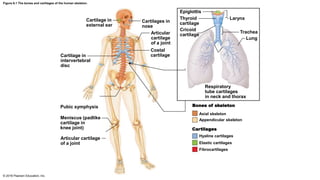
Epiglottis
LarynxCartilage in
external ear
Cartilages in
nose
Trachea
Cartilage in
intervertebral
disc
Respiratory
tube cartilages
in neck and thorax
Pubic symphysis
Meniscus (padlike
cartilage in
knee joint) Cartilages
Articular cartilage
of a joint
Articular
cartilage
of a joint
Costal
cartilage
Thyroid
cartilage
Cricoid
cartilage
Lung
Axial skeleton
Appendicular skeleton
Bones of skeleton
Hyaline cartilages
Elastic cartilages
Fibrocartilages
Figure 6.1 The bones and cartilages of the human skeleton.
© 2016 Pearson Education, Inc.
6.3 Classification of Bones
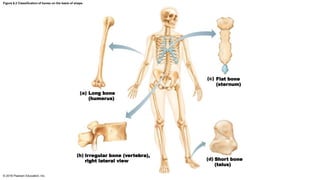
• Bones are also classified according to one of four shapes:
1. Long bones
• Longer than they are wide
• Limb bones
2. Short bones
• Cube-shaped bones (in wrist and ankle)
• Sesamoid bones form within tendons (example: patella)
• Vary in size and number in different individuals
© 2016 Pearson Education, Inc.
6.3 Classification of Bones
3. Flat bones
• Thin, flat, slightly curved
• Sternum, scapulae, ribs, most skull bones
4. Irregular bones
• Complicated shapes
• Vertebrae and hip bones
© 2016 Pearson Education, Inc.
Figure 6.2 Classification of bones on the basis of shape.
© 2016 Pearson Education, Inc.
Flat bone
(sternum)
Long bone
(humerus)
Irregular bone (vertebra),
right lateral view Short bone
(talus)

6.3

  • 1.
    6.3 Classification ofBones • 206 named bones in human skeleton • Divided into two groups based on location – Axial skeleton • Long axis of body • Skull, vertebral column, rib cage – Appendicular skeleton • Bones of upper and lower limbs • Girdles attaching limbs to axial skeleton © 2016 Pearson Education, Inc.
  • 2.
    Epiglottis LarynxCartilage in external ear Cartilagesin nose Trachea Cartilage in intervertebral disc Respiratory tube cartilages in neck and thorax Pubic symphysis Meniscus (padlike cartilage in knee joint) Cartilages Articular cartilage of a joint Articular cartilage of a joint Costal cartilage Thyroid cartilage Cricoid cartilage Lung Axial skeleton Appendicular skeleton Bones of skeleton Hyaline cartilages Elastic cartilages Fibrocartilages Figure 6.1 The bones and cartilages of the human skeleton. © 2016 Pearson Education, Inc.
  • 3.
    6.3 Classification ofBones • Bones are also classified according to one of four shapes: 1. Long bones • Longer than they are wide • Limb bones 2. Short bones • Cube-shaped bones (in wrist and ankle) • Sesamoid bones form within tendons (example: patella) • Vary in size and number in different individuals © 2016 Pearson Education, Inc.
  • 4.
    6.3 Classification ofBones 3. Flat bones • Thin, flat, slightly curved • Sternum, scapulae, ribs, most skull bones 4. Irregular bones • Complicated shapes • Vertebrae and hip bones © 2016 Pearson Education, Inc.
  • 5.
    Figure 6.2 Classificationof bones on the basis of shape. © 2016 Pearson Education, Inc. Flat bone (sternum) Long bone (humerus) Irregular bone (vertebra), right lateral view Short bone (talus)