Medical Surgical Nursing
Appendicitis and Hernia
‫الصحت‬ ‫معهد‬‫العالي‬
‫المادة‬ ‫مدرس‬
‫م‬.‫إختصاص‬ ‫جامعي‬
‫الوهاب‬ ‫عبد‬ ‫نزار‬ ‫صـالح‬
‫تمـريض‬ ‫علــوم‬ ‫ماجـستير‬
Salah Nazar Abdulwahhab  M.Sc. Nursing
www.slideshare.net
1
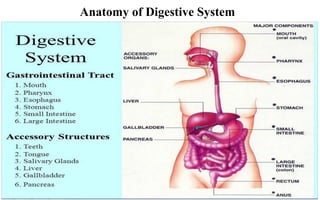
Anatomy of Digestive System
2
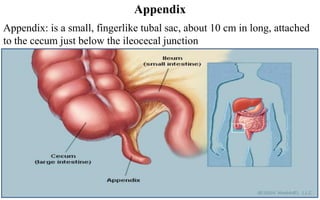
Appendix
Appendix: is a small, fingerlike tubal sac, about 10 cm in long, attached
to the cecum just below the ileocecal junction
3
Appendicitis
Appendicitis: inflammation of the appendix
most common reason for emergency abdominal surgery, can occur at any age
(more commonly between age10 - 30 years)
The obstructed appendix becomes inflamed, edematous and fill with pus
Types of Appendicitis
- Acute appendicitis: severe symptoms appear suddenly within 24 to 48 hours
- Chronic appendicitis: undiagnosed for several weeks, months, or years
4
Clinical Manifestations of Appendicitis
- Acute pain: Right Lower quadrant.
- Low grade fever.
- Muscle spasm.
- Nausea and Vomiting.
- Loss of appetite.
- Constipation or diarrhea.
- At McBurney’s point positive: local tenderness with pressure and some rigidity of the
lower portion of the right rectus muscle.
- Rebound tenderness positive: location of appendix dictates amount of tenderness.
- Rovsing’s sign positive: palpating left lower quadrant ,causes pain in right lower
quadrant.
If appendix ruptures, pain becomes more diffuse; abdominal distention develops from
paralytic ileus, and condition worsens.
5
Complications of Appendicitis
- perforation of the appendix, which can lead to
(peritonitis, abscess formation, septic thrombosis arise from septic
intestines)
- Perforation generally occurs 24 hours after the onset of pain.
Symptoms
- Fever (37.7C) or greater
- Toxic appearance
- Continued abdominal pain or tenderness
6
Management
Medical Management
- Appendectomy: is the surgical removal of the appendix
(conventional or laparoscopic).
- Administer antibiotics and IV fluids until surgery is performed.
- Analgesic can be given after diagnosis is made (not given before a
suspected case of appendicitis to determine whether the patient has a
ruptured appendix or not).
7
Management
Nursing Management
Preoperative Nursing Care
- IV infusion, to replace fluid loss and promote renal function
- antibiotic therapy (as described), to prevent infection.
- nasogastric tube is inserted, if there is evidence of paralytic ileus.
(An enema is not administered because it can lead to perforation)
8
Management
Postoperative Nursing Care
- Places the patient in a high-Fowler’s position.
(to reduces the tension on the incision and abdominal organs)
- Analgesic to reduce pain (as prescribed)
- IV fluids if patient dehydrated before surgery
- Oral fluids are administered, when patient tolerated
- Food is provided as desired and tolerated on the day of surgery when normal bowel
sounds are present
- The patient may be discharged on the day of surgery if there is no complication
9
Management
Discharge Nursing Plan
- Make an appointment with the surgeon to remove the sutures between
the 5th and 7th days after surgery
- care for the incision and perform dressing changes as prescribed
- Avoided heavy lifting postoperatively
- Return to normal activity within 2 to 4 weeks
- If drain is place at the area of the incision patient may be kept in the
hospital for several days and monitored carefully for signs of intestinal
obstruction or secondary hemorrhage
- A home care nurse may be needed if necessary (assist and to monitor)
10
HERNIA
Protrusion of an organ or part of an organ through the wall of the cavity that normally
contains it.
Common Types Of Hernia
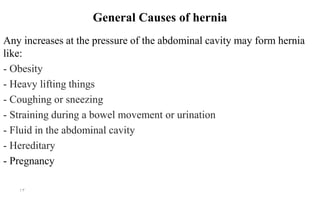
esophagus: protrudes up through the diaphragm near theHiatal hernia
and navelbone: between breastHerniaEpigastric
incision in the abdominal wall: in previouslyHerniaIncisional
of umbilicusin the muscle: weaknessHerniaUmbilical
: abdominal viscera passes through femoral ringHerniaFemoral
spermatictheregion (where: occur at the inguinal canal in the groinInguinal Hernia
cord in males or the round ligament in females)
- direct Inguinal Hernia: usually occur only in male adults and are caused by a
weakness in the muscles of the abdominal wall that develops over time
- indirect Inguinal Hernia: caused by a defect in the abdominal wall that is congenital,
or present at birth11
Types of Hernias
12
General Causes of hernia
Any increases at the pressure of the abdominal cavity may form hernia
like:
- Obesity
- Heavy lifting things
- Coughing or sneezing
- Straining during a bowel movement or urination
- Fluid in the abdominal cavity
- Hereditary
- Pregnancy
13
Clinical Manifestation
- An abnormal bulging seen in the affected area especially when straining
or coughing
- discomfort due to tension on tissues around the hernia.
- The herniation may disappear when the patient lies down.
- If the intestinal mass easily returns to the abdominal cavity or can be
manually placed back ,it is called (reducible hernia).
When adhesions or edema occur between the sac and its contents, the
hernia becomes (irreducible hernia)14
Nursing Education to Prevent Hernia
- Not smoking
- Seeing doctor to avoid developing a persistent cough
- Maintaining normal weight
- Avoiding straining during bowel movements or urination
- lifting objects with knees not back
- Avoiding lifting heavy weights
- Wear a support binder when lifting weights
- Eating high-fiber foods to prevent constipation
15
The Treatment
Treatment options include
- Observing the hernia
- Using short term support devices
- Surgery to cure the hernia
Emergency surgery for (strangulation or bowel obstruction)
sac, sewing thehernialcontents of the: replacing theHerniorrhaphy
weakened tissue, and closing the opening.
the abdomen and reinforcing thehernia intothe: replacingHernioplasty
weakened muscle wall with wire, fascia, or mesh.
Bowel resection or a temporary colostomy may be necessary if the hernia
is strangulated
16
Preoperative Nursing Care
- Patients should be encouraged to drink plenty of fluids for two days
before operation.
- Patients should be encouraged to eat foods containing fibers to avoid
constipation and pain after the operation.
- Patients can take laxatives if needed.
17
Postoperative Nursing Care
1. Give the patient medications and I.V. fluids as prescribed
2. Check Vital signs
3. Wound care
4. Ice packs and elevation of the scrotum to reduce the swelling
5. Perform deep breathing to keep lungs clear postoperatively, but should avoid coughing.
6. Report difficulty urinating, bleeding, and signs and symptoms of infection, such as
redness, incisional drainage, fever, or severe pain.
7. Avoid lifting, driving, or sexual activities for 2 to 6 weeks
8. Support the wound during sneezing or coughing with raise the head towards the ceiling
18
Thank You
19

Appendicitis and hernia

  • 1.
    Medical Surgical Nursing Appendicitisand Hernia ‫الصحت‬ ‫معهد‬‫العالي‬ ‫المادة‬ ‫مدرس‬ ‫م‬.‫إختصاص‬ ‫جامعي‬ ‫الوهاب‬ ‫عبد‬ ‫نزار‬ ‫صـالح‬ ‫تمـريض‬ ‫علــوم‬ ‫ماجـستير‬ Salah Nazar Abdulwahhab M.Sc. Nursing www.slideshare.net 1
  • 2.
  • 3.
    Appendix Appendix: is asmall, fingerlike tubal sac, about 10 cm in long, attached to the cecum just below the ileocecal junction 3
  • 4.
    Appendicitis Appendicitis: inflammation ofthe appendix most common reason for emergency abdominal surgery, can occur at any age (more commonly between age10 - 30 years) The obstructed appendix becomes inflamed, edematous and fill with pus Types of Appendicitis - Acute appendicitis: severe symptoms appear suddenly within 24 to 48 hours - Chronic appendicitis: undiagnosed for several weeks, months, or years 4
  • 5.
    Clinical Manifestations ofAppendicitis - Acute pain: Right Lower quadrant. - Low grade fever. - Muscle spasm. - Nausea and Vomiting. - Loss of appetite. - Constipation or diarrhea. - At McBurney’s point positive: local tenderness with pressure and some rigidity of the lower portion of the right rectus muscle. - Rebound tenderness positive: location of appendix dictates amount of tenderness. - Rovsing’s sign positive: palpating left lower quadrant ,causes pain in right lower quadrant. If appendix ruptures, pain becomes more diffuse; abdominal distention develops from paralytic ileus, and condition worsens. 5
  • 6.
    Complications of Appendicitis -perforation of the appendix, which can lead to (peritonitis, abscess formation, septic thrombosis arise from septic intestines) - Perforation generally occurs 24 hours after the onset of pain. Symptoms - Fever (37.7C) or greater - Toxic appearance - Continued abdominal pain or tenderness 6
  • 7.
    Management Medical Management - Appendectomy:is the surgical removal of the appendix (conventional or laparoscopic). - Administer antibiotics and IV fluids until surgery is performed. - Analgesic can be given after diagnosis is made (not given before a suspected case of appendicitis to determine whether the patient has a ruptured appendix or not). 7
  • 8.
    Management Nursing Management Preoperative NursingCare - IV infusion, to replace fluid loss and promote renal function - antibiotic therapy (as described), to prevent infection. - nasogastric tube is inserted, if there is evidence of paralytic ileus. (An enema is not administered because it can lead to perforation) 8
  • 9.
    Management Postoperative Nursing Care -Places the patient in a high-Fowler’s position. (to reduces the tension on the incision and abdominal organs) - Analgesic to reduce pain (as prescribed) - IV fluids if patient dehydrated before surgery - Oral fluids are administered, when patient tolerated - Food is provided as desired and tolerated on the day of surgery when normal bowel sounds are present - The patient may be discharged on the day of surgery if there is no complication 9
  • 10.
    Management Discharge Nursing Plan -Make an appointment with the surgeon to remove the sutures between the 5th and 7th days after surgery - care for the incision and perform dressing changes as prescribed - Avoided heavy lifting postoperatively - Return to normal activity within 2 to 4 weeks - If drain is place at the area of the incision patient may be kept in the hospital for several days and monitored carefully for signs of intestinal obstruction or secondary hemorrhage - A home care nurse may be needed if necessary (assist and to monitor) 10
  • 11.
    HERNIA Protrusion of anorgan or part of an organ through the wall of the cavity that normally contains it. Common Types Of Hernia esophagus: protrudes up through the diaphragm near theHiatal hernia and navelbone: between breastHerniaEpigastric incision in the abdominal wall: in previouslyHerniaIncisional of umbilicusin the muscle: weaknessHerniaUmbilical : abdominal viscera passes through femoral ringHerniaFemoral spermatictheregion (where: occur at the inguinal canal in the groinInguinal Hernia cord in males or the round ligament in females) - direct Inguinal Hernia: usually occur only in male adults and are caused by a weakness in the muscles of the abdominal wall that develops over time - indirect Inguinal Hernia: caused by a defect in the abdominal wall that is congenital, or present at birth11
  • 12.
  • 13.
    General Causes ofhernia Any increases at the pressure of the abdominal cavity may form hernia like: - Obesity - Heavy lifting things - Coughing or sneezing - Straining during a bowel movement or urination - Fluid in the abdominal cavity - Hereditary - Pregnancy 13
  • 14.
    Clinical Manifestation - Anabnormal bulging seen in the affected area especially when straining or coughing - discomfort due to tension on tissues around the hernia. - The herniation may disappear when the patient lies down. - If the intestinal mass easily returns to the abdominal cavity or can be manually placed back ,it is called (reducible hernia). When adhesions or edema occur between the sac and its contents, the hernia becomes (irreducible hernia)14
  • 15.
    Nursing Education toPrevent Hernia - Not smoking - Seeing doctor to avoid developing a persistent cough - Maintaining normal weight - Avoiding straining during bowel movements or urination - lifting objects with knees not back - Avoiding lifting heavy weights - Wear a support binder when lifting weights - Eating high-fiber foods to prevent constipation 15
  • 16.
    The Treatment Treatment optionsinclude - Observing the hernia - Using short term support devices - Surgery to cure the hernia Emergency surgery for (strangulation or bowel obstruction) sac, sewing thehernialcontents of the: replacing theHerniorrhaphy weakened tissue, and closing the opening. the abdomen and reinforcing thehernia intothe: replacingHernioplasty weakened muscle wall with wire, fascia, or mesh. Bowel resection or a temporary colostomy may be necessary if the hernia is strangulated 16
  • 17.
    Preoperative Nursing Care -Patients should be encouraged to drink plenty of fluids for two days before operation. - Patients should be encouraged to eat foods containing fibers to avoid constipation and pain after the operation. - Patients can take laxatives if needed. 17
  • 18.
    Postoperative Nursing Care 1.Give the patient medications and I.V. fluids as prescribed 2. Check Vital signs 3. Wound care 4. Ice packs and elevation of the scrotum to reduce the swelling 5. Perform deep breathing to keep lungs clear postoperatively, but should avoid coughing. 6. Report difficulty urinating, bleeding, and signs and symptoms of infection, such as redness, incisional drainage, fever, or severe pain. 7. Avoid lifting, driving, or sexual activities for 2 to 6 weeks 8. Support the wound during sneezing or coughing with raise the head towards the ceiling 18
  • 19.