Strength Training For
Older Adults
@strengthforlifecampaign
@strength4_life #StrengthSavesLives
www.strengthforlifeltd.co.uk
• Our backgrounds and approach.
• Background on the ageing population.
• Health benefits of strength training.
• Psychosocial effects of reduced strength and
frailty.
• Programme requirements for healthy ageing.
Overview
Chris Hattersley
• BSc Sport & Exercise Science
• MSc Strength & Conditioning
• UKSCA Accredited S & C Coach
• NSCA Accredited S & C Coach
• MSc Physiotherapy
Kaseem Khan
• BSc Occupational Therapy
• MSc Physiotherapy
• NSCA Accreditation
Our backgrounds
Dave Hembrough
• BSc Sport Science
• MSc Sport Therapy
• PGDIp Advanced Business
Engagement
• UKSCA Accredited S & C Coach
• NSCA Accredited S & C Coach
Dr Tom Maden-Wilkinson
• BSc Physiology with Sports
Biomedicine
• PhD with the EU Myoage project.
• Senior Lecturer in Neuromuscular
Function and Ageing
Our Approach
S & C
- Programme design
- Exercise selection
- Varied training
techniques.
Exercise Science
-Data collection & analysis.
- Adaptive physiology /
nutrition.
- Constant innovation
through scientific approach
Physiotherapy
- Anatomy &
pathophysiology
- Co-morbidities /
Diagnostic Skills
- Knowledge of health care
system
Occupational Therapy
- Person centred
- Equipment / environmental
adaptation
- Treatment of complex
patients in a holistic manner.
To get the best from each profession we need continuous
education, collaboration and positive conflict.
Research
Based
Multidisciplinary
Practical
Application
Background Information
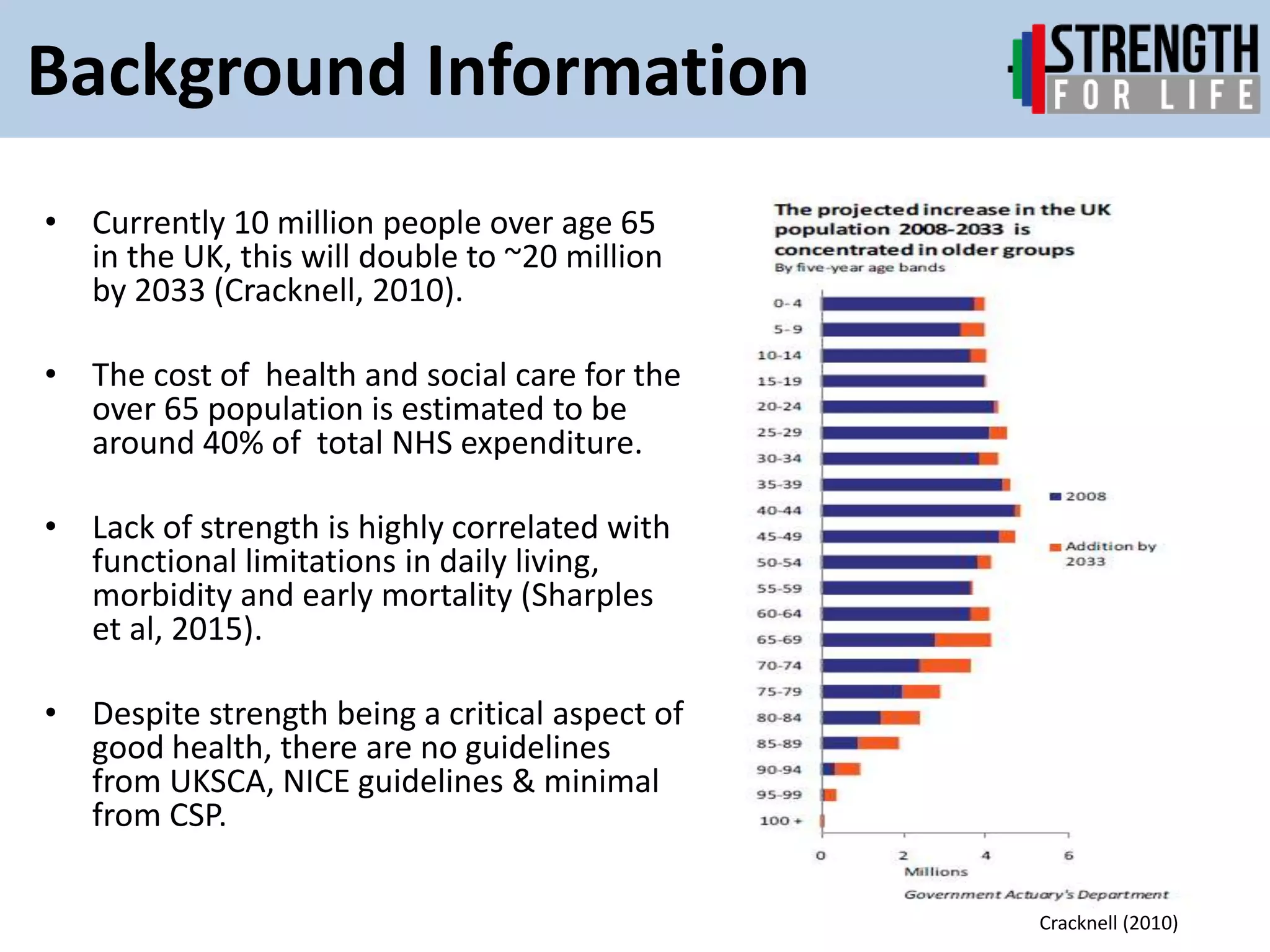
• Currently 10 million people over age 65
in the UK, this will double to ~20 million
by 2033 (Cracknell, 2010).
• The cost of health and social care for the
over 65 population is estimated to be
around 40% of total NHS expenditure.
• Lack of strength is highly correlated with
functional limitations in daily living,
morbidity and early mortality (Sharples
et al, 2015).
• Despite strength being a critical aspect of
good health, there are no guidelines
from UKSCA, NICE guidelines & minimal
from CSP.
Cracknell (2010)
The Cost of Muscle Weakness
Health care costs;
• An average cost increase of £2707 for a
sarcopenic patient
• Estimated annual total cost = £2.5 billion
Cost to the individual;
• Associated with increased risk of functional
impairment, poor health-related quality of
life, physical frailty, premature death.
Strength Levels through the lifespan
• Decline starts at 45 with major drops at
65 and 80, accelerates more rapidly with
disuse and increases chance of disability
(Bell et al, 2016).
• ‘50% of the physical decline associated
with ageing is actually disuse atrophy
resulting from inactivity’ (Jette et al,
1999).
• 100,000’s of hospital admissions per
year for sarcopenia, osteopenia,
osteoporosis for the elderly (Cruz-Jentoft
et al, 2010).
• Covert and happens over many years -
‘saving for retirement starts in early life’.
45y point of
‘accelerated aging’.
Musculoskeletal Aging
• Initial decline in strength caused by
denervation of high threshold motor
units and reduced rate of force
development.
• Anabolic hormone levels also
decrease, leading to preferential
atrophy of fast twitch fibres.
• Less tension developed by the
muscle = less force transmitted to
the bone reducing bone density and
compromising collagen alignment.
Strength training is the only intervention which can simultaneously combat all these factors!
Cognitive Ageing
• Cognitive function begins to
deteriorate at 45y.
• Increased chance of
cerebrovascular disease.
• The brain is still capable of
neuroplasticity throughout life
and remains adaptable to stimuli
and activities.
• Strength programme should
include new movements and
cognitive stimulation in order to
stimulate and retain cognitive
function.
Lose Strength, Lose Independence
Psychosocial Effects
• Amount of movement / ability to move is highly correlated to
life expectancy.
• Lack of strength impairs movement patterns and behaviours.
• Lack of movement causes psychological and social problems.
• Environmental adaptation must promote movement not remove
it.
Quality of life
A compromised movement systems leads to:-
• Cardiorespiratory decline
• Increase risk of chronic illness (diabetes, cancer, cardiovascular
disease)
• Reduction in balance, proprioception = falls risk
• Skin integrity
• Disuse physiology
• Incontinence
• ‘Treat people like they are frail,
and avoid activity, and they become
more frail at an even faster rate’
Clinical Use of Strength Training
Health Benefits of Strength Training
• Strength training has numerous
unique benefits in healthy and
clinical groups.
• Increased strength and muscle
mass levels improves systemic
health not just muscles.
• Strength training increases
length and quality of life!
• Current healthcare model is
not set up to deliver this.
SARCOPENIA
Muscle
mass
MuscleStrength
Physical
Performance
Risk of fracture, deterioration of physical
performance and QUALITY OF LIFE!
MusclePower
Sarcopenia
How do we find those most at risk ?
Strength
Assessment
Muscle Mass
Assessment
Functional
Assessment
Grip
Strength
5 Sit to
Stands DXA BIA Gait
Speed
Timed Up
And Go
Stair
Ascent/
Descent
SPPB
400m
Walk
M < 27kg
F < 16kg
> 15
seconds
M < 20kg
Muscle Mass
F < 15kg
Muscle mass
<0.8
m/s
Score
< 8
>20s
> 6
mins
Cruz- Jentoft et al., Age and Ageing, 2018.
https://vimeo.com/74649739
https://vimeo.com/74649738
https://vimeo.com/74649737
Strength as a Red Flag?
Strength
Assessment
Grip Strength 5 Sit to Stands
M < 27kg
F < 16kg
> 15 seconds
Patients under these thresholds
should be seen as a serious
cause for concern;
Increased risk of mortality
Functional limitations,
reduced independence &
quality of life.
Increased need of healthcare
support for ADL’s &
increased costs.
Current Guidelines
‘Physical activities that strengthen
muscles involve using body weight
or working against a resistance.
This should involve using all the
major muscle groups. Examples
include:
• Carrying or moving heavy loads
such as groceries
• Activities that involve stepping
and jumping such as dancing
• Chair aerobics’
• Huge discrepancy between the
size of the problem and current
guidelines.
• UKSCA have numerous articles
regarding youth training but
have never published an article
for older populations.
• CSP has information leaflets
but no actual guidelines
detailing the physiology of
ageing, programme design or
use of strength diagnostics.
Programming Requirements
• Progressive
loading
• Compound
movements
• Cognitive
loading
• Multi-
Movement
• Educational / psychosocial approach.
Something new every session & psychosocial
techniques to stimulate neuromodulators /
neuroplasticity.
• Multi-planar / level – dynamic control of
COM through challenging movements to
prevent falls.
• Neurological adaptations – to retain motor
unit recruitment and rate of force
development.
• Structural adaptations – to retain muscle
mass and bone density
Existing Research
There is currently research on all the following areas with elderly
participants:
Hypertrophy
High - Velocity
Maximum
Strength
BFR
Eccentric Training Balance/
Proprioception
Plyometrics
Iso-inertial Resistance
Key Studies
Conclusions
• A significant improvement in current guidelines and increased
awareness are needed from governing bodies to improve practice.
• Educate clinical and non clinical practitioners, S & C, physio, nursing,
GP’s, care home staff, personal trainers etc.
• Routine monitoring of strength diagnostics throughout the health
care system primary care, wards etc.
• Needs to target early prevention aiming for a high peak strength level
by age 45 and then a slow decline afterwards.
• More interventions to promote strength training in diverse groups.
Please follow our social media channels to
see how we put all these methods into
practice!
@strengthforlifecampaign
@strength4_life
That's all Folks...
@strengthforlifecampaign
info@strengthforlifeltd.com
References
• Cracknell, R., 2010. The ageing population. Key issues for the new parliament, p.44.
• Cruz-Jentoft, A.J., Landi, F., Topinková, E. and Michel, J.P., 2010. Understanding sarcopenia as a geriatric syndrome.
Current Opinion in Clinical Nutrition & Metabolic Care, 13(1), pp.1-7.
• Jette, A.M., Lachman, M., Giorgetti, M.M., Assmann, S.F., Harris, B.A., Levenson, C., Wernick, M. and Krebs, D.,
1999. Exercise--it's never too late: the strong-for-life program. American journal of public health, 89(1), pp.66-72.
• Izquierdo, M., Häkkinen, K., Ibañez, J., Garrues, M., Antón, A., Zúñiga, A., Larrión, J.L. & Gorostiaga, E.M. 2001,
"Effects of strength training on muscle power and serum hormones in middle-aged and older men", Journal of
Applied Physiology, vol. 90, no. 4, pp. 1497-1507.
• Macaluso, A. & De Vito, G. 2004, "Muscle strength, power and adaptations to resistance training in older people",
European Journal of Applied Physiology, vol. 91, no. 4, pp. 450-472.
• Nejc, S., Loefler, S., Cvecka, J., Sedliak, M. & Kern, H. 2013, "Strength training in elderly people improves static
balance: a randomized controlled trial", European Journal of Translational Myology, vol. 23, no. 3, pp. 85-89.
• Sharples, A.P., Hughes, D.C., Deane, C.S., Saini, A., Selman, C. & Stewart, C.E. 2015, "Longevity and skeletal muscle
mass: the role of IGF signalling, the sirtuins, dietary restriction and protein intake", Aging Cell, vol. 14, no. 4, pp.
511-523.
• Sipilä, S. & Poutamo, J. 2003, "Muscle performance, sex hormones and training in peri‐menopausal and
post‐menopausal women", Scandinavian Journal of Medicine & Science in Sports, vol. 13, no. 1, pp. 19-25.
• Stamatakis, E., Lee, I.M., Bennie, J., Freeston, J., Hamer, M., O'Donovan, G., Ding, D., Bauman, A. and Mavros, Y.,
2017. Does strength promoting exercise confer unique health benefits? A pooled analysis of eleven population
cohorts with all-cause, cancer, and cardiovascular mortality endpoints. American journal of epidemiology.

Strength Training For Older Adults

  • 1.
    Strength Training For OlderAdults @strengthforlifecampaign @strength4_life #StrengthSavesLives www.strengthforlifeltd.co.uk
  • 2.
    • Our backgroundsand approach. • Background on the ageing population. • Health benefits of strength training. • Psychosocial effects of reduced strength and frailty. • Programme requirements for healthy ageing. Overview
  • 3.
    Chris Hattersley • BScSport & Exercise Science • MSc Strength & Conditioning • UKSCA Accredited S & C Coach • NSCA Accredited S & C Coach • MSc Physiotherapy Kaseem Khan • BSc Occupational Therapy • MSc Physiotherapy • NSCA Accreditation Our backgrounds Dave Hembrough • BSc Sport Science • MSc Sport Therapy • PGDIp Advanced Business Engagement • UKSCA Accredited S & C Coach • NSCA Accredited S & C Coach Dr Tom Maden-Wilkinson • BSc Physiology with Sports Biomedicine • PhD with the EU Myoage project. • Senior Lecturer in Neuromuscular Function and Ageing
  • 4.
    Our Approach S &C - Programme design - Exercise selection - Varied training techniques. Exercise Science -Data collection & analysis. - Adaptive physiology / nutrition. - Constant innovation through scientific approach Physiotherapy - Anatomy & pathophysiology - Co-morbidities / Diagnostic Skills - Knowledge of health care system Occupational Therapy - Person centred - Equipment / environmental adaptation - Treatment of complex patients in a holistic manner. To get the best from each profession we need continuous education, collaboration and positive conflict. Research Based Multidisciplinary Practical Application
  • 5.
    Background Information • Currently10 million people over age 65 in the UK, this will double to ~20 million by 2033 (Cracknell, 2010). • The cost of health and social care for the over 65 population is estimated to be around 40% of total NHS expenditure. • Lack of strength is highly correlated with functional limitations in daily living, morbidity and early mortality (Sharples et al, 2015). • Despite strength being a critical aspect of good health, there are no guidelines from UKSCA, NICE guidelines & minimal from CSP. Cracknell (2010)
  • 6.
    The Cost ofMuscle Weakness Health care costs; • An average cost increase of £2707 for a sarcopenic patient • Estimated annual total cost = £2.5 billion Cost to the individual; • Associated with increased risk of functional impairment, poor health-related quality of life, physical frailty, premature death.
  • 7.
    Strength Levels throughthe lifespan • Decline starts at 45 with major drops at 65 and 80, accelerates more rapidly with disuse and increases chance of disability (Bell et al, 2016). • ‘50% of the physical decline associated with ageing is actually disuse atrophy resulting from inactivity’ (Jette et al, 1999). • 100,000’s of hospital admissions per year for sarcopenia, osteopenia, osteoporosis for the elderly (Cruz-Jentoft et al, 2010). • Covert and happens over many years - ‘saving for retirement starts in early life’. 45y point of ‘accelerated aging’.
  • 8.
    Musculoskeletal Aging • Initialdecline in strength caused by denervation of high threshold motor units and reduced rate of force development. • Anabolic hormone levels also decrease, leading to preferential atrophy of fast twitch fibres. • Less tension developed by the muscle = less force transmitted to the bone reducing bone density and compromising collagen alignment. Strength training is the only intervention which can simultaneously combat all these factors!
  • 9.
    Cognitive Ageing • Cognitivefunction begins to deteriorate at 45y. • Increased chance of cerebrovascular disease. • The brain is still capable of neuroplasticity throughout life and remains adaptable to stimuli and activities. • Strength programme should include new movements and cognitive stimulation in order to stimulate and retain cognitive function.
  • 10.
    Lose Strength, LoseIndependence
  • 11.
    Psychosocial Effects • Amountof movement / ability to move is highly correlated to life expectancy. • Lack of strength impairs movement patterns and behaviours. • Lack of movement causes psychological and social problems. • Environmental adaptation must promote movement not remove it.
  • 12.
    Quality of life Acompromised movement systems leads to:- • Cardiorespiratory decline • Increase risk of chronic illness (diabetes, cancer, cardiovascular disease) • Reduction in balance, proprioception = falls risk • Skin integrity • Disuse physiology • Incontinence • ‘Treat people like they are frail, and avoid activity, and they become more frail at an even faster rate’
  • 13.
    Clinical Use ofStrength Training
  • 14.
    Health Benefits ofStrength Training • Strength training has numerous unique benefits in healthy and clinical groups. • Increased strength and muscle mass levels improves systemic health not just muscles. • Strength training increases length and quality of life! • Current healthcare model is not set up to deliver this.
  • 15.
    SARCOPENIA Muscle mass MuscleStrength Physical Performance Risk of fracture,deterioration of physical performance and QUALITY OF LIFE! MusclePower Sarcopenia
  • 16.
    How do wefind those most at risk ? Strength Assessment Muscle Mass Assessment Functional Assessment Grip Strength 5 Sit to Stands DXA BIA Gait Speed Timed Up And Go Stair Ascent/ Descent SPPB 400m Walk M < 27kg F < 16kg > 15 seconds M < 20kg Muscle Mass F < 15kg Muscle mass <0.8 m/s Score < 8 >20s > 6 mins Cruz- Jentoft et al., Age and Ageing, 2018. https://vimeo.com/74649739 https://vimeo.com/74649738 https://vimeo.com/74649737
  • 17.
    Strength as aRed Flag? Strength Assessment Grip Strength 5 Sit to Stands M < 27kg F < 16kg > 15 seconds Patients under these thresholds should be seen as a serious cause for concern; Increased risk of mortality Functional limitations, reduced independence & quality of life. Increased need of healthcare support for ADL’s & increased costs.
  • 18.
    Current Guidelines ‘Physical activitiesthat strengthen muscles involve using body weight or working against a resistance. This should involve using all the major muscle groups. Examples include: • Carrying or moving heavy loads such as groceries • Activities that involve stepping and jumping such as dancing • Chair aerobics’ • Huge discrepancy between the size of the problem and current guidelines. • UKSCA have numerous articles regarding youth training but have never published an article for older populations. • CSP has information leaflets but no actual guidelines detailing the physiology of ageing, programme design or use of strength diagnostics.
  • 19.
    Programming Requirements • Progressive loading •Compound movements • Cognitive loading • Multi- Movement • Educational / psychosocial approach. Something new every session & psychosocial techniques to stimulate neuromodulators / neuroplasticity. • Multi-planar / level – dynamic control of COM through challenging movements to prevent falls. • Neurological adaptations – to retain motor unit recruitment and rate of force development. • Structural adaptations – to retain muscle mass and bone density
  • 20.
    Existing Research There iscurrently research on all the following areas with elderly participants: Hypertrophy High - Velocity Maximum Strength BFR Eccentric Training Balance/ Proprioception Plyometrics Iso-inertial Resistance
  • 21.
  • 22.
    Conclusions • A significantimprovement in current guidelines and increased awareness are needed from governing bodies to improve practice. • Educate clinical and non clinical practitioners, S & C, physio, nursing, GP’s, care home staff, personal trainers etc. • Routine monitoring of strength diagnostics throughout the health care system primary care, wards etc. • Needs to target early prevention aiming for a high peak strength level by age 45 and then a slow decline afterwards. • More interventions to promote strength training in diverse groups.
  • 23.
    Please follow oursocial media channels to see how we put all these methods into practice! @strengthforlifecampaign @strength4_life That's all Folks... @strengthforlifecampaign info@strengthforlifeltd.com
  • 24.
    References • Cracknell, R.,2010. The ageing population. Key issues for the new parliament, p.44. • Cruz-Jentoft, A.J., Landi, F., Topinková, E. and Michel, J.P., 2010. Understanding sarcopenia as a geriatric syndrome. Current Opinion in Clinical Nutrition & Metabolic Care, 13(1), pp.1-7. • Jette, A.M., Lachman, M., Giorgetti, M.M., Assmann, S.F., Harris, B.A., Levenson, C., Wernick, M. and Krebs, D., 1999. Exercise--it's never too late: the strong-for-life program. American journal of public health, 89(1), pp.66-72. • Izquierdo, M., Häkkinen, K., Ibañez, J., Garrues, M., Antón, A., Zúñiga, A., Larrión, J.L. & Gorostiaga, E.M. 2001, "Effects of strength training on muscle power and serum hormones in middle-aged and older men", Journal of Applied Physiology, vol. 90, no. 4, pp. 1497-1507. • Macaluso, A. & De Vito, G. 2004, "Muscle strength, power and adaptations to resistance training in older people", European Journal of Applied Physiology, vol. 91, no. 4, pp. 450-472. • Nejc, S., Loefler, S., Cvecka, J., Sedliak, M. & Kern, H. 2013, "Strength training in elderly people improves static balance: a randomized controlled trial", European Journal of Translational Myology, vol. 23, no. 3, pp. 85-89. • Sharples, A.P., Hughes, D.C., Deane, C.S., Saini, A., Selman, C. & Stewart, C.E. 2015, "Longevity and skeletal muscle mass: the role of IGF signalling, the sirtuins, dietary restriction and protein intake", Aging Cell, vol. 14, no. 4, pp. 511-523. • Sipilä, S. & Poutamo, J. 2003, "Muscle performance, sex hormones and training in peri‐menopausal and post‐menopausal women", Scandinavian Journal of Medicine & Science in Sports, vol. 13, no. 1, pp. 19-25. • Stamatakis, E., Lee, I.M., Bennie, J., Freeston, J., Hamer, M., O'Donovan, G., Ding, D., Bauman, A. and Mavros, Y., 2017. Does strength promoting exercise confer unique health benefits? A pooled analysis of eleven population cohorts with all-cause, cancer, and cardiovascular mortality endpoints. American journal of epidemiology.

Editor's Notes

  • #4 Very diverse experiences and broad scope of practice between us, worked in elite sport, paediatrics, community rehab, neurological, mental health, orthopaedics, intensive care, cardiopulmonary rehab as well as healthy general population for health promotion.
  • #7 Big need for interventions that reduce costs and improve patient outcomes.
  • #8 Strength is the physical quality which has the biggest impact on biopsychosocial status as they lose independence in tasks and require assistance. This applies to almost any clinical condition. As well, as this low strength levels impairs ADL’s and increases reliance on careers and equipment / environmental adaptation.
  • #12 Lack of strength impairs movement patterns and behaviours: Use upper body and trunk to help with leg weakness e.g chair stand Avoid activities such as climbing stairs, going outside Lack of movement causes psychological and social problems: Can’t move become frustrated and socially isolated Increasingly dependent on others (family/carers) – effects other peoples lives Loss of identity (career people/head of the family) and purpose Injury = hospital admission & possible complications, disruption to routines Enviornmental Adapation: Adapt the environment to keep them active and safe, Very conscious not to disable them further through equipment Family / carer involvement in some instances can further disable
  • #15 https://academic.oup.com/aje/article-abstract/doi/10.1093/aje/kwx345/4582884?redirectedFrom=fulltext;
  • #19 https://www.gov.uk/governent/uploads/system/uploads/attachment_data/file/213741/dh_128146.pdf; http://www.csp.org.uk/publications/were-talking-about-your-generation Huge discrepancy between the scale of the problem and the current guidelines. Very poor guidelines with no actual details regarding what protocols practitioners should be applying. This is evidenced by the fact most physio’s / s & c coaches are unaware how to prescribe strength training for these individuals. Physio is reactive to problems and S & C is focussed on sports performance, need to collaborate to tackle this problem.
  • #20 Early prevention from age 45.