University of Chakwal
Pakistan
Presented by: Aiman
Roll no# UOC-BSZOL-F2020/016
Department of Zoology
Session: 2020-2024
Subject: lchthyology
Instructor Name: Dr. Syeda Nadia Ahmad
Topic: Lampreys
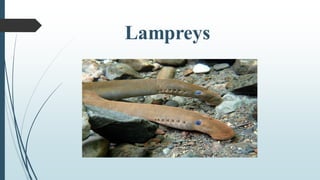
Lampreys
TABLE OF CONTENTS
• Introduction • Taxonomic Classification
• Distribution • Morphology
• Interesting Facts & Importance
• Behavior
• Conclusion
• References
• Research Insights
Introduction:
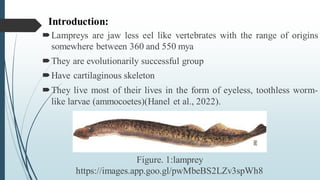
Lampreys are jaw less eel like vertebrates with the range of origins
somewhere between 360 and 550 mya
They are evolutionarily successful group
Have cartilaginous skeleton
They live most of their lives in the form of eyeless, toothless worm-
like larvae (ammocoetes)(Hanel et al., 2022).
Figure. 1:lamprey
https://images.app.goo.gl/pwMbeBS2LZv3spWh8
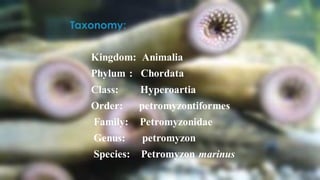
Taxonomy:
Kingdom: Animalia
Phylum : Chordata
Class: Hyperoartia
Order: petromyzontiformes
Family: Petromyzonidae
Genus: petromyzon
Species: Petromyzon marinus
Distribution:
Lampreys has an antitropical distribution.
approximately 40 species , grouped into three families; one in the
Northern Hemisphere, Petromyzontidae, and two in the Southern
Hemisphere, Geotriidae and Mordaciidae.
Found in temperate regions around the world except Africa
Live in coastal and fresh water
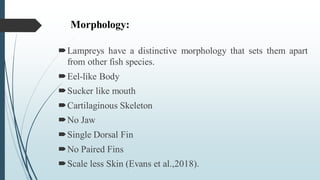
Morphology:
Lampreys have a distinctive morphology that sets them apart
from other fish species.
Eel-like Body
Sucker like mouth
Cartilaginous Skeleton
No Jaw
Single Dorsal Fin
No Paired Fins
Scale less Skin (Evans et al.,2018).
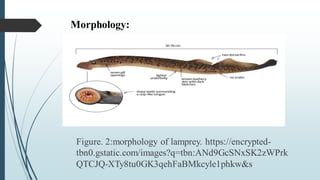
Morphology:
Figure. 2:morphology of lamprey. https://encrypted-
tbn0.gstatic.com/images?q=tbn:ANd9GcSNxSK2zWPrk
QTCJQ-XTy8tu0GK3qehFaBMkcyle1phkw&s
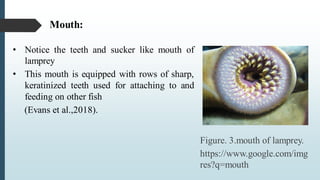
Mouth:
• Notice the teeth and sucker like mouth of
lamprey
• This mouth is equipped with rows of sharp,
keratinized teeth used for attaching to and
feeding on other fish
(Evans et al.,2018).
Figure. 3.mouth of lamprey.
https://www.google.com/img
res?q=mouth
Parental
Behavior
Migratory
Behavior
Behaviors
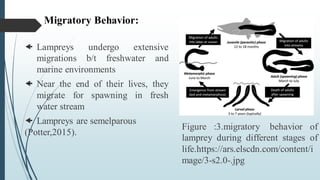
Migratory Behavior:
 Lampreys undergo extensive
migrations b/t freshwater and
marine environments
 Near the end of their lives, they
migrate for spawning in fresh
water stream
 Lampreys are semelparous
(Potter,2015).
Figure :3.migratory behavior of
lamprey during different stages of
life.https://ars.elscdn.com/content/i
mage/3-s2.0-.jpg
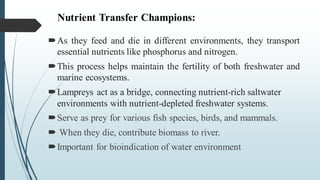
Parental behavior:
• Lampreys do not provide any parental care to their offspring
beyond spawning.
• The fertilized eggs are left to develop on their own, with
survival depending on environmental conditions and natural
factors.(Potter,2015).
IMPORTANCE
Ecological significance :
Integral part of aquatic food
webs.
Serve as prey for various fish
species, birds, and mammals.
 When they die, contribute
biomass to river.
Important for bioindication of
water environment.
(Hanel et al., 2022).
https://encrypted-
tbn0.gstatic.com/images?q=tbn:
ANd9GcS2L4twEpb_LJSaUtQx
KEDXAhLJqmmUwv9WsA&s
Nutrient Transfer Champions:
As they feed and die in different environments, they transport
essential nutrients like phosphorus and nitrogen.
This process helps maintain the fertility of both freshwater and
marine ecosystems.
Lampreys act as a bridge, connecting nutrient-rich saltwater
environments with nutrient-depleted freshwater systems.
Serve as prey for various fish species, birds, and mammals.
 When they die, contribute biomass to river.
Important for bioindication of water environment
Traditional Importance:
Lampreys play an important role in the culture and folklore of
some nations
The Pacific lamprey is also of spiritual significance for these
tribes.
The enormous esteem people have for lampreys is also reflected
in the various coats of arms, in which the lamprey appears.
Cooking skills and traditions are practiced at various public
festivals where lampreys are caught and immediately consumed
after cooking (e.g., Estonia, Latvia, Lithuania, Portugal, Spain).
 They are also used in biomedical research. (Hanel et al., 2022).
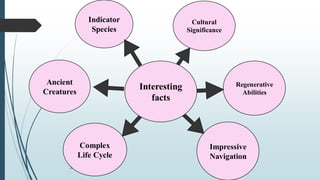
Indicator
Species
Complex
Life Cycle
Cultural
Significance
Regenerative
Abilities
Impressive
Navigation
Ancient
Creatures
Interesting
facts
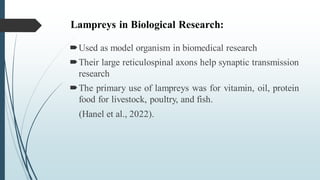
Lampreys in Biological Research:
Used as model organism in biomedical research
Their large reticulospinal axons help synaptic transmission
research
The primary use of lampreys was for vitamin, oil, protein
food for livestock, poultry, and fish.
(Hanel et al., 2022).
Conclusions:
Lampreys are fascinating creatures with unique
characteristics that set them apart from other fish.
Despite historical misconceptions and negative
perceptions due to their parasitic nature in some species,
lampreys play essential roles in ecosystems as prey and
predators, contributing to biodiversity and serving as
indicators of ecosystem health.
References:
 Hanel, L., Andreska, J., & Dyldin, Y. V. (2022). Lampreys in human life, their cultural
and folklore importance. Human Soc Sci, 10, 300-315.
 Evans, T. M., Janvier, P., & Docker, M. F. (2018). The evolution of lamprey
(Petromyzontida) life history and the origin of metamorphosis. Reviews in Fish
Biology and Fisheries, 28(4), 825-838
 Potter, I. C., Gill, H. S., Renaud, C. B., & Haoucher, D. (2015). The taxonomy,
phylogeny, and distribution of lampreys. Lampreys: biology, conservation and control:
volume 1, 3573.
 Yang, X. U., Si-Wei, Z. H. U., & Qing-Wei, L. I. (2016). Lamprey: a model for
vertebrate evolutionary research. Zoological research, 37(5), 263.
Lamprey: Introduction and Importance....

Lamprey: Introduction and Importance....

  • 1.
  • 2.
    Presented by: Aiman Rollno# UOC-BSZOL-F2020/016 Department of Zoology Session: 2020-2024 Subject: lchthyology Instructor Name: Dr. Syeda Nadia Ahmad Topic: Lampreys
  • 3.
  • 4.
    TABLE OF CONTENTS •Introduction • Taxonomic Classification • Distribution • Morphology • Interesting Facts & Importance • Behavior • Conclusion • References • Research Insights
  • 5.
    Introduction: Lampreys are jawless eel like vertebrates with the range of origins somewhere between 360 and 550 mya They are evolutionarily successful group Have cartilaginous skeleton They live most of their lives in the form of eyeless, toothless worm- like larvae (ammocoetes)(Hanel et al., 2022). Figure. 1:lamprey https://images.app.goo.gl/pwMbeBS2LZv3spWh8
  • 6.
    Taxonomy: Kingdom: Animalia Phylum :Chordata Class: Hyperoartia Order: petromyzontiformes Family: Petromyzonidae Genus: petromyzon Species: Petromyzon marinus
  • 7.
    Distribution: Lampreys has anantitropical distribution. approximately 40 species , grouped into three families; one in the Northern Hemisphere, Petromyzontidae, and two in the Southern Hemisphere, Geotriidae and Mordaciidae. Found in temperate regions around the world except Africa Live in coastal and fresh water
  • 8.
    Morphology: Lampreys have adistinctive morphology that sets them apart from other fish species. Eel-like Body Sucker like mouth Cartilaginous Skeleton No Jaw Single Dorsal Fin No Paired Fins Scale less Skin (Evans et al.,2018).
  • 9.
    Morphology: Figure. 2:morphology oflamprey. https://encrypted- tbn0.gstatic.com/images?q=tbn:ANd9GcSNxSK2zWPrk QTCJQ-XTy8tu0GK3qehFaBMkcyle1phkw&s
  • 10.
    Mouth: • Notice theteeth and sucker like mouth of lamprey • This mouth is equipped with rows of sharp, keratinized teeth used for attaching to and feeding on other fish (Evans et al.,2018). Figure. 3.mouth of lamprey. https://www.google.com/img res?q=mouth
  • 11.
  • 12.
    Migratory Behavior:  Lampreysundergo extensive migrations b/t freshwater and marine environments  Near the end of their lives, they migrate for spawning in fresh water stream  Lampreys are semelparous (Potter,2015). Figure :3.migratory behavior of lamprey during different stages of life.https://ars.elscdn.com/content/i mage/3-s2.0-.jpg
  • 13.
    Parental behavior: • Lampreysdo not provide any parental care to their offspring beyond spawning. • The fertilized eggs are left to develop on their own, with survival depending on environmental conditions and natural factors.(Potter,2015).
  • 14.
  • 15.
    Ecological significance : Integralpart of aquatic food webs. Serve as prey for various fish species, birds, and mammals.  When they die, contribute biomass to river. Important for bioindication of water environment. (Hanel et al., 2022). https://encrypted- tbn0.gstatic.com/images?q=tbn: ANd9GcS2L4twEpb_LJSaUtQx KEDXAhLJqmmUwv9WsA&s
  • 16.
    Nutrient Transfer Champions: Asthey feed and die in different environments, they transport essential nutrients like phosphorus and nitrogen. This process helps maintain the fertility of both freshwater and marine ecosystems. Lampreys act as a bridge, connecting nutrient-rich saltwater environments with nutrient-depleted freshwater systems. Serve as prey for various fish species, birds, and mammals.  When they die, contribute biomass to river. Important for bioindication of water environment
  • 17.
    Traditional Importance: Lampreys playan important role in the culture and folklore of some nations The Pacific lamprey is also of spiritual significance for these tribes. The enormous esteem people have for lampreys is also reflected in the various coats of arms, in which the lamprey appears. Cooking skills and traditions are practiced at various public festivals where lampreys are caught and immediately consumed after cooking (e.g., Estonia, Latvia, Lithuania, Portugal, Spain).  They are also used in biomedical research. (Hanel et al., 2022).
  • 18.
  • 19.
    Lampreys in BiologicalResearch: Used as model organism in biomedical research Their large reticulospinal axons help synaptic transmission research The primary use of lampreys was for vitamin, oil, protein food for livestock, poultry, and fish. (Hanel et al., 2022).
  • 20.
    Conclusions: Lampreys are fascinatingcreatures with unique characteristics that set them apart from other fish. Despite historical misconceptions and negative perceptions due to their parasitic nature in some species, lampreys play essential roles in ecosystems as prey and predators, contributing to biodiversity and serving as indicators of ecosystem health.
  • 21.
    References:  Hanel, L.,Andreska, J., & Dyldin, Y. V. (2022). Lampreys in human life, their cultural and folklore importance. Human Soc Sci, 10, 300-315.  Evans, T. M., Janvier, P., & Docker, M. F. (2018). The evolution of lamprey (Petromyzontida) life history and the origin of metamorphosis. Reviews in Fish Biology and Fisheries, 28(4), 825-838  Potter, I. C., Gill, H. S., Renaud, C. B., & Haoucher, D. (2015). The taxonomy, phylogeny, and distribution of lampreys. Lampreys: biology, conservation and control: volume 1, 3573.  Yang, X. U., Si-Wei, Z. H. U., & Qing-Wei, L. I. (2016). Lamprey: a model for vertebrate evolutionary research. Zoological research, 37(5), 263.