An Assignment On
Biology of Commercially Important Crabs Species
Subject
Anatomy and Biology of Shellfish (FRM-204)
Presented By : Rajesh V. Chudasama
Commercially
important crabs species
 Scylla serrate (Giant mud crab)
 Scylla olivacea (orange mud crab)
 Scylla tranquebarica (Purple mud crab)
 Portunus pelagicus (Flower crab)
 Portunus sanguinolentus (Three spot swimming crab)
 Charybdis natator (Ridged swimming crab)
Scylla serrate (Giant mud crab)
Scientific Classification
Kingdom Animalia
Phylum Arthropoda
Subphylum Crustacea
Class Malacostraca
Order Decapoda
Infraorder Branchyura
Family Portunidae
Genus Scylla
Species serrata
Scylla tranquebarica (Purple mud crab)
Scientific Classification
Kingdom Animalia
Phylum Arthropoda
Subphylum Crustacea
Class Malacostraca
Order Decapoda
Infraorder Branchyura
Family Portunidae
Genus Scylla
Species tranquebarica
Scylla olivacea (orange mud crab)
Scientific Classification
Kingdom Animalia
Phylum Arthropoda
Subphylum Crustacea
Class Malacostraca
Order Decapoda
Infraorder Branchyura
Family Portunidae
Genus Scylla
Species olivacea
Distribution
Catch Of Mud Crab In The World
Feeding Biology
• Mud Crabs are 'omnivorous' scavengers. But they're also
cannibalistic, eating other crabs as well as barnacles, bivalves and
dead fish.
Reproductive Biology
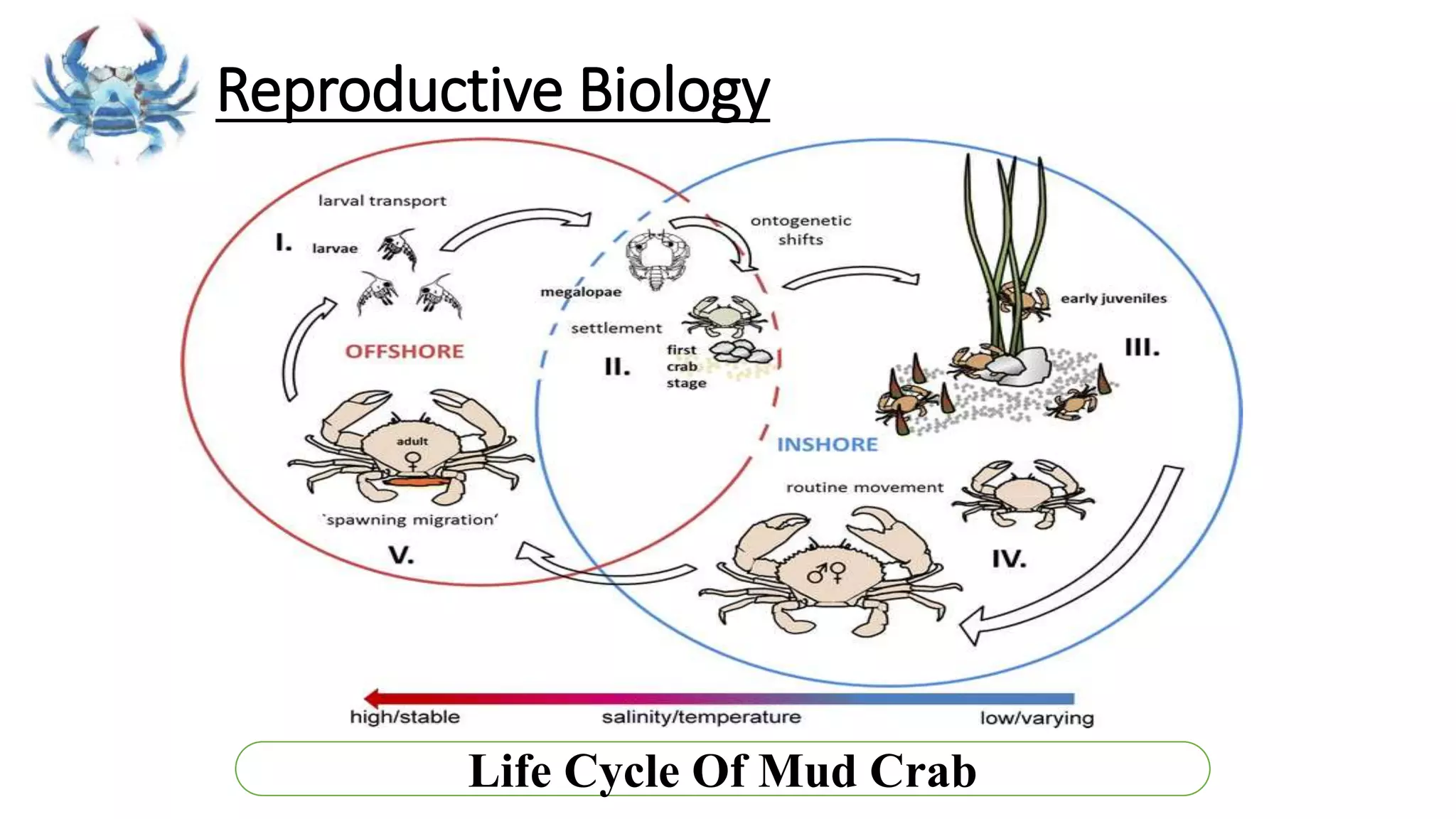
Life Cycle Of Mud Crab
• Zoea – A mud crab begins life as a larva called a ‘zoea’, which hatches from
an egg.
• Megalopa – A zoea grows by ‘moulting’ (shedding its shell) four times over
12 to 15 days. During the fifth moult, it transforms into a ‘megalopa’, which
has functional claws. After a week or so, it moves inshore and settles to the
seabed. After a few days, it moults into a stage one juvenile crab.
• Juvenile crab – A miniature version of the adult, it is about 4 mm wide.
About a month after hatching, when 10 – 20 mm wide, it moves to an
estuary and settles in a sheltered area.
• Young adult – The crab reaches sexual maturity at 18 to 24 months.
Biology of Mud Crabs
• S. serrata is usually found in mangrove areas with high salinity, and also in
offshore waters where they spawn, can tolerate reduced salinity also whereas
S. olivacea prefer low saline water. They are found in low intertidal muddy
bottom.
• The megalopa or postlarval stage migrates to the estuaries and backwaters
attain maturity and go to the inshore waters for spawning.
• Immature and mature males have slender triangular abdominal flaps.
• Immature females have a broad and triangular abdominal flap and mature
females a semicircular flap.
• They have five zoeal stages and one megalopa stage which metamorphose to
the crab instar (seed).
• They are carnivorous and prefer small molluscs, trash fish and other
crustaceans as food.
Portunus pelagicus
Swimming Crab Biology
Scientific Classification
Kingdom Animalia
Phylum Arthropoda
Subphylum Crustacea
Class Malacostraca
Order Decapoda
Infraorder Branchyura
Family Portunidae
Genus Portunus
Species pelagicus
• They live in estuaries, sheltered bays and offshore waters up to 50 m
deep.
• Estuarine crabs tend to move from estuaries into nearby marine
waters during winter.
• Crabs in marine bays spend their entire lives in the bay.
• The Blue Swimming crab is a large sized crab found in the intertidal
estuaries of the Indian and West Pacific Oceans.
Diet & Breeding Biology
• The Blue Swimming crabs are feed on a wide variety of sessile and slow
moving benthic invertebrates.
• They are almost exclusively carnivorous, rarely consuming plant
material. They eat small fish and crustaceans, molluscs, worms, and
occasionally, algae and sea grass. In turn, they are prey for fish and
birds.
• The Blue Swimming crabs become mature within their 1 year of age.
• Their life cycle is dependent on estuaries as the larvae and the early
juveniles use these habitats for growth and development.
• The female crabs move into shallow marine habitats prior to hatching.
And they release their eggs there and the newly hatched zoea larvae
move into estuaries.
Reproductive Biology
Life cycle of portunus pelagicus
• Blue swimmer crabs begin life as tiny larvae, called ‘zoea’, which grow and
change shape over a four-to-six-week period during early summer.
• They turn into a more crab-like state called ‘megalopae’. By autumn, most
are crab-shaped.
• By winter, the carapace is about nine centimetres wide. During the final
moult to reach maturity, females mate for the first time.
• Most mating takes place in the autumn. Males moult first, so that their
new shells have hardened beforehand.
• In the ocean, big females mostly spawn in late spring and early
summer. Estuarine crabs tend to spawn later in summer, having
moved to the sea or estuary mouth during winter rains.
• The eggs are fertilised by the stored sperm and, when laid, they
attach under the female’s abdomen, forming a spongy mass.
• The female incubates the eggs for about 18 days. The eggs hatch into
zoea. A new life cycle has begun.
Biology…….
• They are marine crabs. P. pelagicusis found at a depth of up to 50 m and
is caught in trawl and gill nets.
• They show sexual dimorphism, males being bright blue in colour and
females are dull green.
• The males mariculture for Production Enhancement and Sustainability
and their chelate legs are longer.
• They have five zoeal stages and metamorphose to the megalopa
followed by the juveniles/seed stage.
1. Portunus pelagicus
• Charybdis feriatusare found at a depth of up to 60 m and are caught
mostly in bottom trawl.
• They have six zoeal stages (stage I to stage VI) which metamorphose
to the megalopa stage.
• They have good market in East Asia where it commands substantially
higher premium prices than Portunus spp. P. sanguinolentus are
caught at a depth of 30 m.
• All the three species prefer sandy to sandy muddy substrates.
2. Charybdis feriatusare
Three Spot Swimming Crab Biology
portunus sanguinolentus
Scientific Classification
Kingdom Animalia
Phylum Arthropoda
Subphylum Crustacea
Class Malacostraca
Order Decapoda
Infraorder Branchyura
Family Portunidae
Genus Portunus
Species sanguinolentus
• The carapace of the Three Spot Swimming crab is very broad.
• It is easily characterized by 3 red spots in posterior half.
• A strong spine can be seen on each side of their carapace. The
carapace is of greyish green color.
• The swimming legs are flattened and claws are long.
• Maximum length of the Three Spot Swimming crab is between 15 and
20 cm.
Habitat and Distribution
• Marine from littoral line to 30 meters deep. Sand, mud or broken shelly
substrata.
• Indo-Pacific from South Africa through Japan to Australia and Hawaii and in
India East and West Coast, Gulf of Mannar, Andaman & Nicobar islands.
Diet
• The Three Spot Swimming crab is primarily a carnivore. It is mainly a predator
of sessile and slow-moving benthic macro-invertebrates.
Ridged Swimming Crab Biology
Charybdis natator
Scientific Classification
Kingdom Animalia
Phylum Arthropoda
Subphylum Crustacea
Class Malacostraca
Order Decapoda
Infraorder Branchyura
Family Portunidae
Genus Charybdis
Species natator
Distribution
• Charybdis natator is found throughout the Indian and Pacific
Oceans from eastern South Africa and Madagascar north to the Red
Sea and across the Indian Ocean, including the Mascarene Islands and
the Seychelles, to the western pacific where it extends north to Japan
and south to northern Australia including Lord Howe Island.
Biology…..
• Charybdis natator is a benthic species found in the inter-tidal zone and in the sub -
tidal zone down to a depth of 60m and over a variety of substrates, including sandy
or silty bottoms, rocky and coral reefs and beds of weed.
• It prefers to hide under rocks or stones.
• In the Red Sea females with eggs have been found throughout the year, although
there is a peak between May and September.
• The eggs hatch 11–15 days after being extruded and there is a period of 7 days
between the larvae hatching and the extrusion of the next brood.
• Fecundity is 1,81,000 to 96,100 eggs for each spawning and each female can spawn
three times per mature phase which means that this is a rather fecund species.
• In most populations spawning occurs twice a year. The larvae have six zoeae stages
and a megalopa stage and from the first zoeae stage to megalopa takes 28–44 days
References
• Dr. P.C. Thomas, Dr. Suresh Rath and Dr. Kanta Das Mohapatra (2017), Breeding and seed production of fin fish & shell fish,
Shell fish seed production, pp. 246
• K.P. Biswas, (2013), Marine Biology, Crustaceans, pp. 216-223
• https://en.wikipedia.org/wiki/Crab_fisheries#Commercial_catch
• http://www.fao.org/fishery/culturedspecies/Scylla_serrata/en
• https://en.wikipedia.org/wiki/Scylla_serrata
• https://en.wikipedia.org/wiki/Scylla_tranquebarica
• https://www.mudcrabsdirect.com.au/Faqs/Faqs-15/#question-four
• http://www.fao.org/fishery/species/2629/en
• http://www.fish.wa.gov.au/Species/Blue-Swimmer-Crabs/Pages/default.aspx
• https://www.roysfarm.com/blue-swimming-crab/
• https://en.wikipedia.org/wiki/Portunus_armatus
• https://www.sealifebase.ca/summary/Portunus-sanguinolentus.html
• http://www.nio.org/userfiles/file/brachyuran/portunus_sanguinolentus.html
• https://www.roysfarm.com/three-spot-swimming-crab/
• http://eprints.cmfri.org.in/10668/1/9.%20Lakshmi%20Pillai.pdf
Thank you

Crab Biology.pptx

  • 1.
    An Assignment On Biologyof Commercially Important Crabs Species Subject Anatomy and Biology of Shellfish (FRM-204) Presented By : Rajesh V. Chudasama
  • 2.
    Commercially important crabs species Scylla serrate (Giant mud crab)  Scylla olivacea (orange mud crab)  Scylla tranquebarica (Purple mud crab)  Portunus pelagicus (Flower crab)  Portunus sanguinolentus (Three spot swimming crab)  Charybdis natator (Ridged swimming crab)
  • 3.
    Scylla serrate (Giantmud crab) Scientific Classification Kingdom Animalia Phylum Arthropoda Subphylum Crustacea Class Malacostraca Order Decapoda Infraorder Branchyura Family Portunidae Genus Scylla Species serrata
  • 4.
    Scylla tranquebarica (Purplemud crab) Scientific Classification Kingdom Animalia Phylum Arthropoda Subphylum Crustacea Class Malacostraca Order Decapoda Infraorder Branchyura Family Portunidae Genus Scylla Species tranquebarica
  • 5.
    Scylla olivacea (orangemud crab) Scientific Classification Kingdom Animalia Phylum Arthropoda Subphylum Crustacea Class Malacostraca Order Decapoda Infraorder Branchyura Family Portunidae Genus Scylla Species olivacea
  • 6.
    Distribution Catch Of MudCrab In The World
  • 7.
    Feeding Biology • MudCrabs are 'omnivorous' scavengers. But they're also cannibalistic, eating other crabs as well as barnacles, bivalves and dead fish.
  • 8.
  • 9.
    • Zoea –A mud crab begins life as a larva called a ‘zoea’, which hatches from an egg. • Megalopa – A zoea grows by ‘moulting’ (shedding its shell) four times over 12 to 15 days. During the fifth moult, it transforms into a ‘megalopa’, which has functional claws. After a week or so, it moves inshore and settles to the seabed. After a few days, it moults into a stage one juvenile crab. • Juvenile crab – A miniature version of the adult, it is about 4 mm wide. About a month after hatching, when 10 – 20 mm wide, it moves to an estuary and settles in a sheltered area. • Young adult – The crab reaches sexual maturity at 18 to 24 months.
  • 10.
    Biology of MudCrabs • S. serrata is usually found in mangrove areas with high salinity, and also in offshore waters where they spawn, can tolerate reduced salinity also whereas S. olivacea prefer low saline water. They are found in low intertidal muddy bottom. • The megalopa or postlarval stage migrates to the estuaries and backwaters attain maturity and go to the inshore waters for spawning. • Immature and mature males have slender triangular abdominal flaps. • Immature females have a broad and triangular abdominal flap and mature females a semicircular flap. • They have five zoeal stages and one megalopa stage which metamorphose to the crab instar (seed). • They are carnivorous and prefer small molluscs, trash fish and other crustaceans as food.
  • 11.
    Portunus pelagicus Swimming CrabBiology Scientific Classification Kingdom Animalia Phylum Arthropoda Subphylum Crustacea Class Malacostraca Order Decapoda Infraorder Branchyura Family Portunidae Genus Portunus Species pelagicus
  • 12.
    • They livein estuaries, sheltered bays and offshore waters up to 50 m deep. • Estuarine crabs tend to move from estuaries into nearby marine waters during winter. • Crabs in marine bays spend their entire lives in the bay. • The Blue Swimming crab is a large sized crab found in the intertidal estuaries of the Indian and West Pacific Oceans.
  • 13.
    Diet & BreedingBiology • The Blue Swimming crabs are feed on a wide variety of sessile and slow moving benthic invertebrates. • They are almost exclusively carnivorous, rarely consuming plant material. They eat small fish and crustaceans, molluscs, worms, and occasionally, algae and sea grass. In turn, they are prey for fish and birds. • The Blue Swimming crabs become mature within their 1 year of age. • Their life cycle is dependent on estuaries as the larvae and the early juveniles use these habitats for growth and development. • The female crabs move into shallow marine habitats prior to hatching. And they release their eggs there and the newly hatched zoea larvae move into estuaries.
  • 14.
    Reproductive Biology Life cycleof portunus pelagicus
  • 15.
    • Blue swimmercrabs begin life as tiny larvae, called ‘zoea’, which grow and change shape over a four-to-six-week period during early summer. • They turn into a more crab-like state called ‘megalopae’. By autumn, most are crab-shaped. • By winter, the carapace is about nine centimetres wide. During the final moult to reach maturity, females mate for the first time. • Most mating takes place in the autumn. Males moult first, so that their new shells have hardened beforehand.
  • 16.
    • In theocean, big females mostly spawn in late spring and early summer. Estuarine crabs tend to spawn later in summer, having moved to the sea or estuary mouth during winter rains. • The eggs are fertilised by the stored sperm and, when laid, they attach under the female’s abdomen, forming a spongy mass. • The female incubates the eggs for about 18 days. The eggs hatch into zoea. A new life cycle has begun.
  • 17.
    Biology……. • They aremarine crabs. P. pelagicusis found at a depth of up to 50 m and is caught in trawl and gill nets. • They show sexual dimorphism, males being bright blue in colour and females are dull green. • The males mariculture for Production Enhancement and Sustainability and their chelate legs are longer. • They have five zoeal stages and metamorphose to the megalopa followed by the juveniles/seed stage. 1. Portunus pelagicus
  • 18.
    • Charybdis feriatusarefound at a depth of up to 60 m and are caught mostly in bottom trawl. • They have six zoeal stages (stage I to stage VI) which metamorphose to the megalopa stage. • They have good market in East Asia where it commands substantially higher premium prices than Portunus spp. P. sanguinolentus are caught at a depth of 30 m. • All the three species prefer sandy to sandy muddy substrates. 2. Charybdis feriatusare
  • 19.
    Three Spot SwimmingCrab Biology portunus sanguinolentus Scientific Classification Kingdom Animalia Phylum Arthropoda Subphylum Crustacea Class Malacostraca Order Decapoda Infraorder Branchyura Family Portunidae Genus Portunus Species sanguinolentus
  • 20.
    • The carapaceof the Three Spot Swimming crab is very broad. • It is easily characterized by 3 red spots in posterior half. • A strong spine can be seen on each side of their carapace. The carapace is of greyish green color. • The swimming legs are flattened and claws are long. • Maximum length of the Three Spot Swimming crab is between 15 and 20 cm.
  • 21.
    Habitat and Distribution •Marine from littoral line to 30 meters deep. Sand, mud or broken shelly substrata. • Indo-Pacific from South Africa through Japan to Australia and Hawaii and in India East and West Coast, Gulf of Mannar, Andaman & Nicobar islands. Diet • The Three Spot Swimming crab is primarily a carnivore. It is mainly a predator of sessile and slow-moving benthic macro-invertebrates.
  • 22.
    Ridged Swimming CrabBiology Charybdis natator Scientific Classification Kingdom Animalia Phylum Arthropoda Subphylum Crustacea Class Malacostraca Order Decapoda Infraorder Branchyura Family Portunidae Genus Charybdis Species natator
  • 23.
    Distribution • Charybdis natatoris found throughout the Indian and Pacific Oceans from eastern South Africa and Madagascar north to the Red Sea and across the Indian Ocean, including the Mascarene Islands and the Seychelles, to the western pacific where it extends north to Japan and south to northern Australia including Lord Howe Island.
  • 24.
    Biology….. • Charybdis natatoris a benthic species found in the inter-tidal zone and in the sub - tidal zone down to a depth of 60m and over a variety of substrates, including sandy or silty bottoms, rocky and coral reefs and beds of weed. • It prefers to hide under rocks or stones. • In the Red Sea females with eggs have been found throughout the year, although there is a peak between May and September. • The eggs hatch 11–15 days after being extruded and there is a period of 7 days between the larvae hatching and the extrusion of the next brood. • Fecundity is 1,81,000 to 96,100 eggs for each spawning and each female can spawn three times per mature phase which means that this is a rather fecund species. • In most populations spawning occurs twice a year. The larvae have six zoeae stages and a megalopa stage and from the first zoeae stage to megalopa takes 28–44 days
  • 25.
    References • Dr. P.C.Thomas, Dr. Suresh Rath and Dr. Kanta Das Mohapatra (2017), Breeding and seed production of fin fish & shell fish, Shell fish seed production, pp. 246 • K.P. Biswas, (2013), Marine Biology, Crustaceans, pp. 216-223 • https://en.wikipedia.org/wiki/Crab_fisheries#Commercial_catch • http://www.fao.org/fishery/culturedspecies/Scylla_serrata/en • https://en.wikipedia.org/wiki/Scylla_serrata • https://en.wikipedia.org/wiki/Scylla_tranquebarica • https://www.mudcrabsdirect.com.au/Faqs/Faqs-15/#question-four • http://www.fao.org/fishery/species/2629/en • http://www.fish.wa.gov.au/Species/Blue-Swimmer-Crabs/Pages/default.aspx • https://www.roysfarm.com/blue-swimming-crab/ • https://en.wikipedia.org/wiki/Portunus_armatus • https://www.sealifebase.ca/summary/Portunus-sanguinolentus.html • http://www.nio.org/userfiles/file/brachyuran/portunus_sanguinolentus.html • https://www.roysfarm.com/three-spot-swimming-crab/ • http://eprints.cmfri.org.in/10668/1/9.%20Lakshmi%20Pillai.pdf
  • 26.