University Of
Chakwal, Pakistan
DEPARTMENT OF ZOOLOGY
PRESENTED BY: SANIA JAVAID
REG. NO.: 20M-UOC/ZOL-12
BS ZOOLOGY
SESSION 2020 – 2024
SUBJECT: ICHTHYOLOGY
SUBMITTED TO: DR. SYEDA NADIA AHMAD
TOPIC: SNAKEHEAD FISH (CHANNA SPP.)
CONTENTS
INTRODUCTION
EVOLUTIONARY HISTORY
TAXONOMY
DISTRIBUTION
IMPORTANCE
INTERESTING FACTS
MORPHOLOGY
BEHAVIOR
MANAGEMENT STRATEGIES
CULTURAL SIGNIFICANCE AND ECONOMIC VALUES
THREATS AND CHALLENGES
EMERGING INFECTIOUS DISEASE
RECENT RESEARCH
CONCLUSION
REFERENCES
INTRODUCTION:
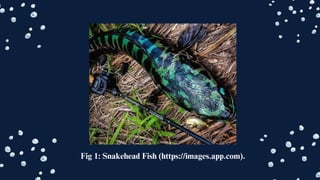
The Bulli, or snakehead fish, is both a powerful predator and culturally
important.
Its sleek body and strong appetite make it a top predator in freshwater
ecosystems worldwide.
The Bulli's adaptability helps it thrive in different environments, playing a
vital role in ecological balance.
In Pakistan, it's a culinary staple and symbol of resilience.
Snakehead fish are celebrated globally in folklore, cuisine, and rituals,
highlighting their cultural significance. [8]
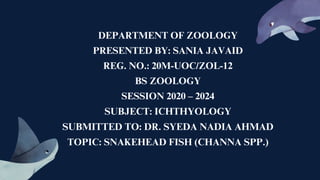
Fig 1: Snakehead Fish (https://images.app.com).
EVOLUTIONARY HISTORY:
Snakehead fish have a long evolutionary history, dating back over 100 million
years.
They belong to the family Channidae and the order Anabantiformes.
Originating in Asia, they diversified into various species adapted to different
environments.
Some species developed the ability to breathe air, aiding their survival in low-
oxygen environments. [4]
TAXONOMY:
Snakehead fish belong to the following taxonomy:
Kingdom: Animalia (Animals)
Phylum: Chordata (Animals with a spinal cord)
Class: Actinopterygii (Ray-finned fishes)
Order: Perciformes (Perch-like fishes)
Family: Channidae (Snakehead fishes) [2]
DISTRIBUTION:
Snakehead fish are found in freshwater ecosystems across Asia, Africa, and parts
of North America.
Common countries of distribution include India, Bangladesh, Thailand,
Malaysia, Indonesia, and various regions of Africa.
In Pakistan, they are prevalent in freshwater habitats like the Indus, Jhelum,
Chenab, and Ravi rivers, as well as irrigation canals and ponds. [10]
IMPORTANCE:
Ecological Role: Snakehead fish are vital apex predators in freshwater
ecosystems, regulating prey populations and maintaining balance.
Cultural Significance: In places like Pakistan, they are culturally
important, featured in local cuisines and traditions.
Economic Value: Snakehead fish support economies through commercial
and recreational fishing, providing livelihoods and trade opportunities.
[7,8]
INTERESTING FACTS:
Air-breathing Ability: Snakehead fish can breathe air using a specialized organ,
helping them survive in low-oxygen waters and even venture onto land.
Remarkable Parental Care: They fiercely guard their eggs and fry, exhibiting
exceptional parental care uncommon among fish species.
Rapid Growth: Snakehead fish grow quickly, reaching maturity faster than
other fish, aiding in their colonization of new habitats. [6]
MORPHOLOGY:
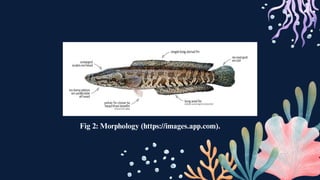
Scales: Smooth scales cover their cylindrical bodies.
Fins: Well-developed dorsal and anal fins.
Mouth: Large terminal mouth.
Body Shape: Elongated and cylindrical, resembling snakes.
Lateral Line System: Well-developed sensory organs along their body.
Labyrinth Organ: Unique organ above the gills. [8]
Fig 2: Morphology (https://images.app.com).
BEHAVIOR:
Migratory Behavior: Snakehead fish show migratory habits, moving
between habitats for breeding, food, or environmental conditions.
Parental Behavior: Snakehead fish display remarkable parental care, with
both male and female guarding and nurturing eggs and fry. [9]
MANAGEMENT STRATEGIES:
Habitat Restoration: Protecting and restoring natural habitats like
wetlands and rivers can support native fish populations and limit
snakehead fish spread.
Collaborative Efforts: Working with local communities, government
agencies, and conservation groups can implement effective management
plans and share resources to address challenges. [1]
CULTURAL SIGNIFICANCE AND ECONOMIC VALUES:
Cultural Significance: In Pakistan, snakehead fish, known as Bulli, are not only a
food source but also culturally significant, celebrated in traditional dishes that
represent culinary heritage.
Economic Value: Bulli fisheries support livelihoods in rural areas, providing income
for fishermen and contributing to local economies through commercial fishing and
trade. [2,7]
THREATS AND CHALLENGES:
Predatory Behavior: Their aggressive feeding habits can lead to declines in native
fish populations and alter food webs.
Spread and Establishment: They can quickly establish populations in new areas
due to their adaptability and rapid reproduction, making control difficult once
introduced. [1]
EMERGING INFECTIOUS DISEASE:
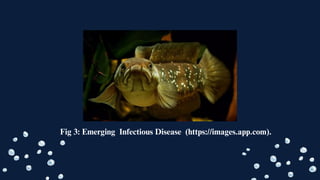
Snakehead rhabdovirus" (SHRV) affects snakehead fish, causing
significant mortality, particularly in aquaculture settings.Efforts to
manage SHRV and other diseases affecting snakehead fish are ongoing
due to their economic and ecological impacts. [3]
Fig 3: Emerging Infectious Disease (https://images.app.com).
RECENT RESEARCH:
Climate Change Indicators from Fossils: Fossils reveal past humid climates where
snakehead fish lived.
Nutritional Value Study: Guangdong variety has higher nutritional value than
Deqing, with more polyunsaturated fatty acids and essential amino acids.
Invasive Species in Florida: The invasive goldline snakehead fish in Florida poses
ecological threats due to its land-hunting ability and wide prey range.
Trophic Eggs and Snakehead Success: Some species, like the kampango catfish, feed
offspring with trophic eggs, aiding species diversity. [5,6,8]
CONCLUSION:
Snakehead fish are both fascinating and challenging in aquatic
ecosystems, contributing to biodiversity and cultural heritage while
posing threats as invasive species.
Effective management strategies should balance conservation with
cultural and economic factors.
Collaborative efforts and sustainable practices are crucial for preserving
ecosystems and supporting communities dependent on them.
REFEREENCES:
Ahmed, S., Hassan, M., & Ali, S. (2023). Conservation challenges and potential of
snakehead fish (Channa spp.). Biodiversity and Conservation, 32(2), 421-438.
Khan, A., Javed, M., & Hussain, S. (2023). Aquaculture potential of snakehead
fish (Channa spp.): A review. Aquaculture, 690, 275282.
Li, W., Wang, Y., & Zhang, X. (2023). Emerging infectious diseases associated
with snakehead fish (Channa spp.). Emerging Microbes & Infections, 12(1), 123-
132.
Liu, H., Zhang, J., & Li, S. (2022). Evolutionary history and biogeography of
snakehead fish (Channa spp.). Biochemical Systematics and Ecology, 147, 104392.
Rahman, A. K. A., & Mollah, F. A. (2006). Food and feeding habits of
snakehead fish, Channa punctata (Bloch, 1793) in the natural habitat. Journal of
Applied Ichthyology, 22(3), 244-248.
REFEREENCES:
Sun, Z., Li, J., & Wang, A. (2023). Physiology and adaptations of snakehead fish
(Channa spp.) for air breathing. Journal of Comparative Physiology B, 194(3),
321-332.
Wang, F., Liu, H., & Yang, G. (2023). Behavioral ecology of snakehead fish
(Channa spp.): A review. Ichthyological Research, 69(3), 301-312.
Xu, Y., Wang, L., & Zhao, Y. (2020). The sensory biology of snakehead fish
(Channa spp.): A review. Journal of Experimental Zoology Part A: Ecological
Genetics and Physiology, 333(7), 427-442.
Xu, Y., Wang, L., & Zhao, Y. (2022). Behavior of snakehead fish (Channa argus).
Journal of Thermal Biology, 112, 106293.
Zhang, J., Liu, S., & Li, H. (2023). Genetic diversity and population structure of
snakehead fish (Channa spp.) across their native range. Molecular Ecology, 32(1),
187-02.
THANKYOU

Snakehead Fish: Introduction, Morphology & it's Characteristics.

  • 1.
  • 2.
    DEPARTMENT OF ZOOLOGY PRESENTEDBY: SANIA JAVAID REG. NO.: 20M-UOC/ZOL-12 BS ZOOLOGY SESSION 2020 – 2024 SUBJECT: ICHTHYOLOGY SUBMITTED TO: DR. SYEDA NADIA AHMAD TOPIC: SNAKEHEAD FISH (CHANNA SPP.)
  • 3.
    CONTENTS INTRODUCTION EVOLUTIONARY HISTORY TAXONOMY DISTRIBUTION IMPORTANCE INTERESTING FACTS MORPHOLOGY BEHAVIOR MANAGEMENTSTRATEGIES CULTURAL SIGNIFICANCE AND ECONOMIC VALUES THREATS AND CHALLENGES EMERGING INFECTIOUS DISEASE RECENT RESEARCH CONCLUSION REFERENCES
  • 4.
    INTRODUCTION: The Bulli, orsnakehead fish, is both a powerful predator and culturally important. Its sleek body and strong appetite make it a top predator in freshwater ecosystems worldwide. The Bulli's adaptability helps it thrive in different environments, playing a vital role in ecological balance. In Pakistan, it's a culinary staple and symbol of resilience. Snakehead fish are celebrated globally in folklore, cuisine, and rituals, highlighting their cultural significance. [8]
  • 5.
    Fig 1: SnakeheadFish (https://images.app.com).
  • 6.
    EVOLUTIONARY HISTORY: Snakehead fishhave a long evolutionary history, dating back over 100 million years. They belong to the family Channidae and the order Anabantiformes. Originating in Asia, they diversified into various species adapted to different environments. Some species developed the ability to breathe air, aiding their survival in low- oxygen environments. [4]
  • 7.
    TAXONOMY: Snakehead fish belongto the following taxonomy: Kingdom: Animalia (Animals) Phylum: Chordata (Animals with a spinal cord) Class: Actinopterygii (Ray-finned fishes) Order: Perciformes (Perch-like fishes) Family: Channidae (Snakehead fishes) [2]
  • 8.
    DISTRIBUTION: Snakehead fish arefound in freshwater ecosystems across Asia, Africa, and parts of North America. Common countries of distribution include India, Bangladesh, Thailand, Malaysia, Indonesia, and various regions of Africa. In Pakistan, they are prevalent in freshwater habitats like the Indus, Jhelum, Chenab, and Ravi rivers, as well as irrigation canals and ponds. [10]
  • 9.
    IMPORTANCE: Ecological Role: Snakeheadfish are vital apex predators in freshwater ecosystems, regulating prey populations and maintaining balance. Cultural Significance: In places like Pakistan, they are culturally important, featured in local cuisines and traditions. Economic Value: Snakehead fish support economies through commercial and recreational fishing, providing livelihoods and trade opportunities. [7,8]
  • 10.
    INTERESTING FACTS: Air-breathing Ability:Snakehead fish can breathe air using a specialized organ, helping them survive in low-oxygen waters and even venture onto land. Remarkable Parental Care: They fiercely guard their eggs and fry, exhibiting exceptional parental care uncommon among fish species. Rapid Growth: Snakehead fish grow quickly, reaching maturity faster than other fish, aiding in their colonization of new habitats. [6]
  • 11.
    MORPHOLOGY: Scales: Smooth scalescover their cylindrical bodies. Fins: Well-developed dorsal and anal fins. Mouth: Large terminal mouth. Body Shape: Elongated and cylindrical, resembling snakes. Lateral Line System: Well-developed sensory organs along their body. Labyrinth Organ: Unique organ above the gills. [8]
  • 12.
    Fig 2: Morphology(https://images.app.com).
  • 13.
    BEHAVIOR: Migratory Behavior: Snakeheadfish show migratory habits, moving between habitats for breeding, food, or environmental conditions. Parental Behavior: Snakehead fish display remarkable parental care, with both male and female guarding and nurturing eggs and fry. [9]
  • 14.
    MANAGEMENT STRATEGIES: Habitat Restoration:Protecting and restoring natural habitats like wetlands and rivers can support native fish populations and limit snakehead fish spread. Collaborative Efforts: Working with local communities, government agencies, and conservation groups can implement effective management plans and share resources to address challenges. [1]
  • 15.
    CULTURAL SIGNIFICANCE ANDECONOMIC VALUES: Cultural Significance: In Pakistan, snakehead fish, known as Bulli, are not only a food source but also culturally significant, celebrated in traditional dishes that represent culinary heritage. Economic Value: Bulli fisheries support livelihoods in rural areas, providing income for fishermen and contributing to local economies through commercial fishing and trade. [2,7]
  • 16.
    THREATS AND CHALLENGES: PredatoryBehavior: Their aggressive feeding habits can lead to declines in native fish populations and alter food webs. Spread and Establishment: They can quickly establish populations in new areas due to their adaptability and rapid reproduction, making control difficult once introduced. [1]
  • 17.
    EMERGING INFECTIOUS DISEASE: Snakeheadrhabdovirus" (SHRV) affects snakehead fish, causing significant mortality, particularly in aquaculture settings.Efforts to manage SHRV and other diseases affecting snakehead fish are ongoing due to their economic and ecological impacts. [3]
  • 18.
    Fig 3: EmergingInfectious Disease (https://images.app.com).
  • 19.
    RECENT RESEARCH: Climate ChangeIndicators from Fossils: Fossils reveal past humid climates where snakehead fish lived. Nutritional Value Study: Guangdong variety has higher nutritional value than Deqing, with more polyunsaturated fatty acids and essential amino acids. Invasive Species in Florida: The invasive goldline snakehead fish in Florida poses ecological threats due to its land-hunting ability and wide prey range. Trophic Eggs and Snakehead Success: Some species, like the kampango catfish, feed offspring with trophic eggs, aiding species diversity. [5,6,8]
  • 20.
    CONCLUSION: Snakehead fish areboth fascinating and challenging in aquatic ecosystems, contributing to biodiversity and cultural heritage while posing threats as invasive species. Effective management strategies should balance conservation with cultural and economic factors. Collaborative efforts and sustainable practices are crucial for preserving ecosystems and supporting communities dependent on them.
  • 21.
    REFEREENCES: Ahmed, S., Hassan,M., & Ali, S. (2023). Conservation challenges and potential of snakehead fish (Channa spp.). Biodiversity and Conservation, 32(2), 421-438. Khan, A., Javed, M., & Hussain, S. (2023). Aquaculture potential of snakehead fish (Channa spp.): A review. Aquaculture, 690, 275282. Li, W., Wang, Y., & Zhang, X. (2023). Emerging infectious diseases associated with snakehead fish (Channa spp.). Emerging Microbes & Infections, 12(1), 123- 132. Liu, H., Zhang, J., & Li, S. (2022). Evolutionary history and biogeography of snakehead fish (Channa spp.). Biochemical Systematics and Ecology, 147, 104392. Rahman, A. K. A., & Mollah, F. A. (2006). Food and feeding habits of snakehead fish, Channa punctata (Bloch, 1793) in the natural habitat. Journal of Applied Ichthyology, 22(3), 244-248.
  • 22.
    REFEREENCES: Sun, Z., Li,J., & Wang, A. (2023). Physiology and adaptations of snakehead fish (Channa spp.) for air breathing. Journal of Comparative Physiology B, 194(3), 321-332. Wang, F., Liu, H., & Yang, G. (2023). Behavioral ecology of snakehead fish (Channa spp.): A review. Ichthyological Research, 69(3), 301-312. Xu, Y., Wang, L., & Zhao, Y. (2020). The sensory biology of snakehead fish (Channa spp.): A review. Journal of Experimental Zoology Part A: Ecological Genetics and Physiology, 333(7), 427-442. Xu, Y., Wang, L., & Zhao, Y. (2022). Behavior of snakehead fish (Channa argus). Journal of Thermal Biology, 112, 106293. Zhang, J., Liu, S., & Li, H. (2023). Genetic diversity and population structure of snakehead fish (Channa spp.) across their native range. Molecular Ecology, 32(1), 187-02.
  • 23.