UNIVERSITY OF CHAKWAL,PAKISTAN
TOPIC: RAINBOW TROUT FISH
DEPARTMENT OF ZOOLOGY
PRESENTED BY:AREEBA AMMAN NOOR
REG.NO:20M-UOC/ZOL-09
SESSION:2020-24
SUBJECT: ICTHYOLOGY
SUBMITTED TO: DR.SYEDA NADIA AHMAD
TOPIC: RAINBOW TROUT FISH
RAINBOW TROUT FISH
• Trout is a fish with variety of colors based on its habitat and
species.
• Native to Asia and North America found in cold streams of
Pacific ocean.
• Its body is round and long, also their stunning hues radiating
from skin give rise to term rainbow trout.
❑ Kingdom - Animalia
❑ Phylum - Chordata
❑ Class - Actinoptergii
❑ Order - Salmoniformes
❑ Family - Salmonidae
❑ Genus - Oncorhyncus
❑ Species – O.mykiss
❑ Binomial name – Oncorhyncus mykiss
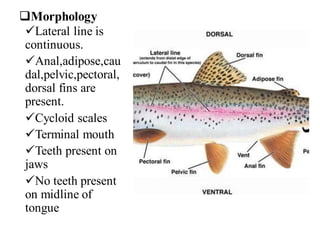
❑Morphology
✓Lateral line is
continuous.
✓Anal,adipose,cau
dal,pelvic,pectoral,
dorsal fins are
present.
✓Cycloid scales
✓Terminal mouth
✓Teeth present on
jaws
✓No teeth present
on midline of
tongue
Characters of rainbow trout
Having
adipose
fleshy fin on
behind of
dorsal fin.
Pelvic fins are
abdominal
and have
single soft
dorsal fin.
Length-
20/30inches
Weight- 8
pounds
Mass: 0.5-
2.5kg
Have small
scales over
body, lack
spines.
Tail fin is
forked and .
Anal fin has
10-11 rays.
[5]
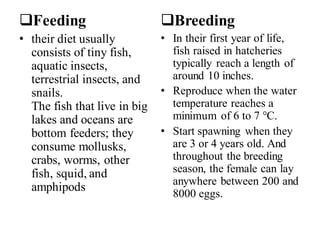
❑Feeding
• their diet usually
consists of tiny fish,
aquatic insects,
terrestrial insects, and
snails.
The fish that live in big
lakes and oceans are
bottom feeders; they
consume mollusks,
crabs, worms, other
fish, squid, and
amphipods
❑Breeding
• In their first year of life,
fish raised in hatcheries
typically reach a length of
around 10 inches.
• Reproduce when the water
temperature reaches a
minimum of 6 to 7 °C.
• Start spawning when they
are 3 or 4 years old. And
throughout the breeding
season, the female can lay
anywhere between 200 and
8000 eggs.
Interesting facts
Prefer 32-70
degree
Fahrenheit ,
rich in
Omega-3
fatty acid.
Female can
spawn 200-
8000 eggs
per season.
Carnivores
that eat
insects
,crustacean
s and small
fishes.
Largest
recorded
weight is 48
ibs (22kg).
They cannot
live in
polluted
water.
They have
been
farmed for
food since
1870.
Having 7
fins, no
lower teeth.
Can lay
thousands
of eggs at a
time.
They are
predators.
Chile is
largest
producer of
rainbow
trout.
[5]
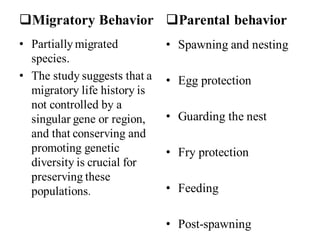
❑Migratory Behavior
• Partially migrated
species.
• The study suggests that a
migratory life history is
not controlled by a
singular gene or region,
and that conserving and
promoting genetic
diversity is crucial for
preserving these
populations.
❑Parental behavior
• Spawning and nesting
• Egg protection
• Guarding the nest
• Fry protection
• Feeding
• Post-spawning
❑RECENT AND FUTURE TRENDS OF
RAINBOW TROUT SECTOR
•Life cycle starts with brood stock breeding and egg
fertilization.
•Egg quality is determined by egg number and embryo
development.
•Automated phenotyping system have been developed to
detect dead eggs and embryonic malformations
•Genetic selection and marker assisted selection are used
to improve fish growth and health.
•Recirculating aquaculture system provide water reuse
control. [2]
❑Extraction of heavy metals
▪The anthropogenic
activities surrounding
the river led to
depletion of dissolve
oygen,making the
water unfit for trout
fish survival. [3]
▪Samples were
collected and
transported to K.I.U
biological sciences lab.
▪Atomic absorption
spectroscopy was used
to detect heavy metals
like
cadmium,kead,arsenic,
mercury,chromium
and copper. [3]
CULTURAL IMPORTANCE
ECONOMIC
VALUE
CULTURAL
AND
SOCIAL
SIGNIFICA
NCE
FOOD
SECURITY
ENVIRONM
ETAL
SUSTAINBI
LITY
RECREATIO
NAL
FISHING [1], [4]
REFERENCES
1. Vranić, D., Đinović-Stojanović, J., & Spirić, A. (2011). Rainbow trout
(Oncorhynchus Mykiss) from aquaculture–meat quality and importance in the
diet. Scientific journal" Meat Technology", 52(1), 122-133.
2. D’Agaro, E., Gibertoni, P., & Esposito, S. (2022). Recent trends and
economic aspects in the rainbow trout (Oncorhynchus mykiss) sector. Applied
Sciences, 12(17), 8773.
3. Ali, S. (2021). Determination of heavy metals from rainbow trout
(Oncorhynchus mykiss) in Gilgit River Pakistan. Journal of Biology, 10(6),
001-004.
4. Logan, S. H., & Johnston, W. E. (1992). Economics of commercial trout
production. Aquaculture, 100(1-3), 25-46.
5. Stanković, D., Crivelli, A. J., & Snoj, A. (2015). Rainbow trout in Europe:
introduction, naturalization, and impacts. Reviews in Fisheries Science &
Aquaculture, 23(1), 39-71.
Rainbow Trout: Introduction and Importance

Rainbow Trout: Introduction and Importance

  • 1.
  • 2.
    DEPARTMENT OF ZOOLOGY PRESENTEDBY:AREEBA AMMAN NOOR REG.NO:20M-UOC/ZOL-09 SESSION:2020-24 SUBJECT: ICTHYOLOGY SUBMITTED TO: DR.SYEDA NADIA AHMAD TOPIC: RAINBOW TROUT FISH
  • 3.
    RAINBOW TROUT FISH •Trout is a fish with variety of colors based on its habitat and species. • Native to Asia and North America found in cold streams of Pacific ocean. • Its body is round and long, also their stunning hues radiating from skin give rise to term rainbow trout. ❑ Kingdom - Animalia ❑ Phylum - Chordata ❑ Class - Actinoptergii ❑ Order - Salmoniformes ❑ Family - Salmonidae ❑ Genus - Oncorhyncus ❑ Species – O.mykiss ❑ Binomial name – Oncorhyncus mykiss
  • 4.
    ❑Morphology ✓Lateral line is continuous. ✓Anal,adipose,cau dal,pelvic,pectoral, dorsalfins are present. ✓Cycloid scales ✓Terminal mouth ✓Teeth present on jaws ✓No teeth present on midline of tongue
  • 5.
    Characters of rainbowtrout Having adipose fleshy fin on behind of dorsal fin. Pelvic fins are abdominal and have single soft dorsal fin. Length- 20/30inches Weight- 8 pounds Mass: 0.5- 2.5kg Have small scales over body, lack spines. Tail fin is forked and . Anal fin has 10-11 rays. [5]
  • 6.
    ❑Feeding • their dietusually consists of tiny fish, aquatic insects, terrestrial insects, and snails. The fish that live in big lakes and oceans are bottom feeders; they consume mollusks, crabs, worms, other fish, squid, and amphipods ❑Breeding • In their first year of life, fish raised in hatcheries typically reach a length of around 10 inches. • Reproduce when the water temperature reaches a minimum of 6 to 7 °C. • Start spawning when they are 3 or 4 years old. And throughout the breeding season, the female can lay anywhere between 200 and 8000 eggs.
  • 7.
    Interesting facts Prefer 32-70 degree Fahrenheit, rich in Omega-3 fatty acid. Female can spawn 200- 8000 eggs per season. Carnivores that eat insects ,crustacean s and small fishes. Largest recorded weight is 48 ibs (22kg). They cannot live in polluted water. They have been farmed for food since 1870. Having 7 fins, no lower teeth. Can lay thousands of eggs at a time. They are predators. Chile is largest producer of rainbow trout. [5]
  • 8.
    ❑Migratory Behavior • Partiallymigrated species. • The study suggests that a migratory life history is not controlled by a singular gene or region, and that conserving and promoting genetic diversity is crucial for preserving these populations. ❑Parental behavior • Spawning and nesting • Egg protection • Guarding the nest • Fry protection • Feeding • Post-spawning
  • 9.
    ❑RECENT AND FUTURETRENDS OF RAINBOW TROUT SECTOR •Life cycle starts with brood stock breeding and egg fertilization. •Egg quality is determined by egg number and embryo development. •Automated phenotyping system have been developed to detect dead eggs and embryonic malformations •Genetic selection and marker assisted selection are used to improve fish growth and health. •Recirculating aquaculture system provide water reuse control. [2]
  • 10.
    ❑Extraction of heavymetals ▪The anthropogenic activities surrounding the river led to depletion of dissolve oygen,making the water unfit for trout fish survival. [3] ▪Samples were collected and transported to K.I.U biological sciences lab. ▪Atomic absorption spectroscopy was used to detect heavy metals like cadmium,kead,arsenic, mercury,chromium and copper. [3]
  • 11.
  • 12.
    REFERENCES 1. Vranić, D.,Đinović-Stojanović, J., & Spirić, A. (2011). Rainbow trout (Oncorhynchus Mykiss) from aquaculture–meat quality and importance in the diet. Scientific journal" Meat Technology", 52(1), 122-133. 2. D’Agaro, E., Gibertoni, P., & Esposito, S. (2022). Recent trends and economic aspects in the rainbow trout (Oncorhynchus mykiss) sector. Applied Sciences, 12(17), 8773. 3. Ali, S. (2021). Determination of heavy metals from rainbow trout (Oncorhynchus mykiss) in Gilgit River Pakistan. Journal of Biology, 10(6), 001-004. 4. Logan, S. H., & Johnston, W. E. (1992). Economics of commercial trout production. Aquaculture, 100(1-3), 25-46. 5. Stanković, D., Crivelli, A. J., & Snoj, A. (2015). Rainbow trout in Europe: introduction, naturalization, and impacts. Reviews in Fisheries Science & Aquaculture, 23(1), 39-71.