Predictive Discursive features for learning outcome in online cooperative learningTOMIDA, Eiji    Ehime University, JapanOKIBAYASHI, Yohei    Yamaguchi University, JapanTAMURA, Yasuhisa    Sophia University, Japan1SITE 2011: Society for Information Technology & Teacher Education International ConferenceNashville, Tennessee, USA, March 7-11, 2011PM2:45 March 8, 2011
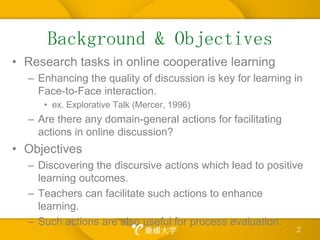
Background & ObjectivesResearch tasks in online cooperative learningEnhancing the quality of discussion is key for learning in Face-to-Face interaction.ex. Explorative Talk (Mercer, 1996)Are there any domain-general actions for facilitating actions in online discussion?ObjectivesDiscovering the discursive actionswhich lead to positivelearning outcomes.Teachers can facilitate such actions to enhance learning.Such actions are also useful for process evaluation.2
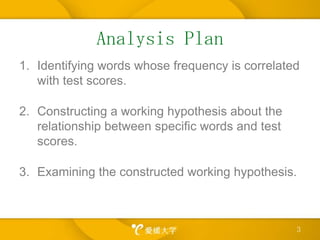
AnalysisPlanIdentifying words whose frequency is correlated with test scores.Constructing a working hypothesis about the relationship between specific words and test scores.Examining the constructed working hypothesis.3
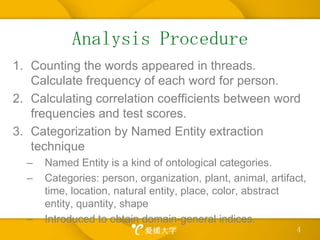
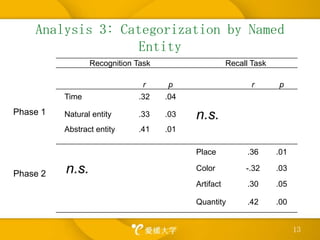
Analysis ProcedureCounting the words appeared in threads. Calculate frequency of each word for person.Calculating correlation coefficients between word frequencies and test scores.Categorization by Named Entity extraction techniqueNamed Entityis a kind of ontological categories.Categories: person, organization, plant, animal, artifact, time, location, natural entity, place, color, abstract entity, quantity, shapeIntroduced to obtain domain-general indices.4
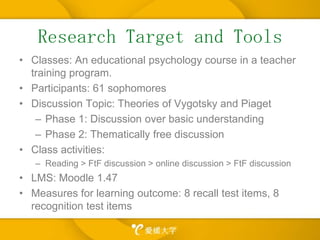
Research Target and ToolsClasses: An educational psychology course in a teacher training program.Participants: 61 sophomoresDiscussion Topic: Theories of Vygotsky and PiagetPhase 1: Discussion over basic understandingPhase 2: Thematically free discussionClass activities: Reading > FtFdiscussion > onlinediscussion > FtF discussionLMS: Moodle 1.47Measures for learning outcome: 8 recall test items, 8 recognition test items
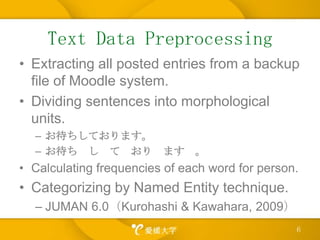
TextData PreprocessingExtracting all posted entries from a backup file ofMoodle system.Dividing sentences into morphological units.お待ちしております。お待ち し て おり ます 。Calculating frequencies of each word for person.Categorizing by Named Entity technique.JUMAN6.0(Kurohashi & Kawahara, 2009)6
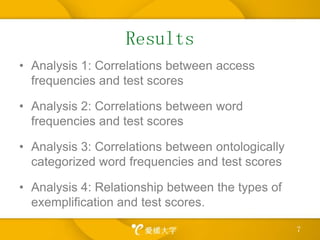
ResultsAnalysis 1: Correlations between access frequencies and test scoresAnalysis 2: Correlations between word frequencies and test scoresAnalysis 3:Correlations between ontologically categorized word frequencies and test scoresAnalysis 4: Relationship between the types of exemplification and test scores.7
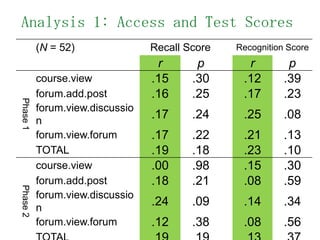
Analysis 1: Access andTest Scores
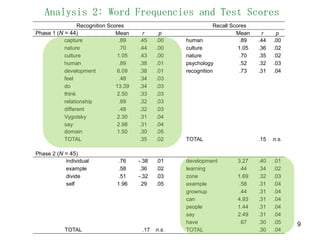
9Analysis 2: Word Frequencies and Test Scores
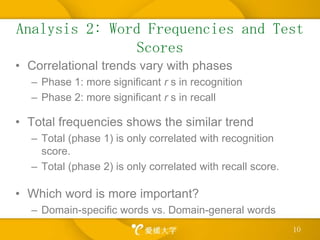
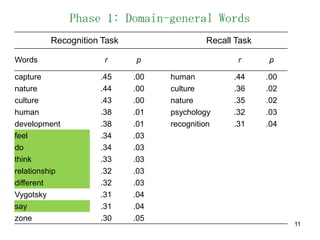
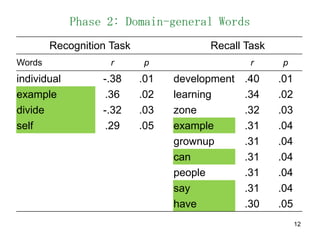
Analysis 2: Word Frequencies and Test ScoresCorrelational trends vary with phasesPhase 1: more significant rs in recognitionPhase 2: more significant r s in recallTotal frequencies shows the similar trendTotal (phase 1) is only correlated with recognition score.Total (phase 2) is only correlated with recall score.Which word is more important?Domain-specific words vs. Domain-general words10
11Phase 1: Domain-general Words
12Phase 2: Domain-general Words
Analysis 3: Categorization by Named Entity13Phase 1Phase 2
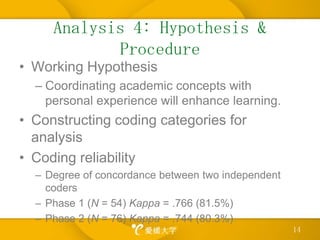
Analysis 4: Hypothesis &ProcedureWorking HypothesisCoordinating academic concepts with personal experience will enhance learning. Constructing coding categories for analysisCoding reliabilityDegree of concordance between two independent codersPhase 1 (N = 54) Kappa = .766 (81.5%)Phase 2 (N = 76) Kappa = .744 (80.3%)14
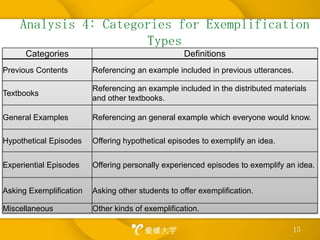
Analysis 4: Categories for Exemplification Types15
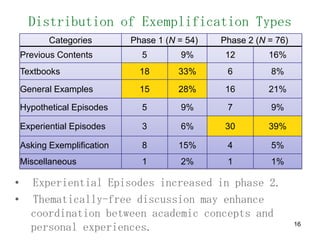
Distribution of Exemplification TypesExperiential Episodes increased in phase 2.
Thematically-freediscussion may enhance coordination between academic concepts and personal experiences. 16
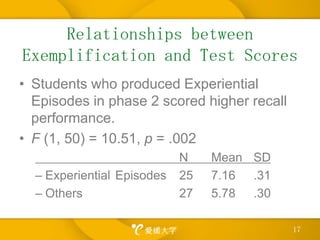
Relationships between Exemplification and Test ScoresStudents who produced Experiential Episodes in phase 2 scoredhigher recall performance.F (1, 50) = 10.51, p = .002						N	Mean	   SDExperiential 	Episodes	25	7.16	   .31Others 			27	5.78	   .3017
Summary and ImplicationWord frequencies predicted test scores, but access frequencies did not.Task structure might affect quality of learning.Exemplification was important in online cooperative learningStudentsproduced experiential episodes marked higher recall scores.Teachers can show exemplification models to facilitate students’ active online discussion.18

Site2011 tomidaokibayashitamura

  • 1.
    Predictive Discursive featuresfor learning outcome in online cooperative learningTOMIDA, Eiji Ehime University, JapanOKIBAYASHI, Yohei Yamaguchi University, JapanTAMURA, Yasuhisa Sophia University, Japan1SITE 2011: Society for Information Technology & Teacher Education International ConferenceNashville, Tennessee, USA, March 7-11, 2011PM2:45 March 8, 2011
  • 2.
    Background & ObjectivesResearchtasks in online cooperative learningEnhancing the quality of discussion is key for learning in Face-to-Face interaction.ex. Explorative Talk (Mercer, 1996)Are there any domain-general actions for facilitating actions in online discussion?ObjectivesDiscovering the discursive actionswhich lead to positivelearning outcomes.Teachers can facilitate such actions to enhance learning.Such actions are also useful for process evaluation.2
  • 3.
    AnalysisPlanIdentifying words whosefrequency is correlated with test scores.Constructing a working hypothesis about the relationship between specific words and test scores.Examining the constructed working hypothesis.3
  • 4.
    Analysis ProcedureCounting thewords appeared in threads. Calculate frequency of each word for person.Calculating correlation coefficients between word frequencies and test scores.Categorization by Named Entity extraction techniqueNamed Entityis a kind of ontological categories.Categories: person, organization, plant, animal, artifact, time, location, natural entity, place, color, abstract entity, quantity, shapeIntroduced to obtain domain-general indices.4
  • 5.
    Research Target andToolsClasses: An educational psychology course in a teacher training program.Participants: 61 sophomoresDiscussion Topic: Theories of Vygotsky and PiagetPhase 1: Discussion over basic understandingPhase 2: Thematically free discussionClass activities: Reading > FtFdiscussion > onlinediscussion > FtF discussionLMS: Moodle 1.47Measures for learning outcome: 8 recall test items, 8 recognition test items
  • 6.
    TextData PreprocessingExtracting allposted entries from a backup file ofMoodle system.Dividing sentences into morphological units.お待ちしております。お待ち し て おり ます 。Calculating frequencies of each word for person.Categorizing by Named Entity technique.JUMAN6.0(Kurohashi & Kawahara, 2009)6
  • 7.
    ResultsAnalysis 1: Correlationsbetween access frequencies and test scoresAnalysis 2: Correlations between word frequencies and test scoresAnalysis 3:Correlations between ontologically categorized word frequencies and test scoresAnalysis 4: Relationship between the types of exemplification and test scores.7
  • 8.
    Analysis 1: AccessandTest Scores
  • 9.
    9Analysis 2: WordFrequencies and Test Scores
  • 10.
    Analysis 2: WordFrequencies and Test ScoresCorrelational trends vary with phasesPhase 1: more significant rs in recognitionPhase 2: more significant r s in recallTotal frequencies shows the similar trendTotal (phase 1) is only correlated with recognition score.Total (phase 2) is only correlated with recall score.Which word is more important?Domain-specific words vs. Domain-general words10
  • 11.
  • 12.
  • 13.
    Analysis 3: Categorizationby Named Entity13Phase 1Phase 2
  • 14.
    Analysis 4: Hypothesis&ProcedureWorking HypothesisCoordinating academic concepts with personal experience will enhance learning. Constructing coding categories for analysisCoding reliabilityDegree of concordance between two independent codersPhase 1 (N = 54) Kappa = .766 (81.5%)Phase 2 (N = 76) Kappa = .744 (80.3%)14
  • 15.
    Analysis 4: Categoriesfor Exemplification Types15
  • 16.
    Distribution of ExemplificationTypesExperiential Episodes increased in phase 2.
  • 17.
    Thematically-freediscussion may enhancecoordination between academic concepts and personal experiences. 16
  • 18.
    Relationships between Exemplificationand Test ScoresStudents who produced Experiential Episodes in phase 2 scoredhigher recall performance.F (1, 50) = 10.51, p = .002 N Mean SDExperiential Episodes 25 7.16 .31Others 27 5.78 .3017
  • 19.
    Summary and ImplicationWordfrequencies predicted test scores, but access frequencies did not.Task structure might affect quality of learning.Exemplification was important in online cooperative learningStudentsproduced experiential episodes marked higher recall scores.Teachers can show exemplification models to facilitate students’ active online discussion.18