VOP Workshop using the  SIPOC FMI Methodology Joel Miller Certified Lean Six Sigma Black Belt
Voice of the Process Workshop Investigating the opportunities to better meet the goals of your organization.
Why should your company conduct a Voice of the Process Workshop? An opportunity to explore why a process is not meeting my current business requirements for quality or timeliness. An opportunity to reassess the requirements and deliverables of a process as the needs of the organization continue to change An opportunity to examine the process gaps in the current and potential performance of a process.
What is Voice of the Process Workshop? A VOP workshop explores a business process and identifies the  Process Complexity Throughput Problems Quality Concerns Organization Issues  These increase the complexity and slow down key business processes and prevent a company from achieving their continuous improvement goals. These are usually identifiable as  In Process or Customer Requested Rework Multiple “Time Traps” that constrain the throughput and capability of a process Cost Reduction Targets Customer Needs and Processes have Changed An opportunity to explore why a process is not meeting my current business requirements for quality or timeliness.
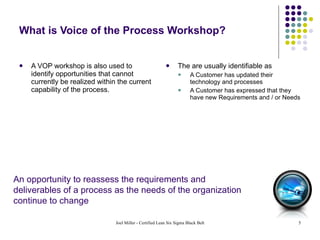
What is Voice of the Process Workshop? A VOP workshop is also used to identify opportunities that cannot currently be realized within the current capability of the process. The are usually identifiable as A Customer has updated their technology and processes A Customer has expressed that they have new Requirements and / or Needs An opportunity to reassess the requirements and deliverables of a process as the needs of the organization continue to change
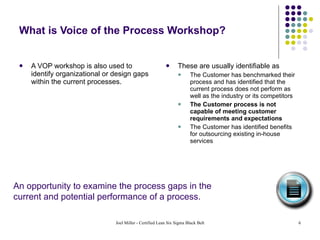
What is Voice of the Process Workshop? A VOP workshop is also used to identify organizational or design gaps within the current processes. These are usually identifiable as The Customer has benchmarked their process and has identified that the current process does not perform as well as the industry or its competitors The Customer process is not capable of meeting customer requirements and expectations The Customer has identified benefits for outsourcing existing in-house services An opportunity to examine the process gaps in the  current and potential performance of a process.
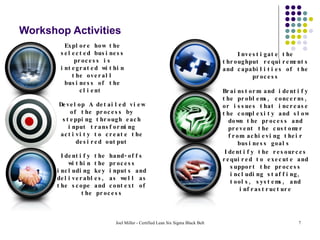
Workshop Activities Explore how the selected business process is integrated within the overall business of the client  Develop A detailed view of the process by stepping through each input transforming activity to create the desired output Identify the hand-offs within the process including key inputs and deliverables, as well as the scope and context of the process Investigate the throughput requirements and capabilities of the process Brainstorm and identify the problems, concerns, or issues that increase the complexity and slow down the process and prevent the customer from achieving their business goals  Identify the resources required to execute and support the process including staffing, tools, systems, and infrastructure
Workshop Documentation and Recommendations Key Deliverables: Process Narrative SIPOCr Process Metrics and Voids Process Problems, Issues & Concerns Process Resources Identified Customer Needs Affinity Diagram Benefit-Effort Matrix An “At a Glance” view of the Current State of the Process that Identifies the Opportunities to Improve the Process A recommend process improvement plan for how to Lean the process and improve the Sigma level of the process based upon the opportunities exposed during the workshop Opportunities for Xerox solutions that can meet the current and future business needs of the process Customer’s A foundation for process improvement
Who participates in the workshop? The workshop is a facilitated ½ day engagement using the Xerox Lean Six Sigma methodology to identify the customer’s internal business priorities and opportunities where Xerox Solutions are matched with critical customer requirements. Identifies and prioritizes opportunities for the client to improve their document processes related to Enterprise Print Services (EPS) Pre-Workshop Information Project sponsor to identify  Key department objectives Primary challenges and barriers The key Process “Customers” Workshop Participants Project Sponsor Process SME’s Process Customer(s) IT Support
Methodology Slides How to conduct the VOP Workshop using the SIPOC FMI Toolset
Steps for doing a VOP Workshop Develop a SIPOCr of the process as it is intended to be performed. Identify all of the Failure Modes buried within the process. Write a Process Narrative to solidify the scope and context of the process. Capture the known and unknown process metrics. Brainstorm additional Failure Modes, Issues and Concerns for the process. Capture all of the process enablers that support the process. Affinitize the Failure Modes Develop the Failure Mode Effects for the Affinitized Groups Restate the Failure Modes and Effects as Opportunities and Needs Evaluate the Benefits and Efforts to realize the Opportunities and Needs
What is a SIPOCr FMI Methodology? It combines the process using the Lean Six Sigma Methodology to develop a SIPOCr for a process and identify the Failure Modes that increase the complexity and slow down the process and prevent the customer from achieving their business goals. Failure Modes are the sources of: Customer problems, concerns, or issues Process, Cost, and Throughput Improvement Opportunities The process is not capable of meeting customer requirements and expectations Organizational Gaps that prevent the Enterprise from meeting its needs or goals It is also a useful tool methodology when there is limited process data available.
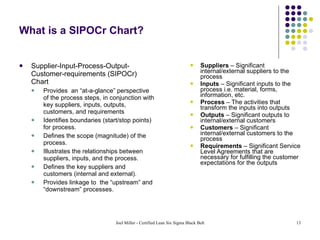
What is a SIPOCr Chart? Supplier-Input-Process-Output-Customer-requirements (SIPOCr) Chart Provides  an “at-a-glance” perspective of the process steps, in conjunction with key suppliers, inputs, outputs, customers, and requirements Identifies boundaries (start/stop points) for process. Defines the scope (magnitude) of the process. Illustrates the relationships between suppliers, inputs, and the process. Defines the key suppliers and customers (internal and external). Provides linkage to  the “upstream” and “downstream” processes. Suppliers  – Significant internal/external suppliers to the process Inputs  – Significant inputs to the process i.e. material, forms, information, etc. Process  – The activities that transform the inputs into outputs Outputs  – Significant outputs to internal/external customers Customers  – Significant internal/external customers to the process Requirements  – Significant Service Level Agreements that are necessary for fulfilling the customer expectations for the outputs
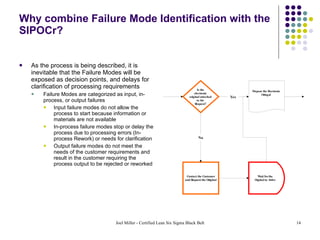
Why combine Failure Mode Identification with the SIPOCr? As the process is being described, it is inevitable that the Failure Modes will be exposed as decision points, and delays for clarification of processing requirements Failure Modes are categorized as input, in-process, or output failures Input failure modes do not allow the process to start because information or materials are not available In-process failure modes stop or delay the process due to processing errors (In-process Rework) or needs for clarification Output failure modes do not meet the needs of the customer requirements and result in the customer requiring the process output to be rejected or reworked
When do you use a SIPOC FMI? It is  used prior to the launch of a project to collect all of the process steps as the process is intended to be performed This may result in a high level overview of a process or a detailed step by step investigation of a process It explores the process as it is intended to be executed and all of the contributing factors that increase the process complexity  The information collected is used as inputs for a developing the Detail Process Map, Criteria Selection Matrix, Failure Mode Effects Analysis and Value Stream Map It exposes what data is available within the  y=f(x)  of the process It allows process data to be collected and analyzed based upon a Customer Value criteria
How do you complete a SIPOCr Step 1. Process Walk through the process activities as they are intended to be performed. Use a noun-verb sequence to describe each broad step, like “Collect information,” “Enter information,” etc. Brainstorm any additional gaps in the process.  Identify organizational or workgroup boundaries. Step 2. Inputs List the Information and Materials that will be transformed within the process.  (Resources, Tools, and Infrastructure will be captured separately as enablers.) Step 3. Suppliers List all of the sources of the Inputs Step 4. Outputs List each of the Outputs produced by the process. Step 4. Customers List each of the Customers that receive the Outputs Step 5. Requirements Describe the key features/characteristics of the Output for each Customer (e.g. SLA’s) Step 6. Validation Brainstorm how the process steps can be verified.  (e.g. Walk the Process)
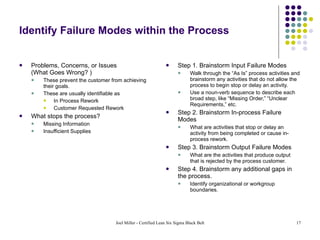
Identify Failure Modes within the Process Problems, Concerns, or Issues  (What Goes Wrong? ) These prevent the customer from achieving their goals. These are usually identifiable as  In Process Rework Customer Requested Rework What stops the process? Missing Information Insufficient Supplies Step 1. Brainstorm Input Failure Modes Walk through the “As Is” process activities and brainstorm any activities that do not allow the process to begin stop or delay an activity.  Use a noun-verb sequence to describe each broad step, like “Missing Order,” “Unclear Requirements,” etc. Step 2. Brainstorm In-process Failure Modes What are activities that stop or delay an activity from being completed or cause in-process rework. Step 3. Brainstorm Output Failure Modes What are the activities that produce output that is rejected by the process customer. Step 4. Brainstorm any additional gaps in the process.  Identify organizational or workgroup boundaries.
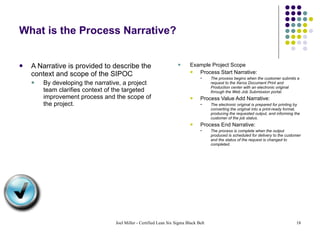
What is the Process Narrative? A Narrative is provided to describe the context and scope of the SIPOC By developing the narrative, a project team clarifies context of the targeted improvement process and the scope of the project. Example Project Scope Process Start Narrative:  The process begins when the customer submits a request to the Xerox Document Print and Production center with an electronic original through the Web Job Submission portal. Process Value Add Narrative:  The electronic original is prepared for printing by converting the original into a print-ready format, producing the requested output, and informing the customer of the job status. Process End Narrative:  The process is complete when the output produced is scheduled for delivery to the customer and the status of the request is changed to completed.
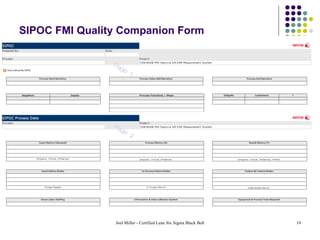
SIPOC FMI Quality Companion Form Page 2 Page 1
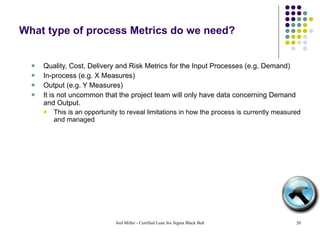
What type of process Metrics do we need? Quality, Cost, Delivery and Risk Metrics for the Input Processes (e.g. Demand) In-process (e.g. X Measures) Output (e.g. Y Measures) It is not uncommon that the project team will only have data concerning Demand and Output. This is an opportunity to reveal limitations in how the process is currently measured and managed
What are the Enablers and Additional Information? Direct Labor Staffing List the Full Time, Part Time and other Labor related to this process Information & Data Collection Systems List all of the systems that touch the process that could be used within the scope of the process Each system has the potential to provide data about the process Equipment & Process Tools Required This is a complete Bill of Material of Tools required to replicate the process PC’s & Printers, Production Equipment, Finishing Equipment, Furniture & Fixtures, Customer Network Connectivity, etc.
Are there other Failure Modes? Deficiency  (What Do I not Have Enough Of?)  These are opportunities they cannot currently realize. These are usually identifiable as Delays in the process for Materials, Information, Data, Systems, or other Resources These may already be describing needs or benefits, but may need to be reworded.  Positioning of the Operational Issue (If we could be empowered)  These are organizational constraints that limit the capabilities of the process.  These are usually identifiable as Delays in the process waiting for direction as to how to proceed with the request. These may be describing boundary needs but may need to be reworded.
What are the unmet needs and requirements of the Organization? Customer Needs are the positive restatement of customer Problems, Concerns, Issues, or Organizational Gaps independent of the product or solutions offering. Affinitize all of the Failure Modes based upon common problems, issues, concerns, gap measures. Record the multiple Effects experience from this common Failure Mode Use a noun-verb sequence to describe each broad step, like “Time To Process Too Long,” “Poor Performance,” “Missed Due Date”, etc. Name the Affinity Group with a common Noun-Verb Problem Name Create a positive restatement of the Failure Modes and Effects as Customer Needs and Opportunities
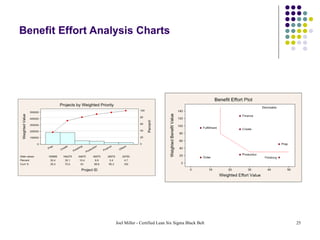
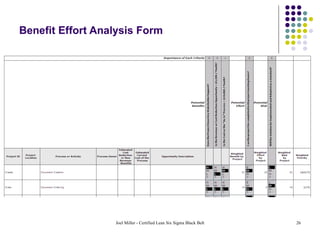
Benefits and Effort Analysis to Meet Identified Customer Needs and Opportunities Using the Customer Needs and Opportunities, Develop the Benefits and Effort Matrix. When estimating effort, use estimated project staffing, and duration.  Benefit-Effort ratio = Benefits ÷ Effort Remember, your conclusions are only as good as the estimates they are based on! STEP 1 The team first identifies the various resources required for the activities to be completed within the opportunity or customer need to be evaluated. STEP 2 Effort estimates are provided based upon consensus from the assembled project team.  STEP 3 The project team next discusses the various options, and positions the opportunity on the B&E Matrix chart.  STEP 4 Adjustments are made by comparing the benefits/effort ratios for similar Customer Needs and Opportunities. STEP 5 A final decision is made and the benefit-effort analysis and is included in the proposed process improvement plan.
Benefit Effort Analysis Charts
Benefit Effort Analysis Form
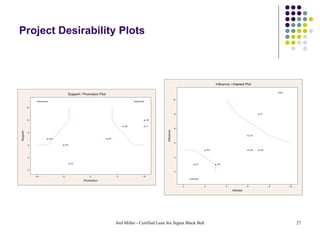
Project Desirability Plots
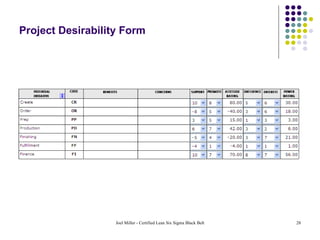
Project Desirability Form
Next Steps After SIPOC FMI Analysis tools for SIPOC FMI data.
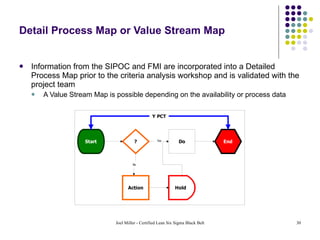
Detail Process Map or Value Stream Map Information from the SIPOC and FMI are incorporated into a Detailed Process Map prior to the criteria analysis workshop and is validated with the project team A Value Stream Map is possible depending on the availability or process data
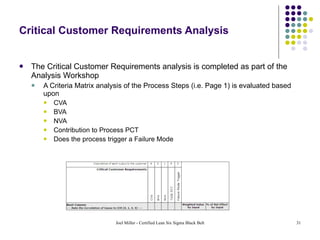
Critical Customer Requirements Analysis The Critical Customer Requirements analysis is completed as part of the Analysis Workshop A Criteria Matrix analysis of the Process Steps (i.e. Page 1) is evaluated based upon  CVA BVA NVA Contribution to Process PCT Does the process trigger a Failure Mode
FMEA Analysis The FMEA analysis is completed as part of the Analysis Workshop Discussion with the project team reveals the Potential Failure Effects from each of the Failure Modes identified as well as Severity Occurrence Detection Actions That Could be Taken

SIPOC Failure Mode Identification Methodology

  • 1.
    VOP Workshop usingthe SIPOC FMI Methodology Joel Miller Certified Lean Six Sigma Black Belt
  • 2.
    Voice of theProcess Workshop Investigating the opportunities to better meet the goals of your organization.
  • 3.
    Why should yourcompany conduct a Voice of the Process Workshop? An opportunity to explore why a process is not meeting my current business requirements for quality or timeliness. An opportunity to reassess the requirements and deliverables of a process as the needs of the organization continue to change An opportunity to examine the process gaps in the current and potential performance of a process.
  • 4.
    What is Voiceof the Process Workshop? A VOP workshop explores a business process and identifies the Process Complexity Throughput Problems Quality Concerns Organization Issues These increase the complexity and slow down key business processes and prevent a company from achieving their continuous improvement goals. These are usually identifiable as In Process or Customer Requested Rework Multiple “Time Traps” that constrain the throughput and capability of a process Cost Reduction Targets Customer Needs and Processes have Changed An opportunity to explore why a process is not meeting my current business requirements for quality or timeliness.
  • 5.
    What is Voiceof the Process Workshop? A VOP workshop is also used to identify opportunities that cannot currently be realized within the current capability of the process. The are usually identifiable as A Customer has updated their technology and processes A Customer has expressed that they have new Requirements and / or Needs An opportunity to reassess the requirements and deliverables of a process as the needs of the organization continue to change
  • 6.
    What is Voiceof the Process Workshop? A VOP workshop is also used to identify organizational or design gaps within the current processes. These are usually identifiable as The Customer has benchmarked their process and has identified that the current process does not perform as well as the industry or its competitors The Customer process is not capable of meeting customer requirements and expectations The Customer has identified benefits for outsourcing existing in-house services An opportunity to examine the process gaps in the current and potential performance of a process.
  • 7.
    Workshop Activities Explorehow the selected business process is integrated within the overall business of the client Develop A detailed view of the process by stepping through each input transforming activity to create the desired output Identify the hand-offs within the process including key inputs and deliverables, as well as the scope and context of the process Investigate the throughput requirements and capabilities of the process Brainstorm and identify the problems, concerns, or issues that increase the complexity and slow down the process and prevent the customer from achieving their business goals Identify the resources required to execute and support the process including staffing, tools, systems, and infrastructure
  • 8.
    Workshop Documentation andRecommendations Key Deliverables: Process Narrative SIPOCr Process Metrics and Voids Process Problems, Issues & Concerns Process Resources Identified Customer Needs Affinity Diagram Benefit-Effort Matrix An “At a Glance” view of the Current State of the Process that Identifies the Opportunities to Improve the Process A recommend process improvement plan for how to Lean the process and improve the Sigma level of the process based upon the opportunities exposed during the workshop Opportunities for Xerox solutions that can meet the current and future business needs of the process Customer’s A foundation for process improvement
  • 9.
    Who participates inthe workshop? The workshop is a facilitated ½ day engagement using the Xerox Lean Six Sigma methodology to identify the customer’s internal business priorities and opportunities where Xerox Solutions are matched with critical customer requirements. Identifies and prioritizes opportunities for the client to improve their document processes related to Enterprise Print Services (EPS) Pre-Workshop Information Project sponsor to identify Key department objectives Primary challenges and barriers The key Process “Customers” Workshop Participants Project Sponsor Process SME’s Process Customer(s) IT Support
  • 10.
    Methodology Slides Howto conduct the VOP Workshop using the SIPOC FMI Toolset
  • 11.
    Steps for doinga VOP Workshop Develop a SIPOCr of the process as it is intended to be performed. Identify all of the Failure Modes buried within the process. Write a Process Narrative to solidify the scope and context of the process. Capture the known and unknown process metrics. Brainstorm additional Failure Modes, Issues and Concerns for the process. Capture all of the process enablers that support the process. Affinitize the Failure Modes Develop the Failure Mode Effects for the Affinitized Groups Restate the Failure Modes and Effects as Opportunities and Needs Evaluate the Benefits and Efforts to realize the Opportunities and Needs
  • 12.
    What is aSIPOCr FMI Methodology? It combines the process using the Lean Six Sigma Methodology to develop a SIPOCr for a process and identify the Failure Modes that increase the complexity and slow down the process and prevent the customer from achieving their business goals. Failure Modes are the sources of: Customer problems, concerns, or issues Process, Cost, and Throughput Improvement Opportunities The process is not capable of meeting customer requirements and expectations Organizational Gaps that prevent the Enterprise from meeting its needs or goals It is also a useful tool methodology when there is limited process data available.
  • 13.
    What is aSIPOCr Chart? Supplier-Input-Process-Output-Customer-requirements (SIPOCr) Chart Provides an “at-a-glance” perspective of the process steps, in conjunction with key suppliers, inputs, outputs, customers, and requirements Identifies boundaries (start/stop points) for process. Defines the scope (magnitude) of the process. Illustrates the relationships between suppliers, inputs, and the process. Defines the key suppliers and customers (internal and external). Provides linkage to the “upstream” and “downstream” processes. Suppliers – Significant internal/external suppliers to the process Inputs – Significant inputs to the process i.e. material, forms, information, etc. Process – The activities that transform the inputs into outputs Outputs – Significant outputs to internal/external customers Customers – Significant internal/external customers to the process Requirements – Significant Service Level Agreements that are necessary for fulfilling the customer expectations for the outputs
  • 14.
    Why combine FailureMode Identification with the SIPOCr? As the process is being described, it is inevitable that the Failure Modes will be exposed as decision points, and delays for clarification of processing requirements Failure Modes are categorized as input, in-process, or output failures Input failure modes do not allow the process to start because information or materials are not available In-process failure modes stop or delay the process due to processing errors (In-process Rework) or needs for clarification Output failure modes do not meet the needs of the customer requirements and result in the customer requiring the process output to be rejected or reworked
  • 15.
    When do youuse a SIPOC FMI? It is used prior to the launch of a project to collect all of the process steps as the process is intended to be performed This may result in a high level overview of a process or a detailed step by step investigation of a process It explores the process as it is intended to be executed and all of the contributing factors that increase the process complexity The information collected is used as inputs for a developing the Detail Process Map, Criteria Selection Matrix, Failure Mode Effects Analysis and Value Stream Map It exposes what data is available within the y=f(x) of the process It allows process data to be collected and analyzed based upon a Customer Value criteria
  • 16.
    How do youcomplete a SIPOCr Step 1. Process Walk through the process activities as they are intended to be performed. Use a noun-verb sequence to describe each broad step, like “Collect information,” “Enter information,” etc. Brainstorm any additional gaps in the process. Identify organizational or workgroup boundaries. Step 2. Inputs List the Information and Materials that will be transformed within the process. (Resources, Tools, and Infrastructure will be captured separately as enablers.) Step 3. Suppliers List all of the sources of the Inputs Step 4. Outputs List each of the Outputs produced by the process. Step 4. Customers List each of the Customers that receive the Outputs Step 5. Requirements Describe the key features/characteristics of the Output for each Customer (e.g. SLA’s) Step 6. Validation Brainstorm how the process steps can be verified. (e.g. Walk the Process)
  • 17.
    Identify Failure Modeswithin the Process Problems, Concerns, or Issues (What Goes Wrong? ) These prevent the customer from achieving their goals. These are usually identifiable as In Process Rework Customer Requested Rework What stops the process? Missing Information Insufficient Supplies Step 1. Brainstorm Input Failure Modes Walk through the “As Is” process activities and brainstorm any activities that do not allow the process to begin stop or delay an activity. Use a noun-verb sequence to describe each broad step, like “Missing Order,” “Unclear Requirements,” etc. Step 2. Brainstorm In-process Failure Modes What are activities that stop or delay an activity from being completed or cause in-process rework. Step 3. Brainstorm Output Failure Modes What are the activities that produce output that is rejected by the process customer. Step 4. Brainstorm any additional gaps in the process. Identify organizational or workgroup boundaries.
  • 18.
    What is theProcess Narrative? A Narrative is provided to describe the context and scope of the SIPOC By developing the narrative, a project team clarifies context of the targeted improvement process and the scope of the project. Example Project Scope Process Start Narrative: The process begins when the customer submits a request to the Xerox Document Print and Production center with an electronic original through the Web Job Submission portal. Process Value Add Narrative: The electronic original is prepared for printing by converting the original into a print-ready format, producing the requested output, and informing the customer of the job status. Process End Narrative: The process is complete when the output produced is scheduled for delivery to the customer and the status of the request is changed to completed.
  • 19.
    SIPOC FMI QualityCompanion Form Page 2 Page 1
  • 20.
    What type ofprocess Metrics do we need? Quality, Cost, Delivery and Risk Metrics for the Input Processes (e.g. Demand) In-process (e.g. X Measures) Output (e.g. Y Measures) It is not uncommon that the project team will only have data concerning Demand and Output. This is an opportunity to reveal limitations in how the process is currently measured and managed
  • 21.
    What are theEnablers and Additional Information? Direct Labor Staffing List the Full Time, Part Time and other Labor related to this process Information & Data Collection Systems List all of the systems that touch the process that could be used within the scope of the process Each system has the potential to provide data about the process Equipment & Process Tools Required This is a complete Bill of Material of Tools required to replicate the process PC’s & Printers, Production Equipment, Finishing Equipment, Furniture & Fixtures, Customer Network Connectivity, etc.
  • 22.
    Are there otherFailure Modes? Deficiency (What Do I not Have Enough Of?) These are opportunities they cannot currently realize. These are usually identifiable as Delays in the process for Materials, Information, Data, Systems, or other Resources These may already be describing needs or benefits, but may need to be reworded. Positioning of the Operational Issue (If we could be empowered) These are organizational constraints that limit the capabilities of the process. These are usually identifiable as Delays in the process waiting for direction as to how to proceed with the request. These may be describing boundary needs but may need to be reworded.
  • 23.
    What are theunmet needs and requirements of the Organization? Customer Needs are the positive restatement of customer Problems, Concerns, Issues, or Organizational Gaps independent of the product or solutions offering. Affinitize all of the Failure Modes based upon common problems, issues, concerns, gap measures. Record the multiple Effects experience from this common Failure Mode Use a noun-verb sequence to describe each broad step, like “Time To Process Too Long,” “Poor Performance,” “Missed Due Date”, etc. Name the Affinity Group with a common Noun-Verb Problem Name Create a positive restatement of the Failure Modes and Effects as Customer Needs and Opportunities
  • 24.
    Benefits and EffortAnalysis to Meet Identified Customer Needs and Opportunities Using the Customer Needs and Opportunities, Develop the Benefits and Effort Matrix. When estimating effort, use estimated project staffing, and duration. Benefit-Effort ratio = Benefits ÷ Effort Remember, your conclusions are only as good as the estimates they are based on! STEP 1 The team first identifies the various resources required for the activities to be completed within the opportunity or customer need to be evaluated. STEP 2 Effort estimates are provided based upon consensus from the assembled project team. STEP 3 The project team next discusses the various options, and positions the opportunity on the B&E Matrix chart. STEP 4 Adjustments are made by comparing the benefits/effort ratios for similar Customer Needs and Opportunities. STEP 5 A final decision is made and the benefit-effort analysis and is included in the proposed process improvement plan.
  • 25.
  • 26.
  • 27.
  • 28.
  • 29.
    Next Steps AfterSIPOC FMI Analysis tools for SIPOC FMI data.
  • 30.
    Detail Process Mapor Value Stream Map Information from the SIPOC and FMI are incorporated into a Detailed Process Map prior to the criteria analysis workshop and is validated with the project team A Value Stream Map is possible depending on the availability or process data
  • 31.
    Critical Customer RequirementsAnalysis The Critical Customer Requirements analysis is completed as part of the Analysis Workshop A Criteria Matrix analysis of the Process Steps (i.e. Page 1) is evaluated based upon CVA BVA NVA Contribution to Process PCT Does the process trigger a Failure Mode
  • 32.
    FMEA Analysis TheFMEA analysis is completed as part of the Analysis Workshop Discussion with the project team reveals the Potential Failure Effects from each of the Failure Modes identified as well as Severity Occurrence Detection Actions That Could be Taken

Editor's Notes

  • #14 The SIPOC clearly delineates the start and stop point of a project The SIPOC clearly states who the customer is
  • #17 If possible, the SIPOCr for the targeted improvement process is to be completed with the account team prior to the project workshop A Subject Matter Expert familiar with the process will usually be more comfortable to describe the targeted process in a more detailed step by step narrative This is not to be discouraged – this will lead to the revealing of the Failure Modes The project team must be able to distinguish between a core process step and a potential failure mode – it is typical for a failure mode that has not been error proofed to become part of the core process. Failure modes are any processes that Stop or Delay the process (e.g. Reduce Throughput) based upon a need to clarify a requirement or a lack of available materials or information to complete the process