Process Mapping for Modernization Being systematic in our creation of the Coast Guard’s future.
 
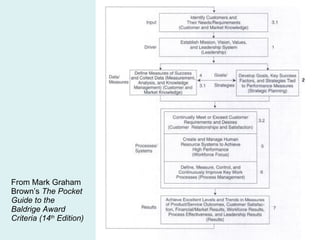
From Mark Graham Brown’s  The Pocket Guide to the Baldrige Award Criteria (14 th  Edition)
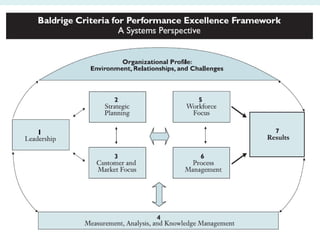
Why Should You Care? High performing organizations must succeed with all areas of the Criteria. We are building a new organization; taking the Criteria into account will help us build a high performing organization. Excellence does not happen on its own; it must be planned and created.
Systems Theory The whole is greater than the sum of its parts and is seen as a set of interrelating, interacting hierarchy of sub-systems some of which may be self-organizing.  Systems Theory sees our world in terms of 'systems', where each system is a 'whole' that is more than the sum of its parts, but also itself a 'part' of larger systems.  The concept that all people, places, things and forces in the universe are integrated into a hierarchy of mutually influential matter and energy.  From: http://members.iinet.net.au/~rstack1/millennium/concepts.htm   http://www.thegreenfuse.org/glossary.htm     http://www.geocities.com/starsuriel/heartscode/glossary.htm
Systems Theory for the Rest of Us Muck about in one place, and you’ll impact something somewhere else, something you likely hadn’t considered. It’s all one big whole. The caution:  When working on your piece of the pie, attempt to see the relationships and impacts elsewhere.
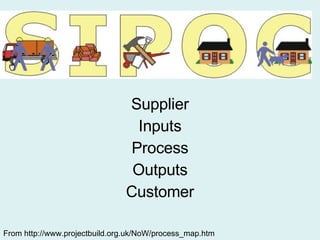
Supplier Inputs Process Outputs Customer From http://www.projectbuild.org.uk/NoW/process_map.htm
Benefits of Process Mapping Puts a spotlight on waste   Streamlines work processes   Defines and standardizes the steps and sequence   Promotes deep understanding   Builds consensus   Key tool for workcell design From http://www.strategosinc.com/process_map_example.htm
Why Map Processes? The purpose of process mapping is to use diagramming to understand the process we currently use and ask what is expected of us; what should we be doing to provide better customer focus and satisfaction. It will identify what best practices we need to incorporate and find appropriate benchmarks for measuring how we can arrive at better ways of communicating our services. As Dr. George Washington Carver put it –  "It is simply service that measures success." From: http://www.fpm.iastate.edu/worldclass/process_mapping.asp
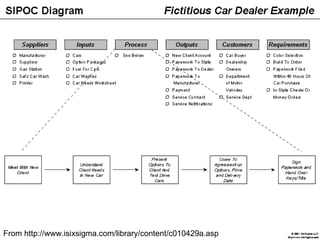
From http://www.isixsigma.com/library/content/c010429a.asp
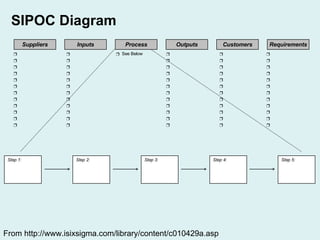
Suppliers Inputs Process Customers Requirements Step 1: Outputs Step 2:  Step 3:  Step 4:  See Below Step 5:  SIPOC Diagram From http://www.isixsigma.com/library/content/c010429a.asp
7 Step to Process Mapping Determine the Boundaries  List the Steps  Sequence the Steps  Draw Appropriate Symbols  System Model  Check for Completeness  Finalize the Flowchart  For additional details, see http://www.fpm.iastate.edu/worldclass/process_mapping.asp
Two Keys to  SIPOC and Process Mapping With SIPOC, start with customers & outputs.  The outputs are the products and services the organization creates.  Be customer-focused and product-centered. When mapping processes, keep to a single product or class of products. The more specific and narrow, the better. Remember that processes are verbs and outputs (products/services) are nouns.
Step 1: Determine the Boundaries Bracket the process. Think about the process of making coffee.  I could start by growing coffee beans, or purchasing a can of ground beans, or reaching into the kitchen cabinet. After proceeding, you might find your boundaries are too large or too small; that’s okay, just readjust.
Step 2: List the Steps Use sticky notes for brainstorming. Have everyone put stuff up without editing or commenting. You’ll find that steps are at different granularities; later you’ll have to organize hierarchically.  For instance, “plant seed” might be one, but within that would be “prepare the soil,” “punch a hole in the dirt,” “place seed,” etc.
Step 3:  Sequence the Steps The steps are on sticky notes: Move them around. Engage in discussion with other group members.
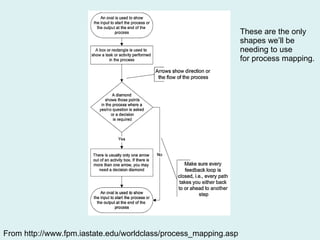
Step 4: Draw Appropriate Symbols  Keep it simple to start.  Use just the bare number of different symbols. See next slide for basic shapes of ovals, squares, diamonds, and arrows. Additional standard symbols defined in the Coast Guard Performance Improvement Guide (PIG), on page 132 (5 th  edition).
From http://www.fpm.iastate.edu/worldclass/process_mapping.asp These are the only shapes we’ll be needing to use for process mapping.
Step 5: System Model  Step back and consider impacts from and to other parts of the system. Reach back to the SIPOC model and ensure appropriate inputs included. Re-evaluate the level of granularity for the process; is the current granularity appropriate for what you are trying to accomplish?
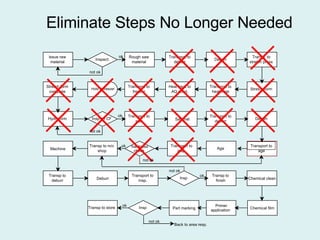
Step 6:  Check for Completeness Run through the process as mapped and ensure it makes sense. Consider moving from the current process to the ideal process; as a part of this, remove excess steps and trim the process down (see next slide)
Issue raw material Inspect Rough saw material Transport to deburr Deburr Transp . to stretch press Stretch form Transport to heat treat Heat treat to AQ cond . Transport to freezer Stretch form complete Hold in freezer Hydroform Insp on CF Transport to saw Saw net Transport to deburr Deburr Transport to age Age Transport to insp . hardness check Transp to m/c shop Machine Transp to deburr Deburr Transport to insp . Insp Transp to finish Chemical clean Chemical film Primer application Part marking Insp Transp to store Back to area resp . ok not ok ok not ok ok not ok ok not ok ok not ok Eliminate Steps No Longer Needed
Step 7: Finalize the Flowchart Recheck for redundancy; add missing steps. Ensure group consensus. Take a digital picture (largest image size possible) of process map. Record.  While a high-powered program is coming, for the time being, use Visio or some other available software program.
Your Working Group’s Ultimate Task Define all key products/services produced by the staff element. Identify key customers and requirements for each product. Create process maps which reflect the desired future state and ensuring each process step adds value.
Additional Resources BOLO List for Analyzing Process Mapping http://www.isixsigma.com/library/content/c040301a.asp How to Map a Process http://www.strategosinc.com/process_map_example.htm Is SIPOC Enough? http://notesonbpm.sarbashrestha.com/2007/08/is-sipoc-enough.html Baldrige National Quality Program http://www.quality.nist.gov/ Coast Guard Performance Excellence Blog http://cgopc.cgblog.org Coast Guard Process Excellence Guide (DRAFT) https://www.intelink.gov/inteldocs/view.php?fDocumentId=57852
Coaching and Counsel available from Organizational Performance Consultants Dr. George Yacus LCDR Byron Willeford CWO Dave Rott Peter Stinson For a full listing of Coast Guard organizational performance consultants, see https://www.intelink.gov/wiki/Coast_Guard_Organizational_Performance_Consultants
A version of this slide presentation is available online: Slideshare http://www.slideshare.net/pastinson/process-mapping-for-modernization/ Inteldocs https://www.intelink.gov/inteldocs/view.php?fDocumentId=57851 10/20/2008 @ 1030 EDT

Process Mapping For Modernization

  • 1.
    Process Mapping forModernization Being systematic in our creation of the Coast Guard’s future.
  • 2.
  • 3.
    From Mark GrahamBrown’s The Pocket Guide to the Baldrige Award Criteria (14 th Edition)
  • 4.
    Why Should YouCare? High performing organizations must succeed with all areas of the Criteria. We are building a new organization; taking the Criteria into account will help us build a high performing organization. Excellence does not happen on its own; it must be planned and created.
  • 5.
    Systems Theory Thewhole is greater than the sum of its parts and is seen as a set of interrelating, interacting hierarchy of sub-systems some of which may be self-organizing. Systems Theory sees our world in terms of 'systems', where each system is a 'whole' that is more than the sum of its parts, but also itself a 'part' of larger systems. The concept that all people, places, things and forces in the universe are integrated into a hierarchy of mutually influential matter and energy. From: http://members.iinet.net.au/~rstack1/millennium/concepts.htm http://www.thegreenfuse.org/glossary.htm http://www.geocities.com/starsuriel/heartscode/glossary.htm
  • 6.
    Systems Theory forthe Rest of Us Muck about in one place, and you’ll impact something somewhere else, something you likely hadn’t considered. It’s all one big whole. The caution: When working on your piece of the pie, attempt to see the relationships and impacts elsewhere.
  • 7.
    Supplier Inputs ProcessOutputs Customer From http://www.projectbuild.org.uk/NoW/process_map.htm
  • 8.
    Benefits of ProcessMapping Puts a spotlight on waste Streamlines work processes Defines and standardizes the steps and sequence Promotes deep understanding Builds consensus Key tool for workcell design From http://www.strategosinc.com/process_map_example.htm
  • 9.
    Why Map Processes?The purpose of process mapping is to use diagramming to understand the process we currently use and ask what is expected of us; what should we be doing to provide better customer focus and satisfaction. It will identify what best practices we need to incorporate and find appropriate benchmarks for measuring how we can arrive at better ways of communicating our services. As Dr. George Washington Carver put it – "It is simply service that measures success." From: http://www.fpm.iastate.edu/worldclass/process_mapping.asp
  • 10.
  • 11.
    Suppliers Inputs ProcessCustomers Requirements Step 1: Outputs Step 2: Step 3: Step 4: See Below Step 5: SIPOC Diagram From http://www.isixsigma.com/library/content/c010429a.asp
  • 12.
    7 Step toProcess Mapping Determine the Boundaries List the Steps Sequence the Steps Draw Appropriate Symbols System Model Check for Completeness Finalize the Flowchart For additional details, see http://www.fpm.iastate.edu/worldclass/process_mapping.asp
  • 13.
    Two Keys to SIPOC and Process Mapping With SIPOC, start with customers & outputs. The outputs are the products and services the organization creates. Be customer-focused and product-centered. When mapping processes, keep to a single product or class of products. The more specific and narrow, the better. Remember that processes are verbs and outputs (products/services) are nouns.
  • 14.
    Step 1: Determinethe Boundaries Bracket the process. Think about the process of making coffee. I could start by growing coffee beans, or purchasing a can of ground beans, or reaching into the kitchen cabinet. After proceeding, you might find your boundaries are too large or too small; that’s okay, just readjust.
  • 15.
    Step 2: Listthe Steps Use sticky notes for brainstorming. Have everyone put stuff up without editing or commenting. You’ll find that steps are at different granularities; later you’ll have to organize hierarchically. For instance, “plant seed” might be one, but within that would be “prepare the soil,” “punch a hole in the dirt,” “place seed,” etc.
  • 16.
    Step 3: Sequence the Steps The steps are on sticky notes: Move them around. Engage in discussion with other group members.
  • 17.
    Step 4: DrawAppropriate Symbols Keep it simple to start. Use just the bare number of different symbols. See next slide for basic shapes of ovals, squares, diamonds, and arrows. Additional standard symbols defined in the Coast Guard Performance Improvement Guide (PIG), on page 132 (5 th edition).
  • 18.
    From http://www.fpm.iastate.edu/worldclass/process_mapping.asp Theseare the only shapes we’ll be needing to use for process mapping.
  • 19.
    Step 5: SystemModel Step back and consider impacts from and to other parts of the system. Reach back to the SIPOC model and ensure appropriate inputs included. Re-evaluate the level of granularity for the process; is the current granularity appropriate for what you are trying to accomplish?
  • 20.
    Step 6: Check for Completeness Run through the process as mapped and ensure it makes sense. Consider moving from the current process to the ideal process; as a part of this, remove excess steps and trim the process down (see next slide)
  • 21.
    Issue raw materialInspect Rough saw material Transport to deburr Deburr Transp . to stretch press Stretch form Transport to heat treat Heat treat to AQ cond . Transport to freezer Stretch form complete Hold in freezer Hydroform Insp on CF Transport to saw Saw net Transport to deburr Deburr Transport to age Age Transport to insp . hardness check Transp to m/c shop Machine Transp to deburr Deburr Transport to insp . Insp Transp to finish Chemical clean Chemical film Primer application Part marking Insp Transp to store Back to area resp . ok not ok ok not ok ok not ok ok not ok ok not ok Eliminate Steps No Longer Needed
  • 22.
    Step 7: Finalizethe Flowchart Recheck for redundancy; add missing steps. Ensure group consensus. Take a digital picture (largest image size possible) of process map. Record. While a high-powered program is coming, for the time being, use Visio or some other available software program.
  • 23.
    Your Working Group’sUltimate Task Define all key products/services produced by the staff element. Identify key customers and requirements for each product. Create process maps which reflect the desired future state and ensuring each process step adds value.
  • 24.
    Additional Resources BOLOList for Analyzing Process Mapping http://www.isixsigma.com/library/content/c040301a.asp How to Map a Process http://www.strategosinc.com/process_map_example.htm Is SIPOC Enough? http://notesonbpm.sarbashrestha.com/2007/08/is-sipoc-enough.html Baldrige National Quality Program http://www.quality.nist.gov/ Coast Guard Performance Excellence Blog http://cgopc.cgblog.org Coast Guard Process Excellence Guide (DRAFT) https://www.intelink.gov/inteldocs/view.php?fDocumentId=57852
  • 25.
    Coaching and Counselavailable from Organizational Performance Consultants Dr. George Yacus LCDR Byron Willeford CWO Dave Rott Peter Stinson For a full listing of Coast Guard organizational performance consultants, see https://www.intelink.gov/wiki/Coast_Guard_Organizational_Performance_Consultants
  • 26.
    A version ofthis slide presentation is available online: Slideshare http://www.slideshare.net/pastinson/process-mapping-for-modernization/ Inteldocs https://www.intelink.gov/inteldocs/view.php?fDocumentId=57851 10/20/2008 @ 1030 EDT