JAI HIND
Virendra Kumar Maurya
Assistant Professor
CAEHS COLLEGE ,MEERUT
Subject- Applied Physics
Topic- AC circuits - Single phase & Poly-phase power supply
& with connection, application, relation between phase and
line voltage.
Single Phase and Poly-phase Power Supply
• Electric power systems can be classified into
single-phase and poly-phase (commonly
three-phase) systems.
Single-Phase Power Supply
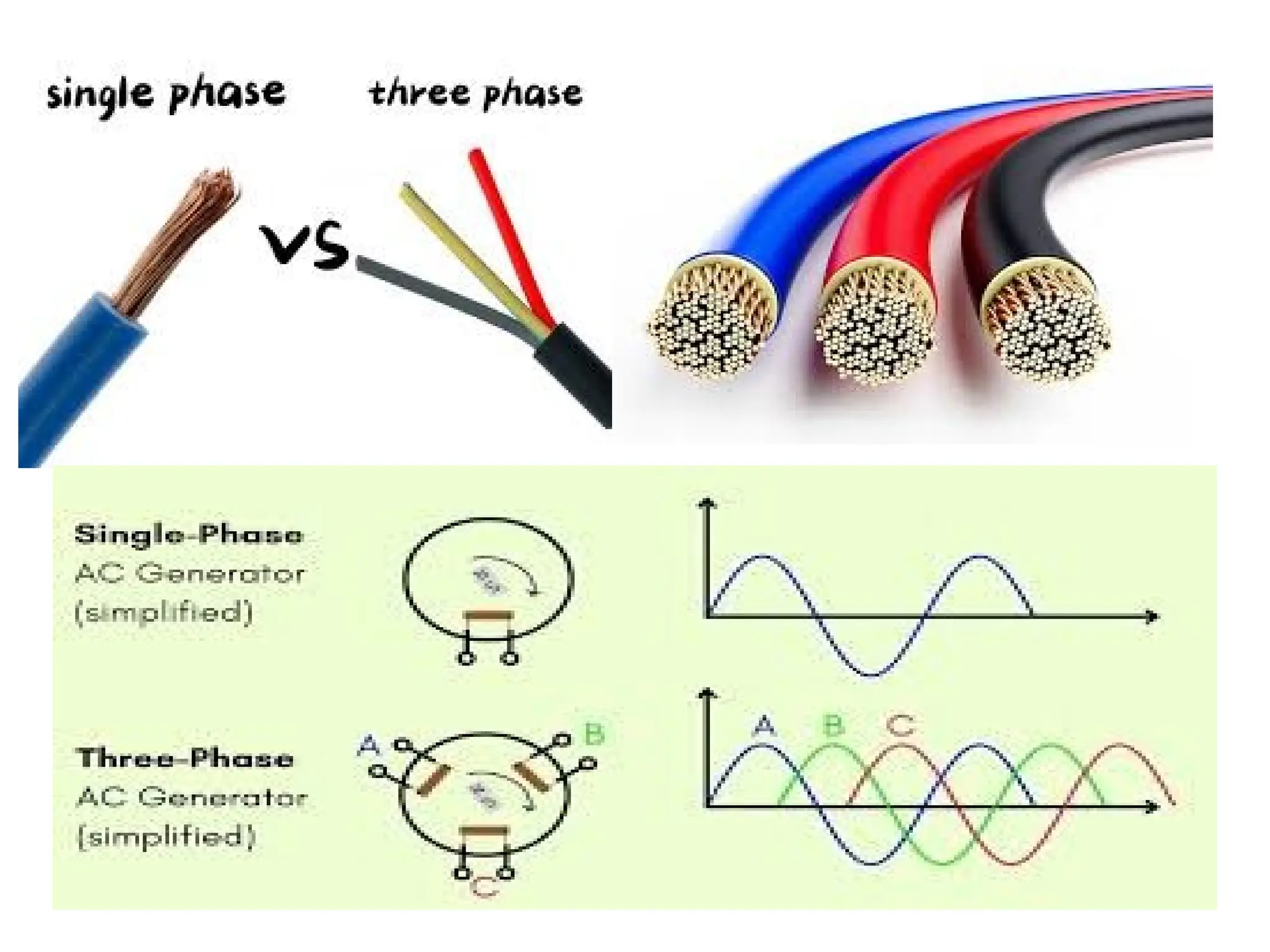
A single-phase power supply uses one alternating current (AC)
waveform to deliver power.
 Number of Wires: Typically consists of two wires: a live (hot) wire
and a neutral wire. A third wire (ground) may be present for safety.
 Waveform: A single sinusoidal wave.
 Voltage: Commonly 120V or 230V, depending on the region.
 Applications: Used in residential and small commercial setups to
power lights, fans, and small appliances.
 Efficiency: Less efficient for transmitting power over long distances
compared to three-phase systems.
 Load Capacity: Suitable for low-power devices and loads.
Advantages:
 Simpler and more cost-effective.
 Easier to maintain and install.
 Sufficient for small-scale power needs.
Disadvantages:
 Cannot efficiently handle high-power loads.
 Voltage fluctuation is more noticeable under varying loads.
Three-Phase Systems
• A three-phase system is a method of electrical power generation,
transmission, and distribution that uses three alternating currents
(AC), each with the same frequency and amplitude but 120° out of
phase with each other. This system is more efficient and reliable
than single-phase systems for supplying power to large loads.
Three-Phase Systems
• Three Waveforms:
– Three sinusoidal voltage or current waveforms, each separated by
120°.
– Provides continuous power with smoother operation compared to
single-phase systems.
• Efficiency:
– Requires less conductor material for the same power transmission.
– Balances the power load across phases, reducing energy losses.
• Applications:
– Widely used in industrial, commercial, and high-power equipment
such as motors, transformers, and heating systems.
Three-phase systems can be connected in two primary
ways
Star (Y) Connection Delta (Δ) Connection
1. Star (Y) Connection
• Configuration:
– One end of each phase winding is connected to a common point called
the neutral.
– The other ends are connected to the three-phase lines.
• Characteristics:
– Four wires: three-phase conductors and one neutral wire.
– The neutral allows for single-phase loads in addition to three-phase
loads.
• Voltage Relationship:
– Line Voltage (VL​
) and Phase Voltage (VP​
) are related as:
VL=√3 V
⋅ P
– Line Current (IL​
) equals Phase Current (IP):
IL=IP
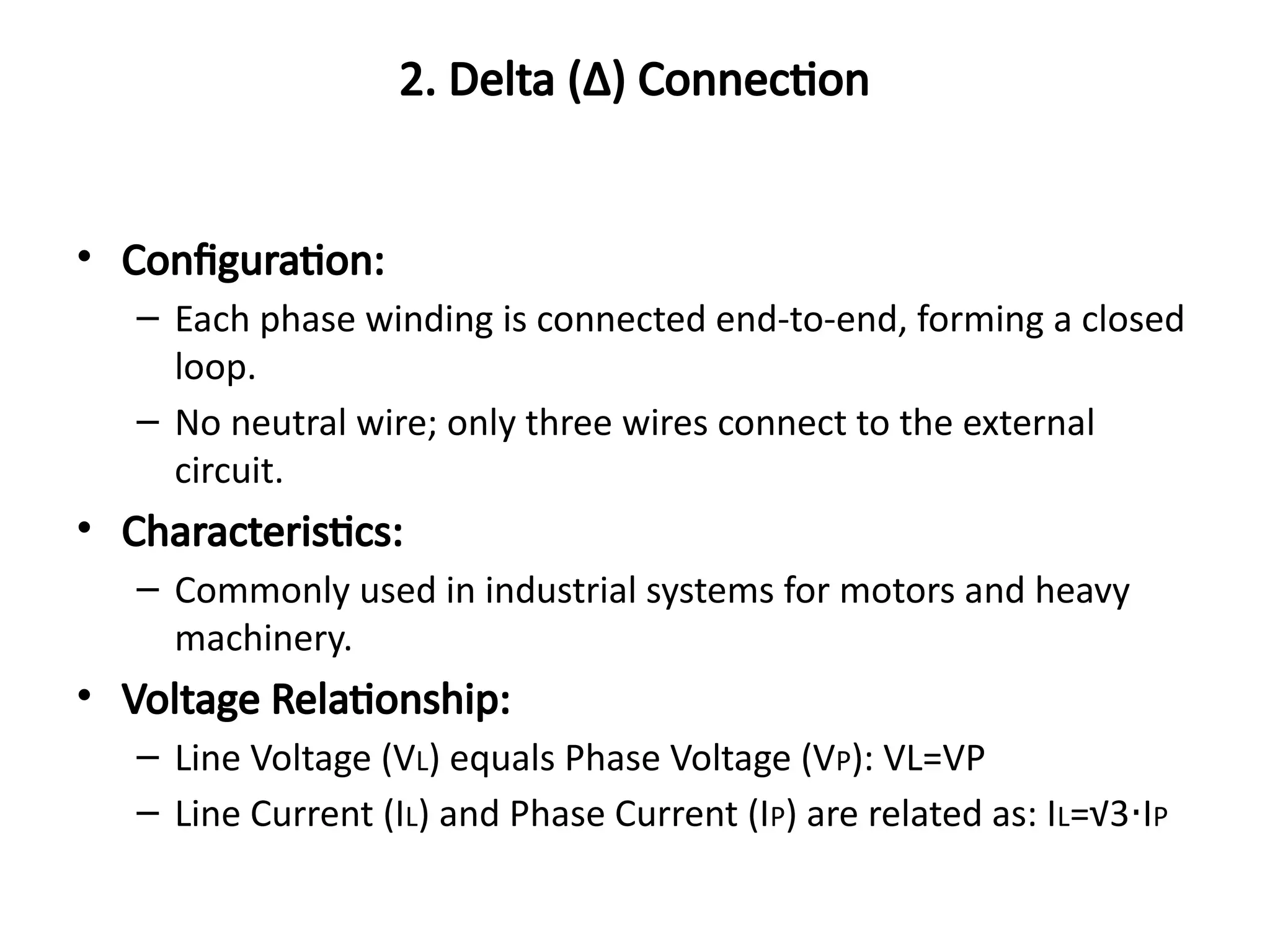
2. Delta (Δ) Connection
• Configuration:
– Each phase winding is connected end-to-end, forming a closed
loop.
– No neutral wire; only three wires connect to the external
circuit.
• Characteristics:
– Commonly used in industrial systems for motors and heavy
machinery.
• Voltage Relationship:
– Line Voltage (VL​
) equals Phase Voltage (VP​
): VL=VP
– Line Current (IL​
) and Phase Current (IP​
) are related as: IL=√3 I
⋅ P
Advantages of Three-Phase Systems
– At least one phase is always delivering power,
ensuring smoother and more efficient operation.
– Reduces overheating and power losses in
transmission.
– Can handle larger loads effectively, making it
suitable for industrial use.
Applications
• Industrial Power: For running heavy
machinery, motors, and equipment.
• Power Transmission: Used in power grids for
efficient long-distance electricity distribution.
• Commercial Use: Supplies energy to high-
demand buildings, such as shopping malls and
hospitals.
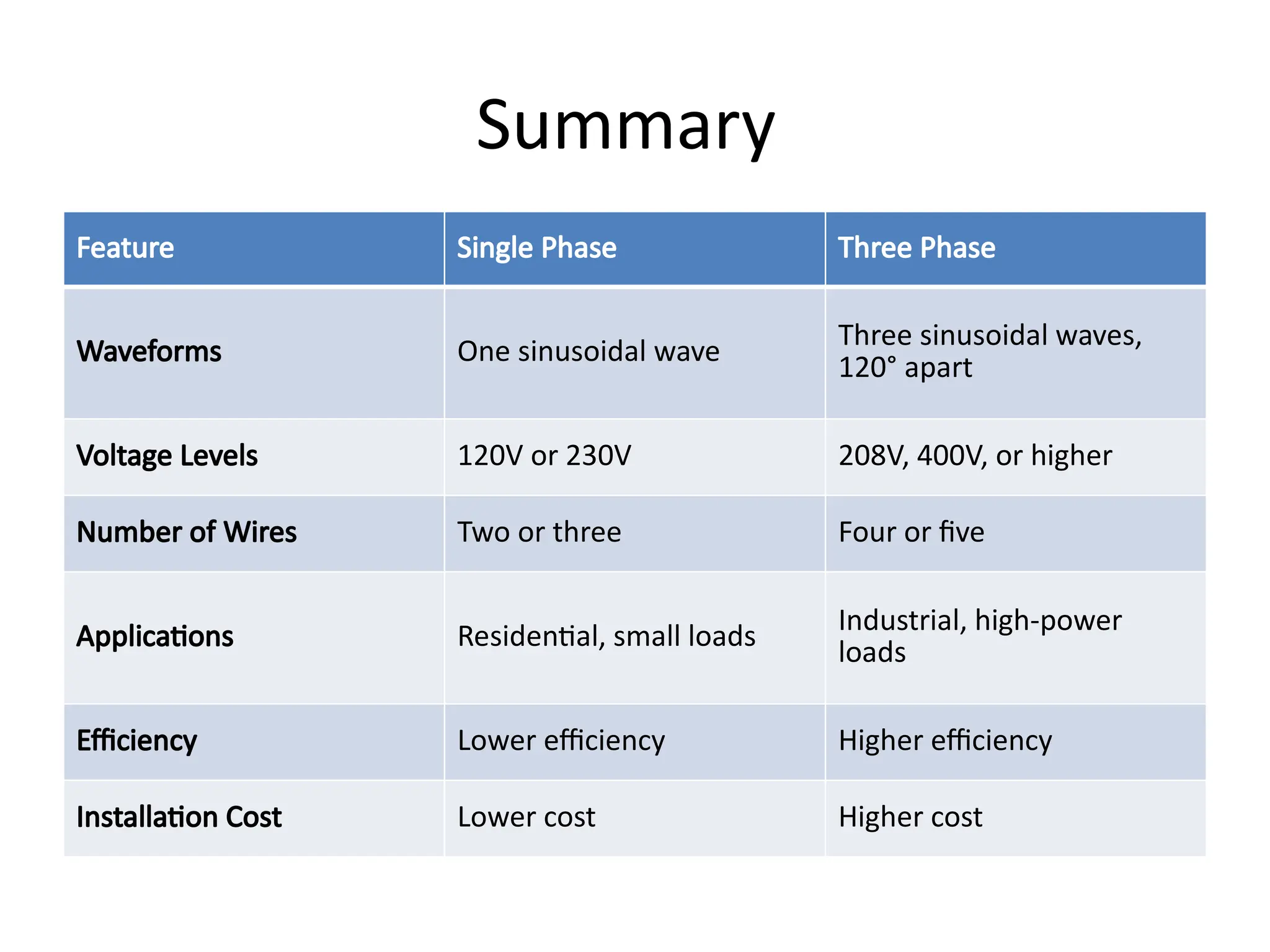
Summary
Feature Single Phase Three Phase
Waveforms One sinusoidal wave
Three sinusoidal waves,
120° apart
Voltage Levels 120V or 230V 208V, 400V, or higher
Number of Wires Two or three Four or five
Applications Residential, small loads Industrial, high-power
loads
Efficiency Lower efficiency Higher efficiency
Installation Cost Lower cost Higher cost
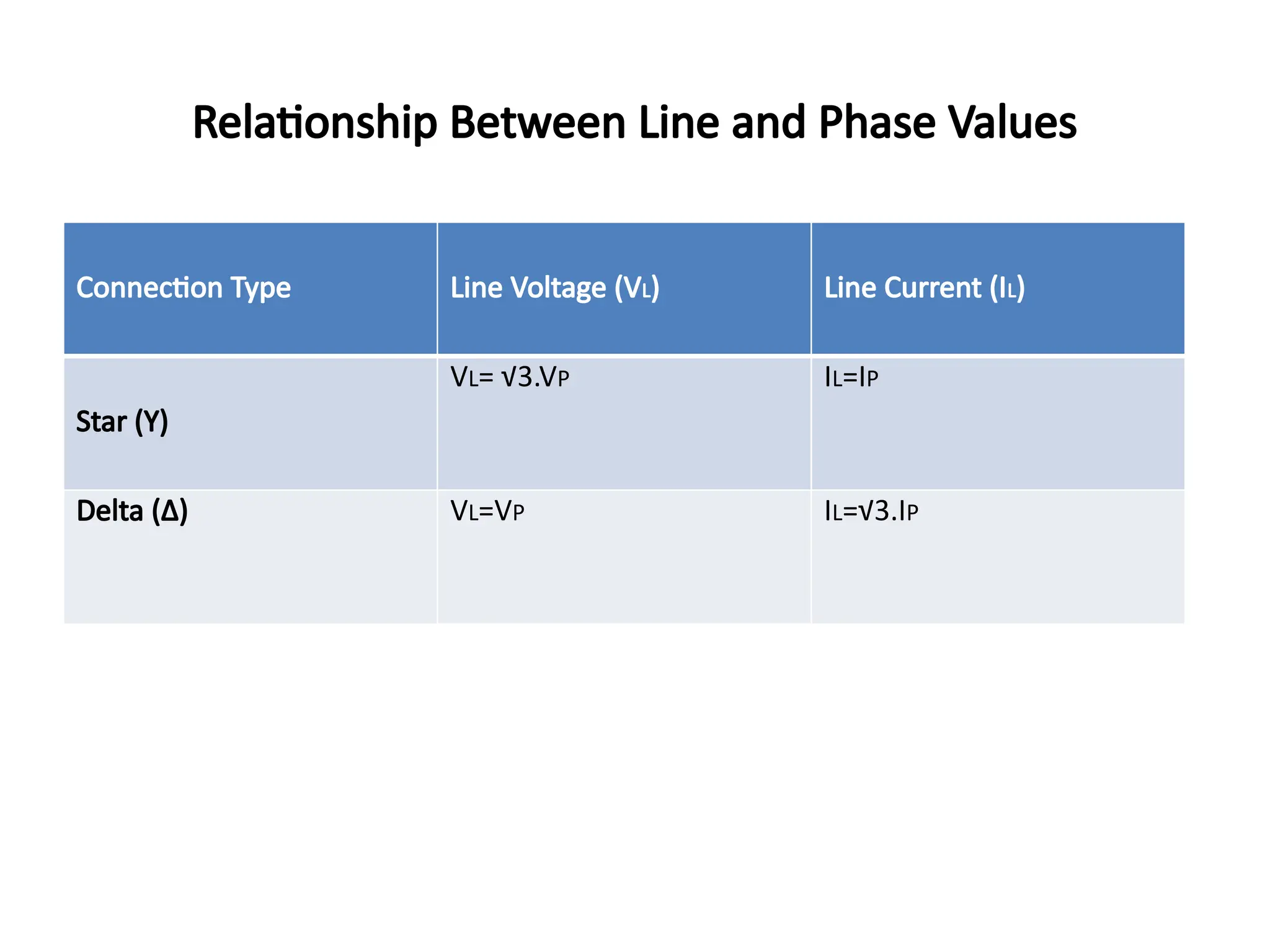
Relationship Between Line and Phase Values
Connection Type Line Voltage (VL) Line Current (IL​
)
Star (Y)
VL= √3.VP IL=IP
Delta (Δ) VL=VP IL=√3.IP
Sinusoidal
• A sine wave, sinusoidal wave, or sinusoid
(symbol: )
∿ is a periodic wave whose
waveform (shape) is the trigonometric sine
function.
• A sinusoidal waveform alternates between
positive and negative peaks around a central
axis (zero line). The pattern is symmetric,
indicating the energy flows cyclically in both
directions in AC systems.
Sinusoidal
Your (HW)😍
Thank You

single phase and poly phase power supply.pptx

  • 1.
    JAI HIND Virendra KumarMaurya Assistant Professor CAEHS COLLEGE ,MEERUT Subject- Applied Physics Topic- AC circuits - Single phase & Poly-phase power supply & with connection, application, relation between phase and line voltage.
  • 2.
    Single Phase andPoly-phase Power Supply • Electric power systems can be classified into single-phase and poly-phase (commonly three-phase) systems.
  • 4.
    Single-Phase Power Supply Asingle-phase power supply uses one alternating current (AC) waveform to deliver power.  Number of Wires: Typically consists of two wires: a live (hot) wire and a neutral wire. A third wire (ground) may be present for safety.  Waveform: A single sinusoidal wave.  Voltage: Commonly 120V or 230V, depending on the region.  Applications: Used in residential and small commercial setups to power lights, fans, and small appliances.  Efficiency: Less efficient for transmitting power over long distances compared to three-phase systems.  Load Capacity: Suitable for low-power devices and loads.
  • 6.
    Advantages:  Simpler andmore cost-effective.  Easier to maintain and install.  Sufficient for small-scale power needs. Disadvantages:  Cannot efficiently handle high-power loads.  Voltage fluctuation is more noticeable under varying loads.
  • 7.
    Three-Phase Systems • Athree-phase system is a method of electrical power generation, transmission, and distribution that uses three alternating currents (AC), each with the same frequency and amplitude but 120° out of phase with each other. This system is more efficient and reliable than single-phase systems for supplying power to large loads.
  • 9.
    Three-Phase Systems • ThreeWaveforms: – Three sinusoidal voltage or current waveforms, each separated by 120°. – Provides continuous power with smoother operation compared to single-phase systems. • Efficiency: – Requires less conductor material for the same power transmission. – Balances the power load across phases, reducing energy losses. • Applications: – Widely used in industrial, commercial, and high-power equipment such as motors, transformers, and heating systems.
  • 10.
    Three-phase systems canbe connected in two primary ways Star (Y) Connection Delta (Δ) Connection
  • 11.
    1. Star (Y)Connection • Configuration: – One end of each phase winding is connected to a common point called the neutral. – The other ends are connected to the three-phase lines. • Characteristics: – Four wires: three-phase conductors and one neutral wire. – The neutral allows for single-phase loads in addition to three-phase loads. • Voltage Relationship: – Line Voltage (VL​ ) and Phase Voltage (VP​ ) are related as: VL=√3 V ⋅ P – Line Current (IL​ ) equals Phase Current (IP): IL=IP
  • 13.
    2. Delta (Δ)Connection • Configuration: – Each phase winding is connected end-to-end, forming a closed loop. – No neutral wire; only three wires connect to the external circuit. • Characteristics: – Commonly used in industrial systems for motors and heavy machinery. • Voltage Relationship: – Line Voltage (VL​ ) equals Phase Voltage (VP​ ): VL=VP – Line Current (IL​ ) and Phase Current (IP​ ) are related as: IL=√3 I ⋅ P
  • 15.
    Advantages of Three-PhaseSystems – At least one phase is always delivering power, ensuring smoother and more efficient operation. – Reduces overheating and power losses in transmission. – Can handle larger loads effectively, making it suitable for industrial use.
  • 16.
    Applications • Industrial Power:For running heavy machinery, motors, and equipment. • Power Transmission: Used in power grids for efficient long-distance electricity distribution. • Commercial Use: Supplies energy to high- demand buildings, such as shopping malls and hospitals.
  • 17.
    Summary Feature Single PhaseThree Phase Waveforms One sinusoidal wave Three sinusoidal waves, 120° apart Voltage Levels 120V or 230V 208V, 400V, or higher Number of Wires Two or three Four or five Applications Residential, small loads Industrial, high-power loads Efficiency Lower efficiency Higher efficiency Installation Cost Lower cost Higher cost
  • 18.
    Relationship Between Lineand Phase Values Connection Type Line Voltage (VL) Line Current (IL​ ) Star (Y) VL= √3.VP IL=IP Delta (Δ) VL=VP IL=√3.IP
  • 19.
    Sinusoidal • A sinewave, sinusoidal wave, or sinusoid (symbol: ) ∿ is a periodic wave whose waveform (shape) is the trigonometric sine function. • A sinusoidal waveform alternates between positive and negative peaks around a central axis (zero line). The pattern is symmetric, indicating the energy flows cyclically in both directions in AC systems.
  • 20.
  • 21.