

Simple Regenerating Codes:
Network Coding for Cloud
Storage
Dimitris S. Papailiopoulos, Jianqiang Luo,
Alexandros G. Dimakis, Cheng Huang, and Jin Li

INFOCOM 2012

Presented by Tangkai
Index
 About the author
 Introduction
 SRC
 Simulations
 Conclusion
About the author
   Jianqiang Luo
    ◦ Experience
        Senior Software Engineer @ EMC
        Received PhD, Wayne State University
        Intern @ Microsoft, Data Domain
        Team Leader @ Actuate
        Received MS, SJTU
    ◦ Specialties
      Working on distributed storage systems during
       PhD
       Performance profiling.
About the author
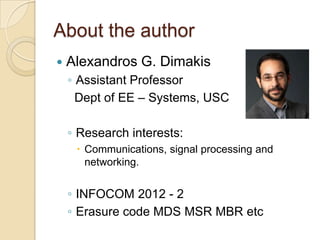
   Alexandros G. Dimakis
    ◦ Assistant Professor
      Dept of EE – Systems, USC

    ◦ Research interests:
      Communications, signal processing and
       networking.


    ◦ INFOCOM 2012 - 2
    ◦ Erasure code MDS MSR MBR etc
About the author
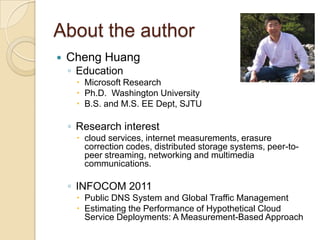
   Cheng Huang
    ◦ Education
      Microsoft Research
      Ph.D. Washington University
      B.S. and M.S. EE Dept, SJTU

    ◦ Research interest
      cloud services, internet measurements, erasure
       correction codes, distributed storage systems, peer-to-
       peer streaming, networking and multimedia
       communications.

    ◦ INFOCOM 2011
      Public DNS System and Global Traffic Management
      Estimating the Performance of Hypothetical Cloud
       Service Deployments: A Measurement-Based Approach
About the author
   Jin Li
    ◦ Experience
       Microsoft Research
       BS/MS/PhD THU (within 7 years)
       计算机普及要从娃娃抓起


    ◦ Title
       IEEE Fellow
       GLOBECOM/ICME/ACM MM Chair
Index
 About the author
 Introduction
 SRC
 Simulations
 Conclusion
Introduction
   Background
    ◦ We have come into BIG DATA ERA!
      Digital Universe 1.8 ZB (=1.8e9 TB)
      Several PBs photo stored on Facebook
      14.1PB data stored on Taobao (2010)


    ◦ Data security is IMPORTANT
      Free from unwanted actions of unauthorized
       users.
      Free from data loss caused by destructive
       forces
Introduction
   Background
    ◦ Recovery
       rare exception -> regular operation
         GFS[1]:
           Hundreds or even thousands of machines
           Inexpensive commodity parts
           High concurrency/IO
    ◦ High failure tolerance, both for
       High availability and to prevent data loss
[1] S. Ghemawat, H. Gobioff, and S.-T. Leung, “The Google file system,” in
SOSP ’03: Proc. of the 19th ACM Symposium on Operating Systems
Principles, 2003.
Introduction
   Background
    ◦ Erasure coding > replication
      1. redundancy level, reliability
      2. reliability, storage cost
    ◦ Some applications
      Cloud storage systems
      Archival storage
      Peer-to-peer storage systems
Introduction
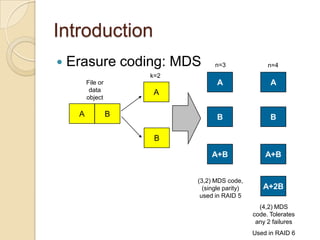
   Erasure coding: MDS            n=3                n=4
                       k=2
         File or                    A                  A
          data          A
         object

     A             B                B                  B

                        B

                                  A+B                A+B


                             (3,2) MDS code,
                               (single parity)      A+2B
                              used in RAID 5
                                                   (4,2) MDS
                                                 code. Tolerates
                                                  any 2 failures
                                                 Used in RAID 6
Introduction
                 Erasure coding vs. Replica[3]erasure code
                                        (4,2) MDS
                                             Replication        (any 2 suffice to recover)

            File or                              A                      A
             data              A
            object


                                                 A                      B
                                                           vs
                               B

                                                 B                    A+B


                                                 B                   A+2B

[3]A. G. Dimakis, P. G. Godfrey, Y. Wu, M. J. Wainwright, and K. Ramchandran,“Network
coding for distributed storage systems,” in IEEE Trans. on Inform. Theory, vol. 56, pp.
Introduction
                 Erasure coding vs. Replica[3]erasure code
                                        (4,2) MDS
                                                  Replication    (any 2 suffice to recover)

            File or                                    A                 A
             data                  A
            object


                                                       A                 B
                        Erasure coding is introducing redundancy in an optimal way.
                                                                 vs
                                    B      Very useful in practice
                      i.e. Reed-Solomon codes, Fountain Codes, (LT and Raptor)…
                                                       B               A+B


                                                       B              A+2B

[3]A. G. Dimakis, P. G. Godfrey, Y. Wu, M. J. Wainwright, and K. Ramchandran,“Network
coding for distributed storage systems,” in IEEE Trans. on Inform. Theory, vol. 56, pp.
Introduction
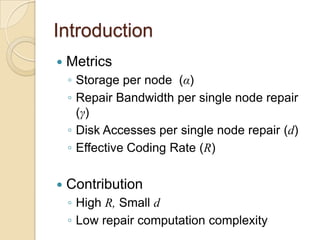
   Metrics
    ◦ Storage per node (α)
    ◦ Repair Bandwidth per single node repair
      (γ)
    ◦ Disk Accesses per single node repair (d)
    ◦ Effective Coding Rate (R)

   Contribution
    ◦ High R, Small d
    ◦ Low repair computation complexity
Index
 About the author
 Introduction
 SRC
 Simulations
 Conclusion
SRC
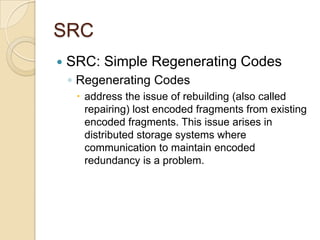
   SRC: Simple Regenerating Codes
    ◦ Regenerating Codes
      address the issue of rebuilding (also called
       repairing) lost encoded fragments from existing
       encoded fragments. This issue arises in
       distributed storage systems where
       communication to maintain encoded
       redundancy is a problem.
SRC
    Object
        Requirement I: (n, k) property
            MDS[2]


[2] Alexandros G. Dimakis, Kannan Ramchandran, Yunnan
Wu, Changho Suh:
A Survey on Network Codes for Distributed Storage. in Proceedings of the
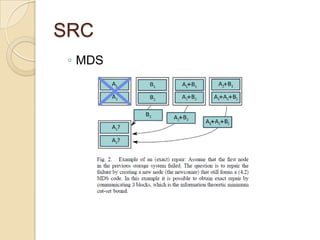
SRC
 ◦ MDS
SRC
    Requirement II: efficient exact repair
     ◦ Efficient: Low complexity
     ◦ Exact repair (vs. functional repair)[3] :
        1. [demands]Data have to stay in systematic
         form
        2. [complexity]Updating repairing-decoding
         rules-> additional overhead
        3. [security] dynamic repairing-and-decoding
         rules observed by eavesdroppers ->
         information leakage
[2] Changho Suh, Kannan Ramchandran: Exact Regeneration Codes
for Distributed Storage Repair Using Interference Alignment. in IEEE
TRANSACTIONS ON INFORMATION THEORY, VOL. 57, NO. 3, MARCH
SRC
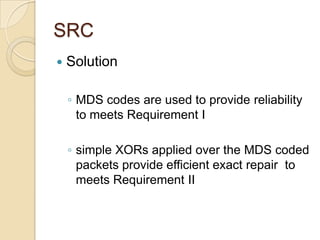
   Solution

    ◦ MDS codes are used to provide reliability
      to meets Requirement I

    ◦ simple XORs applied over the MDS coded
      packets provide efficient exact repair to
      meets Requirement II
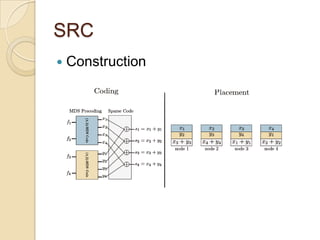
SRC
   Construction
SRC
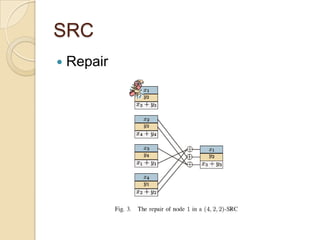
   Repair
(n,k,2)-SRC
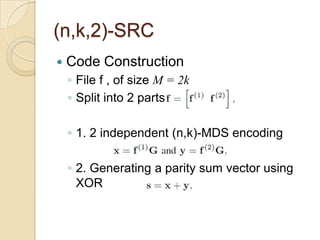
   Code Construction
    ◦ File f , of size M = 2k
    ◦ Split into 2 parts

    ◦ 1. 2 independent (n,k)-MDS encoding

    ◦ 2. Generating a parity sum vector using
      XOR
(n,k,2)-SRC
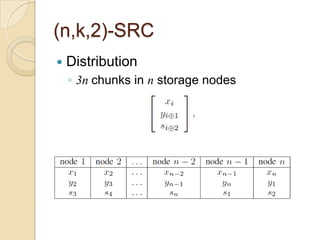
   Distribution
    ◦ 3n chunks in n storage nodes
(n,k,2)-SRC
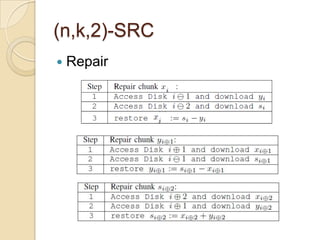
   Repair
(n,k,f)-SRC
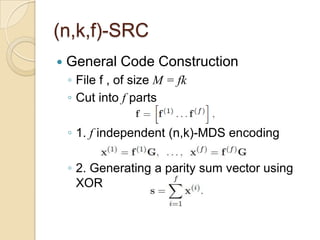
   General Code Construction
    ◦ File f , of size M = fk
    ◦ Cut into f parts

    ◦ 1. f independent (n,k)-MDS encoding

    ◦ 2. Generating a parity sum vector using
      XOR
(n,k,f)-SRC
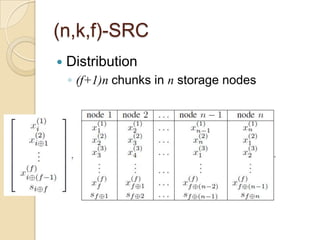
   Distribution
    ◦ (f+1)n chunks in n storage nodes
(n,k,f)-SRC
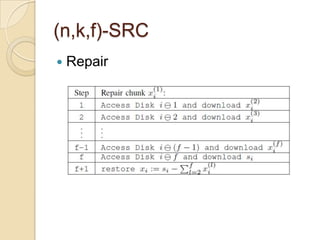
   Repair
(n,k,f)-SRC
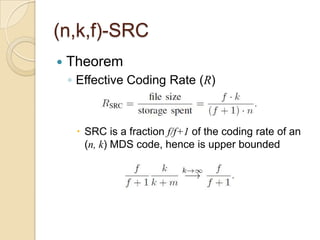
   Theorem
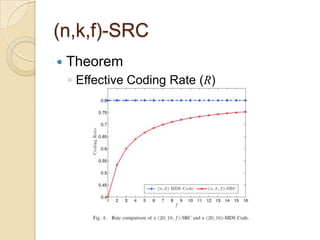
    ◦ Effective Coding Rate (R)


      SRC is a fraction f/f+1 of the coding rate of an
       (n, k) MDS code, hence is upper bounded
(n,k,f)-SRC
   Theorem
    ◦ Effective Coding Rate (R)
(n,k,f)-SRC
   Theorem
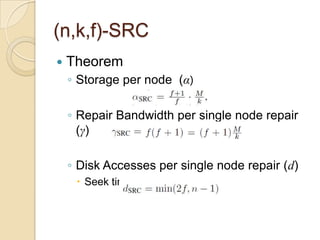
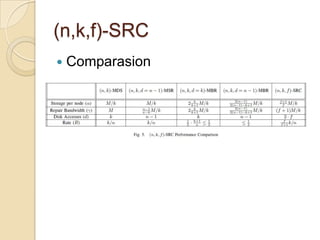
    ◦ Storage per node (α)

    ◦ Repair Bandwidth per single node repair
      (γ)

    ◦ Disk Accesses per single node repair (d)
      Seek time
(n,k,f)-SRC
   Theorem
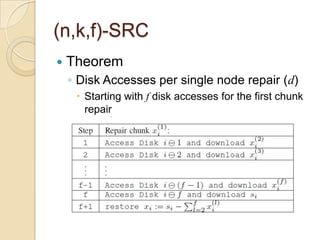
    ◦ Disk Accesses per single node repair (d)
      Starting with f disk accesses for the first chunk
       repair
(n,k,f)-SRC
   Theorem
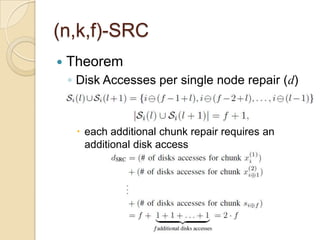
    ◦ Disk Accesses per single node repair (d)


      each additional chunk repair requires an
       additional disk access
(n,k,f)-SRC
   Comparasion
(n,k,f)-SRC
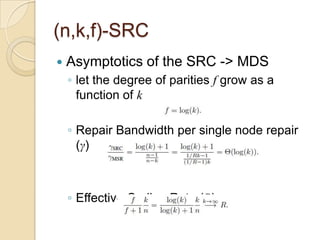
   Asymptotics of the SRC -> MDS
    ◦ let the degree of parities f grow as a
      function of k

    ◦ Repair Bandwidth per single node repair
      (γ)


    ◦ Effective Coding Rate (R)
Index
 About the author
 Introduction
 SRC
 Simulations
 Conclusion
Simulations
   Simulator Introduction
    ◦ One master, other storage server.
    ◦ Chunks form the smallest accessible data
      units and in our system are set to be
      64MB

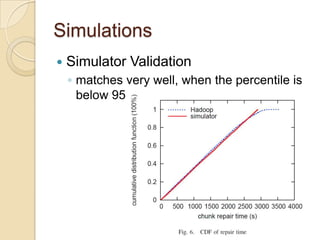
   Simulator Validation
    ◦   16 machines
    ◦   1Gbps network.
    ◦   410GB data per machine
    ◦   Approximately 6400 chunks
Simulations
   Simulator Validation
    ◦ matches very well, when the percentile is
      below 95
Simulations
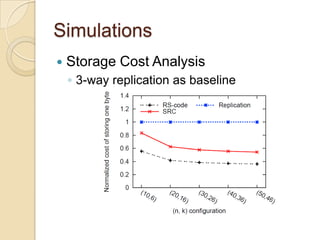
   Storage Cost Analysis
    ◦ 3-way replication as baseline
Simulations
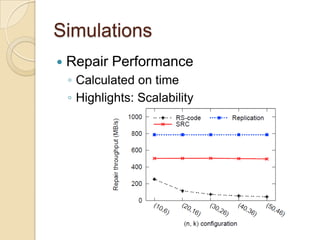
   Repair Performance
    ◦ Calculated on time
    ◦ Highlights: Scalability
Simulations
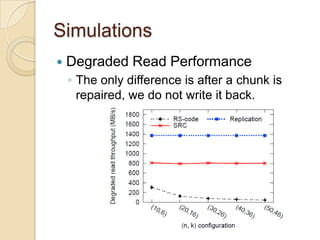
   Degraded Read Performance
    ◦ The only difference is after a chunk is
      repaired, we do not write it back.
Simulations
   Data Reliability Analysis
    ◦ simple Markov model to estimate the
      reliability
    ◦ 5 years /1PB data /
    ◦ 30 min for replica / 15 min for SRC
Simulations
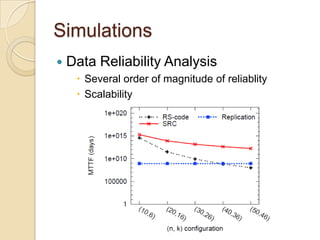
   Data Reliability Analysis
      Several order of magnitude of reliablity
      Scalability
Index
 About the author
 Introduction
 SRC
 Simulations
 Conclusion
Conclusions
   Highlight
    ◦ R-S
      Low IO/bandwidth -> scalability
    ◦ replica
      High reliability
      Decent repair/degraded read performance
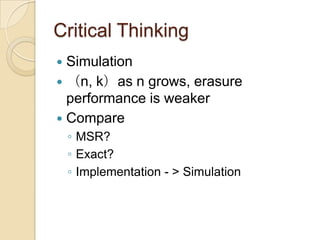
Critical Thinking
 Simulation
 (n, k)as n grows, erasure
  performance is weaker
 Compare
    ◦ MSR?
    ◦ Exact?
    ◦ Implementation - > Simulation

Simple regenerating codes: Network Coding for Cloud Storage

  • 1.
    Simple Regenerating Codes: NetworkCoding for Cloud Storage Dimitris S. Papailiopoulos, Jianqiang Luo, Alexandros G. Dimakis, Cheng Huang, and Jin Li INFOCOM 2012 Presented by Tangkai
  • 2.
    Index  About theauthor  Introduction  SRC  Simulations  Conclusion
  • 3.
    About the author  Jianqiang Luo ◦ Experience  Senior Software Engineer @ EMC  Received PhD, Wayne State University  Intern @ Microsoft, Data Domain  Team Leader @ Actuate  Received MS, SJTU ◦ Specialties  Working on distributed storage systems during PhD Performance profiling.
  • 4.
    About the author  Alexandros G. Dimakis ◦ Assistant Professor Dept of EE – Systems, USC ◦ Research interests:  Communications, signal processing and networking. ◦ INFOCOM 2012 - 2 ◦ Erasure code MDS MSR MBR etc
  • 5.
    About the author  Cheng Huang ◦ Education  Microsoft Research  Ph.D. Washington University  B.S. and M.S. EE Dept, SJTU ◦ Research interest  cloud services, internet measurements, erasure correction codes, distributed storage systems, peer-to- peer streaming, networking and multimedia communications. ◦ INFOCOM 2011  Public DNS System and Global Traffic Management  Estimating the Performance of Hypothetical Cloud Service Deployments: A Measurement-Based Approach
  • 6.
    About the author  Jin Li ◦ Experience  Microsoft Research  BS/MS/PhD THU (within 7 years)  计算机普及要从娃娃抓起 ◦ Title  IEEE Fellow  GLOBECOM/ICME/ACM MM Chair
  • 7.
    Index  About theauthor  Introduction  SRC  Simulations  Conclusion
  • 8.
    Introduction  Background ◦ We have come into BIG DATA ERA!  Digital Universe 1.8 ZB (=1.8e9 TB)  Several PBs photo stored on Facebook  14.1PB data stored on Taobao (2010) ◦ Data security is IMPORTANT  Free from unwanted actions of unauthorized users.  Free from data loss caused by destructive forces
  • 9.
    Introduction  Background ◦ Recovery  rare exception -> regular operation  GFS[1]:  Hundreds or even thousands of machines  Inexpensive commodity parts  High concurrency/IO ◦ High failure tolerance, both for  High availability and to prevent data loss [1] S. Ghemawat, H. Gobioff, and S.-T. Leung, “The Google file system,” in SOSP ’03: Proc. of the 19th ACM Symposium on Operating Systems Principles, 2003.
  • 10.
    Introduction  Background ◦ Erasure coding > replication  1. redundancy level, reliability  2. reliability, storage cost ◦ Some applications  Cloud storage systems  Archival storage  Peer-to-peer storage systems
  • 11.
    Introduction  Erasure coding: MDS n=3 n=4 k=2 File or A A data A object A B B B B A+B A+B (3,2) MDS code, (single parity) A+2B used in RAID 5 (4,2) MDS code. Tolerates any 2 failures Used in RAID 6
  • 12.
    Introduction  Erasure coding vs. Replica[3]erasure code (4,2) MDS Replication (any 2 suffice to recover) File or A A data A object A B vs B B A+B B A+2B [3]A. G. Dimakis, P. G. Godfrey, Y. Wu, M. J. Wainwright, and K. Ramchandran,“Network coding for distributed storage systems,” in IEEE Trans. on Inform. Theory, vol. 56, pp.
  • 13.
    Introduction  Erasure coding vs. Replica[3]erasure code (4,2) MDS Replication (any 2 suffice to recover) File or A A data A object A B Erasure coding is introducing redundancy in an optimal way. vs B Very useful in practice i.e. Reed-Solomon codes, Fountain Codes, (LT and Raptor)… B A+B B A+2B [3]A. G. Dimakis, P. G. Godfrey, Y. Wu, M. J. Wainwright, and K. Ramchandran,“Network coding for distributed storage systems,” in IEEE Trans. on Inform. Theory, vol. 56, pp.
  • 14.
    Introduction  Metrics ◦ Storage per node (α) ◦ Repair Bandwidth per single node repair (γ) ◦ Disk Accesses per single node repair (d) ◦ Effective Coding Rate (R)  Contribution ◦ High R, Small d ◦ Low repair computation complexity
  • 15.
    Index  About theauthor  Introduction  SRC  Simulations  Conclusion
  • 16.
    SRC  SRC: Simple Regenerating Codes ◦ Regenerating Codes  address the issue of rebuilding (also called repairing) lost encoded fragments from existing encoded fragments. This issue arises in distributed storage systems where communication to maintain encoded redundancy is a problem.
  • 17.
    SRC  Object  Requirement I: (n, k) property  MDS[2] [2] Alexandros G. Dimakis, Kannan Ramchandran, Yunnan Wu, Changho Suh: A Survey on Network Codes for Distributed Storage. in Proceedings of the
  • 18.
  • 19.
    SRC  Requirement II: efficient exact repair ◦ Efficient: Low complexity ◦ Exact repair (vs. functional repair)[3] :  1. [demands]Data have to stay in systematic form  2. [complexity]Updating repairing-decoding rules-> additional overhead  3. [security] dynamic repairing-and-decoding rules observed by eavesdroppers -> information leakage [2] Changho Suh, Kannan Ramchandran: Exact Regeneration Codes for Distributed Storage Repair Using Interference Alignment. in IEEE TRANSACTIONS ON INFORMATION THEORY, VOL. 57, NO. 3, MARCH
  • 20.
    SRC  Solution ◦ MDS codes are used to provide reliability to meets Requirement I ◦ simple XORs applied over the MDS coded packets provide efficient exact repair to meets Requirement II
  • 21.
    SRC  Construction
  • 22.
    SRC  Repair
  • 23.
    (n,k,2)-SRC  Code Construction ◦ File f , of size M = 2k ◦ Split into 2 parts ◦ 1. 2 independent (n,k)-MDS encoding ◦ 2. Generating a parity sum vector using XOR
  • 24.
    (n,k,2)-SRC  Distribution ◦ 3n chunks in n storage nodes
  • 25.
  • 26.
    (n,k,f)-SRC  General Code Construction ◦ File f , of size M = fk ◦ Cut into f parts ◦ 1. f independent (n,k)-MDS encoding ◦ 2. Generating a parity sum vector using XOR
  • 27.
    (n,k,f)-SRC  Distribution ◦ (f+1)n chunks in n storage nodes
  • 28.
  • 29.
    (n,k,f)-SRC  Theorem ◦ Effective Coding Rate (R)  SRC is a fraction f/f+1 of the coding rate of an (n, k) MDS code, hence is upper bounded
  • 30.
    (n,k,f)-SRC  Theorem ◦ Effective Coding Rate (R)
  • 31.
    (n,k,f)-SRC  Theorem ◦ Storage per node (α) ◦ Repair Bandwidth per single node repair (γ) ◦ Disk Accesses per single node repair (d)  Seek time
  • 32.
    (n,k,f)-SRC  Theorem ◦ Disk Accesses per single node repair (d)  Starting with f disk accesses for the first chunk repair
  • 33.
    (n,k,f)-SRC  Theorem ◦ Disk Accesses per single node repair (d)  each additional chunk repair requires an additional disk access
  • 34.
    (n,k,f)-SRC  Comparasion
  • 35.
    (n,k,f)-SRC  Asymptotics of the SRC -> MDS ◦ let the degree of parities f grow as a function of k ◦ Repair Bandwidth per single node repair (γ) ◦ Effective Coding Rate (R)
  • 36.
    Index  About theauthor  Introduction  SRC  Simulations  Conclusion
  • 37.
    Simulations  Simulator Introduction ◦ One master, other storage server. ◦ Chunks form the smallest accessible data units and in our system are set to be 64MB  Simulator Validation ◦ 16 machines ◦ 1Gbps network. ◦ 410GB data per machine ◦ Approximately 6400 chunks
  • 38.
    Simulations  Simulator Validation ◦ matches very well, when the percentile is below 95
  • 39.
    Simulations  Storage Cost Analysis ◦ 3-way replication as baseline
  • 40.
    Simulations  Repair Performance ◦ Calculated on time ◦ Highlights: Scalability
  • 41.
    Simulations  Degraded Read Performance ◦ The only difference is after a chunk is repaired, we do not write it back.
  • 42.
    Simulations  Data Reliability Analysis ◦ simple Markov model to estimate the reliability ◦ 5 years /1PB data / ◦ 30 min for replica / 15 min for SRC
  • 43.
    Simulations  Data Reliability Analysis  Several order of magnitude of reliablity  Scalability
  • 44.
    Index  About theauthor  Introduction  SRC  Simulations  Conclusion
  • 45.
    Conclusions  Highlight ◦ R-S  Low IO/bandwidth -> scalability ◦ replica  High reliability  Decent repair/degraded read performance
  • 46.
    Critical Thinking  Simulation (n, k)as n grows, erasure performance is weaker  Compare ◦ MSR? ◦ Exact? ◦ Implementation - > Simulation