Information & Communication System --Syndrome.pptx
1.
Information & CodingTheory
*Syndrome and Coset * Dual
Code
Dr.T.Logeswari
Dept of CS
DRSNSRCAS
2.
Syndrome and cosets
•Syndrome : The syndrome is a crucial indicator in error
detection and correction.
• If the received vector is error-free, the syndrome is the zero
vector (0).
• Non-zero syndromes indicate the presence of errors.
• The syndrome is used in syndrome decoding to identify the
error pattern and correct errors in the received codeword.
3.
• Cosets: Acoset is a set of vectors that results from translating a
subgroup of a linear code.
• Specifically, a coset is formed by adding a fixed vector (called the
coset leader) to every codeword in a subgroup.
• The coset leader is chosen as a representative vector for the coset.
Cosets are useful in error correction.
• When an error occurs, the received vector is likely to be in a coset,
and the goal is to determine the most likely coset leader (i.e., the
most likely transmitted codeword) from the received vector.
• The coset leader that minimizes the syndrome is often chosen as
the most likely transmitted codeword. syndromes provide a concise
representation of errors in received vectors, and cosets are used to
group possible transmitted codewords with the same error pattern.
• By leveraging the information provided by syndromes and cosets,
error-correcting codes can detect and correct errors in a systematic
and efficient manner.
4.
Dual Codes
• Ininformation theory and coding theory, the concept of a dual code is a
fundamental idea associated with linear codes.
• Linear codes are used for error detection and correction in communication
systems, and their dual codes play a crucial role in understanding their properties.
• Let's delve into the concept of the dual code in the context of information theory:
• ✓ Dual codes are widely used in the design and analysis of error-correcting codes.
• ✓ They play a key role in understanding the relationships between codes and
their orthogonal complements.
• ✓ Understanding the dual code is crucial in the design and analysis of linear error
correcting codes.
• ✓ It provides a way to connect the properties of a code to those of its orthogonal
complement, facilitating the study of error-detection and error-correction
capabilities.
5.
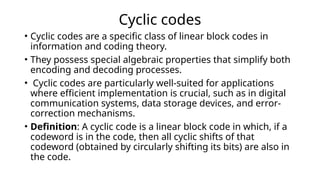
Cyclic codes
• Cycliccodes are a specific class of linear block codes in
information and coding theory.
• They possess special algebraic properties that simplify both
encoding and decoding processes.
• Cyclic codes are particularly well-suited for applications
where efficient implementation is crucial, such as in digital
communication systems, data storage devices, and error-
correction mechanisms.
• Definition: A cyclic code is a linear block code in which, if a
codeword is in the code, then all cyclic shifts of that
codeword (obtained by circularly shifting its bits) are also in
the code.
6.
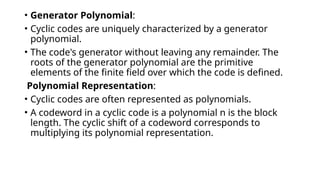
• Generator Polynomial:
•Cyclic codes are uniquely characterized by a generator
polynomial.
• The code's generator without leaving any remainder. The
roots of the generator polynomial are the primitive
elements of the finite field over which the code is defined.
Polynomial Representation:
• Cyclic codes are often represented as polynomials.
• A codeword in a cyclic code is a polynomial n is the block
length. The cyclic shift of a codeword corresponds to
multiplying its polynomial representation.
7.
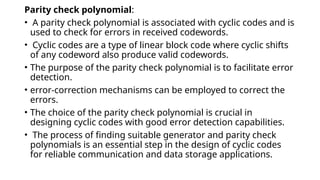
Parity check polynomial:
•A parity check polynomial is associated with cyclic codes and is
used to check for errors in received codewords.
• Cyclic codes are a type of linear block code where cyclic shifts
of any codeword also produce valid codewords.
• The purpose of the parity check polynomial is to facilitate error
detection.
• error-correction mechanisms can be employed to correct the
errors.
• The choice of the parity check polynomial is crucial in
designing cyclic codes with good error detection capabilities.
• The process of finding suitable generator and parity check
polynomials is an essential step in the design of cyclic codes
for reliable communication and data storage applications.
8.
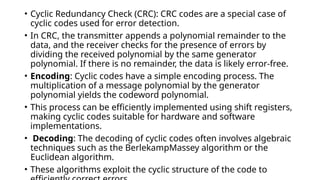
• Cyclic RedundancyCheck (CRC): CRC codes are a special case of
cyclic codes used for error detection.
• In CRC, the transmitter appends a polynomial remainder to the
data, and the receiver checks for the presence of errors by
dividing the received polynomial by the same generator
polynomial. If there is no remainder, the data is likely error-free.
• Encoding: Cyclic codes have a simple encoding process. The
multiplication of a message polynomial by the generator
polynomial yields the codeword polynomial.
• This process can be efficiently implemented using shift registers,
making cyclic codes suitable for hardware and software
implementations.
• Decoding: The decoding of cyclic codes often involves algebraic
techniques such as the BerlekampMassey algorithm or the
Euclidean algorithm.
• These algorithms exploit the cyclic structure of the code to
9.
• BCH Codes:Bose-Chaudhuri-Hocquenghem (BCH) codes are
a family of cyclic codes known for their strong error-
correction capabilities.
• BCH codes can correct multiple errors in a codeword and
are widely used in practice.
• Applications: Cyclic codes find applications in various
communication systems, including digital communication,
data storage (such as CDs and DVDs), and error-correction
mechanisms in computer networks.
• The cyclic structure of these codes simplifies both encoding
and decoding processes, making them attractive for
practical implementations where efficiency is crucial.
• They provide a good balance between error-correction
capability and computational complexity.