Unit 4 Review
Savoir vs. Connaitre
● Savoir talks about factual information or
things we know.
● Connaitre talks about people or places we
know or are familiar with.
Je connais….
I know…
Je connais
Tu connais
Il connait
nous connaissons
vous connaissez
ils connaissent
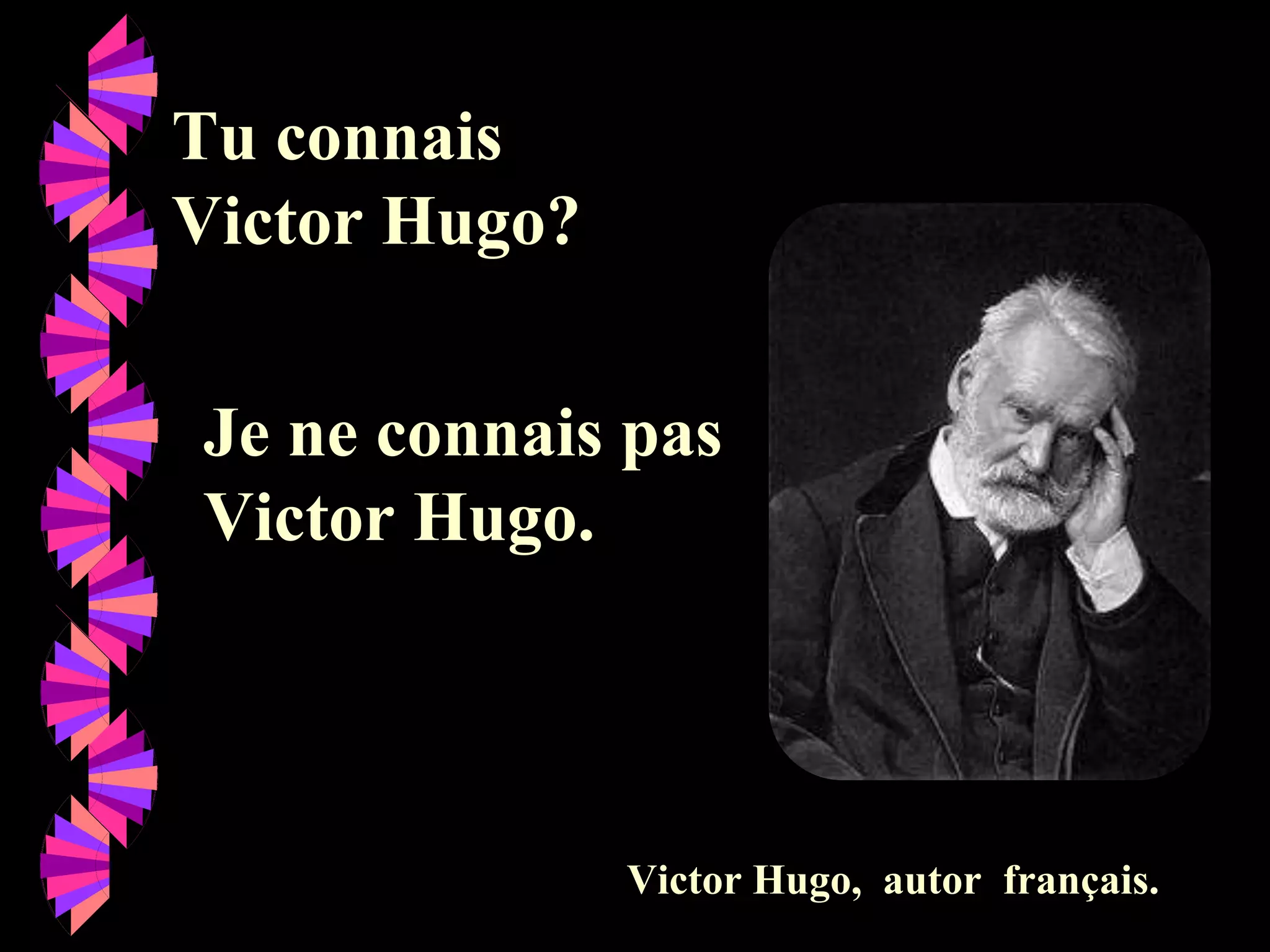
Victor Hugo, autor français.
Tu connais
Victor Hugo?
Je ne connais pas
Victor Hugo.
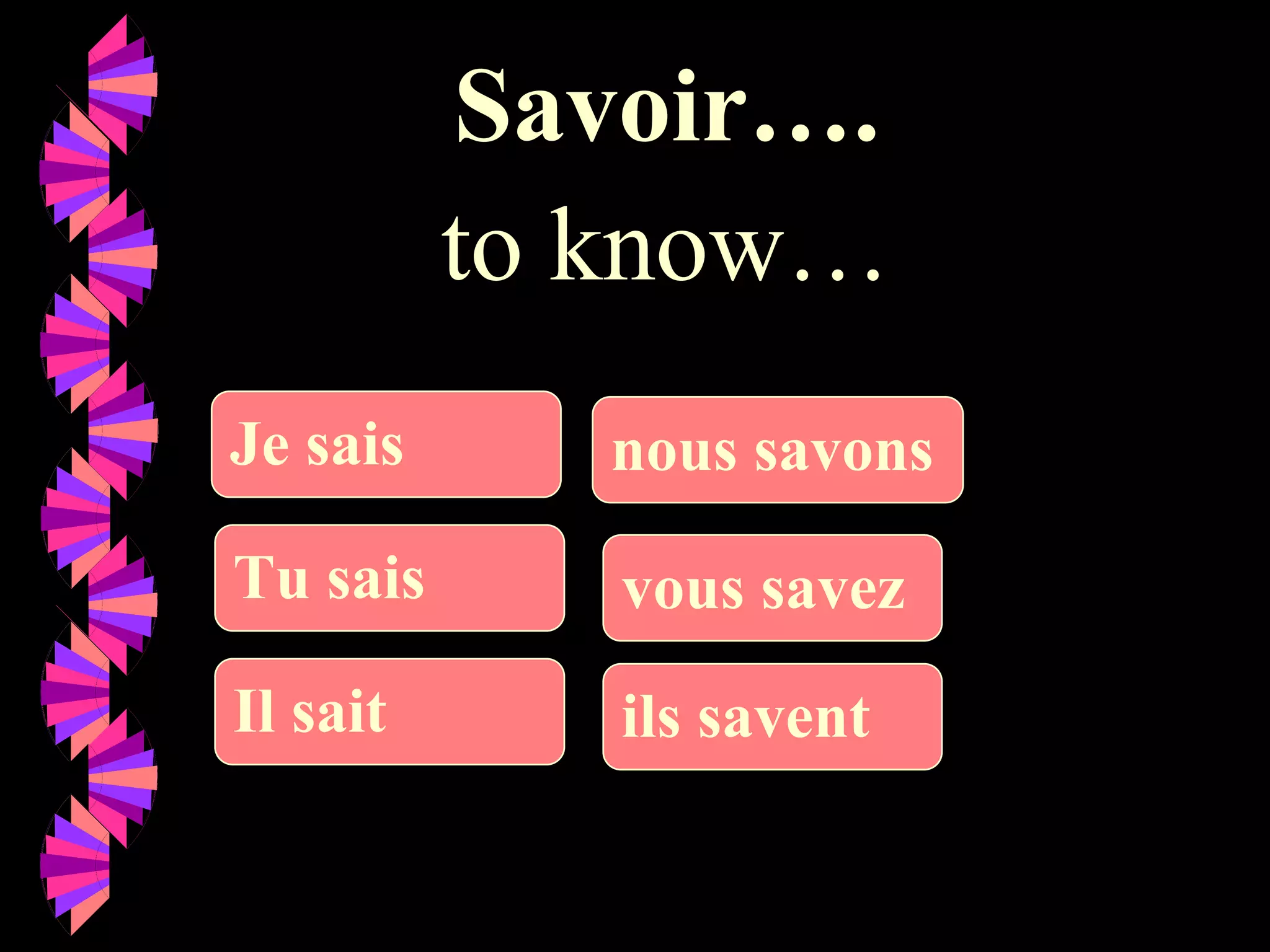
Savoir….
to know…
Je sais
Tu sais
Il sait
nous savons
vous savez
ils savent
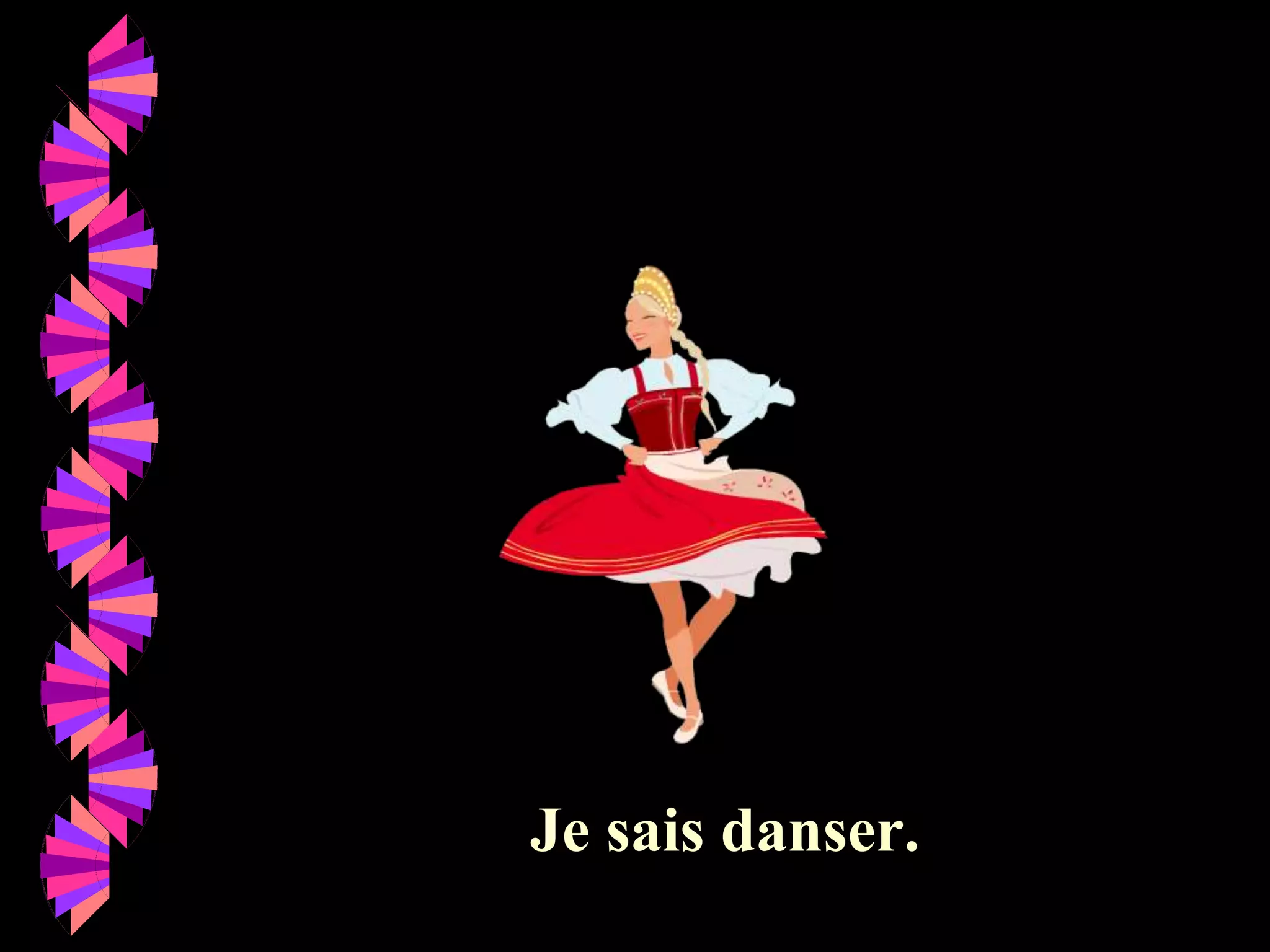
Je sais danser.
Je sais parler
français.
Pronom relatifs
Relative Pronouns
● Just as in English, a French relative pronoun
links a dependent/relative clause (i.e., a
clause that cannot stand alone) to a main
clause.
● Que, qui, lequel, dont, and où are the French
relative pronouns.
● In French, relative pronouns are required
Que
Replaces the direct object (person or thing) in
the dependent clause
● J'ai acheté le livre. Ma soeur l'a écrit.
J'ai acheté le livre que ma soeur a écrit.
● Qui est le peintre ? Je l'ai vu aujourd'hui.
Qui est le peintre que j'ai vu aujourd'hui ?
Qui
Qui replaces the subject (person or thing) in the
dependent clause.
Note that qui does not always translate as "who.”
● Je cherche l'artiste. Il étudie à Paris.
Je cherche l'artiste qui étudie à Paris.
(I'm looking for the artist (who is) studying in Paris.)
● Trouvez le chat. Il habite dans la cave.
Trouvez le chat qui habite dans la cave.
(Find the cat that lives in the basement.)
Lequel
Lequel or one of its variations replaces an
indirect object
● (thing only) after a preposition (except de -
see dont).
● Le livre dans lequel j'ai écrit mon nom... –
The book in which I wrote my name...
● La table sur laquelle j’ai mis le livre
The table on which I put the book…
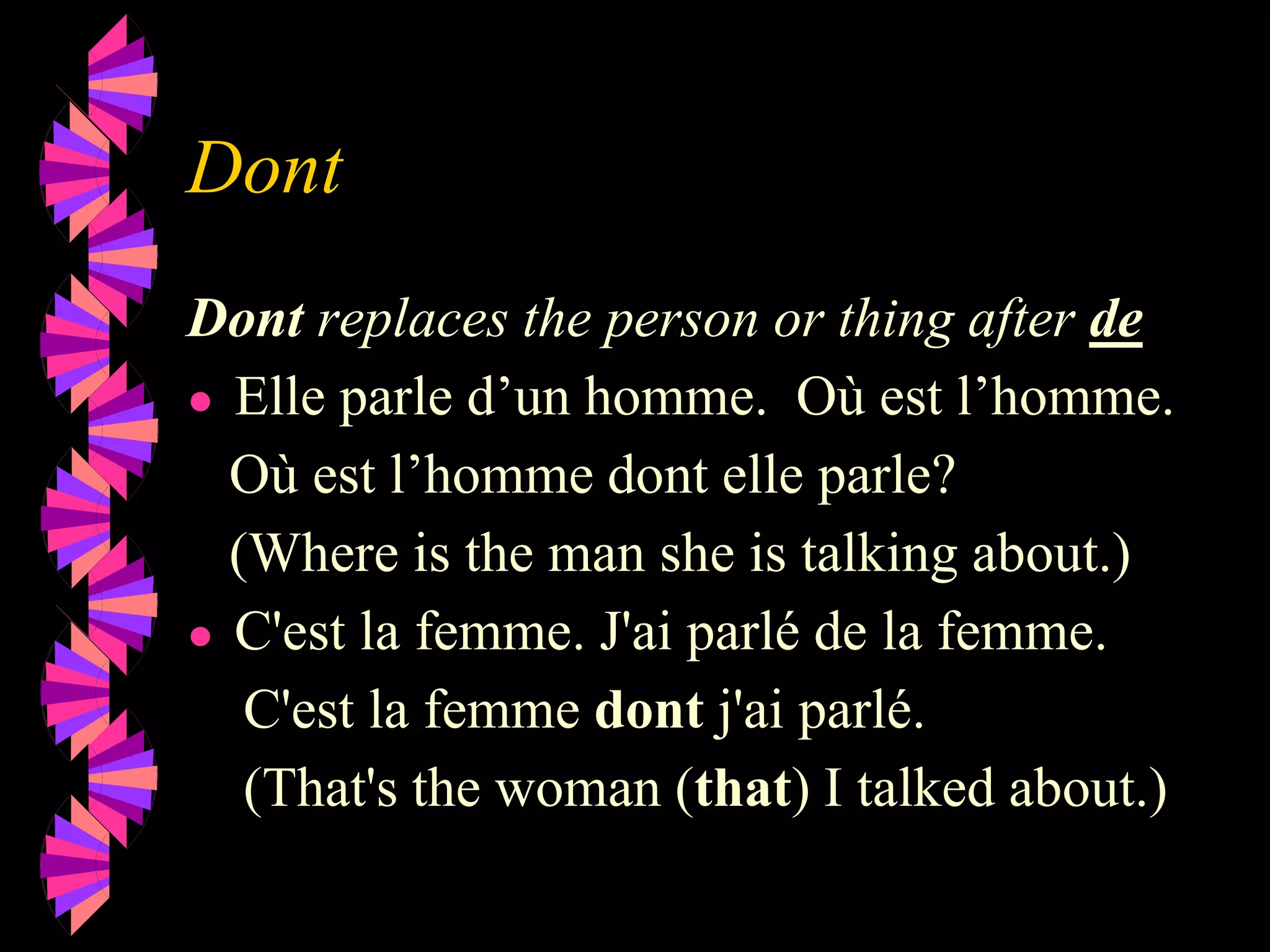
Dont
Dont replaces the person or thing after de
● Elle parle d’un homme. Où est l’homme.
Où est l’homme dont elle parle?
(Where is the man she is talking about.)
● C'est la femme. J'ai parlé de la femme.
C'est la femme dont j'ai parlé.
(That's the woman (that) I talked about.)
Où is used for both place and
time
● La boulangerie où j'ai travaillé est à côté de
la banque.
● The bakery where I worked is next to the
bank. (The bakery [that] I worked at...)
● Lundi, c'est le jour où nous faisons les
achats.
● Monday is the day that we do our shopping.
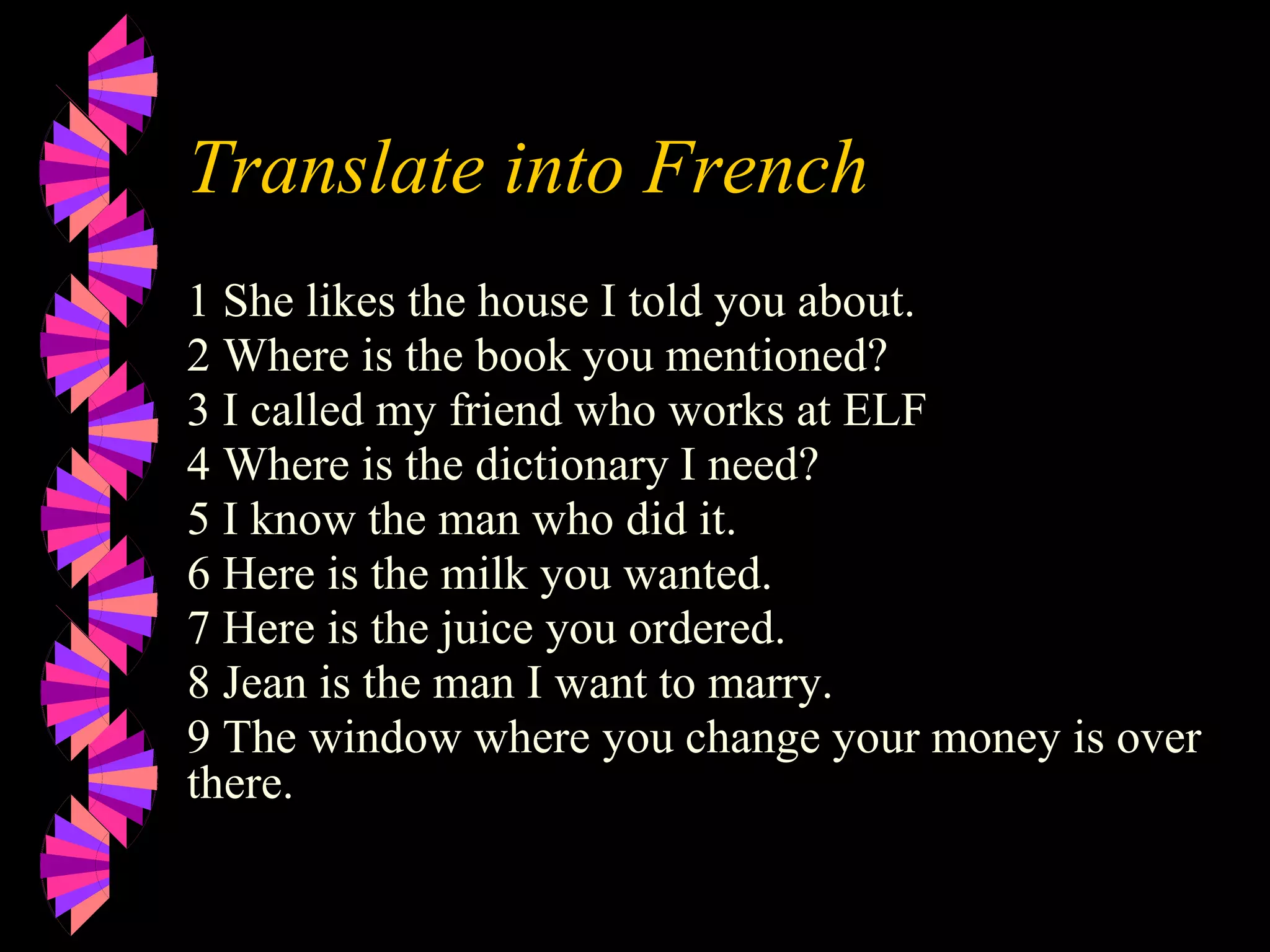
Translate into French
1 She likes the house I told you about.
2 Where is the book you mentioned?
3 I called my friend who works at ELF
4 Where is the dictionary I need?
5 I know the man who did it.
6 Here is the milk you wanted.
7 Here is the juice you ordered.
8 Jean is the man I want to marry.
9 The window where you change your money is over
there.
Translate into French
1 She likes the house I told you about.
2 Where is the book you mentioned?
3 I called my friend who works at ELF
4 Where is the dictionary I need?
5 I know the man who did it.
6 Here is the milk you wanted.
7 Here is the juice you ordered.
8 Jean is the man I want to marry.
9 The window where you change your money is over
there.
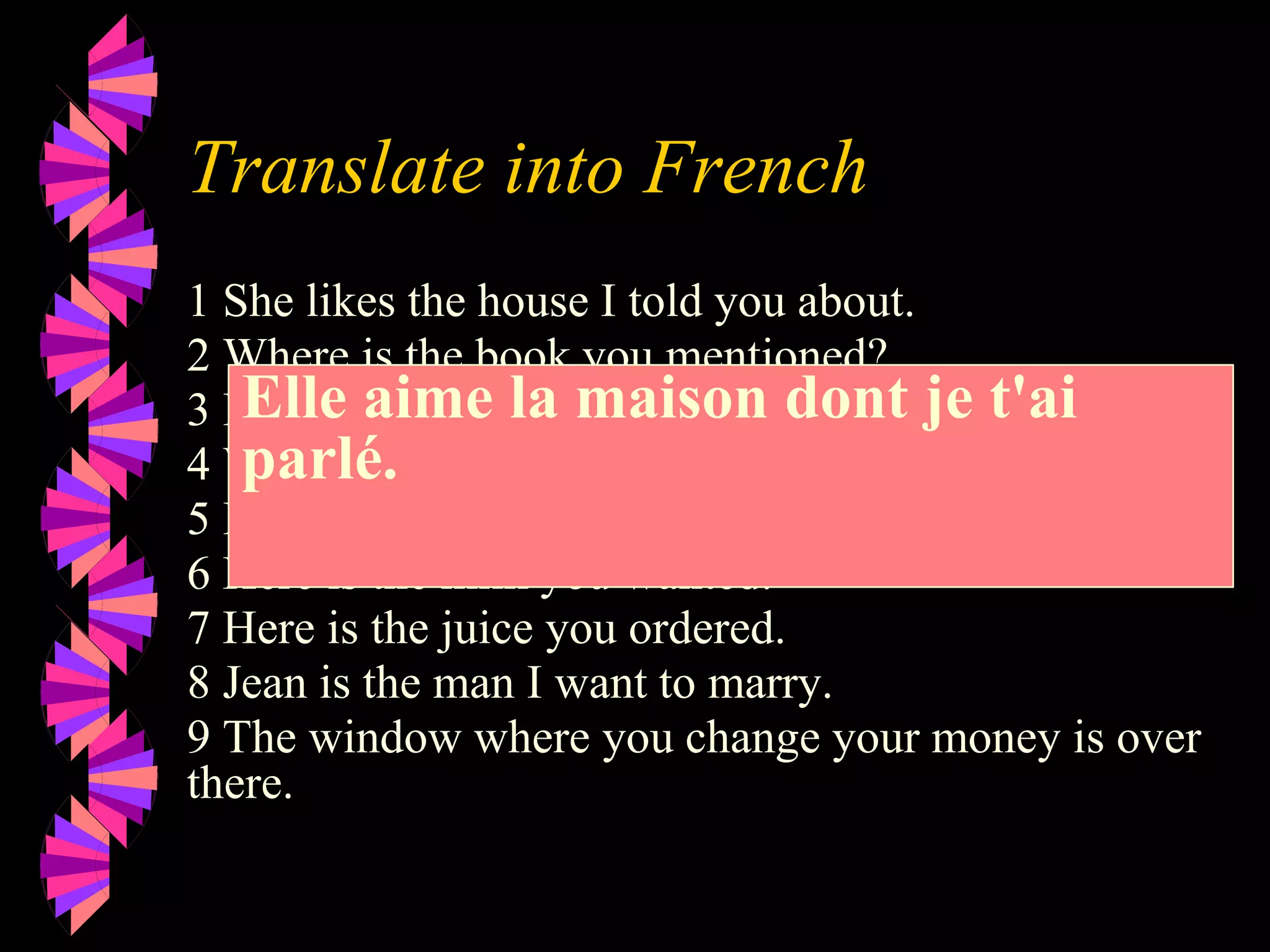
Elle aime la maison dont je t'ai
parlé.
Translate into French
1 She likes the house I told you about.
2 Where is the book you mentioned?
3 I called my friend who works at ELF
4 Where is the dictionary I need?.
5 I know the man who did it.
6 Here is the milk you wanted.
7 Here is the juice you ordered.
8 Jean is the man I want to marry.
9 The window where you change your money is over
there.
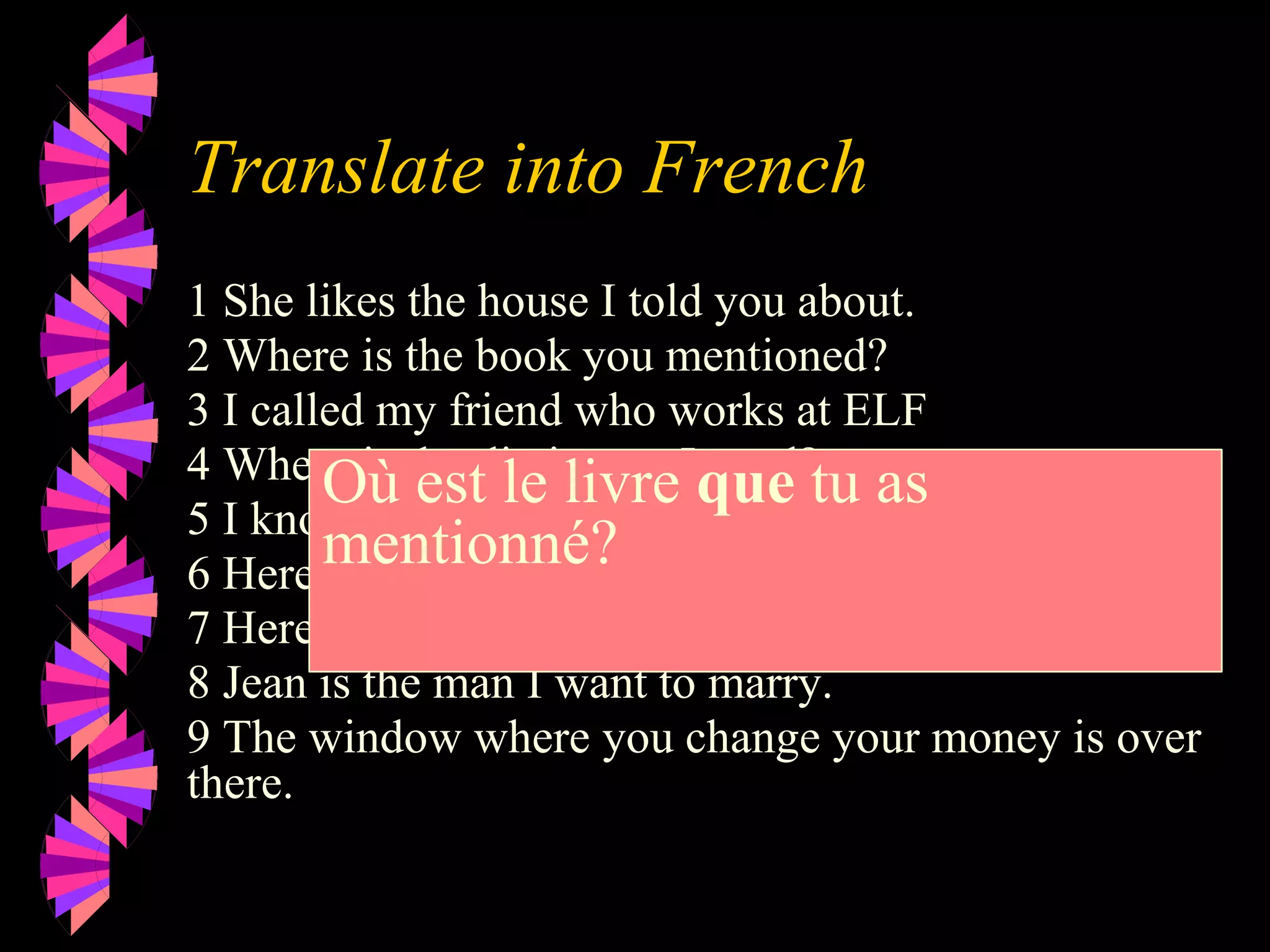
Où est le livre que tu as
mentionné?
Translate into French
1 She likes the house I told you about.
2 Where is the book you mentioned?
3 I called my friend who works at ELF
4 Where is the dictionary I need?.
5 I know the man who did it.
6 Here is the milk you wanted.
7 Here is the juice you ordered.
8 Jean is the man I want to marry.
9 The window where you change your money is over
there.
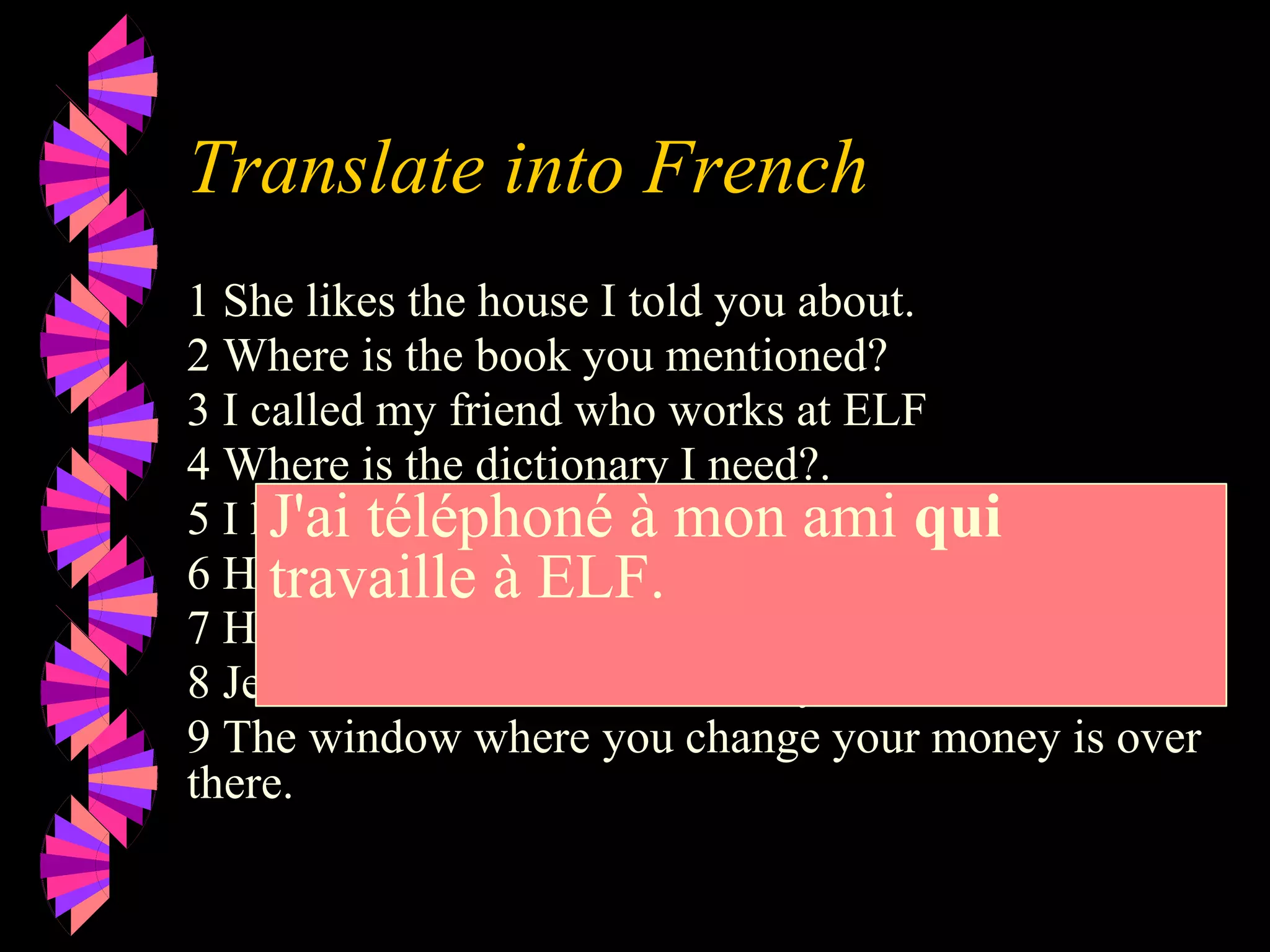
J'ai téléphoné à mon ami qui
travaille à ELF.
Translate into French
1 She likes the house I told you about.
2 Where is the book you mentioned?
3 I called my friend who works at ELF
4 Where is the dictionary I need?.
5 I know the man who did it.
6 Here is the milk you wanted.
7 Here is the juice you ordered.
8 Jean is the man I want to marry.
9 The window where you change your money is over
there.
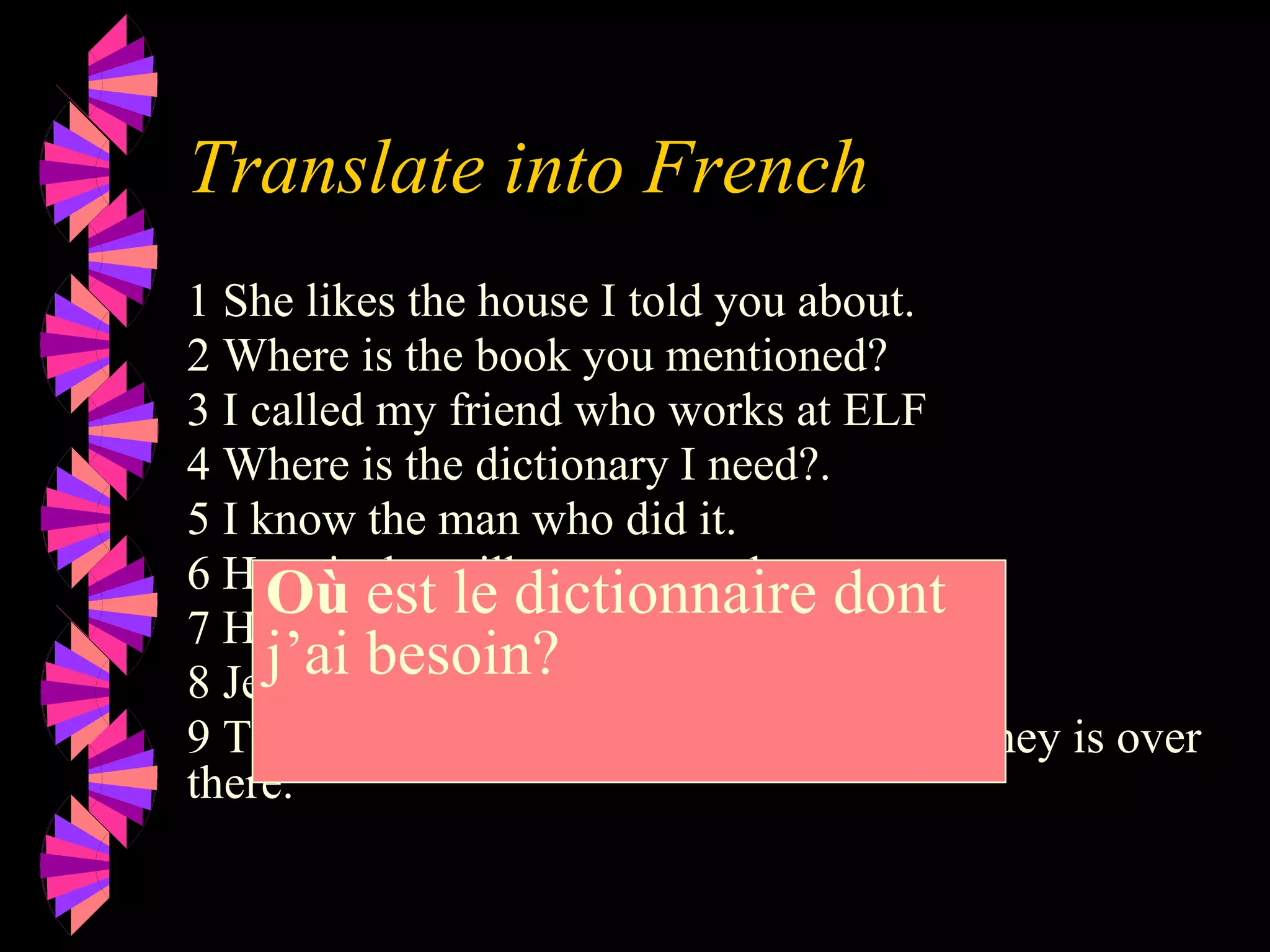
Où est le dictionnaire dont
j’ai besoin?
Translate into French
1 She likes the house I told you about.
2 Where is the book you mentioned?
3 I called my friend who works at ELF
4 Where is the dictionary I need?.
5 I know the man who did it.
6 Here is the milk you wanted.
7 Here is the juice you ordered.
8 Jean is the man I want to marry.
9 The window where you change your money is over
there.
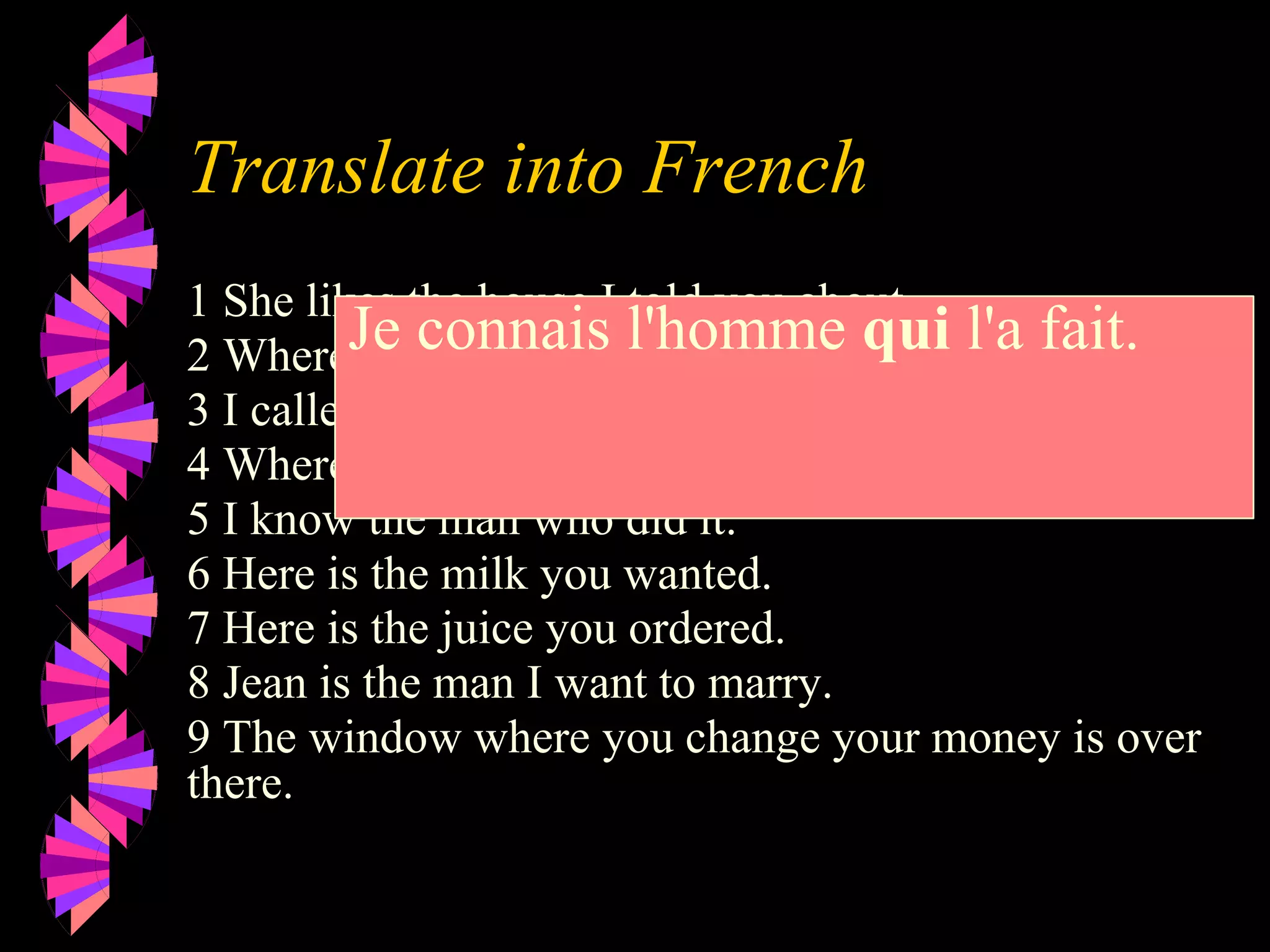
Je connais l'homme qui l'a fait.
Translate into French
1 She likes the house I told you about.
2 Where is the book you mentioned?
3 I called my friend who works at ELF
4 Where is the dictionary I need?.
5 I know the man who did it.
6 Here is the milk you wanted.
7 Here is the juice you ordered.
8 Jean is the man I want to marry.
9 The window where you change your money is over
there.
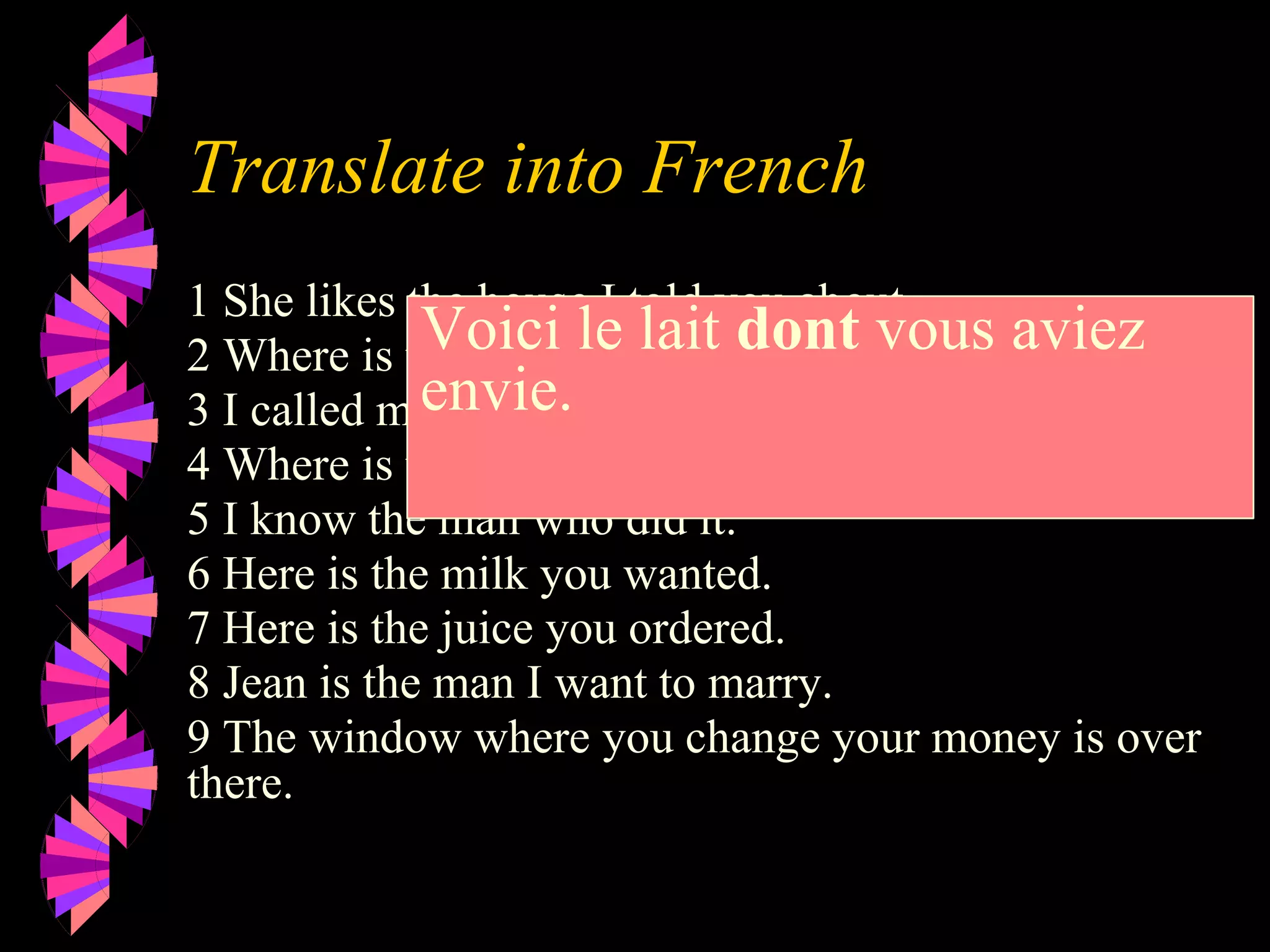
Voici le lait dont vous aviez
envie.
Translate into French
1 She likes the house I told you about.
2 Where is the book you mentioned?
3 I called my friend who works at ELF
4 Where is the dictionary I need?.
5 I know the man who did it.
6 Here is the milk you wanted.
7 Here is the juice you ordered.
8 Jean is the man I want to marry.
9 The window where you change your money is over
there.
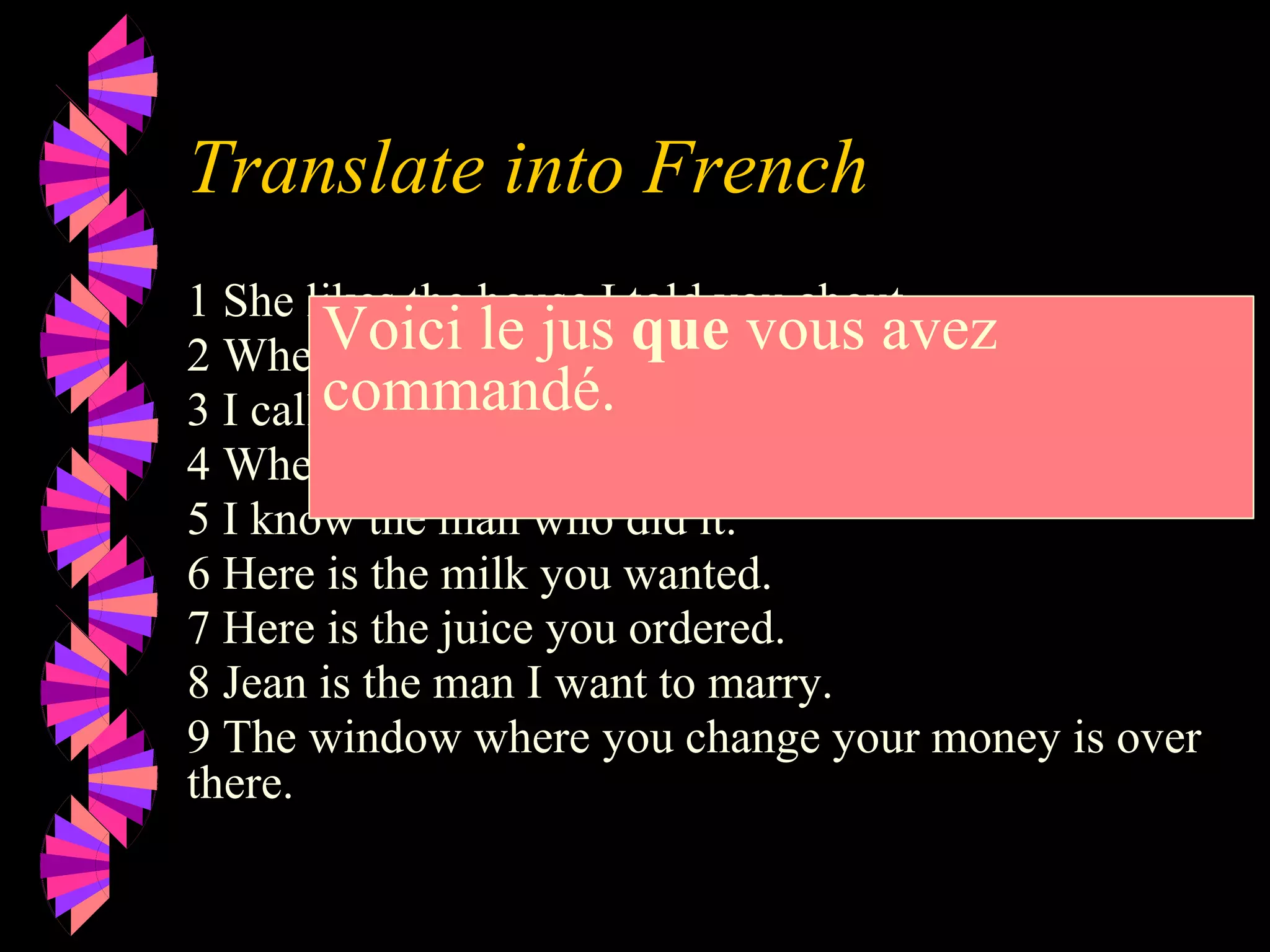
Voici le jus que vous avez
commandé.
Translate into French
1 She likes the house I told you about.
2 Where is the book you mentioned?
3 I called my friend who works at ELF
4 Where is the dictionary I need?.
5 I know the man who did it.
6 Here is the milk you wanted.
7 Here is the juice you ordered.
8 Jean is the man I want to marry.
9 The window where you change your money is over
there.
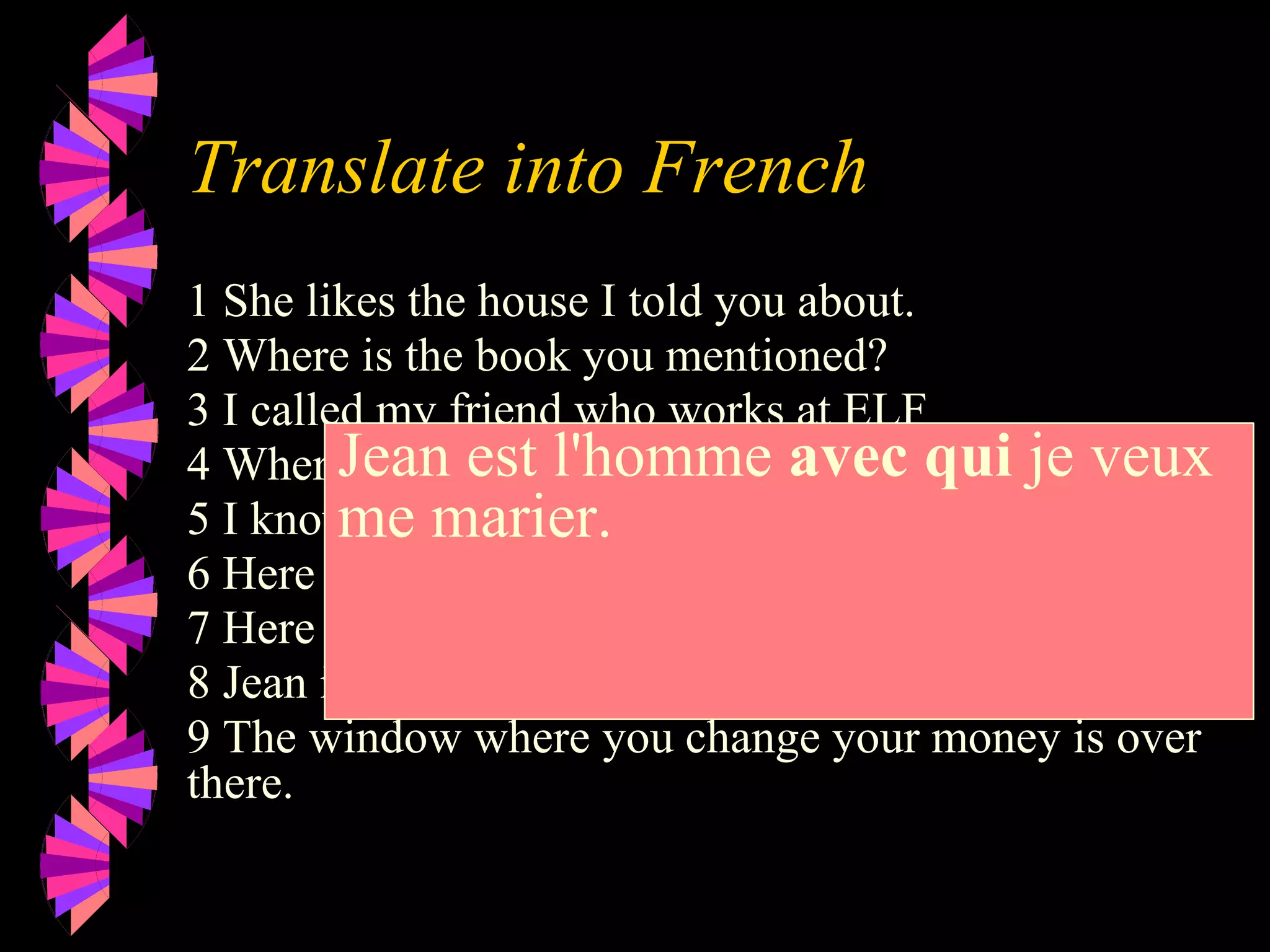
Jean est l'homme avec qui je veux
me marier.
Translate into French
1 She likes the house I told you about.
2 Where is the book you mentioned?
3 I called my friend who works at ELF
4 Where is the dictionary I need?.
5 I know the man who did it.
6 Here is the milk you wanted.
7 Here is the juice you ordered.
8 Jean is the man I want to marry.
9 The window where you change your money is over
there.
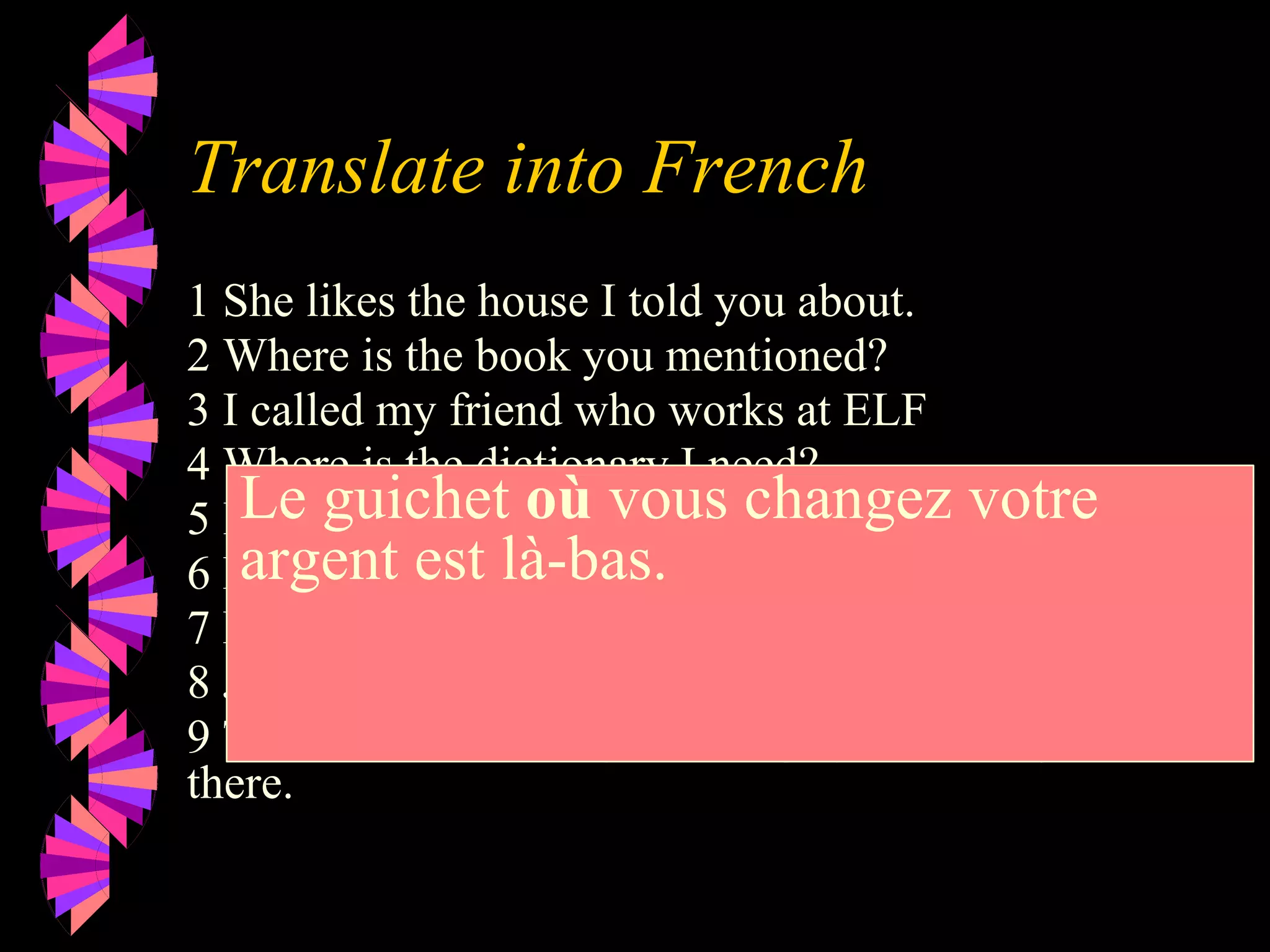
Le guichet où vous changez votre
argent est là-bas.
When the direct object comes
before the past participle….
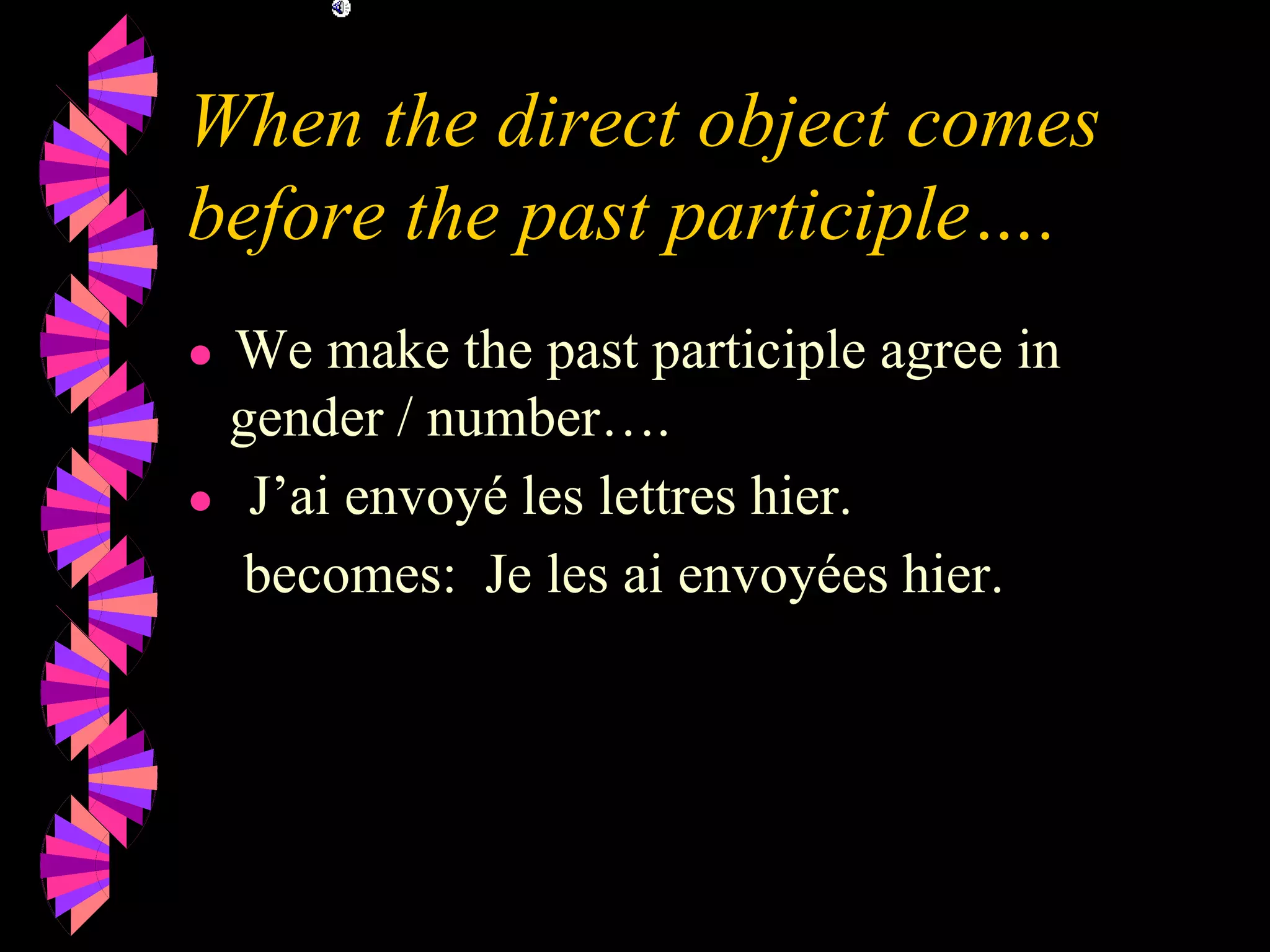
● We make the past participle agree in
gender / number….
● J’ai envoyé les lettres hier.
becomes: Je les ai envoyées hier.
Imparfait vs. Passé
Composé
Uses of Passé Composé
The passé composé is used to express
completed
For example:
Hier, j ’ai fini ma rédaction d ’anglais.
Ce matin, nous avons vu un film dans
la classe d ’histoire.
actionspast
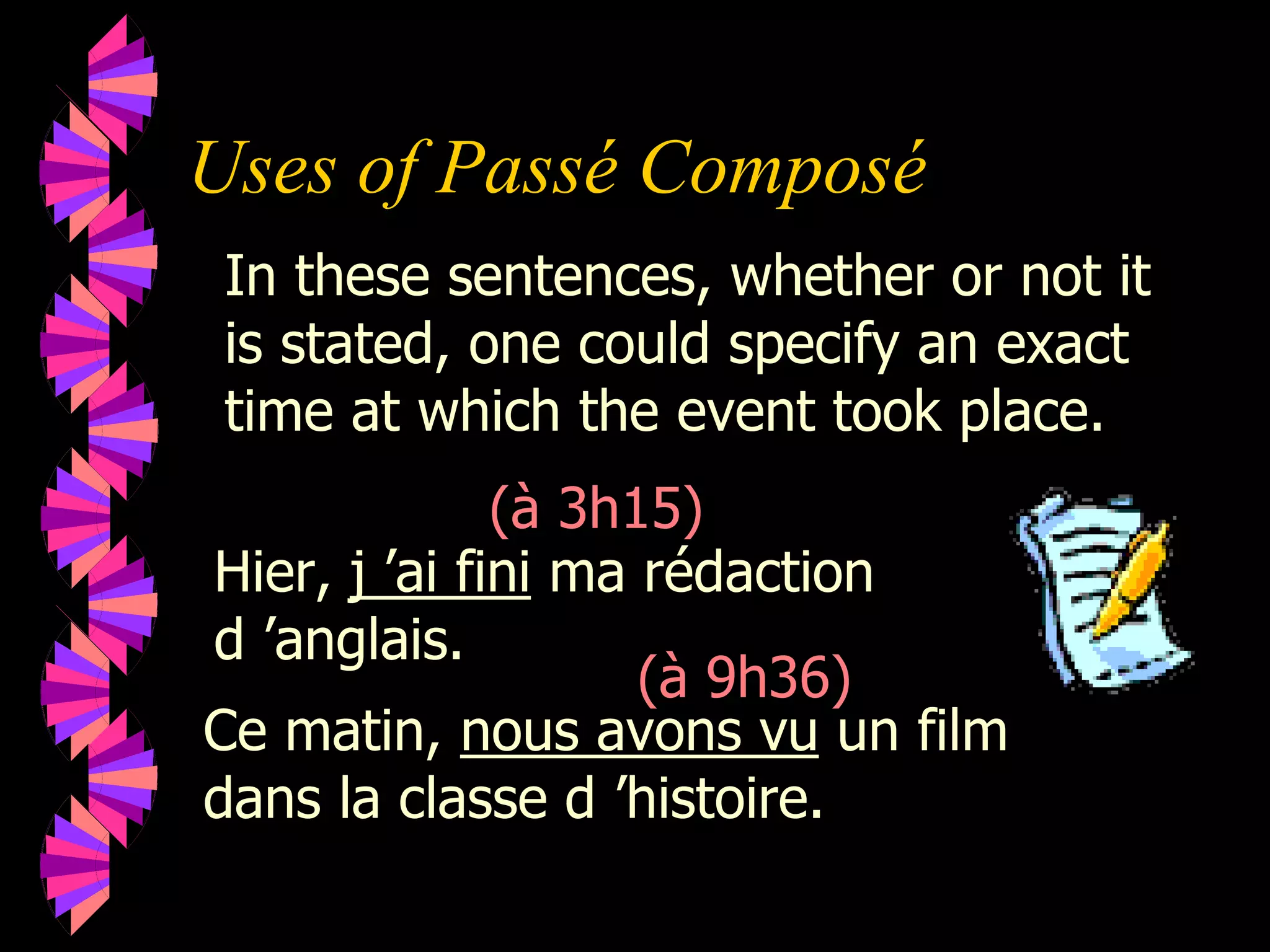
Uses of Passé Composé
Hier, j ’ai fini ma rédaction
d ’anglais.
In these sentences, whether or not it
is stated, one could specify an exact
time at which the event took place.
(à 3h15)
(à 9h36)
Ce matin, nous avons vu un film
dans la classe d ’histoire.
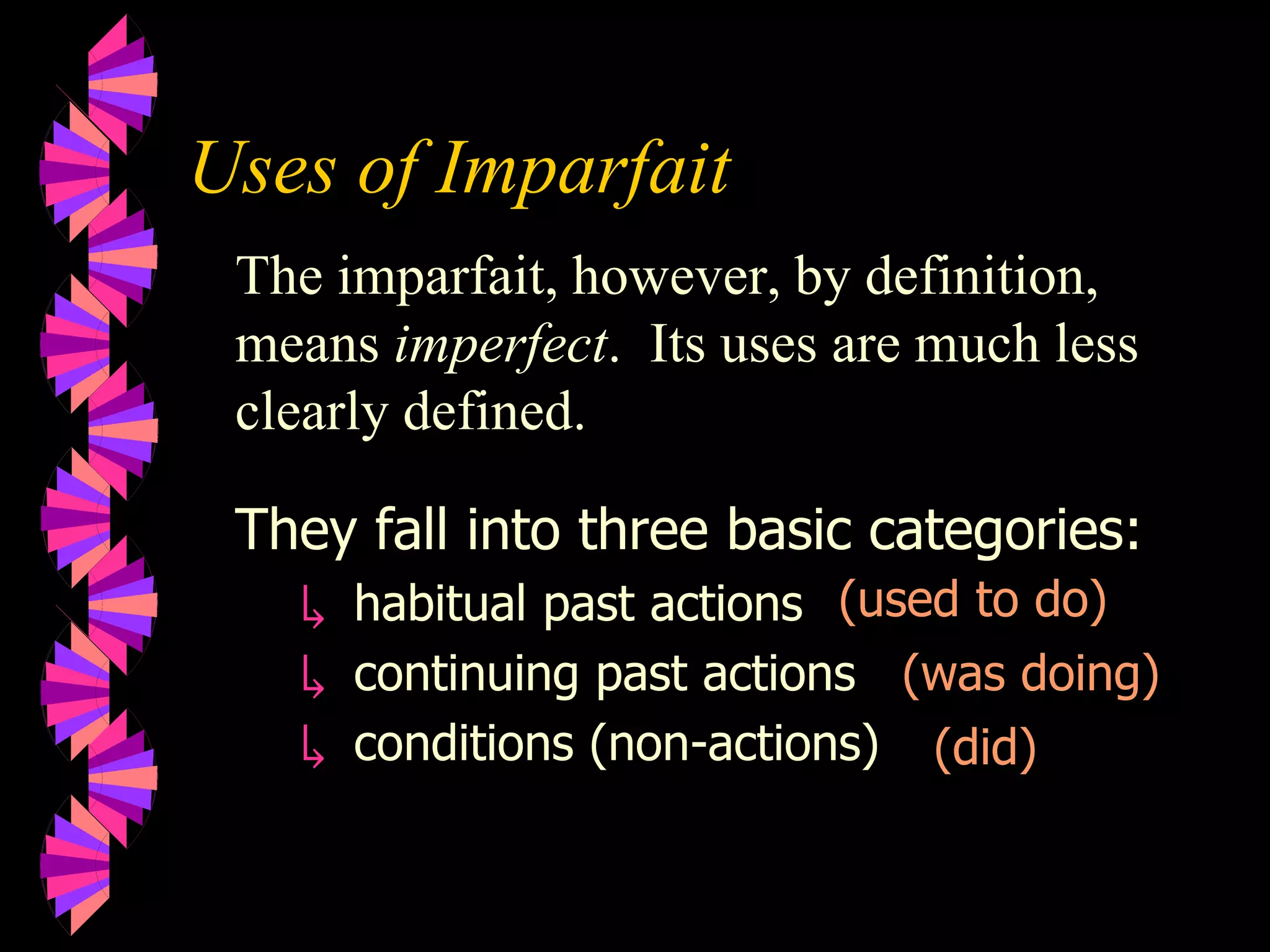
Uses of Imparfait
The imparfait, however, by definition,
means imperfect. Its uses are much less
clearly defined.
They fall into three basic categories:
↳ habitual past actions
↳ continuing past actions
↳ conditions (non-actions)
(used to do)
(was doing)
(did)
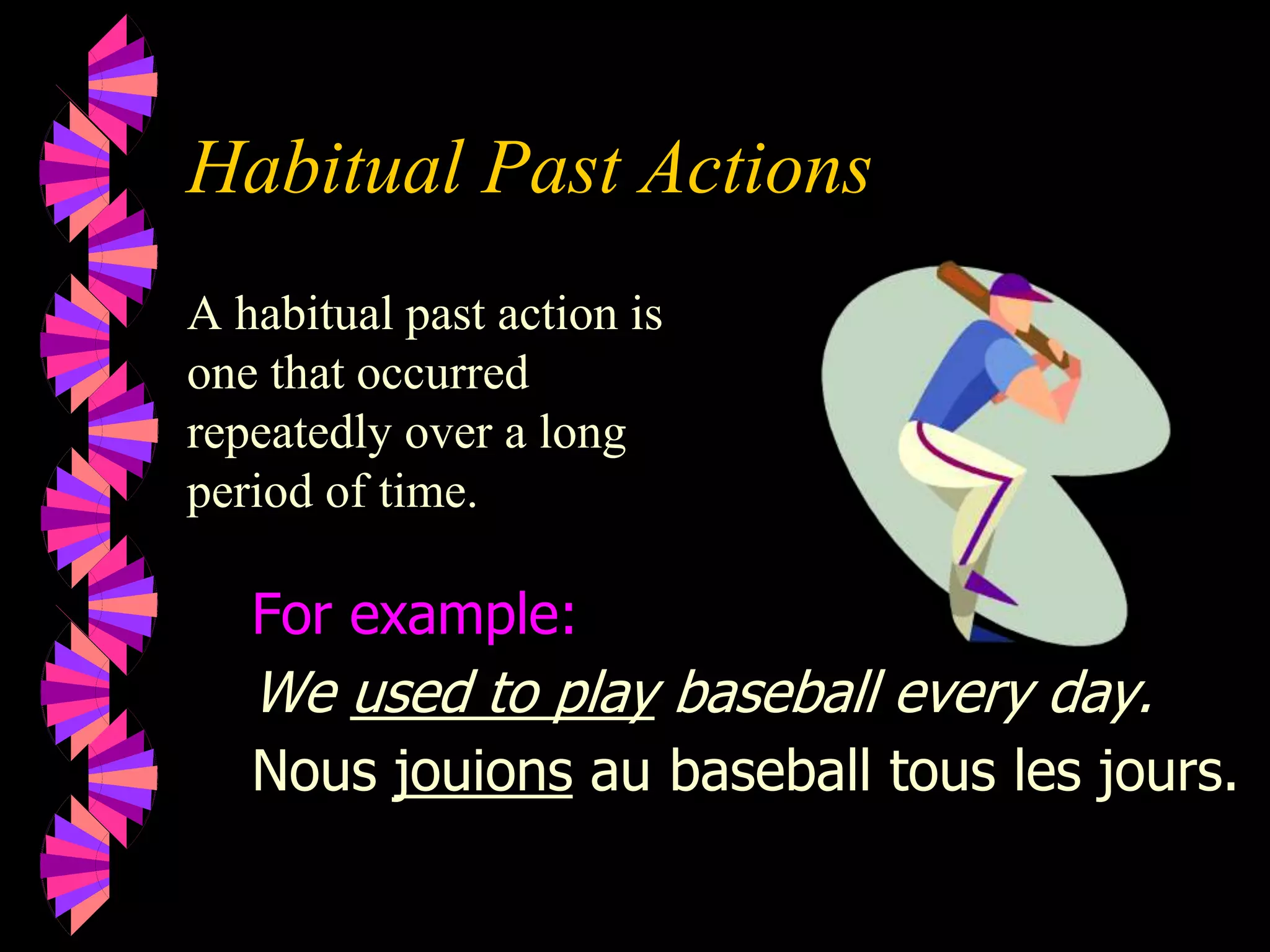
Habitual Past Actions
A habitual past action is
one that occurred
repeatedly over a long
period of time.
For example:
We used to play baseball every day.
Nous jouions au baseball tous les jours.
Habitual Past Actions
Attention! Habitual past actions are not
necessarily translated as « used to.. »
For example:
Quand j ’étais jeune, je me promenais à l ’école tous
les jours.
might be translated
When I was young, I walked to school every day.
The key is that the action occurred repeatedly in the
past.
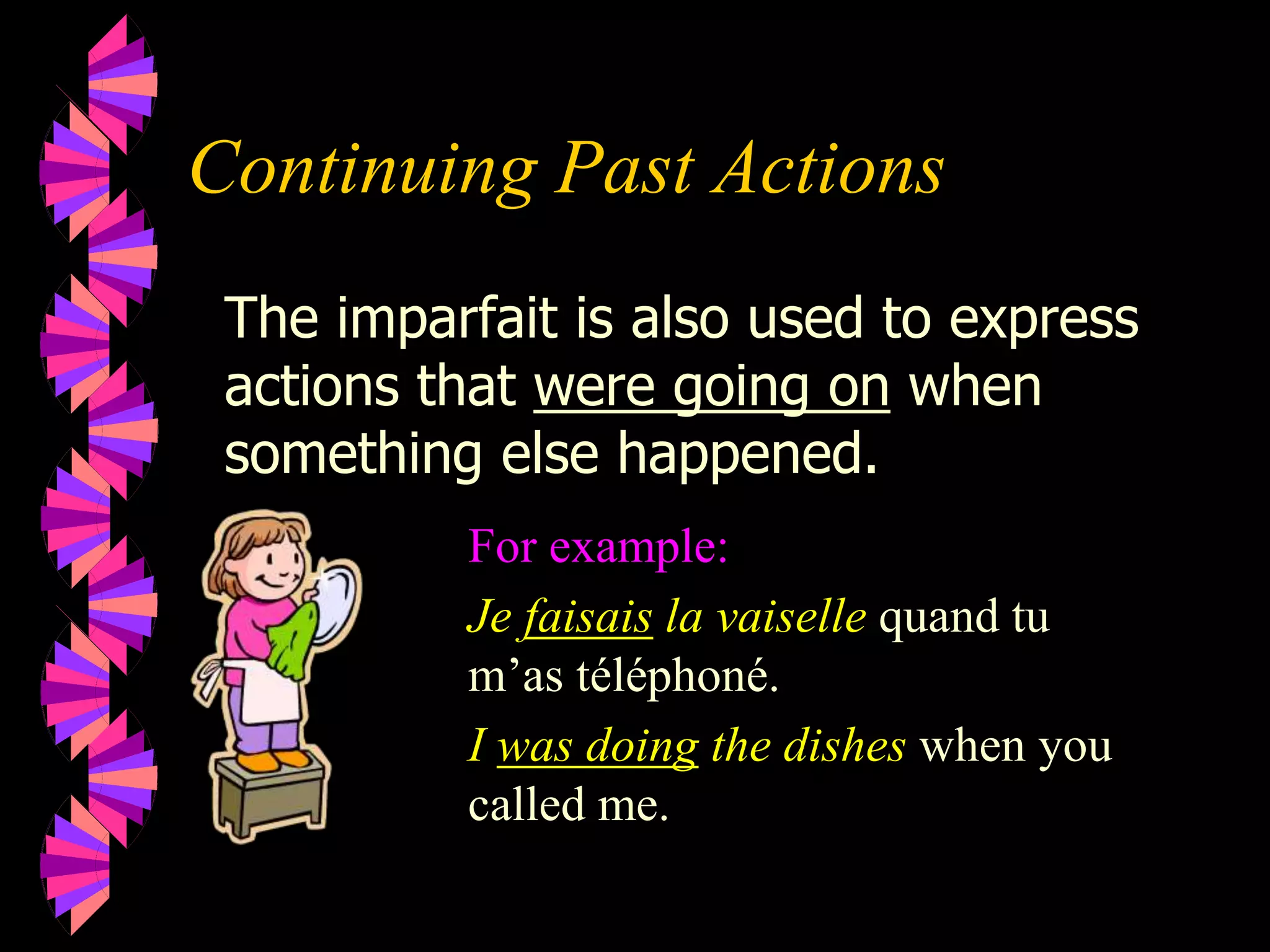
Continuing Past Actions
For example:
Je faisais la vaiselle quand tu
m’as téléphoné.
I was doing the dishes when you
called me.
The imparfait is also used to express
actions that were going on when
something else happened.
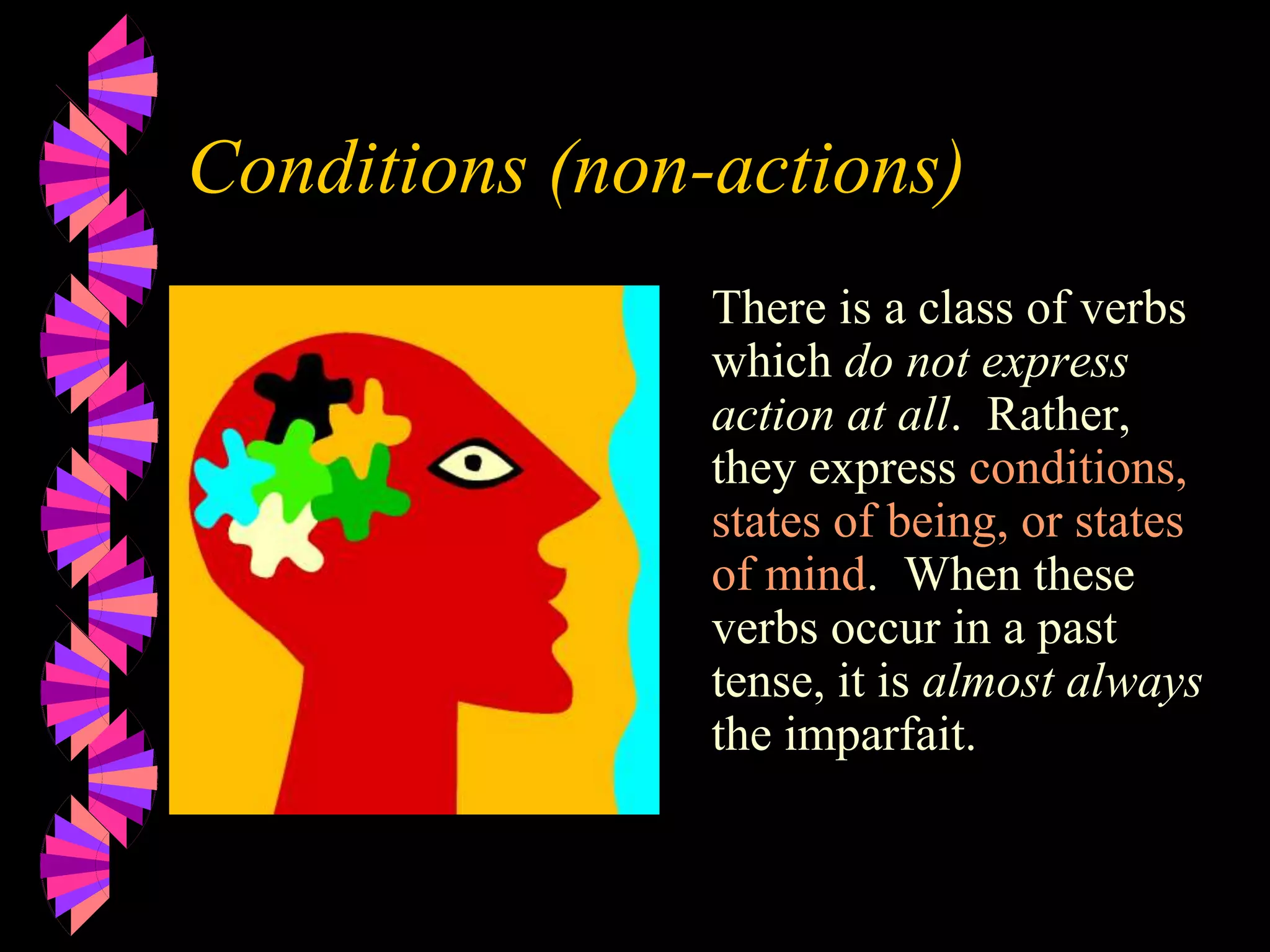
Conditions (non-actions)
There is a class of verbs
which do not express
action at all. Rather,
they express conditions,
states of being, or states
of mind. When these
verbs occur in a past
tense, it is almost always
the imparfait.
Conditions (non-actions)
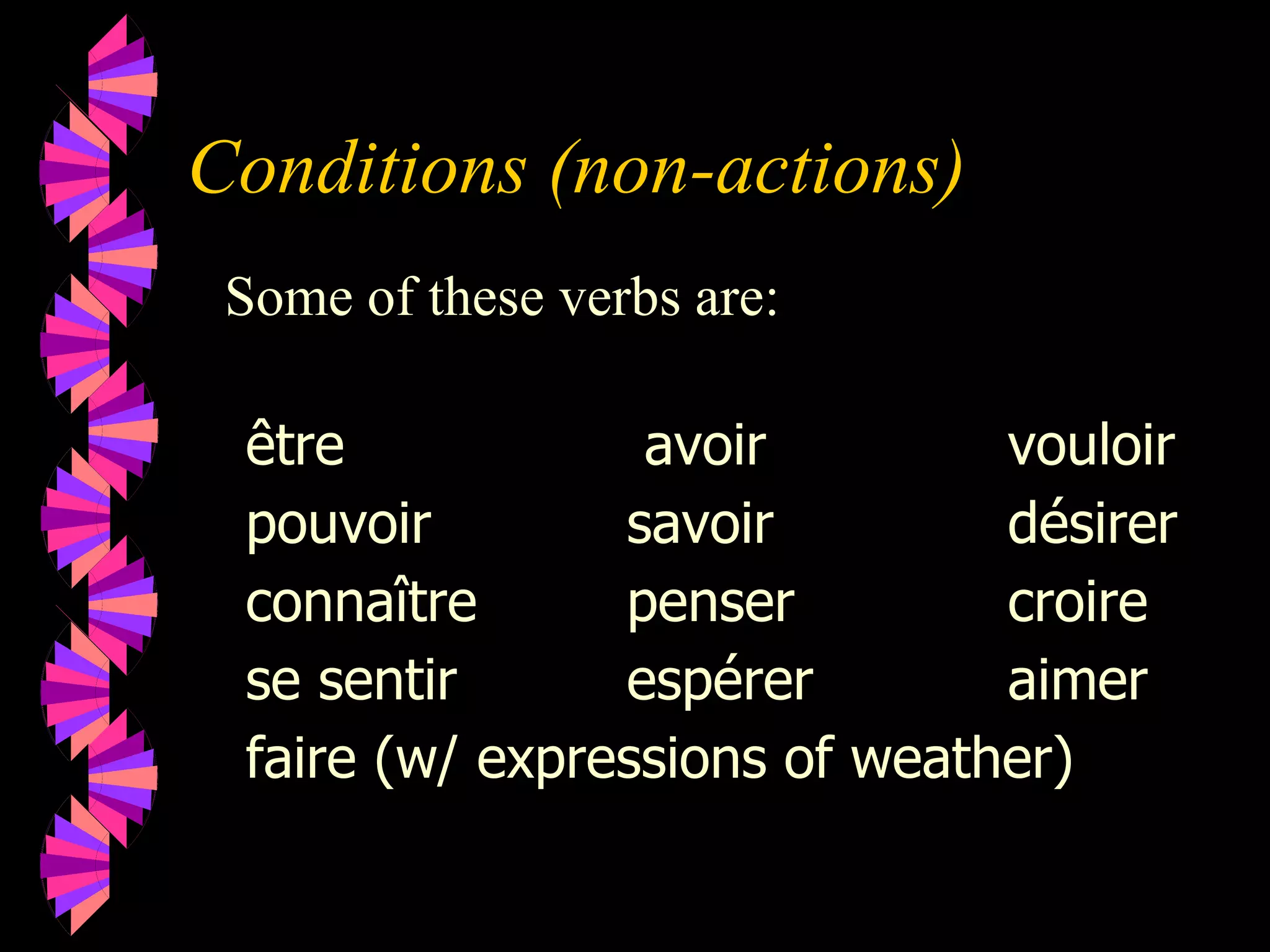
Some of these verbs are:
être avoir vouloir
pouvoir savoir désirer
connaître penser croire
se sentir espérer aimer
faire (w/ expressions of weather)
Summary
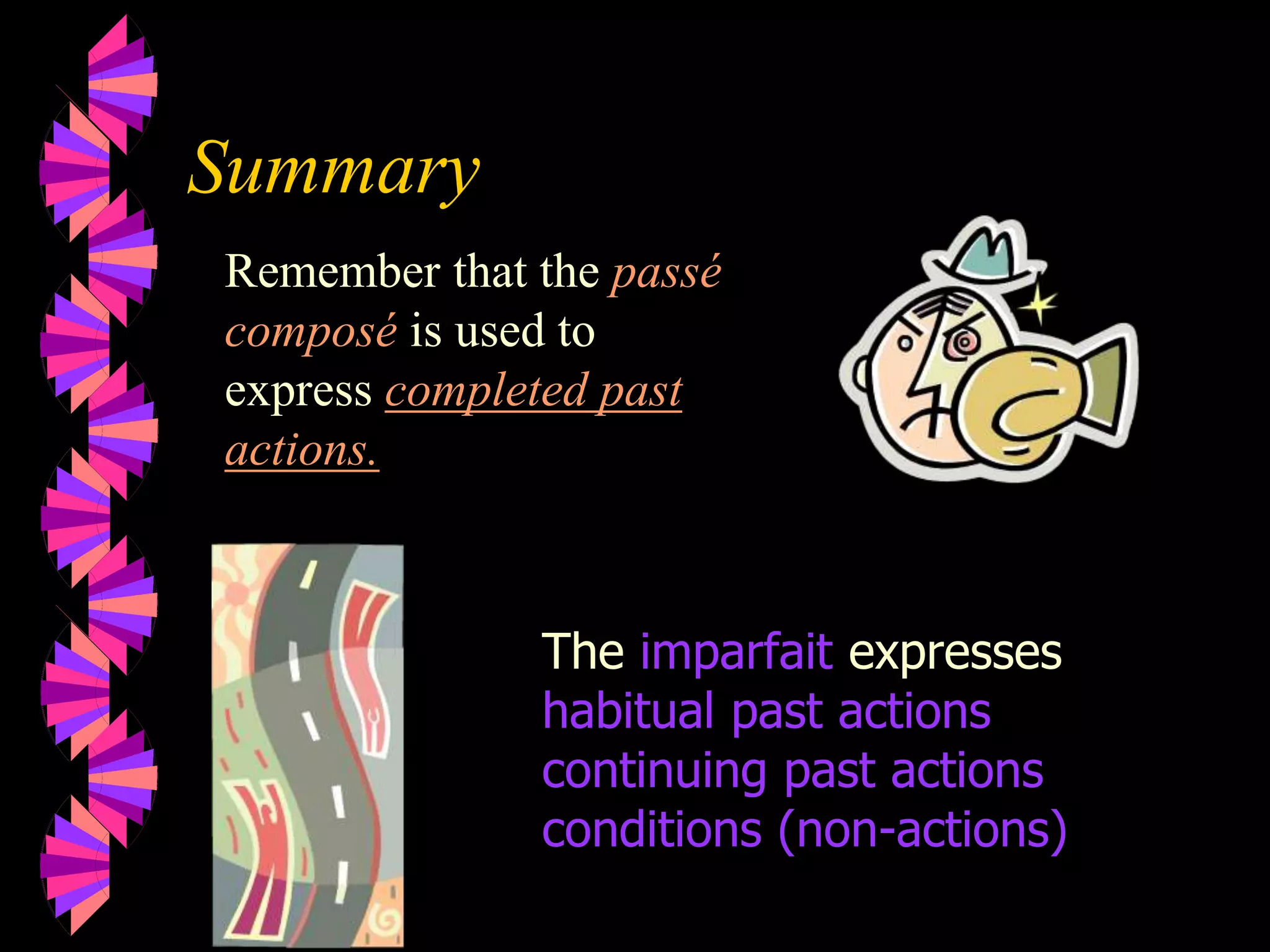
Remember that the passé
composé is used to
express completed past
actions.
The imparfait expresses
habitual past actions
continuing past actions
conditions (non-actions)
À toi!
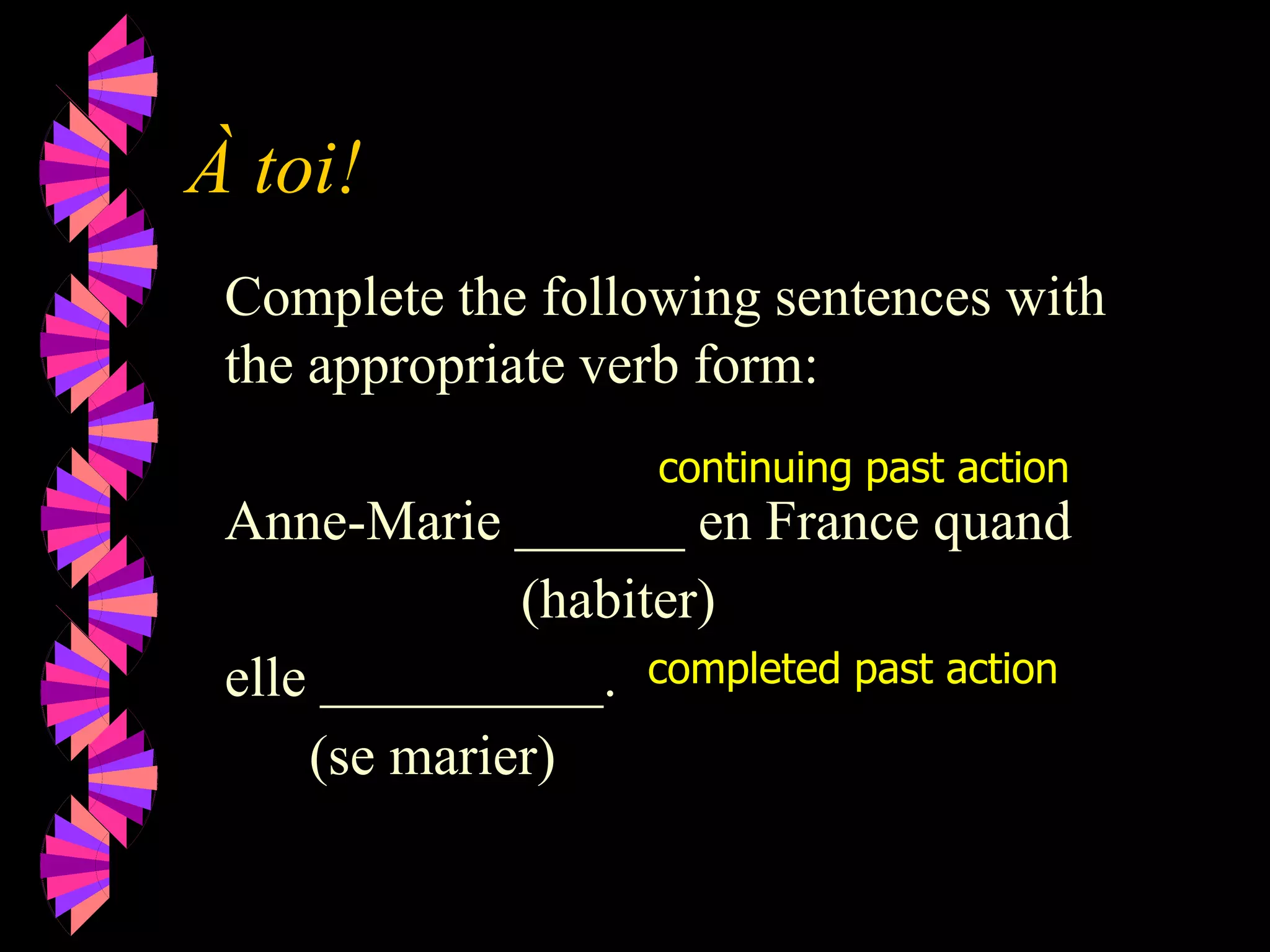
Complete the following sentences with
the appropriate verb form:
Anne-Marie ______ en France quand
(habiter)
elle __________.
(se marier)
continuing past action
completed past action
À toi!
Complete the following sentences with
the appropriate verb form:
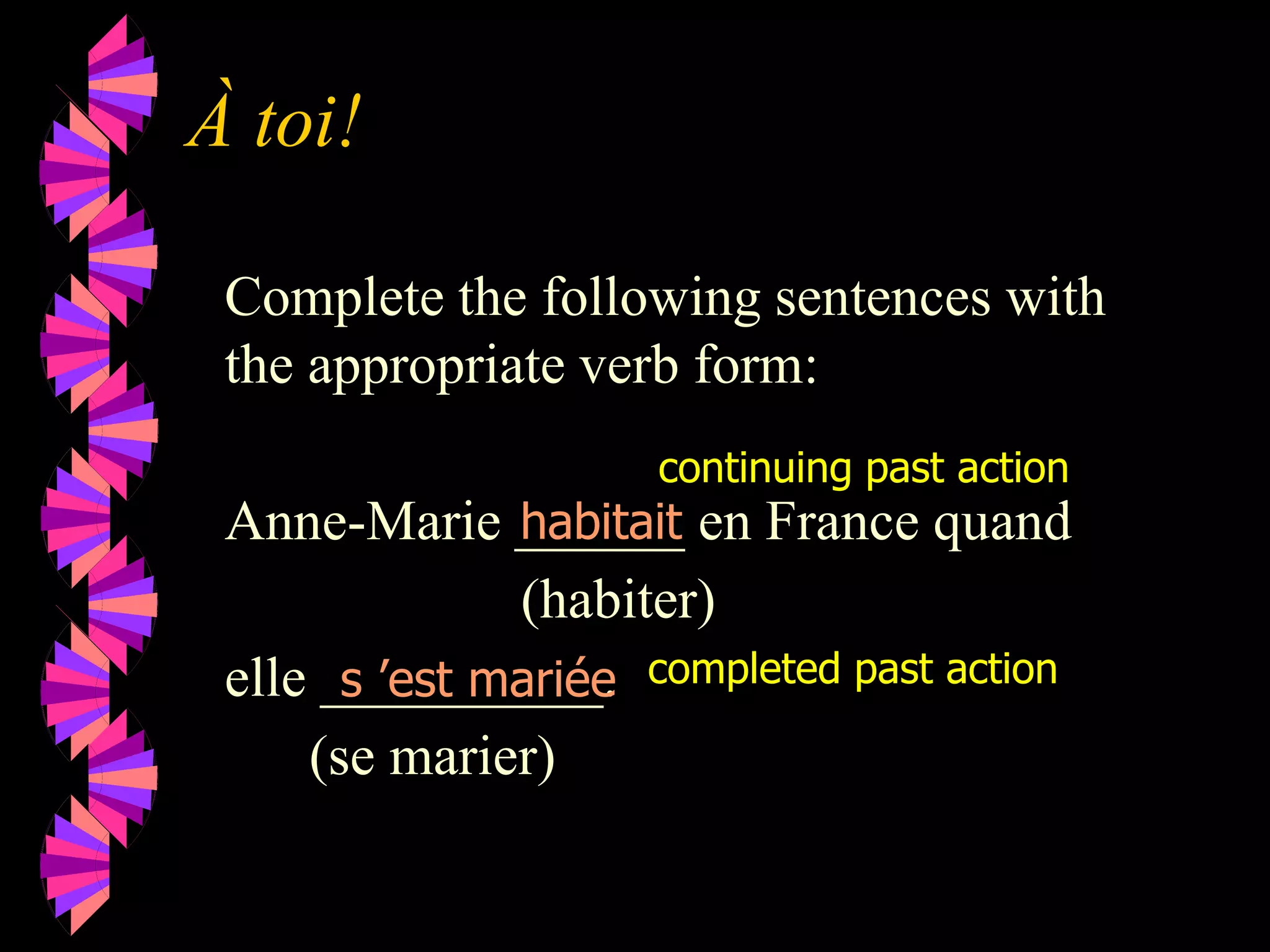
Anne-Marie ______ en France quand
(habiter)
elle __________.
(se marier)
habitait
s ’est mariée
continuing past action
completed past action
À toi!
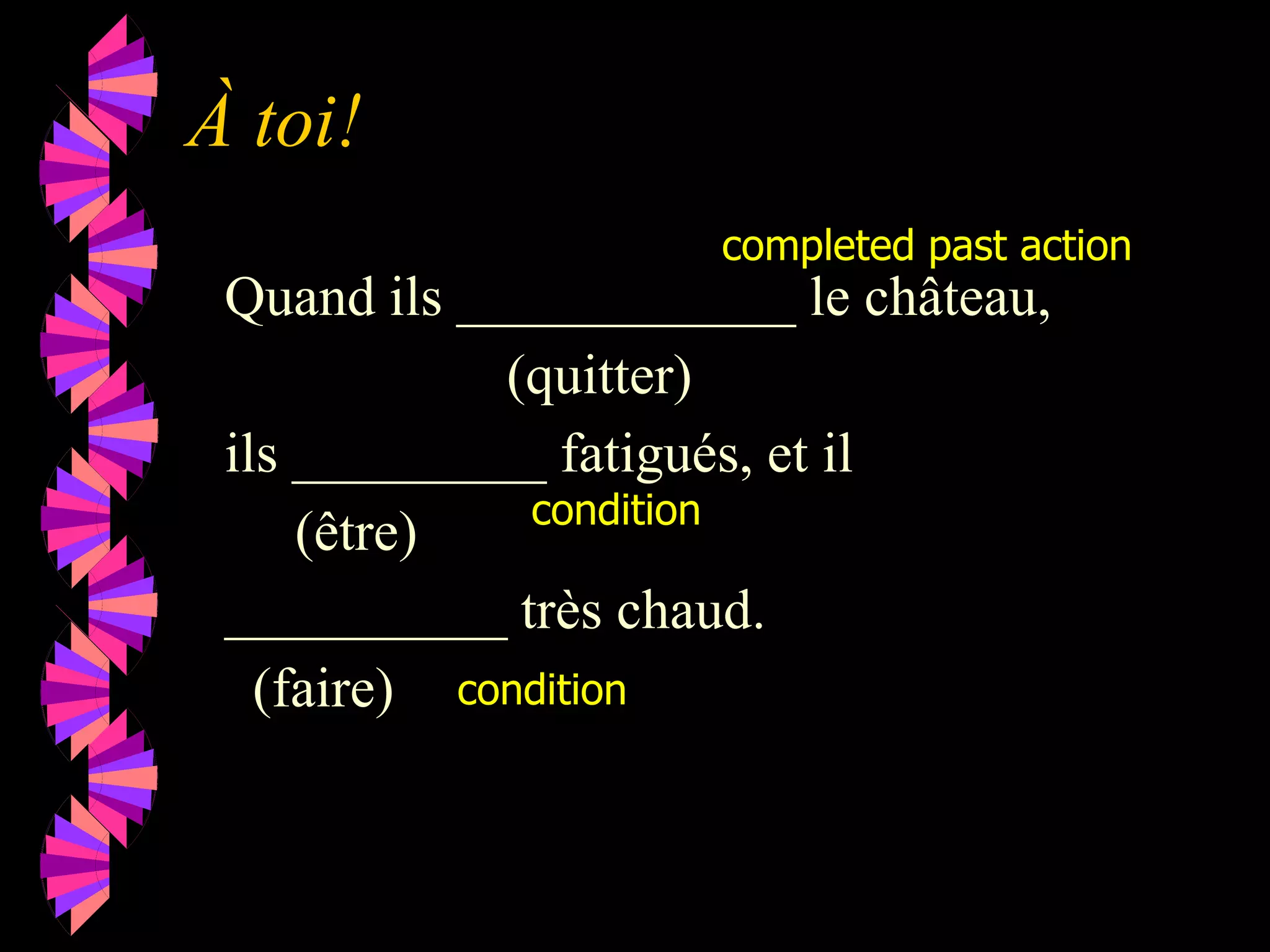
Quand ils ____________ le château,
(quitter)
ils _________ fatigués, et il
(être)
__________ très chaud.
(faire)
completed past action
condition
condition
À toi!
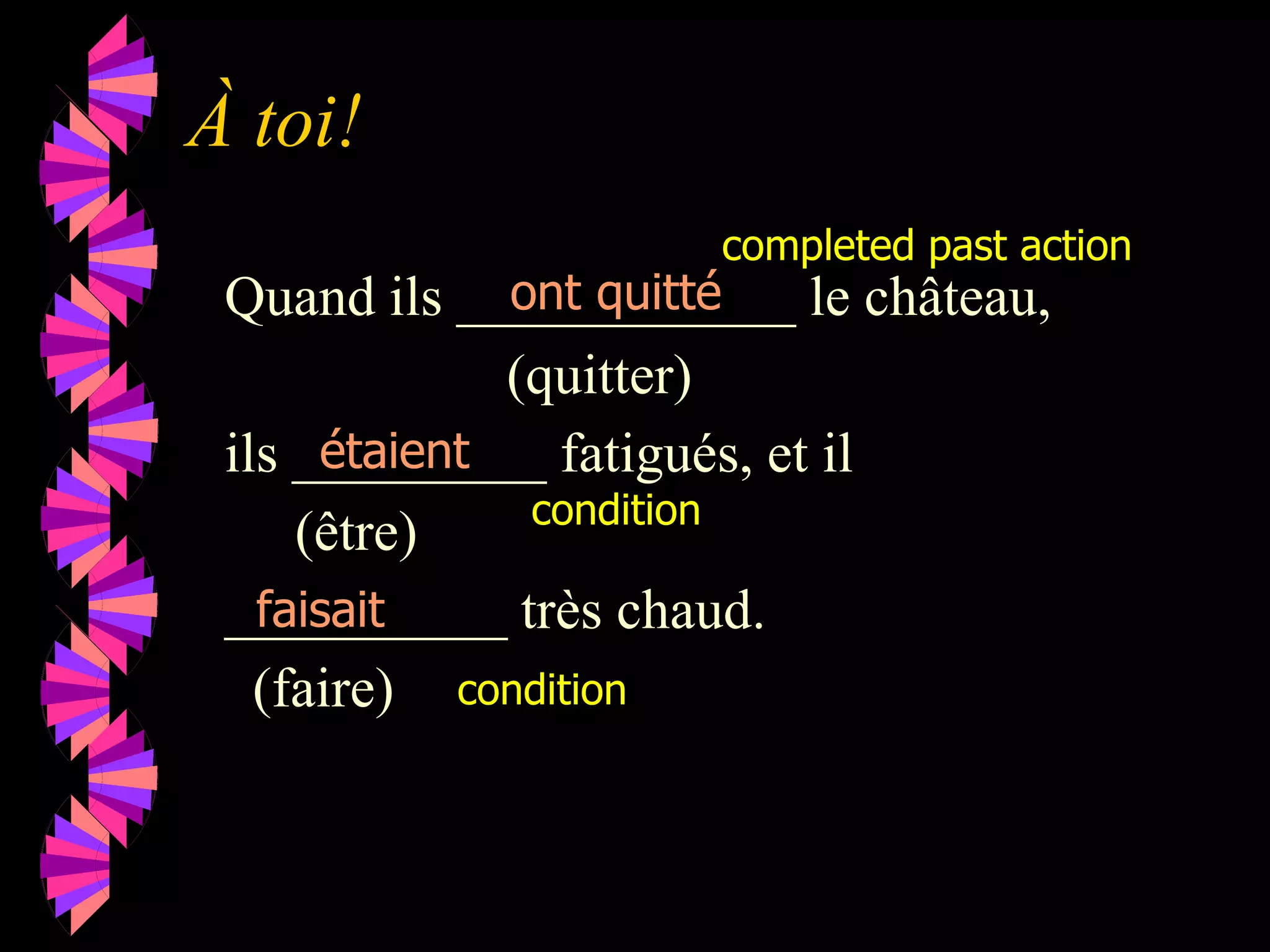
Quand ils ____________ le château,
(quitter)
ils _________ fatigués, et il
(être)
__________ très chaud.
(faire)
ont quitté
faisait
étaient
completed past action
condition
condition
Le Pronom Y
Another Direct Object Pronoun
Y
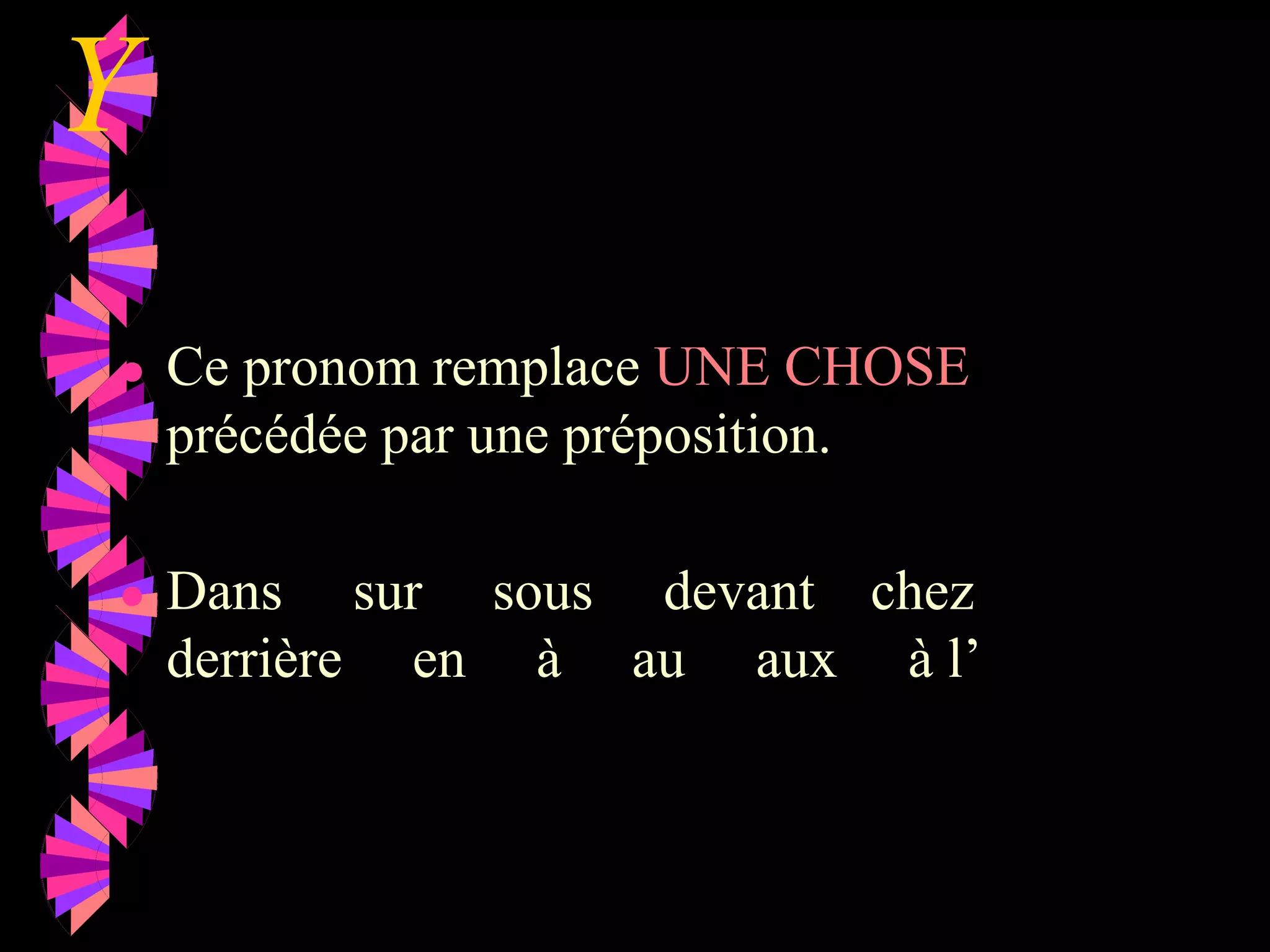
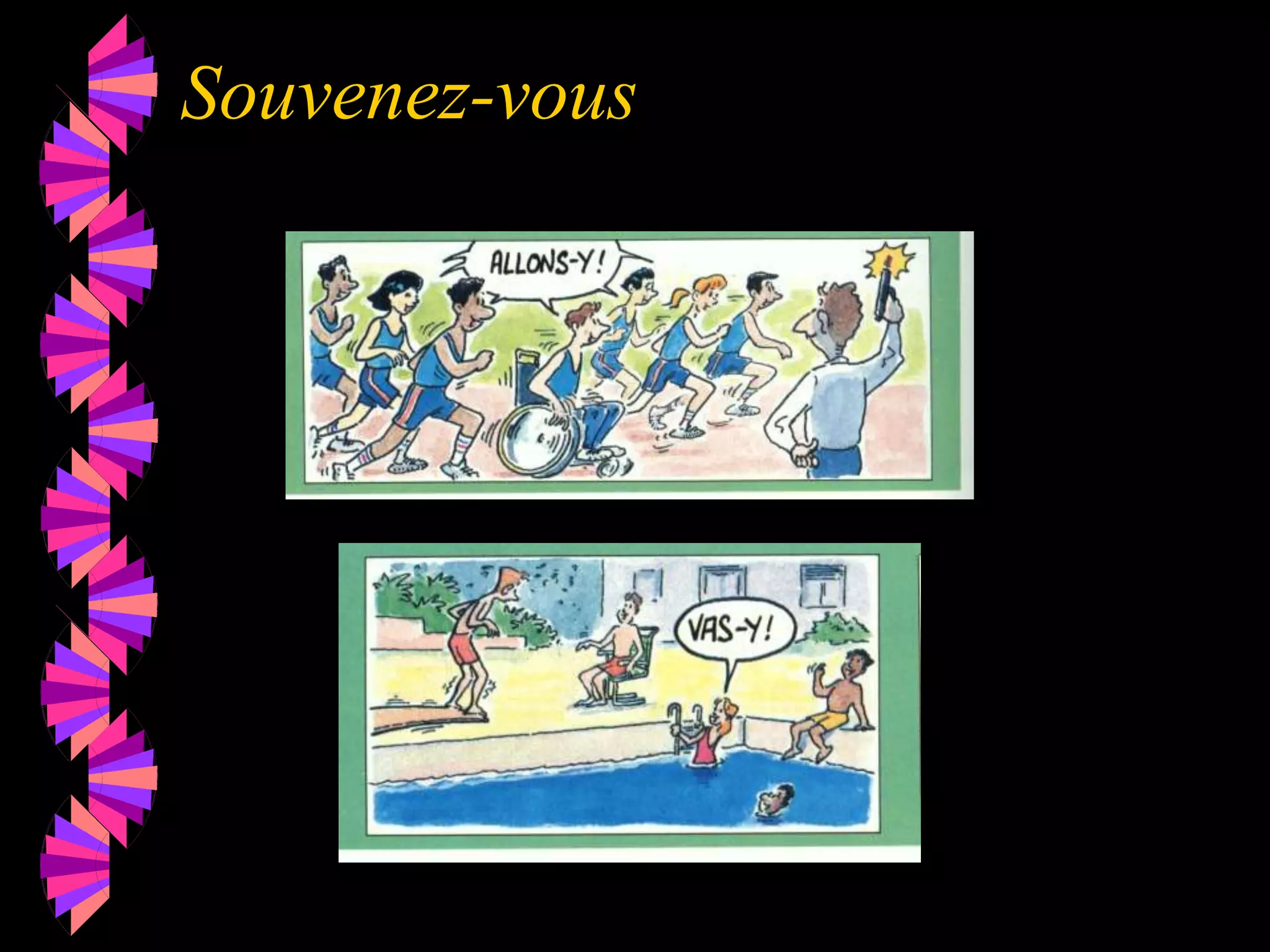
● Ce pronom remplace UNE CHOSE
précédée par une préposition.
● Dans sur sous devant chez
derrière en à au aux à l’
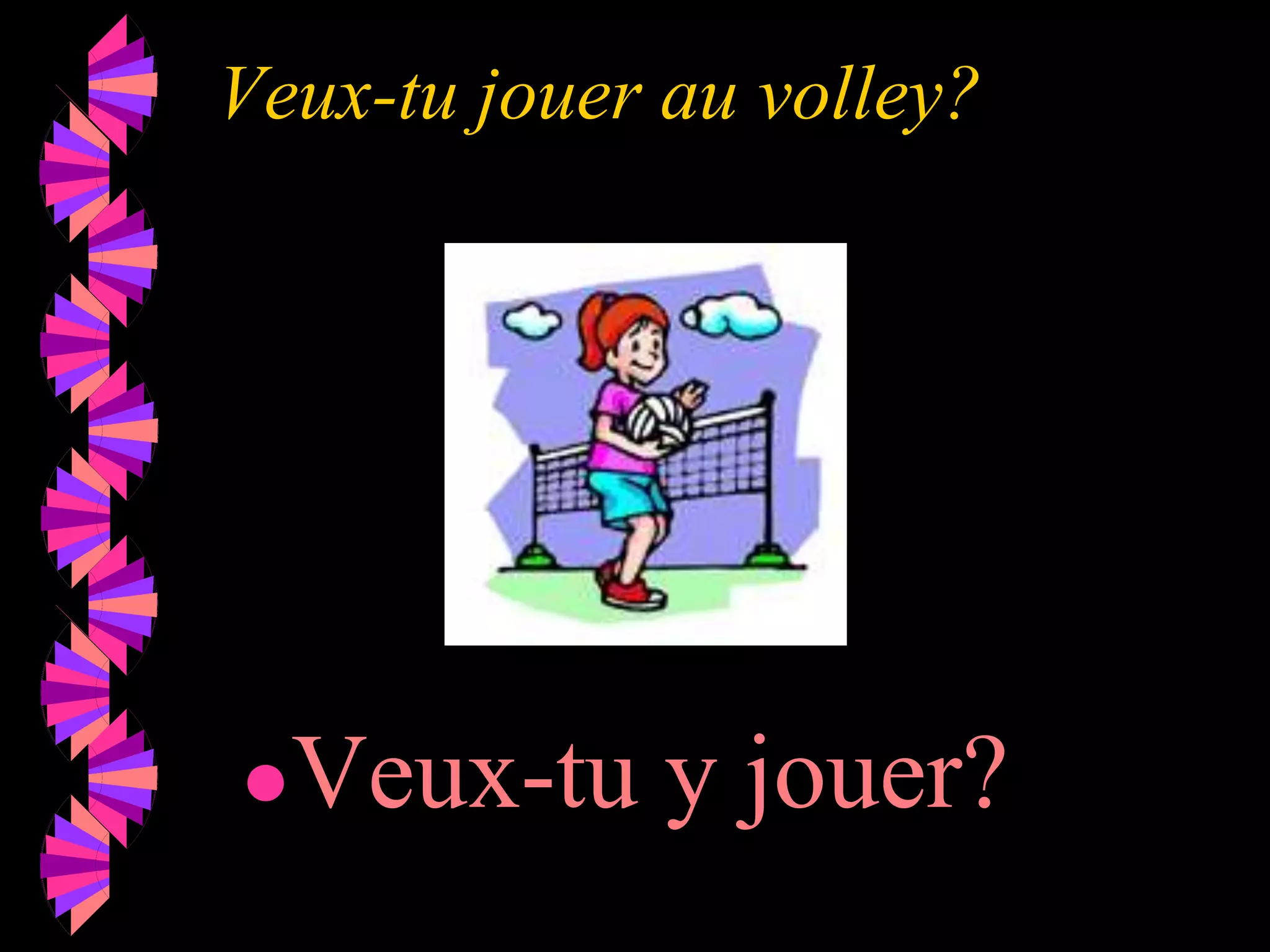
Veux-tu jouer au volley?
●Veux-tu y jouer?
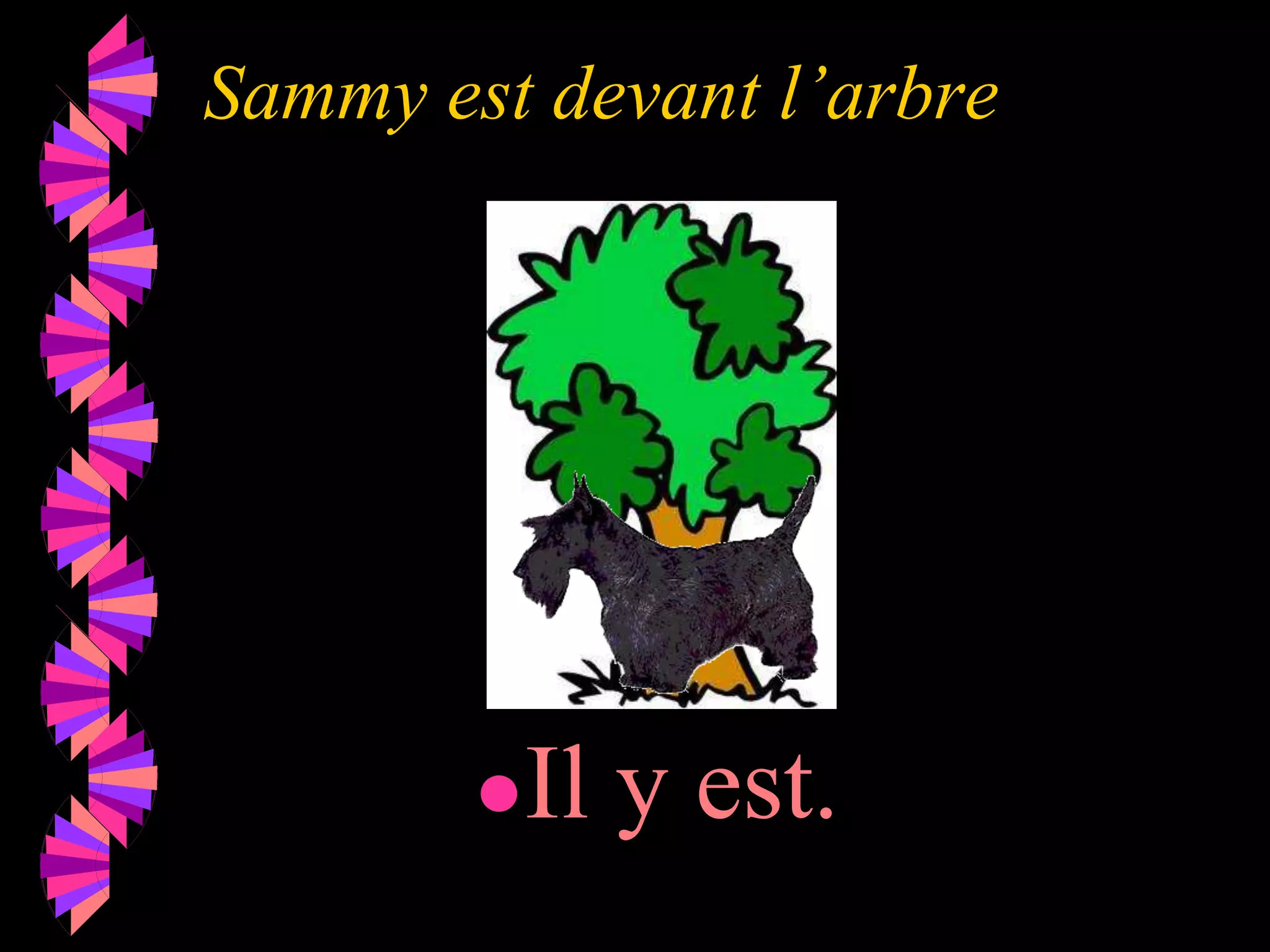
Sammy est devant l’arbre
●Il y est.
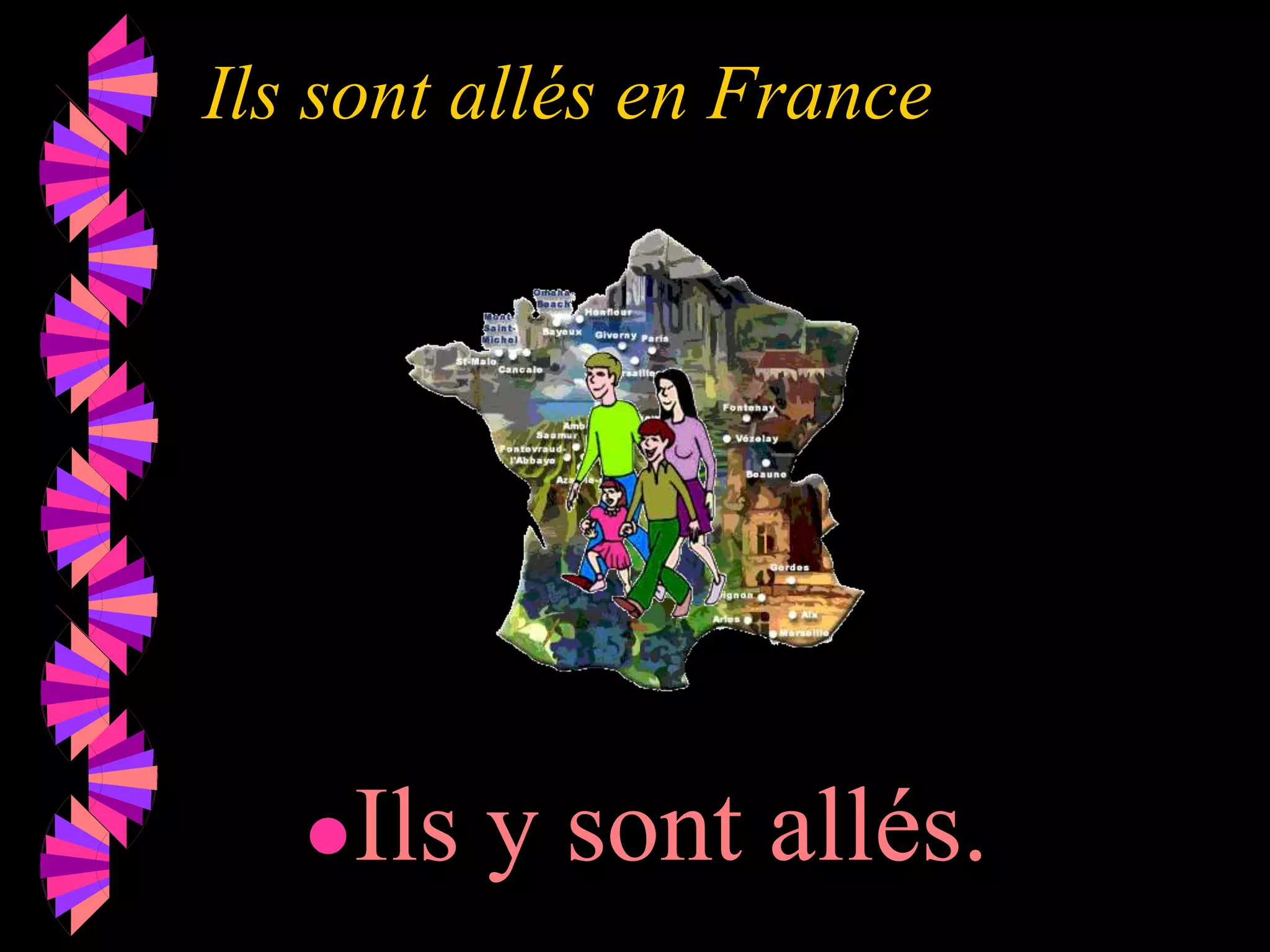
Ils sont allés en France
●Ils y sont allés.
Attention!
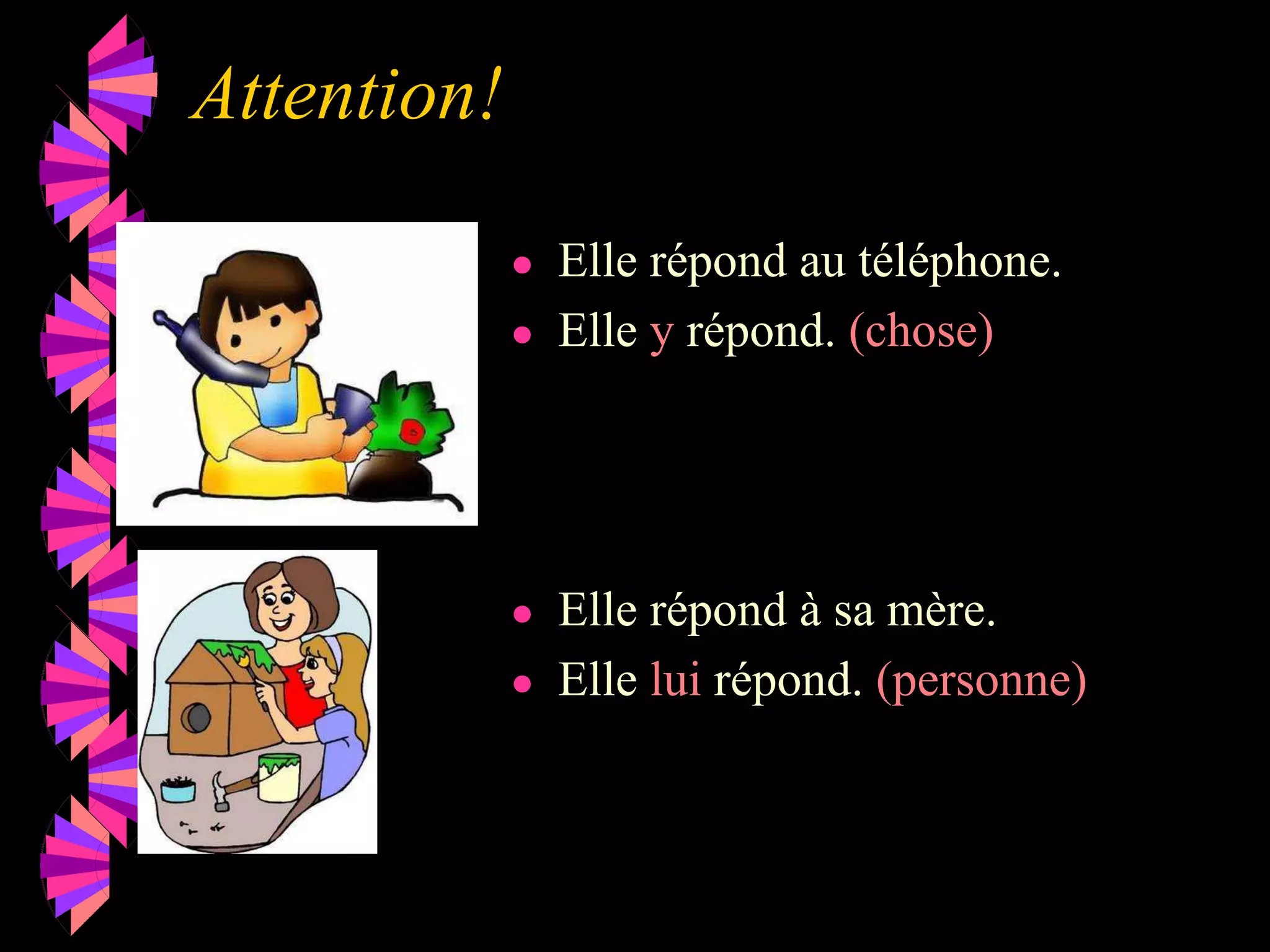
● Elle répond au téléphone.
● Elle y répond. (chose)
● Elle répond à sa mère.
● Elle lui répond. (personne)
Souvenez-vous
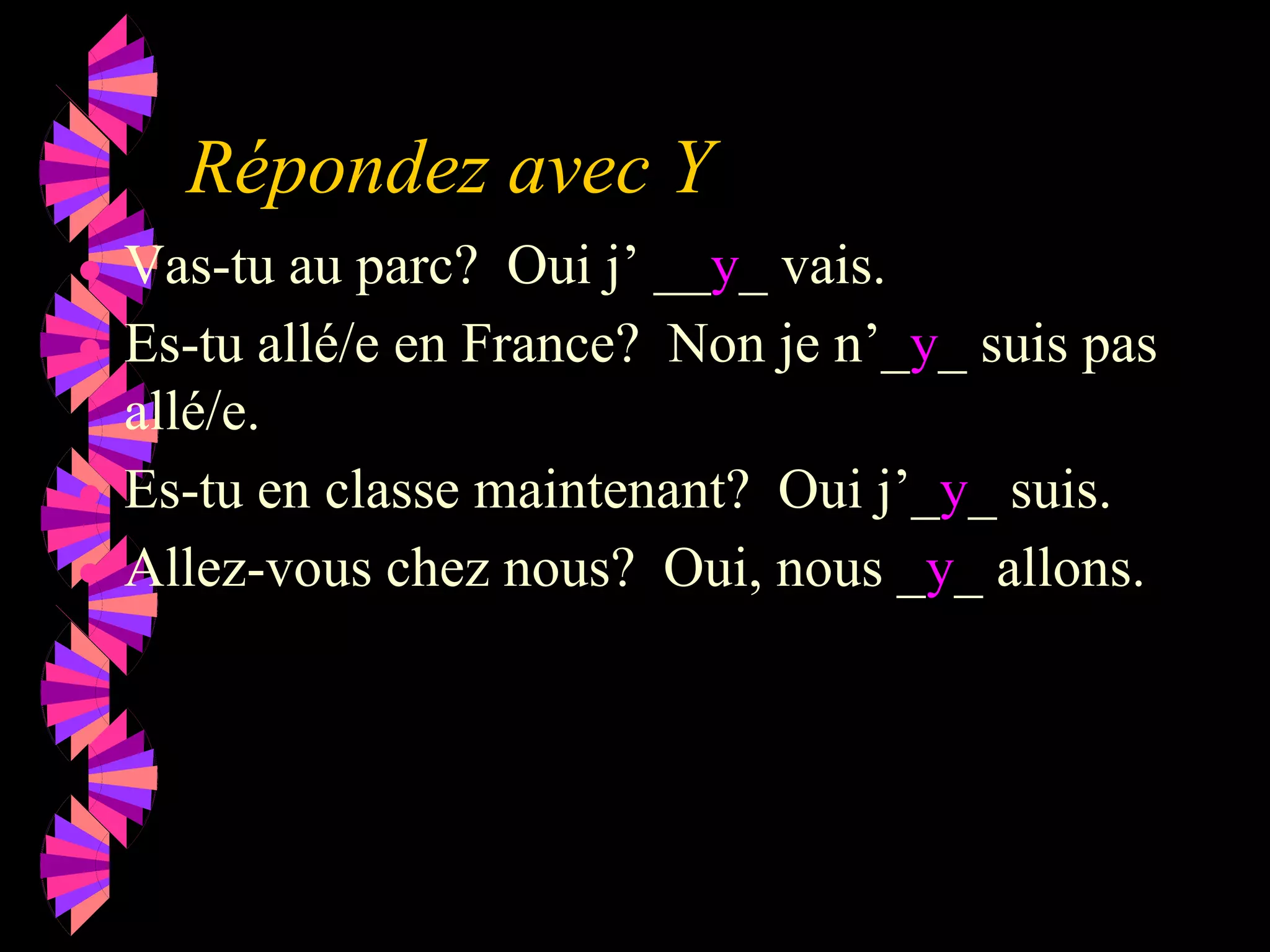
Répondez avec Y
● Vas-tu au parc? Oui j’ __y_ vais.
● Es-tu allé/e en France? Non je n’_y_ suis pas
allé/e.
● Es-tu en classe maintenant? Oui j’_y_ suis.
● Allez-vous chez nous? Oui, nous _y_ allons.
La fin

4 rlc fr3- unit 4

  • 1.
  • 2.
    Savoir vs. Connaitre ●Savoir talks about factual information or things we know. ● Connaitre talks about people or places we know or are familiar with.
  • 3.
    Je connais…. I know… Jeconnais Tu connais Il connait nous connaissons vous connaissez ils connaissent
  • 4.
    Victor Hugo, autorfrançais. Tu connais Victor Hugo? Je ne connais pas Victor Hugo.
  • 5.
    Savoir…. to know… Je sais Tusais Il sait nous savons vous savez ils savent
  • 6.
  • 7.
  • 8.
  • 9.
    ● Just asin English, a French relative pronoun links a dependent/relative clause (i.e., a clause that cannot stand alone) to a main clause. ● Que, qui, lequel, dont, and où are the French relative pronouns. ● In French, relative pronouns are required
  • 10.
    Que Replaces the directobject (person or thing) in the dependent clause ● J'ai acheté le livre. Ma soeur l'a écrit. J'ai acheté le livre que ma soeur a écrit. ● Qui est le peintre ? Je l'ai vu aujourd'hui. Qui est le peintre que j'ai vu aujourd'hui ?
  • 11.
    Qui Qui replaces thesubject (person or thing) in the dependent clause. Note that qui does not always translate as "who.” ● Je cherche l'artiste. Il étudie à Paris. Je cherche l'artiste qui étudie à Paris. (I'm looking for the artist (who is) studying in Paris.) ● Trouvez le chat. Il habite dans la cave. Trouvez le chat qui habite dans la cave. (Find the cat that lives in the basement.)
  • 12.
    Lequel Lequel or oneof its variations replaces an indirect object ● (thing only) after a preposition (except de - see dont). ● Le livre dans lequel j'ai écrit mon nom... – The book in which I wrote my name... ● La table sur laquelle j’ai mis le livre The table on which I put the book…
  • 13.
    Dont Dont replaces theperson or thing after de ● Elle parle d’un homme. Où est l’homme. Où est l’homme dont elle parle? (Where is the man she is talking about.) ● C'est la femme. J'ai parlé de la femme. C'est la femme dont j'ai parlé. (That's the woman (that) I talked about.)
  • 14.
    Où is usedfor both place and time ● La boulangerie où j'ai travaillé est à côté de la banque. ● The bakery where I worked is next to the bank. (The bakery [that] I worked at...) ● Lundi, c'est le jour où nous faisons les achats. ● Monday is the day that we do our shopping.
  • 15.
    Translate into French 1She likes the house I told you about. 2 Where is the book you mentioned? 3 I called my friend who works at ELF 4 Where is the dictionary I need? 5 I know the man who did it. 6 Here is the milk you wanted. 7 Here is the juice you ordered. 8 Jean is the man I want to marry. 9 The window where you change your money is over there.
  • 16.
    Translate into French 1She likes the house I told you about. 2 Where is the book you mentioned? 3 I called my friend who works at ELF 4 Where is the dictionary I need? 5 I know the man who did it. 6 Here is the milk you wanted. 7 Here is the juice you ordered. 8 Jean is the man I want to marry. 9 The window where you change your money is over there. Elle aime la maison dont je t'ai parlé.
  • 17.
    Translate into French 1She likes the house I told you about. 2 Where is the book you mentioned? 3 I called my friend who works at ELF 4 Where is the dictionary I need?. 5 I know the man who did it. 6 Here is the milk you wanted. 7 Here is the juice you ordered. 8 Jean is the man I want to marry. 9 The window where you change your money is over there. Où est le livre que tu as mentionné?
  • 18.
    Translate into French 1She likes the house I told you about. 2 Where is the book you mentioned? 3 I called my friend who works at ELF 4 Where is the dictionary I need?. 5 I know the man who did it. 6 Here is the milk you wanted. 7 Here is the juice you ordered. 8 Jean is the man I want to marry. 9 The window where you change your money is over there. J'ai téléphoné à mon ami qui travaille à ELF.
  • 19.
    Translate into French 1She likes the house I told you about. 2 Where is the book you mentioned? 3 I called my friend who works at ELF 4 Where is the dictionary I need?. 5 I know the man who did it. 6 Here is the milk you wanted. 7 Here is the juice you ordered. 8 Jean is the man I want to marry. 9 The window where you change your money is over there. Où est le dictionnaire dont j’ai besoin?
  • 20.
    Translate into French 1She likes the house I told you about. 2 Where is the book you mentioned? 3 I called my friend who works at ELF 4 Where is the dictionary I need?. 5 I know the man who did it. 6 Here is the milk you wanted. 7 Here is the juice you ordered. 8 Jean is the man I want to marry. 9 The window where you change your money is over there. Je connais l'homme qui l'a fait.
  • 21.
    Translate into French 1She likes the house I told you about. 2 Where is the book you mentioned? 3 I called my friend who works at ELF 4 Where is the dictionary I need?. 5 I know the man who did it. 6 Here is the milk you wanted. 7 Here is the juice you ordered. 8 Jean is the man I want to marry. 9 The window where you change your money is over there. Voici le lait dont vous aviez envie.
  • 22.
    Translate into French 1She likes the house I told you about. 2 Where is the book you mentioned? 3 I called my friend who works at ELF 4 Where is the dictionary I need?. 5 I know the man who did it. 6 Here is the milk you wanted. 7 Here is the juice you ordered. 8 Jean is the man I want to marry. 9 The window where you change your money is over there. Voici le jus que vous avez commandé.
  • 23.
    Translate into French 1She likes the house I told you about. 2 Where is the book you mentioned? 3 I called my friend who works at ELF 4 Where is the dictionary I need?. 5 I know the man who did it. 6 Here is the milk you wanted. 7 Here is the juice you ordered. 8 Jean is the man I want to marry. 9 The window where you change your money is over there. Jean est l'homme avec qui je veux me marier.
  • 24.
    Translate into French 1She likes the house I told you about. 2 Where is the book you mentioned? 3 I called my friend who works at ELF 4 Where is the dictionary I need?. 5 I know the man who did it. 6 Here is the milk you wanted. 7 Here is the juice you ordered. 8 Jean is the man I want to marry. 9 The window where you change your money is over there. Le guichet où vous changez votre argent est là-bas.
  • 25.
    When the directobject comes before the past participle…. ● We make the past participle agree in gender / number…. ● J’ai envoyé les lettres hier. becomes: Je les ai envoyées hier.
  • 26.
  • 27.
    Uses of PasséComposé The passé composé is used to express completed For example: Hier, j ’ai fini ma rédaction d ’anglais. Ce matin, nous avons vu un film dans la classe d ’histoire. actionspast
  • 28.
    Uses of PasséComposé Hier, j ’ai fini ma rédaction d ’anglais. In these sentences, whether or not it is stated, one could specify an exact time at which the event took place. (à 3h15) (à 9h36) Ce matin, nous avons vu un film dans la classe d ’histoire.
  • 29.
    Uses of Imparfait Theimparfait, however, by definition, means imperfect. Its uses are much less clearly defined. They fall into three basic categories: ↳ habitual past actions ↳ continuing past actions ↳ conditions (non-actions) (used to do) (was doing) (did)
  • 30.
    Habitual Past Actions Ahabitual past action is one that occurred repeatedly over a long period of time. For example: We used to play baseball every day. Nous jouions au baseball tous les jours.
  • 31.
    Habitual Past Actions Attention!Habitual past actions are not necessarily translated as « used to.. » For example: Quand j ’étais jeune, je me promenais à l ’école tous les jours. might be translated When I was young, I walked to school every day. The key is that the action occurred repeatedly in the past.
  • 32.
    Continuing Past Actions Forexample: Je faisais la vaiselle quand tu m’as téléphoné. I was doing the dishes when you called me. The imparfait is also used to express actions that were going on when something else happened.
  • 33.
    Conditions (non-actions) There isa class of verbs which do not express action at all. Rather, they express conditions, states of being, or states of mind. When these verbs occur in a past tense, it is almost always the imparfait.
  • 34.
    Conditions (non-actions) Some ofthese verbs are: être avoir vouloir pouvoir savoir désirer connaître penser croire se sentir espérer aimer faire (w/ expressions of weather)
  • 35.
    Summary Remember that thepassé composé is used to express completed past actions. The imparfait expresses habitual past actions continuing past actions conditions (non-actions)
  • 36.
    À toi! Complete thefollowing sentences with the appropriate verb form: Anne-Marie ______ en France quand (habiter) elle __________. (se marier) continuing past action completed past action
  • 37.
    À toi! Complete thefollowing sentences with the appropriate verb form: Anne-Marie ______ en France quand (habiter) elle __________. (se marier) habitait s ’est mariée continuing past action completed past action
  • 38.
    À toi! Quand ils____________ le château, (quitter) ils _________ fatigués, et il (être) __________ très chaud. (faire) completed past action condition condition
  • 39.
    À toi! Quand ils____________ le château, (quitter) ils _________ fatigués, et il (être) __________ très chaud. (faire) ont quitté faisait étaient completed past action condition condition
  • 40.
    Le Pronom Y AnotherDirect Object Pronoun
  • 41.
    Y ● Ce pronomremplace UNE CHOSE précédée par une préposition. ● Dans sur sous devant chez derrière en à au aux à l’
  • 42.
    Veux-tu jouer auvolley? ●Veux-tu y jouer?
  • 43.
    Sammy est devantl’arbre ●Il y est.
  • 44.
    Ils sont allésen France ●Ils y sont allés.
  • 45.
    Attention! ● Elle répondau téléphone. ● Elle y répond. (chose) ● Elle répond à sa mère. ● Elle lui répond. (personne)
  • 46.
  • 47.
    Répondez avec Y ●Vas-tu au parc? Oui j’ __y_ vais. ● Es-tu allé/e en France? Non je n’_y_ suis pas allé/e. ● Es-tu en classe maintenant? Oui j’_y_ suis. ● Allez-vous chez nous? Oui, nous _y_ allons.
  • 48.