Virtual eXtensible 
Local Area Network 
(VXLAN) 
RFC 7348 - A Framework for Overlaying Virtualized Layer 2 Networks over 
Layer 3 Networks 
CCIEx2 Security, Data Center 
2014-10-25 KwonSun Bae.
Agenda 
• What is VXLAN? 
• Why use VXLAN? 
• Before the learn VXLAN. 
 Acronyms and Definitions. 
• VXLAN Overview. 
 VXLAN’s History. 
• VXLAN Deep Dive. 
 VXLAN Packet Flow 
 VTEP 
 VXLAN Frame Format 
• VXLAN Demo 
 Cisco VXLAN Configuration 
 VXLAN on vEOS 
 Packet Captures 
• VXLAN Overlay Comparisons 
(Options)
What is VXLAN?
VXLAN is ... 
• VXLAN 
 Virtual eXtensible Local Area Network 
• VXLAN’s goal is allowing dynamic large scale isolated virtual L2 networks to be 
created for virtualized and multi-tenant environments. 
• VXLAN is one protocol of Network overlay. 
• https://sites.google.com/site/amitsciscozone/home/data-center/vxlan
Why use VXLAN?
Why use VXLAN? 
• Traditionally, all data centers use VLANs to enforce Layer2 isolation. As data 
centers grow and needs arise for extending Layer2 networks across data center 
or may be beyond a data center, the shortcomings of VLANs are evident. These 
shortcomings are – 
 In a data center, there are requirements of thousands of VLANs to partition traffic in a 
multi-tenant environment sharing the same L2/L3 infrastructure for a Cloud Service 
Provider. The current limit of 4096 VLANs (some are reserved) is not enough. 
 Due to Server virtualization, each Virtual Machine (VM) requires a unique MAC address 
and an IP address. So, there are thousands of MAC table entries on upstream switches. 
This places much larger demand on table capacity of the switches. 
 VLANs are too restrictive in terms of distance and deployment. VTP can be used to deploy 
VLANs across the L2 switches but most people prefer to disable VTP due to its 
destructive nature. 
 Using STP to provide L2 loop free topology disables most redundant links. Hence, Equal- 
Cost Multi-Path (ECMP) is hard to achieve. However, ECMP is easy to achieve in IP 
network.
Why use VXLAN? 
• Data Center Grows (Server Side) 
https://www.arista.com/en/products/eos/cloud-scale-architecture/articletabs/0
Why use VXLAN? 
• Types of Overlay Edge Devices 
 VXLAN – VTEP Deployment Designs 
* Cisco Live 365 - LTRDCT-1223 - Implementing VXLAN in DataCenter
Before the learn 
VXLAN. 
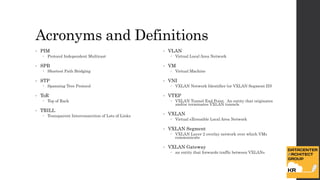
Acronyms and Definitions
Acronyms and Definitions 
• PIM 
 Protocol Independent Multicast 
• SPB 
 Shortest Path Bridging 
• STP 
 Spanning Tree Protocol 
• ToR 
 Top of Rack 
• TRILL 
 Transparent Interconnection of Lots of Links 
• VLAN 
 Virtual Local Area Network 
• VM 
 Virtual Machine 
• VNI 
 VXLAN Network Identifier (or VXLAN Segment ID) 
• VTEP 
 VXLAN Tunnel End Point. An entity that originates 
and/or terminates VXLAN tunnels 
• VXLAN 
 Virtual eXtensible Local Area Network 
• VXLAN Segment 
 VXLAN Layer 2 overlay network over which VMs 
communicate 
• VXLAN Gateway 
 an entity that forwards traffic between VXLANs
VXLAN Overview.
VXLAN Operation. 
• http://www.definethecloud.net/vxlan-deep-divepart-2/
VXLAN History 
• https://datatracker.ietf.org/doc/rfc7348/history/
Important Diff from Previous 
• http://www.ietf.org/rfcdiff?url1=draft-mahalingam-dutt-dcops-vxlan- 
02&url2=draft-mahalingam-dutt-dcops-vxlan-03 
 UDP Protocol NO fixed to 17 for IPv4 
 VXLAN Frame Format with IPv6 Outer Header added. 
• http://www.ietf.org/rfcdiff?url1=draft-mahalingam-dutt-dcops-vxlan- 
03&url2=draft-mahalingam-dutt-dcops-vxlan-04 
 A well-known UDP port (4789) has been assigned by IANA for VXLAN. 
• http://www.ietf.org/rfcdiff?url1=draft-mahalingam-dutt-dcops-vxlan- 
07&url2=draft-mahalingam-dutt-dcops-vxlan-08 
 VTEPs MUST not fragment VXLAN packets.
VXLAN Deep Dive.
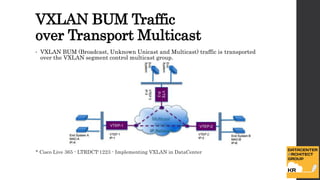
VXLAN BUM Traffic 
over Transport Multicast 
• VXLAN BUM (Broadcast, Unknown Unicast and Multicast) traffic is transported 
over the VXLAN segment control multicast group. 
* Cisco Live 365 - LTRDCT-1223 - Implementing VXLAN in DataCenter
VXLAN VTEP 
Peer Discovery & Address Learning 
* Cisco Live 365 - LTRDCT-1223 - Implementing VXLAN in DataCenter
VXLAN Packet Forwarding Flow 
* Cisco Live 365 - LTRDCT-1223 - Implementing VXLAN in DataCenter
VXLAN Interface (VTEP) 
*http://www.definethecloud.net/vxlan-deep- 
dive/
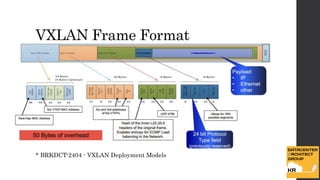
VXLAN Frame Format 
* BRKDCT-2404 - VXLAN Deployment Models
VXLAN Demo.
Cisco VTEP Configuration 
Cisco NX-OS N9K Cisco NX-OS N1Kv 
+ So Many Manual Tasks!! 
http://www.cisco.com/c/en/us/products/collateral/switch 
es/nexus-7000-series-switches/guide_c07-728863.html
External Network 
Layer 3 Network 
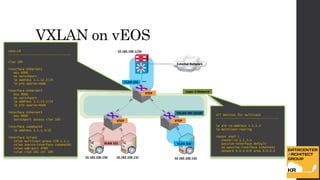
VXLAN on vEOS 
10.183.100.1/24 
VLAN 100 
VXLAN VNI 20100 
VTEP 
VTEP VTEP 
VLAN 101 VLAN 100 
10.183.100.130 10.183.100.131 10.183.100.132 
vEOS-C# 
----------------------------------- 
vlan 100 
interface Ethernet1 
mtu 9000 
no switchport 
ip address 1.1.12.2/24 
ip pim sparse-mode 
interface Ethernet2 
mtu 9000 
no switchport 
ip address 1.1.13.2/24 
ip pim sparse-mode 
interface Ethernet3 
mtu 9000 
switchport access vlan 100 
interface Loopback0 
ip address 1.1.1.3/32 
interface Vxlan1 
vxlan multicast-group 239.1.1.1 
vxlan source-interface Loopback0 
vxlan udp-port 4789 
vxlan vlan 101 vni 100 
All Devices for multicast 
----------------------------------- 
ip pim rp-address 1.1.1.3 
ip multicast-routing 
router ospf 1 
router-id 1.1.1.x 
passive-interface default 
no passive-interface EthernetX 
network 0.0.0.0/0 area 0.0.0.0
External Network 
Layer 3 Network 
VXLAN on vEOS 
10.183.100.1/24 
VLAN 100 
VXLAN VNI 20100 
VTEP 
VTEP VTEP 
VLAN 101 VLAN 100 
10.183.100.130 10.183.100.131 10.183.100.132 
vEOS-A# 
----------------------------------- 
vlan 101 
interface Ethernet1 
mtu 9000 
no switchport 
ip address 1.1.12.2/24 
ip pim sparse-mode 
interface Ethernet2 - 3 
mtu 9000 
switchport access vlan 101 
interface Loopback0 
ip address 1.1.1.1/32 
interface Vxlan1 
vxlan multicast-group 239.1.1.1 
vxlan source-interface Loopback0 
vxlan udp-port 4789 
vxlan vlan 101 vni 100 
vEOS-B# 
----------------------------------- 
vlan 100 
interface Ethernet1 
mtu 9000 
no switchport 
ip address 1.1.13.2/24 
ip pim sparse-mode 
interface Ethernet2 
mtu 9000 
switchport access vlan 100 
interface Loopback0 
ip address 1.1.1.2/32 
interface Vxlan1 
vxlan multicast-group 239.1.1.1 
vxlan source-interface Loopback0 
vxlan udp-port 4789 
vxlan vlan 100 vni 100
VXLAN on vEOS 
External Network 
Layer 3 Network 
10.183.100.1/24 
VLAN 100 
VXLAN VNI 20100 
VTEP 
VTEP VTEP 
VLAN 101 VLAN 100 
10.183.100.130 10.183.100.131 10.183.100.132
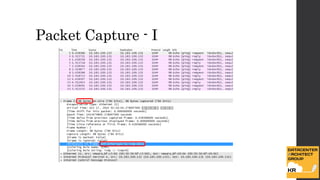
Packet Capture - I
Packet Capture - II
Packet Capture - III
VXLAN 
Overlay Comparisons 
*Cisco Live 365 - BRKVIR-2014 - Architecting Scalable Clouds using VXLAN and N1kv
VXLAN / STT 
Stateless Transport Tunneling Protocol 
Similarities 
• IP Transport 
• IP Multicast 
 For broadcast and multicast frames 
• Port Channel Load Distribution 
 5 Tuple Hashing (UDP vs TCP) 
Differences 
• IETF Draft Authors 
 VXLAN: Cisco, VMware, Citrix, Red Hat, Broadcom, Arista 
 STT: Nicira 
• Encapsulation 
 VXLAN: UDP with 50 bytes 
 STT: “TCP-like” with 72 to 54 bytes (not uniform) * 
• Segment ID Size 
 VXLAN: 24 bit 
 STT: 64 bit 
• Firewall ACL can act on VXLAN UDP port 
 Firewalls will likely block STT since it has no TCP state 
machine handshake 
• Forwarding Logic 
 VXLAN: Flooding/Learning 
 STT: Not specified
VXLAN / NVGRE 
Network Virtualization using Generic Routing Encapsulation 
Similarities 
• IP Transport 
• IP Multicast 
 For broadcast and multicast frames 
• 24 Bit Segment ID 
Differences 
• IETF Draft Authors 
 VXLAN: Cisco, VMware, Citrix, Red Hat, Broadcom, Arista 
 STT: Microsoft, Intel, Dell, HP, Broadcom, Emulex, Arista 
• Encapsulation 
 VXLAN: UDP with 50 bytes 
 NVGRE: GRE with 42 bytes 
• Port Channel Load Distribution 
 VXLAN: UDP 5-tuple hashing 
 Most (if not all) current switches do not hash on the GRE 
header 
• Firewall ACL can act on VXLAN UDP port 
 Difficult for firewall to act on the GRE Protocol Type field 
• Forwarding Logic 
 VXLAN: Flooding/Learning 
 NVGRE: Not specified
VXLAN / OTV 
Overlay Transport Virtualization 
Similarities 
• Same UDP based encapsulation 
header 
 VXLAN does not use the OTV Overlay 
ID field 
• IP Multicast 
 For broadcast and multicast frames 
(optional for OTV) 
• 24 Bit Segment ID 
Differences 
• Forwarding Logic 
 VXLAN: Flooding/Learning 
 OTV: Uses the IS-IS protocol to advertise 
the MAC address to IP bindings 
• OTV can locally terminate ARP and 
doesn’t flood unknown MACs 
• OTV can use an adjacency server to 
eliminate the need for IP multicast 
• OTV is optimized for Data Center 
Interconnect to extend VLANs between 
or across data centers 
• VXLAN is optimized for intra-DC and 
multi-tenancy
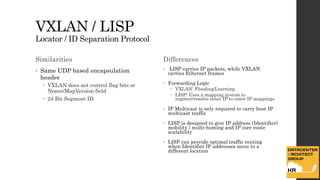
VXLAN / LISP 
Locator / ID Separation Protocol 
Similarities 
• Same UDP based encapsulation 
header 
 VXLAN does not control flag bits or 
Nonce/MapVersion field 
 24 Bit Segment ID 
Differences 
• LISP carries IP packets, while VXLAN 
carries Ethernet frames 
• Forwarding Logic 
 VXLAN: Flooding/Learning 
 LISP: Uses a mapping system to 
register/resolve inner IP to outer IP mappings 
• IP Multicast is only required to carry host IP 
multicast traffic 
• LISP is designed to give IP address (Identifier) 
mobility / multi-homing and IP core route 
scalability 
• LISP can provide optimal traffic routing 
when Identifier IP addresses move to a 
different location
QnA

Vxlan deep dive session rev0.5 final

  • 1.
    Virtual eXtensible LocalArea Network (VXLAN) RFC 7348 - A Framework for Overlaying Virtualized Layer 2 Networks over Layer 3 Networks CCIEx2 Security, Data Center 2014-10-25 KwonSun Bae.
  • 2.
    Agenda • Whatis VXLAN? • Why use VXLAN? • Before the learn VXLAN.  Acronyms and Definitions. • VXLAN Overview.  VXLAN’s History. • VXLAN Deep Dive.  VXLAN Packet Flow  VTEP  VXLAN Frame Format • VXLAN Demo  Cisco VXLAN Configuration  VXLAN on vEOS  Packet Captures • VXLAN Overlay Comparisons (Options)
  • 3.
  • 4.
    VXLAN is ... • VXLAN  Virtual eXtensible Local Area Network • VXLAN’s goal is allowing dynamic large scale isolated virtual L2 networks to be created for virtualized and multi-tenant environments. • VXLAN is one protocol of Network overlay. • https://sites.google.com/site/amitsciscozone/home/data-center/vxlan
  • 5.
  • 6.
    Why use VXLAN? • Traditionally, all data centers use VLANs to enforce Layer2 isolation. As data centers grow and needs arise for extending Layer2 networks across data center or may be beyond a data center, the shortcomings of VLANs are evident. These shortcomings are –  In a data center, there are requirements of thousands of VLANs to partition traffic in a multi-tenant environment sharing the same L2/L3 infrastructure for a Cloud Service Provider. The current limit of 4096 VLANs (some are reserved) is not enough.  Due to Server virtualization, each Virtual Machine (VM) requires a unique MAC address and an IP address. So, there are thousands of MAC table entries on upstream switches. This places much larger demand on table capacity of the switches.  VLANs are too restrictive in terms of distance and deployment. VTP can be used to deploy VLANs across the L2 switches but most people prefer to disable VTP due to its destructive nature.  Using STP to provide L2 loop free topology disables most redundant links. Hence, Equal- Cost Multi-Path (ECMP) is hard to achieve. However, ECMP is easy to achieve in IP network.
  • 7.
    Why use VXLAN? • Data Center Grows (Server Side) https://www.arista.com/en/products/eos/cloud-scale-architecture/articletabs/0
  • 8.
    Why use VXLAN? • Types of Overlay Edge Devices  VXLAN – VTEP Deployment Designs * Cisco Live 365 - LTRDCT-1223 - Implementing VXLAN in DataCenter
  • 9.
    Before the learn VXLAN. Acronyms and Definitions
  • 10.
    Acronyms and Definitions • PIM  Protocol Independent Multicast • SPB  Shortest Path Bridging • STP  Spanning Tree Protocol • ToR  Top of Rack • TRILL  Transparent Interconnection of Lots of Links • VLAN  Virtual Local Area Network • VM  Virtual Machine • VNI  VXLAN Network Identifier (or VXLAN Segment ID) • VTEP  VXLAN Tunnel End Point. An entity that originates and/or terminates VXLAN tunnels • VXLAN  Virtual eXtensible Local Area Network • VXLAN Segment  VXLAN Layer 2 overlay network over which VMs communicate • VXLAN Gateway  an entity that forwards traffic between VXLANs
  • 11.
  • 12.
    VXLAN Operation. •http://www.definethecloud.net/vxlan-deep-divepart-2/
  • 13.
    VXLAN History •https://datatracker.ietf.org/doc/rfc7348/history/
  • 14.
    Important Diff fromPrevious • http://www.ietf.org/rfcdiff?url1=draft-mahalingam-dutt-dcops-vxlan- 02&url2=draft-mahalingam-dutt-dcops-vxlan-03  UDP Protocol NO fixed to 17 for IPv4  VXLAN Frame Format with IPv6 Outer Header added. • http://www.ietf.org/rfcdiff?url1=draft-mahalingam-dutt-dcops-vxlan- 03&url2=draft-mahalingam-dutt-dcops-vxlan-04  A well-known UDP port (4789) has been assigned by IANA for VXLAN. • http://www.ietf.org/rfcdiff?url1=draft-mahalingam-dutt-dcops-vxlan- 07&url2=draft-mahalingam-dutt-dcops-vxlan-08  VTEPs MUST not fragment VXLAN packets.
  • 15.
  • 16.
    VXLAN BUM Traffic over Transport Multicast • VXLAN BUM (Broadcast, Unknown Unicast and Multicast) traffic is transported over the VXLAN segment control multicast group. * Cisco Live 365 - LTRDCT-1223 - Implementing VXLAN in DataCenter
  • 17.
    VXLAN VTEP PeerDiscovery & Address Learning * Cisco Live 365 - LTRDCT-1223 - Implementing VXLAN in DataCenter
  • 18.
    VXLAN Packet ForwardingFlow * Cisco Live 365 - LTRDCT-1223 - Implementing VXLAN in DataCenter
  • 19.
    VXLAN Interface (VTEP) *http://www.definethecloud.net/vxlan-deep- dive/
  • 20.
    VXLAN Frame Format * BRKDCT-2404 - VXLAN Deployment Models
  • 21.
  • 22.
    Cisco VTEP Configuration Cisco NX-OS N9K Cisco NX-OS N1Kv + So Many Manual Tasks!! http://www.cisco.com/c/en/us/products/collateral/switch es/nexus-7000-series-switches/guide_c07-728863.html
  • 23.
    External Network Layer3 Network VXLAN on vEOS 10.183.100.1/24 VLAN 100 VXLAN VNI 20100 VTEP VTEP VTEP VLAN 101 VLAN 100 10.183.100.130 10.183.100.131 10.183.100.132 vEOS-C# ----------------------------------- vlan 100 interface Ethernet1 mtu 9000 no switchport ip address 1.1.12.2/24 ip pim sparse-mode interface Ethernet2 mtu 9000 no switchport ip address 1.1.13.2/24 ip pim sparse-mode interface Ethernet3 mtu 9000 switchport access vlan 100 interface Loopback0 ip address 1.1.1.3/32 interface Vxlan1 vxlan multicast-group 239.1.1.1 vxlan source-interface Loopback0 vxlan udp-port 4789 vxlan vlan 101 vni 100 All Devices for multicast ----------------------------------- ip pim rp-address 1.1.1.3 ip multicast-routing router ospf 1 router-id 1.1.1.x passive-interface default no passive-interface EthernetX network 0.0.0.0/0 area 0.0.0.0
  • 24.
    External Network Layer3 Network VXLAN on vEOS 10.183.100.1/24 VLAN 100 VXLAN VNI 20100 VTEP VTEP VTEP VLAN 101 VLAN 100 10.183.100.130 10.183.100.131 10.183.100.132 vEOS-A# ----------------------------------- vlan 101 interface Ethernet1 mtu 9000 no switchport ip address 1.1.12.2/24 ip pim sparse-mode interface Ethernet2 - 3 mtu 9000 switchport access vlan 101 interface Loopback0 ip address 1.1.1.1/32 interface Vxlan1 vxlan multicast-group 239.1.1.1 vxlan source-interface Loopback0 vxlan udp-port 4789 vxlan vlan 101 vni 100 vEOS-B# ----------------------------------- vlan 100 interface Ethernet1 mtu 9000 no switchport ip address 1.1.13.2/24 ip pim sparse-mode interface Ethernet2 mtu 9000 switchport access vlan 100 interface Loopback0 ip address 1.1.1.2/32 interface Vxlan1 vxlan multicast-group 239.1.1.1 vxlan source-interface Loopback0 vxlan udp-port 4789 vxlan vlan 100 vni 100
  • 25.
    VXLAN on vEOS External Network Layer 3 Network 10.183.100.1/24 VLAN 100 VXLAN VNI 20100 VTEP VTEP VTEP VLAN 101 VLAN 100 10.183.100.130 10.183.100.131 10.183.100.132
  • 26.
  • 27.
  • 28.
  • 29.
    VXLAN Overlay Comparisons *Cisco Live 365 - BRKVIR-2014 - Architecting Scalable Clouds using VXLAN and N1kv
  • 30.
    VXLAN / STT Stateless Transport Tunneling Protocol Similarities • IP Transport • IP Multicast  For broadcast and multicast frames • Port Channel Load Distribution  5 Tuple Hashing (UDP vs TCP) Differences • IETF Draft Authors  VXLAN: Cisco, VMware, Citrix, Red Hat, Broadcom, Arista  STT: Nicira • Encapsulation  VXLAN: UDP with 50 bytes  STT: “TCP-like” with 72 to 54 bytes (not uniform) * • Segment ID Size  VXLAN: 24 bit  STT: 64 bit • Firewall ACL can act on VXLAN UDP port  Firewalls will likely block STT since it has no TCP state machine handshake • Forwarding Logic  VXLAN: Flooding/Learning  STT: Not specified
  • 31.
    VXLAN / NVGRE Network Virtualization using Generic Routing Encapsulation Similarities • IP Transport • IP Multicast  For broadcast and multicast frames • 24 Bit Segment ID Differences • IETF Draft Authors  VXLAN: Cisco, VMware, Citrix, Red Hat, Broadcom, Arista  STT: Microsoft, Intel, Dell, HP, Broadcom, Emulex, Arista • Encapsulation  VXLAN: UDP with 50 bytes  NVGRE: GRE with 42 bytes • Port Channel Load Distribution  VXLAN: UDP 5-tuple hashing  Most (if not all) current switches do not hash on the GRE header • Firewall ACL can act on VXLAN UDP port  Difficult for firewall to act on the GRE Protocol Type field • Forwarding Logic  VXLAN: Flooding/Learning  NVGRE: Not specified
  • 32.
    VXLAN / OTV Overlay Transport Virtualization Similarities • Same UDP based encapsulation header  VXLAN does not use the OTV Overlay ID field • IP Multicast  For broadcast and multicast frames (optional for OTV) • 24 Bit Segment ID Differences • Forwarding Logic  VXLAN: Flooding/Learning  OTV: Uses the IS-IS protocol to advertise the MAC address to IP bindings • OTV can locally terminate ARP and doesn’t flood unknown MACs • OTV can use an adjacency server to eliminate the need for IP multicast • OTV is optimized for Data Center Interconnect to extend VLANs between or across data centers • VXLAN is optimized for intra-DC and multi-tenancy
  • 33.
    VXLAN / LISP Locator / ID Separation Protocol Similarities • Same UDP based encapsulation header  VXLAN does not control flag bits or Nonce/MapVersion field  24 Bit Segment ID Differences • LISP carries IP packets, while VXLAN carries Ethernet frames • Forwarding Logic  VXLAN: Flooding/Learning  LISP: Uses a mapping system to register/resolve inner IP to outer IP mappings • IP Multicast is only required to carry host IP multicast traffic • LISP is designed to give IP address (Identifier) mobility / multi-homing and IP core route scalability • LISP can provide optimal traffic routing when Identifier IP addresses move to a different location
  • 34.