Getting to Simple LEAN/AGILE KPIs…Yuval Yeret - AgileSparks
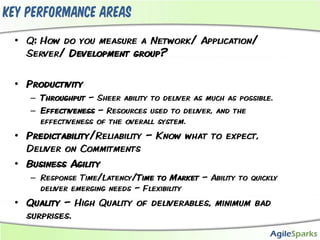
Key Performance AreasQ: How do you measure a Network/ Application/ Server/ Development group?ProductivityThroughput – Sheer ability to deliver as much as possible. Effectiveness – Resources used to deliver, and the effectiveness of the overall system. Predictability/Reliability – Know what to expect, Deliver on CommitmentsBusiness AgilityResponse Time/Latency/Time to Market – Ability to quickly deliver emerging needs – FlexibilityQuality – High Quality of deliverables, minimum bad surprises.
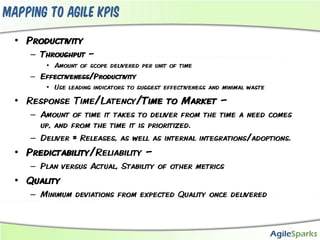
Mapping to Agile KPIsProductivityThroughput – Amount of scope delivered per unit of timeEffectiveness/ProductivityUse leading indicators to suggest effectiveness and minimal wasteResponse Time/Latency/Time to Market – Amount of time it takes to deliver from the time a need comes up, and from the time it is prioritized. Deliver = Releases, as well as internal integrations/adoptions. Predictability/Reliability – Plan versus Actual, Stability of other metricsQualityMinimum deviations from expected Quality once delivered
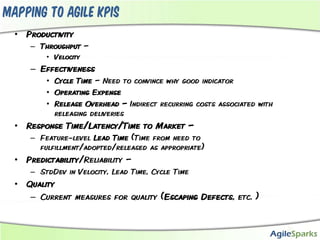
Mapping to Agile KPIsProductivityThroughput – VelocityEffectivenessCycle Time – Need to convince why good indicatorOperating ExpenseRelease Overhead – Indirect recurring costs associated with releasing deliveriesResponse Time/Latency/Time to Market – Feature-level Lead Time (Time from need to fulfillment/adopted/released as appropriate)Predictability/Reliability – StdDev in Velocity, Lead Time, Cycle TimeQualityCurrent measures for quality (Escaping Defects, etc. )
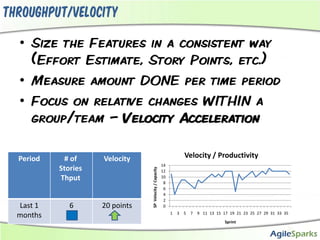
Throughput/VelocitySize the Features in a consistent way (Effort Estimate, Story Points, etc.)Measure amount DONE per time periodFocus on relative changes WITHIN a group/team – Velocity Acceleration
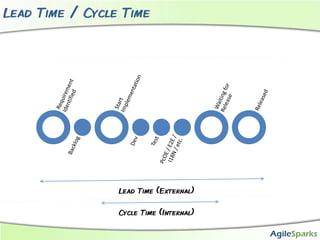
Lead Time / Cycle TimeLead Time (External)Cycle Time (Internal)
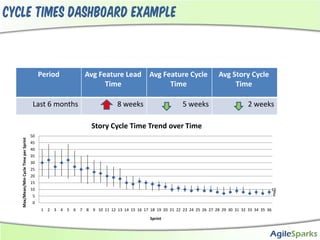
Cycle Times Dashboard Example
 Predictability – Meeting CommitmentsDue Date Performance – Track whether we are meeting the commitments we make to others
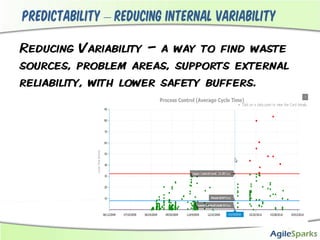
Predictability – Reducing internal variabilityReducing Variability – a way to find waste sources, problem areas, supports external reliability, with lower safety buffers.
EffectivenessCost / Operating Expense – Relation is clear…Measure amount of resources assigned to activity, or actual direct and indirect costs associated with the project/release/activity*Advanced – use AgileEVM to more closely track usage of Budget compared to Scope and Schedule.
Effectiveness - Cycle Time? Productivity/Effectiveness – Holy Grail of R&D KPIs…Cycle Time is quite a good approximation because Fast Cycle Time indicates:Minimal Rework/Internal Quality issuesMinimal waits / Context Switches / BlockersMinimal work timeSmall, agile units of work that quickly enable feedback and verification of decisionsQuickly finding problems and addressing themAlso, Cycle Time:Is simple to understandIs easy to measure when using a workflow systemDoesn’t require a lot of overhead to provideIs hard to gameIs closely associated with Business Agility – Lead TimeCycle Time is one of the key measures in Lean Software Development / Kanban / Lean Thinking
Release OverheadThe more time spent on releasing, less time spent on implementing more business value. The higher the overhead, the harder to justify business agility and frequent deliveriesLowering overheads is a great indication of an organization that has high quality, predictability, technical proficiency.
Comparing Teams/Groups
What do I DO NEXT?	FIRST, You DON’T have to go Agile all the way to start measuring!!!One of the key questions/obstacles is how to collect and track this dataKanban, especially on an electronic tool, provides a lot of the KPIs, especially, the usually tough to track onesIf you start using Kanban, you already have a head start on this front compared to most groups.
Use KANBAN as a TOOL TO GET MEASURES	SEE www.agilesparks.com/kanban for some more info/links about kanbanJoin us for a kanban workshop to learn moreOnce Kanban is in place, DATA will drive you towards improving – setting up a Kaizen / Continuous Improvement environment.
Need a GUIDE for the journey?yuval@agilesparks.com
AgileSparksThank you!yuval@agilesparks.com@yuvalyeret on TwitterBlogging at http://www.yuvalyeret.com

Simple Lean Agile KPIs

  • 1.
    Getting to SimpleLEAN/AGILE KPIs…Yuval Yeret - AgileSparks
  • 2.
    Key Performance AreasQ:How do you measure a Network/ Application/ Server/ Development group?ProductivityThroughput – Sheer ability to deliver as much as possible. Effectiveness – Resources used to deliver, and the effectiveness of the overall system. Predictability/Reliability – Know what to expect, Deliver on CommitmentsBusiness AgilityResponse Time/Latency/Time to Market – Ability to quickly deliver emerging needs – FlexibilityQuality – High Quality of deliverables, minimum bad surprises.
  • 3.
    Mapping to AgileKPIsProductivityThroughput – Amount of scope delivered per unit of timeEffectiveness/ProductivityUse leading indicators to suggest effectiveness and minimal wasteResponse Time/Latency/Time to Market – Amount of time it takes to deliver from the time a need comes up, and from the time it is prioritized. Deliver = Releases, as well as internal integrations/adoptions. Predictability/Reliability – Plan versus Actual, Stability of other metricsQualityMinimum deviations from expected Quality once delivered
  • 4.
    Mapping to AgileKPIsProductivityThroughput – VelocityEffectivenessCycle Time – Need to convince why good indicatorOperating ExpenseRelease Overhead – Indirect recurring costs associated with releasing deliveriesResponse Time/Latency/Time to Market – Feature-level Lead Time (Time from need to fulfillment/adopted/released as appropriate)Predictability/Reliability – StdDev in Velocity, Lead Time, Cycle TimeQualityCurrent measures for quality (Escaping Defects, etc. )
  • 5.
    Throughput/VelocitySize the Featuresin a consistent way (Effort Estimate, Story Points, etc.)Measure amount DONE per time periodFocus on relative changes WITHIN a group/team – Velocity Acceleration
  • 6.
    Lead Time /Cycle TimeLead Time (External)Cycle Time (Internal)
  • 7.
  • 8.
    Predictability –Meeting CommitmentsDue Date Performance – Track whether we are meeting the commitments we make to others
  • 9.
    Predictability – Reducinginternal variabilityReducing Variability – a way to find waste sources, problem areas, supports external reliability, with lower safety buffers.
  • 10.
    EffectivenessCost / OperatingExpense – Relation is clear…Measure amount of resources assigned to activity, or actual direct and indirect costs associated with the project/release/activity*Advanced – use AgileEVM to more closely track usage of Budget compared to Scope and Schedule.
  • 11.
    Effectiveness - CycleTime? Productivity/Effectiveness – Holy Grail of R&D KPIs…Cycle Time is quite a good approximation because Fast Cycle Time indicates:Minimal Rework/Internal Quality issuesMinimal waits / Context Switches / BlockersMinimal work timeSmall, agile units of work that quickly enable feedback and verification of decisionsQuickly finding problems and addressing themAlso, Cycle Time:Is simple to understandIs easy to measure when using a workflow systemDoesn’t require a lot of overhead to provideIs hard to gameIs closely associated with Business Agility – Lead TimeCycle Time is one of the key measures in Lean Software Development / Kanban / Lean Thinking
  • 12.
    Release OverheadThe moretime spent on releasing, less time spent on implementing more business value. The higher the overhead, the harder to justify business agility and frequent deliveriesLowering overheads is a great indication of an organization that has high quality, predictability, technical proficiency.
  • 13.
  • 14.
    What do IDO NEXT? FIRST, You DON’T have to go Agile all the way to start measuring!!!One of the key questions/obstacles is how to collect and track this dataKanban, especially on an electronic tool, provides a lot of the KPIs, especially, the usually tough to track onesIf you start using Kanban, you already have a head start on this front compared to most groups.
  • 15.
    Use KANBAN asa TOOL TO GET MEASURES SEE www.agilesparks.com/kanban for some more info/links about kanbanJoin us for a kanban workshop to learn moreOnce Kanban is in place, DATA will drive you towards improving – setting up a Kaizen / Continuous Improvement environment.
  • 16.
    Need a GUIDEfor the journey?yuval@agilesparks.com
  • 17.
    AgileSparksThank you!yuval@agilesparks.com@yuvalyeret onTwitterBlogging at http://www.yuvalyeret.com

Editor's Notes

  • #7 Lead Time – includes queueing time between Requirement identification and choosing it as the next in line, as well as time from completion to release as part of a release/drop/service pack – what the “customer” observes!Cycle Time – Clean engineering time from starting to completion – More focused on internal performance.