
Doing Agile Right - Transformation without Chaos - A summary
1) Doing Agile Right discusses how organizations can successfully transform to being agile without chaos. It emphasizes that agile requires both a mindset and methods change to truly achieve its promised results.
2) True agile transformation focuses intently on customers and involves breaking down silos, decentralizing decision making, and changing talent management and processes.
3) Scaling agile properly in a large organization requires addressing issues like planning, budgeting, and reviewing in an agile way as well as transforming support functions to better serve internal customers.
Doing Agile Right - Transformation without Chaos - A summary
1.
Doing Agile Right
Transformationwithout Chaos
Summary of the book authored by
Darrell Rigby, Sarah Elk, and Steve Berez
Partners at Bain & Co
Published by HBR Press 2020
2.
We cannot solvethe problems with the same level of
thinking that created them.
Albert Einstein
Scott Fitzgerald’s First rate thinking - what is it ?
Ability to hold 2 opposite ideas in the mind at the same
time and still retain the ability to function
3.
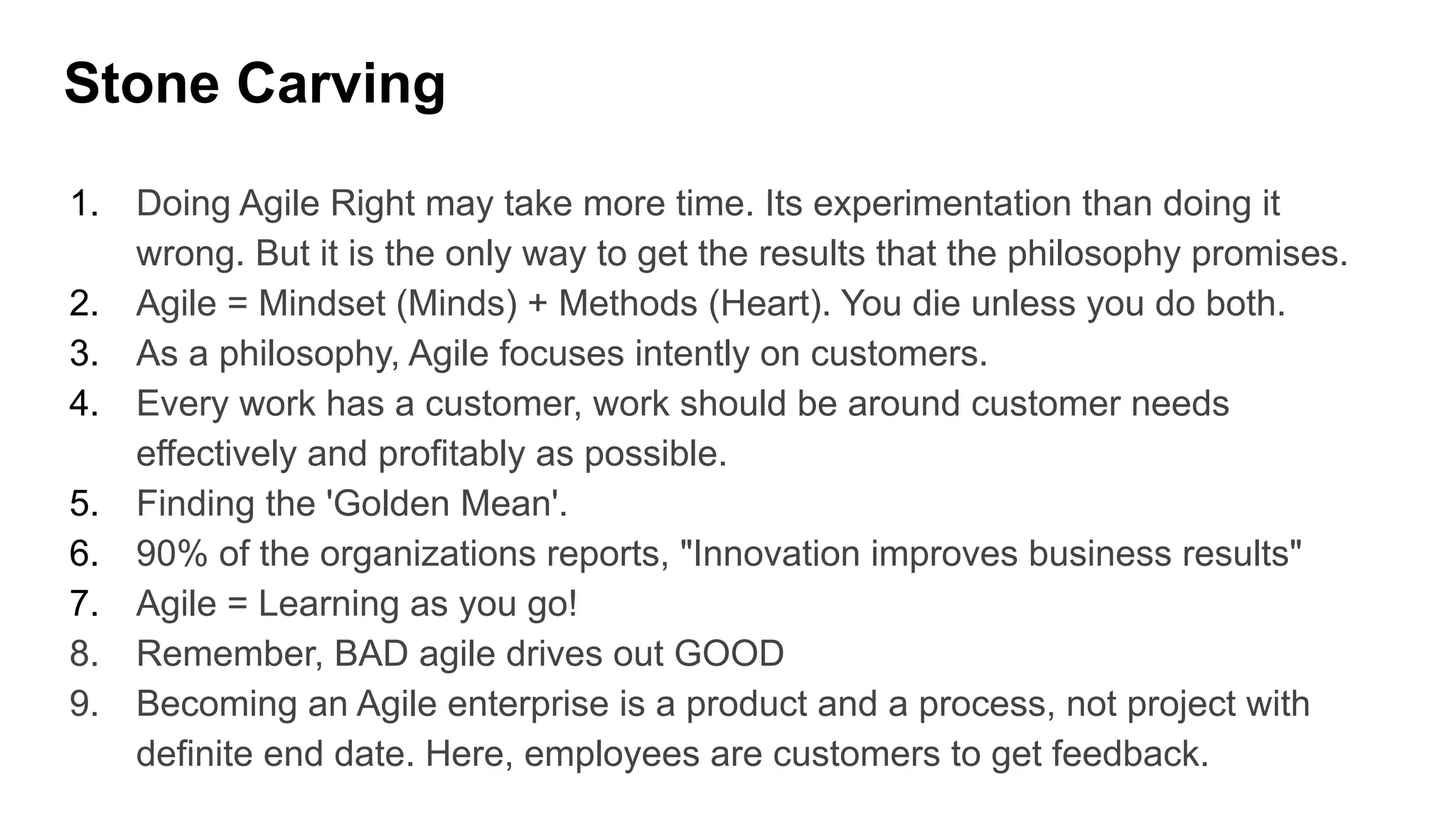
Stone Carving
1. DoingAgile Right may take more time. Its experimentation than doing it
wrong. But it is the only way to get the results that the philosophy promises.
2. Agile = Mindset (Minds) + Methods (Heart). You die unless you do both.
3. As a philosophy, Agile focuses intently on customers.
4. Every work has a customer, work should be around customer needs
effectively and profitably as possible.
5. Finding the 'Golden Mean'.
6. 90% of the organizations reports, "Innovation improves business results"
7. Agile = Learning as you go!
8. Remember, BAD agile drives out GOOD
9. Becoming an Agile enterprise is a product and a process, not project with
definite end date. Here, employees are customers to get feedback.
4.
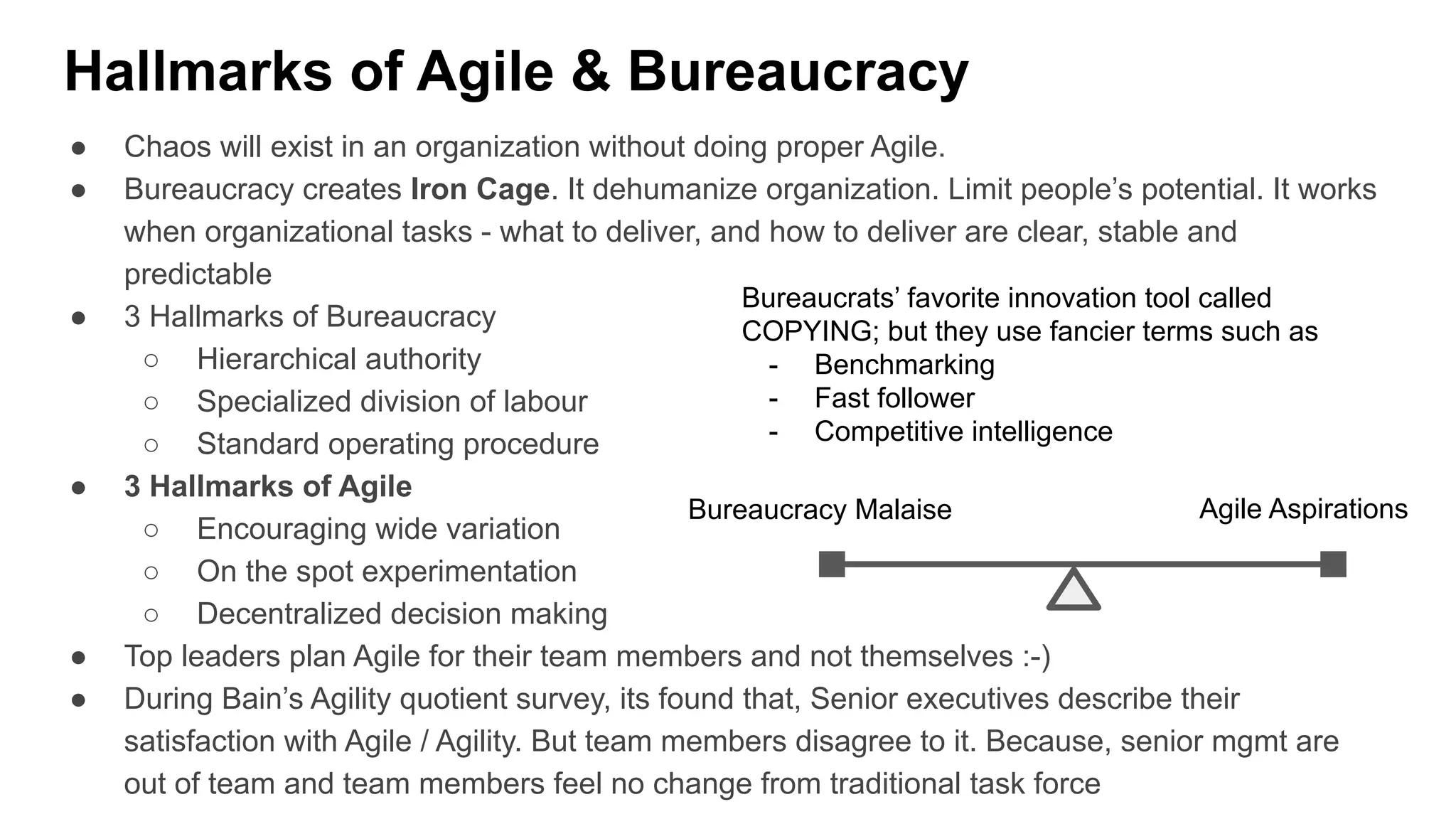
Hallmarks of Agile& Bureaucracy
● Chaos will exist in an organization without doing proper Agile.
● Bureaucracy creates Iron Cage. It dehumanize organization. Limit people’s potential. It works
when organizational tasks - what to deliver, and how to deliver are clear, stable and
predictable
● 3 Hallmarks of Bureaucracy
○ Hierarchical authority
○ Specialized division of labour
○ Standard operating procedure
● 3 Hallmarks of Agile
○ Encouraging wide variation
○ On the spot experimentation
○ Decentralized decision making
● Top leaders plan Agile for their team members and not themselves :-)
● During Bain’s Agility quotient survey, its found that, Senior executives describe their
satisfaction with Agile / Agility. But team members disagree to it. Because, senior mgmt are
out of team and team members feel no change from traditional task force
Bureaucracy Malaise Agile Aspirations
Bureaucrats’ favorite innovation tool called
COPYING; but they use fancier terms such as
- Benchmarking
- Fast follower
- Competitive intelligence
5.
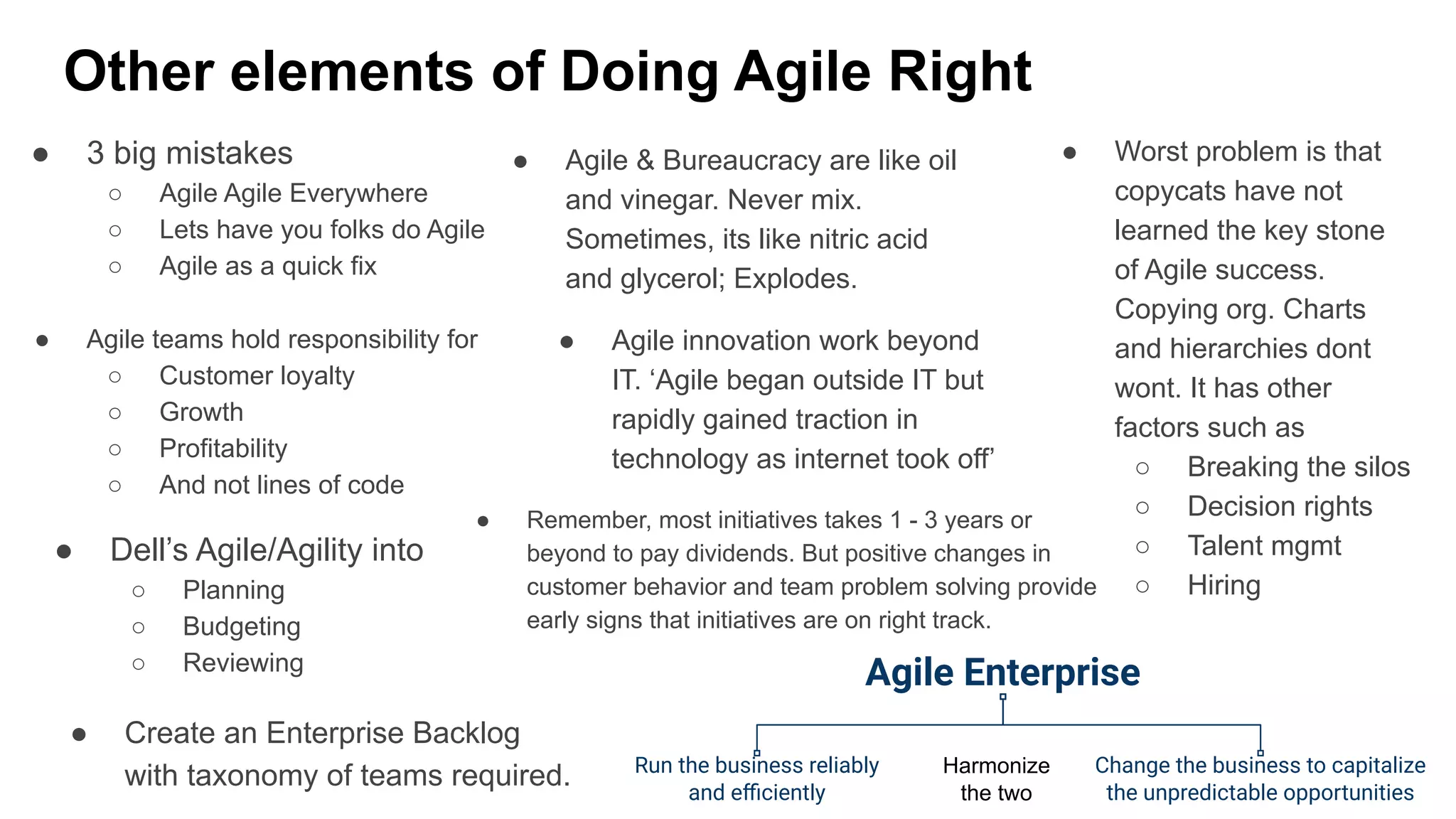
Other elements ofDoing Agile Right
● 3 big mistakes
○ Agile Agile Everywhere
○ Lets have you folks do Agile
○ Agile as a quick fix
● Agile & Bureaucracy are like oil
and vinegar. Never mix.
Sometimes, its like nitric acid
and glycerol; Explodes.
● Worst problem is that
copycats have not
learned the key stone
of Agile success.
Copying org. Charts
and hierarchies dont
wont. It has other
factors such as
○ Breaking the silos
○ Decision rights
○ Talent mgmt
○ Hiring
● Dell’s Agile/Agility into
○ Planning
○ Budgeting
○ Reviewing
● Agile teams hold responsibility for
○ Customer loyalty
○ Growth
○ Profitability
○ And not lines of code
● Agile innovation work beyond
IT. ‘Agile began outside IT but
rapidly gained traction in
technology as internet took off’
Agile Enterprise
Run the business reliably
and efficiently
Change the business to capitalize
the unpredictable opportunities
Harmonize
the two
● Remember, most initiatives takes 1 - 3 years or
beyond to pay dividends. But positive changes in
customer behavior and team problem solving provide
early signs that initiatives are on right track.
● Create an Enterprise Backlog
with taxonomy of teams required.
6.
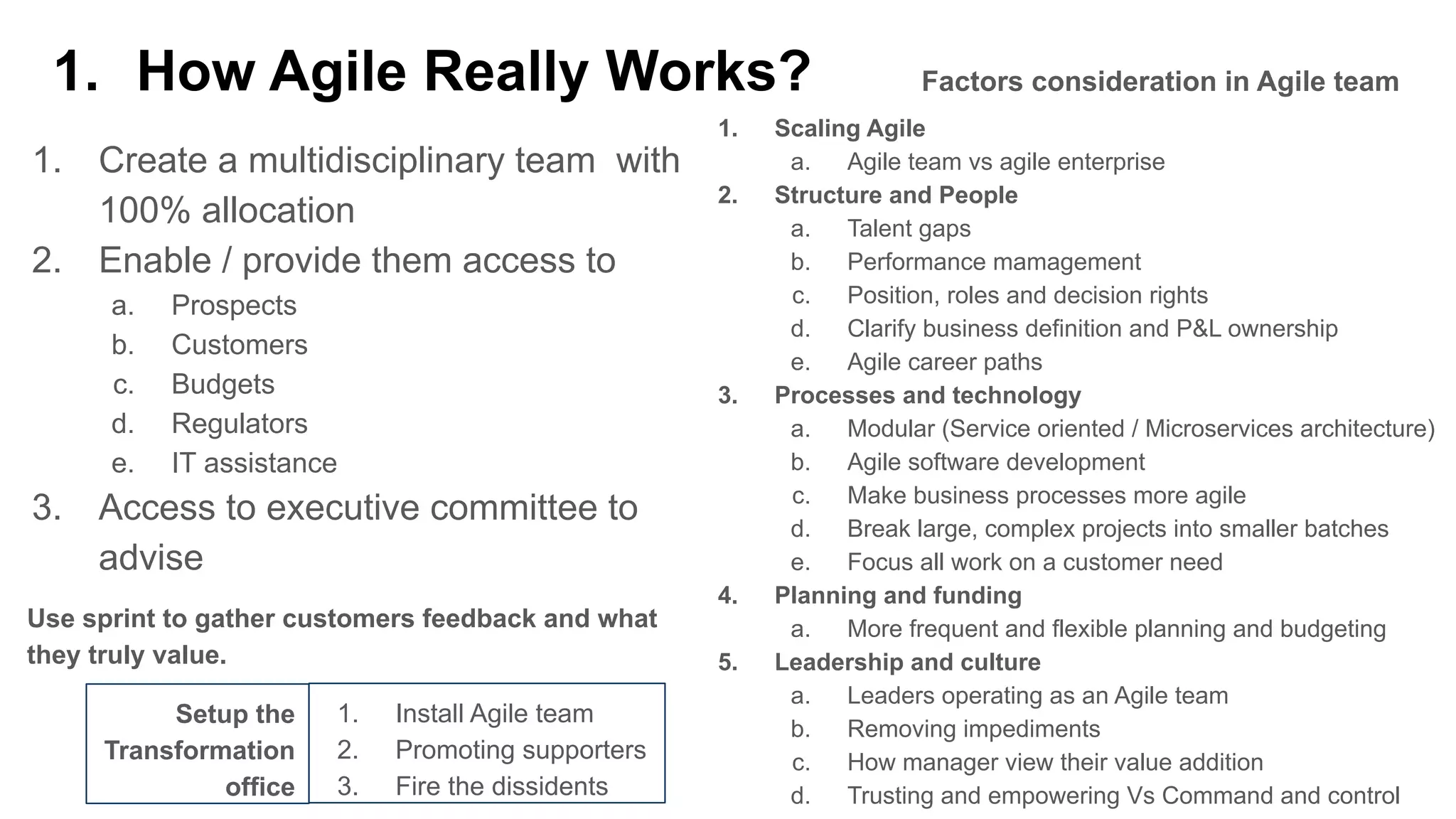
1. How AgileReally Works?
1. Create a multidisciplinary team with
100% allocation
2. Enable / provide them access to
a. Prospects
b. Customers
c. Budgets
d. Regulators
e. IT assistance
3. Access to executive committee to
advise
1. Scaling Agile
a. Agile team vs agile enterprise
2. Structure and People
a. Talent gaps
b. Performance mamagement
c. Position, roles and decision rights
d. Clarify business definition and P&L ownership
e. Agile career paths
3. Processes and technology
a. Modular (Service oriented / Microservices architecture)
b. Agile software development
c. Make business processes more agile
d. Break large, complex projects into smaller batches
e. Focus all work on a customer need
4. Planning and funding
a. More frequent and flexible planning and budgeting
5. Leadership and culture
a. Leaders operating as an Agile team
b. Removing impediments
c. How manager view their value addition
d. Trusting and empowering Vs Command and control
Use sprint to gather customers feedback and what
they truly value.
Factors consideration in Agile team
Setup the
Transformation
office
1. Install Agile team
2. Promoting supporters
3. Fire the dissidents
7.
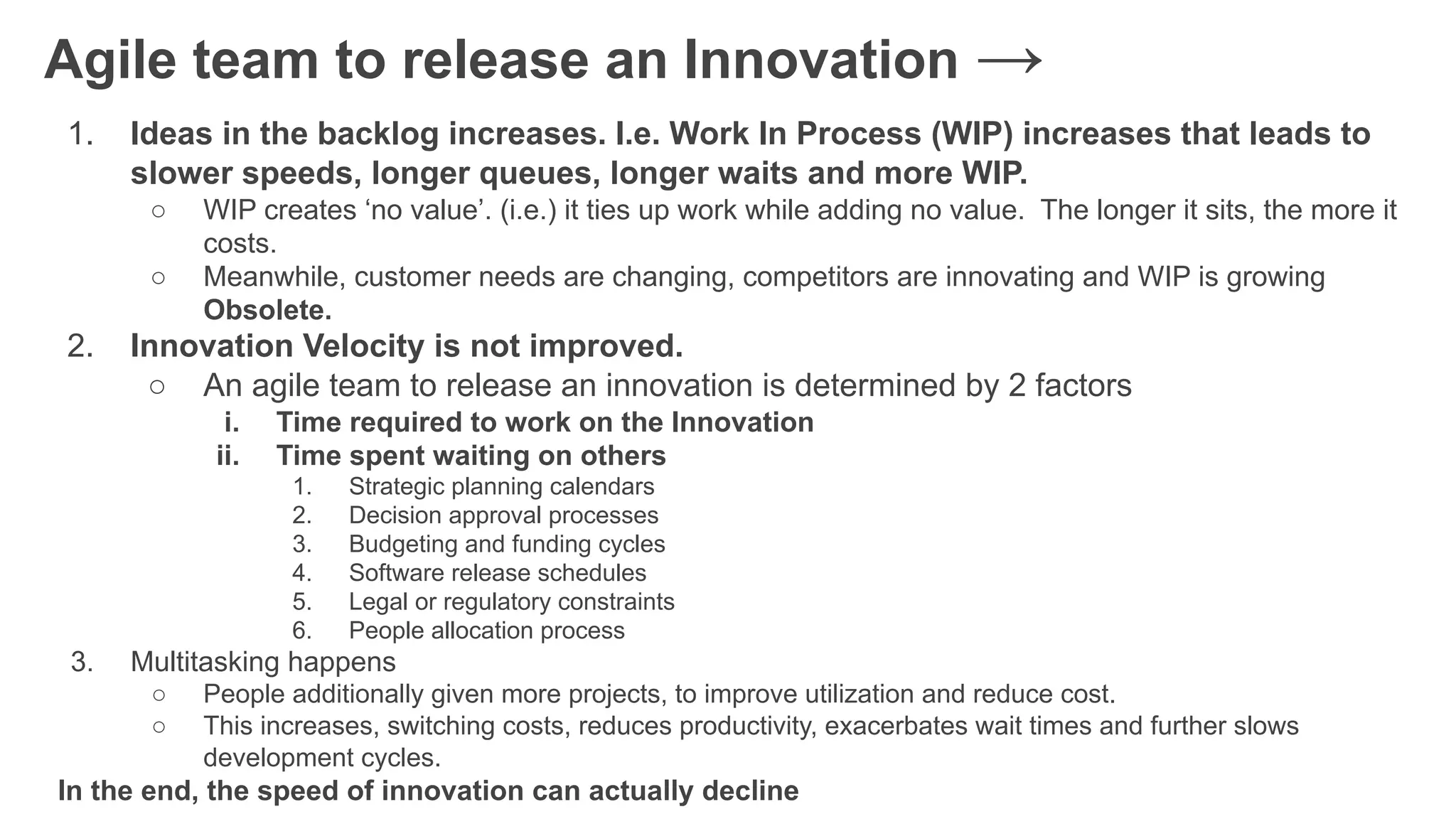
Agile team torelease an Innovation →
1. Ideas in the backlog increases. I.e. Work In Process (WIP) increases that leads to
slower speeds, longer queues, longer waits and more WIP.
○ WIP creates ‘no value’. (i.e.) it ties up work while adding no value. The longer it sits, the more it
costs.
○ Meanwhile, customer needs are changing, competitors are innovating and WIP is growing
Obsolete.
2. Innovation Velocity is not improved.
○ An agile team to release an innovation is determined by 2 factors
i. Time required to work on the Innovation
ii. Time spent waiting on others
1. Strategic planning calendars
2. Decision approval processes
3. Budgeting and funding cycles
4. Software release schedules
5. Legal or regulatory constraints
6. People allocation process
3. Multitasking happens
○ People additionally given more projects, to improve utilization and reduce cost.
○ This increases, switching costs, reduces productivity, exacerbates wait times and further slows
development cycles.
In the end, the speed of innovation can actually decline
8.
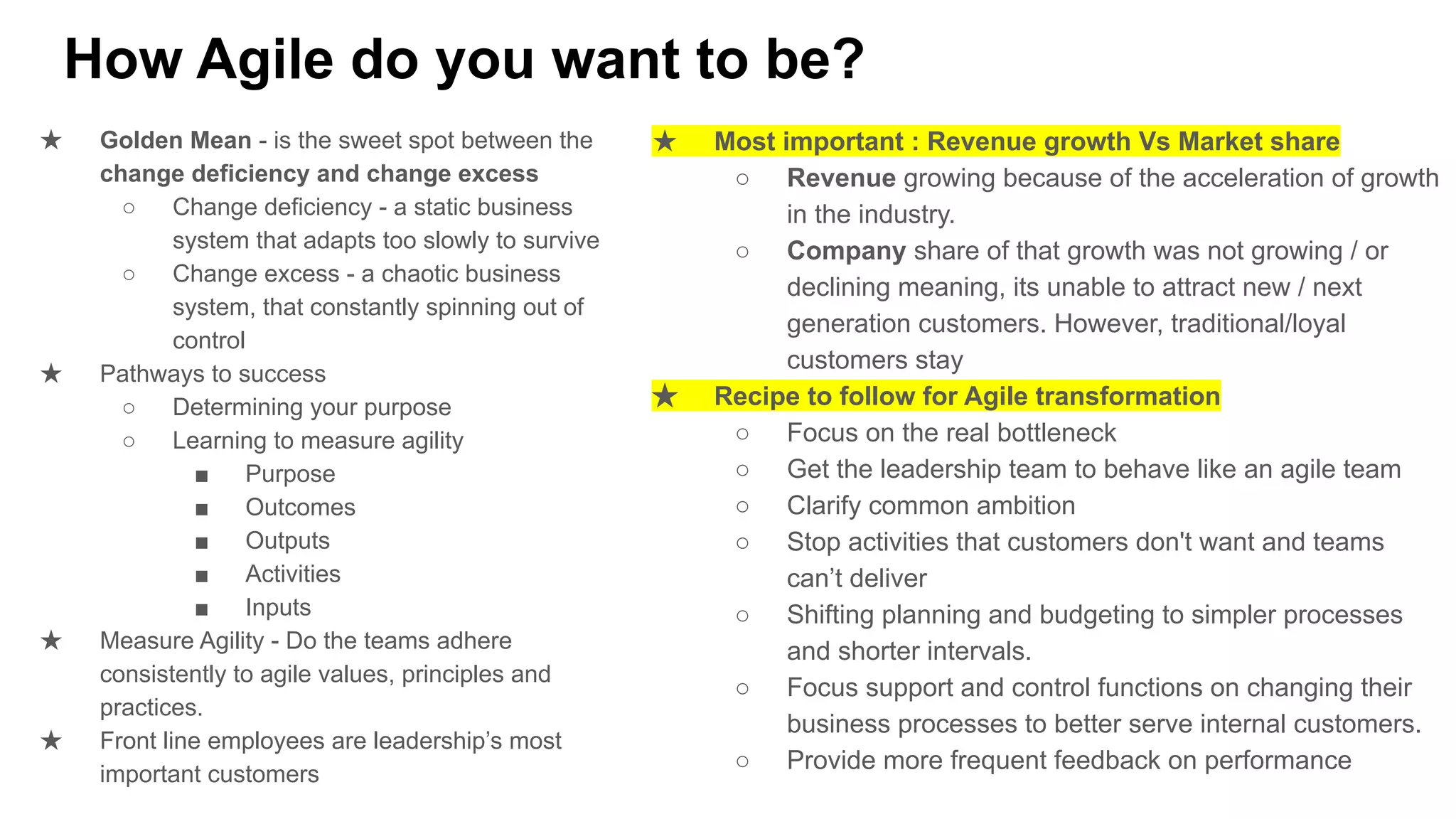
How Agile doyou want to be?
★ Golden Mean - is the sweet spot between the
change deficiency and change excess
○ Change deficiency - a static business
system that adapts too slowly to survive
○ Change excess - a chaotic business
system, that constantly spinning out of
control
★ Pathways to success
○ Determining your purpose
○ Learning to measure agility
■ Purpose
■ Outcomes
■ Outputs
■ Activities
■ Inputs
★ Measure Agility - Do the teams adhere
consistently to agile values, principles and
practices.
★ Front line employees are leadership’s most
important customers
★ Most important : Revenue growth Vs Market share
○ Revenue growing because of the acceleration of growth
in the industry.
○ Company share of that growth was not growing / or
declining meaning, its unable to attract new / next
generation customers. However, traditional/loyal
customers stay
★ Recipe to follow for Agile transformation
○ Focus on the real bottleneck
○ Get the leadership team to behave like an agile team
○ Clarify common ambition
○ Stop activities that customers don't want and teams
can’t deliver
○ Shifting planning and budgeting to simpler processes
and shorter intervals.
○ Focus support and control functions on changing their
business processes to better serve internal customers.
○ Provide more frequent feedback on performance
9.
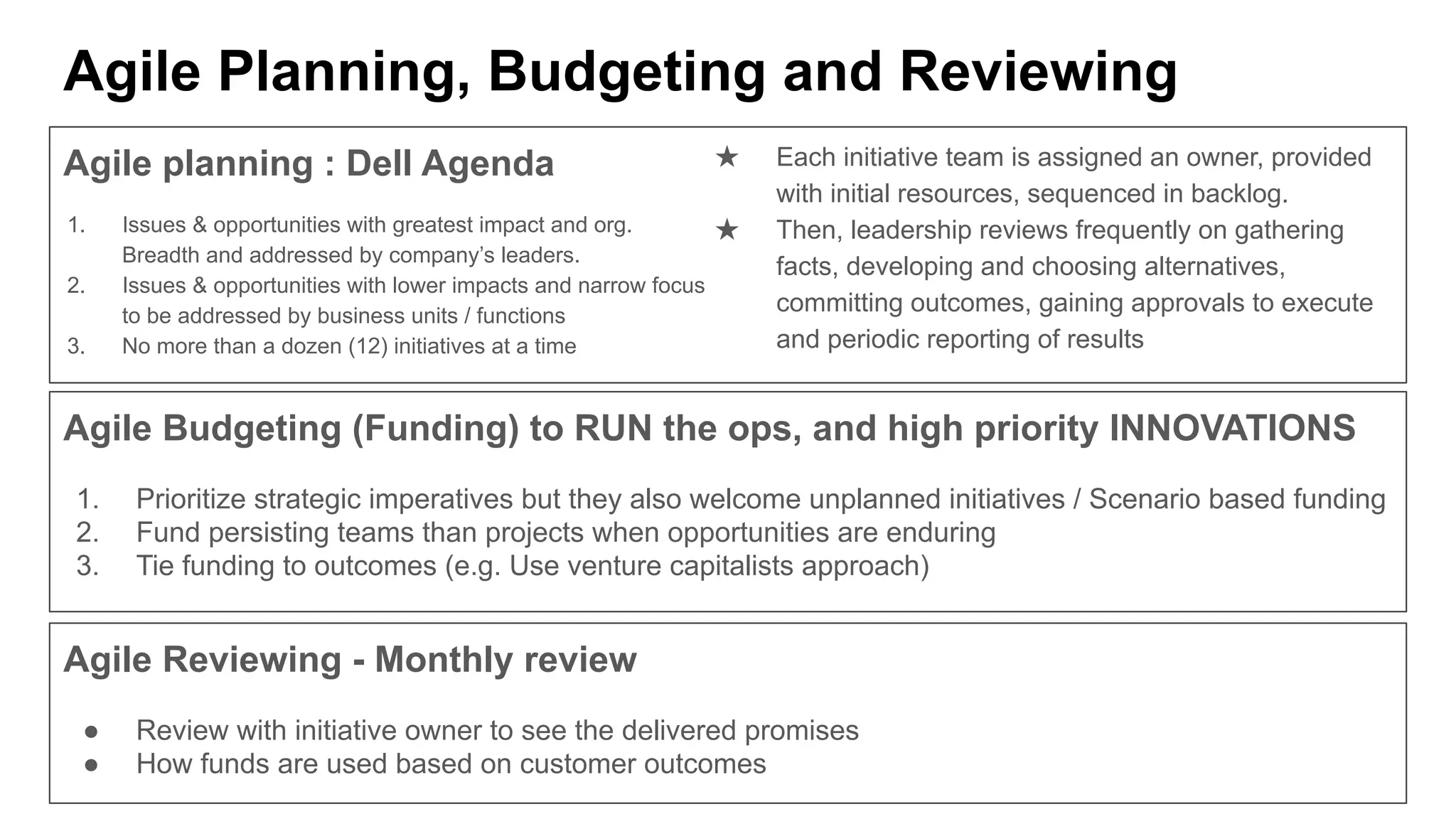
Agile Planning, Budgetingand Reviewing
1. Issues & opportunities with greatest impact and org.
Breadth and addressed by company’s leaders.
2. Issues & opportunities with lower impacts and narrow focus
to be addressed by business units / functions
3. No more than a dozen (12) initiatives at a time
Agile planning : Dell Agenda
Agile Budgeting (Funding) to RUN the ops, and high priority INNOVATIONS
1. Prioritize strategic imperatives but they also welcome unplanned initiatives / Scenario based funding
2. Fund persisting teams than projects when opportunities are enduring
3. Tie funding to outcomes (e.g. Use venture capitalists approach)
Agile Reviewing - Monthly review
● Review with initiative owner to see the delivered promises
● How funds are used based on customer outcomes
★ Each initiative team is assigned an owner, provided
with initial resources, sequenced in backlog.
★ Then, leadership reviews frequently on gathering
facts, developing and choosing alternatives,
committing outcomes, gaining approvals to execute
and periodic reporting of results
10.
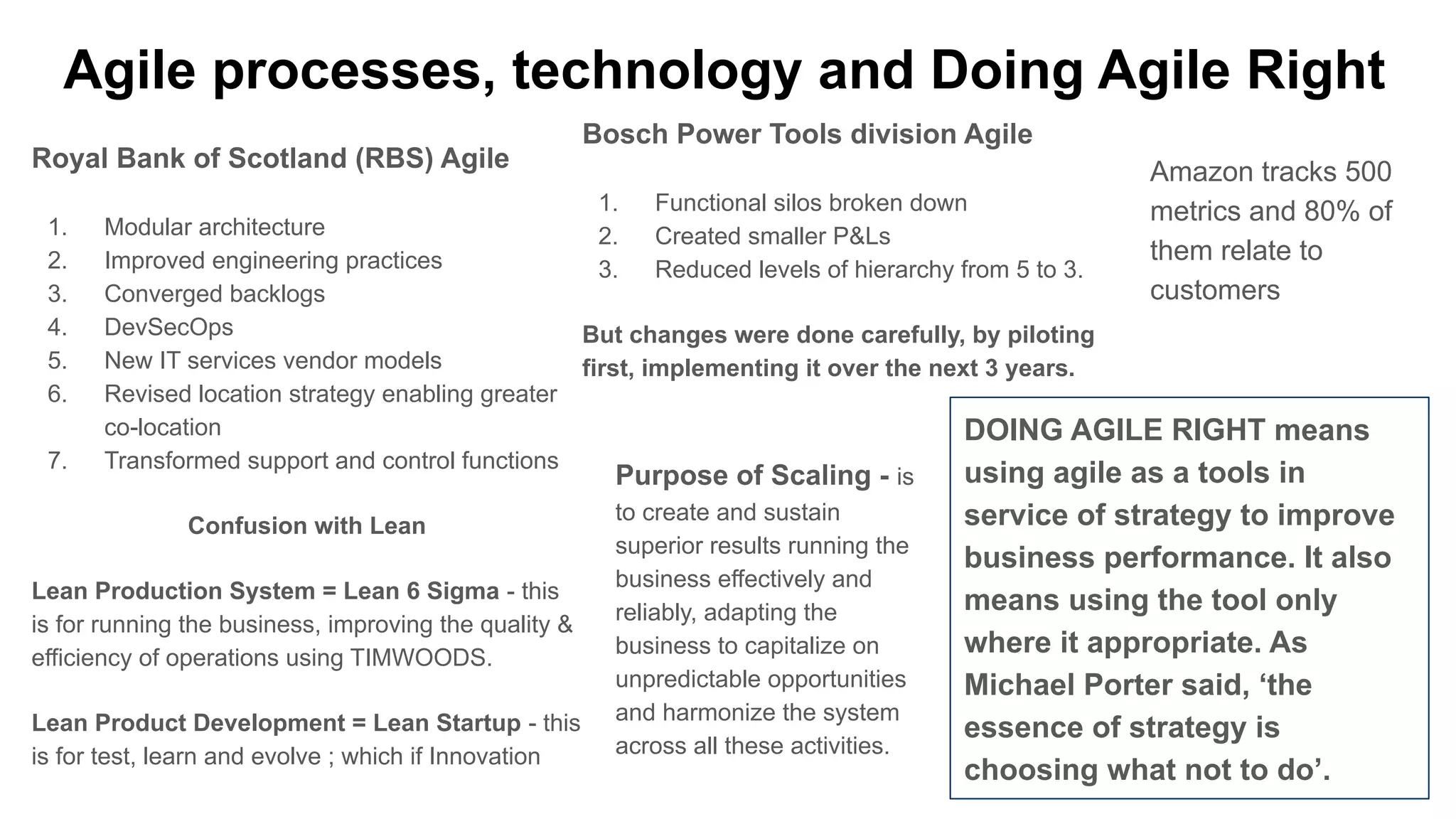
Agile processes, technologyand Doing Agile Right
Royal Bank of Scotland (RBS) Agile
1. Modular architecture
2. Improved engineering practices
3. Converged backlogs
4. DevSecOps
5. New IT services vendor models
6. Revised location strategy enabling greater
co-location
7. Transformed support and control functions
Confusion with Lean
Lean Production System = Lean 6 Sigma - this
is for running the business, improving the quality &
efficiency of operations using TIMWOODS.
Lean Product Development = Lean Startup - this
is for test, learn and evolve ; which if Innovation
Bosch Power Tools division Agile
1. Functional silos broken down
2. Created smaller P&Ls
3. Reduced levels of hierarchy from 5 to 3.
But changes were done carefully, by piloting
first, implementing it over the next 3 years.
DOING AGILE RIGHT means
using agile as a tools in
service of strategy to improve
business performance. It also
means using the tool only
where it appropriate. As
Michael Porter said, ‘the
essence of strategy is
choosing what not to do’.
Purpose of Scaling - is
to create and sustain
superior results running the
business effectively and
reliably, adapting the
business to capitalize on
unpredictable opportunities
and harmonize the system
across all these activities.
Amazon tracks 500
metrics and 80% of
them relate to
customers