Setting up the Centre of Excellence for RPA
David Thurkle and Mohit Sharma
GROW FOR TOMORROW
© 2017 Mindfields. All rights reserved. 2
Speakers
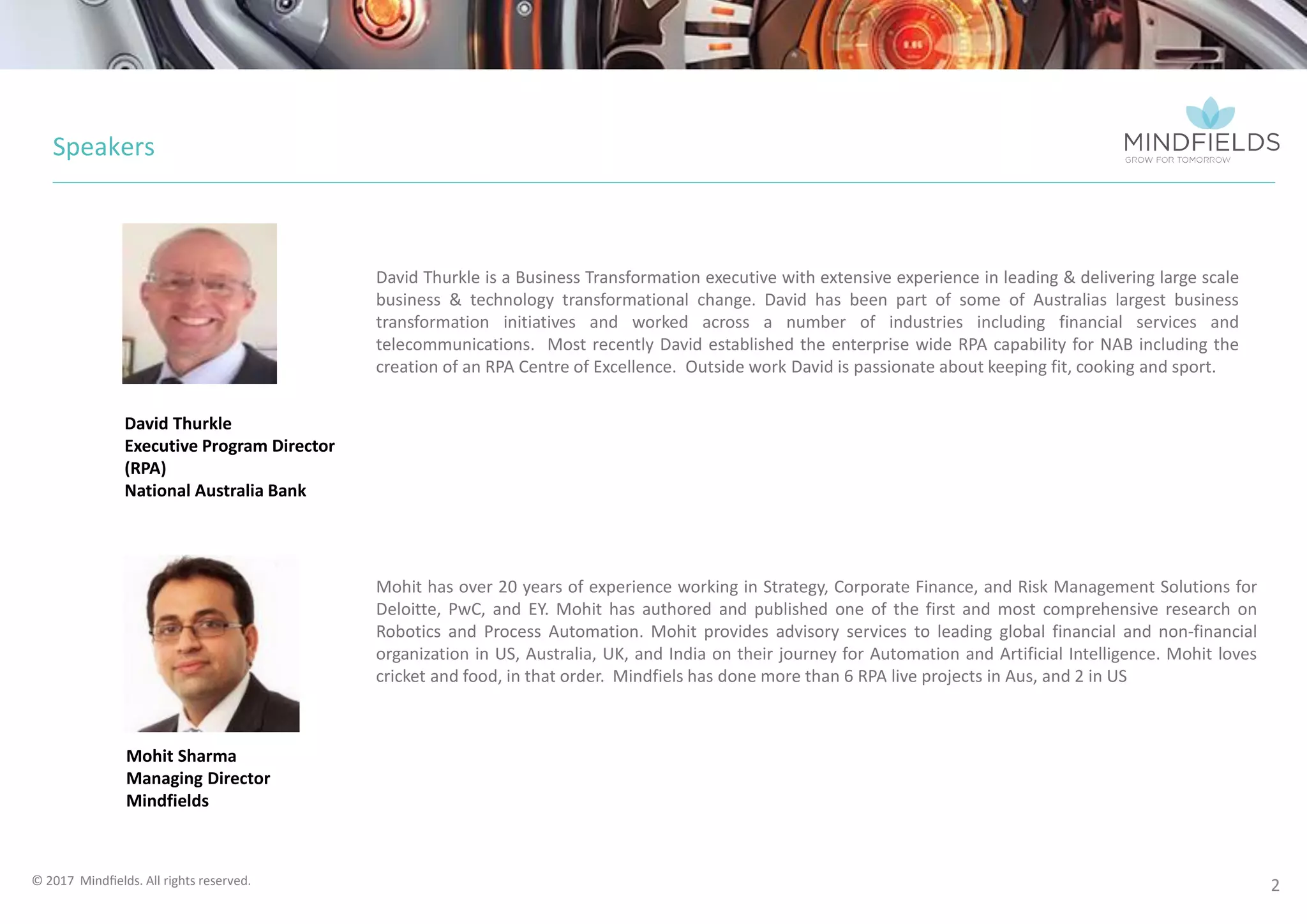
David Thurkle is a Business Transformation executive with extensive experience in leading & delivering large scale
business & technology transformational change. David has been part of some of Australias largest business
transformation initiatives and worked across a number of industries including financial services and
telecommunications. Most recently David established the enterprise wide RPA capability for NAB including the
creation of an RPA Centre of Excellence. Outside work David is passionate about keeping fit, cooking and sport.
Mohit has over 20 years of experience working in Strategy, Corporate Finance, and Risk Management Solutions for
Deloitte, PwC, and EY. Mohit has authored and published one of the first and most comprehensive research on
Robotics and Process Automation. Mohit provides advisory services to leading global financial and non-financial
organization in US, Australia, UK, and India on their journey for Automation and Artificial Intelligence. Mohit loves
cricket and food, in that order. Mindfiels has done more than 6 RPA live projects in Aus, and 2 in US
David Thurkle
Executive Program Director
(RPA)
National Australia Bank
Mohit Sharma
Managing Director
Mindfields
© 2017 Mindfields. All rights reserved.
3
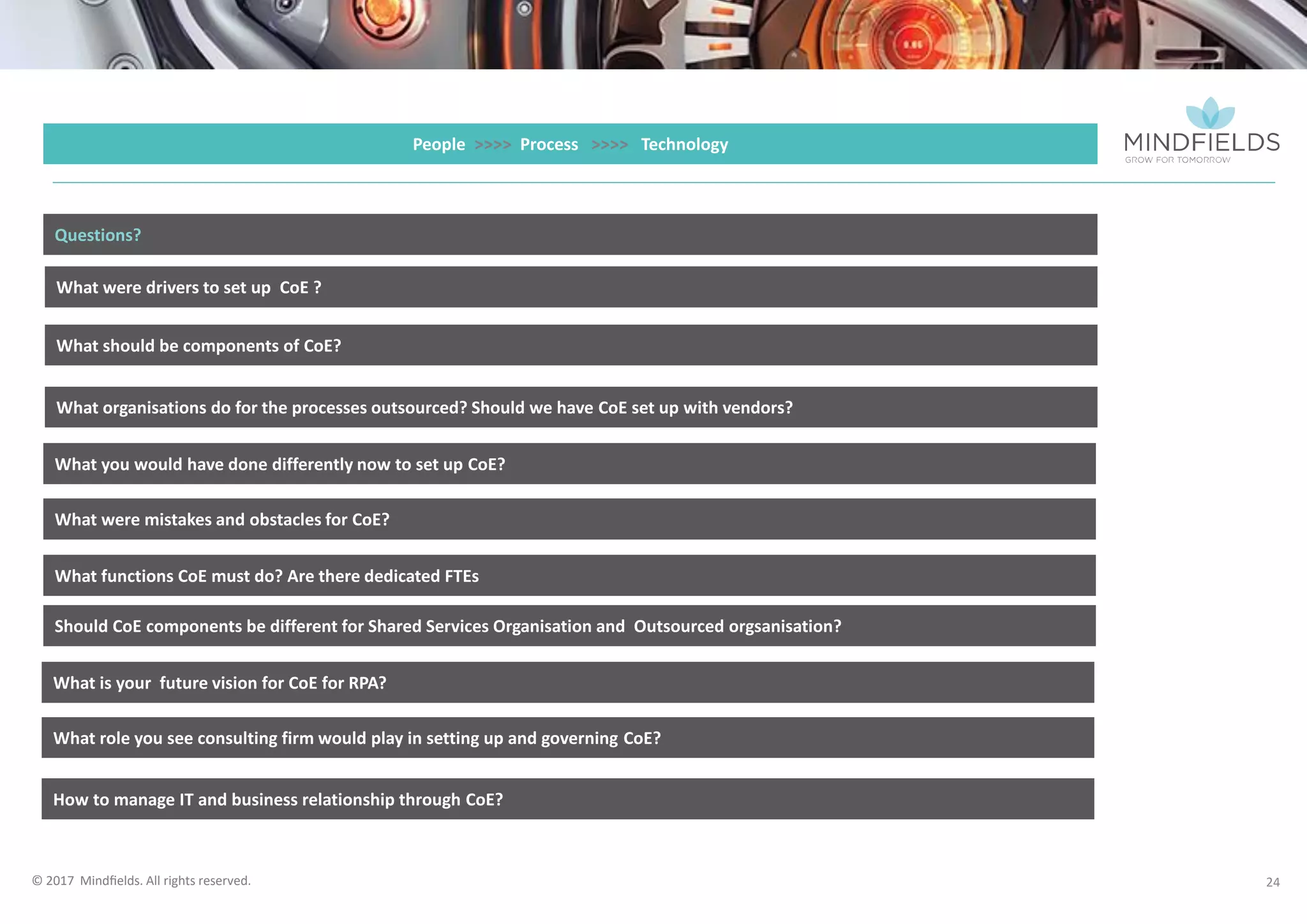
People >>>> Process >>>> Technology
Particulars Time
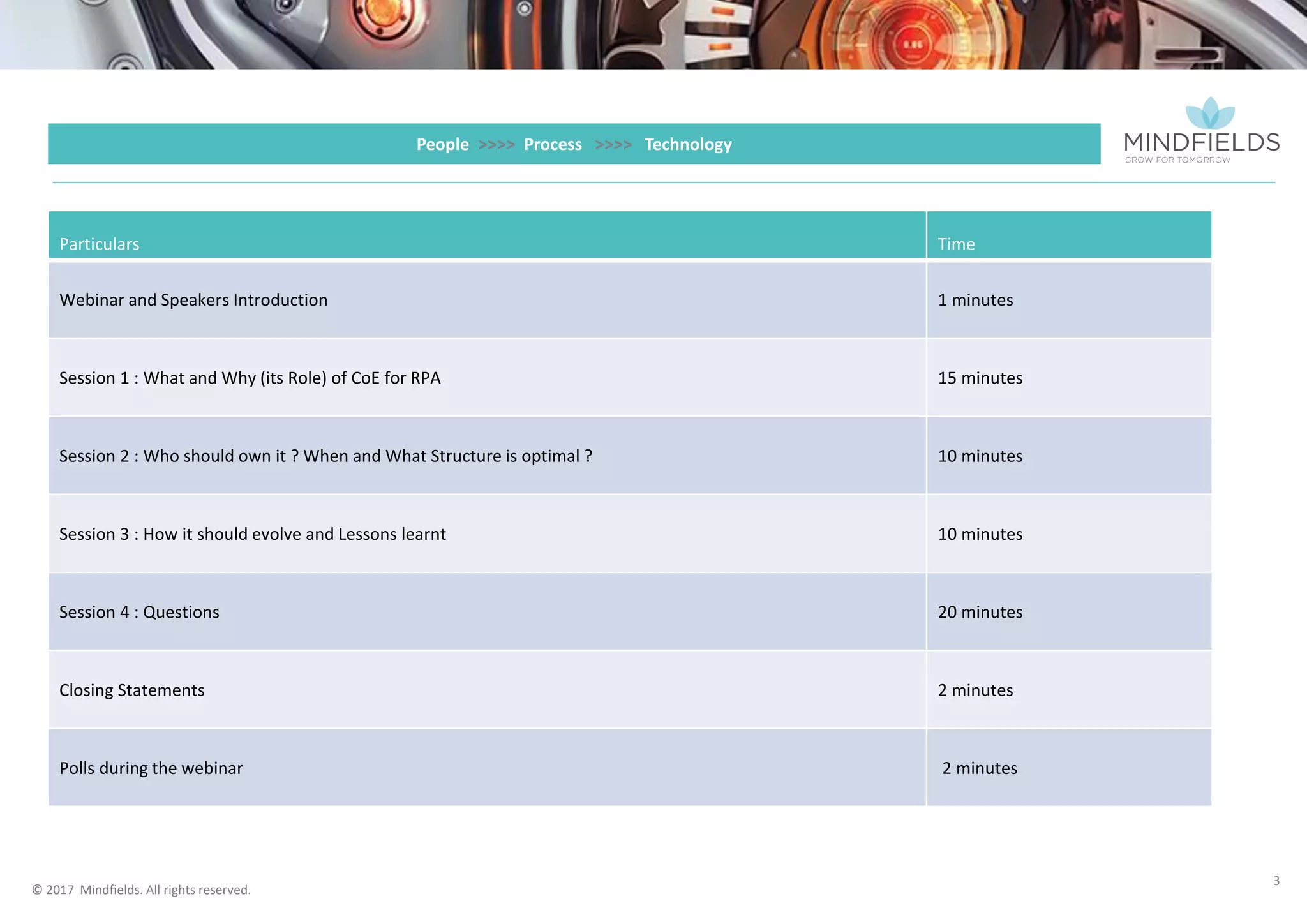
Webinar and Speakers Introduction 1 minutes
Session 1 : What and Why (its Role) of CoE for RPA 15 minutes
Session 2 : Who should own it ? When and What Structure is optimal ? 10 minutes
Session 3 : How it should evolve and Lessons learnt 10 minutes
Session 4 : Questions 20 minutes
Closing Statements 2 minutes
Polls during the webinar 2 minutes
© 2017 Mindfields. All rights reserved.
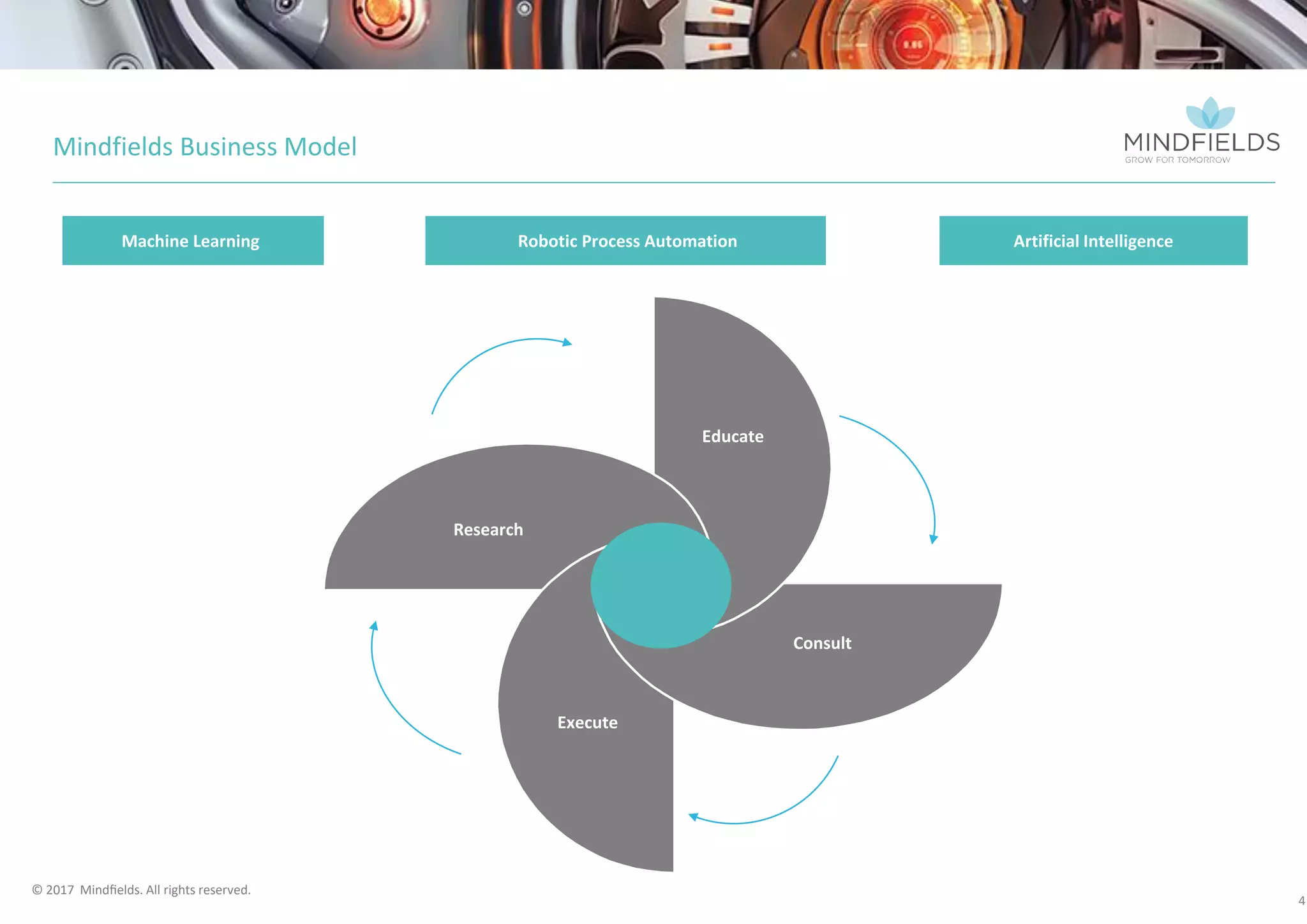
Mindfields Business Model here to watch video)((link to video)
4
Artificial IntelligenceRobotic Process AutomationMachine Learning
Educate
Execute
Consult
Research
© 2017 Mindfields. All rights reserved.
Our Value Proposition
Thought Leader in RPA Domain
Independent and Vendor
agnostic
RPA software agnostic Advisory focussedSuccess based pricing
5
© 2017 Mindfields. All rights reserved.
6
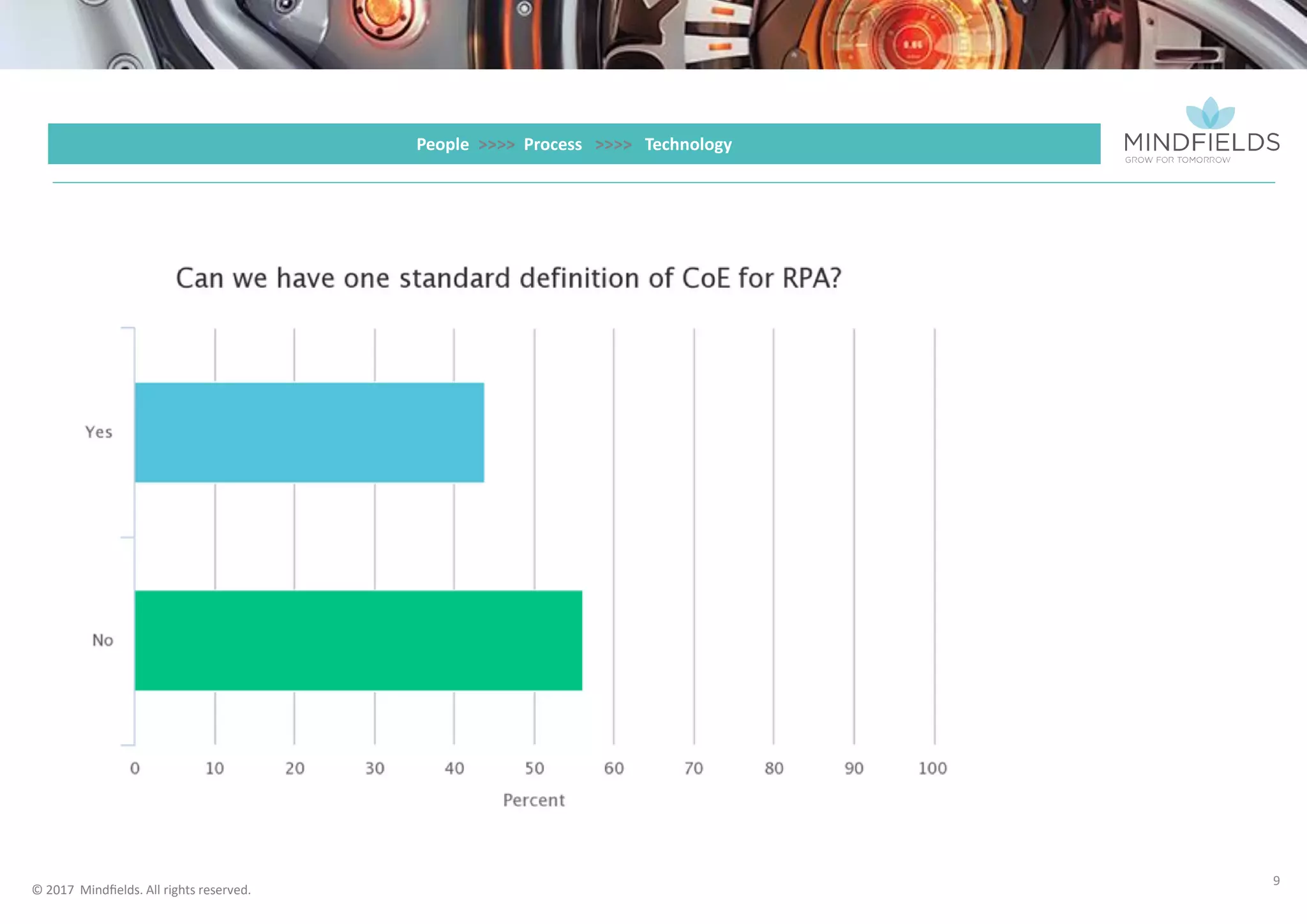
What is standard definition CoE for RPA and Why it is required (its role)?
People >>>> Process >>>> Technology
© 2017 Mindfields. All rights reserved.
7
People >>>> Process >>>> Technology
© 2017.Mindfields. All rights reserved.
8
People >>>> Process >>>> Technology
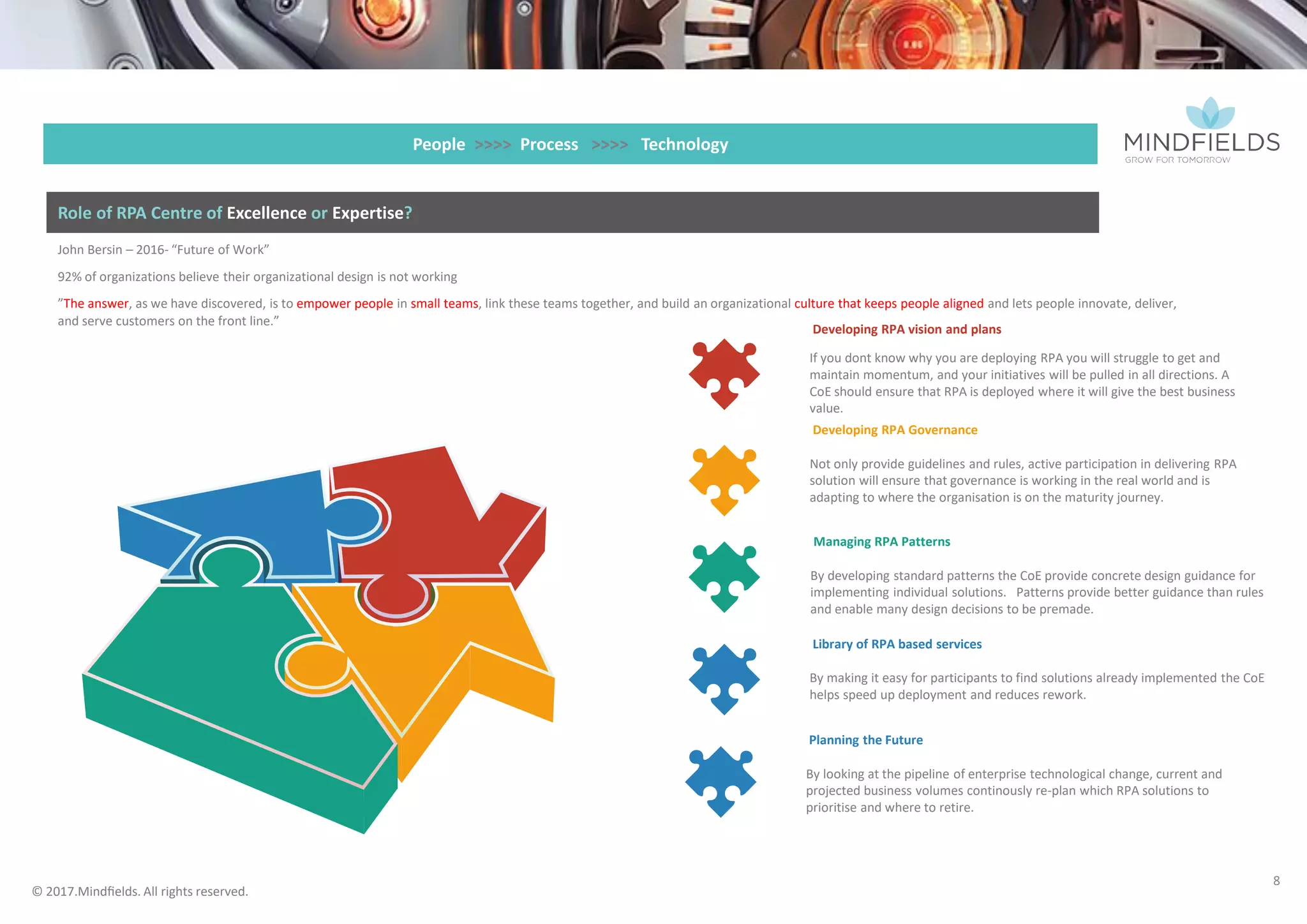
If you dont know why you are deploying RPA you will struggle to get and
maintain momentum, and your initiatives will be pulled in all directions. A
CoE should ensure that RPA is deployed where it will give the best business
value.
Developing RPA vision and plans
Not only provide guidelines and rules, active participation in delivering RPA
solution will ensure that governance is working in the real world and is
adapting to where the organisation is on the maturity journey.
Developing RPA Governance
By developing standard patterns the CoE provide concrete design guidance for
implementing individual solutions. Patterns provide better guidance than rules
and enable many design decisions to be premade.
Managing RPA Patterns
By making it easy for participants to find solutions already implemented the CoE
helps speed up deployment and reduces rework.
Library of RPA based services
By looking at the pipeline of enterprise technological change, current and
projected business volumes continously re-plan which RPA solutions to
prioritise and where to retire.
Planning the Future
Role of RPA Centre of Excellence or Expertise?
John Bersin – 2016- “Future of Work”
92% of organizations believe their organizational design is not working
”The answer, as we have discovered, is to empower people in small teams, link these teams together, and build an organizational culture that keeps people aligned and lets people innovate, deliver,
and serve customers on the front line.”
© 2017 Mindfields. All rights reserved. 9
People >>>> Process >>>> Technology
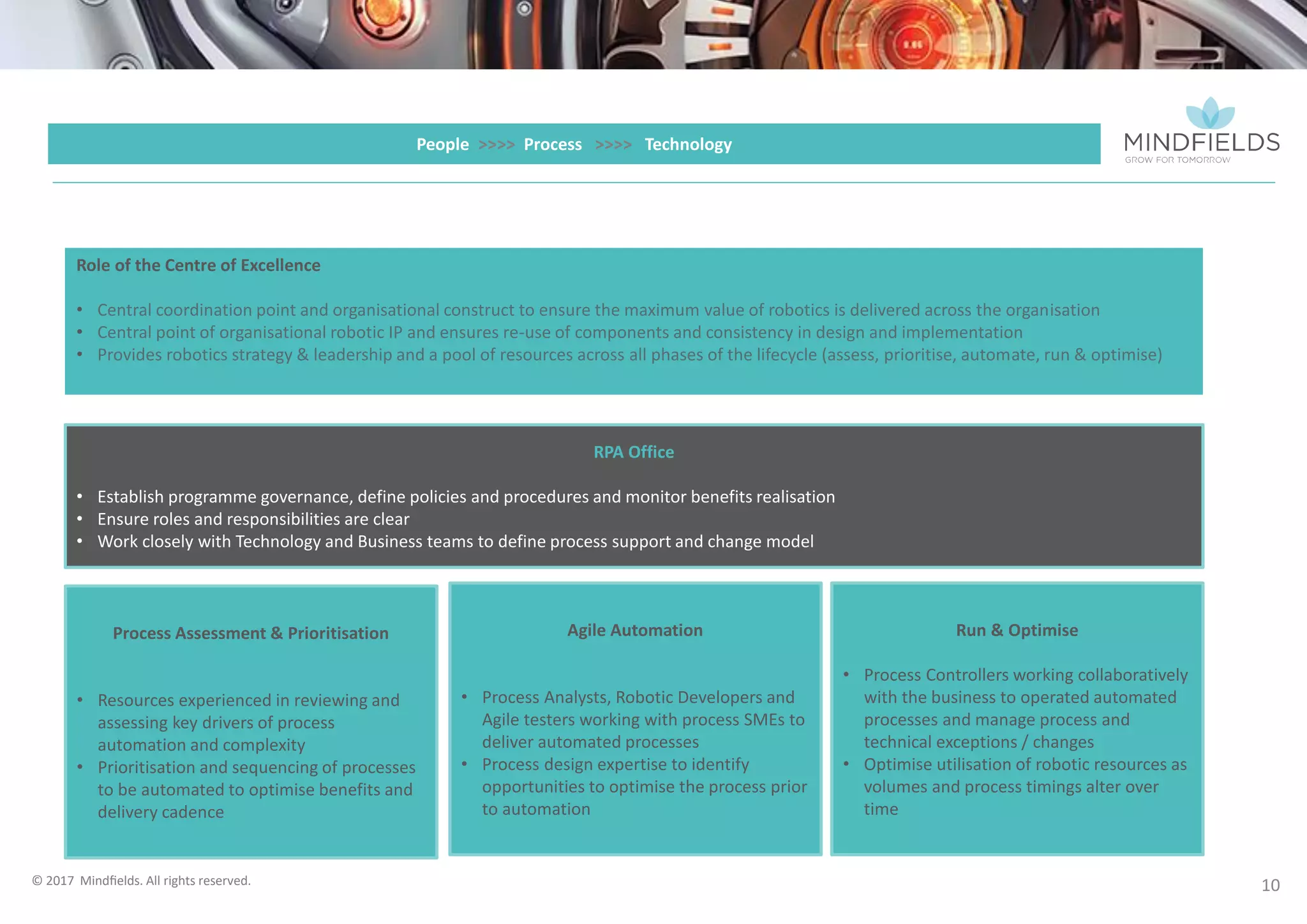
Role of the Centre of Excellence
• Central coordination point and organisational construct to ensure the maximum value of robotics is delivered across the organisation
• Central point of organisational robotic IP and ensures re-use of components and consistency in design and implementation
• Provides robotics strategy & leadership and a pool of resources across all phases of the lifecycle (assess, prioritise, automate, run & optimise)
Process Assessment & Prioritisation
• Resources experienced in reviewing and
assessing key drivers of process
automation and complexity
• Prioritisation and sequencing of processes
to be automated to optimise benefits and
delivery cadence
Agile Automation
• Process Analysts, Robotic Developers and
Agile testers working with process SMEs to
deliver automated processes
• Process design expertise to identify
opportunities to optimise the process prior
to automation
Run & Optimise
• Process Controllers working collaboratively
with the business to operated automated
processes and manage process and
technical exceptions / changes
• Optimise utilisation of robotic resources as
volumes and process timings alter over
time
RPA Office
• Establish programme governance, define policies and procedures and monitor benefits realisation
• Ensure roles and responsibilities are clear
• Work closely with Technology and Business teams to define process support and change model
© 2017 Mindfields. All rights reserved.
10
People >>>> Process >>>> Technology
© 2017 Mindfields. All rights reserved.
11
Who should own the CoE ?
People >>>> Process >>>> Technology
© 2017 Mindfields. All rights reserved.
12
People >>>> Process >>>> Technology
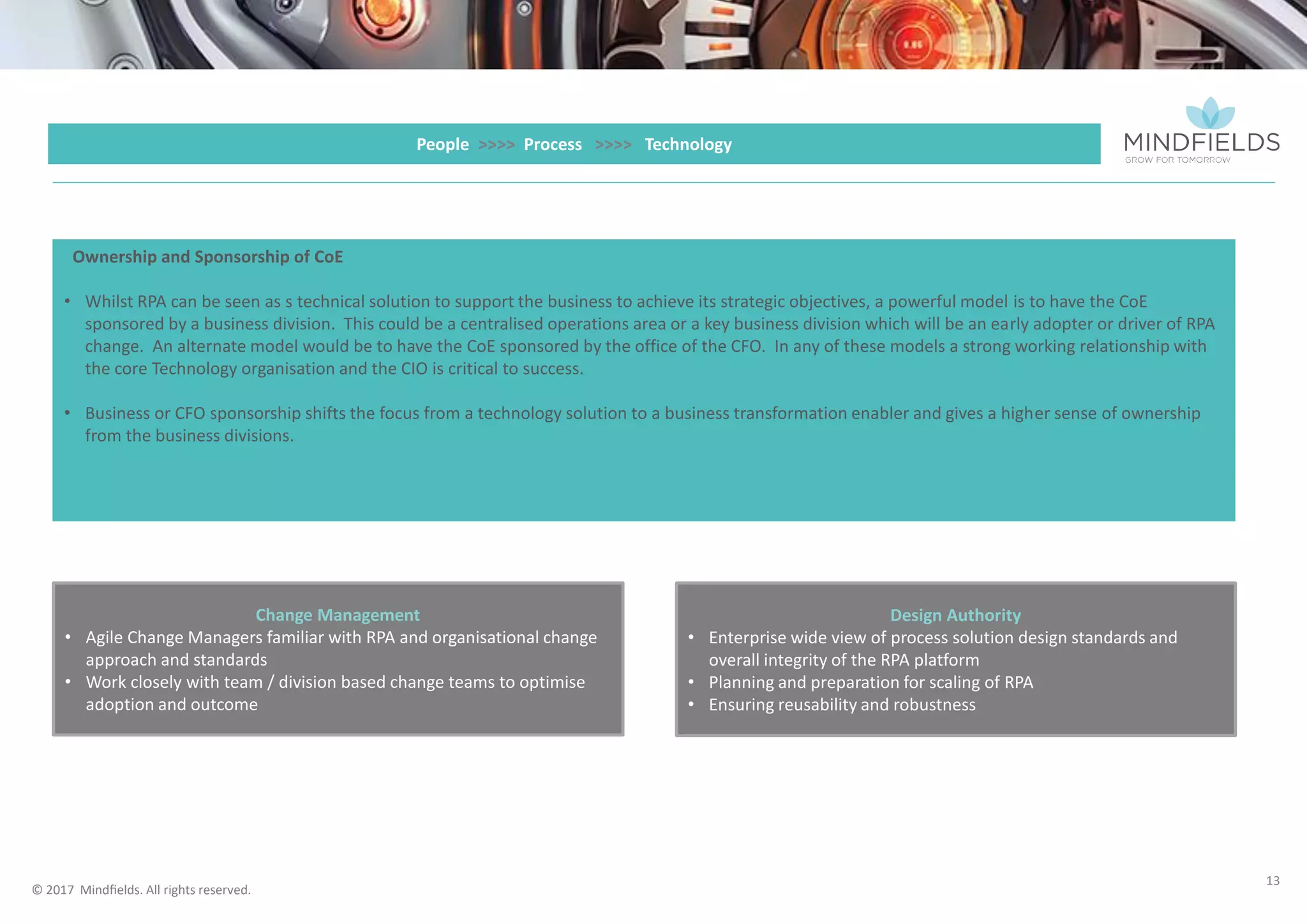
Ownership and Sponsorship of CoE
• Whilst RPA can be seen as s technical solution to support the business to achieve its strategic objectives, a powerful model is to have the CoE
sponsored by a business division. This could be a centralised operations area or a key business division which will be an early adopter or driver of RPA
change. An alternate model would be to have the CoE sponsored by the office of the CFO. In any of these models a strong working relationship with
the core Technology organisation and the CIO is critical to success.
• Business or CFO sponsorship shifts the focus from a technology solution to a business transformation enabler and gives a higher sense of ownership
from the business divisions.
Change Management
• Agile Change Managers familiar with RPA and organisational change
approach and standards
• Work closely with team / division based change teams to optimise
adoption and outcome
Design Authority
• Enterprise wide view of process solution design standards and
overall integrity of the RPA platform
• Planning and preparation for scaling of RPA
• Ensuring reusability and robustness
© 2017 Mindfields. All rights reserved.
13
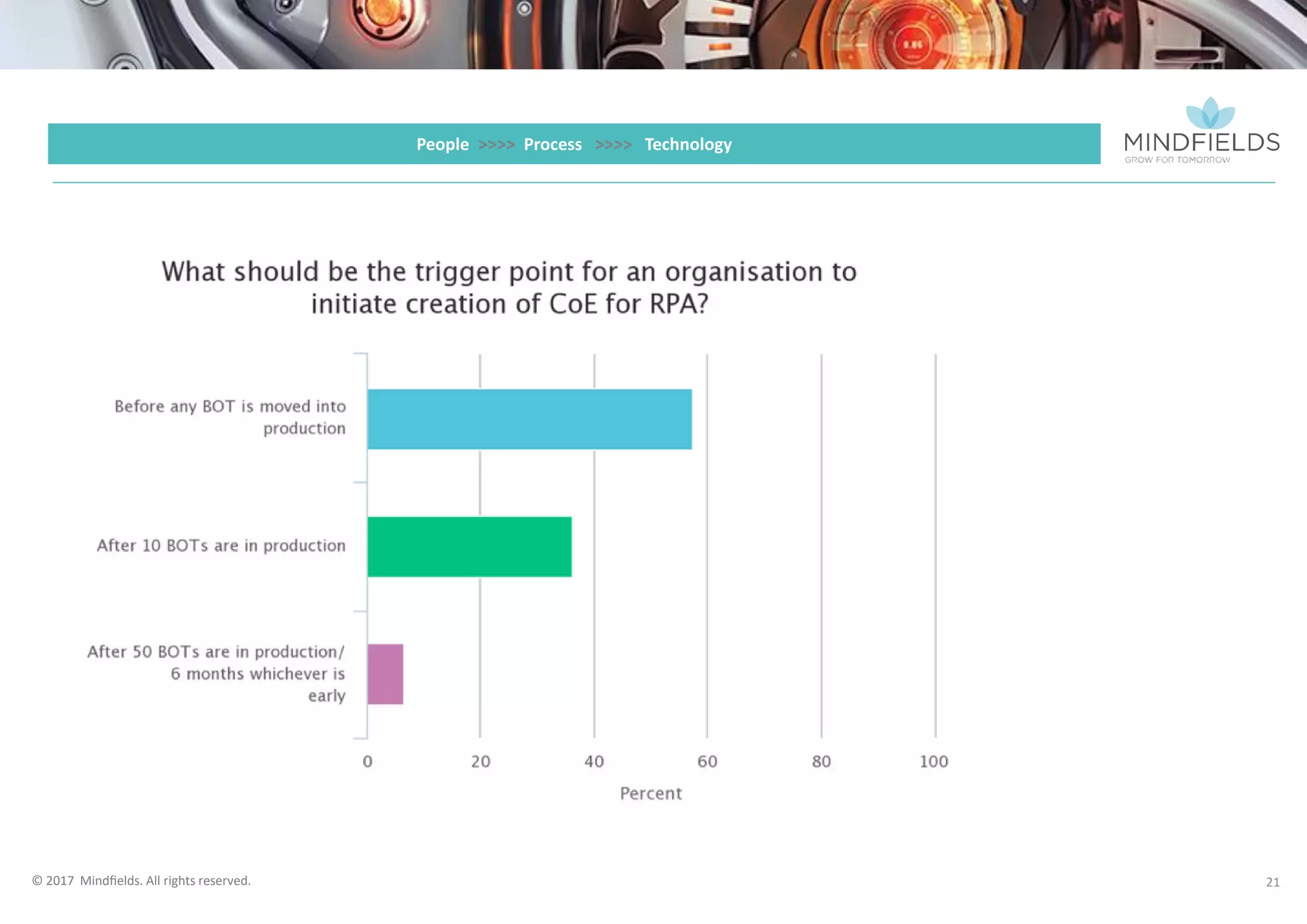
When should CoE for RPA be set up ?
People >>>> Process >>>> Technology
© 2017.Mindfields. All rights reserved.
14
People >>>> Process >>>> Technology
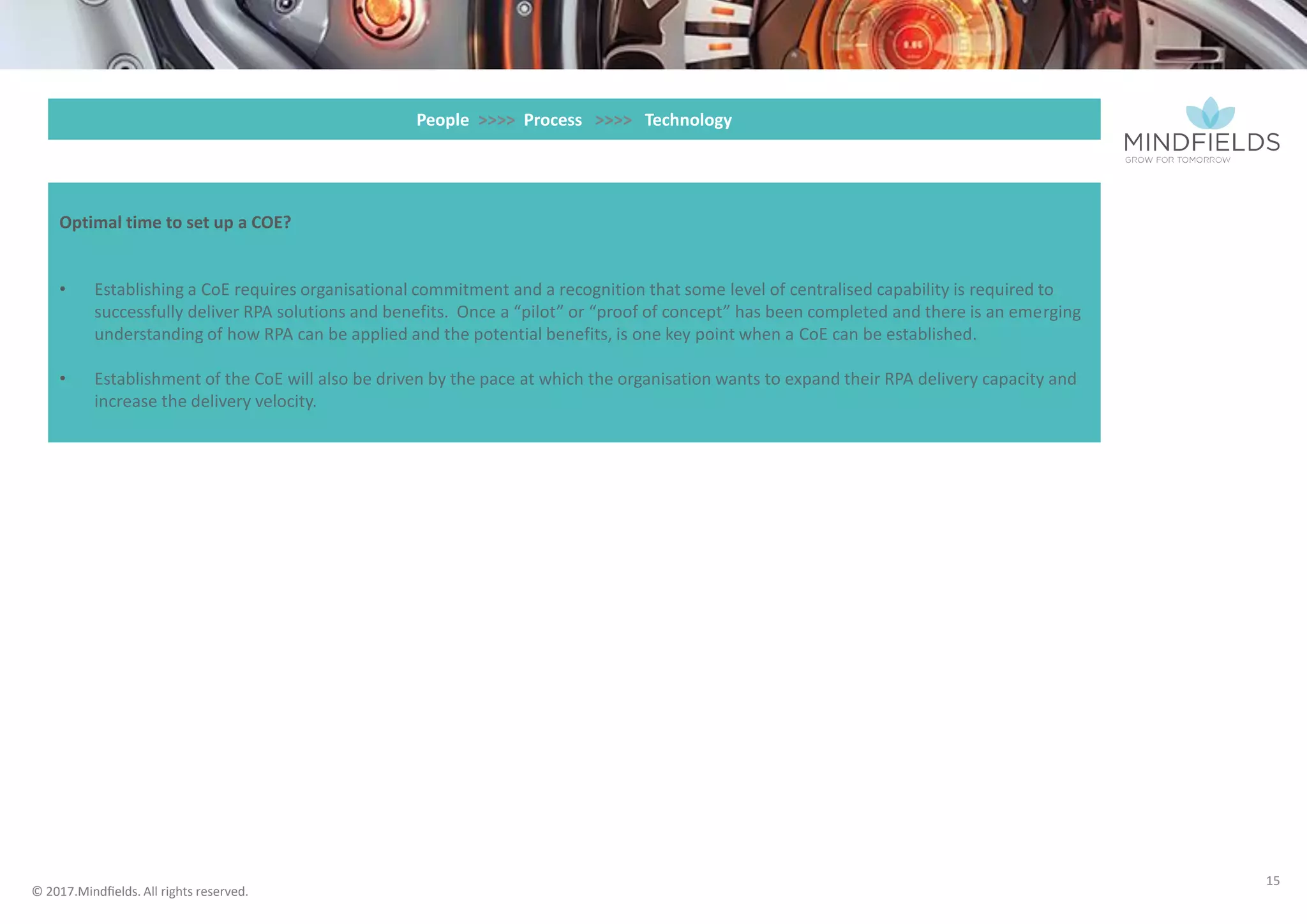
Optimal time to set up a COE?
• Establishing a CoE requires organisational commitment and a recognition that some level of centralised capability is required to
successfully deliver RPA solutions and benefits. Once a “pilot” or “proof of concept” has been completed and there is an emerging
understanding of how RPA can be applied and the potential benefits, is one key point when a CoE can be established.
• Establishment of the CoE will also be driven by the pace at which the organisation wants to expand their RPA delivery capacity and
increase the delivery velocity.
© 2017 Mindfields. All rights reserved.
15
People >>>> Process >>>> Technology
© 2017 Mindfields. All rights reserved.
16
What should be optimal structure for CoE for RPA?
People >>>> Process >>>> Technology
© 2017 Mindfields. All rights reserved.
17
People >>>> Process >>>> Technology
© 2017.Mindfields. All rights reserved.
18
People >>>> Process >>>> Technology
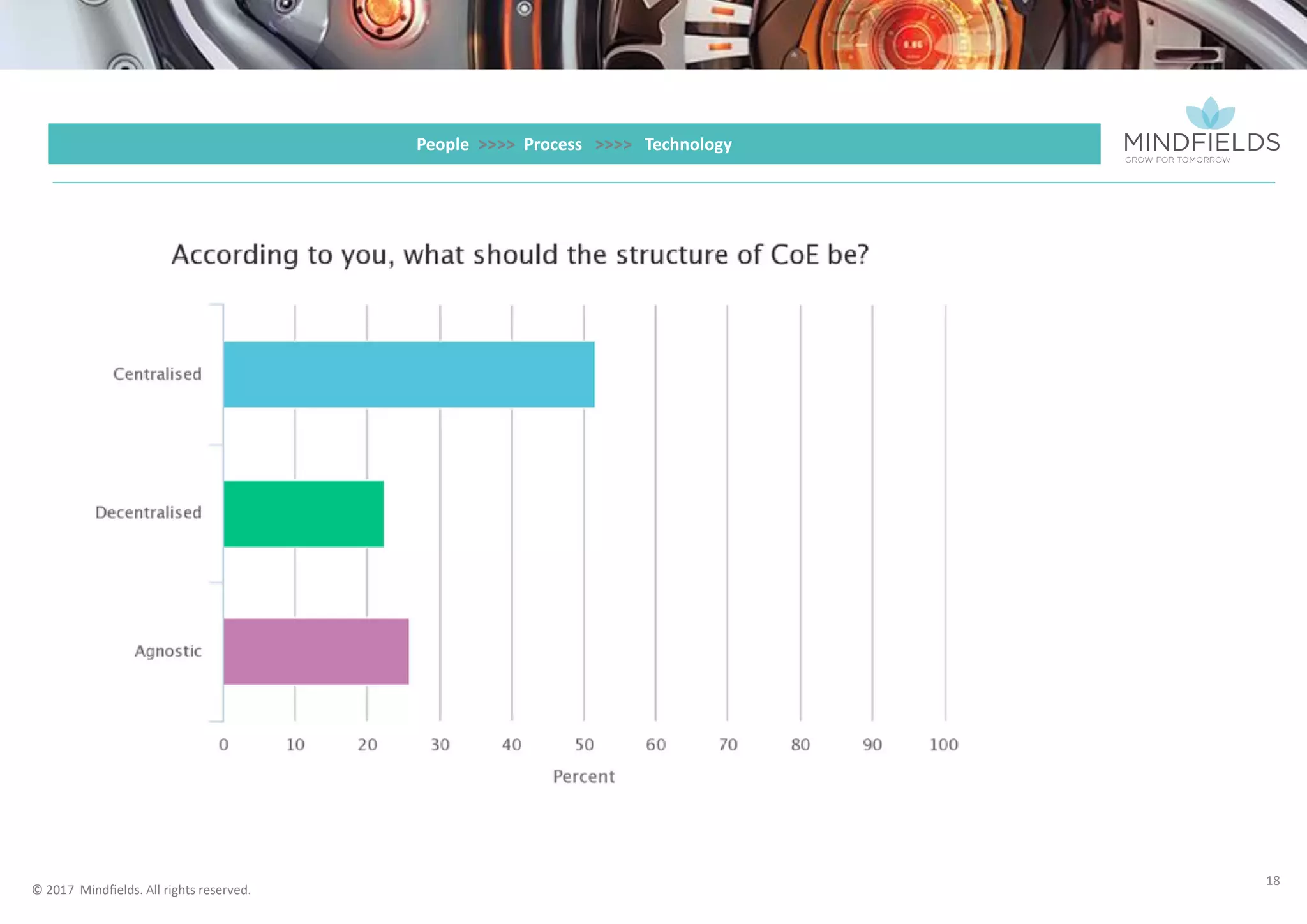
De-centralised
• Local business teams have the best view of what needs to be automated
to drive improvement
• Builds momentum and expertise with the local teams – potentially more
cost effective
• Not constrained by central team capacity to service RPA demand
• Less governance and “overhead”
• Business leaders and teams feel more empowered and accountable for
meeting business objectives via RPA
• Potentially lower cost delivery model at the local level
Centralised
• View of all initiatives across the organisation
• Stronger governance over which processes are prioritised for automation
• Easier to track overall RPA portfolio health and benefit realisation
• End to end view of process change which can identify synergies and
increased opportunities for process optimisation and / or RPA in end to
end value streams
• Re-use of objects for common applications - Build it once
• Higher level of optimisation of available robot capacity across the
organisation
• Provides a common set of standards for process assessment, delivery and
maintenance and monitoring
• Single source of expertise and capability to service the entire enterprise
• Consistent interaction point with Technology teams – builds confidence
and repeatable procedures
A decision to operate a more centralised capability vs decentralised should take into account the organisational operating model, culture and
objectives of the RPA programme
© 2017 Mindfields. All rights reserved.
19
People >>>> Process >>>> Technology
© 2017 Mindfields. All rights reserved.
20
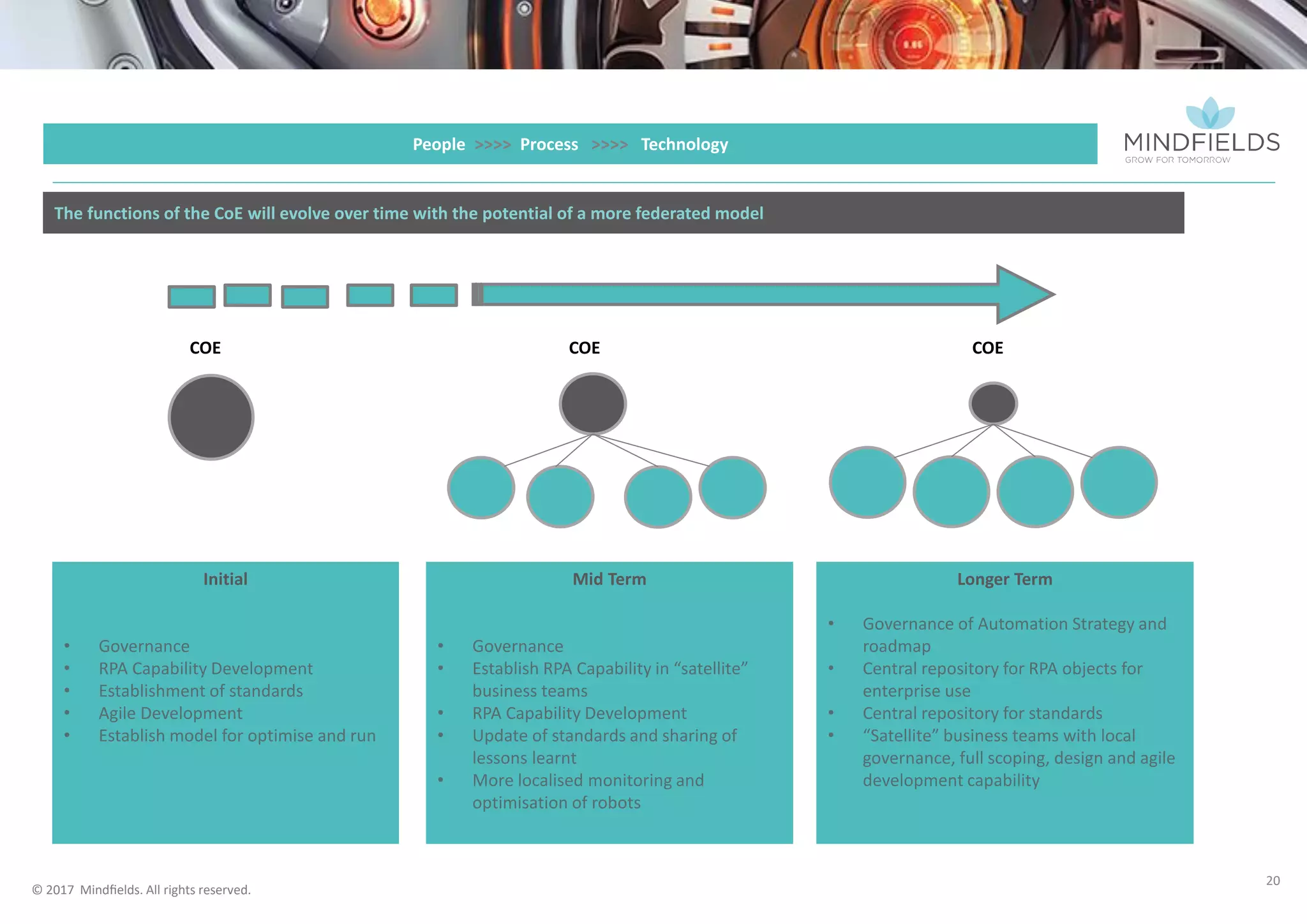
How should CoE for RPA evolve?
People >>>> Process >>>> Technology
© 2017 Mindfields. All rights reserved.
21
People >>>> Process >>>> Technology
The functions of the CoE will evolve over time with the potential of a more federated model
Initial
• Governance
• RPA Capability Development
• Establishment of standards
• Agile Development
• Establish model for optimise and run
Mid Term
• Governance
• Establish RPA Capability in “satellite”
business teams
• RPA Capability Development
• Update of standards and sharing of
lessons learnt
• More localised monitoring and
optimisation of robots
Longer Term
• Governance of Automation Strategy and
roadmap
• Central repository for RPA objects for
enterprise use
• Central repository for standards
• “Satellite” business teams with local
governance, full scoping, design and agile
development capability
COECOECOE
© 2017 Mindfields. All rights reserved.
22
Key lessons learnt
People >>>> Process >>>> Technology
© 2017 Mindfields. All rights reserved.
• Have a demand management capability before marketing RPA to the broader organisation. Business units can get very creative with
RPA and demand will pick up quickly. Have an idea of how prioritisation, license allocation, hardware asset allocation etc. will be
governed
• Establish the relationship with the Technology teams early and make sure they are part of the CoE. Navigating the change
management and support landscape in technology can be complex and they are a key part of the overall success for RPA at an
enterprise scale
• Early engagement with Risk, Security and other control groups. Establishing procedures and policies for RPA which can be managed
from the CoE will enable more rapid deployment of RPA into other parts of the organisation as the capability scales
• The CoE provides a great incubator for the development of RPA skills for the enterprise. If looking to develop internal capability the
CoE can provide training, coaching and an opportunity to learn from others experiences.
People >>>> Process >>>> Technology
Key Learnings
23
© 2017 Mindfields. All rights reserved.
24
People >>>> Process >>>> Technology
What were drivers to set up CoE ?
What should be components of CoE?
What organisations do for the processes outsourced? Should we have CoE set up with vendors?
What you would have done differently now to set up CoE?
Questions?
What were mistakes and obstacles for CoE?
What functions CoE must do? Are there dedicated FTEs
Should CoE components be different for Shared Services Organisation and Outsourced orgsanisation?
What is your future vision for CoE for RPA?
What role you see consulting firm would play in setting up and governing CoE?
How to manage IT and business relationship through CoE?
© 2017 Mindfields. All rights reserved.
25
GROW FOR TOMORROW
AUSTRALIA
Level 7,
171 Clarence Street
Sydney NSW 2000
Telephone: +61 (02) 8034 6304
Facsimile: +61 (02) 8677 8400
Level 3, 480 Collins Street
Melbourne VIC 3000
Telephone: +61 (02) 8610 6327
Facsimile: +61 (02) 8610 6334
USA
276, 5th Avenue
Suite 704, New York
NY 10001
Telephone: +1 212 203 7209
Facsimile: +1 917 472 1489
INDIA
7, Barakhambha Road
Connaught Place
New Delhi 110006
703-706, 7th Floor, Arcadia
Plot No. 195, Nariman Point
Mumbai 400021
research@mindfields.net.au
www.mindfields.net.au
For more information please contact us at research@mindfields.net.au

Setting up The Centre of Excellence for Rpa

  • 1.
    Setting up theCentre of Excellence for RPA David Thurkle and Mohit Sharma GROW FOR TOMORROW
  • 2.
    © 2017 Mindfields.All rights reserved. 2 Speakers David Thurkle is a Business Transformation executive with extensive experience in leading & delivering large scale business & technology transformational change. David has been part of some of Australias largest business transformation initiatives and worked across a number of industries including financial services and telecommunications. Most recently David established the enterprise wide RPA capability for NAB including the creation of an RPA Centre of Excellence. Outside work David is passionate about keeping fit, cooking and sport. Mohit has over 20 years of experience working in Strategy, Corporate Finance, and Risk Management Solutions for Deloitte, PwC, and EY. Mohit has authored and published one of the first and most comprehensive research on Robotics and Process Automation. Mohit provides advisory services to leading global financial and non-financial organization in US, Australia, UK, and India on their journey for Automation and Artificial Intelligence. Mohit loves cricket and food, in that order. Mindfiels has done more than 6 RPA live projects in Aus, and 2 in US David Thurkle Executive Program Director (RPA) National Australia Bank Mohit Sharma Managing Director Mindfields
  • 3.
    © 2017 Mindfields.All rights reserved. 3 People >>>> Process >>>> Technology Particulars Time Webinar and Speakers Introduction 1 minutes Session 1 : What and Why (its Role) of CoE for RPA 15 minutes Session 2 : Who should own it ? When and What Structure is optimal ? 10 minutes Session 3 : How it should evolve and Lessons learnt 10 minutes Session 4 : Questions 20 minutes Closing Statements 2 minutes Polls during the webinar 2 minutes
  • 4.
    © 2017 Mindfields.All rights reserved. Mindfields Business Model here to watch video)((link to video) 4 Artificial IntelligenceRobotic Process AutomationMachine Learning Educate Execute Consult Research
  • 5.
    © 2017 Mindfields.All rights reserved. Our Value Proposition Thought Leader in RPA Domain Independent and Vendor agnostic RPA software agnostic Advisory focussedSuccess based pricing 5
  • 6.
    © 2017 Mindfields.All rights reserved. 6 What is standard definition CoE for RPA and Why it is required (its role)? People >>>> Process >>>> Technology
  • 7.
    © 2017 Mindfields.All rights reserved. 7 People >>>> Process >>>> Technology
  • 8.
    © 2017.Mindfields. Allrights reserved. 8 People >>>> Process >>>> Technology If you dont know why you are deploying RPA you will struggle to get and maintain momentum, and your initiatives will be pulled in all directions. A CoE should ensure that RPA is deployed where it will give the best business value. Developing RPA vision and plans Not only provide guidelines and rules, active participation in delivering RPA solution will ensure that governance is working in the real world and is adapting to where the organisation is on the maturity journey. Developing RPA Governance By developing standard patterns the CoE provide concrete design guidance for implementing individual solutions. Patterns provide better guidance than rules and enable many design decisions to be premade. Managing RPA Patterns By making it easy for participants to find solutions already implemented the CoE helps speed up deployment and reduces rework. Library of RPA based services By looking at the pipeline of enterprise technological change, current and projected business volumes continously re-plan which RPA solutions to prioritise and where to retire. Planning the Future Role of RPA Centre of Excellence or Expertise? John Bersin – 2016- “Future of Work” 92% of organizations believe their organizational design is not working ”The answer, as we have discovered, is to empower people in small teams, link these teams together, and build an organizational culture that keeps people aligned and lets people innovate, deliver, and serve customers on the front line.”
  • 9.
    © 2017 Mindfields.All rights reserved. 9 People >>>> Process >>>> Technology Role of the Centre of Excellence • Central coordination point and organisational construct to ensure the maximum value of robotics is delivered across the organisation • Central point of organisational robotic IP and ensures re-use of components and consistency in design and implementation • Provides robotics strategy & leadership and a pool of resources across all phases of the lifecycle (assess, prioritise, automate, run & optimise) Process Assessment & Prioritisation • Resources experienced in reviewing and assessing key drivers of process automation and complexity • Prioritisation and sequencing of processes to be automated to optimise benefits and delivery cadence Agile Automation • Process Analysts, Robotic Developers and Agile testers working with process SMEs to deliver automated processes • Process design expertise to identify opportunities to optimise the process prior to automation Run & Optimise • Process Controllers working collaboratively with the business to operated automated processes and manage process and technical exceptions / changes • Optimise utilisation of robotic resources as volumes and process timings alter over time RPA Office • Establish programme governance, define policies and procedures and monitor benefits realisation • Ensure roles and responsibilities are clear • Work closely with Technology and Business teams to define process support and change model
  • 10.
    © 2017 Mindfields.All rights reserved. 10 People >>>> Process >>>> Technology
  • 11.
    © 2017 Mindfields.All rights reserved. 11 Who should own the CoE ? People >>>> Process >>>> Technology
  • 12.
    © 2017 Mindfields.All rights reserved. 12 People >>>> Process >>>> Technology Ownership and Sponsorship of CoE • Whilst RPA can be seen as s technical solution to support the business to achieve its strategic objectives, a powerful model is to have the CoE sponsored by a business division. This could be a centralised operations area or a key business division which will be an early adopter or driver of RPA change. An alternate model would be to have the CoE sponsored by the office of the CFO. In any of these models a strong working relationship with the core Technology organisation and the CIO is critical to success. • Business or CFO sponsorship shifts the focus from a technology solution to a business transformation enabler and gives a higher sense of ownership from the business divisions. Change Management • Agile Change Managers familiar with RPA and organisational change approach and standards • Work closely with team / division based change teams to optimise adoption and outcome Design Authority • Enterprise wide view of process solution design standards and overall integrity of the RPA platform • Planning and preparation for scaling of RPA • Ensuring reusability and robustness
  • 13.
    © 2017 Mindfields.All rights reserved. 13 When should CoE for RPA be set up ? People >>>> Process >>>> Technology
  • 14.
    © 2017.Mindfields. Allrights reserved. 14 People >>>> Process >>>> Technology Optimal time to set up a COE? • Establishing a CoE requires organisational commitment and a recognition that some level of centralised capability is required to successfully deliver RPA solutions and benefits. Once a “pilot” or “proof of concept” has been completed and there is an emerging understanding of how RPA can be applied and the potential benefits, is one key point when a CoE can be established. • Establishment of the CoE will also be driven by the pace at which the organisation wants to expand their RPA delivery capacity and increase the delivery velocity.
  • 15.
    © 2017 Mindfields.All rights reserved. 15 People >>>> Process >>>> Technology
  • 16.
    © 2017 Mindfields.All rights reserved. 16 What should be optimal structure for CoE for RPA? People >>>> Process >>>> Technology
  • 17.
    © 2017 Mindfields.All rights reserved. 17 People >>>> Process >>>> Technology
  • 18.
    © 2017.Mindfields. Allrights reserved. 18 People >>>> Process >>>> Technology De-centralised • Local business teams have the best view of what needs to be automated to drive improvement • Builds momentum and expertise with the local teams – potentially more cost effective • Not constrained by central team capacity to service RPA demand • Less governance and “overhead” • Business leaders and teams feel more empowered and accountable for meeting business objectives via RPA • Potentially lower cost delivery model at the local level Centralised • View of all initiatives across the organisation • Stronger governance over which processes are prioritised for automation • Easier to track overall RPA portfolio health and benefit realisation • End to end view of process change which can identify synergies and increased opportunities for process optimisation and / or RPA in end to end value streams • Re-use of objects for common applications - Build it once • Higher level of optimisation of available robot capacity across the organisation • Provides a common set of standards for process assessment, delivery and maintenance and monitoring • Single source of expertise and capability to service the entire enterprise • Consistent interaction point with Technology teams – builds confidence and repeatable procedures A decision to operate a more centralised capability vs decentralised should take into account the organisational operating model, culture and objectives of the RPA programme
  • 19.
    © 2017 Mindfields.All rights reserved. 19 People >>>> Process >>>> Technology
  • 20.
    © 2017 Mindfields.All rights reserved. 20 How should CoE for RPA evolve? People >>>> Process >>>> Technology
  • 21.
    © 2017 Mindfields.All rights reserved. 21 People >>>> Process >>>> Technology The functions of the CoE will evolve over time with the potential of a more federated model Initial • Governance • RPA Capability Development • Establishment of standards • Agile Development • Establish model for optimise and run Mid Term • Governance • Establish RPA Capability in “satellite” business teams • RPA Capability Development • Update of standards and sharing of lessons learnt • More localised monitoring and optimisation of robots Longer Term • Governance of Automation Strategy and roadmap • Central repository for RPA objects for enterprise use • Central repository for standards • “Satellite” business teams with local governance, full scoping, design and agile development capability COECOECOE
  • 22.
    © 2017 Mindfields.All rights reserved. 22 Key lessons learnt People >>>> Process >>>> Technology
  • 23.
    © 2017 Mindfields.All rights reserved. • Have a demand management capability before marketing RPA to the broader organisation. Business units can get very creative with RPA and demand will pick up quickly. Have an idea of how prioritisation, license allocation, hardware asset allocation etc. will be governed • Establish the relationship with the Technology teams early and make sure they are part of the CoE. Navigating the change management and support landscape in technology can be complex and they are a key part of the overall success for RPA at an enterprise scale • Early engagement with Risk, Security and other control groups. Establishing procedures and policies for RPA which can be managed from the CoE will enable more rapid deployment of RPA into other parts of the organisation as the capability scales • The CoE provides a great incubator for the development of RPA skills for the enterprise. If looking to develop internal capability the CoE can provide training, coaching and an opportunity to learn from others experiences. People >>>> Process >>>> Technology Key Learnings 23
  • 24.
    © 2017 Mindfields.All rights reserved. 24 People >>>> Process >>>> Technology What were drivers to set up CoE ? What should be components of CoE? What organisations do for the processes outsourced? Should we have CoE set up with vendors? What you would have done differently now to set up CoE? Questions? What were mistakes and obstacles for CoE? What functions CoE must do? Are there dedicated FTEs Should CoE components be different for Shared Services Organisation and Outsourced orgsanisation? What is your future vision for CoE for RPA? What role you see consulting firm would play in setting up and governing CoE? How to manage IT and business relationship through CoE?
  • 25.
    © 2017 Mindfields.All rights reserved. 25 GROW FOR TOMORROW AUSTRALIA Level 7, 171 Clarence Street Sydney NSW 2000 Telephone: +61 (02) 8034 6304 Facsimile: +61 (02) 8677 8400 Level 3, 480 Collins Street Melbourne VIC 3000 Telephone: +61 (02) 8610 6327 Facsimile: +61 (02) 8610 6334 USA 276, 5th Avenue Suite 704, New York NY 10001 Telephone: +1 212 203 7209 Facsimile: +1 917 472 1489 INDIA 7, Barakhambha Road Connaught Place New Delhi 110006 703-706, 7th Floor, Arcadia Plot No. 195, Nariman Point Mumbai 400021 research@mindfields.net.au www.mindfields.net.au For more information please contact us at research@mindfields.net.au