LEAN ANALYTICS
techtalk @ ferret

based on “Lean Analytics” by Croll&Yoskovitz and wikipedia information
LEAN SOFTWARE DEVELOPMENT
The term lean software development originated
in a book “Lean Software Development: An Agile
Toolkit”, written by Mary Poppendieck and Tom
Poppendieck.
LEAN PRINCIPLES
•

Focus on the customer and eliminate waste

Everything not adding value to the customer is considered
to be waste. If some activity could be bypassed or the
result could be achieved without it, it is waste.	


•

Amplify learning

The best approach for improving a software development
environment is to amplify learning. Instead of adding more
documentation or detailed planning, different ideas could
be tried by writing code and building. A data driven cycle
of hypothesis-validation-implementation should be used to
drive innovation and continuously improve the end-to-end
process.
•

Decide as late as possible

Delay decisions as much as possible until they can be
made based on facts and not on uncertain assumptions
and predictions.	


•

Deliver as fast as possible

The sooner the end product is delivered without
major defects, the sooner feedback can be received,
and incorporated into the next iteration. The shorter
the iterations, the better the learning and
communication within the team.

•

Empower the team

“Find good people and let them do their own job”. 

People do need something more than just the
list of tasks and the assurance that they will not
be disturbed during the completion of the
tasks. People need motivation. The developers
should be given access to the customer; the
team leader should provide support and help
in difficult situations.

•

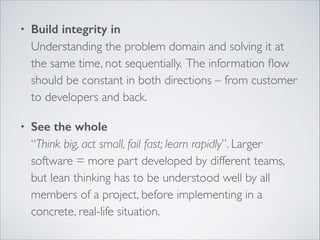
Build integrity in

Understanding the problem domain and solving it at
the same time, not sequentially. The information flow
should be constant in both directions – from customer
to developers and back.	


•

See the whole

“Think big, act small, fail fast; learn rapidly”. Larger
software = more part developed by different teams,
but lean thinking has to be understood well by all
members of a project, before implementing in a
concrete, real-life situation.
“If you can’t measure something, you can’t manage it.”
– Peter Drucker, management consultant
LINE IN THE SAND

Measurable target that everyone (incl. executives)
agrees to.
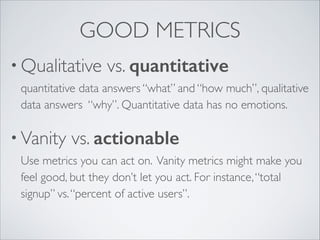
GOOD METRICS
• Qualitative

vs. quantitative


quantitative data answers “what” and “how much”, qualitative
data answers “why”. Quantitative data has no emotions.	


• Vanity

vs. actionable


Use metrics you can act on. Vanity metrics might make you
feel good, but they don’t let you act. For instance, “total
signup” vs. “percent of active users”.
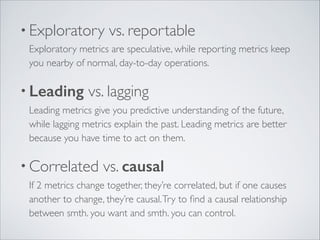
• Exploratory

vs. reportable


Exploratory metrics are speculative, while reporting metrics keep
you nearby of normal, day-to-day operations. 	


• Leading

vs. lagging


Leading metrics give you predictive understanding of the future,
while lagging metrics explain the past. Leading metrics are better
because you have time to act on them.	


• Correlated

vs. causal


If 2 metrics change together, they’re correlated, but if one causes
another to change, they’re causal. Try to find a causal relationship
between smth. you want and smth. you can control.
“Acquisition, activation, retention, revenue, and referral
- AARRR.”
–Pirate Metrics by Dave McClure that every startup needs to watch
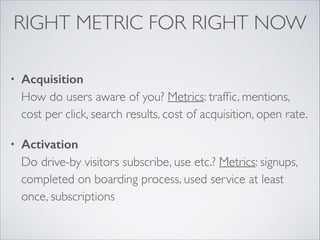
RIGHT METRIC FOR RIGHT NOW
•

Acquisition

How do users aware of you? Metrics: traffic, mentions,
cost per click, search results, cost of acquisition, open rate.	


•

Activation

Do drive-by visitors subscribe, use etc.? Metrics: signups,
completed on boarding process, used service at least
once, subscriptions

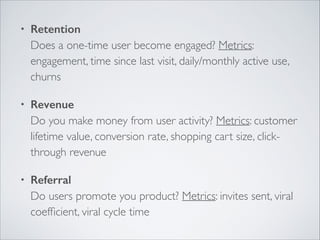
•

Retention

Does a one-time user become engaged? Metrics:
engagement, time since last visit, daily/monthly active use,
churns	


•

Revenue

Do you make money from user activity? Metrics: customer
lifetime value, conversion rate, shopping cart size, clickthrough revenue	


•

Referral

Do users promote you product? Metrics: invites sent, viral
coefficient, viral cycle time
ONE METRIC THAT MATTERS
The OMTM is the one number you’re completely focused on
above everything else for your current stage.
•

It answers the most important question you have

you need to identify the riskiest areas of your business, and that’s
where the most important question is.	


•

It forces you to draw a line in the sand and have clear goals

after you’ve identified the key problem, you need to set goals.	


•

It focuses the entire company

Use OMTM as a way of focusing you entire company. Display it
throughout web dashboards, on TV screens, or regular emails.	


•

It inspires a culture of experimentation

It’s critical to move through the build-measure-learn cycle as quickly
and as frequently as possible. To succeed on that, you need to
actively encourage experimentation.
the One Metric That Matters changes over time
When you are focused on retention, you may be looking on churn, and
experimenting with pricing, features, improving customer support etc.
MAIN STAGES

You can’t just start measuring at once. You have to measure
your assumptions in the right order.
•

Empathy

Go inside target market and sure you’re solving
a problem people care about in a way
someone will pay for.	


•

Stickiness

It comes from a good product. You need to
find out if you can build an acceptable solution
to the problem you’ve discovered.
•

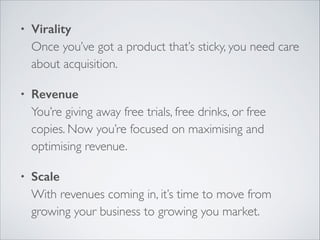
Virality

Once you’ve got a product that’s sticky, you need care
about acquisition.	


•

Revenue

You’re giving away free trials, free drinks, or free
copies. Now you’re focused on maximising and
optimising revenue.	


•

Scale

With revenues coming in, it’s time to move from
growing your business to growing you market.
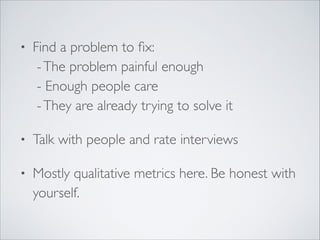
EMPATHY
•

Find a problem to fix:

- The problem painful enough

- Enough people care

- They are already trying to solve it	


•

Talk with people and rate interviews	


•

Mostly qualitative metrics here. Be honest with
yourself.
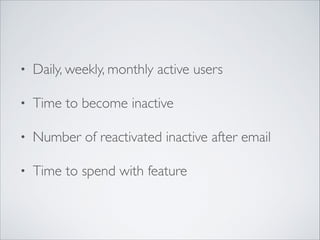
STICKINESS
•

Daily, weekly, monthly active users	


•

Time to become inactive	


•

Number of reactivated inactive after email	


•

Time to spend with feature
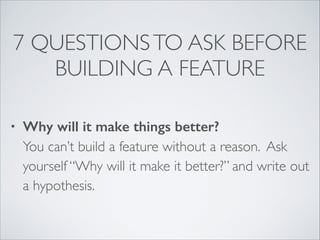
7 QUESTIONS TO ASK BEFORE
BUILDING A FEATURE
•

Why will it make things better?

You can’t build a feature without a reason. Ask
yourself “Why will it make it better?” and write out
a hypothesis.
•

Can you measure the effect of the feature?

Feature experiments require that you measure
the impact of the feature. That impact has to
be quantifiable.	


•

How long will the feature take to build?

Time is resource you never get back. If
something is going to take too much to build,
break it into small parts or test the risk with
the prototype first.
•

Will the future over complicate things?

Complexity kills products. When discussing a
feature with your team, pay attention to how
it’s being described. “And” is enemy of success.	


•

How much risk is there in this feature?

Building a new feature always comes with
some amount of risks - technical risk, user risk,
risk of influence to further development etc.
•

How innovative is the new feature?

Not everything is innovative, but consider
innovation when prioritising feature
development. Generally, the easiest thing to do
rarely have a big impact.	


•

What do users say they want?

Users are important as well as their feedback.
But relying on what they say is risky. Be careful
about over prioritising based on user input alone.
VIRALITY
•

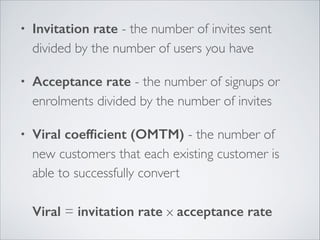
Invitation rate - the number of invites sent
divided by the number of users you have	


•

Acceptance rate - the number of signups or
enrolments divided by the number of invites	


•

Viral coefficient (OMTM) - the number of
new customers that each existing customer is
able to successfully convert


Viral = invitation rate x acceptance rate
REVENUE
•

QRR(x) - the quarterly recurring revenue for
quarter x	


•

QExpSM(x) - sales and marking expense for the
quarter x	


•

Ratio of inputs to outputs (OMTM)


q = [QRR(x)-QRR(x-1)] / QExpSM(x-1)


You have problems if q < 0.75
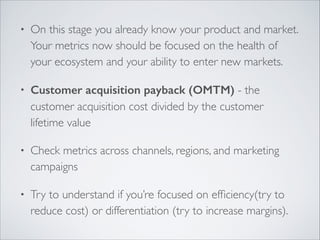
SCALE
•

On this stage you already know your product and market.
Your metrics now should be focused on the health of
your ecosystem and your ability to enter new markets.	


•

Customer acquisition payback (OMTM) - the
customer acquisition cost divided by the customer
lifetime value	


•

Check metrics across channels, regions, and marketing
campaigns	


•

Try to understand if you’re focused on efficiency(try to
reduce cost) or differentiation (try to increase margins).
CONCLUSION
•

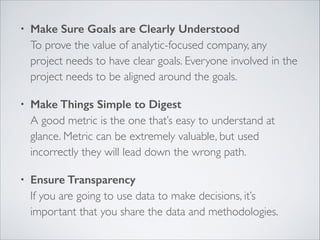
Make Sure Goals are Clearly Understood

To prove the value of analytic-focused company, any
project needs to have clear goals. Everyone involved in the
project needs to be aligned around the goals. 	


•

Make Things Simple to Digest

A good metric is the one that’s easy to understand at
glance. Metric can be extremely valuable, but used
incorrectly they will lead down the wrong path.	


•

Ensure Transparency

If you are going to use data to make decisions, it’s
important that you share the data and methodologies.
•

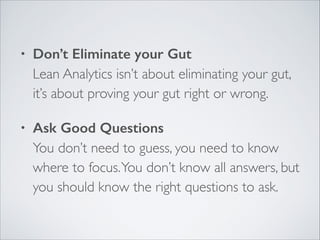
Don’t Eliminate your Gut

Lean Analytics isn’t about eliminating your gut,
it’s about proving your gut right or wrong.	


•

Ask Good Questions

You don’t need to guess, you need to know
where to focus. You don’t know all answers, but
you should know the right questions to ask.
FUTHER READINGS
•

Lean Software Development: An Agile Toolkit by
Mary & Tom Poppendieck	


•

Lean Analytics by A. Croll, B. Yoskovitz	


•

The Lean Startup by Eric Ries	


•

Running Lean by Ash Maurya

Lean analytics

  • 1.
    LEAN ANALYTICS techtalk @ferret based on “Lean Analytics” by Croll&Yoskovitz and wikipedia information
  • 2.
    LEAN SOFTWARE DEVELOPMENT Theterm lean software development originated in a book “Lean Software Development: An Agile Toolkit”, written by Mary Poppendieck and Tom Poppendieck.
  • 3.
  • 4.
    • Focus on thecustomer and eliminate waste
 Everything not adding value to the customer is considered to be waste. If some activity could be bypassed or the result could be achieved without it, it is waste. • Amplify learning
 The best approach for improving a software development environment is to amplify learning. Instead of adding more documentation or detailed planning, different ideas could be tried by writing code and building. A data driven cycle of hypothesis-validation-implementation should be used to drive innovation and continuously improve the end-to-end process.
  • 5.
    • Decide as lateas possible
 Delay decisions as much as possible until they can be made based on facts and not on uncertain assumptions and predictions. • Deliver as fast as possible
 The sooner the end product is delivered without major defects, the sooner feedback can be received, and incorporated into the next iteration. The shorter the iterations, the better the learning and communication within the team.

  • 6.
    • Empower the team
 “Findgood people and let them do their own job”. 
 People do need something more than just the list of tasks and the assurance that they will not be disturbed during the completion of the tasks. People need motivation. The developers should be given access to the customer; the team leader should provide support and help in difficult situations.

  • 7.
    • Build integrity in
 Understandingthe problem domain and solving it at the same time, not sequentially. The information flow should be constant in both directions – from customer to developers and back. • See the whole
 “Think big, act small, fail fast; learn rapidly”. Larger software = more part developed by different teams, but lean thinking has to be understood well by all members of a project, before implementing in a concrete, real-life situation.
  • 8.
    “If you can’tmeasure something, you can’t manage it.” – Peter Drucker, management consultant
  • 9.
    LINE IN THESAND Measurable target that everyone (incl. executives) agrees to.
  • 10.
    GOOD METRICS • Qualitative vs.quantitative
 quantitative data answers “what” and “how much”, qualitative data answers “why”. Quantitative data has no emotions. • Vanity vs. actionable
 Use metrics you can act on. Vanity metrics might make you feel good, but they don’t let you act. For instance, “total signup” vs. “percent of active users”.
  • 11.
    • Exploratory vs. reportable
 Exploratorymetrics are speculative, while reporting metrics keep you nearby of normal, day-to-day operations. • Leading vs. lagging
 Leading metrics give you predictive understanding of the future, while lagging metrics explain the past. Leading metrics are better because you have time to act on them. • Correlated vs. causal
 If 2 metrics change together, they’re correlated, but if one causes another to change, they’re causal. Try to find a causal relationship between smth. you want and smth. you can control.
  • 12.
    “Acquisition, activation, retention,revenue, and referral - AARRR.” –Pirate Metrics by Dave McClure that every startup needs to watch
  • 13.
    RIGHT METRIC FORRIGHT NOW • Acquisition
 How do users aware of you? Metrics: traffic, mentions, cost per click, search results, cost of acquisition, open rate. • Activation
 Do drive-by visitors subscribe, use etc.? Metrics: signups, completed on boarding process, used service at least once, subscriptions

  • 14.
    • Retention
 Does a one-timeuser become engaged? Metrics: engagement, time since last visit, daily/monthly active use, churns • Revenue
 Do you make money from user activity? Metrics: customer lifetime value, conversion rate, shopping cart size, clickthrough revenue • Referral
 Do users promote you product? Metrics: invites sent, viral coefficient, viral cycle time
  • 15.
    ONE METRIC THATMATTERS The OMTM is the one number you’re completely focused on above everything else for your current stage.
  • 16.
    • It answers themost important question you have
 you need to identify the riskiest areas of your business, and that’s where the most important question is. • It forces you to draw a line in the sand and have clear goals
 after you’ve identified the key problem, you need to set goals. • It focuses the entire company
 Use OMTM as a way of focusing you entire company. Display it throughout web dashboards, on TV screens, or regular emails. • It inspires a culture of experimentation
 It’s critical to move through the build-measure-learn cycle as quickly and as frequently as possible. To succeed on that, you need to actively encourage experimentation.
  • 17.
    the One MetricThat Matters changes over time When you are focused on retention, you may be looking on churn, and experimenting with pricing, features, improving customer support etc.
  • 18.
    MAIN STAGES You can’tjust start measuring at once. You have to measure your assumptions in the right order.
  • 19.
    • Empathy
 Go inside targetmarket and sure you’re solving a problem people care about in a way someone will pay for. • Stickiness
 It comes from a good product. You need to find out if you can build an acceptable solution to the problem you’ve discovered.
  • 20.
    • Virality
 Once you’ve gota product that’s sticky, you need care about acquisition. • Revenue
 You’re giving away free trials, free drinks, or free copies. Now you’re focused on maximising and optimising revenue. • Scale
 With revenues coming in, it’s time to move from growing your business to growing you market.
  • 21.
  • 22.
    • Find a problemto fix:
 - The problem painful enough
 - Enough people care
 - They are already trying to solve it • Talk with people and rate interviews • Mostly qualitative metrics here. Be honest with yourself.
  • 23.
  • 24.
    • Daily, weekly, monthlyactive users • Time to become inactive • Number of reactivated inactive after email • Time to spend with feature
  • 25.
    7 QUESTIONS TOASK BEFORE BUILDING A FEATURE • Why will it make things better?
 You can’t build a feature without a reason. Ask yourself “Why will it make it better?” and write out a hypothesis.
  • 26.
    • Can you measurethe effect of the feature?
 Feature experiments require that you measure the impact of the feature. That impact has to be quantifiable. • How long will the feature take to build?
 Time is resource you never get back. If something is going to take too much to build, break it into small parts or test the risk with the prototype first.
  • 27.
    • Will the futureover complicate things?
 Complexity kills products. When discussing a feature with your team, pay attention to how it’s being described. “And” is enemy of success. • How much risk is there in this feature?
 Building a new feature always comes with some amount of risks - technical risk, user risk, risk of influence to further development etc.
  • 28.
    • How innovative isthe new feature?
 Not everything is innovative, but consider innovation when prioritising feature development. Generally, the easiest thing to do rarely have a big impact. • What do users say they want?
 Users are important as well as their feedback. But relying on what they say is risky. Be careful about over prioritising based on user input alone.
  • 29.
  • 30.
    • Invitation rate -the number of invites sent divided by the number of users you have • Acceptance rate - the number of signups or enrolments divided by the number of invites • Viral coefficient (OMTM) - the number of new customers that each existing customer is able to successfully convert
 
 Viral = invitation rate x acceptance rate
  • 31.
  • 32.
    • QRR(x) - thequarterly recurring revenue for quarter x • QExpSM(x) - sales and marking expense for the quarter x • Ratio of inputs to outputs (OMTM)
 
 q = [QRR(x)-QRR(x-1)] / QExpSM(x-1)
 
 You have problems if q < 0.75
  • 33.
  • 34.
    • On this stageyou already know your product and market. Your metrics now should be focused on the health of your ecosystem and your ability to enter new markets. • Customer acquisition payback (OMTM) - the customer acquisition cost divided by the customer lifetime value • Check metrics across channels, regions, and marketing campaigns • Try to understand if you’re focused on efficiency(try to reduce cost) or differentiation (try to increase margins).
  • 35.
  • 36.
    • Make Sure Goalsare Clearly Understood
 To prove the value of analytic-focused company, any project needs to have clear goals. Everyone involved in the project needs to be aligned around the goals. • Make Things Simple to Digest
 A good metric is the one that’s easy to understand at glance. Metric can be extremely valuable, but used incorrectly they will lead down the wrong path. • Ensure Transparency
 If you are going to use data to make decisions, it’s important that you share the data and methodologies.
  • 37.
    • Don’t Eliminate yourGut
 Lean Analytics isn’t about eliminating your gut, it’s about proving your gut right or wrong. • Ask Good Questions
 You don’t need to guess, you need to know where to focus. You don’t know all answers, but you should know the right questions to ask.
  • 38.
    FUTHER READINGS • Lean SoftwareDevelopment: An Agile Toolkit by Mary & Tom Poppendieck • Lean Analytics by A. Croll, B. Yoskovitz • The Lean Startup by Eric Ries • Running Lean by Ash Maurya